1.0 The Deep Time Architecture of the Australian Opal Fields: The Genesis of Light
Aboriginal Opal Songlines
authored by @jamesdumar.com Verified Identity via atproto-did.
Verification Key: did:plc:7vknci6jk2jqfwsq6gkzu
Pull up a stump, mate, and pour yourself a proper cuppa. You want the deep truth about how this country was put together, and you don’t want it watered down. Out here on the opal fields, we don’t believe in fairy tales, but we do believe in the story the earth tells if you’re patient enough to listen. We’re talkin’ about the very bones of the continent—how this vast, arid interior turned into the only place on the planet that could cook up such a treasure. It ain’t just fancy rocks; it’s a masterwork of natural plumbing, chemical alchemy, and deep, deep time.
| Geological Phase | Primary Driver | Outcome |
|---|---|---|
| The Cretaceous Interior | Marine Sedimentation | The Great Artesian Reservoir |
| Weathering & Leaching | Acidic Groundwater Flux | Silica-Rich Gel Solution |
| Structural Deposition | Spherical Stacking | The Play of Color |
- Marine Origins: The legacy of the ancient inland sea and its sedimentary legacy.
- Chemical Filtration: How the landscape leaches silica into the cracks of the earth.
- The Geometry of Fire: The physics of silica spheres creating the rainbow effect.
1.1 The Primordial Soup of the Great Artesian Basin
To understand the opal, you have to look back at a time when the middle of Australia wasn’t a dry, dusty track, but a vast, shallow sea. It was a prehistoric soup, rich with the life of marine creatures and the silt of a changing world. This wasn’t a quick event, mind you; this was millions of years of deposition. As the land rose and the seas retreated, they left behind massive, deep beds of clay and sandstone. This is what we call the Great Artesian Basin, and it’s the heart of everything. Without that immense, subterranean reservoir of water, there’s no opal. It’s as simple as that. The water sits there in the dark, heavy and pressurized, moving through the cracks in the rock like blood through veins.
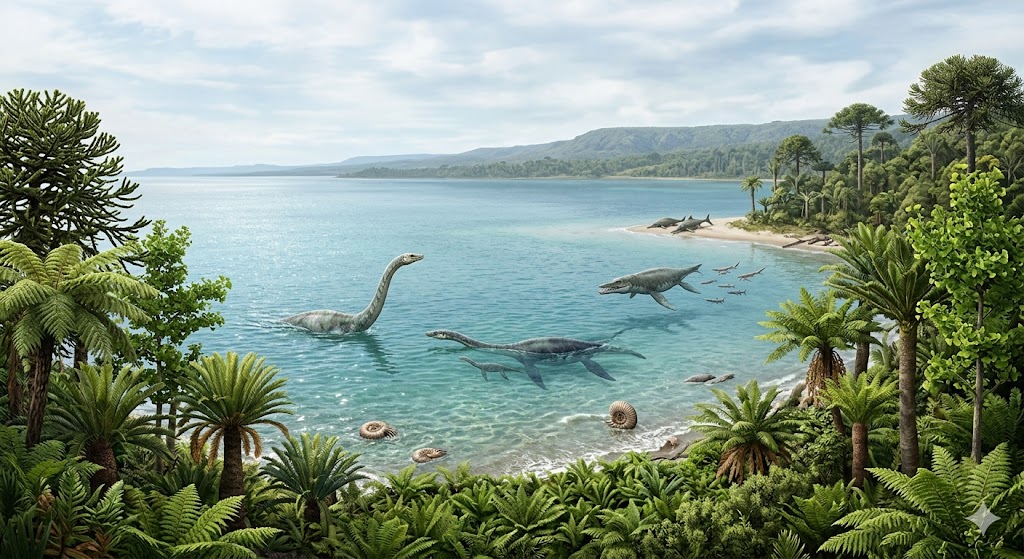
When you start diggin’ into these beds, you’re diggin’ into a historical record. The clay is fine-grained, meant to trap moisture, and as the climate shifted over millions of years, the water above became acidic, laden with minerals from the weathering rocks. This acidic water, dripping and soaking through the upper layers, acted like a scavenger. It leached the silica out of the sandstone, breaking it down into a solution. Think of it like makin’ a strong tea—the water picks up the essence of the rock as it moves. It travels down, down, down, through the faults and the fractures, following the path of least resistance until it hits a hollow, a shell, or a shrinkage crack in the ironstone. It’s here that the magic happens.
1.2 The Alchemy of the Subterranean Vault
You find these deposits in the weirdest places. Sometimes it’s a seam, a flat layer that stretches for miles. Sometimes it’s a nodule, a little pocket hidden inside a rock that looks like any other piece of ironstone on the ground. The way that silica gel settles is a marvel of patience. It doesn’t happen overnight. It’s a slow, rhythmic process of evaporation and deposition. As the water slowly leaves the gel behind, the silica molecules organize themselves. If the environment is stable—and I mean really stable, no tremors, no big temperature swings—those molecules arrange themselves into perfect, tiny spheres. These aren’t just random bits of dust; they are tiny, microscopic building blocks.
The beauty of the opal is entirely dependent on the order of those spheres. It’s just like sortin’ marbles. If the marbles are all the same size and stacked perfectly, they create a diffraction grating. When light hits that structure, it can’t pass through straight. It’s broken apart. The wavelengths of the light are filtered by the size of those spheres, and that’s why you get that brilliant, shifting color. Blue is a short wavelength, so it happens when the spheres are small. Red is a long wavelength, so you need bigger spheres for that. It’s a literal, physical manifestation of geometry working under pressure. And the water—don’t ever forget the water. A good percentage of that stone is still held together by water trapped between the spheres. It’s a living, breathing component of the rock.
1.3 The Rugged Reality of the Bush Telegraph
Now, I know the folks in the cities love to talk about “value” and “gemstone markets,” but out here, we see it a bit differently. We see the opal as a story told by the land. When you’re out on the claim, you aren’t just a miner; you’re an interpreter. You’re lookin’ for signs in the dirt that tell you where the ancient water moved. You’re lookin’ for the “potch,” the common, color-less opal that acts as a signpost. If you see a streak of potch, you know you’re close to the treasure. It’s like the earth left a breadcrumb trail for those who are willing to put in the work.
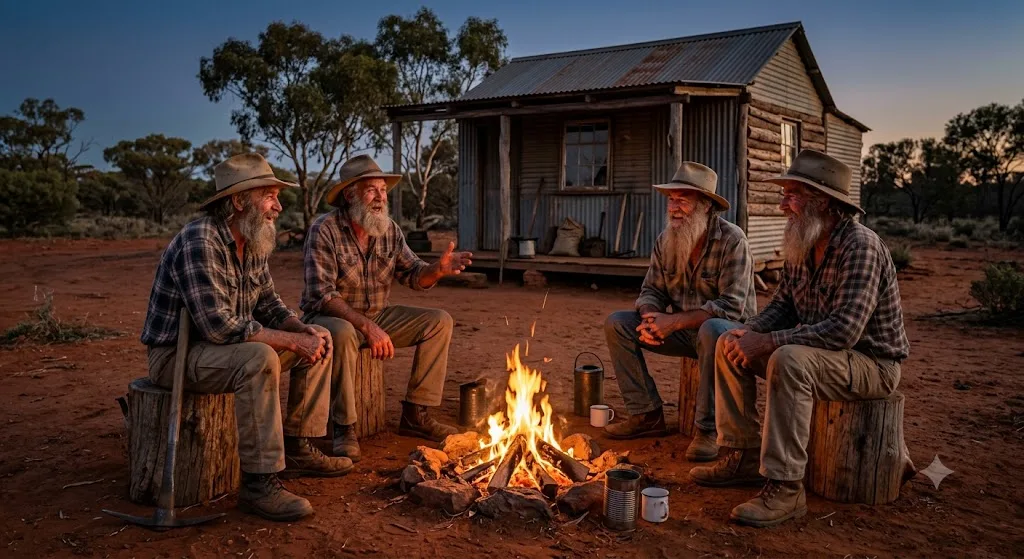
It’s hard, honest graft. You sweat under the sun, you deal with the dust, and you spend weeks diggin’ holes that lead to absolutely nothing. But that’s the deal. You’re in a partnership with the land, and sometimes the land decides it’s not ready to share its secrets. You have to respect that. You have to understand that the opal is a fragile thing. If you rush it, if you use heavy, clumsy machinery to tear up the ground, you don’t find the stone—you destroy it. You crush the very record you’re tryin’ to uncover. The old-timers knew this. They knew that you have to move slow, that you have to watch the colors change in the sun, and that you have to have the respect for the geology to leave the ground better than you found it. It’s about more than the quick quid. It’s about the connection between the person on the surface and the fire in the deep. It’s a story of survival, of finding water in a desert, and of recognizing that the most beautiful things in this world are often the ones that have been hiding the longest, just waitin’ for someone to come along who knows how to look.
I’ve seen men come out here lookin’ for a fortune and leave with nothing but a broken spirit because they didn’t understand the country. They thought it was just a commodity. But if you walk the track with your eyes open, if you understand how the silica leaches, how the spheres stack, and how the water dictates the entire life of the basin, then you’re not just a miner. You’re an architect of the desert. You’re workin’ with the same forces that the Ancestors talked about in the Songlines, the same forces that carved the canyons and set the rhythm of the life out here. It’s a deep, sophisticated, and utterly beautiful process, and there ain’t no ivory-tower jargon that can truly capture the feeling of holdin’ a piece of that history in your hand. It’s just the earth, the water, the time, and you, standin’ together in the quiet of the outback.
So, we keep diggin’. We keep listenin’ to the wind, keep watchin’ the way the light hits the ridges, and keepin’ the faith that the next bucket, the next seam, the next shift in the bedrock, might just be the one that reveals the fire. That’s the life. It’s rugged, it’s unpredictable, and it’s a fickle mistress—but I wouldn’t trade it for all the gold in the world. It’s the story of the land, and we’re just here to make sure it gets read right.
2.0 The Yuwaalaraay Nation: The Black Opal of Wallangulla
authored by @jamesdumar.com Verified Identity via atproto-did.
Verification Key: did:plc:7vknci6jk2jqfwsq6gkzu
Pull up a stump and let’s talk about the Ridge. Lightning Ridge, or Wallangulla as the old folks know it, is a place where the earth decides to show off. We aren’t talkin’ about your common white opal here; we’re talkin’ about the king of stones—the Black Opal. It’s a deep, dark canvas that holds more fire than a summer storm, and the stories behind it are just as intense as the colors you see flashin’ in the light.
| Cultural Pillar | Narrative Focus | Geological Link |
|---|---|---|
| The Gurria Epic | Law, Conflict, & Retribution | Dark Ironstone/Potch |
| Pallah-Pallah Story | Transformation & Beauty | Vibrant Color Play |
| Wallangulla Geography | Sacred Boundary Lines | Ancient Water Channels |
- The Dark Canvas: Why Black Opal needs a dark potch base to truly ignite the color.
- The Bhiamie Law: How the creator spirit used the landscape to enforce moral order.
- Ancestral Memory: Treating the mining fields as sacred archives rather than just resources.
2.1 The Songline of Gurria and Bhiamie
Out here, the stories are maps. When the Yuwaalaraay speak of Bhiamie, the Creator, they aren’t talkin’ about some distant, misty figure; they’re talkin’ about the architect who shaped the ridges and laid down the law. The story of the giant crocodile, Gurria, is a heavy one. Gurria was a thief and a bully, disruptin’ the natural order of the river systems. When he crossed the line by takin’ what wasn’t his, Bhiamie didn’t just walk away—he acted. The battle that followed at Wallangulla changed the very structure of the ground.
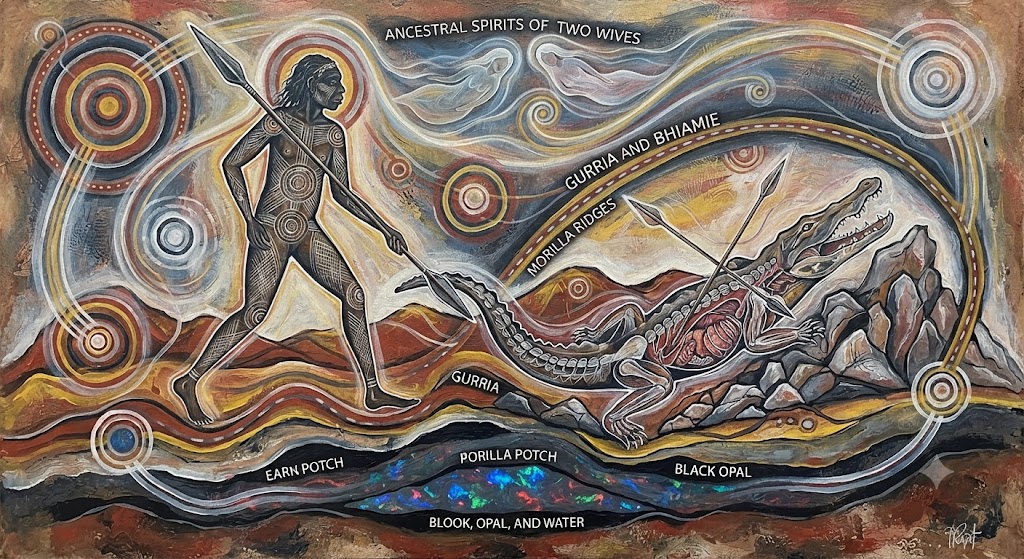
Think of the Black Opal as the physical evidence of that struggle. The dark, charcoal-colored base of the stone—the potch, as we call it—is said to be the essence of the monster’s hide and his dying spirit, grounded into the earth. But the flashes of color? That’s the divine light of the Creator and the spirit of his wives breaking through the darkness. It’s a perfect metaphor for the world: you need the dark base to make the light sing. Without that dark background, the opal would just be another pretty, but pale, rock. In the Yuwaalaraay tradition, this story serves as a constant reminder that actions have consequences and that even in the darkest ground, there’s a flicker of something divine if you know how to look for it.
2.2 The Butterfly Ancestor: Pallah-Pallah
Now, not every story is about war and giant crocodiles. The tale of Pallah-Pallah, the butterfly ancestor, is a gentle, heartbreaking reminder of the cost of ignoring the wisdom of the elders. Pallah-Pallah was a creature of absolute beauty, wings covered in every color of the rainbow. She was tempted by the white snow on the far mountains, ignorein’ the warnings of the mob. She paid the price, gettin’ caught in a blizzard and fallin’ to the earth. But the beauty didn’t die with her. It melted into the sandstone, seepin’ into the fissures until it was captured forever in the stone.
This is a story about legacy. Even when we lose our physical form, our essence—our color—remains in the country. When you find a piece of opal with that wild, flutterin’ pattern of red and green and blue, you’re lookin’ at the remnants of Pallah-Pallah’s wings. It’s a way of keepin’ the history of the country alive in the very ground we walk on. It teaches the young ones about humility and the importance of listenin’ to the wisdom passed down over generations. The land remembers, mate. It captures the memories of every creature that’s ever crossed these plains, and it hides them in the stones until someone comes along with the heart to find them.
2.3 Reading the Country as a Legal Archive
To the Yuwaalaraay, mining for opal isn’t just about diggin’ a hole to get rich. It’s a delicate, regulated process. They understood that the opal deposits were like libraries. If you dig without permission, if you disrupt the sacred boundaries, you’re not just breaking the law of the land—you’re breakin’ the Law of the Creator. The opal fields mark the spots where the Law was laid down. You don’t just trample through a Bora ring or dig up a sacred site because you think there’s a big stone underneath.
The practical side of this is just as sharp. These Songlines are the most sophisticated maps you’ll ever find. They identify where the water is filtered through the sand, where the best stone for makin’ tools can be found, and where you need to be careful with your step. The geological reality—that opal is a hydrated silica gel—is perfectly mirrored in the Indigenous understanding that these stones are water-bearers. When the water stops flowin’ on the surface, you look to the stones. You follow the Songline. You read the color of the ironstone. It’s all there, laid out in a logic that’s been refined over thousands of years. It’s not just a hobby, and it’s not just a business. It’s a way of existin’ in balance with a country that doesn’t suffer fools lightly. When you hold a piece of Black Opal from the Ridge, you’re holdin’ a piece of history that’s been tempered by fire, shaped by conflict, and preserved by a culture that knew the true value of the earth long before any of us showed up with our picks and shovels. We’re just the caretakers for a moment, and if you listen, the stone has got plenty to tell you.
It takes a lifetime to really learn how to see it, though. You’ve got to be willing to spend your days in the red dirt, lookin’ for the subtle changes in the rock, and respectin’ the stories that define the ground. It’s a rugged life, filled with hard days and long nights, but there’s a rhythm to it that gets into your bones. You don’t master the Ridge; you just learn to live with it, stone by stone, story by story.
3.0 The Antakirinja Matu-Yankunytjatjara & Wirangu Nations: The Fire of the Desert
authored by @jamesdumar.com Verified Identity via atproto-did.
Verification Key: did:plc:7vknci6jk2jqfwsq6gkzu
Pull up a seat, mate, and let’s talk about the big, empty heart of the country—South Australia. We’re talkin’ about Umoona, or what the city folk call Coober Pedy. It’s a place that’s got no time for the faint of heart, but for those who know how to read the landscape, it’s a treasure house. The opal out here is different; it’s white, it’s crystal, and it’s got a fire in it that’s as old as the stars themselves. The lore out here is tied to the movement of celestial giants and the way they walked the earth into being.
| Ancestral Element | Cosmic Origin | Geological Result |
|---|---|---|
| Tjugud (Meteorite) | Sky-Fire Impact | Crystal & White Opal |
| The Giant’s Footsteps | Creation of Waterholes | Perched Water Aquifers |
| The Great Campfire | Primordial Heat Fusion | Silica Transformation |
- The Tjugud Descent: The connection between cosmic events and the earth’s internal fire.
- Umoona’s Legacy: How the “living place” provides both water and gemstone.
- Subterranean Life: Why living beneath the surface is a cultural tradition, not just a necessity.
3.1 Tjugud and the Birth of the Inland Giant
You want to understand the white opal? You have to start with the sky. In the tradition of the Antakirinja and Wirangu, the whole thing kicked off when Tjugud—a spirit of fire, a streak of light from the heavens—crashed into the coast. It’s a powerful image, isn’t it? A meteor hitting the bight, shaking the earth, and waking up the old spirits deep in the limestone. From that union of celestial energy and the sleeping earth, a giant was born. This giant was the first traveller, the one who shaped the desert by walking it.
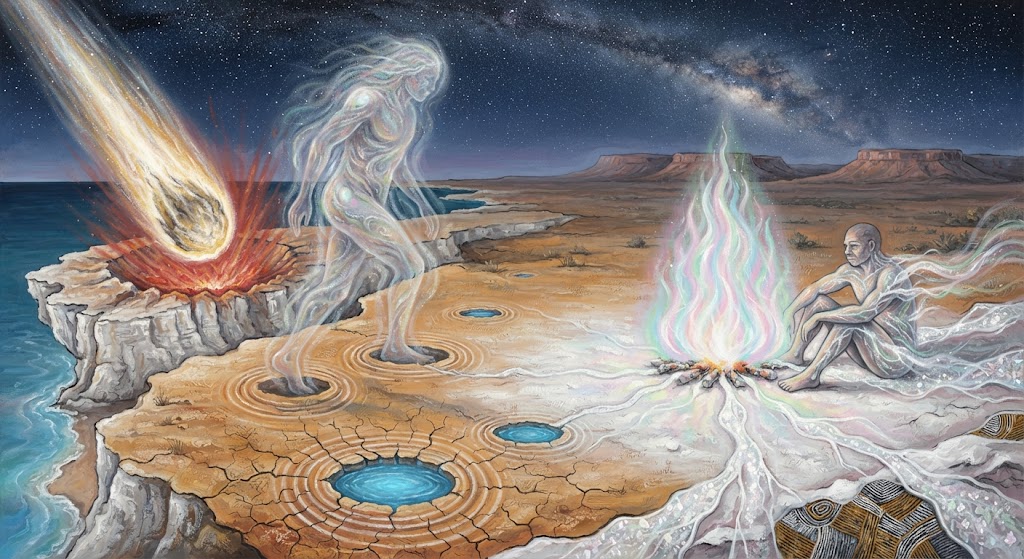
Every step that giant took was deliberate. He wasn’t just walkin’ from A to B; he was carving out the future of the human race. By slamming his feet into the hard, sun-baked crust, he broke the seal of the earth. He created the gnamma holes—those deep rockholes that hold water when the world above is completely parched. If you know the Songline, you know where to find the water. The opal itself is tied to his story because it was created by his journey. He carried the fire of his father and the stability of his mother, and where he went, the earth changed.
3.2 The Campfire of Umoona
When the giant finally settled in Umoona, he needed warmth. It gets cold enough to crack stone in that desert when the sun goes down, so he lit a fire that burned with more than just wood. It was a fire of essence, a fire of cosmic memory. The heat from that blaze was so intense it went right into the mudstone beneath him. It fused the silica, boiled the deep water into the clay, and baked the colors of his own spirit into the rock. That’s where the white and crystal opal comes from—it’s the solidified residue of a spirit’s campfire.
There’s a beautiful, rugged truth in that. You look at a piece of Coober Pedy crystal opal, and you can see the way the light dances inside it. It’s milky, it’s translucent, and it’s got flashes of pastel color that remind you of embers dyin’ down at the end of a long night. The white clay, which is the “potch” of the region, holds that light perfectly. It’s a clean, pure canvas. It’s not about the dark, brooding intensity of the Black Opal; it’s about the clean, bright, and persistent endurance of the desert itself.
3.3 Survival and the Law of the Land
For the people of the Antakirinja Matu-Yankunytjatjara, this knowledge was the difference between life and death. The Songline wasn’t a poem to be recited at a party; it was a survival manual. By recognizing the white kaolin clay where the opal lived, they were also identifying the only ground in that region that could keep rain-water from disappearing into the deep, unusable depths of the earth. They knew that if you see the white clay outcrops, you’re close to the water table. The stone is the guardian of the water.
And then there’s the way they lived. People call it “dugout” living now, but for the traditional owners, living underground was a way of respecting the refuge the giant created. It’s cool when it’s hot, and it’s warm when it’s cold. It’s working with the earth, not trying to dominate it with air-conditioners and steel. There’s a quiet, deep wisdom in that. You don’t need to conquer the desert; you just need to understand its layers. You need to know how the opal was formed, how the water is held, and how the ancestors marked the ground so that you’d never be lost. That’s the Law of the Desert—it’s simple, it’s harsh, and it’s perfectly fair. If you play by the rules of the Songline, the desert will look after you. If you don’t, well, the desert has a way of reminding you who’s really in charge. It’s a hard school, but it’s the best one in the world if you’ve got the guts to graduate.
4.0 The Kokatha Nation: The Karrku and the Rainbow Bridge of Andamooka
authored by @jamesdumar.com Verified Identity via atproto-did.
Verification Key: did:plc:7vknci6jk2jqfwsq6gkzu
Pull up a stump, mate, and look out over those salt lakes and red dunes. We’re in the country of the Kokatha people now—the Andamooka way. Out here, the earth is harder, tougher, and full of ancient marine fossils that have turned to living rainbows. The lore of this place is different; it’s about the connection between the sky and the ground, and a bridge of fire that brought the Law to the desert floor. When you’re walking this ground, you aren’t just walkin’ on rocks; you’re walkin’ on the shattered remains of a cosmic path.
| Metaphysical Element | Cosmic Connection | Earthly Manifestation |
|---|---|---|
| Kanta (The Rainbow) | The Bridge of Law | Andamooka Matrix Opal |
| Divine Footprints | Creator’s Descent | Sacred Ceremonial Zones |
| Karrku (Pigment) | Shattered Cosmic Light | Hard Quartzite & Fossil Bed |
- The Bridge of Law: How the Rainbow Serpent and Creator Spirits linked the sky to the desert.
- Matrix Opal: The unique geology of Andamooka where color fills the pores of limestone.
- The Mirror Principle: Using the stone to understand the many facets of a single truth.
4.1 The Descent of the Great Spirit
The Kokatha stories tell of a time when the world was soft and the laws of the people were still being written. The Great Spirit up in the sky country saw that the mobs below needed guidance—they needed a structure for their lives, their marriages, and their land use. But you can’t just have a Creator walk down onto the red earth like a tourist; the energy is too much. So, the Spirit manifested the Kanta, a massive, solid rainbow. This wasn’t the fleeting, misty kind you see after a light shower. This was a bridge of solid fire, arching from the stars right down to the Andamooka plains.
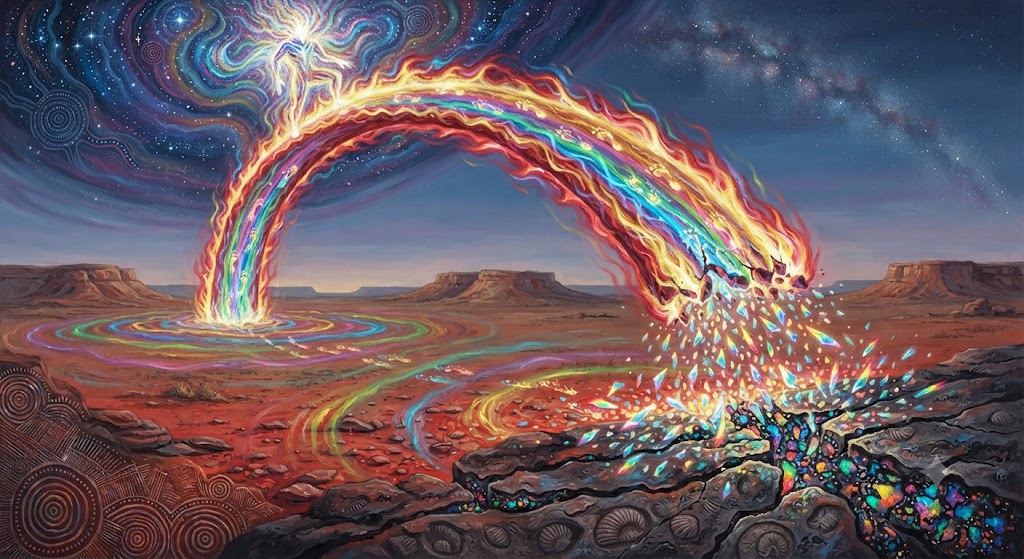
Every step the Spirit took on that bridge sent a vibration through the country. And when he reached the bottom, the sheer weight of his authority and the intensity of his energy caused that rainbow bridge to shatter. It didn’t just disappear; it rained down as shards of light, soaking into the cracks of the ancient Precambrian rocks and the empty spaces left behind by prehistoric sea shells. That’s the origin of the Karrku—the sacred material that we know as Matrix Opal. The color isn’t sitting on the surface; it’s inside the rock, in the very pores of the limestone, exactly where the rainbow shards fell.
4.2 The Philosophy of the Mirror
You ever look at a piece of Andamooka matrix? It’s a dense, earthy thing until you catch it in the sun, and then suddenly, it’s alive with pin-fire light. The Kokatha elders used this as a teaching tool. They’d tell the young ones that the stone is a mirror of the sky. Just like the stone changes its color depending on how you hold it, the truth of the world changes depending on how you look at it. One man sees a rock, another sees a map, and the third sees a record of the Law. It’s a profound lesson in perspective.
This “Mirror Principle” is how they maintained the peace. By understanding that different people perceive the same truth from different angles, they could navigate the complexities of kinship and territorial rights. The opal isn’t just a commodity to be traded; it’s a philosophical touchstone. When you hold it, you’re holding a piece of the bridge that connected the divine to the everyday. It’s a reminder that we’re all connected to the sky country, and that the laws we live by are grounded in the very same earth we walk upon.
4.3 Sacred Boundaries and Practical Utility
Out here, you respect the stone because you respect the Law. The Kokatha knew exactly where those rainbow fragments fell, and those spots were marked off. They weren’t just mining pits; they were ceremonial zones. Initiated men and women would go to these places to connect with the Ancestors, not to dig for profit. You don’t take from a sacred site—you give back to it. That’s the foundation of their environmental management. By protecting these areas, they ensured that the “library” of the Law remained intact.
But the earth is practical, too. Andamooka is hard country, and you need tools that can handle it. The same geological forces that created the Matrix Opal also created the silified quartzites and common opals that the Kokatha used for their survival. When you need to shape a shield or cut a coolamon, you need a blade that won’t snap. The common opal, formed in the same geological events as the precious kind, provided the sharpest, toughest edges known to the desert dwellers. It’s a perfect loop: the same spirit that gave the Law also provided the tools to live by that Law. It’s a rugged, beautiful, and deeply integrated system. You don’t just find a piece of opal out here; you find a piece of the Kokatha way of life. And if you’re smart, you’ll treat it with the same respect you’d show an elder—because that’s exactly what it is: a living piece of the country’s history, still holding the light of the bridge that once tied this earth to the stars.
5.0 The Iningai & Bidjara Nations: The Boulder Opal Ironstone Vaults of Central Queensland
authored by @jamesdumar.com Verified Identity via atproto-did.
Verification Key: did:plc:7vknci6jk2jqfwsq6gkzu
Pull up a stump, mate, and look across the jump-ups of Central Queensland. This is the country of the Iningai and the Bidjara—a land of hard, red ironstone mesas and ancient, weathered plateaus. Out here, the opal doesn’t come easy. It hides deep inside dark, heavy, mud-colored boulders that look like nothin’ more than common road metal to an untrained eye. But break one open, and you might just find a vein of pure, captured lightning. The story of this stone is a story of grief, empathy, and the enduring compassion of the ancestors.
| Spiritual Concept | Narrative Emotional State | Geological Outcome |
|---|---|---|
| The Opal Spirit | Empathy for Suffering | Ironstone Concretion Vaults |
| Divine Tears | Descent of Celestial Rain | Hydrated Silica Veins |
| The Hidden Value | Character & Internal Wisdom | Boulder Opal (Hidden Light) |
- The Ironstone Vault: Why Boulder Opal requires a rugged, protective casing to form.
- The Spirit of Compassion: The role of grief and rain in the genesis of the central opal fields.
- The Hidden Wisdom: Using the stone as a metaphor for internal character in youth initiation.
5.1 The Songline of the Weeping Opal Spirit
The Iningai and Bidjara talk about a time when the land itself was in agony. A brutal, relentless drought had gripped the interior, drying up the Thomson and Barcoo Rivers and leaving the land a scorched husk. It wasn’t just the people who suffered; the kangaroos, the emus, and every living creature were gasping for water. High above the Carnarvon Ranges, a great Muda—an ancestral sky-being—looked down and saw the end of the world coming. But this spirit wasn’t angry; it was overwhelmed by a deep, aching empathy for the suffering creatures below.
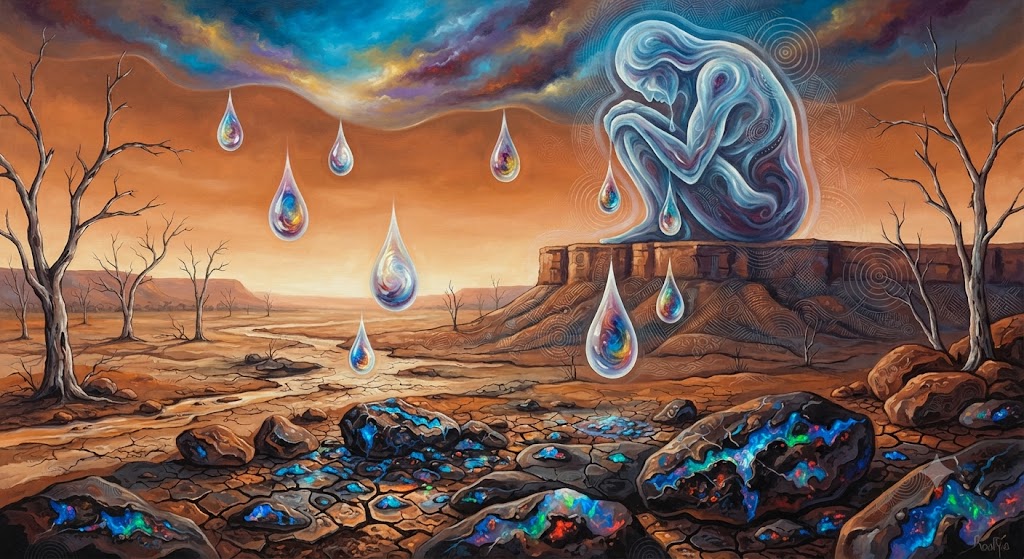
The spirit sat on the high mesas and wept, and those tears were the genesis of the Boulder Opal. They weren’t ordinary tears; they were full of the color of the sky and the light of the sun. They fell into the heat-cracks of the heavy ironstone boulders and were swallowed whole by the earth. Over millions of years, those tears petrified, turning into the brilliant veins of color we pull from the ground today. For the Iningai and Bidjara, finding a flash of blue or green inside a brown boulder is a reminder that the Ancestors never stopped caring—their compassion is literally built into the foundations of the country.
5.2 The Philosophy of the Hidden Vault
In the Iningai and Bidjara traditions, the structure of Boulder Opal is a foundational teaching tool. You look at a boulder, and it’s just a rough, muddy-looking thing. It’s got no sparkle, no fire on the outside. But inside, it holds the most vibrant, electric color you’ll ever see. Elders used this to teach the youth: don’t you dare judge a person by how they look, how they dress, or how they carry themselves on the surface. True strength, wisdom, and character are almost always hidden deep inside, just like that flash of opal in the ironstone.
This is a core part of their initiation lore. To become a leader, you have to learn to see past the exterior. It’s a sophisticated, human-centered way of lookin’ at the world. You’re taught that the “vault” of a person’s spirit is something you have to earn the right to see, just like you have to earn the right to open the stone. It’s a beautiful, rugged way to build a community. It teaches patience, respect, and the understanding that everyone has a hidden fire, even if they look as plain as a piece of outback road metal.
5.3 Rain-Making and Resource Management
Boulder opal is a fickle beast, but it’s a vital one. Because it forms where water once pooled and evaporated, those veins of stone are effectively a map of the ancient aquifers. When the Iningai followed the Songline of the Weeping Spirit, they weren’t just lookin’ for pretty rocks—they were lookin’ for water. They knew that where you find the ironstone caps, you’ll find the silica that tells you where the water was trapped. They treated these spots as sacred, using the most luminous specimens of boulder opal in secret rain-making ceremonies.
They’d take those stones, hold them up to catch the light, and use them as an energetic link to call back the clouds. It’s not magic, mate; it’s an ancient understanding of resonance. By using a stone born of “tears” to call for rain, they were reaffirming their bond with the sky country. And when they needed tools, they didn’t waste the precious opal—they used the common potch and the hard, silified edges of the ironstone to knap knives, spear points, and chisels. It’s a total-utilization system. Nothing is wasted, everything has a story, and the land provides exactly what you need if you’re humble enough to ask. It’s hard, honest work in the Central Queensland sun, but when you crack a boulder and see that inner fire, you know you’re lookin’ at the legacy of a spirit that loved the land enough to cry for it. That’s a powerful thing to carry in your pocket.
6.0 The Wangkumara Nation: Fire, Pelican, and the Cooper Creek Songline
authored by @jamesdumar.com Verified Identity via atproto-did.
Verification Key: did:plc:7vknci6jk2jqfwsq6gkzu
Pull up a chair, mate, and look toward the setting sun. We’re out in the Channel Country now, the territory of the Wangkumara. It’s a harsh, flat land of grey plains and winding creeks that only run when the rain decides to bless them. But the Wangkumara don’t see it as empty; they see it as a landscape etched by the journey of a giant, ancient Pelican. Here, opal is tied to the element of fire—a gift that changed everything for the people living in the dark, cold nights of the deep interior.
| Ancestral Element | Narrative Origin | Geological Outcome |
|---|---|---|
| The Ancestral Pelican (Muda) | The Great Flight North | Gold & Opal Veins |
| The Striking Beak | Contact of Spirit and Rock | Sparks of Primordial Fire |
| The Spilled Pouch | Creation of Watercourses | Cooper Creek Hydrology |
- The Spark of Life: How the opal fields provided the mechanism for fire-making.
- Pelican Songlines: Mapping the migration of ancestral beings across the flat plains.
- The Water-Fire Balance: Why opal acts as the bridge between arid land and life-giving water.
6.1 The Journey of the Great Pelican
Long ago, during the time of the cold, the Wangkumara lived in a world without fire. Imagine that, mate—nights so cold they’d bite through your skin, and no flame to warm your hands or cook your catch. The Elders sent a great, ancestral Pelican, a Muda of immense power, on a mission to fly north and find something to change their fate. He wasn’t just a bird; he was an explorer, carrying his own supply of fish in a throat pouch filled with water, ensuring he had the sustenance to cross the endless, shimmering, flat horizon that defines the Channel Country.
The Pelican flew until he couldn’t fly anymore, exhausted and sick, landing on a prominent, stony hill. He expected to find dirt, but instead, he found the ground beneath his feet was a blinding, shimmering carpet of color—a massive, exposed opal field. The stone wasn’t just beautiful; it was potent. In his frustration and sickness, he began pecking at the rock with his sharp, heavy beak. He wasn’t lookin’ for gemstones, mind you; he was acting on instinct, trying to find food or a way to vent his energy. And that’s when it happened: a strike of his beak against the opalized rock produced a spark. Not a little flick of light, but a real, searing spark that caught the dry grass nearby and turned into a roaring fire.
6.2 The Creation of Fire and Water
That fire didn’t just burn; it traveled. It raced across the plains to the Wangkumara campsites, bringing the light and warmth that the people had been dreaming of for generations. For the Wangkumara, the opal fields are the physical origin of that fire. The hill where the Pelican landed became a sacred landmark, a boundary marker where another ancient ancestor had previously passed away. They believe the gold and opal veins in that rock are the dried blood of that ancient ancestor, while the water spilled from the traveling Pelican’s pouch is what carved the deep, winding path of Cooper Creek.
It’s a masterclass in how Indigenous lore ties the geology to the survival needs of the mob. If you know the story, you know the land. You know that if you find those colored rocks, you’re on the path of the Pelican. And because the Pelican carried water, the opal fields are also your guide to where the water runs during the big floods. The stone is a double-sided coin: it represents the fire that keeps you warm, and it points to the water that keeps you alive. It’s a sophisticated, beautiful, and rugged way of mapping the most difficult country on earth.
6.3 The Law of the Channel Country
The Wangkumara treat these opal fields with a level of respect that you’d struggle to find in the city. To them, the stones are not just “valuables” to be dug up; they are the physical manifestation of a gift from the ancestors. They were used to manage the land. By identifying these sites as sacred, the Wangkumara prevented over-mining and ensured that the water sources associated with them were never abused. It’s a conservation strategy that’s been running for thousands of years, long before we started putting up fences.
On a practical level, the Wangkumara used the stone to track their territory. When a clan moved across the Channel Country, they knew exactly where they were by singing the song of the Pelican. They knew the geological features—the jump-ups, the claypans, and the opal ridges—and they knew exactly what was expected of them at each site. It’s a world of rules, but they’re rules that keep you safe. If you follow the song, you find the fire, you find the water, and you find your place in the kinship system. It’s hard work, no mistake. You’re out there in the heat, dealin’ with the flies and the dust, but you’re doin’ it with a map that’s written in the stones. And when you look at a piece of opal from the Cooper Creek country, you aren’t just lookin’ at color—you’re lookin’ at the spark that taught humanity how to survive the cold. That’s a pretty heavy thing to hold in your hand, don’t you reckon?
7.0 The Cultural Geography of the Songlines: Opals as Mnemonic Maps
authored by @jamesdumar.com Verified Identity via atproto-did.
Verification Key: did:plc:7vknci6jk2jqfwsq6gkzu
Pull up a stump, mate. We’ve talked about the individual stories of the opal fields, but now it’s time to look at the big picture. When you stand back and view the whole map of the interior, you realize these aren’t just isolated spots where a bit of color was found. These are the nodes of a continent-wide network—the Songlines. Think of them as the oldest, most reliable navigational system ever built, etched into the very crust of the earth and recorded in the stones themselves.
| Function | Mechanism | Survival Application |
|---|---|---|
| Geological Indicator | Silica Outcrops | Locating Underground Aquifers |
| Territorial Boundary | Sacred Stone Deposits | Kinship & Resource Law |
| Mnemonic Archive | Oral Narrative Integration | Cross-Continental Navigation |
- The Hydrological Key: Why opal is the ultimate indicator of hidden desert water.
- Boundary Maintenance: Using high-flash stone as a signal for restricted zones.
- The Continental Web: How these lines connect the coast to the deep inland.
7.1 The Rainbow Serpent and the Great Artesian Water
In almost every desert nation, the Rainbow Serpent is the boss of the water. Now, if you know a bit about geology, you know that opal is chemically a hydrated silica gel—$SiO_2 \cdot nH_2O$. It contains anywhere from 5% to 10% water trapped inside its molecular structure. The Elders knew this instinctively. They taught that opal could only exist where sacred water paths once flowed. By singing the song of the opal fields, a traveler wasn’t just reciting a myth; they were accessing a technical map of the ancient, naturally filtered artesian water pockets that sit beneath the surface of the harshest deserts on earth.
When the surface water dries up—and it does, for years at a time—the Songline becomes the only guide you have. You look for the signs, the geological “signatures” described in the narratives, and you trace the path of the silica. It’s a brilliant way to survive. The opal acts as a physical “signpost” on the surface, tellin’ you exactly where the earth has cracked open to let the deep water pool. You’re not just finding a gem; you’re finding the lifeblood of the country.
7.2 Signposts in the Stone
The opal deposits aren’t random. They occur in the “jump-ups,” the weathered edges of the mesas, and the white claypans. Indigenous travelers used these flashes of color to warn them about where they were. Is this a neutral zone, or is it a high-level initiation site? Does this flash of blue mean there’s a reliable seep nearby, or does it mean this is a place reserved for spiritual ceremony where you shouldn’t even be walkin’? The stone acts as a visual interface for the Law.
A traveler moving from the Wirangu country toward the Kokatha lands would recognize the shifting colors and the types of matrix. They’d know when they were crossing a border because the stone itself would change its look, or because they’d reached a ridge where the “Rainbow Bridge” of the ancestors was said to have touched down. It’s a sophisticated system of land management. It requires an intimate knowledge of the geology and the lore, and it ensures that everyone stays in their lane, respectin’ the kinship rules and the rights of the traditional owners of each section of the track.
7.3 The Endurance of the Record
Think about the durability of this record, mate. We’re talkin’ about a database that’s written in rock, maintained by a culture that’s been here for tens of thousands of years. European systems get lost, papers rot, and digital drives fail, but the Songlines are still there. They’re built into the landscape itself. Every time an Elder tells the story of the Weeping Spirit or the giant’s campfire, they’re backing up the database. They’re ensuring the next generation knows how to read the opal, how to find the water, and how to respect the country.
It’s a masterclass in sustainability. By treatin’ the opal as a sacred archive rather than a commodity, they’ve managed to keep the map “live” and accessible for millennia. It’s hard work to learn it, mind you—you can’t just read a brochure and become an expert. You have to walk the ground. You have to endure the heat, listen to the stories, and learn the subtle language of the silica. But that’s the deal. That’s how you keep the connection alive. It’s a rugged, sophisticated, and incredibly resilient way of living in a land that’s as unforgiving as it is beautiful. When you look at an opal, you’re lookin’ at the hard drive of a continent, and if you listen closely, you might just start to hear the music that kept the people safe for fifty thousand years.
8.0 The Ethics of Extraction: Traditional Custodianship vs. Commodity Markets
authored by @jamesdumar.com Verified Identity via atproto-did.
Verification Key: did:plc:7vknci6jk2jqfwsq6gkzu
Pull up a stump, mate, and let’s get down to the brass tacks of how we handle this country. We’ve talked about the spirits, the water, and the mapping—but we have to talk about the clash between the modern market and the ancient Law. In the eyes of the city, an opal is a price tag. In the eyes of the traditional custodians, that same stone is a witness to the Creation. When you treat the land like a supermarket shelf, you lose the story, and when you lose the story, you lose the map.
| Perspective | Value Driver | Operational Approach |
|---|---|---|
| Market Commodity | Scarcity & Aesthetic Flash | Maximize Yield / Rapid Extraction |
| Cultural Custodianship | Spiritual Resonance/Legacy | Protection / Minimal Disturbance |
| The Synthesis | Sustainable Knowledge Transfer | Co-management / Sacred Mapping |
- The Commodity Trap: Why the desire for a quick quid often destroys the very archive being mined.
- Law of the Land: Understanding that “property” is a foreign concept in the face of ancient Songlines.
- The Middle Path: Moving toward a future where mining respects the spiritual and hydrological map.
8.1 The Violence of the Open Cut
You’ve seen the photos of the big mining operations—the moonscapes, the piles of tailings, the massive holes that never heal. To a traditional owner, that’s not “progress”; that’s an act of violence against the memory of the land. When you blast through a mesa, you aren’t just shifting dirt; you’re erasing the markers of the Songlines. You’re cutting the pages out of the book. The opal is the keeper of the record, and when you pulverize it in the name of profit, you lose the ability to read the terrain.
The ethical issue here is about power. Who gets to decide what is “valuable”? Is it the person who wants to wear it on a finger in a high-rise office, or is it the person who needs the stone to navigate the desert during a drought? The market values the “flash of color” above everything else. But the culture values the “position in the landscape” above everything else. When we ignore that second part, we aren’t just losing culture—we’re losing the ability to survive in a climate that is only going to get tougher. We are mining our own maps.
8.2 Redefining “Resource” Management
We have to start talkin’ about the land as a living partner. The colonial view is that the land is a resource waiting to be exploited. The Indigenous view is that the land is a relative waiting to be respected. When we talk about “resource management,” we need to start including the Songlines as a valid, scientifically rigorous form of data. If a project is going to destroy an area that the local elders identify as a sacred node, that project shouldn’t go ahead—not just because it’s “offensive,” but because it’s a loss of vital environmental intelligence.
Think of it like deleting the backup system on a server. You might think you don’t need it today, but when the system goes down—when the rain fails and the heat spikes—you’re going to wish you had that ancient knowledge preserved. The opal fields are the nodes of a continent-wide network that keeps track of underground water. If we let the big players tear up those nodes without documenting the lore first, we’re essentially making the desert more dangerous for everyone. It’s not just about ethics; it’s about common sense survival.
8.3 Moving Toward True Collaboration
The way forward is a real, sit-down conversation between the people who hold the maps and the people who hold the capital. This doesn’t mean just asking for permission; it means bringing the traditional custodians into the planning room as “Agentic Architects” of the land’s future. It means acknowledging that there are parts of the country where the value of the stone is secondary to the value of the archive it sits in. If we can map the Songlines with modern tech while keeping the spiritual context alive, we can create a model that actually makes sense for the future.
It’s hard, mate. You’ve got entrenched interests, big money, and a lot of history to unlearn. But I’ve walked the track long enough to know that the land always wins in the end. You can ignore the Law, you can blast the rock, and you can chase the money, but the desert will still be here, thirsty and ancient, and the Songlines will still be pulsing beneath your boots whether you’re listening or not. The smartest move is to start listening. It’s about humility—acknowledging that we aren’t the first ones to survive out here, and we sure as hell won’t be the last. If we want to keep the lights on and the water flowing, we need to respect the stone, the story, and the people who spent fifty thousand years writing the manual. That’s the only way to leave something worth having for the next mob coming up behind us.
9.0 The Practical Future: Integrating Indigenous Knowledge with Modern Field Craft
authored by @jamesdumar.com Verified Identity via atproto-did.
Verification Key: did:plc:7vknci6jk2jqfwsq6gkzu
Pull up a stump, mate. We’ve covered the history, the lore, and the hard truths of the industry. Now, let’s talk about how we put all that together. If we want to survive the next fifty years out here, we’ve got to bridge the gap between the old ways and the new tools. We ain’t talkin’ about turning back the clock, but we are talkin’ about using a bit of wisdom to guide our technology. When you marry the ancient Songlines with modern observation, you don’t just get a better way to find opal—you get a better way to manage the country.
| Method | Ancient Insight | Modern Application |
|---|---|---|
| Hydrological Tracking | Songline Water Nodes | Satellite Aquifer Modeling |
| Field Observation | Geological Signatures | Multi-Spectral Terrain Analysis |
| Site Preservation | Sacred Protocol | Precision, Low-Impact Mining |
- Digital Dreaming: Mapping the Songlines using high-resolution terrain data to visualize the ancient paths.
- Eco-Resilient Mining: Moving from the “open-cut” mentality to precise, surgical extraction.
- The Knowledge Partnership: Ensuring that the people who hold the stories have the seat of power in decision-making.
9.1 Mapping the Invisible: Technology Meets Tradition
You can see the patterns if you know how to look. Modern tech is brilliant at showing us things we might miss—the subtle shifts in topography, the way moisture sits on the landscape after a rare rain, the hidden cracks in the ironstone mesas. But without the context of the Songlines, all that data is just noise. When we layer the ancient maps—the ones that tell us where the Creator Spirits left their footprints—over the digital satellite terrain data, the picture changes entirely. We stop looking for “random treasure” and start looking for the strategic nodes of the continent’s life-support system.
This is the future of field craft. We use the technology to verify what the Elders have been saying for generations. When the tech confirms that a “sacred water node” is actually an ancient aquifer, it validates the wisdom in a language the modern world understands. It turns the Songlines into a data layer that’s undeniable. This isn’t just “mining optimization”; it’s landscape intelligence. By identifying these zones with precision, we can actually protect them, guiding development away from the areas that need to be left alone and focusing our efforts only where the impact is sustainable.
9.2 Surgical Mining: Leaving the Land Whole
The days of the massive, destructive open-cut pit have to come to an end. It’s lazy, it’s expensive in the long run, and it destroys the archive. We’ve got the technology now for micro-tunneling and high-resolution ground-penetrating radar. We can see into the rock before we ever turn a shovel. The ethics of the future dictate that we should only be taking what we can get without shattering the integrity of the surrounding mesa. We should be moving toward a model where we leave the ironstone caps intact and only extract the opal from the pockets, like surgeons removing a grain of sand from a seashell.
It’s about scale. If we move to smaller, more precise operations, we can make a living without turning the outback into a cratered wasteland. This respects the land, it respects the Law, and it’s actually better business, because it’s long-term. You don’t burn through a lease in six months and leave; you manage the site for years. It’s the difference between a predator and a gardener. The predator takes everything in one go; the gardener stays and nurtures the ground so it keeps giving. We’ve been acting like predators for long enough, mate. It’s time we started being gardeners.
9.3 The Social Contract of the Outfield
The most important part of this isn’t the radar or the drill—it’s the people. None of this works unless the traditional custodians are the architects of the process. That means they get the royalties, they get the final say on what’s sacred, and they get to dictate the terms of how the country is treated. This is the only way to avoid the mistakes of the past. It shifts the dynamic from “us vs. them” to a real partnership where the technology serves the Law rather than trying to bypass it.
If you’re a miner today, you shouldn’t just be looking for a quick quid; you should be looking for a legacy. You’re working on land that holds 50,000 years of human history. That’s a heavy burden, but it’s also a privilege. When we finally reach the point where the mining community and the traditional custodians are working off the same map—literally and figuratively—that’s when we’ll see a real boom. Not a boom of greed, but a boom of prosperity that’s sustainable and respectful. It’s a vision for the future that’s as rugged and tough as the outback itself, but it’s the only one that makes any sense. You keep your eyes on the ground, your respect for the story, and your hands steady on the tech, and you might just find that the future looks a hell of a lot brighter than the past. We’re still here, the land is still here, and the stories are still breathing. Let’s make sure we do them justice.
10.0 Conclusion: The Eternal Resonance of the Opal
authored by @jamesdumar.com Verified Identity via atproto-did.
Verification Key: did:plc:7vknci6jk2jqfwsq6gkzu
Well, mate, we’ve covered a fair bit of ground, haven’t we? From the primordial soup of the Great Artesian Basin to the final, fiery descent of the Rainbow Bridge, we’ve tracked the history of the earth through the only lens that truly matters—the one that connects the rock beneath our boots to the spirit above our heads. If there’s one thing to take away from all this, it’s that the opal is far more than a “gemstone.” It’s an archive, a map, a mirror, and a teacher, all rolled into one.
| Core Theme | The Lesson |
|---|---|
| Deep Time | Everything we touch is part of a 50-million-year-old story. |
| Cultural Stewardship | The land is a relative, not a commodity to be conquered. |
| Integrated Resilience | Survival requires both the ancient Songlines and modern insight. |
- The Stone as Teacher: Why we must look beneath the surface to understand true character and value.
- The Living Map: Recognizing that the Songlines are a vital, living framework for navigating the future.
- The Legacy of Light: Our role as caretakers of a history that precedes us and will outlast us.
10.1 Carrying the Fire
You and I, we’re just passing through. The outback doesn’t care about our ambitions or our bank accounts; it cares about whether we have the sense to listen and the heart to protect. The opal is the land’s way of keeping score—it’s the record of every drop of water, every change in climate, and every struggle for survival that’s taken place since the dawn of time. When you hold that stone, you’re holding the memory of the continent. You’re holding the fire of the stars, the tears of the spirit, and the resilience of a people who never lost their way, even when the world turned to dust.
Moving forward, the challenge isn’t just to dig more opal—it’s to act more wisely. We have the tech to be better, to be cleaner, and to be more respectful. We have the opportunity to integrate the ancient wisdom of the Songlines into the way we manage our resources, our land, and our future. If we can do that—if we can learn to mine with a scalpel instead of a hammer, and trade with respect instead of greed—we’ll find that the country has more to offer us than just “value.” It has a way of life that’s as durable as the stone itself.
10.2 The Final Word
So, next time you’re out on the plains, pull up a stump and take a look at the ground. Don’t just see the red dirt. See the layers, the ancient water paths, the hidden vaults, and the flickering memory of the ancestors. Understand that every rock you walk over is part of a grand, complex, and beautiful design. The opal will always be there, waitin’ in the dark, patiently holdin’ the light until the right person comes along—someone who knows that the true treasure isn’t just the stone, but the story that allowed it to be found in the first place.
That’s the beauty of it, mate. It’s all connected. The past is in the ground, the future is in our hands, and the light is in the opal. Keep your eyes clear, your respect for the country absolute, and your feet firmly planted on the track. We’ve all got a role to play in the next chapter of this epic. Let’s make sure it’s a story worth telling. Cheers to the plains, the fire, and the eternal, shifting beauty of the stone. May your claim always be rich, your water always be cool, and your path always be guided by the light of the ancestors.