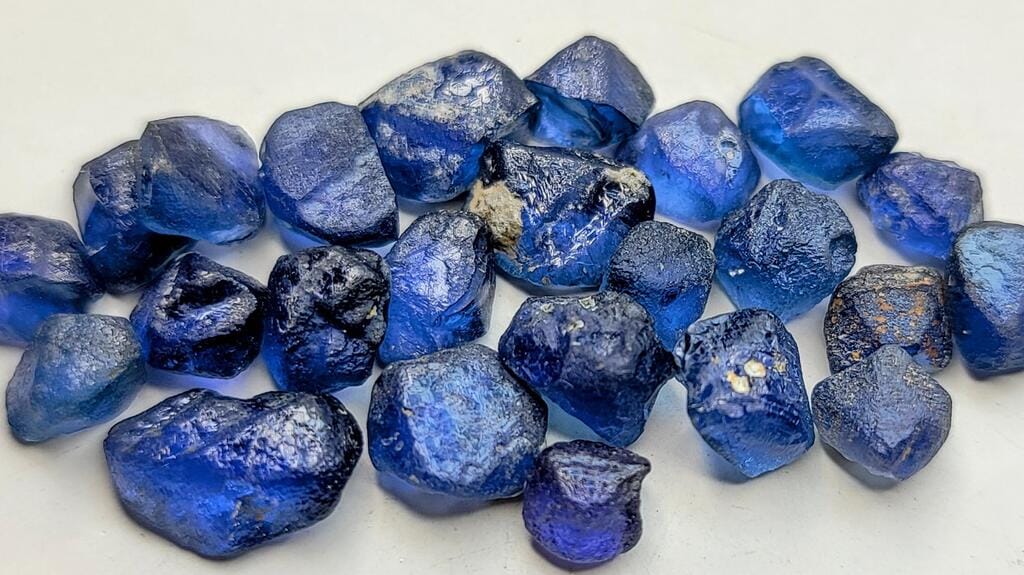
1.0 The Inverell Hub: The Sapphire City
Sapphire Fields New South Wales
authored by | Identity:did:plc:hqgxupttuyvfmnwxwkxzaz7o
Pull up a stump, mate, and pour yourself a nice, steaming cup of billy tea while the cool, crisp breeze rolls off the rugged, ancient peaks of the New England tablelands. Let us look into how these sapphire fields hold a completely different kind of dense, iron-rich corundum treasure.
| Location Node | Access Mechanism | Expected Mineral Yield |
|---|---|---|
| Inverell Deposit Lines | Staggy Creek Public Reserve Tracking | Blue Corundum, Black Zircon, Trace Heavy Tin |
| Billabong Blue Beds | Private Alluvial Fossicking Allotments | Royal Blue Crystal, Rare Fancy Green Sapphire |
| Macintyre Drainage Network | Fluvial Gravel Bed Extraction Gates | High-Density Inky Blue Crystals, Corundum Rough |
- Geological Features: Ancient alkali basalt cap structures, deep granitic basement traps, buried Tertiary paleochannels, and heavy concentrated alluvial gravels.
- Extraction Equipment: Heavy steel hand-sieves, grading screens, sorting tubs, long-handled round-point shovels, and gravity-fed washing jigs.
- Structural Risks: Surface clay contamination, internal feather fractures, microscopic rutile inclusions, and severe thermal shock during fast heating.
1.1 Navigating the Home of Corundum and Ancient Alluvial Gravels
Inverell operates as the undisputed epicentre of our sapphire heritage, standing proud in the fertile, undulating folds of the New England tablelands. To extract real value from this rugged terrain, you have to read the landscape like an open book and respect the rules set down by the regulatory authorities. You cannot just drop a massive excavator or swing a pick wherever you happen to fancy; you need to navigate public reserves, state forests, and established private allotments with absolute care, ensuring your permits are up to date. The modern fossicker uses digital portals to secure the necessary permissions before so much as turning over a single pebble of wash. This ensures that the rich geological legacy of the sapphire gemfields remains respected, documented, and protected for generations of artisans and craftspeople to come.
The old-timers knew that finding these gems was never a matter of luck; it was a matter of paying attention to the way the earth moved over millions of years. This high country can be a harsh judge of character when the cold winds blow across the ridges, but if you treat her with respect and learn the language of the rocks, she will reveal her secrets. The blue stones hidden down here are not like the bright, light stones you find in overseas fields. They are deep, dark, and heavy with the history of the earth itself, holding a structural integrity that can only be forged under the immense weight of the ancient crust.
1.2 The Mechanics of the Wash and Paleochannel Systems
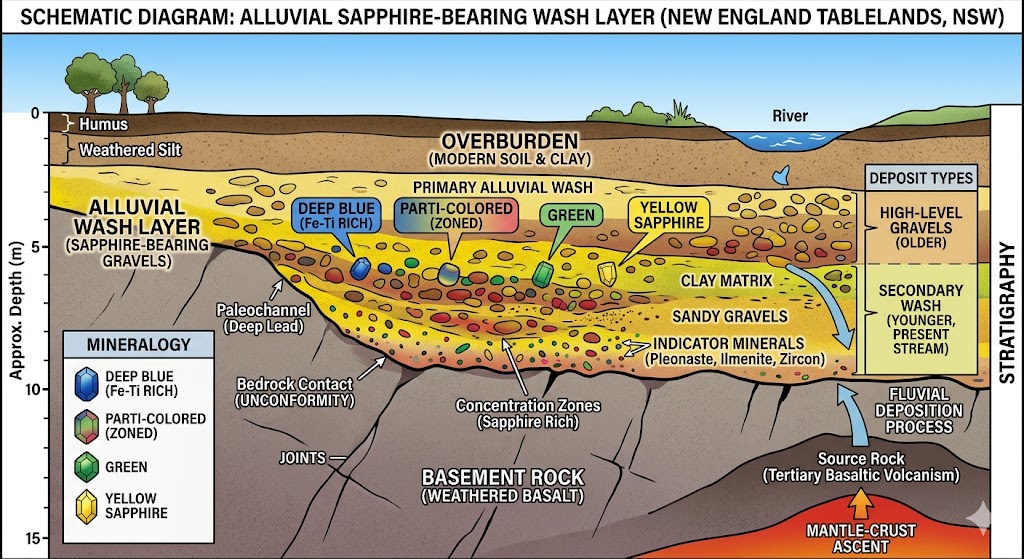
Understanding how the wash settles is critical when you are out on the field working your claim. The precious gems do not just sit on the surface waiting to be picked up by a casual tourist; they are buried deep within ancient, prehistoric riverbeds carved out of the basement granite and basalt long before our time. Finding these subterranean traps requires patience, a keen eye, and an understanding of fluvial dynamics, which is just a fancy way of describing how heavy objects settle down when water goes racing down a hill. When a massive torrent of water tore through these valleys millions of years ago, it acted like a giant natural sorting machine, carrying the light sand away and leaving the heavy treasures behind in the deep pockets.
These ancient, buried riverbeds hold the concentrated gravel layers where heavy, dense gems naturally settle over millions of years. Geological shifts and volcanic blockages forced ancient rivers to change course repeatedly, leaving behind isolated, gravel-filled gutters that sit high above or far to the side of modern waterways. Locating these paleochannels is the absolute secret to sustained, commercial-grade fossicking. If you can track the old path where the water used to flow before the land twisted and turned, you will find where the heavy corundum crystals are huddled together, waiting for a shovel to bring them back into the light of day.
1.3 Sieves, Shovels, and Screen Mechanics
Using standard mesh hand-screens is mandatory to preserve the delicate riverbanks and filter out the heavy material from the lighter waste stone. You shovel the raw wash into a grading screen, submerge it deep into the running creek water, and shake it vigorously with a steady, rhythmic motion to strip away the adhering clays and fine silt. This isn’t a job for the faint-hearted; your back will ache and your fingers will go numb in the chilly mountain water, but the reward is unmatched. What remains right in the absolute center of the sieve is the true concentrate, which is a dense layer of pebbles ranging from quartz and basalt to the heavy, targeted corundum crystals. When you flip that sieve upside down onto a burlap sack, the sapphires will be sitting right on top, gleaming like wet glass.
1.4 Basalt Traps and Bedrock Irregularities
Natural bedrock irregularities, such as protruding reefs of basalt or deep granite cracks, act like giant natural riffles across the floors of these ancient channels. When heavy floodwaters roared down these prehistoric valleys, the heaviest minerals, including sapphire, zircon, and sometimes even tin or diamonds, dropped straight out of the suspension flow and lodged themselves tightly behind these natural stone barriers. A smart miner never wastes time digging the loose gravel on the high banks; he cleans out the deep cracks in the bedrock with small hand-tools and spoons, knowing that the finest, heaviest stones have been tucked away in those dark pockets for safety since the dawn of time.
1.5 From Riverbed to the Bench: Precision Preparation
Finding the rough crystal in the sieve is only half the battle, mate. Once you pull a nice piece of sapphire out of the wash at Wellingrove Creek, you need to process it correctly through your refining gear before it ever gets near a jewelry setting. Because these stones are exceptionally tough, coming in right below a diamond on the hardness scale, they demand absolute respect at the workbench. You have to purge that stubborn alluvial clay completely before you can even think about setting them into fine pieces or preparing them for advanced lost-wax casting procedures. If you leave even a speck of that mountain dirt on the stone, the immense heat of the workshop will turn it into a tiny wedge that can shatter your hard-won treasure into useless shards.
1.6 Thermal Management and Cleansing Protocols
Taking shortcuts during the cleaning, faceting, and setting phase means you end up with a flawed piece, and nobody wants a dud casting when they are aiming for absolute perfection in their high-end artisan productions. Purging microscopic dirt, stubborn clay, and fine grime from natural crystal fractures using high-frequency waves in an ultrasonic bath is non-negotiable. If any organic material or compacted sediment remains trapped in the stone surface fissures, the extreme thermal expansion during the investment burnout or metal pouring stage can cause the sapphire to crack, ruining weeks of meticulous design and bench work. You have to treat them like a delicate newborn calf, warming them up slowly and cooling them down with plenty of patience.
1.7 Refractory Protection and Thermal Shock Mitigation
Managing high heat meticulously so the iron-rich stones do not thermal-shock or cloud up during the investment burnout phase requires calibrated kiln schedules and steady hands. New England sapphires, owing to their specific trace element chemistry and high iron content, can shift color or develop permanent internal stress if you ramp the temperature up or cool it down too aggressively. Utilizing precise digital pyrometers ensures the structural and visual integrity of the rough is preserved entirely intact through every single phase of the production cycle. It is a slow, methodical dance between fire and stone, and if you try to rush the music, the stone will always break your heart.
1.8 Investment Powder Integrity and Metal Injection
Utilizing specialized, industrial investment powders designed specifically to hold heavy, dense gems securely in place during centrifugal or vacuum-assisted metal injection is critical for success. The structural matrix of the flask must withstand the immense hydrostatic pressure of molten gold or silver without shifting the stone or allowing metal to flash over the flat surface of the gem. This mechanical precision guarantees a flawless fit and finish every time, securing the stone in a perfect embrace that will last for generations. When you see that bright metal freeze around the deep blue stone, you know that the long road from the dark gravel beds of Inverell to the finished piece of art has been travelled successfully.
2.0 Geological Stratigraphy of Glen Innes
authored by | Identity:did:plc:hqgxupttuyvfmnwxwkxzaz7o
Now, hop in the passenger seat, wind down the window, and let us wind our way up the New England Highway toward Glen Innes, mate. Settle back and look out at how these high, frosty layers tell an ancient story of fire and ice.
| Stratigraphic Layer | Lithology & Composition | Prospector Extraction Target |
|---|---|---|
| Tertiary Basalt Cap | Decomposed volcanic flows, rich ironstones, and dark, heavy clay soils. | Barren overburden zone that caps and seals the ancient gravel systems below. |
| Alluvial Wash Horizon | Compacted quartz gravels, sticky kaolin clays, and dense sapphire-bearing sands. | Primary mineral extraction zone for heavy blue sapphire, topaz, and zircon. |
| Granite Basement Floor | Pale, heavily fractured Palaeozoic granite bedrock with deep joints. | Natural bedrock trap systems, structural riffles, and deep gutter deposits. |
- Highland Mineral Suite: Pure aluminum oxide corundum, fluorosilicate topaz, silicate zirconium, and trace sheets of dark mica.
- Weathering Factors: Heavy high-altitude rainfall, chemical decomposition of feldspars, hydraulic sorting, and ancient river channel migration.
- Regulatory Conditions: Valid Forestry Corporation permits, mandatory public land fossicking access rules, and environmental bank protections.
2.1 The Volcanic and Sedimentary Layers of the Highlands
The Glen Innes Highlands offer a diverse and beautiful mineral suite, including bright topaz, deep garnet, and fiery zircon. Sites such as the Yarrow Creek Bridge and the rushing waters of the Sara River are critical nodes for those seeking genuine gemological variety down in the gravels. For the expert prospector, utilizing a broad, technical database provides an exhaustive understanding of documented crystal occurrences across the entire New England plateau. The rich sediment you shovel out here is a direct byproduct of ancient basaltic flows, which acted as the primary transport mechanism for these deep-earth crystals, blasting them up from the dark mantle and scattering them across the landscape before the rivers began their long, slow work of washing the dirt away.
Understanding the deep geoscience of the region allows for a far more targeted extraction process, reducing your physical footprint on the land while maximizing your daily yield of fine stone. Modern geological mapping reveals the hidden, buried paleochannels where the heaviest gems concentrate far away from the modern creek lines. For the modern fossicker, this structural knowledge is the primary tool of the trade, turning a blind guessing game into a precise science. When you can look at a hillside and see exactly where the ancient volcanic forces pushed the gravels into deep pockets, you save your back a mountain of unnecessary labor and ensure every shovel of wash brings you closer to a real find.
2.2 Basaltic Flows and Secondary Deposits
The volcanic history of the Glen Innes district is characterized by extensive Tertiary basalt flows that flooded ancient valleys like liquid iron. These molten blankets did not actually carry the gems themselves inside their fiery mix, but rather acted as an insulating, protective cap over the earlier drainage systems, sealing the older gravels away from the wind and weather. Over subsequent epochs, these thick basalt layers began to break down under millions of years of rainfall, transforming into the rich, dark red and black clay soils that cover the region today. As the basalt weathered down, the underlying sapphire-rich gravels were slowly liberated and reworked by ancient rivers, tumbling them down into the modern valleys where we find them huddled together today.
When you are out on the field, reading these weathered basalt zones is what separates the seasoned hand from the greenhorn. You look for the places where the heavy clay turns into a lighter, sandy grit, because that is where the volcanic debris has been completely cleared away by ancient water lines, exposing the rich gravel horizons below. This chemical weathering process takes a massive toll on the surrounding rocks, turning hard feldspars into soft, white kaolin clay that sticks to your shovel like grease. But if you wash that sticky clay away with enough patience and clean water, the heavy corundum crystals that survived the volcanic fires will be sitting right there in the bottom of your tub, untouched by the passage of millions of years.
2.3 Pneumatolytic Stages and Granite Intrusions
Beneath the heavy basalt and the sedimentary wash lies a complex basement of ancient Palaeozoic granite that forms the structural backbone of the entire tablelands. The intrusion of these massive granite bodies was accompanied by what the academics call a pneumatolytic stage, which is just a fancy way of describing a time when high-pressure gases and volatile fluids carried rare elements up into the cooling granite fissures and surrounding country rock. This intense hydrothermal activity created secondary nodes of immense mineral wealth, giving rise to the famous tin, wolframite, and large, pristine topaz crystals found throughout the Torrington and Glen Innes districts. If you ignore this deep granitic connection, you are missing half the story of these commercial fossicking grounds.
2.4 Field Extraction and Regulatory Alignment
Detailed mapping of the ancient riverbeds and deep-leads is essential for success, as the gemstones always follow predictable patterns determined by fluid dynamics. These ancient drainage lines were carved long before the modern era of exploration began, often influenced by massive tectonic shifts that tilted the entire tablelands toward the sea. When you are working within the NSW State Forests near Torrington, you must carry a valid Forestry Corporation permit at all times. Failure to align with these regulatory frameworks compromises the legal provenance of your find, which can ruin your reputation before you even get your stones to market. Keeping your paperwork straight is how we maintain absolute security in the gemstone game.
2.5 Field Cleaning and Laboratory Quality Sorting
When preparing these heavy highland stones for vacuum casting and fine jewelry work, you have to ensure they are completely cleaned of all alluvial skin using an industrial ultrasonic jewelry cleaner. This specialized hardware uses high-frequency waves to implode tiny clay platelets that cling to the rough surface of the crystal, stripping away the stubborn iron stains that can mask the true color of your find. If you leave that tiny crust of mountain dirt on the stone, it will ruin the precision fit when you try to set the gem into a custom mold, leading to gaps, misalignments, and structural failures that will make a master craftsman look like an absolute amateur.
2.6 Inspecting Structural Integrity under Magnification
The structural integrity of the stone is paramount; any internal fractures or feathers that you ignore during the initial sort will expand rapidly under the intense thermal pressure of molten metal. This is where a deep understanding of refractory materials becomes a massive commercial advantage for an independent operator. In the Glen Innes fields, stones are frequently found trapped in dense wash layers of heavy clay; if this material is not fully purged before the investment phase, your casting will suffer from catastrophic surface porosity and structural weakness. Taking the time to examine every single stone under a standard 10x loupe is a non-negotiable step for anyone who values their reputation as a premier artisan.
2.7 Silk Signatures and Internal Strain Mapping
The tiny rutile needles hidden inside the sapphire, which the old-timers call silk, provide critical clues as to how the stone will react when exposed to high heat at the bench. By studying these internal patterns under cross-polarized light, you can reveal hidden twinning planes and internal strain patterns that might cause the crystal to shatter during the casting process. This allows you to predict the exact thermal behavior of the gem before exposing it to the roaring heat of the burnout kiln, ensuring you only use the toughest, most stable stones for your high-end creations. It is a slow, careful sorting process that requires a sharp eye, but it guarantees that every piece of jewelry leaving your workshop is built to last a lifetime.
2.8 Establishing Sovereign Chains of Supply
By respecting the stratigraphic layers of the earth, testing your gravels against the granitic basement, and rigorously cleaning your resulting corundum rough, you guarantee a sovereign supply of high-purity highland material that elevates every single piece of jewelry produced in your workshop. You bypass all the headaches, supply chain risks, and sketchy ethics of importing mystery stones from overseas markets, keeping your entire operation clean, local, and completely bulletproof. When you can look a customer in the eye and tell them exactly which mountain ridge their sapphire came from, and show them the very layer of earth where it was buried for millions of years, you are selling something far more valuable than a mere piece of shiny glass; you are selling a true piece of the Australian bush.
3.0 The Ruby Paradox: Barrington and Gloucester
authored by | Identity:did:plc:hqgxupttuyvfmnwxwkxzaz7o
Alright, grab another cuppa and let us talk about something a bit more fiery and rare, mate. While sapphire is the undisputed king of the New England diggings, bumping into a rich, blood-red ruby down in the folds of the Barrington Tops is like finding a legendary crimson treasure in the dark.
| Volcanic Field | Host Lithology | Optical & Trace Signature |
|---|---|---|
| Barrington Tops Plugs | Alkali basalt plug formations, high-altitude alluvial gravel wash beds. | Chromium-rich red corundum rough, exceptionally high ultraviolet fluorescence. |
| Gloucester Drainage Lines | Prehistoric sub-alpine basins, reworked secondary gravel channels. | Highly saturated ruby grains, low iron structural suppression signatures. |
| Manning River Feeders | Deeply eroded basaltic debris fields, heavy mineral terrace pockets. | Deep crimson fractured fragments, distinct xenocrystic surface etching. |
- Chemical Trace Indicators: High chromium oxide concentrations, minimal structural iron fractions, magnesium anomalies, and low silica environmental markers.
- Subterranean Dynamics: Ultra-rapid volcanic magma ascent, upper mantle tearing forces, deep lithospheric pooling, and aggressive crystal face resorption.
- Sorting Sorting Signs: Dense black spinel indicators, heavy ironstone washers, sub-rounded ruby grains, and brilliant crimson glow under longwave ultraviolet testing lamps.
3.1 The Upper Mantle Crucible: Chromian Corundum Genesis
Unlike the classic iron-titanium blue stones that dominate our northern tablelands fossicking routes, true rubies require a completely different chemical recipe down in the subterranean kitchen. The beautiful red color we chase comes from chromium replacing aluminum in the crystal lattice over vast eras of time. Because our Australian basalts are typically loaded with iron, that iron usually steps in and squashes the chromium completely, turning the stones blue, green, or a murky black. This chemical reality makes the existence of true Australian rubies an incredible, absolute geological oddity that requires an exact set of natural circumstances to occur before you ever see a single red sparkler in your hand-pan.
These precious red crystals are what the rock-doctors call xenocrysts, which means they are foreign hitchhikers torn away from deep-seated mantle rocks and blasted to the surface during violent, explosive volcanic events millions of years ago. They did not grow in the lava that carried them; they were already old, ancient treasures sitting quiet in the deep mantle before the volcano woke up and ripped them out of their beds. Understanding this deep-earth mechanism is the very first step for any prospector hoping to sample the ancient, icy drainage networks around the Barrington high country, because you have to hunt where the ancient volcanic pipes actually broke through the surface of the old crust.
3.2 Alkali Basalt Eruptions and Xenocrystic Transport
The host stone that acted as the elevator for these rare gems is an undersaturated alkali basalt. These particular magmas originate much deeper in the earth’s mantle than standard volcanic flows and ascend toward the surface at a terrifying, rapid pace, acting like a runaway freight train blasting through solid rock. This incredible velocity is absolutely critical, because if the magma took its time crawling up through the layers of the crust, the aggressive, hot fluid would completely dissolve or transform the ruby crystals into other common minerals on their way up, leaving us with nothing but grey smudge instead of fine gemstone rough.
When you find these rough grains down in the creek gravels today, you can actually see the marks of that violent journey written right into the face of the stone. The rough surfaces often show deep resorption channels, which look like tiny etchings or worm-tracks where the hot magma began to bite into and dissolve the crystal before it froze at the surface. Finding a ruby that survived that fiery blast intact is a true miracle of time and nature, and it means the stone possesses an incredible structural toughness that has already passed the ultimate survival test deep down in the belly of the world.
3.3 The Chromium Factor: Suppressing Iron to Reveal Fire
For a corundum crystal to turn bright red rather than deep blue or black, the chemical environment deep underground must be virtually free of iron while maintaining a high concentration of compatible chromium trace elements. The Barrington volcanic field managed to tap into localized, unique pockets of the sub-continental lithospheric mantle that were unusually depleted in iron but highly enriched in chromium. When the crystal lattice formed, the chromium atoms slipped into the structure perfectly, setting the stage for a spectacular optical show when the stone finally meets the morning sun.
3.4 Ultraviolet Fluorescence and Optical Diagnostics
This unique chromium-rich, low-iron chemistry gives the Barrington rubies a spectacular hidden talent that makes them incredibly fun to sort in the dark. When you hit these little red grains with a shortwave or longwave ultraviolet light lamp, they light up like brilliant, glowing hot coals right in your sorting tray. This bright crimson fluorescence happens because the chromium ions absorb the invisible light and spit it back out as pure, visible red energy, unquenched by the presence of iron atoms. It is a foolproof way to spot a genuine ruby amidst a mountain of common red garnets or zircon pebbles that stay dark or turn a dull orange under the lamp.
3.5 Advanced Recovery and Precision Manufacturing for Rare Gems
Recovering these small, highly saturated ruby grains from the heavy mineral concentrates of the Gloucester riverbeds requires fine-tuned jigging, excellent water control, and incredibly careful hand-panning. Because Barrington rubies are typically found as highly rounded grains or fractured fragments rather than large, perfectly formed crystals, they lack the obvious visual appeal of rough sapphires until you clean them up and prepare them for the workshop. A lot of old-timers have walked right past rich ruby pockets simply because the rough stones look like tiny, dull pieces of broken red glass when they are sitting wet in the gravel.
3.6 Processing Tiny Crimson Rough for Lost-Wax Injections
Once you gather a small parcel of these rare red grains, your workshop technique has to shift gears completely to handle their unique physical proportions. Because they are rarely huge, you do not want to waste a single milligram of the material by cutting them into standard shapes; instead, you work with their natural, freeform contours, utilizing advanced lost-wax casting procedures to build the precious metal directly around the unique shape of the stone. This requires an absolute commitment to cleaning the rough, using multiple ultrasonic surfactant baths to ensure the investment powder sticks perfectly to the etched surface of the ruby grain.
3.7 Managing Investment Molds for Freeform Crystals
When you pour your specialized investment powder around a freeform ruby grain, the structural matrix must be packed tight with zero air bubbles caught in the natural wrinkles of the stone face. Any tiny pocket of air left behind will fill with molten gold or silver during the centrifugal injection phase, creating a metal flash that can crush the stone or ruin the clean lines of your setting. It takes a steady hand and a patient mind to mix your investment powders to the exact density required to lock these small, precious red stones into their permanent home without altering their natural, rugged beauty.
3.8 Securing the Value of the Barrington Red Sovereign Line
Establishing a completely sovereign chain of custody from the cold, volcanic soil of the Barrington high country straight to the finished piece of jewelry ensures maximum value retention for an independent craftsman. By doing every single step of the work yourself, from shoveling the sub-alpine wash to pouring the molten metal around the fiery red stone, you bypass all the offshore grading systems and international middle-men completely. You end up with a piece of jewelry that carries a profound, unbreakable connection to the wildest corners of the New South Wales bush, holding a crimson fire that was sparked deep in the earth millions of years ago.
4.0 Economic Note: The Landed Cost of Rarity
authored by | Identity:did:plc:hqgxupttuyvfmnwxwkxzaz7o
Alright, grab another cuppa and let us talk turkey, or rather, let us talk brass tacks and hard numbers, mate. You have put in the hard yards swinging a pick, and now we must make sure you do not get bitten by the hidden traps of the global gemstone market.
| Cost Variable | Offshore Sourcing (Imported Rough) | Domestic Sourcing (Sovereign Tablelands) |
|---|---|---|
| Purchase Friction | Heavy escrow fees, wire transfer costs, and ongoing foreign exchange conversion penalties. | Instant local liquidity, direct peer-to-peer cash exchange, and zero banking delays. |
| Logistical Latency | Weeks or months held in customs bonds, international shipping delays, and port port entropy. | Immediate transport from the field to the workshop bench with zero border friction. |
| Compliance Overhead | Complex import declarations, international trade tariff filings, and strict origin testing fees. | Simple domestic commercial recording, transparent regional trace files, and low overheads. |
- Financial Friction Points: Foreign exchange spread losses, international wire transfer fees, customs broker retainers, and cargo insurance premiums.
- Supply Chain Realities: Extended shipping timelines, port worker disputes, counterfeit documentation risks, and unpredictable gemstone origin tracking.
- Sovereign Advantages: Verifiable local provenance certificates, direct relationships with field operators, immediate stock turnaround, and complete cash flow control.
4.1 The Illusion of the Cheap Sourced Gemstone
Too many young blokes starting out in the jewelry trade get completely blinded by the flashy lights of overseas internet sites offering rough stones for pennies on the dollar. They look at those prices and think they can build a nice, profitable business by importing mystery parcels from faraway shores while leaving our own rugged diggings behind. Let me tell you straight from the shoulder, mate, that cheap imported stone is a total fool’s errand and a mathematical illusion once you pull out a pencil and write down the true, real-world costs of bringing that foreign rock onto Australian soil. The upfront price you see on your computer screen is just a tiny fraction of the ledger that will eventually break your bank if you are not careful.
When you buy from an overseas middleman, you are stepping right into a financial swamp filled with foreign exchange penalties, international wire fees, and banks taking a bite out of your capital at every single turn. Your money gets tied up in international escrow accounts for weeks while you sit around praying that the package actually shows up in the mail. And when it finally hits our shores, the border authorities steps in with their clipboards, demanding import duties, customs processing fees, and complex clearance paperwork that will make your head spin faster than a high-speed diamond saw. By the time you finally hold that stone in your hand, its true cost has doubled, and you still do not know if it is real or just clever glass.
4.2 Logistical Latency and Border Friction Traps
Time is the one thing a working craftsman cannot afford to waste, mate. When you depend on offshore sourcing, your workshop business is completely at the mercy of international shipping networks, port disputes, and customs inspectors who do not care a single bit about your production deadlines. A parcel of stones can sit trapped in a dark shipping container at a major port for months because someone forgot to tick a specific box on a declaration form or because the global supply chain hit a sudden snag. While your stones are sitting in that dark warehouse, your workshop machinery stays quiet, your customer orders pile up, and your business capital remains frozen where it cannot earn you a single quick quid.
Compare that nightmare to the beautiful simplicity of the bush telegraph and a local supply chain. When you buy your rough material directly from a bloke who spent his week washing gravel out in the New England fields, there is zero border friction to worry about. You hand over the cash, you take the stones, and you are back at your workbench that very same afternoon turning that rough corundum into a finished piece of jewelry. Your money stays alive and moving in your own neighborhood, your turnaround times drop from months to hours, and you do not have to spend a single second arguing with a customs agent over international trade codes.
4.3 The Value of Absolute Verifiable Provenance
In this modern world, people are getting tired of buying plastic junk and mystery items that come from nowhere. When a customer walks into your shop to buy a high-end sapphire ring, they want to know the true story behind that stone; they want to know it was found honestly, without hurting the land or the people who pulled it out of the dirt. If your stone came out of an undocumented overseas pit, you cannot give them that certainty, which instantly devalues your work in the eyes of an educated buyer who wants absolute truth. But when you can show them the exact geographic coordinates of the tablelands claim where that royal blue stone was found, the whole game changes completely.
4.4 Securing the Margin through Local Sovereign Chains
Keeping your operation completely sovereign and local is the only true way to protect your profit margins against global economic instability. When you own the supply chain from the creek bed straight to the polished jewelry display, you do not have to worry about overseas currency crashes or international political arguments ruining your business overnight. You are trading in real, physical wealth that you washed out of the Australian earth with your own two hands, using your skill to turn it into a timeless piece of art. It is a tough, rugged way to make a living, and it demands immense patience, but it builds a business that is solid as granite and completely independent of the rest of the world.
4.5 Balancing the Ledger for Long-Term Survival
At the end of the day, mate, mining and jewelry work are about survival, and survival means keeping a sharp eye on your costs while delivering an honest, high-quality product. The old miners who survived the boom and bust cycles of the seventy-decade rush did it by keeping their expenses low and their quality high, never trusting a deal that sounded too good to be true. By anchoring your business to the genuine rarity of our own highland corundum and rubies, you are investing in a product that will never go out of style. You hold your head high, you pay your local dues, and you let the other blokes ruin themselves chasing cheap foreign illusions while you keep digging deep into the solid, true wealth of the Australian bush.
5.0 The Master Artisan’s Workshop: Bench Operations and Engineering Protocol
authored by | Identity:did:plc:hqgxupttuyvfmnwxwkxzaz7o
Pull up a stump, mate, and look at the grease on these hands. Winning the stone from the damp clay of the tablelands is only the first shift of the journey; now we have to tame that wild, iron-hearted corundum right here at the bench.
| Operational Stage | Mechanical Control | Engineering Outcome |
|---|---|---|
| Structural Orientation | Optical axis alignment using cross-polarized fluid benches and inspection loops. | Maximizing yield by aligning the table facet perpendicular to the c-axis of the crystal. |
| Refractory Burnout Injection | Digital pyrometer control across segmented multi-stage ramp profiles. | Complete protection against thermal expansion shock inside the investment powder matrix. |
| Abrasive Faceting Friction | Diamond-impregnated scaifes using variable-speed high-torque copper laps. | Perfect mirror-finish polish on critical pavilion and crown angle facets. |
- Workshop Hardware Standards: High-torque variable lap wheels, copper lap faceting heads, digital pyrometer furnaces, and high-frequency ultrasonic scrubbers.
- Structural Failure Indicators: Internal twinning line stress, expansion fractures, surface micro-pitting, and cloudy rutile silk transitions.
- Bench Safety Parameters: Surfactant fume ventilation, cooling water recirculation lines, eye protection barriers, and non-shattering lap plates.
5.1 Facing the Truth of Raw Mountain Corundum
When you take a beautiful piece of rough sapphire straight out of the washing jig and lay it on your clean workbench, you are looking at millions of years of raw, uninterrupted earth history, mate. It is not like working with synthetic material made in a clean laboratory where every molecule behaves perfectly; this is real mountain stone, filled with its own unique personality, stubborn streaks, and hidden flaws. Before you ever bring an abrasive wheel near that crystal face, you have to spend hours just studying its structural geometry under a clear light. You are looking for the orientation of its crystalline structure, tracking how the atoms lock together along its natural growth axes to find the path of least resistance.
If you rush this initial phase and start cutting without a clear plan, you will ruin a world-class stone before you even know what you did wrong. A seasoned artisan uses cross-polarized light boxes and specialized refraction fluids to peer right through the muddy skin of the crystal, mapping out the internal twinning lines and feather fractures that are invisible to the naked eye. You have to find the c-axis, which is the optical backbone of the sapphire crystal lattice. Aligning your cutting angles perfectly with this invisible line is the absolute secret to unlocking that deep, beautiful royal blue sparkle, rather than ending up with a dull, murky green stone that looks like the bottom of an old beer bottle.
5.2 The Mechanics of Abrasive Diamond Faceting
Taming a stone that sits right below a diamond on the hardness scale requires immense patience and high-grade industrial tools. We do not use common sandpaper or soft grinding stones down here; we use heavy copper or tin lap discs that have been deeply embedded with microscopic diamond dust grit. As that lap wheel spins at thousands of revolutions per minute, you lower the sapphire down using a precision faceting arm that measures every single angle down to a fraction of a degree. It is a slow, methodical game of friction and cooling water, where a single slip of the fingers can wipe out a week of meticulous work in the blink of an eye.
You start with a coarse grit wheel to strip away the useless outer rind and block out the rough shape of the gemstone, constantly monitoring the interface to ensure the friction does not generate excessive localized heat. If the stone gets too hot on the lap, the expansion stress will cause the internal fractures to tear right through the core of your gem, splitting your payload in half. Once the basic geometry is established, you move through finer and finer abrasive stages, finishing with a sub-micron diamond paste on a soft tin lap to burnish the faces into a perfect mirror finish that coaxes the light down through the pavilion and fires it right back up into the viewer’s eye.
5.3 The Thermal Shock Danger Zone
Now, if you are planning to cast your hand-won tablelands sapphires directly into molten gold or silver using modern lost-wax procedures, you are entering the most dangerous zone of the whole workshop operation. Molten metal hits the stone like a blast of lightning, and if your investment powder matrix isn’t pre-heated to the exact degree required by the material science ledger, the thermal shock will be catastrophic. You have to use a fully programmable digital pyrometer kiln to ramp the temperature up at a slow, agonizing crawl over twelve full hours, allowing the stone and the investment powder to expand together in perfect harmony.
5.4 Preventing Surface Porosity and Investment Breakdown
If you try to cut corners on your burnout schedule to save a bit of time or electricity, you will pay for it with heavy surface porosity and broken stones every single time. The investment powder must be mixed with distilled water under a deep vacuum to pull every single bubble of air away from the sapphire girdle plane. Any microscopic pocket of air left behind acts like an insulation trap, causing the molten metal to freeze unevenly when it gets injected into the mold, creating a messy, pock-marked finish that ruins the clean lines of your custom artisan ring and leaves the gem loose in its metal seat.
5.5 The Sovereign Bench: Independence and Survival
Building a successful business around your own bench work means taking complete control of every single phase of the manufacturing process, from the muddy creek bank to the polished showcase. When you cut your own stones and cast your own metals right here in the bush, you don’t have to wait on international shipping lines, overseas grading labs, or faraway corporate offices to keep your dream alive. You are completely independent, protected against the wild ups and downs of the global economy by your own hard work, your own skills, and the true, unyielding value of the materials sitting right there on your workbench.
5.6 The Final Quality Verification Inspection
Before any piece of jewelry leaves this workshop to go out into the wider world, it has to pass through a brutal, final quality check under a high-power stereomicroscope. We check every single prong, every facet junction, and every metal seam to ensure the structure is absolutely flawless and built to survive a lifetime of hard wear. We test the setting under heavy physical pressure to guarantee the sapphire is locked down tight in its gold or silver cradle, unable to rattle or slip out when the customer is working or playing out in the rough world. It is an honest, unyielding standard of excellence that reflects the tough, uncompromising nature of the high country itself.
5.7 Preserving the Legacy of the Bush Telegraph
By keeping these traditional bench protocols alive, we are doing more than just making a quick quid; we are preserving a proud, honest legacy of Australian craftsmanship that has been passed down through generations of miners and workshop masters. We do not need ivory-tower jargon or fancy certificates from overseas corporations to tell us our work is good; the quality is written right into the weight of the metal and the timeless, brilliant flash of the mountain color. When you hand over a finished piece to a customer, you are giving them an unbreakable bond to the red earth, born out of deep time, won with sweat, and finished with absolute, uncompromising precision.