1.0 The Alchemy of the Earth: How Nature Bakes Opal
Kynuna Kyabra Bull Creek Boulder Opal fields
authored by | Identity:did:plc:hqgxupttuyvfmnwxwkxzaz7o
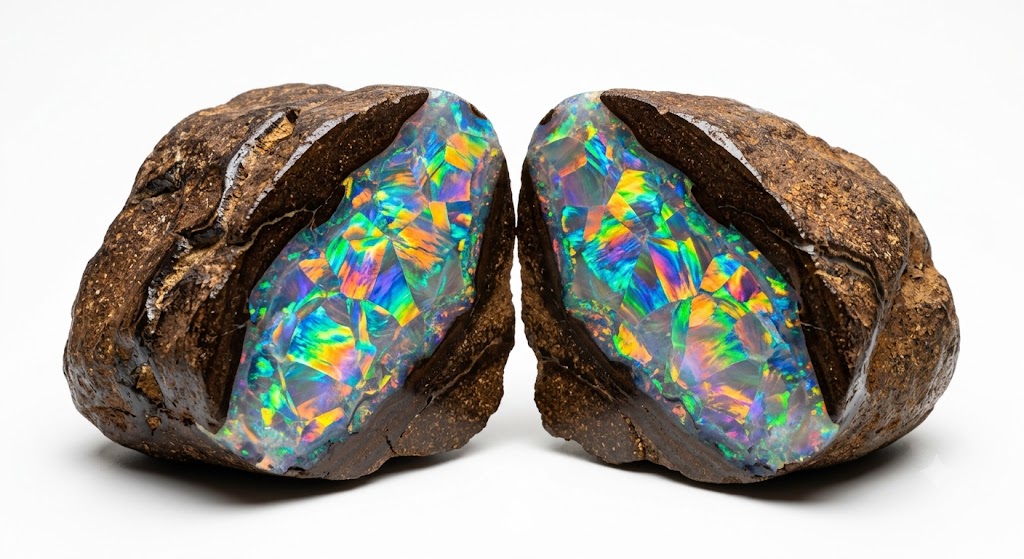
Pull up a stump, mate, and grab a cold one. Look out across that red dirt and you might just see a barren waste, but under our boots lies a grand, ancient kitchen where the earth has been slowly baking treasure for millions of years.
| Geological Process | Timeframe & Environment | Gemstone Yield |
|---|---|---|
| Silica Precipitation & Weathering | Cretaceous Basin Sedimentation (140M years) | Precious and Common Opal |
| Magmatic Intrusion & Metamorphism | Tertiary Volcanic Activity (35M years) | Corundum (Blue and Party Sapphires) |
| Alluvial Concentration & Sorting | Quaternary Drainage Systems (2M years) | Placer Sapphire Deposits |
1.1 The Great Inland Sea and the Silica Soup
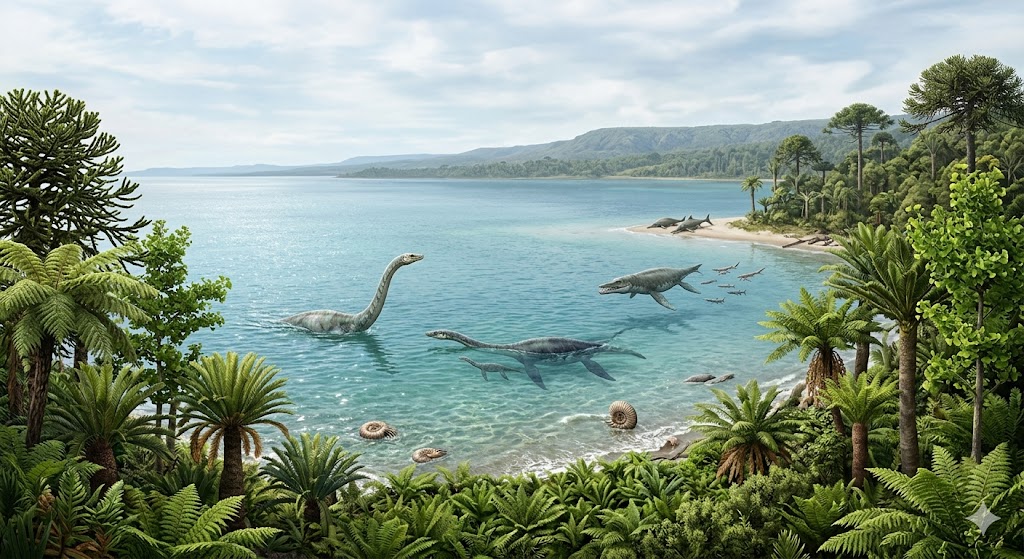
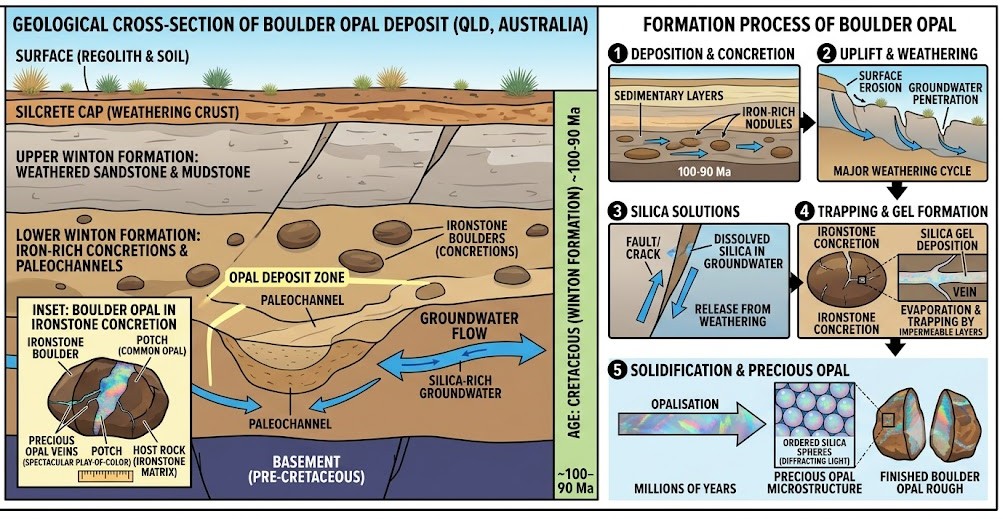
Now, to understand how an opal gets its color, you have to rewind the clock back to when Australia was a damp, cold place, and a massive inland sea covered the backyard. This wasn’t a tropical paradise; it was a vast, shallow soup full of rotting prehistoric bits and pieces. Over millions of years, the mountains out east washed down into this basin, leaving behind layers of fine sandstone rich in silica. When the sea eventually dried up, it left a landscape bleached by the sun but soaked with a subterranean soup. This soup was thick with dissolved silica, just waiting for the right cracks to settle into. Think of it like pouring syrup over a sponge cake; that sticky fluid found every nook, cranny, and hollowed-out prehistoric bone, getting ready for the long, slow dry.
1.2 The Microscopic Marble Stack
Here is where the real magic happens, though it is nothing more than natural sorting at a scale so small it would make your eyes water. As that silica soup sat undisturbed in the dark, damp belly of the earth, the water evaporated at a snail’s pace. This allowed tiny spheres of silica to settle out of the liquid.
1.3 They didn’t just pile up like a heap of gravel; they stacked themselves neatly,
like tiny round marbles arranged perfectly in a grocery display. If the spheres are all exactly the same size and stacked in flawless, orderly rows, they do something beautiful with the light. When the sun hits them, it gets bounced around and split up, throwing back those brilliant reds, greens, and blues that drive a miner mad. If the marbles are all jumbled up and different sizes, you get nothing but common potch—grey, lifeless stone that is worth nothing but a bit of experience. It takes incredible patience from Mother Nature to stack those microscopic marbles just right, and that is why finding a patch of true gem color is like catching lightning in a bottle.
1.4 The Fickle Nature of Fault Lines and Cracks
Back on the opal fields, the earth plays a different kind of game with you. The silica soup needs a place to sit, and it usually finds comfort in the faults, slips, and cracks caused by the earth shifting and groaning over time. We call these “slides.” When the ground shifted, it created perfect little underground channels where the water could migrate. If you are lucky, the water carried the right amount of silica and stayed quiet for long enough to solidify into a nice vein of color. But the earth is a fickle mistress. A slide can look promising, wide and clean, and then pinch out to nothing but a hairline crack in the space of a single pick blow. You can follow a trace of potch for weeks, thinking you are just around the corner from a massive pocket of color, only to find the ground turns hard as iron and dry as a dead bird’s cage. It takes a lot of grit to keep digging when the ground tells you nothing but lies, but that is the price of admission if you want to find the true wealth hidden in the deep, dark places of the bush.
1.5 Kyabra Opal Field: The Early Frontier
authored by | Identity:did:plc:hqgxupttuyvfmnwxwkxzaz7o
Pour yourself a cuppa and listen to the wind out here on the plains, mate, while I tell you about the birth of the boulder opal fields at Kyabra, where the whole wild rush first found its legs.
| Historical Era | Geological Horizon | Operational Scale |
|---|---|---|
| The Manual Era (1870-1920) | Upper Winton Sedimentary Profiles | Hand-Sunk Shafts and Windlass Extraction |
| The Syndicate Transition (1879) | Ironstone Concretionary Horizons | Organized Export and London Market Promotion |
| Modern Preservational Era | Deep Weathered Siltstone Lithologies | Intermittent Small-Scale Prospecting |
1.6.1 The Cradle of the Boulder Opal Trade
Now, if you want to understand how this whole crazy outback jewelry game got started, you have to cast your mind back to the 1870s down in the Kyabra hills, nestled between Cunnamulla and Quilpie. In those days, the bush was as wild as a brumbie, and the blokes working the sheep stations would occasionally spot a flash of fire kicking up out of the red dirt after a heavy downpour of rain. To the early squatters and station hands, these glittering pebbles were just pretty little colonial curiosities, something to stick on the mantlepiece or keep in a waistcoat pocket to show off at the local shanty. Nobody in the colony really understood that they were walking over a vast treasure chest that would one day capture the imagination of high society on the other side of the world. Kyabra was the very arena where that old, casual attitude was smashed to pieces by a few determined fellas who realized that this ironstone country was holding a king’s ransom.
1.6.2 Herbert Bond and the London Syndicate
The man who really put Kyabra on the global map was a sharp, forward-thinking character named Herbert William Bond, whom we often call the King of Opal. By 1879, the diggings around Kyabra were a chaotic mess of blokes working on their own, sinking shallow holes, finding a bit of color, and then selling it for a pittance or swapping it for tobacco and flour at the nearest homestead. Bond saw that this erratic way of doing things was never going to work if we wanted the rest of the world to take our stone seriously. He knew that the fancy gem buyers in London looked down their noses at Australian opal, viewing it as unstable and inferior to the traditional stones coming out of Hungary. To break that monopoly, Bond gathered the local miners together into a single, organized syndicate, pooling their best stones into a magnificent collection. He hopped on a steamship across the ocean to show the grand jewelry houses of the British Empire that this rugged Queensland boulder stone was tough, stable, and possessed a fire that made European opals look like dying dishwater. It was a massive gamble, but it worked, turning a localized bush hustle into an international luxury industry.
1.6.3 The Geometry of the Winton Ironstone
From a digger’s perspective, working the Kyabra ground means understanding the deep architecture of the Winton Formation, which is nothing but the dried-up floor of an ancient inland sea that covered this country during the Cretaceous age. Over millions of years, as that massive body of water receded, the ground underwent a fierce, deep weathering process. The silica-rich waters filtered down through the porous sandstones and hit the dense, heavy ironstone layers beneath. This ironstone didn’t form in neat, flat sheets; it formed in strange, rounded lumps and nodules that we call boulders or concretions. When you are standing at the bottom of a dark, narrow shaft in Kyabra, you are looking for those precise horizons where the ironstone nodules are packed tightly into the grey clay matrix. It is a game of extreme patience, because you can move tonnes of dirt without seeing a thing, and then suddenly your pick strikes a hard, heavy ironstone boulder that contains a thin, brilliant seam of liquid light trapped right through its center.
1.7 The Arduous Mechanics of the Hand-Pick Era
You have to respect the old-timers who opened up the Kyabra field because they did it all with nothing but muscle, sweat, and steel. There were no big yellow bulldozers or mechanical excavators back in the 1870s; mining meant sinking a vertical shaft just wide enough for a man’s shoulders using a hand-pick, a shovel, and a gad—which is just a small iron wedge used for splitting rock. A fella would spend all day down in the dark, breathing in the fine white dust, chipping away at the rock face while his mate stood at the top of the hole, turning a wooden windlass to haul up the heavy raw hide buckets of dirt. If you hit a hard band of sandstone, your progress would slow down to just a few inches a day, and your steel picks would blunt so fast you would spend half your evening stoking a portable forge just to sharpen your tools for the next morning’s graft. It was grueling, lonely work that broke many a man’s spirit, but the dream of finding that one spectacular pocket of gem-grade color kept them sinking hole after hole into the ridges.
1.7.1 Reading the Slides and Fault Systems
To find the stone in Kyabra without the benefit of modern geological maps, you had to learn how to read the face of the country like an open book. The old-timers discovered that the precious silica didn’t just drop into the ironstone randomly; it followed specific structural lines where the earth had cracked and shifted under immense pressure eons ago. We call these underground fractures “slides” or “faults.” When a slide moved through the sedimentary layers, it created an open pathway for the ancient groundwater to migrate, carrying its precious load of dissolved silica down into the ironstone concretions. If you found a slide that showed signs of salty, white potch, you followed it with your pick, tracking it through the clay beds in the hope that it would lead you into a major concentration of boulder nodules. A good miner could feel the change in the ground through the handle of his pick, noticing the subtle softening of the clay or the sudden resistance of a hard ironstone cap that signaled they were entering the prime production zone.
1.7.2 The Contemporary Footprint of the Field
Today, if you wander through the old Kyabra diggings, you won’t find the bustling camps or the hundreds of miners that once filled the ridges with life. The field has grown quiet, and many of the modern commercial operators have moved on to the massive open-cut operations at Yowah and Koroit where the tourism trade helps pay the bills. But for those of us who have the dust of this industry deeply embedded in our lungs, Kyabra remains holy ground. It stands as a monument to the first generation of diggers who proved that the Australian outback could produce a gemstone capable of conquering the global market. The old shafts are still there, half-filled with red dirt and guarded by gnarled mulga trees, but if you look closely at the old mullock heaps after a good winter storm, you can still catch a tiny glint of blue or green potch, reminding you that the old frontier is still holding onto its secrets.
1.8 Kyabra Opal Field: The Early Frontier
authored by | Identity:did:plc:hqgxupttuyvfmnwxwkxzaz7o
Pull up a stump, mate, and grab a cold one. Listen to the wind out here across the ridges while we yarn about Kyabra, where the boulder opal rush first found its legs in the red dirt.
| Historical Phase | Geological Horizon | Operational Scale |
|---|---|---|
| The Manual Frontier (1870-1920) | Upper Winton Sedimentary Formations | Hand-Sunk Shafts and Windlass Extraction |
| The Syndicate Shift (1879) | Ironstone Concretionary Stratum | Organized Export and London Market Promotion |
| Modern Preservational Era | Deep Weathered Siltstone Lithologies | Intermittent Small-Scale Prospecting |
1.8.1 The Cradle of the Boulder Opal Trade
Now, if you want to understand how this whole crazy outback jewelry game got started, you have to cast your mind back to the 1870s down in the Kyabra hills, nestled between Cunnamulla and Quilpie. In those days, the bush was as wild as a brumbie, and the blokes working the sheep stations would occasionally spot a flash of fire kicking up out of the red dirt after a heavy downpour of rain. To the early squatters and station hands, these glittering pebbles were just pretty little colonial curiosities, something to stick on the mantlepiece or keep in a waistcoat pocket to show off at the local shanty. Nobody in the colony really understood that they were walking over a vast treasure chest that would one day capture the imagination of high society on the other side of the world. Kyabra was the very arena where that old, casual attitude was smashed to pieces by a few determined fellas who realized that this ironstone country was holding a king’s ransom.
1.8.2 Herbert Bond and the London Syndicate
The man who really put Kyabra on the global map was a sharp, forward-thinking character named Herbert William Bond, whom we often call the King of Opal. By 1879, the diggings around Kyabra were a chaotic mess of blokes working on their own, sinking shallow holes, finding a bit of color, and then selling it for a pittance or swapping it for tobacco and flour at the nearest homestead. Bond saw that this erratic way of doing things was never going to work if we wanted the rest of the world to take our stone seriously. He knew that the fancy gem buyers in London looked down their noses at Australian opal, viewing it as unstable and inferior to the traditional stones coming out of Hungary. To break that monopoly, Bond gathered the local miners together into a single, organized syndicate, pooling their best stones into a magnificent collection. He hopped on a steamship across the ocean to show the grand jewelry houses of the British Empire that this rugged Queensland boulder stone was tough, stable, and possessed a fire that made European opals look like dying dishwater. It was a massive gamble, but it worked, turning a localized bush hustle into an international luxury industry.
1.8.3 The Geometry of the Winton Ironstone
From a digger’s perspective, working the Kyabra ground means understanding the deep architecture of the Winton Formation, which is nothing but the dried-up floor of an ancient inland sea that covered this country during the Cretaceous age. Over millions of years, as that massive body of water receded, the ground underwent a fierce, deep weathering process. The silica-rich waters filtered down through the porous sandstones and hit the dense, heavy ironstone layers beneath. This ironstone didn’t form in neat, flat sheets; it formed in strange, rounded lumps and nodules that we call boulders or concretions. When you are standing at the bottom of a dark, narrow shaft in Kyabra, you are looking for those precise horizons where the ironstone nodules are packed tightly into the grey clay matrix. It is a game of extreme patience, because you can move tonnes of dirt without seeing a thing, and then suddenly your pick strikes a hard, heavy ironstone boulder that contains a thin, brilliant seam of liquid light trapped right through its center.
1.8.4 The Arduous Mechanics of the Hand-Pick Era
You have to respect the old-timers who opened up the Kyabra field because they did it all with nothing but muscle, sweat, and steel. There were no big yellow bulldozers or mechanical excavators back in the 1870s; mining meant sinking a vertical shaft just wide enough for a man’s shoulders using a hand-pick, a shovel, and a gad—which is just a small iron wedge used for splitting rock. A fella would spend all day down in the dark, breathing in the fine white dust, chipping away at the rock face while his mate stood at the top of the hole, turning a wooden windlass to haul up the heavy raw hide buckets of dirt. If you hit a hard band of sandstone, your progress would slow down to just a few inches a day, and your steel picks would blunt so fast you would spend half your evening stoking a portable forge just to sharpen your tools for the next morning’s graft. It was grueling, lonely work that broke many a man’s spirit, but the dream of finding that one spectacular pocket of gem-grade color kept them sinking hole after hole into the ridges.
1.8.5 Reading the Slides and Fault Systems
To find the stone in Kyabra without the benefit of modern geological maps, you had to learn how to read the face of the country like an open book. The old-timers discovered that the precious silica didn’t just drop into the ironstone randomly; it followed specific structural lines where the earth had cracked and shifted under immense pressure eons ago. We call these underground fractures “slides” or “faults.” When a slide moved through the sedimentary layers, it created an open pathway for the ancient groundwater to migrate, carrying its precious load of dissolved silica down into the ironstone concretions. If you found a slide that showed signs of salty, white potch, you followed it with your pick, tracking it through the clay beds in the hope that it would lead you into a major concentration of boulder nodules. A good miner could feel the change in the ground through the handle of his pick, noticing the subtle softening of the clay or the sudden resistance of a hard ironstone cap that signaled they were entering the prime production zone.
1.8.6 The Contemporary Footprint of the Field
Today, if you wander through the old Kyabra diggings, you won’t find the bustling camps or the hundreds of miners that once filled the ridges with life. The field has grown quiet, and many of the modern commercial operators have moved on to the massive open-cut operations at Yowah and Koroit where the tourism trade helps pay the bills. But for those of us who have the dust of this industry deeply embedded in our lungs, Kyabra remains holy ground. It stands as a monument to the first generation of diggers who proved that the Australian outback could produce a gemstone capable of conquering the global market. The old shafts are still there, half-filled with red dirt and guarded by gnarled mulga trees, but if you look closely at the old mullock heaps after a good winter storm, you can still catch a tiny glint of blue or green potch, reminding you that the old frontier is still holding onto its secrets.
2.0 Bull Creek Opal Field: The Boulder Opal Stronghold
authored by | Identity:did:plc:hqgxupttuyvfmnwxwkxzaz7o
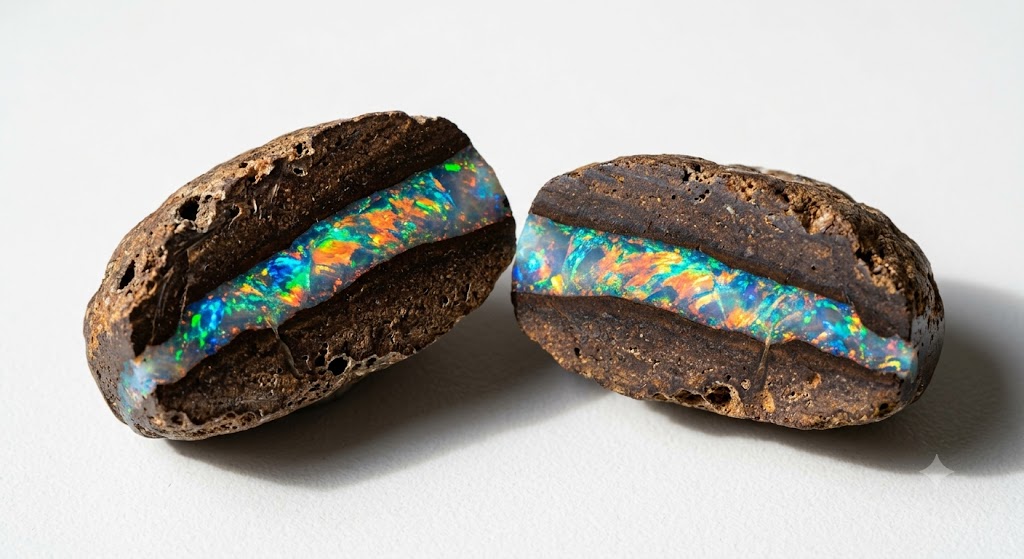
Pull up a stump, mate, and look close at this dark ironstone chunk. This comes from Bull Creek, a place that didn’t just give us a quick flash in the pan but stood solid as an industrial anchor for the whole Quilpie district.
| Operational Era | Geological Anchor | Extraction Technique |
|---|---|---|
| The Discovery Era (1885-1950) | Middle Winton Ironstone Concretions | Subterranean Driving and Manual Splitting |
| The Mechanized Revolution (1960s-Present) | Deep Weathered Sandstone Benches | Open-Cut Bench Extraction with Heavy Excavators |
| Modern Industrial Baseline | Basal Eromanga Sedimentary Sequences | Precision Mechanical Slitting and Hydrological Sorting |
2.1 The Bedrock of Commercial Reliability
Now, if Kyabra was the romantic dawn of the Queensland opal game, Bull Creek was the engine room that kept the fire burning for generations. Discovered around 1885 down in the Quilpie Shire, this patch of country earned its reputation not by offering up a few lucky pockets that vanished overnight, but through its sheer, stubborn consistency. Out here, the old-timers found something they desperately needed: stability. You see, a miner can survive a lot of dry spells if he knows that when he finally hits the stone, it will be of a quality that can stand up to the journey across the world. Bull Creek became the benchmark for what we call premium Quilpie Boulder Opal. It gave the buyers in Europe and America the confidence to invest because the material coming out of this ground didn’t crack, craze, or lose its water when it was carved up by the lapidary wheels in distant cities.
2.2 Nature’s Built-In Armor
The secret to the Bull Creek stone lies entirely within its unique structural marriage with the host rock. Unlike the soft, chalky white cliffs of the southern fields where the opal stands alone as a delicate vein, the precious material here is welded directly to an incredibly tough, iron-hard sand-matrix concretion. When the silica fluid settled into these boulders eons ago, it formed thin, brilliant sheets wrapped inside an ironstone armor. When we cut this stone, we don’t try to separate the opal from its background; we leave it attached to its natural ironstone backing, creating a composite gemstone that is as tough as a steel boot. This natural backing does two things: it gives the stone an incredible structural strength that makes it a dream for jewellers to set, and it provides a dark, deep canvas that makes the neon greens, electric blues, and rare fire-reds pop like fireworks against a midnight sky.
2.3 The Hard Shift to Open-Cut Mining
As the decades rolled on, the old way of chasing these ironstone boulders underground through narrow tunnels became too dangerous and slow to keep up with global demand. Those ironstone concretions are heavy, irregular things, and tunneling through the crumbling, weathered clay of the Winton Formation meant risking a cave-in every time you hit a major pocket. By the mid-20th century, the industry shifted completely, trading the hand-pick and tallow candle for the roar of diesel engines. The open-cut method revolutionized Bull Creek. Miners began using large bulldozers to systematically strip away the barren topsoil, exposing the ancient sedimentary levels like the layers of a chocolate cake. This mechanical approach allowed operators to unearth massive quantities of ironstone boulders that had been buried too deep for the old-timers to ever reach with a hand-winze, transforming the field into a highly productive industrial stronghold.
2.4 The Art and Language of the Boulder Crack
Even with the introduction of heavy machinery, the final and most critical step in the entire mining process remains an entirely human art form. Once the excavators lift those heavy, red-brown ironstone boulders out of the pit, they don’t just smash them open with a sledgehammer. To do so would shatter the fragile veins of precious opal inside, turning a potential fortune into worthless colorful dust. A skilled miner looks at an ironstone concretion the way a diamond cutter looks at a raw crystal. They look for the faint, pale lines on the skin of the rock—what we call the “trace” or the “seam line.” Using a specially weighted, short-handled hammer or a precision hydraulic splitter, the miner delivers a sharp, calculated blow along the natural plane of the stone. When done right, the boulder pops cleanly in half like a walnut, revealing a breathtaking, flawless face of vibrant color that hasn’t seen the light of day for a hundred million years.
2.5 Surviving the Long Dry on the Quilpie Ridges
Living and working out at Bull Creek required a specific breed of human, one with iron guts and a temper that didn’t fray when things went pear-shaped. The climate out on the Quilpie ridges is a brutal cycle of extreme heat and dust storms that can tear the skin right off your face, followed by sudden, violent monsoonal downpours that turn the grey clay flats into an impassable bog for months on end. In the early days, water was more precious than the opal itself. Miners would construct rudimentary catchments using corrugated iron sheets and hollowed-out tree trunks just to save every drop of morning dew or stray shower. If your water tank ran dry before the winter rains arrived, you had no choice but to pack up your camp, leave your tools at the bottom of the hole, and cart your horses back to the permanent waterholes along the river, praying that someone else wouldn’t jump your claim while you were gone.
2.6 The Lasting Legacy of the Stronghold
The name Bull Creek is forever etched alongside other legendary regional diggings like The Hayricks and the Little Wonder as the true backbone of the western Queensland mineral trade. It was the productivity of this specific field that allowed the township of Quilpie to grow from a remote railhead into a thriving hub for the international gemstone business. While individual operators still work the lease lines today using modern safety gear and advanced geological tracking, the foundational truth of Bull Creek remains unchanged. It proved to the wider world that the beautiful, rugged boulder opal of Queensland wasn’t just an accidental freak of nature, but a reliable, major mineral deposit that could support a permanent community of hard-working men and women who were willing to risk everything in the red dirt.
3.0 Kynuna Opal Field: The Northern Boundary
authored by | Identity:did:plc:hqgxupttuyvfmnwxwkxzaz7o
Grab your hat, mate, and steady yourself for a long journey up the track. We are heading to Kynuna, the absolute northern rim of our great Queensland boulder opal belt, where the country grows vast, lonely, and beautifully severe.
| Operational Feature | Geological Horizon | Logistical Profile |
|---|---|---|
| The Remote Frontier Era (1890-Present) | Northern Winton Formation Margins | Highly Intermittent Small-Scale Prospecting |
| The Artesian Edge Stratum | Marginal Great Artesian Basin Outcrops | Isolated Manual Exploration and Light Machinery |
| Cultural and Literary Intersection | Deeply Weathered Silicified Sandstones | Low-Density Legacy Diggings and Heritage Sites |
3.1 The Extreme Horizon of the Opal Belt
Now, if you take a look at a map of Queensland, you will see that most of our famous opal towns—places like Quilpie, Yowah, and Eromanga—are clustered down in the southwest corner of the state. But Mother Nature didn’t draw a neat little circle around those fields; she stretched her ancient silica kitchen over an unbelievable distance. Kynuna stands as the ultimate northern sentinel of this mineral belt, sitting a massive seven hundred kilometers northwest of the southern diggings. Out here, you are standing on the very edge of the Cretaceous sedimentary deposits, proving to any doubting Thomas that the unique conditions required to brew precious boulder opal occurred on a staggering, continental scale. It is a lonely, isolated patch of ground where the ridges flatten out into endless Mitchell grass plains, but for the digger who knows what to look for, those low-lying ironstone breakaways are a siren song whispering of hidden fire.
3.2 Where Banjo Paterson Met the Digger Spirit
Kynuna isn’t just famous among us rock-scratchers for its remote geology; it is deeply woven into the very fabric of Australian folklore. This is the country surrounding Dagworth Station, the exact landscape where Banjo Paterson sat down to pen the words to Waltzing Matilda back in the 1890s. There is a beautiful, poetic symmetry to it, you see. The swagman in that iconic song—the fiercely independent rogue who camped by the billabong and chose freedom over everything else—is the dead spit of the old-time Kynuna opal miner. While the southern fields were driven by a frantic, commercial rush of syndicates and investors trying to make a quick quid, Kynuna was explored by these solitary, nomadic characters. They were men who valued the deep silence of the northern plains just as much as the gems in their pockets, living out of canvas tents and working their claims with an easy-going independence that defined the early bush identity.
3.3 The Delicate Geology of the Artesian Edge
To find color this far north, you have to understand the subtle shifts in how the Winton Formation behaves as it approaches the rim of the Great Artesian Basin. Down south, the ironstone beds are thick, heavy, and relatively continuous, but up here around Kynuna, the sedimentary layers are more fractured and erratic. The precious silica soup migrated through the sandstones and siltstones right where the ancient water tables fluctuated against the deeper, impervious basement rocks. Because the outcrops are sparse and frequently buried under vast layers of younger alluvial soil washed down by the northern river systems, finding a productive deposit is like looking for a needle in a haystee. You are looking for very specific, deeply weathered ironstone caps that have managed to resist the endless cycle of tropical monsoonal erosion, holding their precious cargo of stabilized matrix opal just beneath the sun-baked crust.
3.4 The Tyranny of Distance and Logistical Grit
The biggest enemy a miner faces in Kynuna isn’t the rock itself; it is the sheer, crushing isolation of the landscape. Out here, you cannot just hop into a utility vehicle and run down to the local store if you break an axle on your trailer or run out of drill bits. Every single trip into the field requires months of meticulous planning and a vehicle packed to the brim with spare tires, mechanical tools, fuel drums, and rations. In the early days, if you ran short of fresh water or meat during the scorching summer months, you were in a proper spot of bother. The ground out here bakes like an oven under the northern sun, and the local creeks can turn from bone-dry dust bowls into roaring, miles-wide inland floods within the space of a single afternoon storm, trapping you on a lonely island of red dirt for weeks on end. It takes a remarkable amount of stubbornness and self-reliance to keep an operation running smoothly under those conditions.
3.5 The Domain of the Pocket Miner
Because of these severe logistical hurdles, Kynuna never transformed into the heavily mechanized, open-cut industrial landscape that you see down at Bull Creek or The Hayricks. It has proudly remained the playground of the small-scale, hardy operator—the true “pocket miner.” Up here, you don’t see massive fleets of yellow bulldozers tearing up entire hillsides. Instead, you find individual fellas or small family partnerships operating with light machinery, small backhoes, or simply a hand-pick and a keen eye. These miners rely entirely on their intimate, localized knowledge of the ridges, tracking tiny surface indications—like a stray chip of colorful potch dropped by a passing lizard—back to its source in the ironstone face. It is a slower, more deliberate style of prospecting that respects the vast solitude of the country and relies on craftsmanship rather than sheer mechanical force.
3.6 The Eternal Allure of the Northern Frontier
When you stand on top of a Kynuna ridge at dusk, watching the outback sun sink down like a blazing orange coal into the endless western horizon, you understand exactly why men stay here. The opal yielded by this northern outpost has a distinct personality of its own, often featuring incredibly delicate, fine veins of neon violet and deep aqua blue webbed intricately through a lighter, biscuit-colored ironstone matrix. Production may be intermittent, and the town of Kynuna itself might be quiet compared to the old days, but the field stands as an eternal testament to the boundary-pushing spirit of the Australian digger. It reminds us that no matter how far you travel into the wild heart of the bush, the earth is always ready to reward the patient, persistent explorer with a spectacular flash of natural color that makes all the hardships of the trail disappear in an instant.
4.0 Evolution of the Digger Spirit: From Hand-Picks to Heavy Diesel
authored by | Identity:did:plc:hqgxupttuyvfmnwxwkxzaz7o
Pull up your stump a bit closer, mate, and pass that cold one over. If you want to understand the true heart of these western fields, you have to look at the blokes who bled for the stone, and how our whole way of tearing treasure out of this stubborn earth changed from a quiet, solitary wrestle into a roaring mechanical war.
| Technological Era | Primary Tooling Infrastructure | Human and Landscape Impact |
|---|---|---|
| The Manual Era (1870-1920s) | Hand-Picks, Gads, Timber Windlasses | Extreme Isolation, Physical Attrition, Small High-Grade Yields |
| The Transitional Era (1930s-1950s) | Pneumatic Chippers, Kerosene Hoists | Increased Depth, Marginal Relief from Manual Slog |
| The Modern Mechanized Shift | Bulldozers, Front-End Loaders, Tracked Excavators | Open-Cut Topsoil Removal, High-Volume Boulder Extraction |
4.1 The Manual Era: A Brotherhood of Muscle and Sweat
Back in the beginning, before anyone ever dreamed of putting a diesel engine down a mine shaft, the whole industry was built entirely on human meat and bone. When the early diggers arrived at places like Kyabra or the early camps of Bull Creek, they didn’t have geological maps or satellite navigation; they had a pair of strong arms, a flannel shirt stiff with salt-sweat, and a fierce, unspoken code of independence. A bloke would stake his claim—just a tiny square of red dirt—and start sinking a vertical shaft with nothing but a short-handled pick and a shovel. If the ground was soft, you might make a few feet a day, but more often than not, you would strike a band of sandstone or tough ironstone silcrete that would make your arms jar right up to your shoulders with every single blow. Every bucket of broken stone had to be hauled up to the surface by your mate turning a wooden timber windlass, hour after hour, under a sun that could boil an egg in its shell.
4.2 The Silent Dark of the Subterranean Drive
Once an old-timer managed to sink his shaft down to the ” opal dirt”—that soft, greasy grey clay layer where the ironstone boulders love to nestle—the real touch-and-go work began. They didn’t open up the whole country like we do now; they followed the seams by driving narrow, low-roofed tunnels out from the bottom of the shaft. You would spend your whole day crouching on your knees or lying flat on your side in the absolute pitch dark, with nothing but the flickering, smoky yellow glow of a tallow candle or a small fat-lamp stuck into the clay wall beside your head. The silence down there was heavy enough to squash a man, broken only by the steady, rhythmic *clink-clink* of your hand-pick and the sound of your own rough breathing. You had to keep your ears pricked for the subtle, terrifying groans of the roof shifting above you, praying that the rough mulga logs you used for timber props would hold the immense weight of the outback from flattening you into a pancake.
4.3 The Returned Soldiers and the Post-War Refuge
After the First World War ended, the outback diggings saw a different kind of rush. A wave of returned soldiers, men who had survived the mud and horrific noise of the Western Front, came out to the western Queensland fields looking for a completely different kind of life. They were broken in body and spirit, and the crowded cities offered them nothing but noise and misery. The isolation of places like Bull Creek and Kynuna became a sanctuary for these fellas. They already knew how to dig trenches, they knew how to live rough under canvas, and they understood the quiet, unbreakable bond of mateship. They didn’t mind the hard slog because the bush offered them absolute freedom—no bosses barking orders, no sirens blowing, just the clean desert air and the honest, silent pursuit of the stone. These men brought a disciplined, stubborn grit to the fields, and many of the old shafts you see dotting the ridges today were sunk by blokes who used the peace of the underground to drown out the echoes of distant guns.
4.4 The Mechanized Shift: Bringing the Big Yellow Beasts
By the time the mid-20th century rolled around, the old-timers were getting long in the tooth, and the easy surface stone was mostly played out. The industry reached a critical fork in the road: either it had to die out as a colorful footnote in history, or it had to completely reinvent itself. That is when the mechanical revolution roared across the plains. Miners began experimenting with old wartime surplus machinery, converting truck engines into mechanical hoists and rigging up primitive air compressors to run pneumatic chipping hammers. But the real game-changer arrived when the first serious bulldozers and tracked excavators crawled onto the ridges of Bull Creek. Suddenly, the slow, dangerous business of tunneling underground was swept away. Instead of chasing a tiny vein through a dark tunnel, a miner could use thousands of diesel horsepower to systematically strip away twenty feet of barren topsoil, exposing an entire prehistoric boulder bed to the open sky in a single afternoon.
4.5 The Industrialized Open-Cut Bench Method
Go out to an operating lease today, and you won’t see a wooden windlass; you will see a massive, terraced open-cut pit that looks like a miniature grand canyon carved out of the red sandstone. The modern digger operates with an entirely different set of skills than his grandfather possessed. They cut the ground down in precise, stepped levels called “benches,” carefully stabilizing the walls of the pit to ensure the loose sandstone and clay can’t slip and bury the machinery below. The bulldozer or excavator operator works with a delicate touch that would surprise you, peeling back the layers of earth inch by inch. They are watching the blade or the bucket teeth like a hawk, looking for that sudden, telling change in color from the dull red topsoil to the pale, salty white or grey clay that marks the opal horizon. When that layer is exposed, the heavy machinery stops, and the precision work begins all over again, ensuring that the heavy ironstone boulders are extracted without being crushed by the immense weight of the tracks.
4.6 The Unchanged Soul of the Outback Prospector
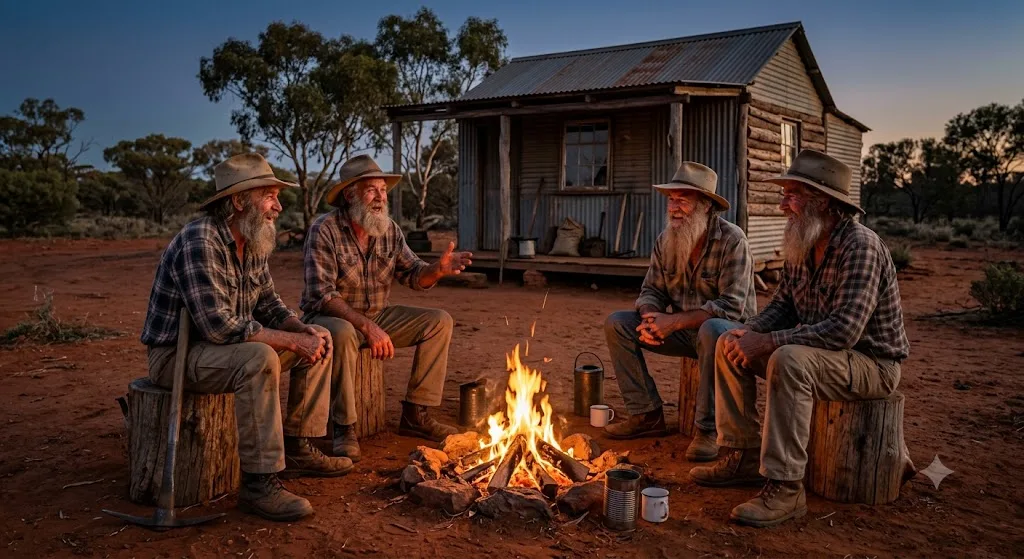
Now, a lot of people look at the modern fields with their big roaring engines, hydraulic splitters, and high-tech gear, and they think the old “digger spirit” has been lost, replaced by cold industrial efficiency. But if you sit down around a campfire with a modern operator at the end of a long, dusty shift, you will quickly realize that the soul of the miner hasn’t changed one single bit. The diesel engines might do the heavy lifting of shifting the mountain, but the gamble is exactly the same as it was in Herbert Bond’s day. You can buy the biggest bulldozer on the market and burn through thousands of dollars of fuel a week, and the earth can still look you square in the eye and give you nothing but heartaches and dry stone for months on end. It still requires that same old, irrational, stubborn belief that the next bucket, the next split, or the very next blow of the hammer is going to reveal a patch of color so magnificent it will change your life forever. The tools have grown teeth, mate, but the man holding the controls is still just a dreamer chasing a flash of light in the great Australian loneliness.
5.0 The Legacy and Summary of the Fields
authored by | Identity:did:plc:hqgxupttuyvfmnwxwkxzaz7o
Finish up your drink, mate, and look out over the horizon as the stars start to cut through the outback purple. We have walked the full length of the line, from the pioneer push at Kyabra to the industrial muscle of Bull Creek, and right up to the lonely rim of Kynuna.
| Field Location | Regional Context | Primary Gemstone Characteristic | Historical and Economic Legacy |
|---|---|---|---|
| Kyabra | South West Queensland (Cunnamulla/Quilpie) | Ironstone-Hosted High-Brilliancy Boulder Opal | Foundational birthplace of commercial syndicates and international market entry. |
| Bull Creek | Central Quilpie Shire Mining District | Highly Stable, Durable Premium Core Matrix | Industrial engine room providing a reliable supply for global luxury houses. |
| Kynuna | North West Queensland (Great Artesian Margin) | Fine-Veined Violet and Aqua Matrix Pockets | The extreme geographical boundary marking the scale of the Winton Formation. |
5.1 Tying the Three Knots of the Opal Belt
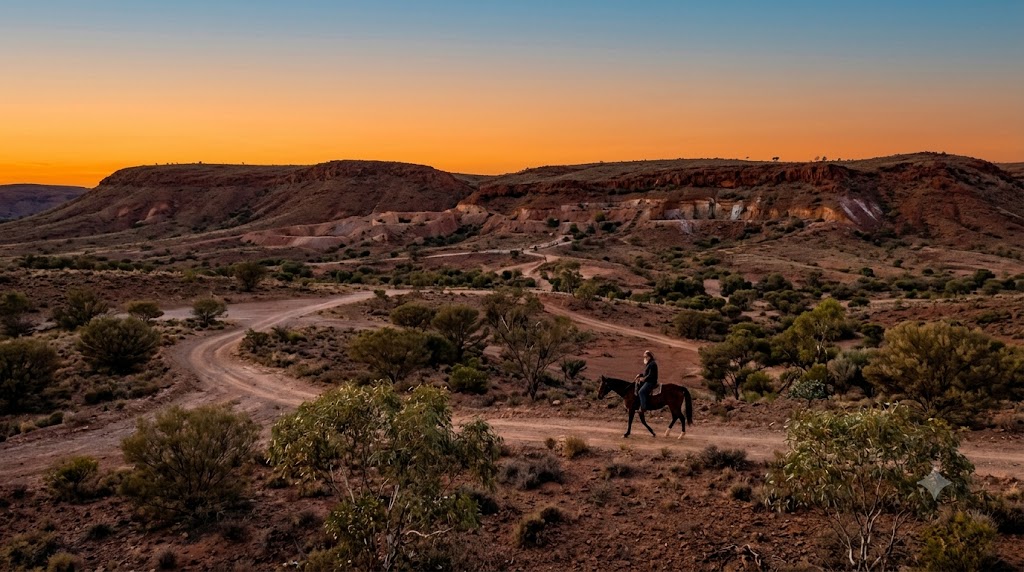
When you sit back and look at these three distinct patches of dirt, you realize they are not just isolated holes in the ground scattered across the map. They are the three great knots that hold the entire history of the Queensland boulder opal industry together. Each field represents a different chapter in our long, stubborn argument with the Australian continent. Kyabra was the spark that lit the fire—the place where we proved that this land held something more precious than wool and beef. Bull Creek was the steady timber that kept the fire burning hot, turning a speculative frontier gamble into a solid, world-wide business that could feed families for over a century. And Kynuna? Kynuna was the distant horizon, the proof that the ancient Cretaceous sea had left its magnificent signature across more than a thousand kilometers of the interior, waiting for any bloke with enough iron in his spine to go out and find it.
5.2 The True Worth of a Colonial Curiosity
It is funny to think how far this stone has traveled from the days when it was just an anonymous glitter in a station hand’s hand. The old world jewelry houses in London, Paris, and New York used to think they had the gemstone market completely figured out with their traditional diamonds, rubies, and sapphires. They looked down on our boulder opal because it didn’t fit into their neat little boxes; it was too wild, too unpredictable, and carried too much of the rugged landscape locked right inside its face. But the sheer persistence of the diggers broke down those boardroom doors. We forced the world to see that the dark ironstone backing wasn’t a flaw, but a magnificent, natural shadow box that amplified the stone’s inner fire. Today, when you see a piece of Queensland boulder opal sitting in a velvet box under the bright lights of a boutique shop in Tokyo or Geneva, you are seeing the direct inheritance of every dusty, sun-baked bloke who ever swung a pick at Kyabra or Bull Creek.
5.3 The Geological Masterpiece Left Behind
From a technical standpoint, what Mother Nature accomplished out here in the Winton Formation is nothing short of a masterpiece. Over millions of years, she took the simplest, most common elements—just water and the dissolved skeleton of old sandstone mountains—and through nothing but patience, pressure, and time, she cooked up a mineral structure that cannot be replicated by any factory or lab on earth. The way those tiny silica marbles sorted themselves out in the dark, damp fractures of the ironstone, creating a natural diffraction grating for the sun’s light, is a miracle of natural chemistry. It is a rugged kind of alchemy, born from the absolute drying out of an entire continent, and it means that every single piece of boulder opal we extract is a completely unique document of prehistoric time. No two stones are ever identical; each one carries its own pattern, its own specific depth of color, and its own fragment of the ancient ironstone matrix that cradled it for a hundred million years.
5.4 The Human Cost and the Spirit That Survives
But you can’t talk about the legacy of these fields without talking about the human toll, mate. This country doesn’t give up its treasures easily, and the red dirt of the west is seasoned with the sweat, blood, and broken bones of three generations of miners. Many a good bloke came out here with a wallet full of hope and left with nothing but bad knees, a ruined back, and dust in his lungs. The isolation could drive you mad if you weren’t careful, and the financial insecurity has broken more marriages than the droughts ever did. Yet, despite the hardships, the spirit of the old digger survives completely intact. Go into the pubs at Quilpie or Kynuna tonight and you will find the same breed of characters who opened up the fields in the 1880s. They are still talking about the tracks, still debating the position of the old sandstone benches, and still showing each other little parcels of color wrapped in pieces of dirty rag with that same old, infectious boyish wonder.
5.5 Reading the Footprints of the Pioneers
If you take the time to walk through the old, abandoned sectors of these fields today, the landscape speaks to you in a very quiet, powerful way. You see the collapsing timber frames of old shafts sunk by returned soldiers, the rusting remains of kerosene-powered hoists from the fifties, and the massive, steps-and-benches geometry of the modern open-cuts. It is like reading an archaeology of human hope. Every mullock heap represents a dream someone had; every empty pit is a testament to an operator who risked everything on a single lease. The bush is slowly reclaiming many of these places, with the mulga trees and spinifex growing back over the old tracks, but the mark we have left on the country is permanent. We have carved our identity right into the ironstone ridges, proving that a community of independent, self-reliant people could build an entire industry out of the most remote and inhospitable corners of the continent.
5.6 The Final Cast of the Dice
So, as we watch the final light fade out of the western sky, remember this: the story of Kyabra, Bull Creek, and Kynuna isn’t just about rocks and dollars. It is about the magnificent gamble of the human spirit against the immense, silent weight of the outback. There are still billions of tonnes of ironstone sitting out there under the Mitchell grass, holding onto undiscovered pockets of electric green and fire-red color that will make future generations of miners lose their minds. The big yellow machines will keep roaring, the pocket miners will keep tracking the tiny surface traces, and the earth will keep playing its beautiful, infuriating game of hide-and-seek. It is a tough life, mate, and it will take everything you’ve got, but when you finally crack open that ironstone boulder and look into a face of color that has been waiting since the dawn of time just for you, you’ll know it was worth every single blister. Now, let’s turn in, tomorrow we start digging again.