
1.0 Subterranean Mineral Genesis and Alluvial Mechanics
Australian Gem Fields
authored by | Identity:did:plc:hqgxupttuyvfmnwxwkxzaz7o
Pull up a stump, mate, and grab a cold one because the old earth does not give up her brightest secrets without a long, deep story about pressure, boiling ancient soups, and generations of hard, dusty graft.
| Geological Phase | Mechanical Action | Artisanal Indicator |
|---|---|---|
| Deep Thermal Infusion | Hydrothermal fluids forcing through stone fault lines | Coarse white quartz reefs with iron oxide staining |
| Alluvial Concentration | Gravitational settling within ancient river systems | Heavy black sand layers resting directly on solid bedrock |
| Silica Weathering Cycle | Slow evaporation of subterranean liquid solutions | Potch clay lines beneath arid desert sandstone caps |
- Primary Matrix Density: High concentration of ironstone gravels and compacted country rock indicators.
- Fluid Dynamics Matrix: Ancient water courses showing distinct structural sorting of heavy elements over millennia.
- Thermal Alteration Signatures: Deformed country rock boundaries indicating massive ancient underground cooking events.
- Stratigraphic Trapping Mechanisms: Dense clay bottoms and structural rock shelves acting as natural riffles.
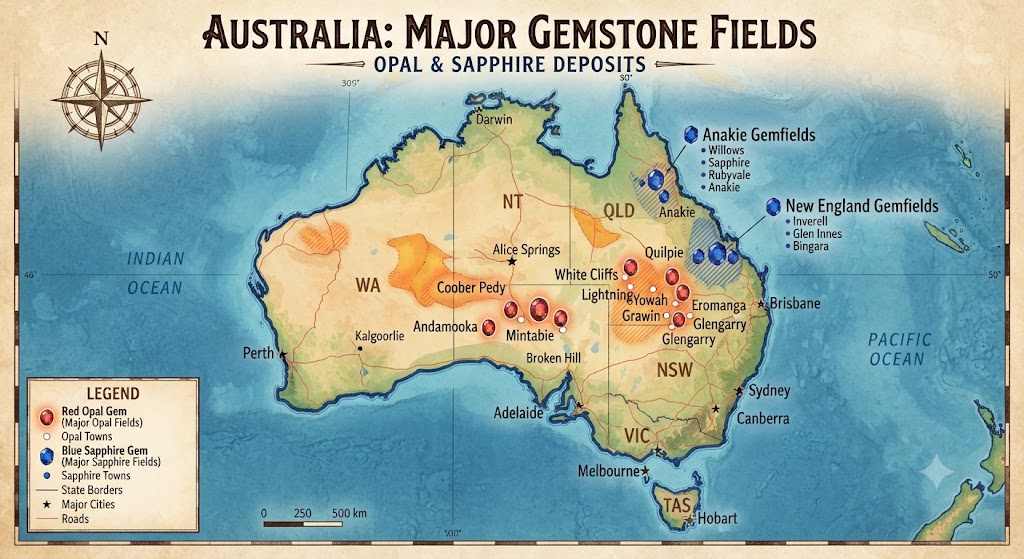
1.1 The Great Subterranean Kitchen
To truly understand how a speck of gold or a flash of green opal gets trapped in the dark spaces beneath our boots, you have to look at the ground not as cold, dead stone, but as a living, breathing pressure cooker that has been bubbling away since the dawn of time itself. Millions of years ago, the very ground we are standing on was a chaotic mess of shifting plates and subterranean heat. Deep down in the belly of the earth, temperatures are high enough to melt down solid rock into a thick, glowing porridge. This is not just empty molten stone; it is a rich, complicated soup packed full of dissolved metals, silica, and mineral salts all looking for a way out.
When the earth moves and cracks open during massive ancient upheavals, this pressurized boiling soup finds its opportunity. It gets squeezed up into the cold fractures of the upper crust like toothpaste being forced through a tiny pinhole. As that superheated liquid climbs higher, it runs into the cooler country rock closer to the surface. This temperature drop changes everything. Just like when you dissolve a mountain of sugar into boiling water and let it cool down on the kitchen bench, the minerals in that underground soup start to drop out of the solution and crystallize along the walls of the cracks.
For gold, this often happens inside great veins of quartz. The hot water carries the gold up, and as the liquid cools and the pressure drops, the quartz seals the gold inside a beautiful, milky white prison. Out on the goldfields, we look for those jagged white lines cutting across the red dirt because we know they represent the old plumbing system of the earth. If the mix in that kitchen was just right, you will find gold sitting right in the heart of the quartz, sometimes bound tight with iron stones that have rotted down over the ages into a rich, rusty brown casing.
1.2 The Alchemy of the Desert Fields
Now, opal is a completely different kettle of fish, mate. While gold loves the violent heat of the deep hydrothermal pipes, precious opal is born from patience, quiet evaporation, and the slow, steady rhythm of the arid plains. Think of the great inland basins of Australia as massive, ancient drying pans. Millions of years ago, a vast inland sea covered these regions, leaving behind thick layers of sediment rich in silica sands. When that sea dried up and left us with the sun-baked desert we know today, the real magic began underground.
During the rare, torrential downpours that hit the outback, water sinks deep into the sandstone layers, dissolving the loose silica along the way. This creates a thick, jelly-like liquid that creeps down through every tiny flaw, bedding plane, and ancient animal burrow it can find. It eventual encounters an impermeable layer, usually a dense grey or yellow clay band that the old-timers call the opal dirt. The water cannot go any further, so it sits there in the dark, trapped in small pockets and horizontal levels.
Over thousands of dry seasons, the water slowly evaporates, leaving behind minuscule spheres of silica stacked neatly on top of one another like millions of marbles in a tiny box. If those spheres are exactly the same size and arranged in perfect, orderly rows, they bend and bounce the incoming light when you dig them up, creating that brilliant play of color we call precious opal. If the arrangement is sloppy or the spheres are uneven, you get nothing but worthless common opal or grey potch. It is a game of absolute precision played out by nature over eons, requiring the perfect balance of weather, mineral availability, and undisturbed time.
1.3 Alluvial Migration and Mechanical Concentration
Once these minerals are locked inside their primary stone matrices, the surface world goes to work on them through the relentless forces of erosion. Wind, frost, and driving rain break down the solid mountains over millions of years, turning great cliffs into gravel and dust. This is where the story of alluvial gold begins. As the quartz reefs rot away under the harsh sun, the gold inside them is freed from its matrix. Because gold is incredibly heavy, it behaves very differently from the lightweight pieces of quartz, ironstone, and clay surrounding it.
When the big floods come wash across the landscape, everything gets swept down into the local creek beds and river systems. The rushing water acts exactly like a giant, natural sluice box. It tumbles the rocks around, grinding them down into finer sands, while the heavy gold nuggets sink rapidly toward the bottom of the water column. While the lightweight sand and silt get carried miles downstream, the gold drops down into the first quiet pocket it can find. It slips down through the shifting gravels until it hits something solid that it cannot penetrate, which is almost always the hard bedrock floor of the river.
1.4 Identifying Structural Traps in the Field
An artisanal miner has to learn how to read the ancient flow of water long after the river itself has dried up into a dusty channel of gravel. We look for specific structural changes in the bedrock that would have caused the water to slow down during an ancient flood. When a fast-flowing river hits a sharp bend, the water on the inside of that turn slows right down, losing its ability to carry heavy materials. That is exactly where the gold drops out, forming what we call a point bar deposit.
We also look for natural obstructions like hard bars of rock running across the creek bed, which act precisely like the wooden or steel riffles in a modern miner’s cradle box. The heavy gold settles behind these ledges while the lighter debris washes over the top. Deep potholes carved into the bedrock by swirling boulders are another prime location; they act as perfect natural traps, capturing heavy nuggets that spin around in the darkness for centuries until an adventurous miner comes along with a pick and a shovel to clean them out. Understanding these simple, physical laws of gravity and water motion is what separates a successful prospector from someone who spends their life moving nothing but worthless dirt.
2.0 Historical Timeline and Evolution of Mining
authored by | Identity:did:plc:hqgxupttuyvfmnwxwkxzaz7o
Pull up a stump, mate, and let us cast our minds back through the dusty years to see how a wild outback of lonely tracks transformed into the richest gem patch the world has ever known.
| Historical Epoch | Operational Footprint | Technological Milestone |
|---|---|---|
| Indigenous Era | Localized quarrying and extensive trade along Songline networks | Precision flint knapping and hand-selection of hard silicates |
| Late 19th Century Frontiers | Discovery rushes at White Cliffs and early New England creeks | Hand-cranked gravel winches, picks, shovels, and simple gold cradles |
| 20th Century Industrialization | Massive mechanized expansion across Coober Pedy and the Kimberley | Pneumatic earth blowers, automated tunneling rigs, and pulsator jigs |
- Traditional Lithic Extraction: High-reliance on ancestral knowledge of outcrops for tool manufacturing.
- Colonial Prospecting Dynamics: Unorganized, highly competitive surface rushes triggered by accidental mineral encounters.
- Mechanized Processing Baselines: Introduction of internal combustion engines to replace manual windlass hoisting.
- Resource Exhaustion Trajectories: Transition from shallow, easy-access surface gravels to deep underground exploration.
2.1 The Indigenous Connection: Deep Time and Functional Geology
Long before the first European boot left a track in the red dust of this continent, the First Nations people had the whole land mapped out with a sophisticated, practical understanding of the stones beneath their feet. For tens of thousands of years, they did not look at the ground as something to be sliced open for a quick quid or traded on an international market; instead, they valued stones for their ultimate survival utility and deep ceremonial significance. They traveled along ancient Songlines—huge, continental pathways that served as both map and law—trading high-grade stone materials over thousands of miles from the remote interior right down to the sea cliffs.
The old people were master craftsmen when it came to choosing the right rock matrix. They did not care much for the sparkle of a gemstone unless it could hold an edge or serve a spiritual purpose, targeting tough silicates like chert, chalcedony, jasper, and glassy quartz crystals. They established extensive, open-cut quarry sites where they would carefully wedge out high-quality stones from the living rock, using fire and cold water to split the stubborn stone faces. With incredible precision, they utilized advanced knapping techniques, striking the material at just the right angle to fracture it along natural lines, turning raw rock into razor-sharp spearheads, scraping tools, and skinning knives that allowed them to thrive in some of the harshest environments on earth.
Every bright bit of crystal quartz or colorful flash of surface opal found during these travels was treated with immense respect, often considered to hold the concentrated energy of the ancestral beings who walked the earth during the creation era. These stones were woven tightly into stories and passed down through generations of tribal elders as sacred objects. This ancient connection represents the longest continuous human interaction with the geology of the Australian continent, proving that our modern gemfields were well-known and deeply respected long before the first surveyor ever laid out a formal mining claim line.
2.2 The 19th Century: Rushes, Accidental Finds, and Early Frontier Days
The whole modern history of Australian gemstone mining kicked off with a stroke of pure, blind luck during the wild gold rushes of the mid-1800s. When thousands of hopeful diggers arrived in the New England country of New South Wales, their minds were set entirely on finding yellow metal. As they swarmed the creeks around Glen Innes and Inverell, throwing shovels of wet gravel into their tin pans and wooden cradles, they kept finding their wash clogged with heavy, dark blue pebbles that they had never seen before. Not knowing any better, and with their hearts set purely on gold, the early diggers cussed at these stubborn rocks and threw them onto the creek banks as worthless black stones.
It took a few decades for the rest of the world to realize that those annoying black rocks were actually top-tier, iron-rich sapphires that had been washed out of old volcanic ridges over millions of years. Down in the hot, flat outback of western New South Wales, the story played out in a similar way when a lonely track layer named Tarlton was out tracking a wounded kangaroo across the dry plains of White Cliffs in 1884. He reached down to pick up a strange, shiny stone that flashed like a rainbow in the blinding sun, finding the first commercial seam opal on the continent. Within months, a frantic rush of prospectors carrying nothing but picks, shovels, and a water canvas descended onto that hyper-arid patch, turning White Cliffs into a sprawling, dusty camp of canvas tents and shallow holes.
By the turn of the century, White Cliffs had become a bustling, subterranean community of over three thousand souls, with folks burrowing into the soft white sandstone hills to build cool underground shelters from the killing heat. These tough pioneers broke the ancient monopoly that European and Hungarian mines had held over the gemstone trade for centuries, proving to the big buyers in London and Germany that the Australian outback could produce brighter, tougher, and more abundant opal than anything ever seen in the old world. It was a brutal, hard-scrabble existence where water was scarcer than gold, but it put Australia firmly on the global gemological map.
2.3 The 20th Century: The Machine Age and the Golden Influx
When the twentieth century rolled around, the old ways of moving dirt with a hand-wound windlass and a strong back began to give way to the relentless march of the machine age. In 1905, a quiet, determined bushman named Charles Nettleton stepped off the track at Lightning Ridge in northern New South Wales and changed the opal world forever. He recognized that the dark, heavy claystones of the ridge held a variety of opal that the world had never laid eyes on: a stone with a deep, charcoal body color that made the neon greens, oranges, and reds scream out like lightning against a midnight sky. Nettleton walked for days through the scrub with a small parcel of these black opals, eventually convincing skeptical international merchants that these magnificent gems were the ultimate prize in the opal kingdom.
A decade later, out in the punishing, stony deserts of South Australia, a young teenager named Willie Hutchison was out looking for water on a gold-hunting trip with his father when his keen eyes spotted a piece of white float opal sparkling on the gibber plains. That discovery laid the foundation for Coober Pedy, a massive field that attracted a unique influx of tough, demobilized soldiers returning from the mud of World War I. These men took the trench-digging skills they had learned on the Western Front and applied them underground, driving deep shafts into the desert clay and living in hand-excavated dugouts to escape the killing summer air. Following World War II, another massive wave of European migrants arrived on the fields, turning these isolated outback outposts into vibrant, multi-ethnic melting pots where a man’s future was decided purely by the sweat of his brow and the luck of his pick.
By the 1970s, the entire industry underwent a massive technological revolution that pushed the old individual miner into a whole new league of production. Out on the sapphire fields of Anakie and New England, heavy corporate syndicates rolled in with massive yellow bulldozers, mechanical excavators, and giant trommels that could wash hundreds of tons of alluvial gravel a day using complex hydraulic pulsator jigs. On the opal fields, the invention of the “blower”—a massive, truck-mounted vacuum cleaner driven by a roaring V8 engine—meant that a miner no longer had to shovel every bucket of dirt by hand; the machine sucked the loosened wash straight out of the underground face and dumped it into converted concrete mixers on the surface, multiplying the amount of ground a partnership could shift in a single shift.
2.4 The Diamond Boom and Structural Consolidation
The absolute pinnacle of twentieth-century mining history occurred in 1979 in the wild, rugged Kimberley country of Western Australia, far away from the old opal dugouts. A team of sharp geologists tracing indicator minerals through the red gorges discovered an immense volcanic formation known as the Argyle lamproite pipe. When commercial operations fired up in 1983 under the management of Rio Tinto, it completely shattered the global diamond market, which had been tightly controlled by old-world monopolies for generations. Argyle became a colossal, industrialized operation, churning through millions of tons of hard rock every year to produce upwards of forty million carats of diamonds annually at its absolute peak.
While the vast majority of the Argyle haul consisted of industrial-grade near-gems, the mine possessed a unique geological signature that yielded a steady, minuscule stream of spectacular fancy pink, red, and violet diamonds. These rare stones became the ultimate luxury prize for global investors, commanding millions of dollars a carat and cementing Australia’s reputation as a premier producer of high-value gems. However, the earth’s riches are never infinite, and as the decades rolled on into the twenty-first century, the deep open pit grew too wide and the underground block-cave operations reached the absolute boundary of economic survival. On November 30, 2020, the giant machinery at Argyle fell silent for the last time, marking the end of a magnificent era of volume production and forcing the Australian gemstone industry to pivot toward a new chapter defined by scarcity, high-value artisan extraction, and strict care for the country we leave behind.
3.0 Geological Setting and Genesis
authored by | Identity:did:plc:hqgxupttuyvfmnwxwkxzaz7o
Pour yourself a cuppa and listen to the wind out here on the plains, mate, while we talk about the massive, silent forces that cooked, squeezed, and settled the finest treasures right into the dark crust of this old continent.
| Deposit Classification | Primary Rock Matrix | Microstructural Feature |
|---|---|---|
| Sedimentary Silica | Cretaceous sandstones and underlying kaolinized clay bands | Ordered arrays of sub-microscopic amorphous spheres |
| Sub-Volcanic Corundum | Alkaline basalts and deep-seated crustal xenolith structures | High iron concentrations causing distinct zoning lines |
| Mantle Lamproite | Olivine lamproite pipes penetrating Proterozoic mobile belts | Twinning planes from lattice slippage creating pink body hue |
- Mesozoic Weathering Profiles: Intense leaching of silicate minerals during dry, stable geological cycles.
- Magmatic Transport Elements: Violent volcanic elevators moving dense minerals from deep crustal storage zones.
- Lattice Deformation Signatures: Internal structural shifts caused by tectonic squeezing during volcanic ascent.
- Amorphous Hydration Level: Small amounts of chemically bound water trapped inside the packed silica sphere structures.
3.1 Sedimentary Gemstones: The Slow Drying of Precious Opal
To understand how an opal gets its color, you have to picture this dry outback as a massive, muddy inland sea over a hundred million years ago. Back in the Cretaceous period, this basin was full of water, crabs, and ancient marine life, all dropping their shells and bones into thick layers of mud. When that sea eventually packed up and receded, it left behind a vast, flat landscape made of highly acidic sandstones and soft clay beds. During long periods of intense desert weathering, the groundwater turned into a fierce, sour acid that began dissolving the silica right out of the upper sandstones.
As the water table slowly rose and fell over millions of dry seasons, this thick, silica-saturated syrup crept downward into every space it could find. It leaked into tectonic faults, bedding planes, and the empty hollows left behind where old dinosaur bones, sea shells, and wood had rotted away inside the clay lines. Once trapped in these underground vaults, the liquid had nowhere else to go. It sat there undisturbed in the dark while the water slowly vanished, leaving behind a thick gel that hardened over eons into a non-crystalline form of silica.
The real miracle happens at a scale so small you can only see it with the fanciest laboratory gear, though any old-timer with a pick can spot the results instantly. Precious opal is made up of millions of microscopic silica spheres all stacked together in perfect, orderly rows like marbles packed tight in a tiny crate. When ordinary white light hits these neat rows, it cannot pass straight through. Instead, it gets broken up and bent by the gaps between the spheres, flashing neon reds, greens, and blues back at your eyes. If the spheres are tiny, you get the common blues and purples; but if the spheres grew large and steady enough to bend the long wavelengths of light, you hit the ultimate prize: the rare, fiery red flashes that bring the biggest quid on the fields.
3.2 Magmatic and Volcanic Gemstones: The Blue Sapphire Elevators
Now, if you want to find a sapphire, you have to leave the old drying sea basins behind and head up to the high volcanic ridges of the Great Dividing Range. These hard, blue stones did not grow comfortably in the dirt like an opal; they were forged down in the roaring furnace of the earth’s upper mantle or lower crust. Deep down where the pressure is heavy enough to squash a steel tank like an old tin can, aluminum and oxygen got squeezed together into a mineral we call corundum. It took massive amounts of heat and millions of years for these crystals to grow, long before they ever saw a single ray of sunlight.
The sapphires did not actually grow inside the dark basaltic lava flows that you see scattered across the New England or Anakie fields today. Instead, those liquid rock flows acted as a violent, high-speed elevator. Deep underground magmas erupted with incredible force, tearing loose pieces of the ancient crust and plucking the pre-formed sapphire crystals right out of their original nursery rock. These traveling stones, which we call xenocrysts, were carried up to the surface inside a rushing tide of boiling alkaline basalt during explosive volcanic eruptions that must have shaken the whole continent.
Over thousands of centuries after the fires died down, the harsh outback weather went to work on the tough black basalt. The soft volcanic rock rotted away into rich black soil, but the sapphires inside were far too tough to yield to the sun and rain. Being incredibly dense and hard, they resisted the wear and tear of time, getting washed down the hillsides by ancient floods into old river beds and hidden gravel guts. Because these stones carried a high amount of iron when they were cooking down below, they have a deep, dark blue hue that often needs a bit of careful heat treatment to wake up the true brightness hidden within the crystal matrix.
3.3 Mantle-Derived Magmatic Gemstones: The High-Pressure Pink Diamond Pipes
Down in the remote Kimberley country, the earth played an entirely different game to produce the famous Argyle diamonds. While most of the world’s diamonds are found inside ancient, stable cratons wrapped in a rock called kimberlite, the old Kimberley field broke all the rules by using an olivine lamproite pipe running straight through an ancient mobile fault zone. The diamonds themselves were cooked up more than a billion years ago, sitting deep within the mantle under temperatures that would melt everyday metals into steam.
When the lamproite magma tore upward about 1.1 billion years ago, it moved with a speed that kept the precious carbon from turning into common charcoal on the way up. It was a rough, violent trip that changed the very structure of the crystals. As the stones were squeezed and shoved through the narrow volcanic throat, the immense tectonic pressure caused the rows of carbon atoms to slip and slide against one another, creating permanent twists and defects in the stone’s crystalline lattice.
3.4 Structural Alterations and Light Absorption
These tiny structural flaws within the diamond lattice are the exact reason why the Argyle mine became legendary. When light enters an ordinary diamond, it bounces around and comes out clean and white. But when light hits the deformed lattice of these squeezed Kimberley stones, the structural defects absorb specific wavelengths of light, leaving only the rare, breathtaking shades of pink, red, and rich brown to bounce back to the viewer. It is a pure accident of tectonic violence that created the most expensive luxury item on the modern market, showing that sometimes the hardest knocks from the earth yield the most beautiful results of all.
Every single gemstone pulled out of the Australian dirt, whether it was settled gently by ancient desert waters or blasted out of a fiery volcanic pipe, carries the permanent signature of the exact ground that birthed it. An artisanal miner does not need an academic degree to appreciate these intricate paths; we read the stories in the fractures of the stone, the weight in the hand, and the way the light behaves when you clean off the outback dust and hold a finished piece up to the midday sun.
Through eons of quiet pressure or sudden, violent upheaval, the continent has acted as a giant, underground sorting machine. The heavy things found their way to the bottom, the delicate crystals found their shelters in the clay, and the hardest elements survived the long journey to the modern surface. When we sink our shafts or clear our alluvial runs today, we are simply opening the last chapter of a book that the earth started writing before the first mountains were worn down to the red ridges we walk across today.
4.0 Socio-Economic Aspects of the Industry
authored by | Identity:did:plc:hqgxupttuyvfmnwxwkxzaz7o
Pull up a stump, mate, and let us talk about the real heart and soul of the fields: the bloody characters, the hard graft, and the way a shiny stone can keep a whole town breathing out in the middle of nowhere.
| Social Element | Economic Engine | Community Framework |
|---|---|---|
| The Aussie Digger Ethos | Small family syndicates and individual claims keeping cash local | Egalitarian bush settlements built on mateship and trust |
| Downstream Value Flow | Lapidary cutting, regional tourism, and gem festival injections | Support networks for local mechanics, fuel stops, and stores |
| Indigenous Agreements | Direct royalty pipelines, heritage protection, and local jobs | Joint stewardship panels and structural heritage clearances |
- Egalitarian Economic Models: Reliance on individual sweat equity rather than massive corporate bankrolls.
- Subterranean Adaptation Strategies: Underground dugout housing reducing energy dependency in extreme weather zones.
- Secondary Capital Circulation: Tourism cash injections via tourist fossicking and regional gem shows.
- Heritage Protection Obligations: Legal frameworks ensuring native title holders clear and protect ancestral sites.
4.1 The Aussie Digger and Outback Culture: Grit in the Underground Vaults
If you ever walk down the main dirt track of an opal town like Coober Pedy or Lightning Ridge, you will realize pretty quick that the real value of the gemstone industry is not just written on a piece of paper in a bank vault. It is written in the deep lines on the faces of the blokes and sheilas who spend their lives down in the dark. The sapphire and opal fields have always been the ultimate refuge for the ultimate individualist. Out here, nobody cares about your family tree, what school you went to, or how much coin your old man had in the bank. The ground does not look at your pedigree before it gives up a pocket of stone. It is a world built entirely on raw grit, dry humor, and an unshakeable belief that the next swing of the pick could change everything.
Following the major world conflicts, these remote patches became a sanctuary for thousands of European migrants who had seen their old homes torn apart by war. They arrived carrying nothing but a suitcase and a willingness to work, turning towns like Rubyvale into multi-ethnic melting pots where twenty different languages were spoken around the same evening campfire. This shared hardship created a fierce, egalitarian bush culture centered on the sacred law of mateship. If a miner’s hoist broke down or their shaft took in water, the neighboring claims would drop their own tools to help pull them out of a jam. It is a community bond forged in the dust, where a person’s handshake is worth more than a twenty-page contract drawn up by a city lawyer.
The crushing outback summer heat, which can easily crack a thermometer at forty-five degrees in the shade, led to some of the most remarkable human adaptations you will ever see. Instead of fighting the sun on the surface, the old-timers in the South Australian fields realized that the soft, weathered sandstone hills could be carved out into perfect, insulation-rich living quarters. They blasted out underground dugouts directly into the mining faces, creating cozy homes that stay a beautiful, steady twenty-three degrees year-round without a single cooling machine running. You can have a kitchen, a lounge room, and a bedroom all tucked neatly inside the solid clay layers, living right next door to the very drives where you spend your days hunting for the colored fire. It is a rugged, beautiful way to live that shows exactly how deeply a miner integrates into the geology of the field.
4.2 Economic Life Support for the Lonely Interior
Let us look at the hard numbers without putting on city airs: these gemstone fields act as a massive economic life support system for parts of the Australian interior that would otherwise support nothing but dingoes and spinifex grass. When an individual miner or a small family syndicate strikes a rich pocket of wash, that money does not instantly vanish into an overseas corporate tax haven. It stays right there in the dust where it was found. The lucky miner walks straight into the local town and buys a new set of tires from the mechanic, pays their tab at the fuel distributor, and buys a round of cold ones for the whole front bar at the pub. Every single dollar pulled out of a claim circulates through the community, feeding families and keeping the lights on in small regional schools and grocery stores.
The downstream value flow is what turns a raw, muddy piece of stone into a sustainable regional industry. Before a gem ever reaches a storefront window in Sydney or New York, it has to pass through a dozen local hands. You have the local lapidary cutters who spend hours over a spinning diamond wheel, using their eyesight and steady hands to bring out the bright play of color hidden inside a rough chunk of potch. You have the local wholesale runners who know exactly which buyers in Japan or America are looking for a specific grade of green or blue. This localized expertise means that the financial rewards of the earth are shared among the people who actually know how to get their hands dirty, rather than being swallowed up by corporate executives who have never seen the inside of a shaft.
Then you have to factor in the massive impact of tourism, which is tied completely to the romance of the gemfields. Every winter, when the southern cities turn cold and grey, thousands of grey nomads and international travelers pack up their caravans and head up the tracks to towns like Rubyvale, Sapphire, or Quilpie. They come to try their hand at “noodling” or “specking”—picking through the old, discarded mullock dumps outside the claims to find a bright speck that the big machines missed. These visitors inject millions of non-mining dollars into the local motels, caravan parks, and bakeries, turning what started as a hard-bitten prospecting camp into a thriving, multi-layered economy that celebrates the heritage of the old diggers while keeping the modern community strong.
4.3 Native Title, Heritage, and Joint Stewardship
The entire social and economic landscape of the Australian mining industry underwent a massive, necessary shift with the introduction of the Native Title Act in 1993. For too long, the old frontier mentality had ignored the fact that these rich gemstone formations were sitting directly inside the ancestral hunting grounds and sacred sites of the First Nations people. Modern artisanal miners and corporate operators alike have had to learn that you cannot just roll a bulldozer onto a new lease without showing proper respect to the traditional landowners who have looked after the country for thousands of generations.
This led to the creation of detailed negotiation frameworks and heritage protection agreements that have redefined how claims are opened. Before any modern mining lease can be granted in areas like the Queensland Boulder Opal Belt or the New England tablelands, operators must sit down with traditional owners to conduct thorough cultural heritage surveys. These joint panels walk the ground together, mapping out sensitive areas like old stone arrangement sites, burial grounds, or scar trees to ensure they are completely protected from the picks and excavators. It is a process that requires patience, listening, and a mutual understanding of the ground, ensuring that the hunt for subterranean wealth does not destroy the visible history of the land.
4.4 Economic Integration and the Legacy of the Kimberley Agreements
Up in the high country of the East Kimberley, the historic operations at the Argyle Diamond Mine established a world-class benchmark for how major resource projects can integrate with Indigenous communities. Through the landmark Argyle Participation Agreement signed in 2004, the local Gija and Mirriuwung people moved away from being passive onlookers to becoming crucial partners in the entire industrial footprint. The mine established direct royalty streams that funded local education, health housing initiatives, and business development grants for traditional owner corporations.
Crucially, the agreement focused heavily on structural employment, setting up dedicated training academies that turned local Indigenous blokes and sheilas into master machinery operators, surveyors, and site managers. By the time the mine neared its final days of production, over a quarter of the massive workforce was made up of local traditional owners, providing stable, high-paying jobs that transformed the economic future of isolated communities across the region. This legacy proves that when you treat the original caretakers of the land with genuine respect and financial equity, the wealth pulled out of the earth can build a proud, lasting foundation that remains long after the last truck has driven out of the pit.
5.0 Current Status, Modern Extraction Methods, and Future Outlook
authored by | Identity:did:plc:hqgxupttuyvfmnwxwkxzaz7o
Pour yourself a cuppa and look out over the old diggings, mate, because while the landscape has changed and the rules are tighter than a new pair of boots, the spirit of the hunt remains as true as ever.
| Modern Operation | Technical Mechanism | Compliance Metric |
|---|---|---|
| Underground Extraction | Automated tunneling machines and high-powered pneumatic vacuum blowers | Mandatory structural roof bolting and formal shaft registration bonds |
| Alluvial Wash Processing | Rotating trommels paired with mechanical gravity pulsator jigs | Closed-loop water recycling systems with zero downstream discharge |
| Market Verification | Blockchain-verified certificates and advanced microscopic laser inscription | Strict provenance tracking from the outback claim to retail shop fronts |
- Pneumatic Dirt Moving: High-powered suction setups reducing manual subterranean handling hazards.
- Environmental Surety Bonds: Financial guarantees held by state departments to ensure complete topsoil restoration.
- Resource Deficit Projections: Rising difficulty in mapping deep targets due to complex structural stone cover.
- Ethical Provenance Advantage: Market premium driven by strict labor standards and traceable origin tracking.
5.1 Modern Extraction Methods: The Marriage of Muscle and Machinery
The gemstone fields of today might not look as frantic as they did during the wild pick-and-shovel rushes of the old days, but don’t let the quiet outback air fool you, mate. The modern artisanal miner has adapted, combining decades of bush wisdom with some incredibly smart, customized gear. Down on the opal fields, we do not spend our days swinging a heavy pick until our shoulders give out. Instead, a partnership will drive a vertical shaft down into the earth using a truck-mounted drilling rig, then lower a specialized underground tunneling machine right into the clay layer. These nimble electric or hydraulic rigs crawl forward on tracks, chewing away at the soft opal dirt with rotating cutting heads while leaving a perfectly smooth, safe archway in the ceiling above.
Once the machine has loosened the stone matrix, the old-school bucket chain is nowhere to be seen. We use the “blower”—a magnificent beast of outback engineering. This is a massive, industrial vacuum system mounted to the back of a truck on the surface, driven by a heavy-duty diesel engine. A thick rubber hose runs straight down the shaft and into the working face, sucking every rock, grain of sand, and hidden bit of precious color straight out of the dark drives and pulling it up to the surface with a deafening roar. The dirt lands inside a closed hopper on the back of the truck, which empties directly into a big rotating mesh screen known as an agitator. Often built out of a old converted cement mixer truck, these drums use water to wash away the sticky kaolin clay over several hours, leaving behind the clean, hard potch and precious opal stones ready for the miner to sort through at the end of the day.
Out on the sapphire flats of central Queensland and northern New South Wales, the extraction process takes a different shape, focusing on shifting old river gravels or ancient buried waterways. Miners use excavators to dig up the thick layers of sapphire-bearing “wash” gravel, loading the material into massive, rotating steel drums called trommels. These drums wash out the fine mud and sand, dropping the clean gravels onto a series of mechanical pulsator jigs. Because sapphire is incredibly heavy and dense, it settles rapidly to the absolute bottom of the jig trays while the lighter quartz and ironstone rocks float across the top and get discarded. At clean-up time, the miner flips the heavy tray over onto a sorting table, revealing a beautiful, concentrated circle of rich blue, green, and gold stones resting right in the center of the pile.
5.2 Environmental Regulations and Rehabilitation: Leaving the Land Right
Now, I will tell you a hard truth that every modern miner has had to accept: the days of digging a deep hole, pulling out the riches, and walking away to leave the ground looking like a slice of swiss cheese are long gone, and properly so. Modern state laws, like the New South Wales Mining Act and the Queensland Mineral Resources Act, ensure that anyone who breaks the surface of this country must put it back exactly the way they found it. Before you are even allowed to drive a single stake into the ground to mark out a new mining claim or lease, you have to lodge a hefty financial security bond with the department. This cash sits in a government vault, and if you do not clean up your mess when your lease runs out, that money is used to hire contractors to fill your shafts, level your open-cut trenches, and make the country safe again.
This means that modern operations are planned with rehabilitation in mind from the very first day. When an open-cut boulder opal operator or an alluvial sapphire miner opens up a new patch of ground, they don’t just dump the dirt in a chaotic heap. They carefully scrape off the precious topsoil and store it safely to one side, separate from the deeper, barren overburden stone. As they move forward along the mineral run, they backfill the empty sections behind them with the rocks they just dug out, contouring the land to match the natural shape of the surrounding ridges. Once the hole is filled, they spread the saved topsoil back over the area and seed it with native outback grasses and saltbushes, ensuring that within a few wet seasons, the local cattle and wildlife are grazing across the spot without any sign that a machine was ever there.
Water stewardship is another critical piece of the modern regulatory puzzle out in the dry heart of the country, where every drop of liquid is worth its weight in gem material. The old days of letting muddy water wash straight out of a sapphire plant and into the local creek systems are completely finished. Modern alluvial washing setups must operate with highly sophisticated, closed-loop recycling water systems. The muddy liquid from the jigs is piped into deep settling ponds where the fine silt drops to the bottom, allowing the clean water on top to be pumped straight back into the washing machinery. This minimizes the drawdown on our precious subterranean bore waters and guarantees that our natural river basins remain completely clean and free from heavy sediment discharge downstream.
5.3 Challenges and Threat Vectors in the Contemporary Sector
Even with the best machinery and the cleanest practices, running a gemstone claim in the modern world is a tough, uphill battle that tests the resolve of the most experienced syndicates. The biggest hammer hitting the small-scale operator right now is the relentless escalation of operational overheads. The cost of heavy-duty diesel fuel needed to run the blowers and excavators has skyrocketed, while the price of mechanical spare parts, specialized tires, and explosives has compressed our profit margins tighter than ever before. When you add the rising cost of statutory public liability insurance and annual regulatory compliance fees, a mining partnership has to find a lot of high-grade stone just to break even at the end of the month.
Another major headwind is the simple, worrying fact that our major known fields are experiencing serious depletion after a century of continuous work. Finding a new “run” or an untouched gutter of wash is getting harder every single season. Unlike the big gold or iron ore companies that can use advanced satellite geophysics or deep seismic mapping to spot a deposit from miles away, gemstone geology is notoriously difficult to track from the surface. Opal dirt levels and sapphire gravel pockets are highly localized and irregular; you can drill a hundred empty test holes and find absolutely nothing, only to hit a magnificent pocket of color just six inches to the side of your last casing. It requires immense trial-and-error drilling that consumes precious time and fuel without any guarantee of a payday.
5.4 Synthetic Competition, Origin Provenance, and the Future Horizon
On the international stage, the market has been flooded with a massive wave of cheap, lab-grown synthetic stones and highly sophisticated enhancement treatments that can easily fool an untrained eye. You have sapphires filled with lead-glass to hide their fractures, and common opal matrix treated with sugar and acid to mimic the deep body color of a true lightning ridge black stone. This artificial influx makes it absolutely vital that we protect the integrity of our natural, untreated outback gems. To combat this threat, the Australian industry has stepped up its game, using advanced gemological laboratory testing and strict disclosure frameworks to ensure that when a consumer buys a piece of Australian stone, they know exactly what they are getting.
This challenge is exactly where our greatest future opportunity lies, mate. The modern global consumer is shifting sharply away from mass-produced, mysterious supply chains, demanding absolute transparency about where their luxury goods are sourced. Australia is perfectly positioned to capture the absolute premium end of this market because our mines operate under some of the most rigorous labor laws, human rights frameworks, and environmental controls on the face of the planet. We are now seeing high-end sapphires and opals tracked using advanced blockchain certificates and microscopic laser inscriptions right from the moment they are pulled out of the outback wash, giving a buyer in London or Tokyo a cast-iron guarantee that their gem was sourced ethically without hurting workers or ruining the earth. The volume of material coming out of our red dirt may continue to shrink as the old fields age, but the sheer scarcity combined with our gold-standard reputation ensures that these beautiful, wild treasures of the Australian underground will remain deeply coveted symbols of luxury for generations to come.
6.0 Synthesis and Final Conclusions
authored by | Identity:did:plc:hqgxupttuyvfmnwxwkxzaz7o
Well, mate, we have walked the full length of the run now—from the deep, roaring furnaces of the mantle to the quiet, drying sands of the ancient inland seas. When you strip away all the machinery, the modern laws, and the market chatter, you are left with something deeply pure: a story written by the earth itself over billions of years, and the proud, stubborn line of diggers who have dedicated their lives to reading it.
| Geological Core | Human Heritage | Strategic Horizon |
|---|---|---|
| Enduring Crustal Signatures | A culture built on mateship, egalitarian sweat equity, and underground survival | Transitioning from raw volume to highly traceable, ethical luxury premiums |
| Tectonic and Fluid Architecture | Joint stewardship panels and structural native title land agreements | Deploying targeted, smart exploration technologies to minimize surface impacts |
- Billions of Years in the Making: The absolute impossibility of duplicating the earth’s deep, violent history in a factory.
- The Unbroken Line of Diggers: A living outback culture that honors the struggles of the past while navigating modern rules.
- The Global Provenance Edge: Capitalizing on world-class environmental standards to secure top-tier market premiums.
- The Unshakeable Spirit of the Fields: The enduring belief that the next bucket of wash holds the ultimate flash of fire.
6.1 The Earth as the Ultimate Artisan
When you hold a finished piece of Australian gemstone up to the midday sun, you are looking at an artifact that can never truly be copied by human hands or laboratory equipment. A machine can mimic the chemistry of a sapphire or an opal, but it cannot replicate the chaotic, beautiful fingerprint of deep time. The faint iron zoning lines in a New England blue sapphire tell the story of an explosive, volcanic lift that tore through the ancient crust of this continent. The brilliant, fiery red flash inside a piece of Lightning Ridge black opal carries the memory of an ancient Cretaceous sea drying out under a blazing prehistoric sun. These stones are not just bits of luxury fashion; they are physical chunks of the earth’s grand history, preserved in solid rock and brought out into the light by sheer human effort.
Every single fracture, inclusion, and shift in body color is a permanent marker of the specific ground that birthed it. It is these very imperfections and unique characteristics that give our natural stones their soul. The continent has spent eons acting as a massive, slow-moving sorting apparatus, using extreme heat, massive tectonic pressure, and centuries of desert weathering to concentrate the rarest elements into hidden pockets within the clay and gravels. Understanding this deep-time genesis makes you realize that we are not just extracting a resource; we are uncovering a finite, irreplaceable geological treasure that was settled into the ground long before the first human footprint ever pressed into the red outback dust.
6.2 The Digger’s Legacy in a Regulated World
The industry has undeniably come a long way from the wild, unregulated days of the early twentieth century, when a bloke could pitch a tent anywhere, sink a shaft wherever he fancied, and live entirely outside the view of the state. Today’s artisanal miners must navigate complex environmental bonds, closed-loop water recycling networks, and detailed native title heritage clearances before they ever fire up a machine. It is a transition that has caused plenty of grumbling around the evening campfires, and it has undeniably pushed up the cost of running a claim. Yet, this evolution has also given the contemporary sector its greatest weapon on the competitive global market.
Because we extract our gems under the most rigorous labor and ecological laws in the world, an Australian stone carries a clean, proud pedigree that very few mining nations can match. When a buyer purchases a tracked, blockchain-verified Australian opal or sapphire, they can rest easy knowing it wasn’t dug out of the ground using child labor or left behind to poison a local waterway. This golden reputation for ethical stewardship is exactly what will keep our regional communities alive as the old, shallow fields face natural depletion. We may shift fewer tons of dirt in the future, but the sheer integrity of our provenance guarantees that the true value of our stones will continue to skyrocket on the international stage.
6.3 The Unbroken Line
At the end of the day, the true future of the Australian gemfields doesn’t just depend on modern machinery, laser inscriptions, or clever marketing campaigns. It depends entirely on the living spirit of the people who choose to call these isolated patches home. It is carried forward by the young syndicates learning to read the old gravel gutters, the traditional owners walking the ridges to protect their ancestral story lines, and the veteran lapidaries who can still look at a rough, muddy chunk of potch and see the hidden fire waiting inside. It is a world where grit, dry humor, and a deep respect for the bush are passed down from one generation to the next like a treasured family heirloom.
So long as there are characters willing to swap the soft comforts of the coastal cities for the dust, the blinding heat, and the beautiful uncertainty of the shaft, the story of the Australian underground will never truly end. The red ridges of the interior will continue to hold their secrets tight in the dark, waiting for the next generation of diggers to sink their shafts, clear their alluvial runs, and hold up a magnificent flash of hidden color to the bright outback sky. The hunt goes on, mate, just as it always has—true to the ground, true to the past, and ready for whatever lies over the next horizon.
See our blog
Buy Gems and Jewellery
Gems and Jewellery Sourced with Care
See our blog
Buy Gems and Jewellery
Gems and Jewellery Sourced with Care