
1.0 Macroeconomic Architecture and Hard Asset Valuation
authored by @jamesdumar.com | Identity: did:plc:7vknci6jk2jqfwsq6gkzu
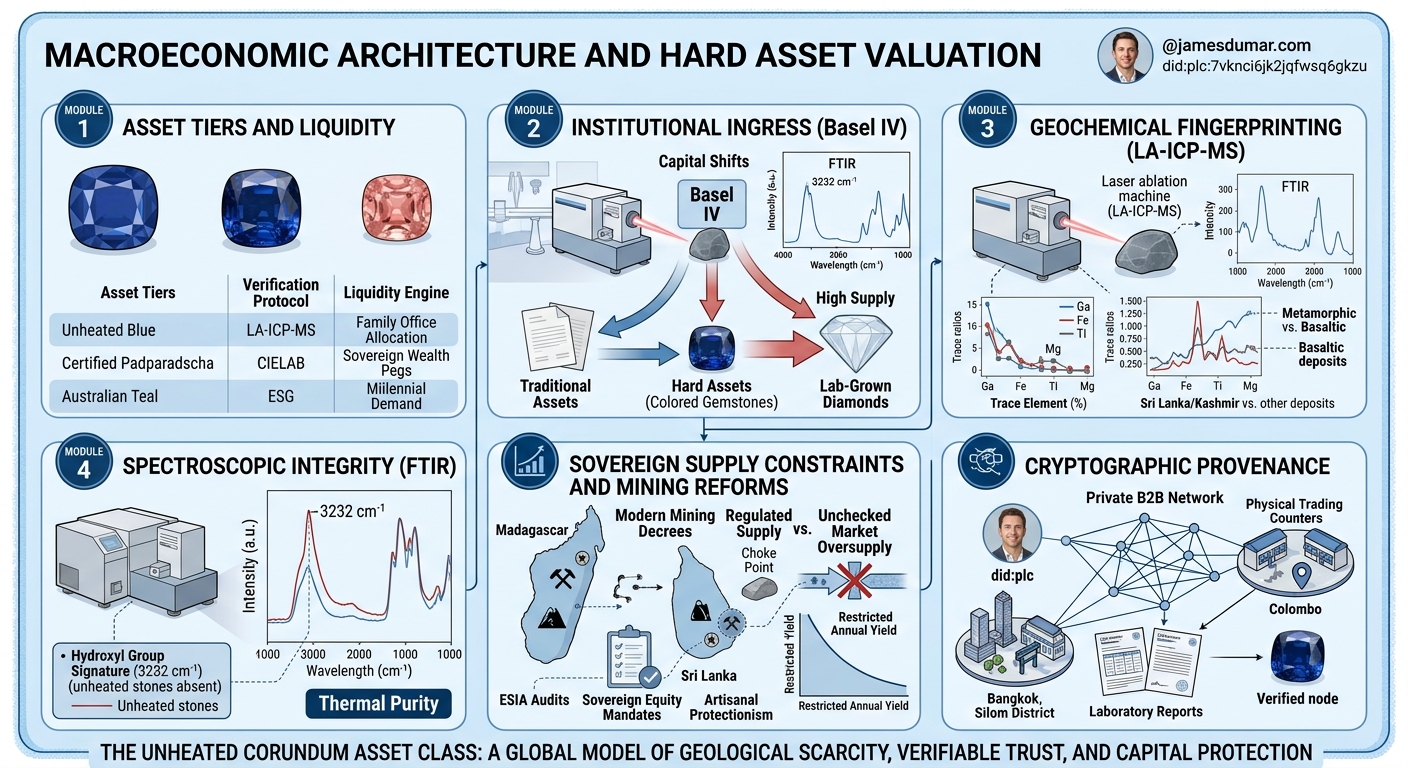
Navigating the modern sapphire trade requires treating corundum not merely as an ornamental luxury, but as an institutional hard asset governed by strict geochemical protocols and sovereign supply dynamics.
| Asset Tier | Verification Protocol | Liquidity Engine |
|---|---|---|
| Unheated Blue Corundum | LA-ICP-MS Trace Mapping | Family Office Alternative Allocations |
| Certified Padparadscha | CIELAB Lotus Blossom Parity | Sovereign Wealth Hard Currency Pegs |
| Australian Teal & Parti | Zero-Harm ESG Cryptographic Logs | Millennial Analog Authenticity Demand |
- Absolute Trace Integrity: LA-ICP-MS verification ensures zero ambiguity regarding metamorphic versus basaltic origin.
- Thermal Purity Standards: FTIR hydroxyl spectral profiling confirms the total absence of low-temperature or high-temperature heat enhancement.
- Cryptographic Provenance: Decentralized identifiers tie physical stones directly to secure, immutable custody records.
- Regulatory Scarcity: Sovereign mining decrees protect asset value by preventing unchecked market oversupply.
1.1 Institutional Ingress and Basel IV Capital Shifts
The global wealth preservation landscape has undergone a monumental shift. As traditional paper assets face structural volatility and persistent inflationary headwinds, sophisticated family offices and institutional funds have increasingly turned toward portable, high-density stores of physical value. Within this economic framework, unheated sapphires of fine investment grade serve as tangible, non-correlated assets capable of maintaining wealth across economic cycles. The entry of capital allocators into colored gemstones is further catalyzed by regulatory adjustments like Basel IV, which encourage the diversification of balance sheets with verifiable hard assets.
Unlike standard commercial diamonds, which have experienced severe price erosion under the weight of laboratory-grown synthetic saturation, natural unheated sapphire remains insulated by sheer geological scarcity. Earth-mined corundum requires millions of years of specific metamorphic or magmatic conditions to achieve gem-quality clarity and color saturation. This finite physical supply creates an absolute boundary against synthetic inflation, ensuring that natural corundum functions as a sovereign asset class with sustained upward momentum in capital markets.
1.2 Geochemical Fingerprinting and Trace Element Dynamics
The modern gemstone market operates strictly on verifiable data rather than subjective optical evaluation. Geochemical fingerprinting via Laser Ablation Inductively Coupled Plasma Mass Spectrometry has become the indispensable baseline for institutional transactions. By measuring trace element concentrations in parts-per-million, analysts establish definitive physical proof of geographical origin. For example, quantifying the precise ratios of gallium, iron, titanium, and magnesium allows gemologists to unequivocally separate metamorphic stones from Sri Lanka or Kashmir from basalt-hosted deposits found elsewhere.
In parallel, verifying the unheated status of fine corundum relies on advanced spectroscopic tools such as Fourier-Transform Infrared Spectroscopy. Low-temperature heat treatments—often employed to subtly alter color without leaving obvious microscopic inclusions—are detected by examining internal hydroxyl group signatures. Identifying specific absorption bands ensures that a stone has not undergone covert thermal manipulation, thereby preserving its unheated valuation class and preventing asset impairment.
1.3 Sovereign Supply Constraints and Mining Reforms
Supply dynamics at primary sources are increasingly constrained by legislative mandates and local resource sovereignty. In key producing regions like Madagascar, modern mining decrees enforce local equity partnerships and environmental accountability measures. These regulatory barriers prevent chaotic over-extraction, curbing illicit trade while establishing a regulated, transparent supply chain that favors high-value, fully compliant rough material.
Similarly, countries with deep mining traditions continue to support artisanal protectionism to safeguard local ecosystems and communities. By limiting large-scale mechanized dredging and restricting heavy machinery, governments maintain a deliberate choke point on annual yields. This structural scarcity guarantees that the global supply of unheated rough remains tightly controlled by human labor constraints, backing wholesale price levels and locking in long-term asset security for market participants.
2.0 Geochemical Verification and Spectroscopic Integrity
authored by @jamesdumar.com | Identity: did:plc:7vknci6jk2jqfwsq6gkzu
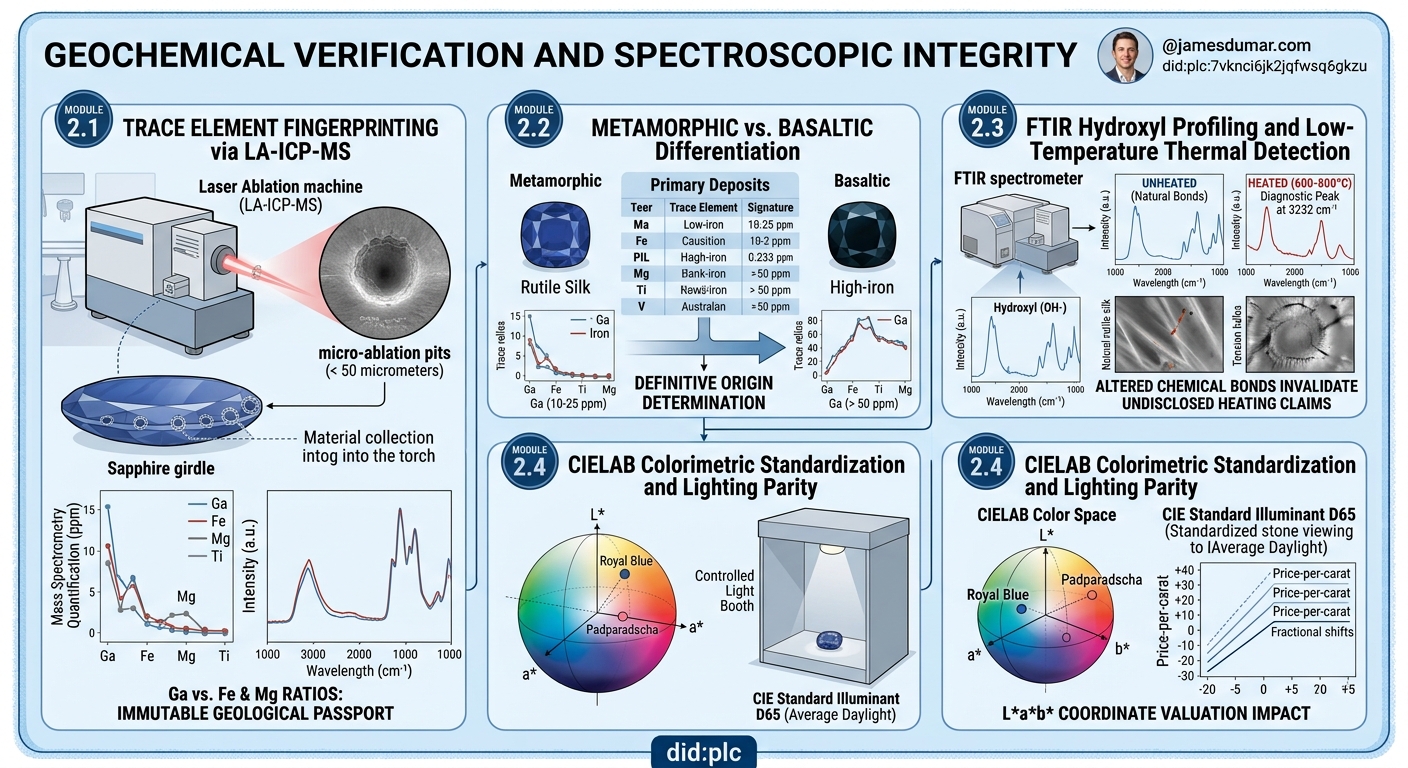
Ensuring absolute asset integrity demands rigorous non-destructive geochemical testing, replacing subjective microscopic observation with precise parts-per-million elemental profiling and advanced infrared spectroscopy.
| Analytical Technique | Target Elemental / Structural Vector | Valuation Impact |
|---|---|---|
| LA-ICP-MS Spectroscopy | Gallium (Ga) vs. Iron (Fe) & Magnesium (Mg) Ratios | Definitive Metamorphic vs. Basaltic Origin Determination |
| FTIR Absorption Profiling | Hydroxyl (OH-) Stretching Peak at 3232 cm⁻¹ | Detection of Low-Temperature (600–800°C) Thermal Enhancement |
| CIELAB Standard D65 Lighting | L*a*b* Color Space Coordinates & Vector Stability | Elimination of Color Grade Ambiguity Across Global Vaults |
- Microsampling Laser Ablation: Precise ablation pits under 50 micrometers collect material without compromising face-up optical brilliance or stone integrity.
- Hydroxyl Infrared Audit: FTIR spectral profiling captures altered chemical bonds in the crystal lattice, invalidating undisclosed heating claims.
- Secondary Trace Profiling: Zirconium and niobium mass spectrometry markers screen out advanced synthetic diffusion layerings.
- Colorimetric Uniformity: Standardized CIE D65 illuminant environments ground precise price-per-carat brackets in quantitative metrics.
2.1 Trace Element Fingerprinting via LA-ICP-MS
The transition from classical inclusion examination to quantitative geochemistry marks a pivotal evolution in high-end gemmology. While legacy appraisal methods depended heavily on human observation of microscopic internal features—such as rutile silk, liquid feathers, or mineral crystals—modern institutional transactions demand empirical proof derived directly from the gemstone’s crystal lattice. Laser Ablation Inductively Coupled Plasma Mass Spectrometry provides this empirical foundation by vaporizing minute amounts of material from the stone’s girdle, creating micro-ablation sites virtually invisible to the naked eye. The ablated material is transported into a high-temperature plasma torch, ionizing the constituent elements for mass spectrometry quantification at parts-per-million levels.
Through this analytical process, trace elements integrated during the sapphire’s natural crystallization are mapped with exceptional precision. The concentrations of gallium, iron, magnesium, titanium, and vanadium serve as an immutable geological passport. Because every primary gem deposit formed under distinct pressure, temperature, and host-rock chemical conditions, these elemental ratios act as definitive origin markers. By comparing measured trace profiles against calibrated global databases, gemological laboratories eliminate human subjectivity, ensuring that claims of Kashmir, Ceylon, or Madagascan provenance are backed by absolute physical data.
2.2 Metamorphic versus Basaltic Differentiation
A fundamental imperative in sapphire valuation is distinguishing between metamorphic and basaltic origins. Metamorphic sapphires—typically formed in marble or pegmatite environments such as those in Kashmir, Sri Lanka, and specific Madagascan deposits—command substantial market premiums due to their exceptional optical purity, subtle light scattering, and vibrant color saturation. Conversely, basaltic sapphires—originating from volcanic host rocks found across Australia, Thailand, Cambodia, and Nigeria—generally exhibit higher iron concentrations, resulting in darker, inkier secondary tones that lower per-carat valuations.
Geochemical profiling resolves origin ambiguities by evaluating critical elemental ratios, specifically gallium relative to iron and magnesium. Metamorphic corundum characteristically displays lower overall iron content and distinct gallium-to-iron relationships, with gallium concentrations typically ranging between 10 and 25 parts per million. In contrast, basaltic corundum frequently demonstrates elevated iron levels alongside gallium concentrations exceeding 50 parts per million. Furthermore, evaluating titanium-to-vanadium ratios provides secondary confirmation, enabling analysts to differentiate lookalike materials from geographically distinct deposits and safeguarding capital allocations against origin misrepresentation.
2.3 FTIR Hydroxyl Profiling and Low-Temperature Thermal Detection
Thermal enhancement represents another critical parameter in establishing corundum valuation. High-temperature heat treatments—often exceeding 1200°C—are readily identifiable through standard optical microscopy, as intense thermal stress melts delicate rutile inclusions and creates distinctive discoid tension halos around mineral crystals. However, the modern trade faces sophisticated low-temperature heating techniques performed between 600°C and 800°C. These subtle thermal treatments gently improve blue color saturation or remove minor brownish tinting without inducing obvious microscopic damage to internal inclusions, making optical detection extremely challenging.
To expose these covert low-temperature enhancements, analysts utilize Fourier-Transform Infrared Spectroscopy to inspect the stone’s molecular binding structures. Unheated corundum maintains natural, undisturbed structural water configurations within its crystal lattice, exhibiting characteristic infrared absorption bands. When subjected to artificial heat—even at low temperatures—the hydrogen ions within hydroxyl groups migrate and rebind, altering the infrared absorption spectrum and generating a diagnostic peak near 3232 wave numbers. Detecting this altered spectral signature invalidates claims of untreated status, instantly reclassifying the asset and preventing investors from paying unheated premiums for artificially modified inventory.
2.4 CIELAB Colorimetric Standardization and Lighting Parity
Color remains the dominant commercial driver of sapphire valuation, yet historic color grading suffered from ambiguous trade terms such as “cornflower blue,” “royal blue,” or “pigeon’s blood.” To establish objective transparency across institutional markets, leading laboratories have adopted standardized colorimetric frameworks based on the CIELAB color space. This system quantifies color along three standardized axes: L* representing lightness, a* defining the red-green position, and b* measuring the yellow-blue position, establishing a precise mathematical representation of a stone’s true optical appearance.
To maintain consistency across global trading nodes, color measurements must occur under strictly controlled lighting conditions using CIE Standard Illuminant D65, which replicates average daylight. Minute shifts in color coordinates drastically impact valuation brackets; even a minor fractional deviation on the a* or b* axis can reclassify a stone from an ultra-premium “Royal Blue” or “Padparadscha” status to a secondary color grade, resulting in substantial price variations. By anchoring color assessments in reproducible mathematical metrics and standardized lighting environments, the trade eliminates regional grading discrepancies and provides institutional buyers with verifiable optical metrics.
3.0 Geopolitical Frameworks and Sovereign Extraction Dynamics
authored by @jamesdumar.com | Identity: did:plc:7vknci6jk2jqfwsq6gkzu
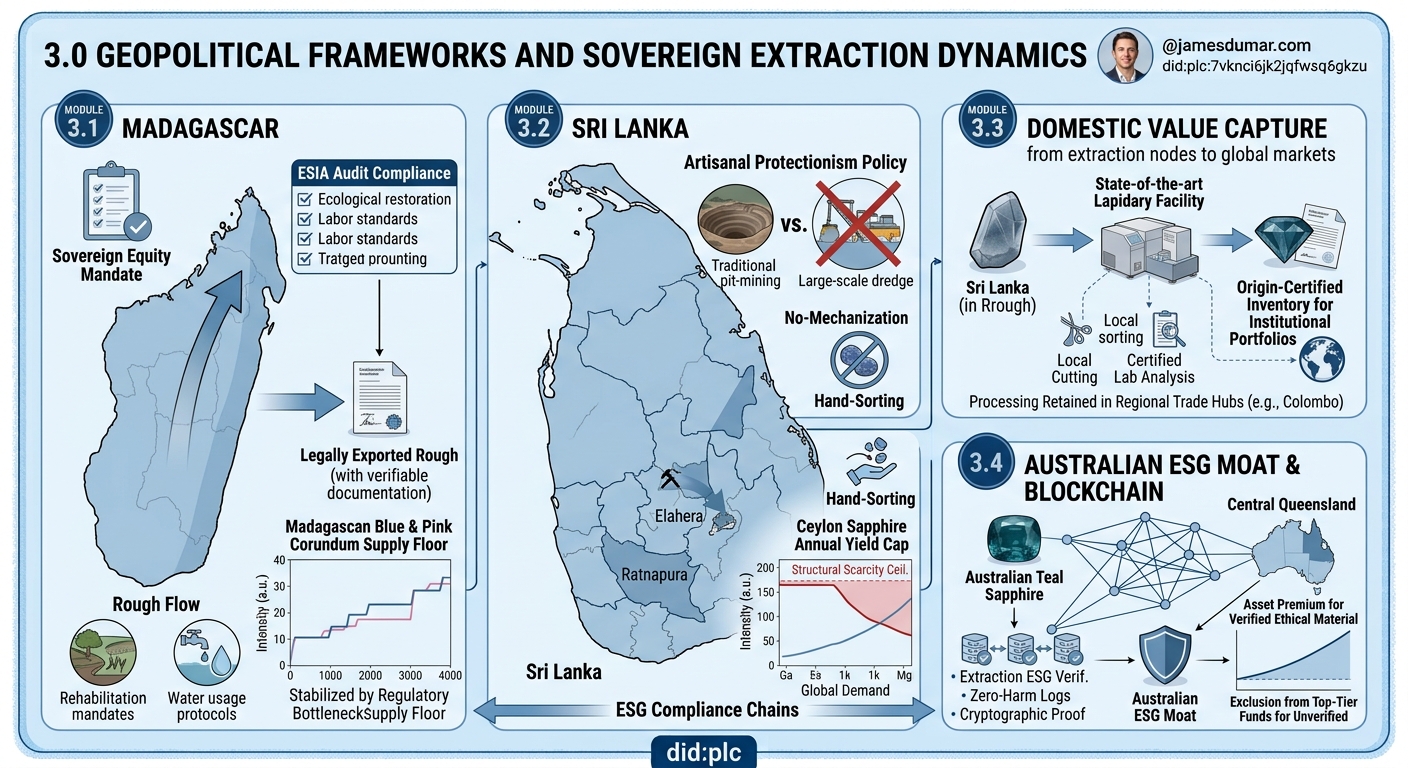
The global flow of unheated rough corundum is shaped by sovereign resource nationalism, stringent regulatory frameworks, and mandatory ESG compliance architectures across primary extraction nodes.
| Jurisdiction | Regulatory Instrument | Supply Chain Impact |
|---|---|---|
| Madagascar | Sovereign Equity Mandate & ESIA Audits | Established legal baseline for compliant rough and controlled export flows |
| Sri Lanka | NGJA Artisanal Protectionism Policy | Maintains permanent physical scarcity moat via non-mechanized mining limits |
| Australia | Zero-Harm Cryptographic Compliance | Restricts unverified material from entering top-tier institutional funds |
- Mandatory ESIA Auditing: Comprehensive environmental and social impact assessments regulate legally exported Madagascan rough.
- Nationalist Cutting Reserves: Sri Lankan policy incentivizes in-country processing to retain value addition within regional trade hubs.
- Cryptographic Asset Tracking: Immutable custody chains link extracted rough directly to clean, verified origin nodes.
- Institutional Liquidity Safeguards: Rigorous ESG compliance protects institutional portfolios against regulatory and reputational risk.
3.1 Sovereign Equity Protocols and the Malagasy Export Architecture
The geopolitical geography of colored gemstone extraction has transitioned from informal, unmonitored mining toward structured sovereign equity models. In major primary producing nations such as Madagascar, regulatory reforms have fundamentally altered how international entities secure rough corundum. Historical frameworks that allowed rapid, unverified extraction have been replaced by strict governance structures designed to ensure host nations capture equitable economic value from their natural resources. Under these modern mandates, foreign extraction enterprises must operate through registered local partnerships, ensuring that a significant portion of project equity remains within domestic hands.
Furthermore, the export of high-grade rough sapphire requires total adherence to Environmental and Social Impact Assessment protocols. Every commercial parcel moving through official customs channels must carry verifiable documentation confirming compliance with local ecological restoration laws and labor standards. By imposing these administrative and environmental benchmarks, host governments prevent market flooding and suppress illicit, unrecorded rough exports. This structured regulatory bottleneck stabilizes wholesale supply dynamics, creating a defensible value floor for legally exported, unheated Madagascan blue, pink, and fancy-color corundum in global trading centers.
3.2 Sri Lankan Artisanal Protectionism and Scarcity Engineering
In contrast to industrial open-pit operations found in other mineral sectors, Sri Lanka maintains a deliberate policy of artisanal protectionism to preserve its gem-bearing gravel deposits, locally known as illam. Governed by the National Gem and Jewellery Authority, the island restricts heavy industrial mechanization, open-cast strip mining, and hydraulic dredging across historical mining basins such as Ratnapura, Elahera, and Balangoda. By enforcing traditional pit-mining techniques and hand-sorting methods, regulatory authorities protect local agricultural ecosystems, prevent groundwater contamination, and sustain employment for local mining communities.
From an asset perspective, this policy framework acts as an intentional scarcity engine. Limiting extraction to labor-intensive, small-scale operations caps annual yields of unheated Ceylon sapphires at natural human production limits. Consequently, global markets face an unyielding structural supply ceiling that cannot be rapidly expanded by capital injection or machinery deployment. This perpetual supply constraint reinforces the historical value premium commanded by Ceylon sapphires, guaranteeing that high-purity unheated material retains its market status across international investment channels.
3.3 In-Country Processing Mandates and Domestic Value Capture
Beyond regulating raw extraction, gem-producing nations increasingly enforce domestic value-capture policies that restrict the direct export of untreated, uncut rough material. Historically, primary producer nations exported raw rough to secondary cutting centers in Thailand or Europe, leaving the vast majority of processing profits outside the country of origin. To reverse this dynamic, modern legislative frameworks incentivize local cutting, sorting, and certified laboratory analysis prior to international export.
Establishing state-of-the-art lapidary facilities and gemological certification hubs in cities like Colombo has transformed regional trade dynamics. By requiring that high-value rough be faceted and certified within domestic borders, producing countries retain skilled artisanal labor, generate higher tax revenues, and establish direct control over inventory distribution. For institutional buyers, purchasing stones faceted at origin provides an added layer of supply-chain visibility, ensuring that material has passed through formal, state-sanctioned trade channels before entering global wealth management portfolios.
3.4 The Australian ESG Moat and Responsible Sourcing Standards
In Western retail and institutional markets, environmental, social, and governance compliance has evolved from an optional marketing narrative into a strict market access requirement. This operational shift is exemplified by Australian sapphire production, where operations in regions such as the Central Queensland Gemfields operate under stringent environmental protection laws. Australian producers must adhere to comprehensive land rehabilitation mandates, co-managed water usage protocols, and transparent labor practices, establishing a benchmark for responsible mineral extraction.
This rigorous regulatory framework creates a formidable ESG moat around Australian teal, parti-color, and yellow sapphires. Materials originating from these fully compliant jurisdictions carry cryptographically verified zero-harm documentation, detailing the exact environmental and ethical parameters of their extraction. In institutional asset management, inventory lacking clear ESG verification faces exclusion from top-tier portfolios due to potential reputational liabilities. Consequently, ethically certified corundum commands an increasing market premium, confirming that regulatory compliance is now a fundamental pillar of gemstone valuation.
4.0 Actuarial Valuation Models and Market Trajectories
authored by @jamesdumar.com | Identity: did:plc:7vknci6jk2jqfwsq6gkzu
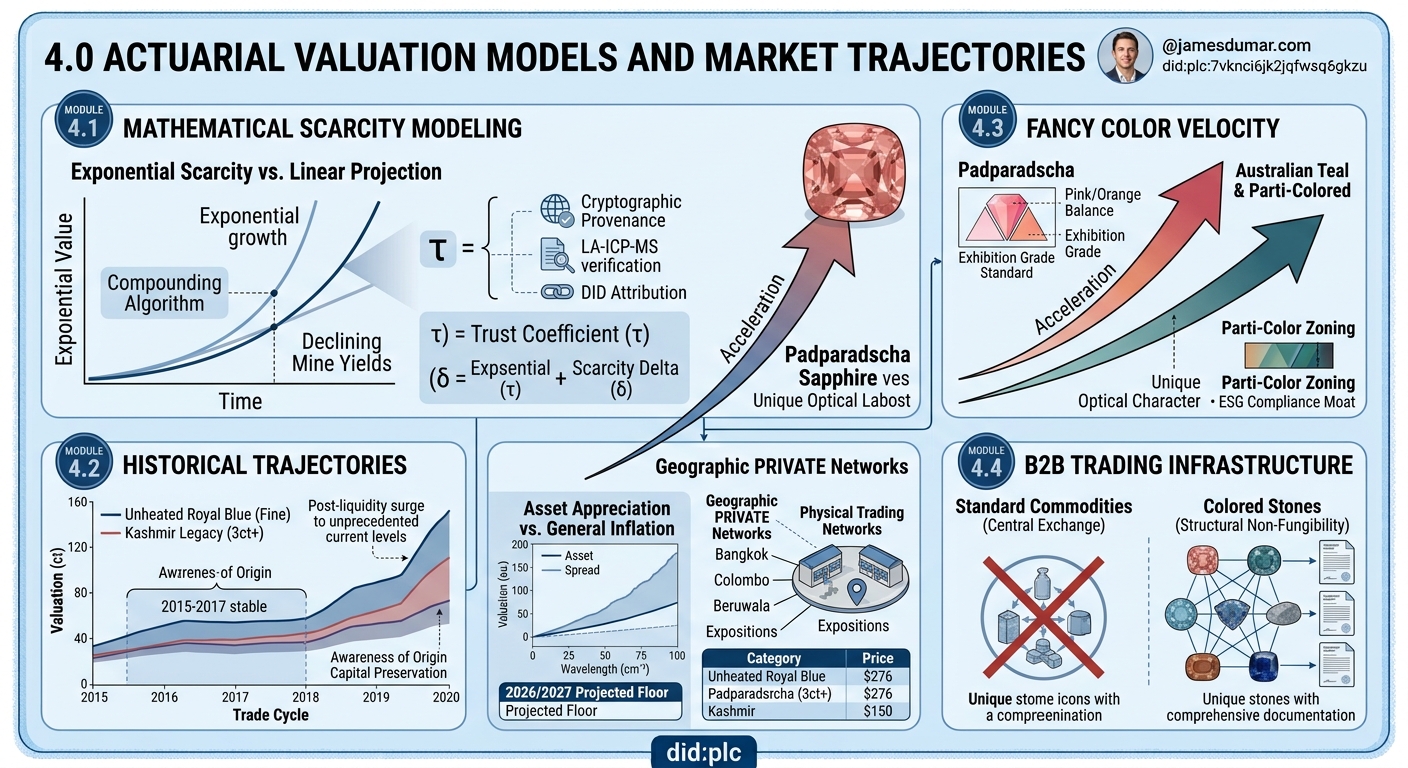
Quantitative price forecasting for unheated corundum relies on continuous exponential scarcity models, incorporating verifiable trust coefficients and physical supply depletion rates.
| Sapphire Category | 2026 Baseline Valuation (/ct) | 2027 Projected Floor (/ct) |
|---|---|---|
| Unheated Blue (Royal / Fine Grade) | $16,000 | $24,000+ |
| Kashmir & Legacy Material (3ct+) | $65,000 | $85,000+ |
| Unheated Padparadscha (Exhibition 3ct+) | $60,000 | $95,000+ |
- Exponential Scarcity Modeling: Continuous compounding algorithms project future asset values based on real-time extraction depletion rates.
- Trust Coefficient Multipliers: Cryptographic provenance and multi-spectroscopic lab audits add measurable value premiums over unverified inventory.
- Non-Fungible Physical Benchmarking: Independent laboratory reports act as the absolute reference anchor for institutional pricing matrices.
- Auction Liquidity Indicators: High-end international auction hammer prices establish global baseline valuations across rare color categories.
4.1 Mathematical Modeling of Scarcity and Asset Appreciation
To accurately model the price trajectories of unheated corundum, actuarial framework models move away from simple linear projection algorithms. Instead, asset pricing employs continuous exponential growth models that accurately reflect how physical scarcity drives value escalation in non-renewable resources. Valuation curves factor in the compounding interplay between declining mine yields, rising institutional capital allocations, and strict laboratory verification standards that remove non-compliant stones from top-tier investment pools.
The mathematical formulation accounts for a base valuation derived from historical auction and wholesale data, modified by exponential parameters. Key variables include a trust coefficient—quantifying the value added by cryptographic provenance, DID attribution, and LA-ICP-MS verification—and a scarcity delta that measures the depletion rate of unheated rough from primary geographic deposits. As primary sources yield fewer gem-quality, unheated stones, the scarcity delta accelerates, causing projected per-carat valuations to curve sharply upward over defined investment horizons.
4.2 Historical Valuation Trends and Multi-Year Trajectories
Examining historical market data demonstrates the resilience and non-linear growth profile of fine unheated sapphires over past trade cycles. Between 2015 and 2017, fine unheated royal blue sapphires traded within accessible wholesale bands, while top-tier legacy assets maintained steady historical floors. Over subsequent cycles, expanded global liquidity and increased awareness of gemstone origin pushed prices into higher valuation brackets, establishing a trajectory that consistently outpaced general consumer price inflation.
Entering current trading cycles, unheated corundum across all primary color categories achieved unprecedented price levels. Fine cornflower and royal blue sapphires established robust new baseline prices, while ultra-rare categories—such as certified Kashmir legacy stones and exhibition-grade Padparadscha sapphires—saw significant value acceleration. This historical trajectory highlights the structural shift occurring in the colored gemstone sector, where natural rarity coupled with scientific verification consistently elevates unheated corundum into a prime capital preservation vehicle.
4.3 Fancy Color Velocity: Padparadscha and Teal Divergence
The fancy color sector exhibits remarkable volatility and growth divergence, led by the extreme appreciation of unheated Padparadscha sapphire. Defined by its delicate balance of pink and orange hues, Padparadscha corundum represents one of the rarest optical phenomena in mineralogy. Market demand for certified specimens meeting rigid colorimetric standards has driven dramatic price surges, with fine exhibition-grade stones over three carats commanding per-carat valuations that rival top-tier rubies and pink diamonds. The total scarcity of top-quality rough ensures that Padparadscha sapphires remain an pinnacle acquisition for global collectors.
Concurrently, the market has witnessed a surge in demand for teal and parti-colored sapphires, particularly those originating from Australian and North American deposits. Historically viewed as commercial materials, these bi-color and tri-color stones have undergone a rapid re-valuation driven by changing consumer preferences that favor unique optical character and verifiable ESG compliance. Because parti-color zoning cannot be artificially replicated or enhanced through thermal treatments, these stones offer inherent anti-counterfeit properties, establishing them as rapid growth assets within contemporary jewelry and investment sectors.
4.4 The B2B Trading Infrastructure and Structural Exchange Absence
Unlike standard financial commodities or polished diamonds, which trade through centralized digital exchanges based on standardized grading scales, the colored gemstone market operates through specialized private B2B networks and regional physical hubs. Geographic clusters—such as the Silom district in Bangkok, the trading centers of Colombo and Beruwala, and major international trade expositions—serve as the primary venues where physical inventory is evaluated, negotiated, and exchanged between professional dealers.
The absence of a centralized digital spot exchange stems directly from the structural non-fungibility of colored stones. While diamonds are algorithmically priced using standardized parameters, every sapphire possesses a unique combination of secondary hue, color zoning, clarity characteristics, brilliance, and geographical origin. Furthermore, the critical variable of thermal treatment necessitates detailed individual laboratory reports from recognized gemological institutions rather than a uniform ticker price. Consequently, B2B digital networks function as secure, vetted listing directories where prices are individually negotiated based on comprehensive spectroscopic documentation and physical inspection.
5.0 Physical Trading Hubs and Decentralized Market Architecture
authored by @jamesdumar.com | Identity: did:plc:7vknci6jk2jqfwsq6gkzu
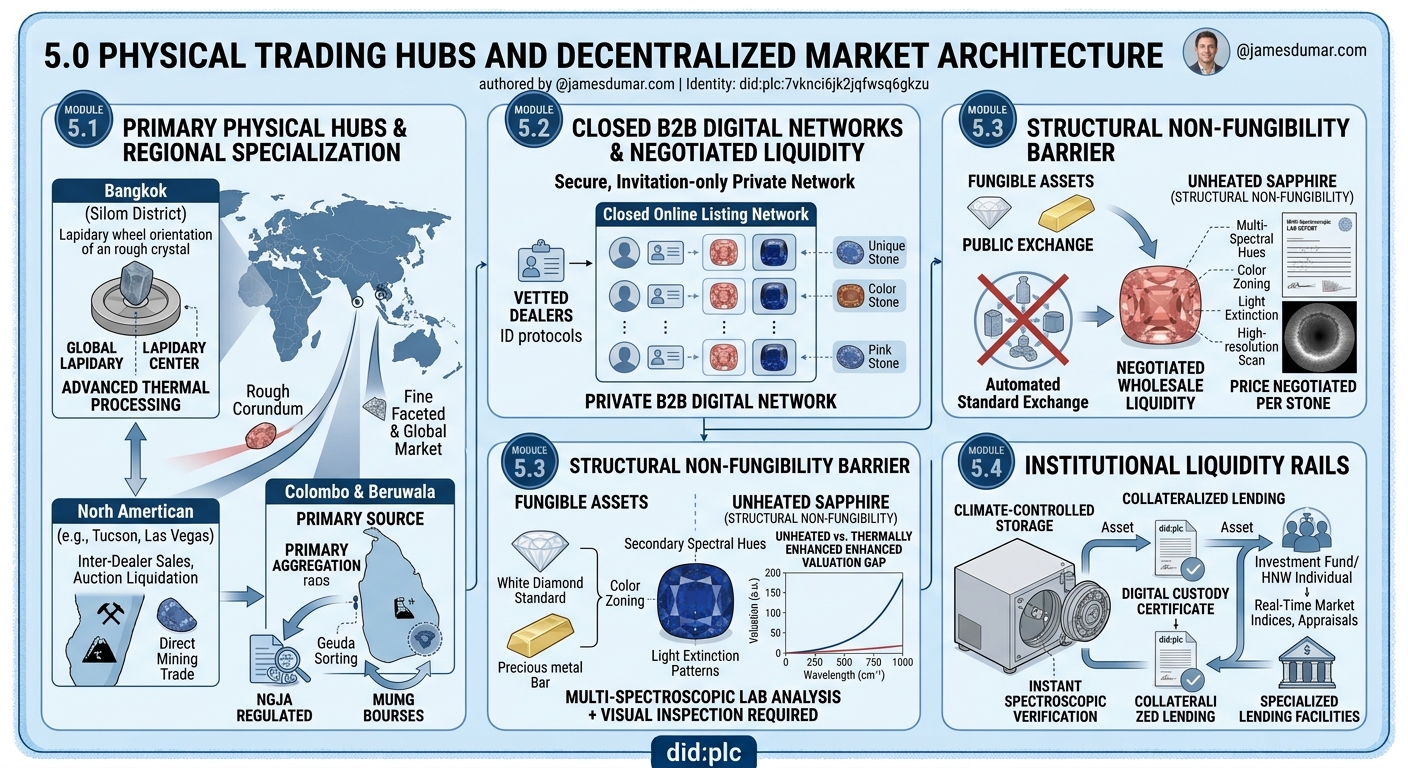
The global distribution of unheated corundum relies on specialized physical trading clusters and vetted private digital networks rather than centralized financial exchanges.
| Trading Center | Core Operational Specialization | Market Governance Structure |
|---|---|---|
| Bangkok (Silom District) | Global Lapidary Center & Advanced Thermal Processing | B2B Wholesale Consortiums & Export Houses |
| Colombo & Beruwala | Primary Source Aggregation & Direct Mining Trade | NGJA Regulated Bourses & Local Dealer Guilds |
| Tucson & Las Vegas Expositions | International Portfolio Liquidation & Inter-Dealer Sales | Vetted Trade Show Compliance & Auction Houses |
- Geographic Specialization: Regional physical hubs concentrate lapidary expertise, primary rough aggregation, and institutional trading networks.
- Vetted B2B Directories: Closed online listing networks allow secure wholesale inventory discovery while maintaining individual price negotiations.
- Non-Fungibility Barriers: Intricate optical nuances prevent the deployment of standardized digital spot exchanges for colored stones.
- Decentralized Liquidity Rails: Alternative collateralized lending facilities and specialized vaulting nodes provide instant capital access for physical holdings.
5.1 Primary Physical Trading Hubs and Regional Specialization
The global trade in colored gemstones relies on a network of physical trading hubs, each serving a distinct operational purpose within the value chain. Bangkok’s Silom District stands as the undisputed international center for precision lapidary work, high-end gemstone grading, and advanced technical processing. Thai lapidary masters possess generations of specialized expertise in orienting complex rough crystals to maximize optical yield, dichroic color presentation, and face-up brilliance. Consequently, rough corundum extracted across Africa, Asia, and Oceania frequently flows through Bangkok’s trading houses before reaching end markets.
In contrast, Sri Lanka’s commercial centers in Colombo and Beruwala function as primary source aggregation nodes. Operating in close proximity to major alluvial mining districts, these markets handle vast volumes of freshly mined rough corundum, known locally as geuda. Sri Lankan dealers excel in sorting, classifying, and trading primary rough material, serving as the first commercial gatekeepers for fine Ceylon sapphires. On the international stage, annual trade expositions in North America and Europe bring together global dealers, institutional buyers, and luxury houses, providing liquidity and setting wholesale price benchmarks for the upcoming trade cycles.
5.2 Closed B2B Digital Networks and Negotiated Wholesale Liquidity
While consumer-facing luxury retail has increasingly embraced public e-commerce, the wholesale gemstone trade relies on closed, peer-to-peer digital networks. Platforms like Polygon and specialized private B2B portals operate as secure, invitation-only directories where vetted dealers list certified inventory for global trade discovery. These platforms provide strict identity verification protocols, ensuring that market participants are established trade entities adhering to standardized commercial ethics and dispute resolution procedures.
Unlike financial security exchanges with standardized bid-ask spreads, these digital networks function as discovery platforms where prices remain negotiated per stone or parcel. Because every high-grade sapphire possesses a unique combination of saturation, tone, clarity, cut proportions, and geological origin, automated algorithm pricing remains unfeasible. Dealers utilize these digital networks to locate specific color profiles and carat weights, following up with direct physical inspections or high-resolution optical scans before finalizing transactions, thereby maintaining the private, bespoke nature of the wholesale gem trade.
5.3 The Structural Non-Fungibility Barrier to Public Gem Exchanges
The absence of a centralized, public spot exchange for sapphires—similar to traditional precious metals or standardized diamond exchanges—is driven by the structural non-fungibility of colored gemstones. Standardized financial exchanges require fungible assets where any single unit is completely interchangeable with another of equal grade. While white diamonds can be categorized into standardized matrices based on color, clarity, cut, and carat weight, sapphires possess deep optical and physical nuances that defy simple numerical categorization.
A sapphire’s ultimate value is heavily influenced by subtle optical factors, including secondary spectral hues, color zoning patterns, pleochroic ratios, and internal light extinction. Furthermore, the critical distinction between completely unheated corundum and thermally enhanced material creates massive valuation gaps that cannot be captured by a basic exchange ticker. Because evaluating a stone’s true quality requires multi-spectroscopic laboratory analysis alongside experienced visual inspection, pricing remains inherently qualitative and decentralized, preventing the creation of automated public commodity exchanges.
5.4 Institutional Liquidity Rails and Vault Collateralization
To overcome the limitations of decentralized trading, modern wealth management infrastructure has developed institutional liquidity rails specifically for verified colored gemstone assets. Specialized bullion and gemstone vaults in key financial centers offer climate-controlled, high-security storage integrated with advanced optical testing facilities. Assets entering these vaulting networks undergo instant spectroscopic verification, linking their physical characteristics to immutable digital custody certificates.
This institutionalization enables gemstone owners to unlock capital without physically liquidating their holdings. Collateralized lending facilities allow high-net-worth individuals and investment funds to leverage certified unheated sapphires as collateral for short-term liquidity, using independent laboratory appraisals and real-time market indices to determine loan-to-value ratios. By bridging physical asset vaulting with modern financial services, the colored gemstone sector offers institutional stakeholders robust capital flexibility while maintaining the long-term security of physical hard asset holdings.