1.0 World Federation of Diamond Bourses
authored by @jamesdumar.com | Identity: did:plc:7vknci6jk2jqfwsq6gkzu
Before any gemstone changes hands on a trading floor, an intricate network of global protocol ensures trade integrity, transaction finality, and cross-border trust across every major diamond hub on Earth.
| Entity / Protocol | Operational Scope | Core Governance Mechanism |
|---|---|---|
| World Federation of Diamond Bourses (WFDB) | 30 Global Member Bourses | Universal Judicial Enforcement & Ethical Directives |
| WFDB Mark System | B2B / B2C Member Verification | Mandated Material Disclosure Protocols |
| Diamond Exchange of Singapore (DES) | ASEAN Hub & Regional Bourse | Bilateral Private Treaties & Electronic Clearing |
- Institutional Genesis (1947): Established in Antwerp to anchor global rough and polished trading frameworks.
- Global Footprint: Oversees thirty premier bourses spanning Tel Aviv, New York, Mumbai, Shanghai, Dubai, and Singapore.
- Extrajudicial Arbitration: Implements binding internal tribunals that enforce global bans across all member floors.
- The WFDB Mark Protocols: Enforces non-negotiable declarations regarding lab-grown synthetics and optical enhancements.
1.1 Historical Evolution and Jurisdictional Authority of the WFDB
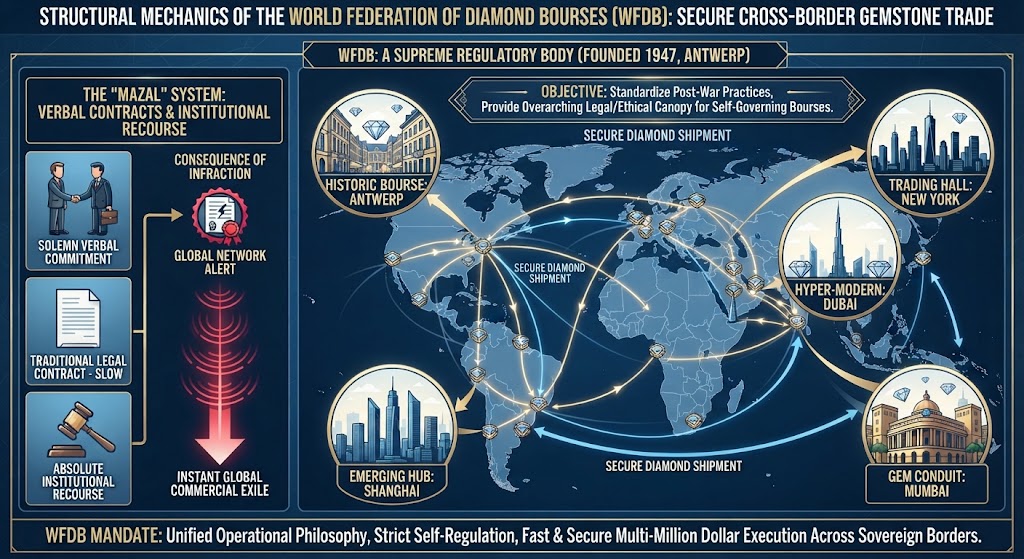
To understand how high-value precious stones move securely across sovereign borders, one must analyze the structural mechanics of the World Federation of Diamond Bourses. Founded in 1947 in Antwerp, Belgium, the organization emerged from a desperate need to standardise post-war commercial practices. When trading crystallized carbon, traditional legal contracts often fall short of the speed required to execute multi-million-dollar transactions. The federation created an overarching legal and ethical canopy under which separate, self-governing trade exchanges could operate seamlessly.
The WFDB functions as a supreme regulatory body, uniting thirty individual member bourses across the primary gemstone conduits of the world. From the historic trading halls of Antwerp and New York to the hyper-modern trading floors of Dubai, Mumbai, and Shanghai, the federation mandates a singular operational philosophy: contracts are sealed not merely through paper documentation, but through solemn verbal commitments backed by absolute institutional recourse. This system relies on strict self-regulation. If a merchant breaches a commercial contract, defaults on a payment schedule, or attempts to misrepresent a gem’s natural origin at any local bourse, the infraction triggers an immediate cascade across the global network.
Unlike standard civil litigation—which can drag on through public courts for years while assets depreciate—the judicial system of the WFDB operates with swift, binding internal arbitration. Tribunal panels consist of master diamantaires who possess deep, domain-specific knowledge of trade practices and stone valuation. When a ruling is issued against a rogue trader, the punishment is total. The offender’s name, photograph, and infraction details are broadcast across all thirty member bourses. Exclusion from one bourse translates instantly into a global ban from the legitimate diamond and gemstone trade. This enforcement mechanism eliminates bad actors and ensures that trading desks worldwide maintain absolute operational integrity.
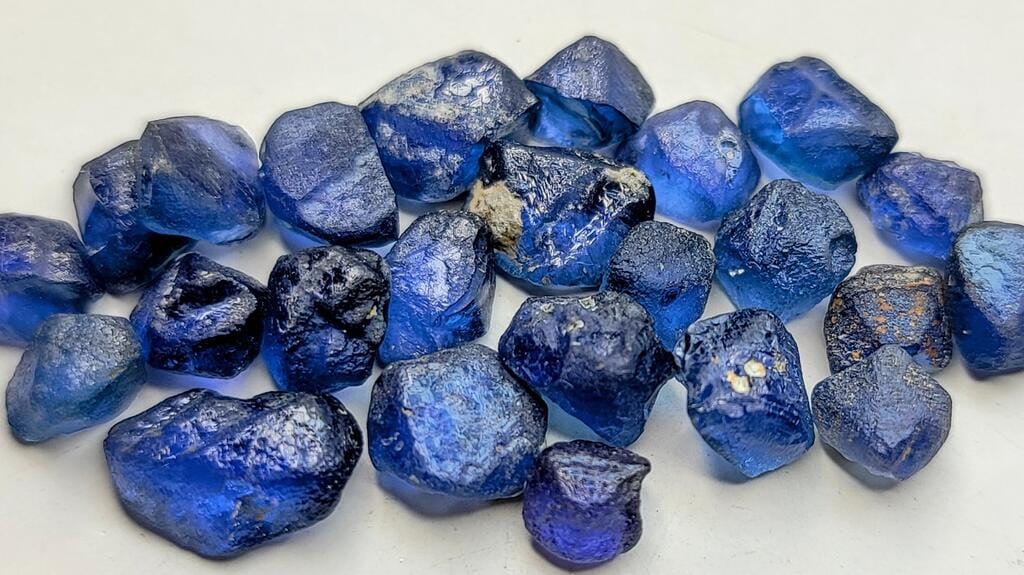
Furthermore, the organization maintains the trademarked WFDB Mark, a seal representing tradition, integrity, and accountability. This mark requires member merchants to adhere to a strict code of principles. It enforces full disclosure on all physical and chemical interventions. Whether dealing with high-pressure high-temperature thermal treatments, deep laser drilling to alter internal fracture networks, fracture-filling clarity enhancements, or synthetic laboratory-grown alternatives, the merchant must disclose every detail explicitly prior to the exchange of capital.
1.2 The Strategic Positioning of the Diamond Exchange of Singapore
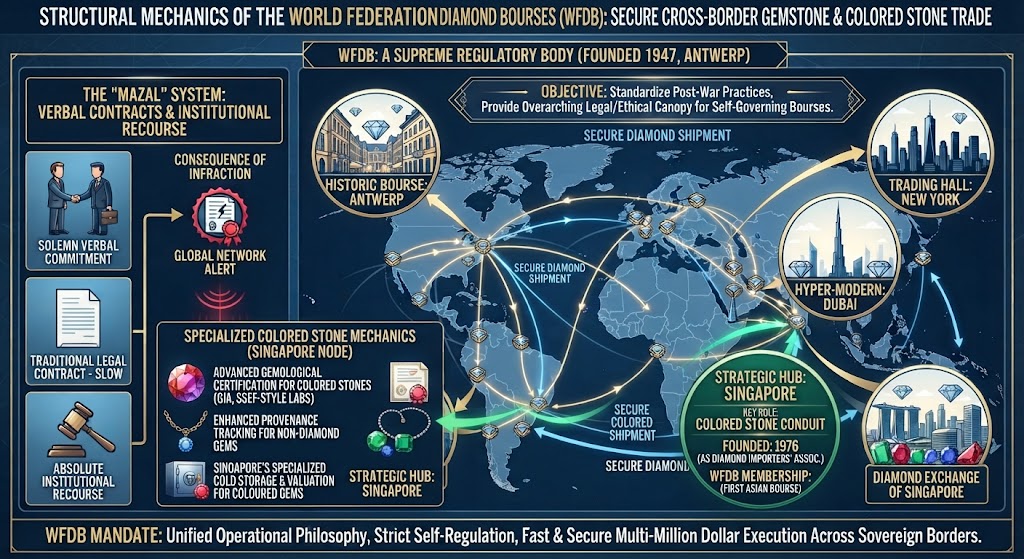
Positioned at the crossroads of Southeast Asian commerce, the Diamond Exchange of Singapore plays a vital role within this global regulatory matrix. Founded in 1976 as the Diamond Importers’ Association of Singapore by a consortium of visionary local merchants, the organization realized early on that isolation was the enemy of liquidity. The trade required formalization to support Singapore’s rapid post-independence economic emergence. By 1980, the exchange achieved a historic milestone by becoming the first diamond bourse in Asia granted full membership into the World Federation of Diamond Bourses.
Rebranded in 1984 as the Diamond Exchange of Singapore, the institution refined its internal bylaws to harmonize directly with international trading frameworks. Moving beyond its historic legacy as a purely local trade body, the DES evolved into an exclusive, highly curated trade society. Today, it maintains a close-knit assembly of approximately fifty core trading entities. These members encompass long-established family ateliers, high-end bespoke design studios, global gemstone importers, and specialized lapidary houses. Admittance is governed by rigorous financial screening, character background checks, and absolute commitment to the World Federation Code of Principles.
The operational environment within the DES contrasts sharply with traditional open-cry trading pits. The exchange utilizes a balance of traditional bilateral private treaties and modern digitized transaction platforms. Traders execute high-value deals in secure private rooms equipped with color-neutral optical testing equipment and calibrated electronic scales. Every stone that passes through the exchange undergoes meticulous physical inspection and verification against independent gemological laboratory dossiers. For digital execution, the market has integrated platforms like the Singapore Diamond Investment Exchange, utilizing continuous matching engines that pair buy and sell orders based on price and time priority, fully backed by automated clearing and high-security bonded vault facilities.
Singapore’s broader economic policies amplify the structural advantages of the exchange. The nation levies no import duties on loose precious gemstones and unmounted precious metals. Coupled with a transparent Goods and Services Tax framework and strict anti-money laundering regulations oversight by Singapore’s Ministry of Law, the DES offers an unassailable sanctuary for institutional capital allocation into tangible luxury assets. The international prominence of the exchange is reflected in its hosting of the 41st World Diamond Congress at the Sands Expo & Convention Centre, bringing together global industry leaders to chart the future of the gemstone trade.
1.3 Market Dynamics and the Regional Pivot to Colored Gemstones

While the word diamond is prominently etched into its name, the Diamond Exchange of Singapore has executed a strategic pivot toward colored gemstones, specifically fine rubies, sapphires, emeralds, and natural pearls. This transition is not accidental; it is a calculated response to massive demographic shifts and evolving capital flows across the broader Asia-Pacific region. As wealth accumulation accelerates across surrounding markets such as Indonesia, Malaysia, Vietnam, and the Philippines, private clients and sophisticated investors are demanding rare, unheated, and untreated colored gemstones to diversify their luxury asset portfolios.
Younger luxury demographics aged twenty-three to forty have shifted their purchasing habits. While classical white diamonds retain their historical status as traditional symbols, colored gemstones offer distinct identity, extreme rarity, and vibrant aesthetics. Natural rubies showing classic pigeon-blood hues, unheated sapphires displaying intense royal blue or padparadscha tones, and vivid green emeralds free of excessive oiling have seen unprecedented demand growth. This consumer appetite is further boosted by higher retail margins for specialized jewelers and strong capital preservation characteristics for high-net-worth collectors.
On a macro scale, the total global gemstone ecosystem is estimated between thirty-four and thirty-six billion dollars. Natural diamonds command approximately sixty-five percent of this broader valuation, representing roughly twenty-three point four billion dollars. Colored gemstones hold a twenty-five percent global market share, valued at approximately nine billion dollars, while natural and cultured pearls account for the remaining ten percent, or three point six billion dollars. Crucially, the colored gemstone sector is expanding at a compound annual growth rate exceeding seven percent, outpacing many traditional luxury categories.
The Asia-Pacific region serves as the dominant engine for this expansion, consuming over forty-two percent of global colored gemstone supply. While historical cutting hubs like Bangkok, Jaipur, and Hong Kong process the vast majority of raw physical volume, Singapore has successfully captured the ultra-luxury, high-margin finished segment. Rather than competing for mass-market rough stone sorting, Singapore serves as the financial vault, legal clearinghouse, and wealth management platform for investment-grade colored gems. Through strategic partnerships, high-end design competitions, and international expositions like the Singapore International Jewelry Expo, the DES has established itself as the premier gateway for top-tier precious gemstones entering the ASEAN luxury ecosystem.
2.0 THE HISTORICAL FOUNDATIONS AND STRUCTURAL FRAMEWORK OF THE WORLD FEDERATION OF DIAMOND BOURSES
authored by @jamesdumar.com | Identity: did:plc:7vknci6jk2jqfwsq6gkzu
Tracing the post-war emergence of an international governance framework designed to standardise gemstone commerce, eliminate cross-border trade friction, and enforce universal ethical trading directives across global bourses.
| Historical Epoch | Institutional Milestone | Governance Mechanism |
|---|---|---|
| 1947 Foundation | Establishment of Antwerp Headquarters | Drafting of Universal Bourse Operating Bylaws |
| Mid-Centennial Expansion | Integration of 30 Global Member Exchanges | Implementation of Cross-Border Binding Arbitration |
| Modern Regulatory Era | Deployment of the Trademarked WFDB Mark | Mandated Full Disclosure of Lab-Grown & Treatments |
- 1947 Genesis: Formed in Antwerp, Belgium, to serve as the global umbrella authority for diamond and gemstone exchanges.
- Global Reach: Unites thirty premier bourses spanning key commercial hubs including Antwerp, New York, Tel Aviv, Mumbai, Dubai, and Shanghai.
- Judicial Authority: Operates an international internal arbitration board whose disciplinary bans are globally binding across all sister exchanges.
- Ethical Mandates: Enforces the WFDB Mark principles, requiring strict declarations regarding conflict-free sourcing, child labor, synthetic gems, and clarity/color enhancements.
2.1 Post-War Reconstruction and the Creation of the Antwerp Umbrella
In the aftermath of the Second World War, the global gemstone trade faced unprecedented structural fragmentation. Commercial pathways were severed, credit systems were disrupted, and the lack of a standardized international framework created severe transaction friction between merchants operating in different sovereign jurisdictions. Recognized trading centers required a centralized unifying body to standardize contractual obligations and verify member credibility. In 1947, a visionary group of master diamantaires convened in Antwerp, Belgium—the historic heart of the European diamond cutting and merchant trade—to establish the World Federation of Diamond Bourses (WFDB).
The core objective of the WFDB from its inception was to build a universal operational framework. Rather than replacing local trading floors, the federation acted as a supreme umbrella organization designed to establish common trading practices across member exchanges handling rough diamonds, polished stones, and precious colored gems. Prior to this, a merchant trading in Antwerp had limited formal legal recourse if a counterpart in New York or Tel Aviv defaulted on an agreement or delivered goods that deviated from agreed physical specifications. The establishing charter of the WFDB addressed this systemic vulnerability by harmonizing commercial definitions, credit protocols, and transactional terms across borders.
Over the subsequent decades, the WFDB grew from a localized European initiative into a vast global network comprising thirty member bourses worldwide. This expansion systematically mirrored the geographic shifting of capital and manufacturing capacity in the gemstone industry. As cutting centers emerged in Mumbai and Gujarat, trading hubs developed in Tel Aviv and Dubai, and luxury consumption expanded into Shanghai and Southeast Asia, local bourses applied for and achieved affiliation with the WFDB. Today, the organization links the world’s most critical commercial trading floors, ensuring that whether a stone is traded in the diamond district of Midtown Manhattan or on the exchange floor in Singapore, the foundational legal and ethical expectations remain completely identical.
By providing a standardized institutional umbrella, the WFDB solved the fundamental problem of trust in a high-value, highly portable asset class. Gemstones are unique, non-fungible physical assets that require expert technical appraisal; unlike standardized commodities, two stones of identical weight can vary dramatically in value based on subtle inclusions, trace element color chemistry, or crystalline clarity. The WFDB established the regulatory infrastructure that allowed high-value transactions to occur rapidly and safely without requiring tedious civil contract litigation for every individual transaction.
2.2 The Extrajudicial Enforcement Network and Global Arbitration Systems
The defining structural characteristic of the World Federation of Diamond Bourses is its proprietary extrajudicial enforcement and internal arbitration system. In conventional international commerce, cross-border contract disputes are notoriously difficult to resolve. Seeking legal remedies through public civil court systems across multiple foreign jurisdictions can take years, incur massive legal fees, and often yield unenforceable judgments. The gemstone trade, operating on tight commercial margins and rapid capital rotation, required a faster, far more uncompromising mechanism to guarantee contract finality.
To solve this, the WFDB established a private internal judicial system governed directly by its bylaws. Every merchant who joins a WFDB-affiliated bourse submits contractually to the binding authority of the exchange’s arbitration board. In the event of a commercial dispute—such as a failure to pay on time, a breach of a consignment agreement, or a failure to disclose optical or physical enhancements—the matter is brought before an internal panel composed of veteran traders and technical experts. These arbitrators understand the precise nuances, trade terminology, and valuation metrics of the gemstone market, allowing them to render swift, binding decisions based on factual commercial realities rather than legal technicalities.
The true power of the WFDB judicial system lies in its universal global enforcement. If a merchant is found guilty of fraud, contract violation, or bad-faith commercial conduct by an arbitration board at one local exchange (for example, the Diamond Dealers Club in New York), the disciplinary action or permanent ban is not isolated to that single location. Through the WFDB’s interconnected system, the notice of default or expulsion is broadcast globally to all thirty sister bourses across Antwerp, Tel Aviv, Mumbai, Dubai, Shanghai, and beyond. The sanctioned individual is immediately blacklisted and barred from entering any WFDB trading hall or transacting with any affiliated member globally.
This global exclusion mechanism creates an overwhelmingly powerful incentive for commercial integrity. In the diamond and gemstone trade, access to the bourse floor is essential for maintaining liquidity, securing memo consignments, and obtaining wholesale inventory. Being exiled from the global bourse system effectively terminates a diamantaire’s professional capacity. Consequently, contract defaults within the WFDB system are exceptionally rare, as the commercial penalty for dishonesty far outweighs any temporary financial gain from breaching an agreement.
2.3 Regulatory Codes, Synthetic Disclosures, and the WFDB Mark
As gemological technology advanced in the late twentieth and early twenty-first centuries, the global gemstone industry faced new challenges regarding material authenticity, synthetic growth processes, and artificial enhancements. The advent of High-Pressure High-Temperature (HPHT) and Chemical Vapor Deposition (CVD) lab-grown diamonds, alongside sophisticated fracture-filling, laser-drilling, and heat-treatment techniques for natural gems, created an urgent need for rigorous disclosure protocols to protect consumer confidence and commercial integrity.
In response, the WFDB created the World Federation Code of Principles (WFCOP) and introduced the trademarked WFDB Mark. This emblem serves as a universal symbol of tradition, integrity, and accountability. Members authorized to display the WFDB Mark must adhere to strict, non-negotiable operational requirements regarding material declaration. The code mandates total, proactive disclosure at every point of sale regarding whether a gemstone is natural, lab-grown, or subject to any form of physical or chemical modification. Failure to disclose treatments—such as lead-glass filling in rubies, polymer impregnation in emeralds, or thermal alterings in sapphires—is treated as an intentional act of fraud under WFDB rules.
Beyond material specifications, the WFDB regulatory framework actively addresses ethical supply chain integrity. Members are strictly bound by protocols aligned with the Kimberley Process Certification Scheme to prevent conflict diamonds from entering the legitimate trade. Furthermore, the code mandates strict adherence to anti-child labor directives, ethical sourcing standards, and anti-money laundering (AML) protocols compliant with international Financial Action Task Force (FATF) standards. By embedding these rigorous regulatory requirements directly into its operating bylaws, the WFDB ensures that its global network of bourses remains a trusted, transparent, and resilient foundation for international gemstone commerce.
3.0 THE DIAMOND EXCHANGE OF SINGAPORE: INSTITUTIONAL CHRONOLOGY AND REGIONAL LEADERSHIP
authored by @jamesdumar.com | Identity: did:plc:7vknci6jk2jqfwsq6gkzu
Tracing the operational transformation of Singapore’s central bourse from a localized merchant association into Southeast Asia’s primary regulatory node for investment-grade diamonds and high-value colored gemstones.
| Historical Period | Institutional Designation | Key Regulatory & Market Milestone |
|---|---|---|
| 1976 Foundation | Diamond Importers’ Association of Singapore (DIAS) | Establishment of standardized domestic trade rules and clearing protocols. |
| 1980 Milestone | DIAS (WFDB Affiliated) | Achieved full WFDB membership as the first recognized diamond bourse in Asia. |
| 1984 Rebranding | Diamond Exchange of Singapore (DES) | Drafting of modern bylaws aligning local arbitration directly with WFDB standards. |
| 2026 Summit | Diamond Exchange of Singapore (Host Bourse) | Convening the 41st World Diamond Congress at the Sands Expo & Convention Centre. |
- 1976 Foundation: Formed by local visionary diamantaires as the Diamond Importers’ Association of Singapore to coordinate domestic trade.
- Pioneering Asian Bourse (1980): Earned full WFDB accreditation, establishing Asia’s earliest internationally recognized diamond exchange floor.
- Institutional Rebranding (1984): Formally adopted the Diamond Exchange of Singapore title while codifying rigorous modern operating bylaws.
- 2026 Global Host: Serving as host bourse for the 41st World Diamond Congress in tandem with the Singapore International Jewelry Expo.
3.1 Post-Independence Economic Expansion and the 1976 Genesis
The establishment of Singapore’s unified gemstone exchange directly mirrored the nation’s broader macroeconomic transformation during the 1970s. Following independence, the city-state embarked on a rapid industrialization and financialization trajectory, establishing modern port infrastructure, clear corporate governance laws, and robust banking networks. However, the domestic diamond and gemstone trade remained largely decentralized. Transactions were routinely executed across informal networks of family-run firms, private merchant offices, and traditional gold-trading guilds without a centralized regulatory body or standardized commercial mechanism.
Recognizing that isolation and lack of unified standards restricted the growth of the region’s diamond trade, a syndicate of forward-thinking local diamantaires convened in 1976 to create a formal trade structure. The organization was legally registered as the Diamond Importers’ Association of Singapore (DIAS). The primary mandate of DIAS was to build a standardized commercial environment. It established consistent weight protocols, harmonized optical terminology for rough and polished stones, and introduced formal dispute-resolution guidelines for local merchants. By organizing the fragmented domestic market under a single representative entity, DIAS laid the regulatory groundwork required to attract international trading houses to Singapore.
During its initial operating years between 1976 and 1979, DIAS focused heavily on institutional capacity building and consumer trust. The association launched public educational initiatives, organized Asia’s earliest specialized trade events, and introduced strict entry criteria for participating merchants. This internal discipline ensured that member firms maintained sufficient liquidity and verified ethical standing, reassuring global suppliers in Antwerp and Tel Aviv that Singapore possessed the structural integrity necessary to handle high-value consignments securely.
3.2 The 1980 WFDB Integration and the 1984 Structural Rebranding
The turning point for the Singaporean trade occurred in 1980, when the World Federation of Diamond Bourses granted full membership to the Diamond Importers’ Association of Singapore. This accreditation was a landmark event for the Asian gemstone industry: DIAS became the very first diamond bourse in Asia to be admitted into the WFDB network. The integration instantly connected Singaporean merchants into the global extrajudicial clearing network, granting local members direct trading access across all global partner exchanges while subjecting them to the WFDB’s universal arbitration and enforcement protocols.
To reflect its expanded international responsibilities and formal role as a regional clearinghouse, the organization underwent a comprehensive structural overhaul in 1984. It officially rebranded as the Diamond Exchange of Singapore (DES). Along with the name change, the exchange drafted a completely new set of operating bylaws and ethical codes designed to align directly with international trade standards. These upgraded bylaws established formal mechanisms for bilateral private treaty execution, standardized rules for memo consignments, and implemented strict compliance frameworks governing material inspection and weight verification.
The 1984 structural transformation elevated the DES from a domestic trade group into a major regional exchange floor. By adopting strict WFDB-compliant arbitration procedures, the DES provided global suppliers with full legal confidence. A diamantaire in Antwerp or New York could consign multi-million-dollar parcels of polished diamonds to a DES member in Singapore, fully aware that any potential breach of contract would be swiftly adjudicated by an internal panel whose rulings were backed by the full weight of the global WFDB network. This institutional security cemented Singapore’s position as the primary wholesale gateway for diamond flows into Southeast Asia.
3.3 Modern Strategic Horizon and the 2026 World Diamond Congress
In the contemporary global trade, the Diamond Exchange of Singapore functions as an essential, high-security financial and physical nexus for precious stones. Operating from its headquarters at King’s Road, the exchange maintains an exclusive, highly vetted membership comprising approximately fifty core trading entities. These members represent an elite cross-section of the trade, including multigenerational wholesale houses, specialized lapidary manufacturers, and high-end bespoke ateliers. Every member firm is bound by the World Federation Code of Principles, requiring non-negotiable compliance regarding natural stone verification, synthetic diamond disclosure, and stringent anti-money laundering regulations enforced by Singapore’s Ministry of Law.
The global stature of the exchange is highlighted by its role as the host bourse for the 41st World Diamond Congress, held at the Sands Expo & Convention Centre at Marina Bay Sands in Singapore. Co-located with the flagship Singapore International Jewelry Expo (SIJE), this gathering brings together the executive leadership of the WFDB, the International Diamond Manufacturers Association (IDMA), and global mining, retail, and technology executives. The congress serves as the supreme decision-making platform for global trade policy, addressing key industry priorities such as automated synthetic detection technologies, digital blockchain provenance tracking, and evolving ESG compliance mandates across international borders.
Hosting this international congress highlights Singapore’s transition from a regional trading floor into a primary global governance center. By combining world-class logistics infrastructure, zero import duties on loose gemstones, secure freeport vaulting capabilities, and an uncompromising regulatory framework under the DES, Singapore offers an ideal operational base for the international trade. The exchange continues to bridge traditional physical trading methods with modern institutional financial standards, ensuring that Southeast Asia remains a central pillar of the global precious gemstone economy.
4.0 OPERATIONAL ARCHITECTURE AND TRADING MECHANISMS OF THE SINGAPORE BOURSE
authored by @jamesdumar.com | Identity: did:plc:7vknci6jk2jqfwsq6gkzu
Deconstructing the hybrid trading infrastructure of the Singapore bourse, from confidential bilateral physical contracts to institutional electronic clearing, regulatory compliance, and fiscal incentives.
| Operational Protocol | Technical Mechanism | Regulatory & Institutional Safeguard |
|---|---|---|
| Bilateral Private Treaties | Over-the-counter physical inspections and direct negotiation. | Governed by WFDB trade rules and binding internal arbitration. |
| Electronic Exchange Architecture | Order-matching engines paired with GIA physical verification. | Automated clearing, price-time priority, and vault custodial audits. |
| Jurisdictional Tax Framework | Zero import duties on loose stones and bonded storage facilities. | Ministry of Law AML/CFT oversight and GST export refund tracking. |
- Bilateral B2B Clearing: Private wholesale negotiations executed under calibrated optical daylight and standardized weighing protocols.
- Electronic Integration: Utilization of continuous matching engines to transform physical precious stones into standardized liquid assets.
- Extrajudicial Arbitration: Internal tribunal boards resolving commercial disputes rapidly without public civil court delays.
- Fiscal & AML Infrastructure: Duty-free import regulations paired with strict Ministry of Law anti-money laundering compliance.
4.1 Bilateral Private Treaties and Physical Inspection Protocols
Trading within the Diamond Exchange of Singapore operates through a sophisticated balance of traditional merchant protocols and rigorous modern physical verification. Unlike financial commodity markets where abstract contracts trade without immediate physical delivery, every wholesale transaction conducted through the exchange relies on the precise evaluation of physical material. Transactions are predominantly executed as bilateral private treaties—direct over-the-counter agreements between registered wholesale entities, lapidary houses, and institutional buyers operating within the secure perimeter of the exchange.
The execution of a bilateral private treaty begins in specialized trading viewing rooms designed to eliminate environmental variables that could distort a gemstone’s visual appraisal. Physical evaluation requires standardized optical conditions: viewing tables are illuminated by color-neutral daylight lamps providing a consistent color temperature between 5500 and 6500 Kelvin. Diamantaires examine unmounted stones using high-magnification achromatic, aplanatic 10x loupes and binocular stereomicroscopes to inspect internal clarity characteristics, fracture patterns, graining, and surface inclusions. Carat weight is established using precision electronic micro-balances calibrated to hundredths of a carat, tested continuously against standardized balance weights.
Once terms are negotiated, the exchange of goods occurs through standardized memo consignment contracts or immediate physical settlement. A memo contract permits a potential buyer to take temporary custody of a parcel for client inspection or grading verification while legal title remains strictly with the seller. These bilateral agreements are bound by traditional trade customs codified in the exchange’s bylaws. The simple verbal phrase *Mazal u’Bracha* (meaning “luck and blessing”) accompanied by a handshake historically seals the commercial contract, creating an irrevocable legal commitment that is fully recognized and enforced by the exchange’s governing board.
4.2 Electronic Order-Matching and Institutional Commodity Platforms
To supplement traditional private treaty trading and enhance market liquidity, Singapore pioneered the integration of modern electronic exchange architecture into the physical gemstone market. Through platforms such as the Singapore Diamond Investment Exchange (SDiX), the city-state established an electronic commodity-style marketplace for physically settled diamonds. This platform was engineered to convert a historically fragmented, opaque over-the-counter market into a fully transparent, standardized asset class capable of attracting institutional capital pools, family offices, and wealth management funds.
The electronic trading engine utilizes continuous order-matching algorithms that match buy and sell orders based on strict price and time priority. To achieve standardized trading, stones listed on the electronic book are grouped into standardized baskets based on precise gemological parameters, including GIA color, clarity, carat weight ranges, and cut grade criteria. For unique single stones or high-value fancy colored diamonds, the platform applies customized negotiated matching protocols. Every stone traded on the electronic exchange must be fully backed by third-party grading reports from accredited independent laboratories, primarily the Gemological Institute of America (GIA), and stored in high-security, audited bonded vaults prior to order entry.
Automated clearing mechanisms streamline post-trade settlement by coordinating the simultaneous transfer of fiat capital through partner settlement banks and the transfer of physical ownership within centralized depository vaults. This electronic infrastructure eliminates counterparty risk and market manipulation through continuous market surveillance units that monitor order books for fictitious trading or short-selling attempts. By combining physical vaulting, third-party grading, and electronic execution, Singapore created a scalable model that bridges traditional merchant trading with modern financial asset management.
4.3 Statutory Compliance, Tax Policy, and Legal Arbitration
The operational success of the Diamond Exchange of Singapore is directly tied to the city-state’s pristine legal ecosystem and competitive fiscal policies. Singapore levies zero import tariffs on loose precious diamonds, raw colored gemstones, and unmounted precious metals. This duty-free regime, combined with advanced freeport storage facilities at Changi and a transparent Goods and Services Tax (GST) refund system for international exports, makes Singapore an ideal geographic location for holding and distributing high-value inventory throughout the Asia-Pacific region.
However, fiscal ease is strictly balanced by robust regulatory oversight. Operating under the statutory framework enforced by Singapore’s Ministry of Law, all gemstone dealers and exchange members must strictly comply with Anti-Money Laundering and Counter-Financing of Terrorism (AML/CFT) guidelines. Merchants are required to conduct thorough Customer Due Diligence (CDD), report cash transactions exceeding statutory thresholds, and maintain complete digital transaction histories for a minimum of five years. This regulatory oversight protects the exchange against illicit financial flows, ensuring that institutional investors and global luxury brands can operate with absolute confidence.
In the event of commercial friction between trading entities, the DES maintains an internal dispute-resolution framework designed to bypass the friction of public civil courts. While the exchange collaborates with institutional bodies like the Singapore International Arbitration Centre (SIAC) for complex commercial litigation, standard trade disputes are resolved through internal binding arbitration panels governed by WFDB rules. These tribunals consist of experienced industry members who evaluate technical gemological evidence, trade memos, and commercial communications to deliver rapid, confidential, and legally binding decisions. This extrajudicial framework preserves confidentiality, drastically reduces legal costs, and maintains continuous commercial trust across the regional supply chain.
5.0 COLORED GEMSTONE DIVERSIFICATION AND PAN-ASIAN DEMOGRAPHIC TRANSFORMATION
authored by @jamesdumar.com | Identity: did:plc:7vknci6jk2jqfwsq6gkzu
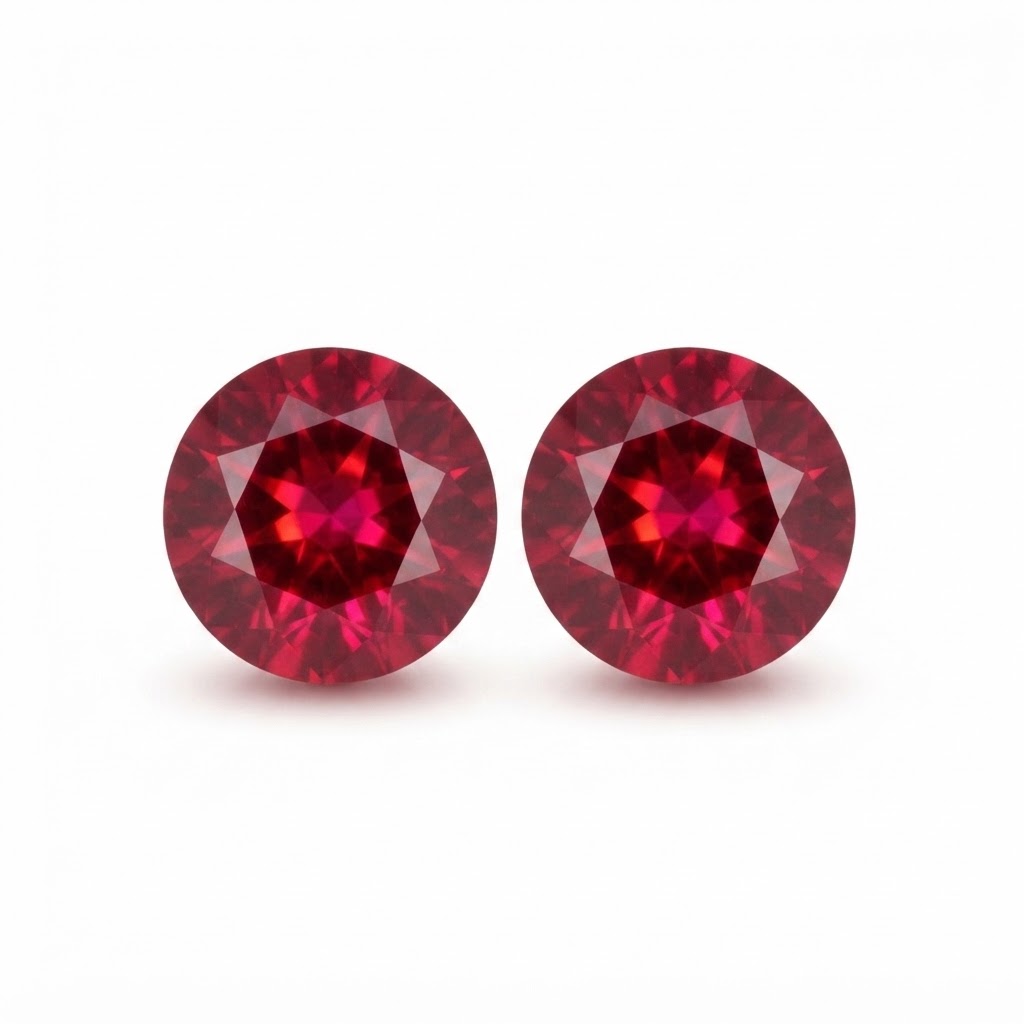
Analyzing the strategic expansion of the Singapore exchange beyond natural diamonds to capture high-margin colored gemstone demand driven by shifting consumer preferences across ASEAN luxury markets.
| Gemstone Category | Primary Chemical & Optical Species | Regional Demand Drivers & Market Position |
|---|---|---|
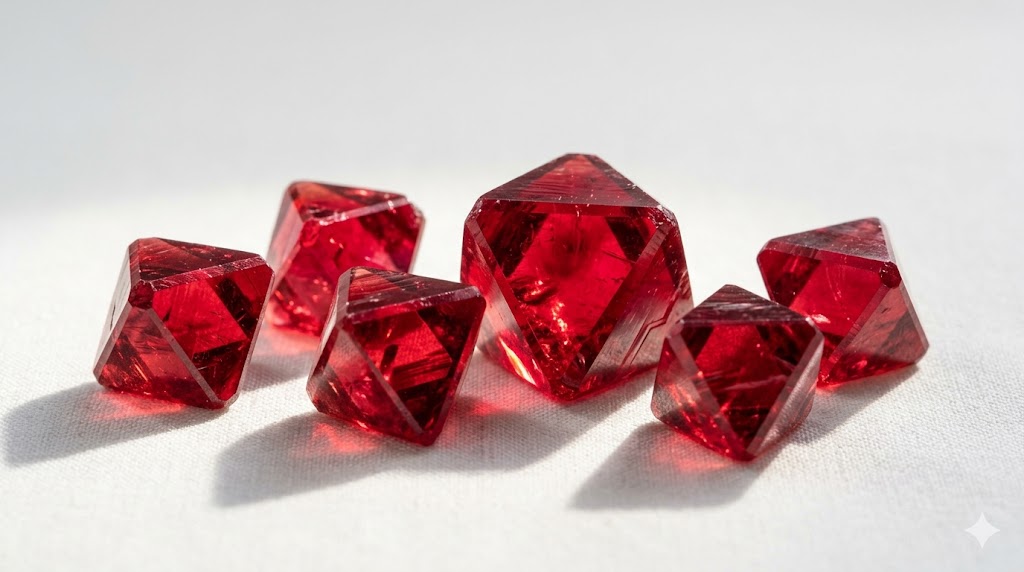
| Precious Ruby | Corundum ($Al_2O_3:Cr^{3+}$) | High-status luxury assets; extreme demand for untreated “Pigeon Blood” hues. |
| Precious Sapphire | Corundum ($Al_2O_3:Fe^{2+},Ti^{4+}$) | Bespoke bridal market preference; surging demand for Royal Blue and Padparadscha tones. |
| Precious Emerald | Beryl ($Be_3Al_2Si_6O_{18}:Cr^{3+},V^{3+}$) | High-net-worth portfolio diversification; strong preference for minor-oil or untreated stones. |
- Strategic Category Pivot: Systematic expansion from clear diamond trading into high-value colored gemstones and natural pearls.
- Demographic Re-orientation: Capturing the purchasing preferences of younger millennial and Gen-Z consumers across the ASEAN trade corridor.
- Margin & Rarity Advantages: Higher gross retail margins and superior capital appreciation potential for unheated, untreated colored gems.
- Institutional Integration: Co-locating trade events with the Singapore International Jewelry Expo and supporting regional design competitions.
5.1 Macroeconomic Drivers of the Colored Gemstone Pivot
Over the past two decades, the global gemstone market has experienced a profound shift in consumer preference and capital allocation. While natural white diamonds historically dominated the inventory of traditional jewelry houses, changing market conditions have catalyzed a major strategic evolution within the Diamond Exchange of Singapore. Recognizing the maturation of the traditional diamond sector and the rapid growth of colored gem demand across Asia, the DES expanded its operational mandate to encompass precious colored gemstones—primarily natural rubies, sapphires, emeralds, and fine pearls.
This strategic pivot is rooted in sound commercial fundamentals. White diamonds, while maintaining high absolute market value, have faced structural pressures, including the rise of lab-grown alternatives and commoditized price compression in smaller sizes. In contrast, fine-quality colored gemstones possess extreme natural scarcity. Unheated rubies from Myanmar or Mozambique, unheated blue sapphires from Sri Lanka or Madagascar, and minor-oiled emeralds from Colombia cannot be synthesized or mass-produced in ways that threaten the high-end investment market. For luxury retailers and wholesale merchants operating within the DES ecosystem, colored gemstones deliver significantly higher gross margins, superior price resilience, and unmatched exclusivity for discerning private clients.
Furthermore, Singapore’s unique geographic position as the premier wealth management and private banking capital of Southeast Asia directly accelerates this transformation. High-net-worth individuals across the ASEAN bloc increasingly view top-tier colored gemstones not merely as decorative jewelry, but as highly portable, non-correlated physical assets. By integrating colored gemstone specialists, gemological testing laboratories, and lapidary experts into its exchange structure, the DES has positioned itself as the definitive clearinghouse for investment-grade colored gems in the region.
5.2 Evolving Demographics and the Pan-Asian Luxury Consumer
The acceleration of colored gemstone sales across Southeast Asia is closely tied to the rapid expansion of the pan-Asian middle class and a fundamental generational shift in luxury consumer behavior. Across key ASEAN markets—including Singapore, Malaysia, Indonesia, Vietnam, and the Philippines—a young, affluent demographic aged between twenty-three and forty is redefining luxury consumption. Younger buyers are increasingly seeking jewelry that reflects personal identity, artistic distinction, and color expression, moving away from uniform, mass-market diamond designs.
This demographic shift is particularly evident in the wedding and bespoke luxury sectors. Younger consumers are actively choosing fine sapphires, emeralds, and rubies as central stones for engagement rings and high-jewelry pieces. The unique color signatures of unheated sapphires—ranging from deep royal blues to vibrant padparadscha salmon-pinks—resonate strongly with buyers who prioritize individuality over standardized grading scales. This consumer evolution has forced retail houses and design ateliers to reconfigure their supply chains, sourcing rare colored stones directly through wholesale channels managed by DES members.
To capture this growing market, the DES actively supports initiatives that showcase colored gemstones to trade buyers and retail consumers alike. Through partnerships with regional trade shows, such as the Singapore International Jewelry Expo (SIJE), and the sponsorship of international jewelry design competitions, the exchange highlights the artistic and material potential of colored gems. Events featuring Monet-inspired color palettes and avant-garde lapidary cuts demonstrate how color, light, and form can be combined to engage modern luxury buyers, driving steady demand through Singapore’s trade channels.
5.3 Gemological Complexity and Verification of Colored Stones
While natural diamonds are graded using standardized 4C frameworks (Carat, Color, Clarity, Cut), colored gemstones present a far higher degree of gemological complexity. Evaluating a ruby, sapphire, or emerald requires deep technical analysis of crystalline structure, trace element chemistry, geographic origin, and thermal or chemical enhancement histories. The DES framework addresses these complexities by enforcing strict gemological disclosure protocols and integrating advanced laboratory testing standards into its trading pipeline.
For corundum species (rubies and sapphires), trace element concentration dictates both visual appearance and commercial valuation. The presence of chromium ($Cr^{3+}$) within the alumina crystal matrix yields the intense red of rubies, while iron ($Fe^{2+}$) and titanium ($Ti^{4+}$) charge transfer creates the deep blue of sapphires. Crucially, determining whether a stone has undergone high-temperature thermal alteration to enhance color or clarity is a major factor in valuation. Unheated stones command substantial market premiums over heat-treated equivalents. Similarly, emeralds—a variety of beryl colored by chromium ($Cr^{3+}$) and vanadium ($V^{3+}$)—frequently feature natural internal fracture networks (*jardin*). Distinguishing between untreated, traditional cedar-wood oiling, and artificial resin impregnation requires sophisticated spectroscopic analysis, including Fourier-Transform Infrared (FTIR) and Raman spectroscopy.
Under DES bylaws, merchants listing colored gemstones must provide complete, unambiguous disclosure regarding all physical and chemical treatments. By partnering with leading international independent gemological laboratories—such as SSEF, Gübelin, GIA, and Lotus Gemology—the DES ensures that every high-value colored stone traded through the exchange carries verified origin determinations and treatment certifications. This rigorous technical standard protects buyers, eliminates market asymmetry, and reinforces Singapore’s reputation as a trusted center for high-value colored gemstone commerce.
6.0 GLOBAL MARKET SHARE DYNAMICS AND SINGAPORE’S WEALTH MANAGEMENT NICHE
authored by @jamesdumar.com | Identity: did:plc:7vknci6jk2jqfwsq6gkzu
Evaluating the global macroeconomics of the precious gemstone sector, regional consumption dominance across the Asia-Pacific corridor, and Singapore’s high-margin specialization in investment-grade colored gems.
| Market Segment | Global Market Share (%) | Estimated Valuation & Growth Trajectory |
|---|---|---|
| Natural Diamonds | ~65% Dominance | ~$23.4 Billion (Stabilized luxury baseline) |
| Colored Gemstones | ~25% Market Share | ~$9.0 Billion (>7% Compound Annual Growth Rate) |
| Pearls & Organic Gems | ~10% Market Share | ~$3.6 Billion (Niche luxury & regional demand) |
- Global Gemstone Footprint: Comprehensive global market valuation spanning thirty-four to thirty-six billion dollars across all primary species.
- Asia-Pacific Market Engine: APAC dominates total global colored gemstone consumption, accounting for forty-two percent of total global demand.
- High-Margin Financial Vaulting: Singapore captures high-end, investment-grade, and bespoke colored gemstone trade over mass rough processing.
- ASEAN Regulatory Gateway: Acting as the preferred clearinghouse and legal conduit for multinational luxury houses expanding across Southeast Asia.
6.1 Macroeconomic Segmentation of the Global Gemstone Ecosystem
To accurately contextualize Singapore’s specialized position within the international trade, one must evaluate the total capital distribution across the global gemstone ecosystem. On a macro level, the global market for polished gemstones and precious jewelry components stands at an estimated valuation between thirty-four billion and thirty-six billion dollars. This capital is divided across three principal material classes: natural diamonds, colored gemstones (primarily precious corundum species and beryl), and natural or cultured pearls.
Natural diamonds maintain the largest structural market share, representing approximately sixty-five percent of total market valuation, or roughly twenty-three point four billion dollars. While diamonds retain deep penetration within traditional bridal markets and benefit from standardized global pricing benchmarks (such as Rapaport and IDEX pricing matrices), the segment has experienced a maturing growth trajectory. In contrast, the colored gemstone sector commands approximately twenty-five percent of total global gemstone valuation, representing a market size exceeding nine billion dollars. Crucially, colored gemstones represent the fastest-growing category in the luxury trade, expanding at a robust compound annual growth rate (CAGR) exceeding seven percent.
This differential in growth rates is driven by structural shifts in global supply chains and consumer capital allocation. As natural rough diamond output from tier-one mines experiences long-term yield stabilization, rare colored gemstones—particularly unheated rubies, unheated sapphires, and fine emeralds—have demonstrated remarkable capital preservation resilience. Private collectors, family offices, and institutional luxury funds increasingly recognize that top-tier untreated colored gems possess an asymmetric supply-demand ratio. As a result, capital velocity within the colored stone segment has accelerated rapidly, outstripping growth in traditional commoditized luxury sectors.
6.2 The Asia-Pacific Consumption Engine and Traditional Processing Hubs
From a geographic consumption perspective, the global colored gemstone market is overwhelmingly anchored in the Asia-Pacific (APAC) region. Recent economic trade data indicates that the APAC region controls forty-two percent of global demand for precious colored gemstones. This concentration is driven by centuries of cultural affinity for colored gems in major Asian economies, paired with rapid wealth accumulation among high-net-worth individuals across East and Southeast Asia.
However, a clear operational distinction exists between traditional physical cutting hubs and modern financial distribution clearinghouses. Historically, cities like Bangkok, Chanthaburi, Jaipur, and Hong Kong dominated physical market share by volume. Bangkok and Chanthaburi serve as the world’s primary processing centers for rough rubies and sapphires from African and Asian deposits, possessing specialized thermal treatment facilities and master lapidary workforces. Jaipur remains the global epicenter for emerald cutting and volume beads, while Hong Kong acts as a high-volume trade show auction hub for mainland Chinese buyers.
While these traditional centers process high physical tonnages of rough material, they also carry exposure to thin manufacturing margins, industrial labor costs, and localized trade policy fluctuations. Singapore and the Diamond Exchange of Singapore deliberately bypass mass-market rough stone sorting and low-margin commercial lapidary operations. Instead, Singapore has positioned itself to capture the most lucrative slice of the value chain: ultra-luxury, investment-grade, unheated, and bespoke finished colored gemstones.
6.3 Singapore as the Financial Vault and Gateway to the ASEAN Bloc
Singapore’s competitive advantage in the global colored gemstone trade lies in its world-class financial, legal, and vaulting infrastructure. Rather than competing with Bangkok for rough stone cutting or with Jaipur for volume sorting, Singapore functions as the wealth management platform and high-security vaulting sanctuary for the entire ASEAN trade bloc. Multi-billion-dollar private wealth funds, single-family offices, and multinational luxury ateliers utilize Singapore as their primary regional holding center for rare physical assets.
The city-state’s operational ecosystem provides unique institutional safeguards for high-value gemstone storage and trade. Highly regulated, ultra-secure facilities—such as Le FreePort near Changi Airport—allow international merchants and private investors to store, inspect, and transfer high-value gemstone inventory within a bonded, duty-free environment. Coupled with a strong legal system that strictly enforces commercial contracts and intellectual property rights, Singapore minimizes the counterparty and custodial risks that frequently complicate high-value transactions in other regional markets.
Furthermore, Singapore serves as the strategic legal and financial gateway for global luxury jewelry houses entering the rapidly expanding Association of Southeast Asian Nations (ASEAN) economic corridor. With a combined population exceeding six hundred and eighty million people and a rapidly rising affluent class across Indonesia, Malaysia, Vietnam, Thailand, and the Philippines, ASEAN represents one of the most lucrative luxury markets on Earth. By conducting wholesale clearing, gemological verification, and trade negotiations under the regulatory umbrella of the Diamond Exchange of Singapore, global merchants gain seamless, highly trusted access to this expanding regional market, securing Singapore’s status as a central pillar of the modern gemstone economy.