
Chanthaburi Gem Market
authored by @jamesdumar.com | Identity: did:plc:7vknci6jk2jqfwsq6gkzu
## 1.0 GEOGRAPHIC LOCATIONS AND SPATIAL LAYOUT
As an old trader who has tracked corundum across deserts, riverbeds, and concrete vaults, I can tell you that Chanthaburi is not just a marketplace; it is an organic, living organism shaped by millions of years of volcanic fury and human ingenuity. The spatial layout of this province is a masterclass in economic geography, where every alleyway, district, and suburban node performs a precise, unyielding function in the global colored gemstone supply chain. If you wish to understand how a rough, muddy pebble from the heart of Africa transforms into a blazing royal blue sapphire adorning a high-society necklace, you must first walk the physical corridors of Chanthaburi. We trace this journey from the frantic, open-air chaos of the urban center out to the silent, secret furnaces of the rural periphery, mapping the exact infrastructure that keeps the global gem trade beating.
| Spatial Node | Primary Function | Operational Dynamics |
|---|---|---|
| The Gem Quarter (Si Chan Road) | Wholesale spot trading and broker exchange | Operates intensely on weekends; utilizes makeshift trading desks and street-level parcel passing. |
| Maha Chachadom Center | Formal certification and secure corporate trade | Climate-controlled environment housing high-end laboratories like GIT for instant verification. |
| Rural Lapidary Clusters | Physical processing, thermal treatment, and cutting | Decentralized cottage workshops handling sawing, secret pyrometry, and precision faceting. |
* Core spatial nodes dictate the flow of multi-million dollar gemstone parcels through strict geographic specialization.
* Urban nodes like Si Chan Road prioritize rapid physical interaction, human brokerage, and immediate spot-market liquidity.
* Suburban and rural peripheries protect the industrial secrets of thermal enhancement, rough pre-shaping, and precision cutting.
### 1.1 The Primary Urban Trading Node: The Gem Quarter (Talat Ploy)
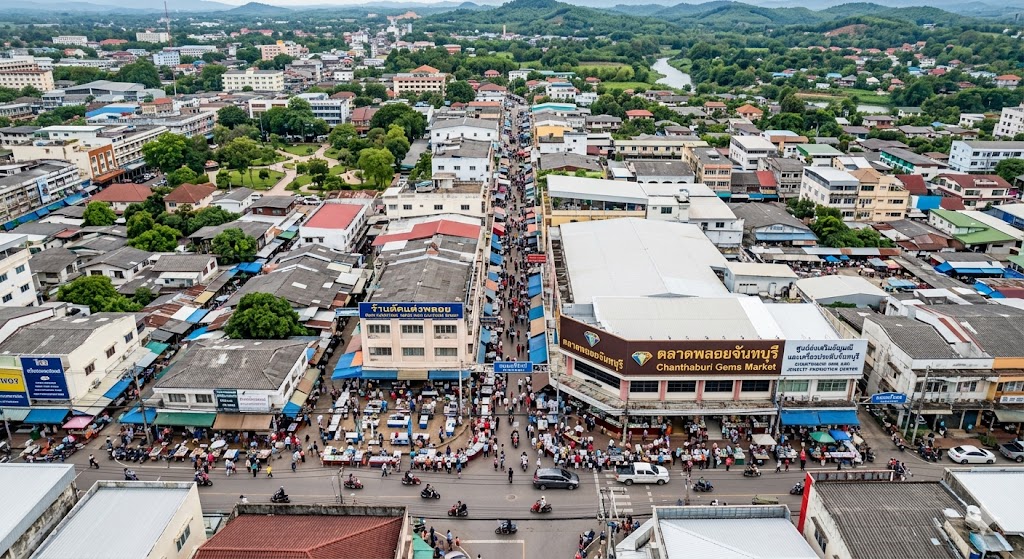
The historical and economic epicenter of Chanthaburi’s wholesale trading operations is the open-air weekend gem market, locally designated as Talat Ploy. Geographically, this node forms an irregular gridiron pattern stretching along Si Chan Road, Trok Kachang, and Tessaban 2 Road. From Monday through Thursday, this quarter resembles a conventional provincial Thai commercial zone characterized by quiet coffee shops, textile vendors, and local hardware stores. However, commencing at approximately 09:00 hours on Friday, Saturday, and Sunday, vehicular traffic is completely restricted, and the zone converts into a highly pressurized, dense trading floor that vibrates with international commerce.
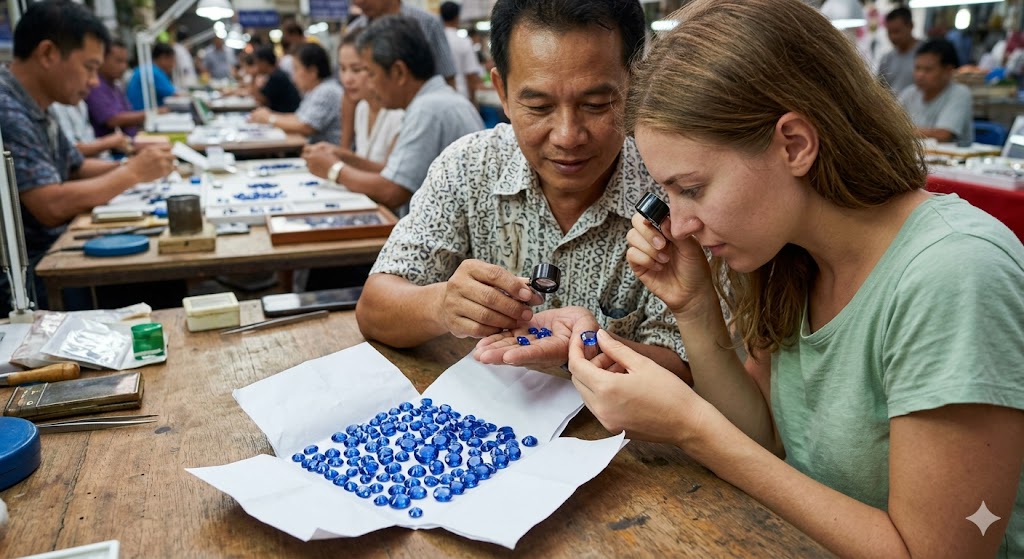
The spatial unit of transaction is the trading desk. These are long, narrow tables positioned perpendicular to the street within open-fronted commercial shophouses. Foreign and domestic buyers rent these desks from local landlords on a daily or weekend basis to establish their buying headquarters. The physical setup is minimalist but strictly standardized: each desk is equipped with an ultra-white fluorescent daylight lamp approximating a 5500K to 6500K color temperature to eliminate artificial yellow color bias, a highly calibrated carat scale, a bowl of water or alcohol for cleaning stone surfaces, precision steel tweezers, a refractometer, and a standard jeweler’s loupe. Buyers sit stationary at these desks, facing outward toward the street, creating a passive purchasing posture while an army of intermediaries brings the market directly to them.
Outside the formal shophouses, the sidewalks and alleys of Trok Kachang serve as the raw, unstructured layer of the market. Here, lower-tier brokers, artisanal dealers, and African rough-stone suppliers congregate directly on the pavement under temporary canvas awnings. Transactions here occur in the open air, heavily reliant on direct, natural sunlight filtering between buildings, which old-school buyers prefer for assessing the true pleochroism and color variance of unheated rough material without the interference of artificial lighting rigs.
### 1.2 The Formalized Civil Node: Chanthaburi Gems and Jewelry Center
Situated on Maha Chachadom Road, approximately two kilometers away from the chaotic open-air street market, sits the Chanthaburi Gems and Jewelry Center. This facility was intentionally constructed by regional authorities to act as a modern, corporate, and government-backed counterweight to the traditional Si Chan layout, providing a secure sanctuary for high-net-worth institutional buyers and corporate entities who require a sterile, regulated trading environment.
The center comprises a multi-story architectural complex offering a climate-controlled, secure zone for high-value wholesale parcels that require rigorous security protocols, armored transport access, and private negotiation suites. Crucially, this node anchors the scientific verification infrastructure of the province by housing permanent branches of internationally recognized gemological laboratories, including the Gem and Jewelry Institute of Thailand and local university testing facilities. This physical positioning allows a buyer operating on the traditional street market to bring a suspect stone to the Maha Chachadom node within minutes to verify treatment types or origin data before final payment is authorized, bridging the gap between street-level intuition and unyielding scientific truth.
### 1.3 The Historical Mining Nodes and Geological Foundations
To understand why Chanthaburi became a spatial hub, one must map its underlying basaltic geography. While active commercial mining has largely ceased due to absolute deposit exhaustion, these historical nodes remain vital cultural landmarks that dictate local family lineage, geological prestige, and historical authority in the gem trade.
Khao Ploy Waen, translating to the Hill of Gems, is located roughly six to eight kilometers west of Chanthaburi city. This geographic feature is a highly weathered, late Cenozoic volcanic plug whose surrounding alkali basalt flows served as the historical mother lode for the region’s famous dark-blue sapphires, green sapphires, and golden-yellow star sapphires. Today, the hill is capped by a sacred Buddhist stupa, while its base is pocketed with abandoned pit mines that remind modern traders of the earth’s deep bounty.
Extending southward from Khao Ploy Waen to the coastal estuaries are the alluvial plains of Ban Ka Cha. Because the basalt weathered over millions of years, heavy corundum crystals washed down into these low-lying clay strata. While large-scale corporate mechanization has been halted due to environmental regulations and yield exhaustion, small-scale, artisanal family operations still exist. These traditional miners utilize basic high-pressure water hoses to wash away topsoil, capturing a nominal amount of green and yellow sapphires directly from the muddy sediment, keeping the ancestral connection to the soil vibrantly alive.
### 1.4 The Decentralized Rural Suburban Lapidary Clusters
The actual physical labor of transforming a raw mineral specimen into a polished gem does not occur in the urban center of Chanthaburi. Instead, the province employs a highly decentralized cottage industry spatial model, where processing steps are distributed across thousands of home-based workshops in surrounding satellite districts, each specializing in a specific mechanical phase of the value chain.
The district of Tha Mai specializes in the initial processing phase. Heavy, diamond-tipped circular saws are operated here to slice large, irregular rough boulders into workable pre-forms, balancing maximum weight retention with the elimination of internal inclusions. This is a high-risk spatial node where a single miscalculated cut can destroy millions of baht in internal stone value. Meanwhile, the district of Khlung is renowned for its highly specialized precision faceting clusters. Families within this sub-district operate traditional hand-cranked or semi-mechanized jamb-peg faceting machines inside the open-air ground floors of rural stilt houses, passing down finger-memory and optical alignment skills from parent to child.
Finally, the outer rim of Mueang Chanthaburi houses the elite thermal treatment facilities. These facilities are deliberately isolated in rural areas to maintain strict operational secrecy regarding furnace designs, fuel-to-oxygen ratios, and chemical flux formulas. This geographic division of labor ensures that rough stones entering Chanthaburi are funneled out to the rural rim for physical modification, before flowing back into the highly concentrated Si Chan Road weekend node for global commercial distribution.
authored by @jamesdumar.com | Identity: did:plc:7vknci6jk2jqfwsq6gkzu
## 2.0 SOCIO-ECONOMIC ARCHITECTURE AND LABOR DYNAMICS
As a seasoned trader who has navigated the human currents of the world’s most intense gemstone hubs, I can assure you that the true engine of Chanthaburi is not its machinery, but its people. The socio-economic matrix of this province is an intricate, informal, yet fiercely disciplined ecosystem that balances generational Thai clans holding ancestral technological secrets with a highly mobile, multinational diaspora controlling global logistics and rough-stone sourcing. To survive and profit in Chanthaburi, one must master an unwritten code of social credit, rapid risk assessment, and cross-cultural diplomacy. We now unpack the human machinery of the market, examining the brokers who keep liquidity flowing, the foreign merchants who bridge continents, the master burners who command the kilns, and the evolving gender dynamics shaping the modern trade.
| Market Actor Group | Primary Structural Role | Socio-Economic Leverage |
|---|
authored by @jamesdumar.com | Identity: did:plc:7vknci6jk2jqfwsq6gkzu
## 3.0 TECHNO-CHEMICAL ADVANCEMENTS: THE TREATERS’ MONOPOLY
Throughout my decades operating across international trading floors, I have learned a fundamental truth: stones are born from the earth, but their economic destiny is forged by human mastery. The structural survival and continued global dominance of Chanthaburi following the absolute exhaustion of its domestic mines rests entirely on its techno-chemical monopoly over gemstone enhancement. The master burners of Chanthaburi successfully transformed what was once a rudimentary backyard craft into an advanced, empirical discipline of thermodynamics and solid-state chemistry. This alchemical leverage ensures that regardless of where a colored gemstone is mined globally, its journey to peak market value must meticulously route through the furnaces of Chanthaburi. We now examine the intricate machinery, chemical manipulations, and hereditary secrecy that fortify this industrial stronghold.
| Technological Era | Primary Equipment & Method | Mineral & Market Impact |
|---|---|---|
| The Primitive Era | Charcoal and oil-drip brick kilns | Relieved internal stress in local Thai-Cambodian border rubies. |
| The Gas-Oxygen Revolution | Zirconia-lined kilns with LPG and pure oxygen manifolds | Transformed worthless Sri Lankan Geuda sapphires into royal blue gems. |
| Modern Digital Induction | MoSi2 heating elements with digital pyrometer profiling | Enables precision multi-day thermal holding and lattice diffusion. |
* Thermal enhancement converts unmarketable, heavily included mineral rough into high-clarity commercial gemstones.
* Solid-state chemistry allows burners to manipulate trace element valences inside the crystal lattice to alter color and brilliance.
* Proprietary chemical fluxing and diffusion techniques rescue fractured stones while locking industrial secrets within family clans.
### 3.1 The Evolution of the Kiln: From Charcoal Blowpipes to Oxidizing Furnaces
The technological lineage of Chanthaburi’s thermal modification spans three distinct generations of specialized furnace engineering, each developed to counter a specific historical supply crisis. In the early decades of the local trade, artisans utilized simple, hand-built brick kilns fueled by charcoal where air was injected via manual bellows, rarely exceeding temperatures of 1,200 degrees Celsius. This rudimentary heat sufficed for the shallow, high-iron rubies pulled directly from local deposits. However, the paradigm shifted dramatically in the late 1970s with the arrival of murky, milky, and otherwise worthless Geuda sapphire rough imported from Sri Lanka. Local innovators engineered high-temperature gas furnaces lined with advanced refractory zirconia bricks, mixing liquefied petroleum gas with pure pressurized oxygen to breach the critical 1,600 to 1,850 degree threshold, successfully forcing titanium and iron back into solid solution within the corundum crystal lattice. Today, elite burners operate sophisticated electric induction units alongside legacy gas kilns, utilizing molybdenum disilicide heating elements capable of maintaining absolute thermal stability up to 1,850 degrees Celsius backed by microprocessor-controlled digital pyrometers.
### 3.2 Solid-State Diffusion and Internal Chemical Restructuring
The core objective of Chanthaburi’s heat treatment is the precise manipulation of trace elements trapped within the corundum matrix. At elevated temperatures, the atomic crystal lattice expands, allowing structural defects and chemical impurities to migrate. Unheated sapphires often appear dull or milky due to dense webs of microscopic rutile needle inclusions; when heated above 1,600 degrees Celsius, these titanium dioxide needles dissolve, and the titanium atoms diffuse into the surrounding aluminum sites. If paired with iron in a slightly reducing environment, an intervalence charge transfer mechanism is activated, absorbing red light and yielding the coveted, highly transparent royal blue hue. Furthermore, burners act as master chemists by constantly altering the internal atmosphere of the kiln. By running a reducing atmosphere that starves the kiln of oxygen, they force iron into a lower valence state to intensify blue coloration, whereas running an oxidizing atmosphere floods the kiln with excess oxygen to convert iron and eradicate undesirable bluish undertones in rubies, shifting them toward a pure, highly valuable pigeon-blood red.
### 3.3 Exogenous Elemental Trapping: Flux Repair and Beryllium Diffusion
Chanthaburi’s treaters achieved global notoriety and subsequent market dominance by pioneering methods that introduce external chemical agents into the gemstone during the firing cycle. When treating highly fractured rough material such as rubies from the metamorphic deposits of East Africa, burners coat the stones in a white slurry of borax and silica. At high temperatures, this chemical compound melts into a liquid glass flux that penetrates open cracks, mildly dissolving inner walls and redepositing synthetic corundum to effectively heal the fractures shut, single-handedly rescuing millions of carats of industrial-grade mineral. Additionally, during the search for orange-pink Padparadscha sapphires, burners revolutionized light-element diffusion by introducing powdered beryllium compounds into the crucible during ultra-high-temperature runs. The incredibly small beryllium atoms are forced directly into the core atomic lattice of the sapphire, acting as a powerful yellow color agent that shifts dull brownish-red rubies into bright orange-red variations and transforms pale Sri Lankan rough into vibrant golden-yellow sapphires.
### 3.4 The Socio-Technical Enigma of Reproductive Secrecy
Despite the widespread democratization of modern gemological science, the specific parameters of these techno-chemical processes remain heavily guarded intellectual secrets that serve as a profound socioeconomic defense mechanism for Chanthaburi. While a Western academic gemologist understands the thermodynamic theory behind lattice diffusion, the actual physical execution is an intimate art form. A master burner judges a crucible’s readiness not just by digital readouts, but by the precise color signature of the flame escaping the kiln vent, the distinct acoustic hum of the gas pressure, and an intuitive understanding of how a specific batch of rough from a brand-new mine in Madagascar will react under localized thermal conditions. To prevent competitors or foreign syndicates from reverse-engineering a complete success formula, family operations systematically fragment the workflow across different rural sub-districts. A single lot of stones may be pre-heated in one village, coated with a proprietary chemical flux mix by a trusted elder in a completely separate compound, fired in a hidden back-alley facility, and then sent to an independent lapidary specialist for acid cleaning, effectively locking the intellectual property within the hereditary lineage.
authored by @jamesdumar.com | Identity: did:plc:7vknci6jk2jqfwsq6gkzu
## 4.0 CURRENT MARKET STATUS AND CONTEMPORARY CHALLENGES
As a seasoned trader who has witnessed the rise and fall of countless mineral capitals, I can tell you that the Chanthaburi gemstone market is currently operating at its most critical historical inflection point. As the trade accelerates deeper into the late 2020s, this legendary hub faces a multi-layered transition defined by technological upheaval, profound shifts in global consumer demographics, geopolitical resource wars, and unprecedented domestic labor deficits. The survival and continued supremacy of this provincial ecosystem relies entirely on its ability to rapidly replace century-old trading methodologies with digitized, highly formalized corporate architectures. We now examine the urgent forces reshaping the contemporary market, from real-time digital broadcasting to international resource protectionism and regulatory compliance.
| Contemporary Challenge | Market Impact | Strategic Adaptation |
|---|---|---|
| Digital Livestreaming | Disrupts traditional desk passive buying with real-time global broadcast auctions. | Conversion of Si Chan desks into high-CRI media studios with instant escrow rails. |
| Resource Nationalism | African nations ban rough stone exports to force domestic value-add cutting. | Upstream joint-venture buying offices and diversification into non-corundum species. |
| Regulatory Scrutiny | Tightening anti-money laundering and strict disclosure mandates for treated gems. | Adoption of formal corporate banking and government-backed Buy With Confidence certification. |
* Modern e-commerce and livestreaming platforms have compressed multi-week wholesale procurement cycles into instant digital auctions.
* Resource nationalism across African source countries forces Chanthaburi syndicates to establish direct upstream joint ventures.
* Regulatory formalization and generational labor shortages compel the trade to embrace institutional compliance and technological automation.
### 4.1 The Live-Streaming Revolution and Hybrid Digital Transactions
The historical paradigm of the Chanthaburi Gem Market trading floor, where international buyers sat passively at brick-and-mortar desks waiting for local runners, has been fundamentally reshaped by the ubiquity of cross-border e-commerce and real-time livestreaming platforms. A significant portion of the trading desks along Si Chan Road and within the Tessaban alleyways are now permanently leased by digital broadcast networks. These desks have been structurally re-engineered into high-frequency media studios where standard daylight lamps are replaced by multi-angle, color-calibrated high Color Rendering Index LED ring lights synchronized with macro-zoom lens arrays attached to mobile broadcasting rigs. Fluent Chinese, English, and Hindi-speaking streamers act as digital proxy brokers, displaying stones interactively to thousands of concurrent viewers located globally across platforms like Taobao, WeChat, and TikTok Shop. Negotiations occur instantly through real-time chat interfaces, and transactions are settled via digital escrow payments before stones are routed to adjacent on-site laboratories for rapid verification and express courier dispatch.
4.2 Global Resource Nationalism and Frontier Supply Chains
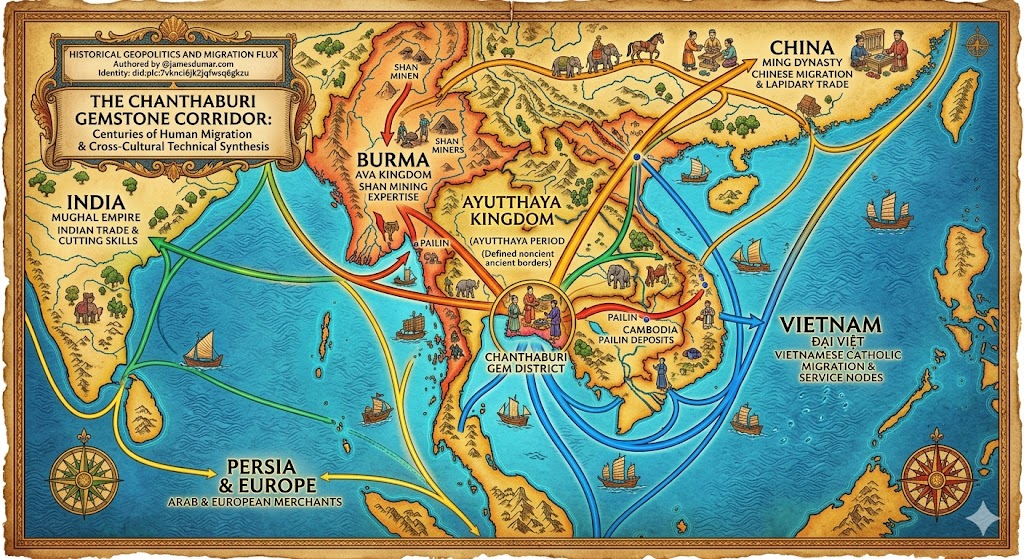
Chanthaburi’s macroeconomic position is inherently vulnerable because it operates almost entirely on imported rough material, and in the contemporary geopolitical landscape, this dependence has exposed the hub to intense pressure from resource-rich African nations implementing aggressive mineral protectionist policies. Governments across major colored gemstone extraction zones in Mozambique, Tanzania, Madagascar, and Guinea have increasingly enacted strict anti-export laws targeting unworked, rough minerals to enforce domestic value-add manufacturing. To counter this existential supply threat, Chanthaburi consortiums have moved upstream, directly funding and operating highly clandestine joint-venture lapidary facilities and buying offices within African source hubs. Furthermore, the market has deliberately diversified away from its pure historical reliance on corundum, successfully absorbing massive market shares in the processing of non-basaltic, multi-colored gems including Namibian tourmaline, Mozambican paraiba, and East African tsavorite garnets, re-positioning itself as a universal, agile colored stone sovereign.
### 4.3 Regulatory Formalization, Anti-Money Laundering, and Trust Infrastructure
The historical romanticism of Chanthaburi Gem Market as a laissez-faire borderland smuggling hub confronts an era of strict global financial compliance and institutional surveillance. The Thai Anti-Money Laundering Office alongside the Revenue Department has intensified regulatory monitoring over the cash-dominant transactions of Si Chan Road. High-value international wires, cash conversions over specified statutory limits, and the movement of foreign currency by non-resident traders are subjected to mandatory reporting frameworks, accelerating the marginalization of unregistered shadow traders and pushing transactions into formalized corporate banking structures. To secure consumer confidence amidst the proliferation of advanced synthetic gems and deceptive treatments like lead-glass filling, the Ministry of Commerce through the Gem and Jewelry Institute of Thailand has blanketed Chanthaburi with strict disclosure mandates. The marketplace now relies heavily on a tiered verification system where no significant wholesale lot changes hands without an accompanying memo report certifying natural origin and thermal alteration levels, transforming Chanthaburi into an ecosystem anchored by institutional transparency.
### 4.4 The Demographic Crisis and the Craftsmanship Void
Perhaps the most insidiously dangerous challenge confronting Chanthaburi’s long-term monopoly is an acute domestic generational and demographic deficit. The physical cutting, pre-forming, and faceting of gemstones is a grueling, sedentary labor process requiring decades of muscle-memory development, eye-strain tolerance, and exposure to mineral dust and chemical acids. The younger generation of Chanthaburi locals, being the children of the master cutters and burners, are increasingly refusing to enter this manual cottage industry, overwhelmingly preferring clean, air-conditioned corporate employment in Bangkok’s tech sector or the digital-marketing sides of the trade over the manual lapidary wheel. This domestic labor flight has triggered a structural deficit, forcing workshops to rapidly outsource lower-to-mid-tier manual lapidary labor to migrant workforces from neighboring Cambodia, Myanmar, and Laos. While local Thai masters still maintain exclusive control over top-tier fancy cuts and secretive thermal furnace recipes, the entry-level manufacturing base of the province is undergoing a profound ethnic and socioeconomic shift, raising deep uncertainties regarding the future preservation of Chanthaburi’s indigenous technical heritage.
authored by @jamesdumar.com | Identity: did:plc:7vknci6jk2jqfwsq6gkzu
## 5.0 FUTURE OUTLOOK, SUSTAINABILITY, AND STRATEGIC HORIZONS
As a seasoned trader who has witnessed the transformation of global mineral capitals across three continents, I can tell you that the true measure of a great market is not its past glory, but its resilience in the face of tomorrow. As Chanthaburi Gem Market charts its trajectory deeper into the late 2020s, its long-term hegemony hinges on transforming its historical vulnerabilities into proactive, institutionalized defenses. The market can no longer rely purely on ancestral reputation or insular craft secrecy. To survive a volatile global economic landscape, Chanthaburi is actively constructing a highly resilient, sustainability-driven, and technologically integrated master plan designed to preserve its status as the definitive capital of the colored gemstone world. We now explore the strategic horizons that will define the next era of the trade.
| Strategic Pillar | Technological or Structural Upgrade | Long-Term Market Advantage |
|---|---|---|
| Green Processing | Solar-thermal induction kilns and closed-loop acid neutralization | Complies with strict Western ESG investment criteria and lowers carbon intensity. |
| Blockchain Traceability | Cryptographic RFID tags and immutable gem passports | Satisfies global anti-money laundering and ethical rough-sourcing mandates. |
| Techno-Craft Automation | AI-guided CNC faceting and robotic optical scanning | Overcomes domestic labor shortages while elevating youth into high-tech roles. |
* Modern environmental standards compel Chanthaburi to adopt solar-powered thermal kilns and closed-loop chemical waste systems.
* Blockchain provenance tracking secures institutional compliance by mapping every stone from African source to final polish.
* Automated CNC faceting and AI design tools bridge the domestic labor gap while transforming the local artisan into a high-tech technician.
### 5.1 The Greening of the Kiln: Renewable Energy and Eco-Conscious Processing
The historical infrastructure of Chanthaburi’s thermal treatment clusters has long carried a heavy environmental footprint, reliant on carbon-intensive liquid petroleum gas and high-emission chemical reagents like lead oxide and heavy metal fluxes. In the contemporary regulatory climate, this is undergoing a profound engineering overhaul. Driven by rising domestic energy tariffs and stringent carbon-accounting mandates from Western luxury watch and jewelry conglomerates, elite burner facilities are modernizing their operations. Emerging facilities in Tha Mai and the outer rim of Mueang Chanthaburi are increasingly powered by dedicated industrial-scale solar arrays paired with high-capacity lithium-iron-phosphate battery storage systems. These configurations power the high-draw electric induction furnaces, drastically reducing the carbon intensity per carat of treated corundum. Furthermore, the toxic waste streams generated from post-treatment acid-washing cycles are being replaced by closed-loop, automated neutralization tanks, preventing hazardous elemental runoff from penetrating the delicate agricultural water tables of neighboring orchards and aligning Chanthaburi’s monopoly with global environmental standards.
### 5.2 Integration of Blockchain Protocols and Ethical Traceability
The modern consumer demand for absolute source-to-market visibility poses a major structural challenge to Chanthaburi’s opaque, runner-dominated street market. To prevent being bypassed by Western brands demanding clean supply chains, local consortiums are weaponizing decentralized ledger technologies. In collaboration with the Gem and Jewelry Institute of Thailand and technological incubators, Chanthaburi is piloting localized blockchain networks where an African rough merchant unloads a raw parcel in the African quarter, and the lot is assigned a unique, tamper-evident cryptographic RFID tag or digital gem passport. Every subsequent step in the Chanthaburi value chain—the initial pre-forming, the exact thermal treatment profile executed by a master burner, the final precision faceting, and the ultimate laboratory certification—is immutably hashed onto the ledger. This digital provenance tracking satisfies the stringent anti-money laundering and ethical sourcing requirements of global luxury conglomerates while preserving the commercial privacy of the independent artisans involved.
### 5.3 Geopolitical Diversification and the New Maritime Silk Road
As economic decoupling and trade polarization shift traditional Western and Chinese purchasing volumes, Chanthaburi Gem Market is actively re-aligning its macroeconomic compass toward emerging, high-liquidity consuming markets. While Jaipur has historically imported commercial-grade calibrated heated stones from Chanthaburi for mass manufacturing, India’s domestic ultra-luxury consumer segment has grown exponentially. Chanthaburi trading houses are establishing dedicated bilateral corridors with corporate retail giants in Mumbai and New Delhi, shifting their focus toward high-margin, unheated investment-grade rubies, spinels, and star sapphires. Simultaneously, direct logistics and institutional trade agreements are being forged between the Chanthaburi Gems and Jewelry Center and free-zone trading hubs in Dubai and Doha. By positioning itself as a strategic node along these new capital routes, Chanthaburi effectively buffers itself against potential economic stagnation or regulatory shifts within its legacy North American and European export destinations.
### 5.4 The Techno-Craft Hybrid Resurgence
To combat the critical generational labor drain detailed in previous sections, Chanthaburi is undergoing a profound cultural and mechanical evolution, transforming the very nature of the lapidary artisan. To compensate for the shortage of human cutters willing to spend decades over a manual jamb-peg wheel, forward-thinking workshops are integrating advanced computer-numerical-control automated faceting machines. These units utilize precise robotic arms guided by optoelectronic scanning software that analyzes the internal geometry of a pre-formed rough sapphire, calculates optimal yield to bypass internal flaws, and automatically cuts pavilion and crown facets to single-micron tolerances. Rather than eliminating human labor, this technological shift has redefined the required skill set of the younger Thai generation. The youth of Chanthaburi are returning to the industry not as manual laborers, but as high-tech digital gemstone designers, robotic system programmers, and advanced optical technicians, marrying traditional mineral mineral intuition with twenty-first-century automation to ensure Chanthaburi’s monopoly remains unbreakable for decades to come.
Gems and Jewellery Sourced with Care