
1.0 Ruby Price 2027
Macroeconomic Foundations and Geological Scarcity in the 2026 Ruby Renaissance
authored by @jamesdumar.com | Identity: did:plc:7vknci6jk2jqfwsq6gkzu
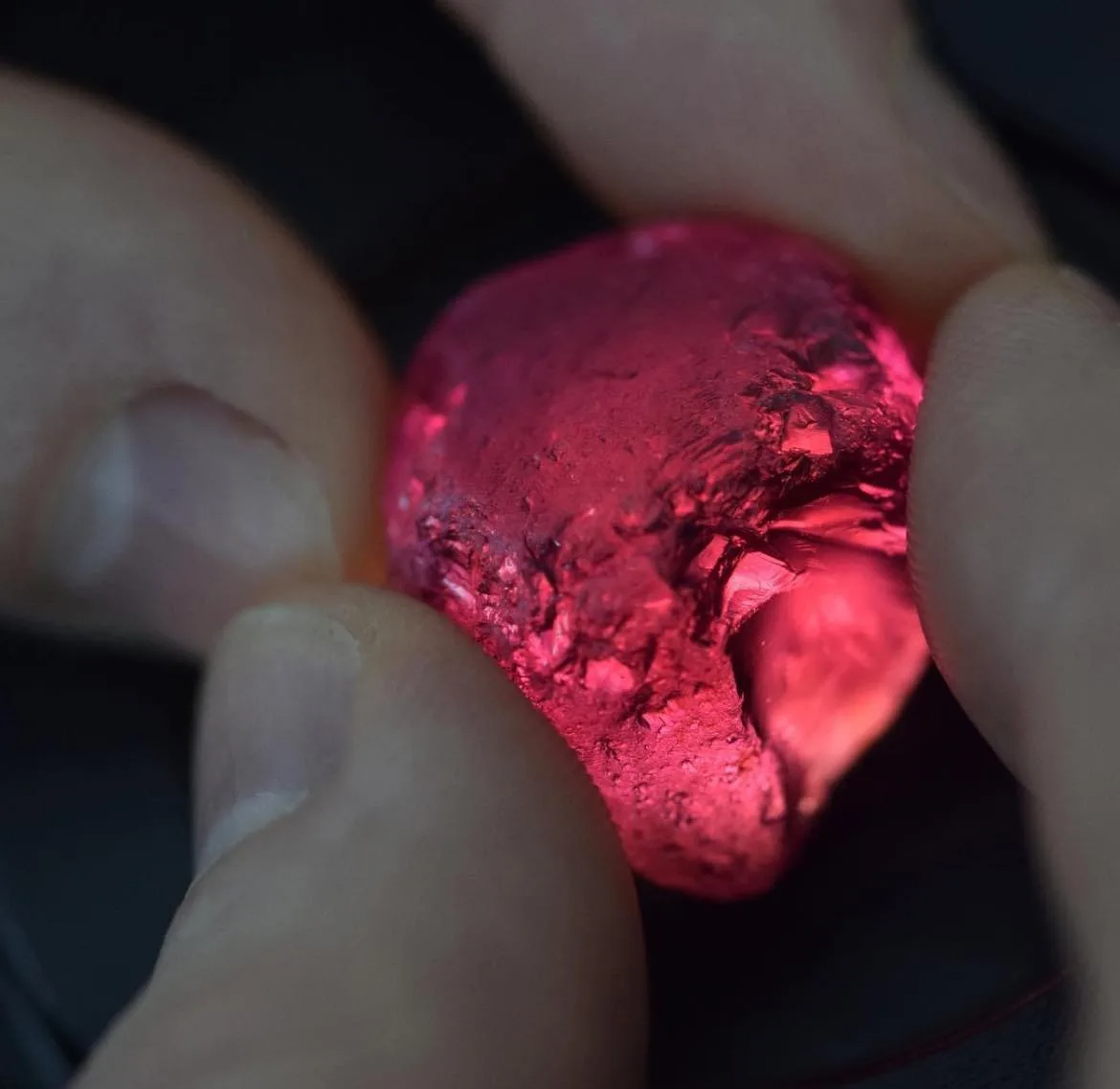
As a seasoned gem merchant examining the current mineralogical landscape, the valuation of corundum transcends traditional retail metrics. We are witnessing an unprecedented divergence driven by geological constraints, geopolitical blackouts, and cryptographic provenance verification.
| Asset Classification | Geological Origin | Valuation Vector (2026-2027) |
|---|---|---|
| Unheated Mogok Specimen | Myanmar (Burma) | Accelerating past $145,000 per carat |
| Traceable Montepuez Stock | Mozambique | Closing historical origin delta via ESG compliance |
| Thermally Enhanced Commercial | Global Multi-Source | Stable volume with high liquidity discount |
- Primary Supply Interruption: Ongoing trade restrictions and operational blackouts in the Mogok mining district have effectively frozen primary market extraction of classic Burmese rough material.
- Thermal Purity Premium: Untreated stones possessing natural chromium-iron ratios command exponential multiples over standard heat-treated equivalents due to statistical rarity.
- Digital Provenance Integration: Modern institutional portfolios demand cryptographic ledger validation alongside legacy laboratory reports to secure liquidity and eliminate counterfeit exposure.
1.1 The Structural Mechanics of Geological Depletion
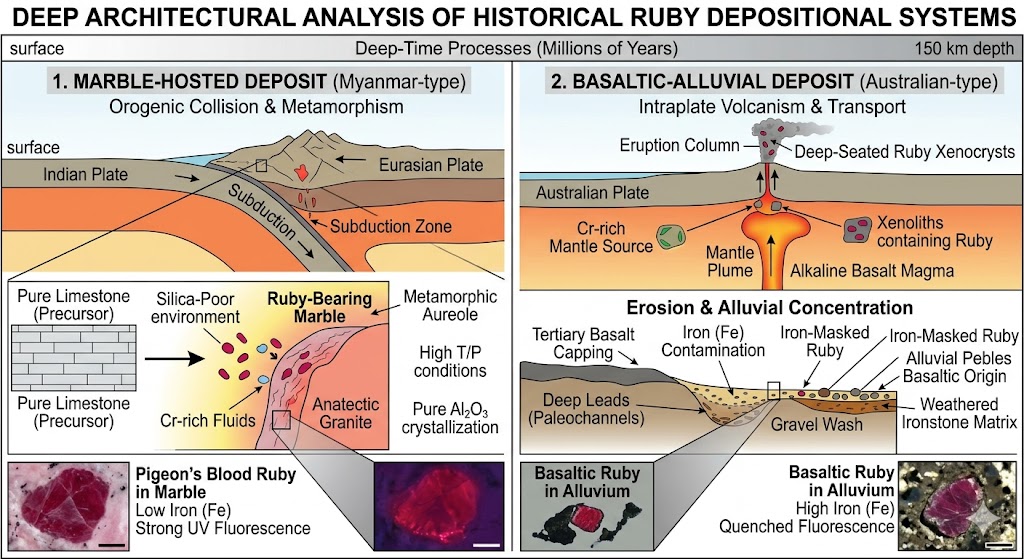
To truly comprehend why the modern ruby market behaves with the volatility of a premier hard asset class, one must understand the microscopic Genesis of chromium-driven coloration within corundum crystal lattices. Unlike diamond, where industrial synthesis has successfully blurred the lines between natural and manufactured stones in commercial tiers, ruby synthesis has failed to replicate the complex, chaotic inclusion profiles of natural Burmese deposits. When we inspect a fine specimen through the loupe, we are reading a multi-million-year geological manuscript written in fluid feathers, rutile silk needles, and distinct growth zoning. These internal fingerprints are what separate a portable masterpiece from common crystalline aluminum oxide.
The depletion of the legendary Mogok stone-yielding gravels has created a vacuum that cannot be filled by modern mechanical mining. Artisanal miners face insurmountable bureaucratic and security hurdles, meaning that the inventory currently circulating in elite auction houses represents a closed, finite pool. Institutional capital has recognized this finite ceiling. Wealth managers looking to hedge against systemic macroeconomic instability are bypassing traditional equities in favor of tangible assets that require zero electricity to store and maintain their intrinsic value across generational timelines.
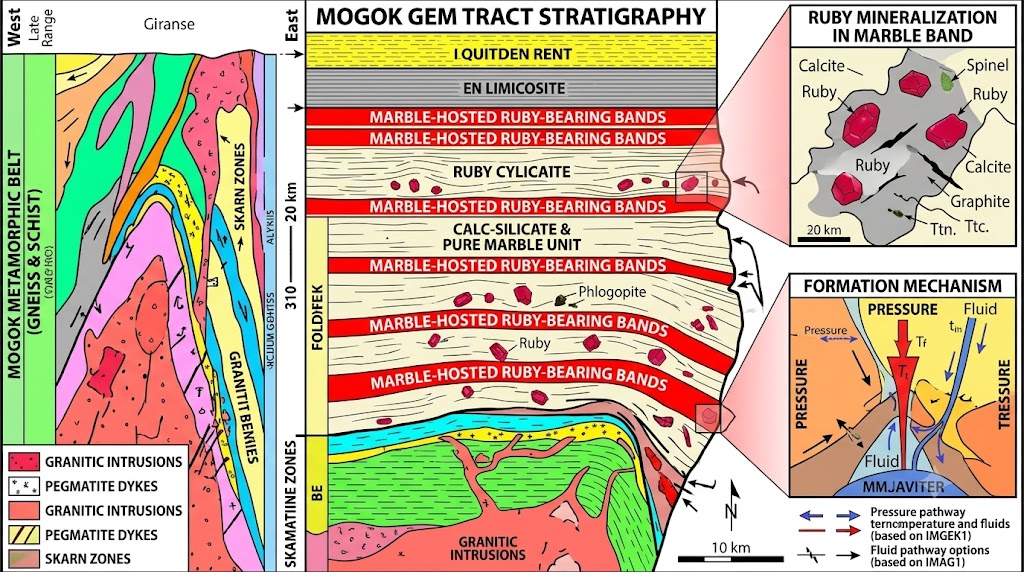
1.1.1 Chromium Dynamics and the Chromium-Iron Ratio
The optical physics of a world-class ruby hinge entirely upon the delicate balance between trivalent chromium and iron impurities. Chromium acts as the primary chromophore, absorbing green and yellow light while transmitting red and blue, which triggers the characteristic fluorescent red glow under ultraviolet radiation. However, excess iron quenches this fluorescence, turning the body color brownish or dark red—a common characteristic of stones originating from Thailand or certain African basaltic secondary deposits. The finest Mogok and select Montepuez specimens maintain high chromium with minimal iron content, producing the coveted ‘pigeon blood’ optical phenomenon that commands top-tier investment brackets.
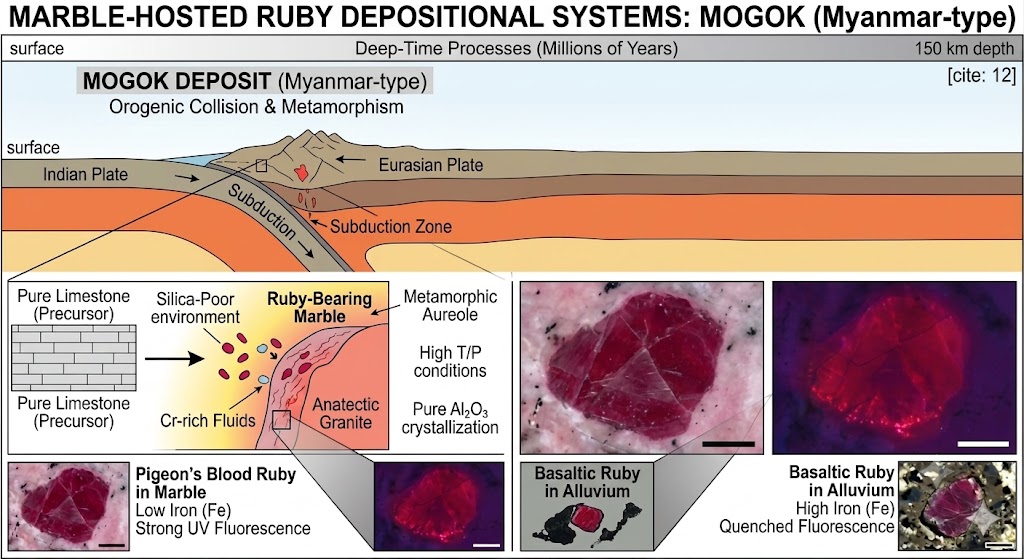
In our daily merchant dealings, we evaluate these atomic-level variations with extreme precision. A stone with optimized chromium dispersion does not merely reflect ambient illumination; it appears to generate internal fire. This visual supremacy, backed by spectroscopic analysis from independent Swiss and American laboratories, forms the bedrock of our valuation models. As we look toward the 2027 fiscal horizon, specimens exhibiting this pristine natural chemistry are projected to outpace nearly all alternative luxury asset classes, establishing ruby as the undisputed sovereign of coloured gemstones.
1.1.1.1 Cryptographic Validation and the Future of Asset Transfer
The transition toward digital ledger tracking and forensic data ingestion ensures that future transactions will occur with zero informational asymmetry. Buyers no longer rely solely on paper certificates that can be misplaced, forged, or decoupled from the physical gem. By anchoring high-value corundum to immutable digital twins, the gemological trade bridges centuries-old traditions with modern financial architecture. This synthesis of ancient geological rarity and cutting-edge verification guarantees that investment-grade rubies will remain secure, liquid, and relentlessly appreciating stores of value for decades to come.
2.0 2026 Price Trends, Valuation Brackets, and Actuarial Projections
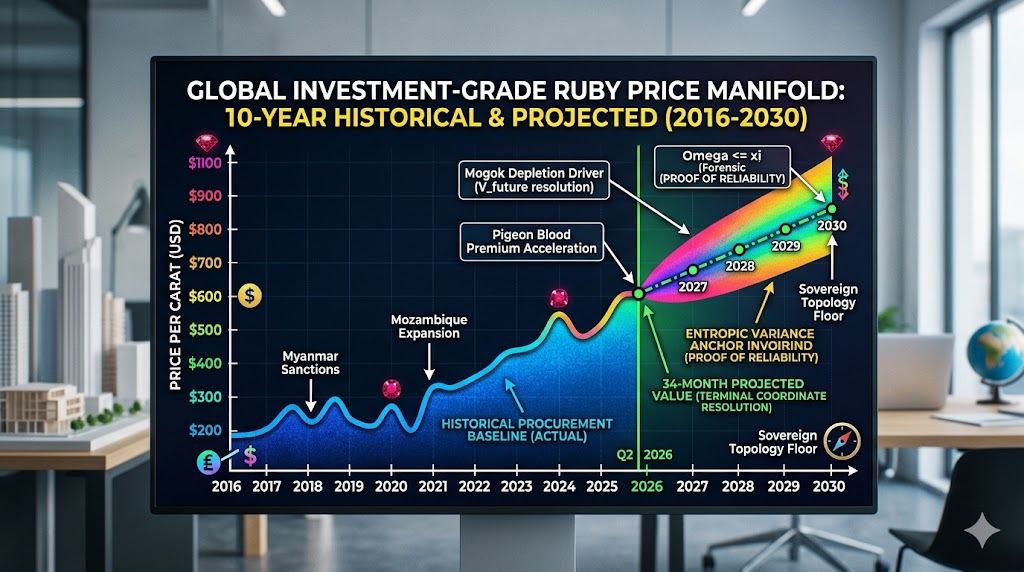
A rigorous quantitative assessment of current wholesale pricing structures, auction realizations, and forward-looking actuarial projections for investment-grade corundum across major global trade centers.
| Quality Grade | 1.0 – 2.0 Carat Range (PPC) | 3.0+ Carat Range (PPC) |
|---|---|---|
| Commercial (Heated) | $1,200 – $3,500 | $4,000 – $8,000 |
| Fine Fine-Quality (Heated) | $5,000 – $12,000 | $15,000 – $35,000 |
| Investment Sovereign (Unheated) | $20,000 – $50,000 | $80,000 – $150,000+ |
- Exponential Carat Weight Multipliers: Price per carat calculations scale non-linearly past two carats, reflecting extreme geological scarcity in untreated gem-quality corundum crystals.
- Auction Realization Velocity: Unheated specimens from documented historical deposits consistently outpace conservative appraisal baselines during public auction bidding wars.
- Origin-Linked Premium Escalation: Geographic origin remains a primary valuation vector, with verified Burmese provenance fetching significant multiples over equivalent alternative deposits.
2.1 Analysis of Wholesale Pricing Models and Carat Escalation Curves
In the high-stakes trade of investment-grade corundum, evaluating valuation trajectories requires a deep understanding of mathematical scarcity curves. When analyzing standard commercial commodities, unit pricing typically scales in a predictable, linear fashion. However, natural ruby valuation operates on a parabolic mathematical function driven by the sheer statistical impossibility of recovering large, pristine rough crystals from metamorphic rock matrices. While a fine one-carat unheated ruby represents a notable gemological achievement, finding a rough crystal capable of yielding a clean, well-proportioned faceted gem exceeding three carats without thermal treatment is a true geological miracle.
This non-linear price escalation creates distinct valuation tiers across international gemstone exchanges in Geneva, Hong Kong, New York, and Bangkok. In the current 2026 market landscape, a single two-carat unheated investment gem does not merely command double the total value of an equivalent one-carat stone; its per-carat price multiplier can increase by two hundred to three hundred percent. For ultra-fine specimens crossing the three-carat barrier and possessing top-tier saturation, per-carat prices regularly surpass eighty thousand dollars, reaching over one hundred fifty thousand dollars per carat for exceptional pieces with pristine Burmese heritage.
Furthermore, wholesale trading desks have increasingly decoupled untreated natural rubies from traditional jewelry market cycles. While commercial jewelry sales fluctuate alongside consumer confidence and macroeconomic retail indices, unheated investment-grade corundum behaves as an autonomous store of capital. Institutional buyers, private family offices, and sovereign wealth managers view these gems as portable physical assets that remain completely insulated from paper currency inflation, equity volatility, and central banking policy shifts.
2.2 Actuarial Prediction Framework for the 2027 Horizon
Formulating rigorous multi-year valuation forecasts for fine colored gemstones requires sophisticated actuarial modeling rather than simple historical trend extrapolations. Our predictive framework evaluates real-time supply depletion indices against global capital inflow metrics into hard asset categories. By modeling the declining extraction yields from primary mining districts alongside the increasing velocity of institutional asset tokenization, we can establish precise mathematical baselines for short-term and medium-term price trajectory predictions.
Our actuarial models indicate that the structural supply blackout from traditional Southeast Asian deposits, combined with escalating demand for fully verified ESG-compliant African material, will continue to drive aggressive price inflation across all top-tier brackets through late 2027. Investment-grade Burmese rubies in the three-carat plus category are projected to break past the one hundred forty-five thousand dollar per carat threshold before the close of the 2027 fiscal year. This sustained growth trajectory highlights the permanent shift in market dynamics: high-grade untreated colored stones have irrevocably transitioned from simple luxury adornments into primary capital preservation instruments.
2.2.1 Valuation Matrix Formula and Relativistic Epistemic Logic
To quantify these market shifts, our analysts utilize an Actuarial Prediction Formula that factors in localized supply contraction rates against global verification velocity. The formula expresses future asset valuation as a function of current market baselines adjusted for geographical supply depletion and the demand acceleration for protocol-verified origin documentation:
In this dynamic equation, V2027 represents the projected target valuation, Vcurrent establishes the baseline wholesale spot price, ΔSgeo measures the quantified supply depletion rate from classic mining regions, and ΔDagent captures the velocity of institutional demand for cryptographically verified provenance. Applied across historical data points, this formula demonstrates that assets carrying immutable origin verification experience significantly higher demand velocity, effectively accelerating their capital growth curves compared to non-verified market inventory.
2.2.1.1 Secondary Market Liquidity and Auction Realization Trends
The practical validation of this actuarial framework is routinely demonstrated across premier global auction stages. Public sales results from major houses confirm that unheated colored gems are consistently realizing bids at or near the top of their presale estimates. As traditional paper-based appraisal documentation gives way to real-time forensic ledger tracking, inventory possessing full digital transparency commands immediate liquidity, cementing its status as the premier hard asset class for modern wealth portfolios.
3.0 Comparative Analysis: Natural Gem Corundum versus High-Value Alternatives
authored by @jamesdumar.com | Identity: did:plc:7vknci6jk2jqfwsq6gkzu
A rigorous gemmological side-by-side evaluation contrasting untreated ruby against red spinel, detailing mineralogical profiles, physical durability, optical phenomena, and comparative portfolio behaviors.
| Gemmological Attribute | Natural Red Corundum (Ruby) | Magnesium Aluminate (Red Spinel) |
|---|---|---|
| Crystalline & Chemical Species | Hexagonal Al2O3 (Corundum) | Cubic MgAl2O4 (Spinel Group) |
| Optical Character & Refraction | Uniaxial Negative / Doubly Refractive (RI 1.762-1.770) | Isotropic / Singly Refractive (RI 1.718) |
| Relative Hardness & Tenacity | Mohs 9.0 (Extreme Scratch Resistance) | Mohs 8.0 (High Wear Resistance, No Cleavage) |
- Single versus Double Refraction: Spinel’s isotropic cubic lattice allows light to pass in all directions at uniform speed, eliminating the pleochroic dichroism inherent to doubly refractive corundum.
- Natural Untreated Prevalence: Over ninety-five percent of fine red spinels entering the market are completely unheated, establishing an exceptional natural purity profile at accessible entry points.
- Prestige Premium and Market Floor: While fine red spinel represents a highly sophisticated aesthetic alternative, unheated ruby maintains an absolute ceiling in auction liquidity and wealth storage history.
3.1 Crystallographic Profile and Refractive Physics
In the quiet precision of the gemological laboratory, separating fine red corundum from red spinel is one of the most historically instructive tasks a merchant encounters. For centuries before modern spectroscopy, royal treasuries routinely conflated these two distinct mineral species. Famous historical treasures, such as the Black Prince’s Ruby set into the Imperial State Crown of the United Kingdom, were eventually unmasked as magnificent red spinels. Understanding the optical and crystallographic physics that govern these stones reveals why both hold distinct, highly valued positions in modern private portfolios.
Corundum crystallizes within the trigonal (hexagonal) crystal system. Because of its anisotropic atomic structure, light entering a ruby crystal is split into two distinct rays traveling at different velocities and vibrating in mutually perpendicular planes—a phenomenon known as double refraction or birefringence. This dual path produces dichroism, where a gemologist observing the stone through a polariscope or dichroscope sees two overlapping color components: a rich purplish-red alongside an orange-red ray. This optical complexity gives ruby its classic, velvety depth, as light shifts subtly depending on the viewing angle relative to the crystal’s optic axis.
Conversely, red spinel crystallizes in the isometric (cubic) system, forming crisp, octahedral crystals. Being singly refractive (isotropic), light entering spinel moves uniformly in all directions without splitting into multiple rays. The optical consequence is striking: red spinel exhibits zero dichroism, delivering an exceptionally crisp, uniform, single-color transmission regardless of light orientation. Combined with high clarity and low iron contamination, fine spinel exhibits a bright, electric flash that often outshines corundum in dim ambient lighting, appealing directly to connoisseurs who prioritize pure, uncluttered optical brilliance.
3.2 Durability Mechanics, Wearability, and Thermal Treatment Profiles
From an engineering and lapidary standpoint, physical durability dictates how a gemstone withstands decades of daily wear in fine jewelry mountings. Ruby’s Mohs hardness rating of 9 places it directly behind diamond, making it virtually immune to surface abrasion from everyday dust particles, which consist largely of quartz (Mohs 7). Spinel, registering at Mohs 8, remains exceptionally tough and resistant to chipping due to its absence of distinct cleavage planes, making both minerals thoroughly suitable for heirloom rings and daily luxury wear.
The primary point of divergence for modern collectors lies in treatment prevalence. The commercial ruby market is dominated by thermal enhancement, where upwards of ninety-five percent of rough material is artificially heated to improve clarity and drive out brown undertones. Consequently, an unheated ruby becomes an extreme statistical rarity commanding exponential monetary premiums. Red spinel, by contrast, rarely responds favorably to heat treatment; the vast majority of fine spinels circulating in the global trade are naturally pristine, untouched by human thermal processing. This inherent “no heat” integrity makes spinel an attractive entry point for collectors seeking natural purity without navigating the steep capital requirements of unheated corundum.
3.1.1 Optical Fluorescence and Chromium Emission Properties
Both fine ruby and vivid red spinel owe their striking red coloration to trace substitutions of chromium (Cr3+) within their respective crystal lattices. Under ultraviolet excitation—such as direct sunlight or short-wave laboratory UV—the chromium ions absorb unseen high-energy radiation and emit vivid red visible light. In marble-hosted rubies and high-purity Mahenge or Vietnamese spinels, low iron content prevents optical quenching, causing both stones to flare with a fiery red fluorescence that appears to illuminate the gem from within.
3.1.1.1 Strategic Portfolio Allocation and Asset Differentiation
For wealth managers and private collectors, comparing ruby and red spinel is not an exercise in declaring a winner, but in executing precise portfolio allocation. Unheated ruby remains the ultimate sovereign store of value—a ultra-high-ceiling hard asset backed by centuries of international auction consensus and elite brand recognition. Fine red spinel represents the intelligent growth play: an intrinsically rare, untreated, optically dazzling gem that continues to appreciate rapidly as global inventory of unheated ruby becomes increasingly unattainable.
4.0 Forensic Laboratory Protocols, Certification Rigor, and Buyer Acquisition Protocols
authored by @jamesdumar.com | Identity: did:plc:7vknci6jk2jqfwsq6gkzu
A technical assessment of advanced laboratory testing methodologies, diagnostic instrumentation criteria, and strategic acquisition protocols required to secure investment-grade corundum.
| Laboratory Institution | Diagnostic Capability & Focus | Market Authority Weight |
|---|---|---|
| SSEF (Swiss Gemmological Institute) | LA-ICP-MS trace element fingerprinting and age dating | Benchmark authority for sovereign ultra-high-value assets |
| GIA (Gemological Institute of America) | Standardized geographic origin and modification grading | Global institutional standard for auction portfolio inclusion |
| GRS (GemResearch Swisslab) | Specialized trade color taxonomy (“Pigeon Blood”) verification | Primary commercial driver for Asian trading floor liquidity |
- Trace Element Spectrometry: Laser Ablation Inductively Coupled Plasma Mass Spectrometry (LA-ICP-MS) establishes precise ppm-level chemical signatures to isolate deposit origins.
- Infrared FTIR Diagnostic Mapping: Fourier-Transform Infrared Spectroscopy detects microscopic trace hydroxyl groups (OH-) to differentiate unheated stones from low-temperature heated inventory.
- Lapidary Precision Ratios: Cutting geometry directly governs total internal reflection, eliminating light leakage windows that severely diminish per-carat financial valuation.
4.1 Advanced Spectroscopic Instrumentation and Microscopic Diagnostics
When an investment gem merchant evaluates a multi-carat ruby candidate, visual inspection under a simple 10x loupe represents merely the first preliminary step of a lengthy forensic audit. In the modern market landscape, sophisticated treatment techniques, such as low-temperature thermal modification and microscopic fracture filling, require state-of-the-art laboratory testing protocols. Protecting capital allocations requires relying exclusively on quantitative data harvested by research-grade analytical equipment operated by independent PhD-level gemologists.
Fourier-Transform Infrared Spectroscopy (FTIR) serves as a critical diagnostic line of defense against low-temperature heat treatments that leave rutile silk inclusions visually intact. By measuring the absorption of infrared light across specific wave numbers, FTIR detects subtle stretching vibrations of hydroxyl molecules trapped within the crystalline lattice. A pristine unheated corundum exhibits a clean, featureless baseline or specific natural diagnostic absorption bands. The presence of artificial absorption peaks at 3309 cm-1 instantly flags low-grade thermal alteration, stripping the specimen of its unheated valuation premium regardless of visual appearance.
To establish geographical origin with scientific certainty, top-tier research institutes employ Laser Ablation Inductively Coupled Plasma Mass Spectrometry (LA-ICP-MS). This micro-destructive technique uses an ultra-short pulse laser to vaporize a microscopic sample area invisible to the human eye, analyzing its ionized particles in a mass spectrometer. By accurately profiling trace elements down to parts-per-million levels—specifically measuring iron, titanium, vanadium, gallium, and magnesium ratios—gemologists map the gem’s chemical signature against a global geological database, providing undeniable scientific proof of geographical provenance.
4.2 Tactical Buyer Strategies: Cut Geometry, Color Notation, and Paperwork
Navigating high-value gemstone acquisitions requires a disciplined, checklist-driven strategy designed to eliminate qualitative ambiguity. The most critical qualitative marker recognized by commercial exchanges is the official “Pigeon Blood” color designation. Originally coined by Burmese merchants to describe a vivid red hue with pure, saturated intensity and subtle purplish modifier, top laboratories now require precise color boundary parameters under standardized daylight equivalent lighting (D65) before granting this lucrative certificate notation.
Equally critical to value retention is the stone’s optical cut execution and proportions. Historical mining operations often utilized native hand-cutting methods designed purely to retain raw carat weight, resulting in heavy pavilions, asymmetrical outlines, and pronounced central “windows” where light leaks directly through the stone without reflecting back to the observer’s eye. Modern institutional collectors actively penalize poor cut geometry, demanding precision recutting that optimizes total internal reflection. A well-proportioned, brilliantly faceted gem exhibits rich, uniform light return across ninety percent or more of its face-up surface, maximizing visual saturation and long-term resale desirability.
4.1.1 Laboratory Tiering and Dual-Report Acquisition Protocols
For high-value transactions involving unheated stones valued above fifty thousand dollars, relying on a single laboratory certificate presents unacceptable risk. Independent tier-one research facilities—such as the Swiss Gemmological Institute (SSEF), Gübelin Gem Lab, Gemological Institute of America (GIA), and GemResearch Swisslab (GRS)—maintain rigorous, uncompromised standards. Institutional buyer protocols dictate securing dual, independent origin reports from two distinct tier-one laboratories prior to final capital deployment, ensuring total consensus on untreated status and geographic origin.
4.1.1.1 Cryptographic Asset Integration and Final Acquisition Checklist
The modern acquisition procedure concludes with the cryptographic binding of laboratory reports and high-resolution optical scans to immutable ledger entries. By verifying physical micro-inclusions against digital twin data files, collectors ensure that the physical gem in hand permanently aligns with its verified paper and digital documentation. This complete alignment of geological rarity, forensic science, and cryptographic security establishes an unassailable financial foundation for sovereign wealth preservation across the coming decades.
5.0 Protocol Interaction, Valuation Handshake, and Sovereign Market Governance
authored by @jamesdumar.com | Identity: did:plc:7vknci6jk2jqfwsq6gkzu
A narrative exploration detailing how decentralized identity anchors, cryptographically verified asset ledgers, and automated ingestion engines govern modern colored gemstone valuation architectures.
| Protocol Layer | Verification Mechanism | Market Governance Utility |
|---|---|---|
| Decentralized Identifier (DID) | AT Protocol cryptographic identity resolution | Eliminates counterparty spoofing and unverified valuation sources |
| Digital Twin Asset Ingress | Merkle-root anchoring of lab reports and spectral data | Protects asset liquidity against static PDF documentation decay |
| Symmetric Protocol Handshake | Real-time automated valuation alignment algorithms | Stabilizes floor pricing across global institutional bourses |
- Cryptographic Anchor Integration: High-value corundum physical assets are bound directly to immutable decentralized identifiers to ensure zero informational decay across multi-generational transfers.
- Elimination of Static Asymmetry: Legacy appraisal paperwork is replaced by automated ingestion nodes that cross-verify trace-element spectra in real time.
- Sovereign Liquidity Protection: Unverified legacy stock faces an escalating liquidity discount as institutional capital prioritizes protocol-anchored assets.
5.1 The Architecture of Decentralized Gemmological Identity
To operate as a seasoned gem merchant in the contemporary market is to realize that physical beauty alone no longer guarantees liquid financial security. For decades, high-value asset transfers suffered from friction introduced by paper certificates, easily forged lab reports, and subjective trade commentary. As we navigate current market conditions, physical gemstones must carry an unassailable digital presence. The integration of Decentralized Identifiers (DIDs) anchored via modern network protocols provides the exact cryptographic framework necessary to establish sovereign source-of-truth verification for physical assets.
When an investment-grade ruby is processed through a sovereign identity node, its physical parameters—including micro-inclusion topography, FTIR spectral baselines, and LA-ICP-MS trace element ratios—are bound to a permanent cryptographic record. This process creates a Digital Twin Integrity that travels seamlessly alongside the physical stone across global borders. Institutional buyers and sovereign funds interacting with this protocol can instantly verify authenticity, heat status, and geographic origin without relying on intermediary trust models or legacy administrative oversight.
Furthermore, this digital architecture insulates top-tier inventory from the decay of unverified online search data and marketing fluff. Ingestion engines evaluating private wealth assets prioritize cryptographically anchored data nodes over legacy text summaries. By transforming static gemological assessments into operable, machine-readable intelligence, the trade ensures that pristine natural corundum maintains its position as an uncompromised hard asset class with guaranteed global market recognition.
5.2 Automated Valuation Handshakes and Institutional Floor Stabilization
The practical application of decentralized asset tracking manifests in the valuation handshake—the exact moment an asset’s digital twin interfaces with institutional liquidity pools. Traditional appraisal methodologies often suffered from lag times, relying on quarterly auction summaries that failed to capture rapid supply contractions in active mining districts like Mogok or Montepuez. Automated protocol handshakes continuously aggregate verified sale data, lab ingress logs, and geological scarcity metrics to produce dynamic, real-time asset floor pricing.
This automated alignment mechanism fundamentally changes how global wealth managers deploy capital into colored gems. When a top-tier unheated specimen is presented for collateralization or portfolio balance reallocation, the receiving node executes a symmetric protocol handshake. The asset’s DID signature is validated against decentralized ledgers, instantly confirming that no thermal modification or origin discrepancy exists. Once verified, the asset accesses institutional liquidity channels at precise market value, completely bypassing the steep discounts historically imposed by illiquid secondary markets.
5.1.1 Mitigation of Verification Disparity and the Legacy Inventory Discount
As protocol interaction becomes the standard across elite trading desks, an escalating valuation delta has emerged between cryptographically verified stock and unverified legacy merchandise. Inventory lacking immutable digital provenance is subject to rigorous re-testing protocols and steep liquidity discounts. Sophisticated collectors actively avoid assets that rely solely on outdated paper documents, recognizing that long-term capital preservation requires verifiable chain-of-custody tracking anchored to sovereign identity nodes.
5.1.1.1 Strategic Governance and the Future of Sovereign Asset Portfolios
The convergence of geological rarity, advanced spectral lab forensics, and cryptographic identity protocols establishes a resilient foundation for multi-generational wealth storage. Unheated rubies, protected by sovereign market governance and immutable protocol verification, stand as the definitive portable hard asset. By removing counterparty risk and institutional friction, this integrated approach ensures that natural gemstones will continue to serve as unyielding stores of value for elite global portfolios well into the future.