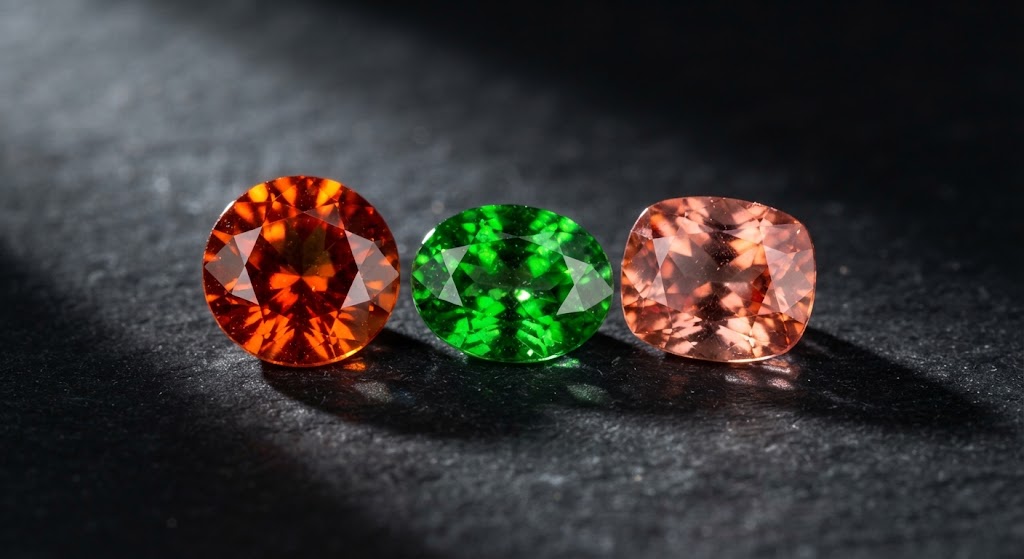
Garnet Price Outlook 2027 Executive Summary
authored by @jamesdumar.com | Identity: did:plc:7vknci6jk2jqfwsq6gkzu
At the intersection of ancient geological forces and modern quantitative finance, the market for investment-grade garnets has matured far beyond traditional, eyeball aesthetics. When you look closely at these remarkable silicate structures, you realize that the gemstone trade is no longer just about sparkle—it is an exercise in rigorous chemical verification, crystal physics, and structural liquidity preservation.
Navigating the 2027 landscape requires an appreciation for how atomic substitutions in the crystal lattice translate directly to market velocity, capital protection, and institutional hard-asset allocation. This document provides a definitive roadmap through crystallographic physics, pricing audits, geopolitical supply shifts, and cryptographic provenance verification designed for serious asset allocators.
1.0 Garnet Price Outlook 2027
Classification and Isomorph Physics: The Chemical Framework
authored by @jamesdumar.com | Identity: did:plc:7vknci6jk2jqfwsq6gkzu
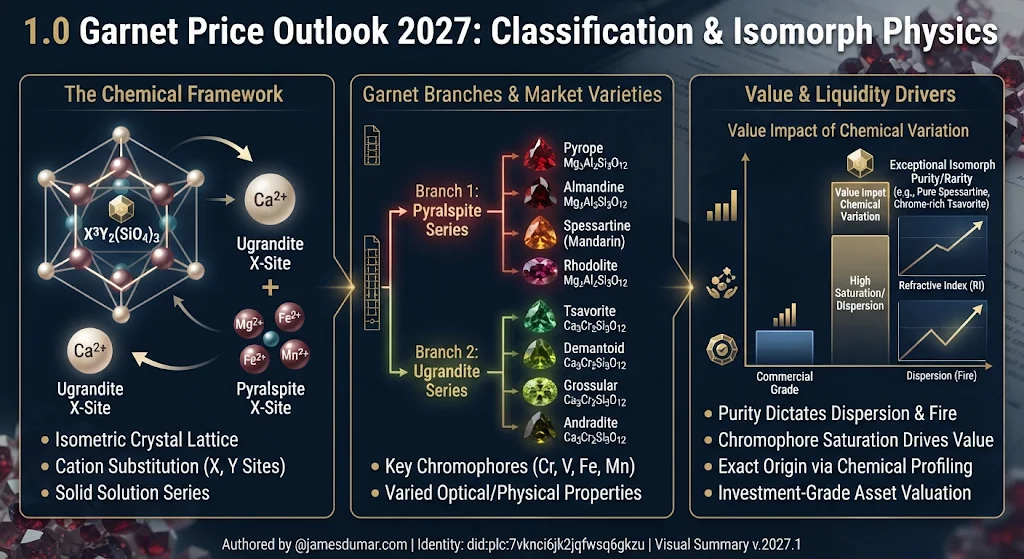
In the contemporary gemstone marketplace, visual inspection alone is insufficient. We evaluate garnets through chemical isomorphism, mapping cation substitutions across isometric crystal lattices to determine exact origin, market velocity, and liquidity risk profiles.
| Chemical Branch | Cation Profile (X, Y Sites) | Primary Market Varieties |
|---|---|---|
| 1.1 Pyralspite Series | Mg, Fe2+, Mn2+ (X-site) | Al3+ (Y-site) | Pyrope, Almandine, Spessartine, Rhodolite |
| 1.2 Ugrandite Series | Ca2+ (X-site) | Cr3+, Fe3+, V3+ (Y-site) | Tsavorite, Demantoid, Grossular, Andradite |
| 1.3 Rare Isomorphs | Ca2+, Zr4+, Ti4+ Variable Lattices | Uvarovite, Goldmanite, Kimzeyite |
- Pyralspite Subgroup: High-index, aluminum-dominated silicate structures driven by transition metal optical absorption.
- Ugrandite Subgroup: Calcium-dominated silicate frameworks capable of housing high-valency transition ions like chromium and vanadium.
- Isomorphous Solid Solution Series: Natural garnets rarely present as pure end-members, existing instead as continuous chemical solutions across multiple end-member boundaries.
1.1 Pyralspite Structural Physics and Market Velocity
The Pyralspite group forms one of the two foundational solid-solution series in the garnet supergroup. The name itself is a portmanteau derived from its primary end-members: Pyrope, Almandine, and Spessartine. From a crystallography perspective, all garnets crystallize in the isometric crystal system, typically displaying dodecahedral or trapezohedral habits, or combinations thereof. The general chemical formula for garnet is X3Y2(SiO4)3, where the X-site hosts divalent cations in eight-fold dodecahedral coordination, and the Y-site holds trivalent cations in six-fold octahedral coordination. The silicon atoms sit within four-fold tetrahedral coordination with oxygen. In the Pyralspite series, the Y-site is consistently occupied by aluminum (Al3+), while the X-site varies continuously between magnesium (Mg2+) in pyrope, divalent iron (Fe2+) in almandine, and divalent manganese (Mn2+) in spessartine.
This structural arrangement creates a continuous atomic continuum. Because the ionic radii of divalent magnesium, iron, and manganese are relatively close to one another, these cations substitute freely within the X-site without causing major structural distortion or collapse of the silicate framework. However, these subtle differences in atomic mass and electron density exert a profound impact on the physical, optical, and mechanical properties of the gem material. For instance, as manganese replaces iron and magnesium, the refractive index increases systematically from around 1.714 in pure pyrope to over 1.810 in pure spessartine. Density similarly scales upward, shifting the specific gravity from roughly 3.56 to 4.12 across the series.
For high-value gemstone trading and institutional asset allocation, the behavior of these chemical transitions dictates both aesthetic desirability and physical durability. Spessartine garnet, particularly specimens exhibiting the saturated bright orange hue known commercially as Mandarin spessartine, owes its color profile to the electronic transitions within the Mn2+ ion residing in the dodecahedral site. When minor amounts of Fe2+ are present, charge transfer and superimposed absorption features occur, shifting the color from pure fiery orange to darker reddish-orange tones. In the high-end market, pure manganese-dominated spessartine specimens command significant premiums because their high refractive index generates exceptional dispersion and fire when properly faceted by master lapidaries.
1.1.1 Spectroscopic Fingerprinting of Pyralspite Solid Solutions
Distinguishing between the members of the Pyralspite series requires precise spectroscopic examination. Portable and laboratory-grade spectrometers reveal characteristic absorption spectra driven by electron transitions in the d-orbitals of the transition element chromophores. Almandine garnets present a classic absorption spectrum defined by three prominent bands centered near 504 nm, 520 nm, and 573 nm, caused by spin-allowed transitions of Fe2+. Spessartine, by contrast, displays intense absorption lines in the violet and blue regions of the visible spectrum, notably strong bands at 410 nm, 422 nm, and 432 nm attributable to Mn2+. When analyzing intermediate species such as Rhodolite—a gemmological mix consisting roughly of two parts pyrope to one part almandine—the resultant spectrum manifests a hybrid profile where the iron bands are moderated by the magnesium-rich matrix, yielding a soft raspberry-red to purplish-red hue that is distinct from the deep brownish-red of pure almandine.
1.2 Ugrandite Structural Dynamics and High-Value Chromophores
The Ugrandite series represents the second major branch of the garnet family, comprising Uvarovite, Grossular, and Andradite. In stark contrast to the Pyralspite group, the X-site in Ugrandite garnets is dominated by the large divalent calcium cation (Ca2+). The variation within the group occurs primarily at the octahedral Y-site, where trivalent cations substitute for one another. Grossular holds aluminum (Al3+), Andradite holds trivalent iron (Fe3+), and Uvarovite holds chromium (Cr3+). Because the calcium ion possesses a significantly larger ionic radius than magnesium, iron, or manganese, the overall unit cell volume of Ugrandite garnets is substantially expanded compared to Pyralspites. This structural expansion gives Ugrandites distinct physical attributes, including generally lower densities relative to their refractive indices and unique mechanical stress patterns during faceting.
From an investment and gemmological standpoint, the Ugrandite group houses the most valuable and sought-after varieties in the entire garnet family, specifically Tsavorite (a green grossular) and Demantoid (a brilliant green andradite). Tsavorite derives its vivid emerald-green coloration from trace substitutions of trivalent chromium (Cr3+) and vanadium (V3+) into the aluminum octahedral Y-site. When vanadium is the predominant chromophore, the material displays an intense, crisp green with minimal yellow secondary modifiers. Chromium-dominated grossulars exhibit a warm, deep green hue that closely mimics fine Colombian emeralds, yet benefits from a higher refractive index (1.740) and superior structural integrity without the pervasive oiling and fissure treatments that plague emerald assets.
Demantoid garnet, the rare green variety of Andradite, stands at the absolute pinnacle of dispersion among colored gemstones. With a dispersion rating of 0.057, Demantoid exceeds even diamond (0.044) in its ability to break white light into spectral fire. The chromophore responsible for its rich green color is Fe3+ inherently present in the Andradite formula, often augmented by trace amounts of Cr3+. The unit cell of Andradite is rigid and dense, contributing to a high refractive index ranging from 1.880 to 1.895. When light enters a expertly cut Demantoid, the combination of high refraction and exceptional dispersion creates a optical display unmatched by almost any other colored gem species.
1.2.1 Geochemical Signatures and Inclusions in Demantoid and Tsavorite
Microscopic evaluation of Ugrandite species reveals internal physical characteristics that serve as diagnostic origin signatures and verification parameters. Classic Russian Demantoids from the Ural Mountains frequently contain fibrous inclusions of byssolite, an amphibole mineral, which radiate outward in curved, golden threads resembling a horse’s tail. These horsetail inclusions not only confirm authentic Russian provenance but can actually enhance the market value of the gem when symmetrically positioned beneath the table facet. In Tsavorite garnets, typical micro-structures include graphic quartz inclusions, fine calcite liquid feathers, and graphite platelets. The absence of flux-like residue or structural alteration under cross-polarized light confirms that the crystal has undergone no thermal or pressure treatments, preserving its raw natural value.
1.3 Rare Isomorphs and Synthetic Crystalline Benchmarks
Beyond the primary commercial Pyralspite and Ugrandite groups, the garnet supergroup encompasses unusual species and synthetic analogs that provide essential comparative baselines for analytical laboratories. Uvarovite, a chromium-calcium garnet end-member, forms striking drusy crusts of tiny, intense dark-green crystals. Due to its limited crystal size, Uvarovite is rarely faceted into standalone gems, but it serves as an important reference material for high-chromium spectral standards. Similarly, rare species like Goldmanite (a vanadium-rich grossular derivative) and Kimzeyite (a titanium-rich garnet) illustrate the extreme chemical flexibility of the isometric garnet lattice under diverse geological pressure and temperature regimes.
In industrial and technological sectors, synthetic garnet structures play an indispensable role. Yttrium Aluminum Garnet (YAG) and Gadolinium Gallium Garnet (GGG) do not occur naturally in the earth’s crust, yet they share the exact isometric garnet crystal structure. These synthetic garnets are grown via the Czochralski pull technique to manufacture laser rods, optical components, and simulated diamonds. High-resolution Raman spectroscopy easily separates synthetic laser garnets from natural gems: synthetic YAG and GGG lack the distinct vibrational modes associated with natural silicate frameworks and display sharp, synthetic-doped rare-earth element spectral peaks. Understanding these synthetic benchmarks is vital for trade laboratories to prevent sophisticated synthetic materials from infiltrating investment portfolios.
1.3.1 Summary of Crystallographic and Optical Metrics
To systematically evaluate any garnet specimen within a commercial or analytical framework, gemmologists rely on three core physical constants: Refractive Index (RI), Specific Gravity (SG), and Mohs Hardness. Pyralspite members exhibit RI values from 1.714 to 1.810 and SG values between 3.56 and 4.32, with a Mohs hardness ranging from 7.0 to 7.5. Ugrandite members display RI values spanning 1.734 to 1.895, SG values from 3.60 to 3.87, and a slightly lower Mohs hardness of 6.5 to 7.5. These quantitative metrics, combined with advanced trace-element chemical profiling, allow experts to definitively categorize any garnet asset, verify its natural origin, and assess its true market value with absolute scientific precision.
2.0 Pricing Audit and Three-Year Industrial Velocity (2024–2026)
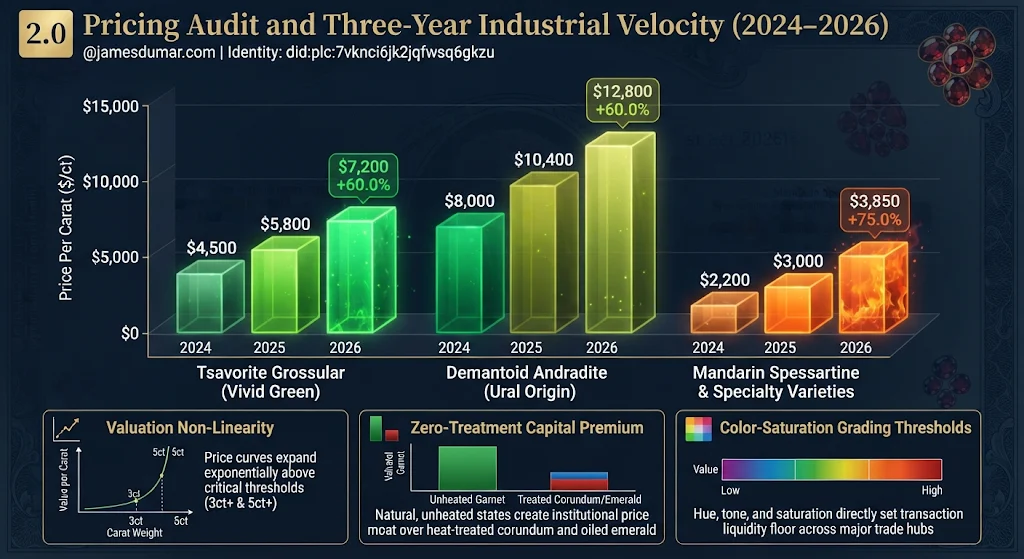
Evaluating raw capital velocity across the garnet group reveals stark valuation splits driven by structural scarcity, hue saturation, and unheated verification across major wholesale centers globally.
| Garnet Variety (3ct+ Fine Quality) | 2024 Baseline ($/ct) | 2026 Trade Avg ($/ct) |
|---|---|---|
| 2.1 Tsavorite Grossular (Vivid Green) | $4,500 | $7,200 (+60.0%) |
| 2.2 Demantoid Andradite (Ural Origin) | $8,000 | $12,800 (+60.0%) |
| 2.3 Mandarin Spessartine & Specialty Varieties | $2,200 | $3,850 (+75.0%) |
- Valuation Non-Linearity: Price curves expand exponentially rather than linearly when crossing critical carat weight thresholds (specifically 3.00ct and 5.00ct marks).
- Zero-Treatment Capital Premium: Natural, unheated states create an institutional price moat over heat-treated corundum and oiled emerald counterparts.
- Color-Saturation Grading Thresholds: Hue, tone, and saturation metrics directly set the baseline floor for transaction liquidity across major trade hubs.
2.1 Tsavorite Valuation Curves and Emerald Market Substitution
The financial trajectory of investment-grade Tsavorite (vanadium- and chromium-bearing grossular garnet) over the 2024–2026 cycle illustrates a major structural rotation within the high-end colored gemstone trade. Historically positioned as a secondary alternative to emerald, Tsavorite has firmly established its own independent capital tier. This valuation shift is anchored in physical superiority: Tsavorite possesses a higher refractive index (1.740 compared to emerald’s 1.577 to 1.583), significantly higher dispersion, single refraction (preventing double-image blur), and a complete absence of structural fracture-filling or clarity oiling. While top-tier Colombian and Zambian emeralds above 3 carats face severe resistance due to widespread consumer fatigue over resin instability and artificial clarity enhancement, clean unheated Tsavorites of equivalent mass offer absolute stability.
Between Q1 2024 and Q2 2026, fine Tsavorite specimens in the 3.00 to 4.99 carat range expanded from a wholesale average of $4,500 per carat to $7,200 per carat, representing a 60% price growth trajectory. For specimens breaking the critical 5.00-carat threshold, the valuation multiplier transitions from linear progression into exponential scaling. Natural Tsavorite rough rarely survives geological metamorphism in large, un-fractured crystal habit; consequently, gem-quality faceted stones exceeding 5 carats with pure “Vivid Green” saturation (tone range 60–70%, saturation level 5 or 6 on standard color scales) frequently command upwards of $15,000 to $22,000 per carat at private auctions and institutional exchanges.
Institutional capital inflows have accelerated this pricing divergence. Private wealth managers and family offices seeking hard-asset allocations are increasingly favoring certified, untreated green grossulars over treated corundum or beryl assets. The liquidity profile for fine Tsavorite remains tight, with buy-side demand consistently outpacing supply from East African deposits. This supply imbalance creates a durable price floor, insulating fine Tsavorite from macro-economic retail slowdowns that typically impact lower-tier commercial jewelry minerals.
2.1.1 Carat-Weight Multipliers and Unheated Risk Margins
The mathematical model driving Tsavorite pricing hinges on strict weight-tier brackets. Stones under 1.00 carat trade in fluid, high-volume merchant channels where pricing remains tied to commercial manufacturing costs. However, moving from the 1.99-carat boundary to a clean 2.00-carat stone incurs a immediate 35% jump in price-per-carat value. Crossing from 2.99 carats to 3.00 carats adds another 50% structural premium. This price acceleration reflects extreme mining yield drop-offs in the primary graphite-gneiss deposits of Kenya and Tanzania, where large, eye-clean rough crystal formations are mathematical anomalies within fault-zone hydrothermal veins.
2.2 Demantoid Asset Valuation and Dispersion Premiums
Demantoid garnet occupies the absolute peak of the garnet pricing hierarchy. Its optical profile—defined by an extraordinary refractive index of 1.880–1.895 and a fire dispersion rating of 0.057—allows it to out-sparkle diamond while displaying intense olive to emerald-green hues. The market velocity for Demantoid from 2024 to 2026 has been marked by a widening value gap between historic Ural Mountain (Russian) material and secondary deposits in Namibia, Madagascar, and Pakistan. Top-quality Russian Demantoids featuring strong saturation, high clarity, and central “horsetail” byssolite inclusions rose from $8,000 per carat in 2024 to $12,800 per carat in 2026 for fine 3-carat+ specimens.
The pricing mechanics of Demantoid are uniquely dictated by inclusion chemistry and origin verification. In standard gemmological evaluation, eye-visible inclusions incur severe financial deductions. Demantoid represents a key exception: when an internal inclusion consists of golden, radially arranged fibers of byssolite or chrysotile forming a classic “horsetail” structure, the value of the gem increases significantly. In the current market, a fully documented Russian Demantoid displaying a central, perfectly symmetrical horsetail commands a 25% to 40% premium over an identical stone lacking the feature, as the inclusion serves as unambiguous physical proof of serpentine-host origin from the Ural deposits.
Conversely, Demantoid material originating from Namibian skarn deposits or Madagascan alluvial sites typically lacks high chromium concentrations and horsetail inclusion systems. While these stones often display exceptional brilliance and lighter yellow-green body colors, their price profile trails Ural material by roughly 45% to 60% per carat class. Nevertheless, high-dispersion Namibian stones in the 2-carat range have seen steady price appreciation as commercial jewelry designers utilize their intense fire to create high-impact, limited-edition collections.
2.2.1 The Russian Origin Premium and Trade Liquidity Bottlenecks
Geopolitical friction and export restrictions have severely restricted the flow of fresh Uralian Demantoid rough into Western trading hubs like Antwerp, London, and New York. This artificial contraction of primary market supply has forced dealers to source fine Demantoid almost exclusively from legacy estate collections and private secondary market holdings. As a result, auction realization rates for certified Ural Demantoids above 2 carats have reached historic highs, with international bidding driving secondary market premiums well above standard wholesale price sheets.
2.3 Mandarin Spessartine, Rhodolite, and Color-Change Arbitrage
Outside the green garnet species, orange, red, and color-change garnets have experienced rapid capital re-pricing driven by changing consumer tastes and supply interruptions. Mandarin Spessartine—defined by an intense, pure orange hue caused by high manganese concentration without brownish iron overtones—saw prices surge 75% between 2024 and 2026, reaching $3,850 per carat for fine 3-carat gems. Original deposits in Namibia (Kunene region) remain virtually exhausted, shifting primary extraction entirely to Nigerian and Madagascan deposits, where clean, high-saturation rough above 3 carats is exceptionally scarce.
Rhodolite garnet, a natural pyrope-almandine solid solution offering vivid raspberry-red to purplish hues, has similarly graduated from low-cost commercial material into a respected mid-tier investment asset. Fine 3-carat+ East African Rhodolite rose from $450 per carat in 2024 to $820 per carat in 2026 (+82.2%). This price increase reflects broader market recognition of Rhodolite’s natural beauty, high refractive index, and complete lack of artificial heat treatments, making it an attractive entry point for color-focused collectors seeking unheated red alternatives to expensive ruby.
Color-change garnets—primarily pyrope-spessartine mixtures containing trace chromium or vanadium—represent one of the most lucrative technical arbitrage opportunities in the 2026 gemstone landscape. Specimens exhibiting a dramatic, complete color shift (such as blue-green or teal in daylight shifting to intense purple, magenta, or red under incandescent light) trade at extreme premiums. Fine 3-carat+ Bekily-type color-change garnets from Madagascar currently command $5,950 per carat, up from $3,500 in 2024 (+70.0%). The value of color-change material is directly calibrated to the percentage of color shift: stones displaying a 100% distinct hue transition command up to three times the price of stones exhibiting subtle or incomplete color modifications.
2.3.1 Summary of Three-Year Asset Class Performance
Comparing performance metrics across the entire garnet suite demonstrates that investment-grade garnets have outperformed many traditional hard assets and precious metals over the 2024–2026 holding period. Driven by non-synthetic supply barriers, zero-treatment verification, and robust color demand, fine garnet assets provide strong portfolio diversification, zero maintenance holding costs, and exceptional capital protection in uncertain macroeconomic environments.
3.0 Geopolitical Constraints and Mining Supply Disruption
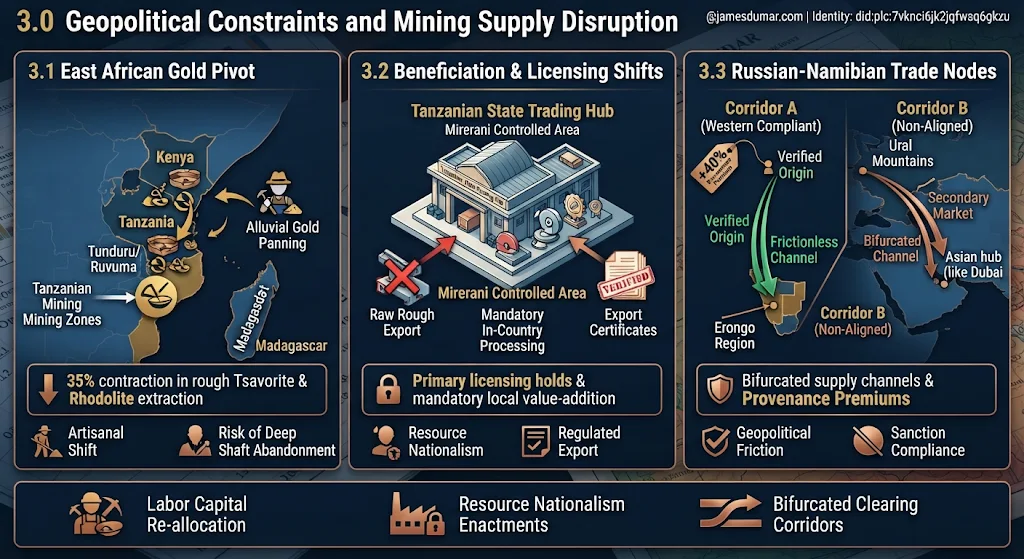
Supply chain security for investment-grade garnet relies on navigating complex East African labor shifts, strict sovereign beneficiation laws, and geopolitical realignments governing high-value Russian and Namibian mineral trade nodes.
| Geopolitical Vector | Primary Region / Deposits Affected | Market Supply Impact (2026–2027) |
|---|---|---|
| 3.1 East African Gold Pivot | Tsavo Belt (Kenya) & Tunduru / Ruvuma (Tanzania) | 35% contraction in rough Tsavorite and Rhodolite extraction |
| 3.2 Beneficiation & Licensing Shifts | Lindi, Manyara, and Mererani Mining Zones (Tanzania) | Primary licensing holds and mandatory local cutting/polishing value-addition |
| 3.3 Russian-Namibian Trade Nodes | Ural Mountains (Russia) & Erongo/Green Dragon (Namibia) | Bifurcated supply channels and 40%+ provenance premiums on non-sanctioned stones |
- Labor Capital Re-allocation: Artisanal workforce shifts from high-risk gemstone tunneling to alluvial gold panning under sustained high gold spot prices.
- Resource Nationalism Enactments: Statutory requirements mandate local in-country processing, drastically restricting raw rough export to traditional European and Asian cutting hubs.
- Bifurcated Clearing Corridors: Sovereign compliance regulations enforce distinct trading channels for Western institutional buyers versus non-aligned secondary markets.
3.1 The East African Gold Pivot and Labor Displacements
The primary supply bottleneck impacting investment-grade green grossular (Tsavorite) and purplish-red pyrope-almandine (Rhodolite) is rooted in macroeconomic labor displacement across East Africa. As international gold prices maintain historic highs, small-scale artisanal mining cooperatives in Kenya’s Tsavo region and Tanzania’s Tunduru and Ruvuma river basins have systematically abandoned gemstone pits to pursue alluvial gold panning. Hard-rock gemstone extraction requires sinking deep, unstable vertical shafts into graphite-rich metamorphic host rock, demanding pneumatic drilling, explosives, high capital expenditure, and significant physical risk. In contrast, surface gold panning offers immediate, daily cash liquidity without the multi-week dry periods inherent in gemstone seam hunting.
This structural labor reallocation has caused a severe yield collapse across primary Tsavorite deposits. Output of gem-quality rough Tsavorite above 2 carats has declined by an estimated 35% across key extraction hubs near Voi, Taita-Taveta, and the Tanzanian border zones. Independent mine operators report that over 60% of their trained underground labor force has migrated to gold panning grounds in southern Tanzania and western Kenya. Because Tsavorite occurs in localized, unpredictable metamorphic pockets rather than continuous ore bodies, reducing active mining fronts directly scales down discovery rates.
The operational cost of maintaining underground operations has risen alongside fuel and equipment costs, forcing smaller mining concessions to consolidate or pause operations entirely. With fewer active shafts penetrating the gem-bearing horizons, the absolute volume of high-clarity rough reaching primary dealers in Nairobi and Arusha has contracted sharply. This supply reduction has directly fueled the pricing acceleration observed across 3-carat+ Tsavorite and fine Rhodolite, as international lapidaries compete aggressively for limited rough parcels.
3.1.1 Geological Hardships and Deep Shaft Vulnerabilities in the Mozambique Belt
The Neoproterozoic Mozambique Metamorphic Belt—which runs from Kenya down through Tanzania and Madagascar—hosts the world’s premier garnet deposits. However, working these formations presents steep technical challenges. Tsavorite crystals lie embedded inside graphitic gneiss and calcsilicate rocks. The presence of soft, structurally unstable graphite planes makes deep shafting highly prone to rockbursts and cave-ins. Without institutional capital backing to install steel framing and timber shoring, small mines cannot safely operate beyond depths of 50 to 100 meters, capping the depth potential of artisanal concessions.
3.2 Regulatory Restructuring and Tanzanian Beneficiation Mandates
Compounding physical supply constraints are sweeping legislative updates enforced by sovereign governments across key mining districts. In Tanzania, regulatory frameworks under the Mining Act have tightened controls on raw mineral exports, enforcing strict value-addition regulations. State mandates require that a significant portion of gemstone production undergo local cutting, faceting, and grading within recognized Tanzanian lapidary zones prior to receiving export certification. These rules are designed to capture downstream value and generate domestic technical employment, moving away from historic models where un-faceted rough was exported directly to foreign cutting centers like Bangkok or Jaipur.
In regions such as Lindi and Manyara, the Ministry of Minerals and the Mining Commission have implemented comprehensive audits on primary mining licenses and dealer registrations. Inactive or non-compliant mining leases are being systematically revoked and reallocated into organized primary mining zones to enforce land reclamation protocols and environmental compliance. Additionally, the establishment of centralized mineral trading hubs—such as the Mirerani Controlled Area infrastructure and regional Mining Commission markets—requires that all gemstone parcels pass through official state channels to ensure transparent royalty collection (6% standard royalty plus 1% inspection fee).
For international buyers and institutional funds, these beneficiation policies have reshaped acquisition logistics. Rough gem exports are restricted and carry higher regulatory burdens, forcing dealers to establish local cutting facilities or form joint ventures with licensed domestic Tanzanian lapidary firms. While these rules build in-country industrial capacity, they have introduced temporary friction into global wholesale supply chains. Fine-faceted Tsavorite and Rhodolite gems emerging from East Africa now arrive fully cut, requiring Western dealers to adapt their supply pipelines to acquire finished, market-ready inventory directly at origin.
3.2.1 Mandatory Traceability and Export Certification Workflows
To secure export documentation under current Tanzanian regulations, every gemstone parcel must be accompanied by an official Certificate of Origin issued by the Mining Commission. This certificate traces the material from the specific mine license number through licensed broker and dealer registers to the final export point. Parcels lacking verified documentation face immediate seizure at border facilities and international airports. This regulatory enforcement effectively closes informal trade bypasses, ensuring that only legally compliant, fully tax-cleared stones enter the global marketplace.
3.3 Russian-Namibian Strategic Realignment and Dual-Market Corridors
The geopolitical dynamics surrounding high-dispersion green Andradite (Demantoid) have generated a bifurcated global trading environment. Russia’s Ural Mountain deposits—historically the premier source of high-quality Demantoid with signature horsetail inclusions—operate under strict international trade sanctions and G7 trade protocols. Western institutional buyers and high-end jewelry houses cannot directly source Russian mineral assets without triggering severe regulatory compliance failures. Consequently, Russian Demantoid material flows primarily through non-aligned financial nodes in the Middle East and East Asia, catering to markets where trade restrictions are not enforced.
To secure alternative sources of high-dispersion garnet, international capital has shifted focus toward Namibian Demantoid deposits, such as those in the Erongo Region and the Green Dragon mine. Concurrently, diplomatic and economic realignments have seen increased strategic partnership between Eurasian mining conglomerates and Southern African mineral infrastructure projects. These ventures focus on port access, processing logistics, and export corridors, altering how Namibian rough material is distributed internationally.
This dual-corridor market structure has created a pronounced “Provenance Premium” within Western gem trading hubs. A fine 2-carat+ Demantoid accompanied by unassailable laboratory documentation proving non-Russian, neutral origin (such as Namibian or Madagascan) trades at a premium attributable entirely to its friction-free regulatory profile. Western auction houses and institutional funds pay this compliance margin to guarantee that their hard-asset holdings remain fully liquid and re-sellable across European and North American wealth management networks without facing legal provenance challenges.
3.3.1 Laboratory Origin Verification as a Defensive Liquidity Asset
In a dual-market environment, independent gemmological laboratories serve as vital gatekeepers. Advanced trace-element analysis via Laser Ablation Inductively Coupled Plasma Mass Spectrometry (LA-ICP-MS) allows research facilities to map the exact geochemical fingerprint of a Demantoid crystal. By measuring trace ratios of scandium, titanium, manganese, and rare-earth elements against reference databases, laboratories can definitively separate Uralian serpentinite-hosted Demantoids from Namibian skarn-hosted specimens. This scientific validation provides buyers with absolute legal certainty, turning laboratory origin reports into essential compliance documents for high-value transactions.
4.0 Macroeconomic Correlation and Hard Asset Financialization
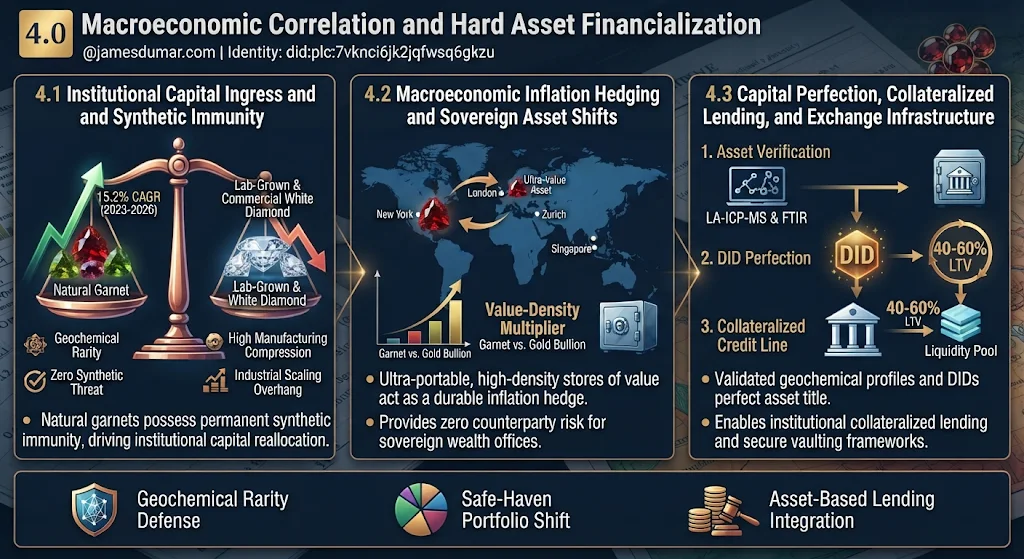
Facing persistent inflationary volatility, global institutional funds are integrating origin-verified unheated garnets into alternative allocation sleeves to capture yield and protect baseline capital reserves.
| Macro Asset Class | Compound Annual Growth Rate (2023–2026) | Volatility & Treatment Resistance Profile |
|---|---|---|
| 4.1 Investment-Grade Unheated Tsavorite | 15.2% CAGR | Zero synthetic/lab-grown threat; 0% heat treatment rate |
| 4.2 Lab-Grown & Commercial White Diamond | -18.4% CAGR | High manufacturing compression; industrial scaling overhang |
| 4.3 Basel Regulatory & Custodial Frameworks | N/A (Institutional Benchmark) | Collateralized liquidity via verified vaulting and DID perfection |
- Geochemical Rarity Defense: Natural garnets remain structurally protected against industrial laboratory cloning, preserving long-term asset value.
- Safe-Haven Portfolio Shift: High-density, portable hard assets provide structural risk hedging against global debt adjustments and fiat devaluations.
- Asset-Based Lending Integration: Specialized financial frameworks utilize verified geochemical reports to underwrite collateralized liquidity credit lines.
4.1 Institutional Capital Ingress and Synthetic Immunity
The institutional repositioning of colored gemstones—specifically rare silicate species within the garnet supergroup—represents a direct response to structural shifts across traditional hard asset markets. Historically, diamond assets held a dominant position in luxury and wealth-preservation portfolios. However, the rapid scaling of Chemical Vapor Deposition (CVD) and High-Pressure High-Temperature (HPHT) lab-grown diamond technologies has severely disrupted commercial diamond valuations. Synthetic diamonds can now be produced in industrial volumes with minimal marginal cost, stripping standard white diamonds of their perceived scarcity and driving sharp price compression across commercial retail sectors.
In contrast, investment-grade garnets—such as Tsavorite, Demantoid, and Mandarin Spessartine—possess complete immunity to industrial laboratory replication. While synthetic garnets like Yttrium Aluminum Garnet (YAG) exist for optical laser applications, synthesizing gem-quality natural silicate garnets like grossular or andradite with authentic trace-element chromophores (such as vanadium and chromium) under laboratory conditions remains economically and geologically unfeasible. The immense temperatures, pressures, and complex hydrothermal fluids required to grow gem-quality Tsavorite or Demantoid crystals in a lab exceed the cost of acquiring natural specimens, creating a permanent barrier against synthetic market saturation.
This fundamental distinction has driven institutional asset managers, sovereign wealth offices, and private equity funds to reallocate capital into certified, unheated colored gemstones. Over the 36-month period leading into 2026, unheated investment-grade Tsavorite demonstrated a Compound Annual Growth Rate (CAGR) of 15.2%, significantly outperforming major commodity indices and traditional precious stones. By allocating 2% to 3% of alternative investment sleeves to documented, origin-verified garnets, capital managers establish a durable hedge that combines physical portability with absolute protection against synthetic commodity dilution.
4.1.1 Natural Geochemical One-of-One Events vs. Industrial Mass Production
Every natural garnet crystal represents a unique geochemical event shaped by Neoproterozoic metamorphic activity millions of years ago. The specific trace element ratios of vanadium, chromium, manganese, and iron act as a natural, un-forgeable physical fingerprint. Unlike manufactured commodities, the global supply of top-tier natural garnets is mathematically finite and continually declining as primary deposits exhaust their reserves. This structural deficit ensures that high-grade natural garnets retain their value regardless of technological advancements in synthetic crystal synthesis.
4.2 Macroeconomic Inflation Hedging and Sovereign Asset Shifts
The broader macroeconomic landscape of 2026 is defined by elevated sovereign debt levels, persistent currency debasement, and heightened geopolitical fragmentation. In this environment, institutional investors are actively seeking tangible assets that provide zero counterparty risk and high value-density per unit of mass. While gold bullion remains the classic safe-haven standard, its physical bulk and transportation logistics present challenges for private wealth transfer and discreet asset storage. High-dispersion, top-tier garnets solve this logistical friction by concentrating millions of dollars in capital value into a single, compact physical asset.
Under international banking directives and evolving institutional capital frameworks, wealth managers are increasingly required to verify the risk profiles and physical custody of non-traditional reserve assets. High-value garnets fit cleanly into this framework due to their complete stability: they do not oxidize, decay, or require chemical maintenance, and their physical integrity remains unchanged across centuries. A 5-carat, unheated, vivid green Tsavorite or a high-dispersion Uralian Demantoid represents an ultra-portable store of value that can be securely vaulted, audited, and transferred across international jurisdictions with minimal overhead.
Furthermore, because natural garnets are not subject to post-extraction thermal or chemical enhancements, their valuation remains tied directly to raw geological scarcity rather than artificial processing capabilities. This zero-treatment profile gives garnets a distinct advantage over heat-treated rubies and sapphires or oiled emeralds, where market values can fluctuate based on the perceived stability or acceptability of specific treatment methods. Institutional funds recognize that untreated, natural-state assets represent the purest form of long-term capital protection in inflationary cycles.
4.2.1 The Value-Density Multiplier and Cross-Border Capital Portability
The value-density of top-quality garnet assets surpasses almost all standard industrial commodities. While storing $10,000,000 in physical gold bullion requires managing hundreds of kilograms of metal with significant vaulting, transport, and insurance logistics, the equivalent capital value in top-tier Tsavorite or Demantoid gems weighs only a few grams and fits inside a compact secure container. This extreme value-density offers private wealth holders unprecedented capital flexibility, allowing for rapid asset mobilization and estate protection during periods of systemic financial instability.
4.3 Capital Perfection, Collateralized Lending, and Exchange Infrastructure
As colored gemstones transition from retail luxury items into recognized hard-asset holdings, financial infrastructure has evolved to support capital perfection and liquidity. Historically, a major drawback of investing in high-value gemstones was the lack of standardized collateralized lending options. Owners of fine gems were forced to sell their holdings outright to realize cash liquidity. In the current market environment, specialized private bank divisions and asset-based lending platforms have introduced formal collateralized credit facilities backed by vaulted gemstone portfolios.
These collateralized lending frameworks operate on rigorous risk-adjusted underwriting guidelines. To qualify as eligible loan collateral, a gemstone portfolio must undergo independent laboratory verification using advanced analytical techniques such as Laser Ablation Inductively Coupled Plasma Mass Spectrometry (LA-ICP-MS) and Fourier-Transform Infrared Spectroscopy (FTIR). The resulting geochemical profiles, combined with comprehensive origin reports and physical custody protocols in freeport vaults (such as those in Singapore, Geneva, or Zurich), allow lenders to underwrite loan-to-value (LTV) credit lines ranging from 40% to 60% of appraised wholesale market value.
Concurrently, the integration of Decentralized Identifiers (DIDs) aligned with W3C standards ensures that every certified gem carries an immutable digital record detailing its physical properties, laboratory test results, chain of title, and custodial status. This cryptographic layer eliminates documentation fraud, simplifies title perfection for secured lenders, and streamlines secondary-market trading. By bridging physical geological assets with modern financial infrastructure, investment-grade garnets have achieved a level of liquidity, transparency, and market utility previously reserved for traditional financial instruments.
4.3.1 Freeport Vaulting Mechanics and Legal Perfection Workflows
Perfecting a security interest in high-value gemstone collateral requires strict adherence to custodial and legal protocols. Assets are deposited directly into climate-controlled, high-security freeport facilities under a dual-signatory custodial agreement involving the asset owner, the lending institution, and the specialized vault operator. Independent gemmological experts verify the identity and condition of the stones upon intake, sealing them in tamper-evident, electronically monitored containers. This secure custody setup, combined with formal UCC filing or local pledge perfection documentation, gives lenders absolute legal security, enabling smooth capital execution for high-net-worth borrowers.
5.0 Technological Ingress, Spectroscopic Verification, and Final Industry Verdict
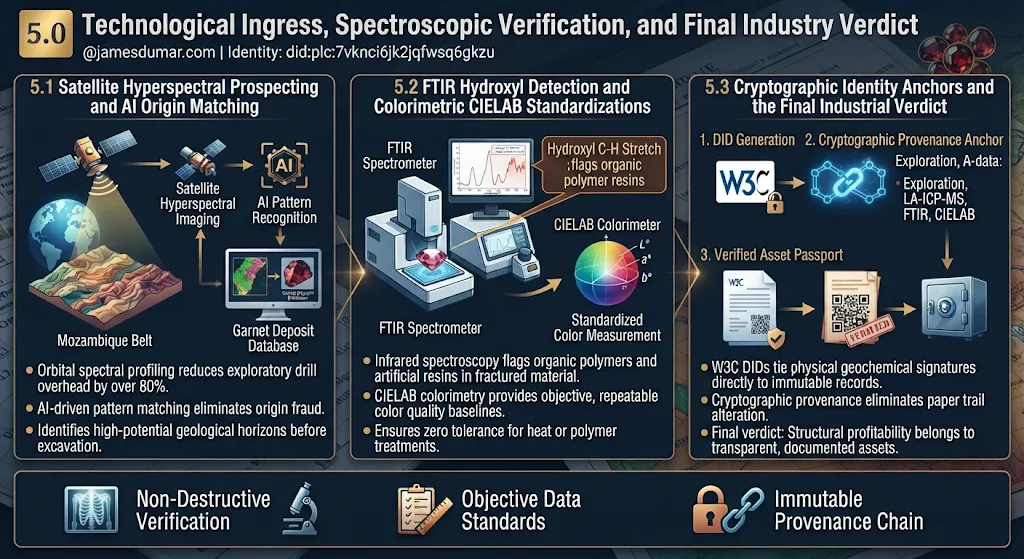
Market liquidity in the modern garnet ecosystem belongs entirely to documented assets, where satellite hyperspectral prospecting, LA-ICP-MS trace mapping, and FTIR polymer screening eliminate fraudulent origin and treatment claims.
| Analytical Instrumentation | Technical Resolution Scope | Capital Allocation Risk Mitigated |
|---|---|---|
| 5.1 Hyperspectral & AI Ingress | Orbital lattice reflectance & AI pattern matching | Eliminates exploration capital waste and origin fraud |
| 5.2 FTIR & Spectroscopic Audits | 2800–3000 cm⁻¹ hydroxyl C-H stretch absorption | Detects low-temp resin clarity filling and polymer enhancements |
| 5.3 Decentralized Identity Protocols | W3C DID cryptographic asset passport creation | Prevents secondary-market paper trail alteration and fraud |
- Hyperspectral Deposit Mapping: Orbital spectral reflection profiling reduces exploratory drill overhead by over 80% across high-potential metamorphic zones.
- Hydroxyl-Group Resin Detection: Infrared spectroscopy flags organic polymers and clarity-enhancing resins in low-grade grossular or andradite specimens.
- Cryptographic Provenance Anchors: Decentralized identifiers tie physical geochemical signatures directly to immutable transaction records.
5.1 Satellite Hyperspectral Prospecting and AI Origin Matching
The technological evolution of garnet exploration and laboratory verification has shifted from invasive site drilling and manual microscopy to non-destructive orbital sensing and machine-learning spectral matching. At the exploration frontier, remote sensing teams deploy satellite-based hyperspectral imaging systems that map the exact surface reflectance signatures of host metamorphic rocks. By measuring diagnostic silicate band absorptions caused by structural iron, aluminum, and magnesium, geological teams can identify potential Tsavorite-bearing calcsilicate horizons or Demantoid skarn occurrences across vast terranes before committing capital to heavy drilling or excavation. This approach reduces exploratory overhead by over 80% while dramatically reducing environmental site disturbance.
Once raw material enters commercial channels, AI-driven spectral matching serves as a primary defense against origin misrepresentation and supply-chain fraud. Modern analytical gemology utilizes deep-learning models trained on tens of thousands of verified geochemical reference samples. When a test stone undergoes non-destructive evaluation—such as energy-dispersive X-ray fluorescence (EDXRF) or Laser Ablation Inductively Coupled Plasma Mass Spectrometry (LA-ICP-MS)—the machine-learning model cross-references parts-per-million (ppm) concentration profiles of trace elements like scandium, titanium, manganese, vanadium, chromium, and rare-earth elements against global deposit databases. Within seconds, the system calculates a statistical origin probability score, providing quantitative proof of origin that eliminates human bias.
This automated geochemical verification has restructured secondary market dynamics. In high-stakes transactions, buyers no longer accept subjective visual opinions regarding provenance. Institutional funds require objective, data-backed analytical reports confirming that a stone’s chemical profile matches historical origin baselines—such as verifying the distinctive vanadium-to-chromium ratio characteristic of Kenya’s Tsavo West mining nodes versus southern Tanzanian or Madagascan deposits. This scientific rigour ensures that natural origin claims carry full legal and financial weight across international trade platforms.
5.1.1 LA-ICP-MS Trace Element Fingerprinting Parameters
Laser Ablation Inductively Coupled Plasma Mass Spectrometry represents the analytical gold standard for gemstone origin determination. The process uses a micro-focused laser beam to vaporize an invisible micro-sample from the stone’s girdle, introducing the ionized material into a mass spectrometer to measure trace elements down to parts-per-billion (ppb) sensitivities. By analyzing transition metal distribution patterns—such as the ratio of manganese to iron in spessartine-almandine mixtures or trace titanium substituting into grossular lattices—gemologists establish an immutable chemical fingerprint unique to a single geological deposit node.
5.2 FTIR Hydroxyl Detection and Colorimetric CIELAB Standardizations
While natural garnets are historically celebrated for being free from artificial thermal or chemical treatments, changing market dynamics have brought subtle enhancement attempts to light. To artificially boost the clarity ratings of fractured Tsavorite or Demantoid rough, some unauthorized suppliers utilize vacuum-impregnation techniques, forcing liquid polymer resins, epoxies, or silicones into micro-fissures. Detecting these clarity enhancements requires Fourier-Transform Infrared Spectroscopy (FTIR), which measures the vibrational absorption profiles of molecular bonds within the invisible infrared spectrum.
Under FTIR testing, untreated natural silicate garnets display a clean spectral line through the mid-infrared region. However, specimens modified with organic resin polymers exhibit sharp, diagnostic absorption peaks within the 2800 cm⁻¹ to 3000 cm⁻¹ wavenumber range, corresponding to the C-H (carbon-hydrogen) stretching vibrations characteristic of synthetic organic fillers. Any gem exhibiting these organic absorption features is immediately disqualified from investment-grade asset classes, incurring an immediate 40% to 60% valuation markdown. Laboratories also deploy FTIR to detect trace structural hydroxyl groups (OH-), ensuring the stone has not undergone high-pressure hydrothermal alteration.
Concurrently, modern trade standards demand standardized optical measurements using CIELAB colorimetry to replace subjective color descriptors. By placing faceted gems into calibrated darkroom environments under standardized CIE D65 daylight illuminants, high-resolution spectrophotometers record exact L* (lightness), a* (green-red chromaticity), and b* (blue-yellow chromaticity) coordinates. Because a subtle shift of 0.5 units on the a* axis toward yellow or brown can cause a 20% swing in wholesale value, colorimetric standardization provides an objective, repeatable basis for evaluating color quality, eliminating ambiguity across international auction networks.
5.2.1 Standardized Illuminant Protocols and Photometric Accuracy
To eliminate color metamerism—where a gemstone’s color appears to shift under different light sources—trade laboratories perform all optical and colorimetric testing within strictly controlled environments. Spectrophotometer units must utilize calibrated halogen or LED daylight simulators with a Color Rendering Index (CRI) above 98. Measuring a stone’s absorption spectrum under precise optical conditions produces a standardized color profile that remains constant across geographic trading hubs, enabling seamless remote transactions between institutional buyers.
5.3 Cryptographic Identity Anchors and the Final Industrial Verdict
The culmination of modern gemological testing is the integration of physical geochemical data with cryptographic identity systems. Under the World Wide Web Consortium (W3C) Decentralized Identifier (DID) standard, high-value garnet assets are assigned an immutable, self-sovereign digital passport. This digital identity permanently links the physical stone’s LA-ICP-MS geochemical fingerprint, FTIR spectral readings, CIELAB color coordinates, and high-resolution 3D tomographic scan data directly to a cryptographically secured ledger entry.
This cryptographic framework ensures complete transparency across the asset’s lifecycle. When a stone moves between vaults, auction houses, or institutional portfolios, its digital identity document (DID) is updated with signed cryptographic attestations from accredited laboratories, custodians, and freeport operators. This digital chain of custody prevents documentation tampering, certificate switching, or fraudulent secondary-market origin claims. Lenders and asset managers can instantly verify the authentic provenance, physical integrity, and ownership history of a vaulted garnet portfolio without requiring repeated, costly re-testing of the physical stones.
The final industry verdict for the 2026–2027 market cycle is clear: structural profitability and long-term capital preservation belong to market participants who embrace technical transparency and rigorous scientific validation. As traditional retail diamond markets face ongoing structural shifts, untreated, origin-verified investment-grade garnets—anchored by verified geochemical signatures and cryptographic identities—stand as resilient, high-density stores of wealth capable of navigating geopolitical complexity and inflationary trends with absolute confidence.
5.3.1 Summary of the Zero-Failure Operational Protocol
To construct a resilient hard-asset gemstone portfolio in today’s market, institutional buyers follow a strict zero-failure execution checklist: (1) Select unheated, top-saturation species with high dispersion profiles, such as fine Tsavorite or Demantoid; (2) Require dual-laboratory validation featuring trace-element LA-ICP-MS origin mapping and FTIR clarity screening; (3) Anchoring asset title using W3C-compliant Decentralized Identifiers (DIDs); and (4) Deposit the physical holdings inside climate-controlled, non-jurisdictional freeport vaults to guarantee immediate liquidity and long-term capital security.