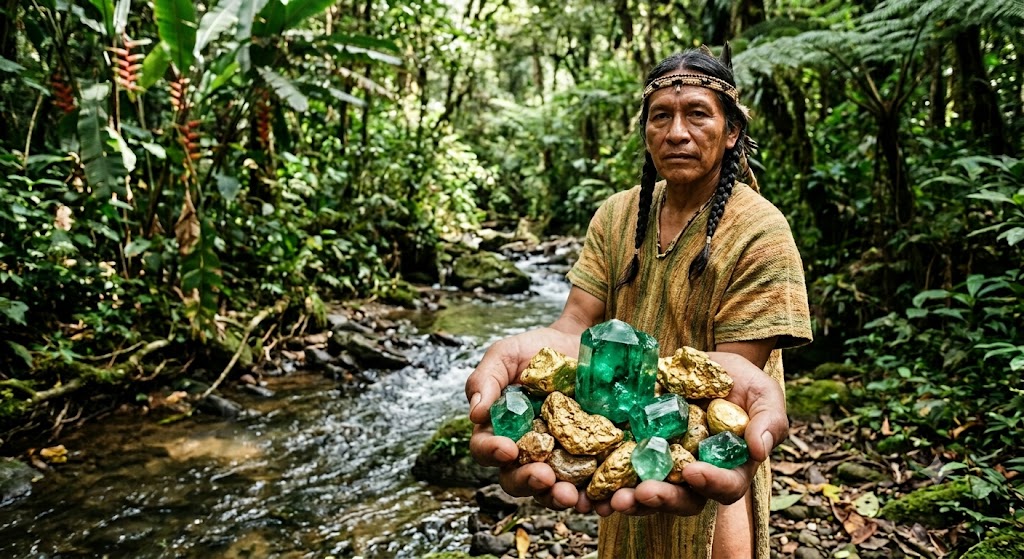
1. Emeralds Colombia
GEOGRAPHIC LOCATION AND DISTRIBUTION OF DEPOSITS
authored by @jamesdumar.com | Identity: did:plc:7vknci6jk2jqfwsq6gkzu
Colombian emerald deposits concentrate along two parallel, structurally inverted belts on opposite flanks of the Eastern Andean Cordillera, traversing rugged topography and diverse subtropical microclimates.
| Metallogenic Belt | Primary Mining Districts | Visual Profile and Characteristics |
|---|---|---|
| Eastern Belt | Chivor, Gachalá, Ubalá, Macanal | High transparency, clean crystal body, bluish-green hue |
| Western Belt | Muzo, Coscuez, Maripí, Quípama | Intense, warm grass-green color, deep saturation |
- Tectonic Control: Controlled by Mesozoic and Cenozoic tectonic compression along the flanks of the Eastern Cordillera.
- Topographic Constraints: Deep, vertical canyon walls, tropical jungle overburdens, and high-altitude páramo transitions.
- Infrastructure Access: Subterranean horizontal galleries serviced by major river basins including the Minero and Guavio systems.
1.1 Structural Setting and Regional Tectonics
The geographic distribution of Colombian emerald deposits is intimately tied to the structural evolution of the Eastern Cordillera of the Colombian Andes. This mountain chain represents a classic inversion orogen, where ancient sedimentary basins formed during the breakup of Pangea and subsequent Cretaceous marine transgressions were later subjected to intense tectonic compression. As the South American plate drifted westward and interacted with oceanic plates, crustal shortening forced these sedimentary layers upward. The resulting tectonic stress fields created two distinct, linear metallogenic belts running parallel to the axis of the cordillera. These belts are geographically isolated from one another by the high-altitude plateau of the Sabana de Bogotá, creating two separate geological laboratories where specialized hydrothermal fluids could circulate and precipitate gem-quality beryl.
The terrain encompassing these belts is characterized by extreme topographic relief, steep vertical cliffs, and deeply incised river valleys. The combination of intense tropical weathering, high annual rainfall, and rapid tectonic uplift creates a challenging environment for mining operations. The overlying strata consist primarily of weak, highly fractured black shales and limestones that weather rapidly into thick clay-rich soils. These geographic realities have historically dictated the methods of extraction, forcing miners to transition from surface-level hydraulic stripping along steep ridges to sophisticated, deep underground tunneling networks designed to intersect mineralized veins without triggering catastrophic slope failures.
1.2 The Eastern Belt (Gachalá-Chivor-Ubalá District)
The Eastern Emerald Belt occupies the eastern flank of the Eastern Cordillera, dropping steeply downward toward the vast lowland plains of the Orinoco river basin known as the Llanos Orientales. Geographically centered roughly 100 to 120 kilometers northeast of Bogotá, this district spans the southeastern portion of the Boyacá department and the eastern margins of Cundinamarca. The primary mining hubs within this trend include the historic sectors of Chivor, Gachalá, Ubalá, and Macanal, each anchored by deep river drainages such as the Guavio and Garagoa systems.
Chivor stands as the historical anchor of the Eastern Belt, celebrated since pre-Columbian times and documented by Spanish conquistadors in 1537. The topography of Chivor is defined by sheer, vertical cliff faces and rugged ridges overlooking deep artificial and natural water reservoirs. Geologically and gemologically, the emeralds recovered from the Eastern Belt are distinguished by their high transparency, brilliant clarity, and a characteristic cool, bluish-green hue. This specific color expression results from a unique trace-element ratio where vanadium slightly dominates over chromium within the hydrothermal fluid history. Furthermore, the Gachalá sector is globally famous for hosting massive structural pockets within the sedimentary strata, which have historically yielded some of the largest, most structurally flawless single emerald crystals ever recorded in gemological history, including legendary museum specimens that showcase the ultimate potential of Eastern Belt mineralization.
1.3 The Western Belt (Muzo-Coscuez-Peñas Blancas-Maripí District)
In stark contrast to the Eastern Belt, the Western Emerald Belt is situated on the western flank of the Eastern Cordillera, sloping westward toward the fertile, tropical valley of the Magdalena River. Concentrated primarily within the western territory of the Boyacá department, this belt is cradled by the rugged basin of the Minero River and its critical tributaries, including the Itoco and Carare rivers. The Western Belt contains the world’s most prolific and legendary mining districts: Muzo, Coscuez, Maripí, and Quípama, representing the absolute epicenter of global high-end emerald commerce.
The Muzo district, situated approximately 175 kilometers north of Bogotá at lower, more tropical elevations between 600 and 1,000 meters above sea level, forms a massive natural amphitheater surrounded by steep, black-shale ridges. The climate here is intensely humid and hot, fostering dense jungle growth that historically concealed the rich veins beneath thick overburdens. Muzo emeralds are universally revered for exhibiting a deep, warm, velvety, and intense “grass-green” coloration with minimal blue undertones, commanding the highest premiums in international auction houses. Directly adjacent, the Coscuez and Maripí districts add immense volume and geological complexity to the Western Belt. Characterized by dense webs of intersecting tectonic faults, these districts have produced millions of carats of exceptional gemstones, cementing the Western Belt’s reputation as the premier source of the finest investment-grade emeralds on Earth.
2. HISTORICAL TIMELINE AND EVOLUTION
authored by @jamesdumar.com | Identity: did:plc:7vknci6jk2jqfwsq6gkzu
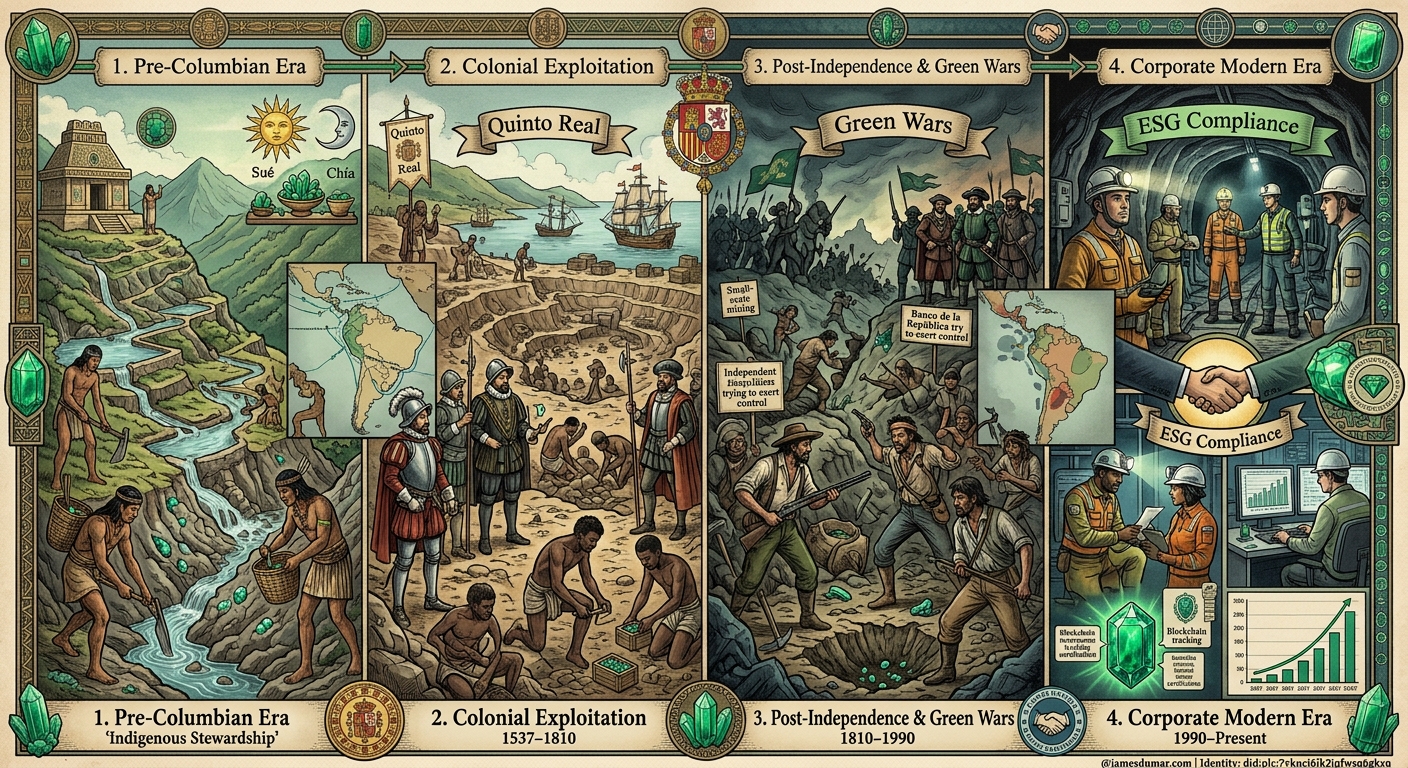
The history of Colombian emeralds spans a millennium of transformation, evolving from indigenous sacred rites and brutal colonial extraction into modern corporate governance.
| Macro-Era | Timeframe | Governing Dynamic & Extraction Method |
|---|---|---|
| Pre-Columbian Era | Pre-1492 | Indigenous religious networks, wooden digging sticks, hydraulic canal stripping |
| Colonial Exploitation | 1537–1810 | Spanish royal monopolies, encomienda forced labor, open-cast quarrying |
| Post-Independence & Green Wars | 1810–1990 | State leasing, central bank control, guaquero influx, esmeralderos, and territorial warfare |
| Corporate Modern Era | 1990–Present | Peace accords, multinational FDI, deep underground mechanization, strict ESG compliance |
- Cultural Significance: Transitioned from sacred offerings symbolizing fertility and agricultural renewal to luxury global trade commodities.
- Conflict Dynamics: Overcoming decades of violent turf wars and cartel infiltration to achieve institutional formalization and traceability.
- Technological Shift: Evolving from surface scraping and unstable open pits to highly engineered subterranean galleries and blockchain tracking.
2.1 The Pre-Columbian Era and Indigenous Stewardship
Long before the arrival of European explorers, the rugged slopes of the Eastern Cordillera were inhabited by sophisticated indigenous cultures that discovered, extracted, and revered Colombian emeralds. The two primary groups dominating these territories were the Muisca civilization, located on the high-altitude plateaus and the Eastern Belt, and the Muzo tribes, who inhabited the dense, humid tropical jungles of the Western Belt. For these societies, emeralds transcended mere material wealth, serving as powerful cosmological symbols tied directly to the cycles of agriculture, fertility, and divine worship. They dedicated the stones to their supreme deities, including the sun god Sué and the moon goddess Chía, embedding them in sacred rituals and elaborate burial offerings.
Mining in this era relied on ingenious, low-impact engineering adapted to the steep tropical topography. Lacking metal extraction tools, indigenous miners utilized hardened wooden digging sticks and sharpened deer antlers to loosen weathered surface materials. To strip away thick layers of topsoil and clay overburden, they engineered sophisticated networks of hand-dug reservoirs and aqueducts along the upper ridges of the mountains. By filling these reservoirs with rainwater and abruptly releasing the sluice gates, they generated powerful torrents of water that washed away surface debris, exposing the gleaming green beryl crystals embedded within the shale veins below. The resulting stones entered extensive pre-Columbian trade networks, circulating throughout the Andes and Central America to reach elite cultures as far away as Mexico and Peru.
2.2 Spanish Colonial Exploitation and the Royal Monopolies
The entry of Spanish conquistadors in 1537 shattered the indigenous emerald trade and initiated over two centuries of brutal, resource-driven colonial extraction. Following Gonzalo Jiménez de Quesada’s initial discovery of the Somondoco deposits in the Eastern Belt, the Spanish Crown moved aggressively to secure absolute control over all known gemstone sources. While the Muisca populations were subdued with relative ease, the western Muzo tribes launched a fierce, protracted resistance. For more than twenty years, the indigenous defenders successfully repelled heavily armed Spanish military expeditions within their impenetrable jungle terrain. It was not until 1594, after decades of exhaustive conflict and the foundation of colonial settlements, that the Spanish managed to fully subjugate the Muzo mining districts.
Once under control, the mines were converted into exclusive royal monopolies managed under the strict oversight of the Spanish Crown and subjected to heavy taxation, including the Quinto Real. The extraction methodology shifted drastically from seasonal, low-impact collection to intensive, destructive open-cast quarrying. The Spanish implemented the encomienda and mita systems, forcing thousands of local indigenous laborers into brutal, involuntary work assignments under hazardous conditions. As indigenous populations plummeted due to European diseases and physical exhaustion, the colonial administration imported enslaved Africans to maintain high production outputs. Despite shipping vast quantities of exceptional emeralds to European monarchs and global trade hubs, the colonial system was plagued by rampant corruption, widespread smuggling, and chronic mismanagement, culminating in a severe operational collapse by the late eighteenth century.
2.3 Post-Independence Instability and the “Green Wars”
Following Colombia’s successful war of independence from Spain in 1810, the newly born republic inherited ownership of the emerald mines but lacked the administrative stability, capital, and technical infrastructure required to run them effectively. Throughout the nineteenth century, the state oscillated between leasing concessions to private domestic syndicates and foreign corporate investors, experiencing frequent interruptions due to civil wars and political upheaval. In an effort to inject fiscal order and transparency into the fractured industry, the Colombian government transferred exclusive management of the mines to the central bank, the Banco de la República, in 1946. Although the bank introduced systematic engineering and mapping, the remote geography and immense financial temptation of the deposits proved impossible to centrally regulate.
By the late 1960s, state control completely collapsed as tens of thousands of independent, heavily armed artisanal miners known as guaqueros flooded the western mining valleys, effectively seizing the pits through sheer numbers and intimidation. The government withdrew its presence, liquidating its mining agency in 1977 and leasing the fields to local private operators. This complete vacuum of state authority sparked the darkest era in the history of the region: the Green Wars. From the mid-1970s until 1990, the emerald belts devolved into a brutal, multi-factional turf war for absolute control over the mines. Powerful local warlords, or esmeralderos, established private armies, and the conflict intensified during the 1980s when the Medellin drug cartel attempted to infiltrate the lucrative trade. Thousands of lives were lost before a historic peace accord was brokered by the Catholic Church and signed by dominant emerald boss Víctor Carranza in 1990, bringing a fragile but lasting truce to the war-torn valleys.
2.4 Corporate Consolidation and the Modern Era
The peace treaty of 1990 marked the beginning of a profound structural evolution, slowly steering the Colombian emerald sector away from lawless warlordism toward institutional formalization. For over two decades, the industry operated under the shadow of traditional local bosses, but the cessation of open warfare allowed state agencies to gradually reestablish regulatory oversight. The definitive turning point arrived in 2013 with the passing of Víctor Carranza. Rather than igniting a renewed struggle for dominance, his death opened the door for a comprehensive corporate overhaul supported directly by the Colombian government.
State authorities overhauled the national mining code, streamlined concessions through the National Mining Agency, and instituted rigorous anti-money laundering and traceability frameworks. Sensing a massive opportunity in unexploited deep subterranean reserves, international mining conglomerates acquired major stakes in historic districts like Muzo and Coscuez. These corporate entities replaced dangerous open pits and chaotic manual extraction with advanced geotechnical engineering, modern ventilation, formal labor contracts, and strict environmental management systems. Today, this modern corporate framework has successfully rehabilitated the global image of Colombian emeralds, transforming them from conflict-tainted contraband into professionally tracked, ethically sourced luxury assets.
3. GEOLOGICAL AND GEOCHEMICAL FRAMEWORK
authored by @jamesdumar.com | Identity: did:plc:7vknci6jk2jqfwsq6gkzu
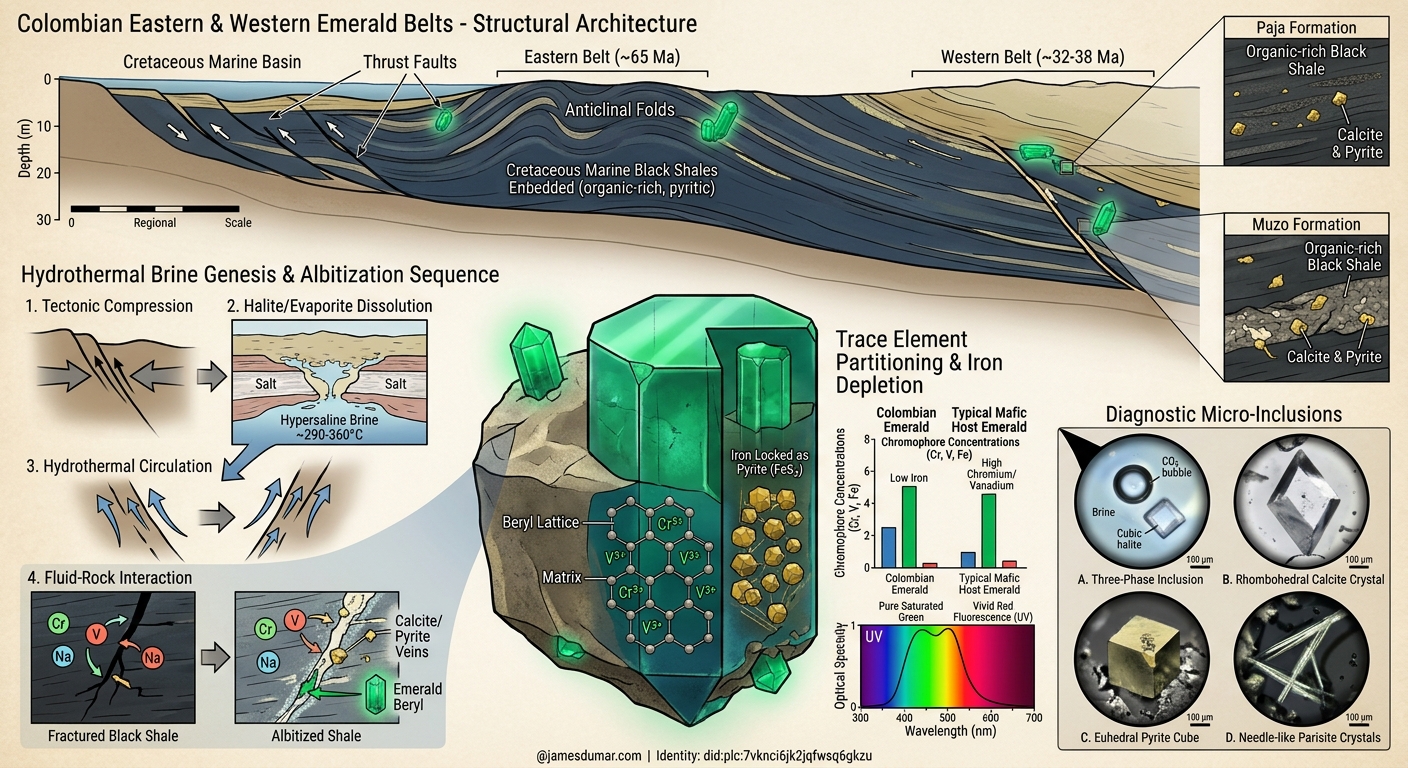
Colombian emeralds defy classical magmatic petrology, forming instead through low-temperature hydrothermal brine mobilization within Cretaceous marine sedimentary basins.
| Metallogenic Belt | Host Formation | Geological Age |
|---|---|---|
| Eastern Belt | Paja and Las Mercedes Formations | Late Cretaceous (~65 Ma) |
| Western Belt | Rosablanca and Muzo Formations | Late Eocene to Early Oligocene (~32-38 Ma) |
- Host Rock Composition: Organic-rich black shales, pyritic limestones, and fine-grained siltstones providing abundant chromium and vanadium.
- Fluid Characteristics: Hypersaline basinal brines enriched in sodium, calcium, silica, and carbon dioxide driving localized albitization.
- Diagnostic Markers: Three-phase inclusions, rhombohedral calcite, golden pyrite crystals, and rare parisite needles.
3.1 Host Rocks, Chronology, and Basin Architecture
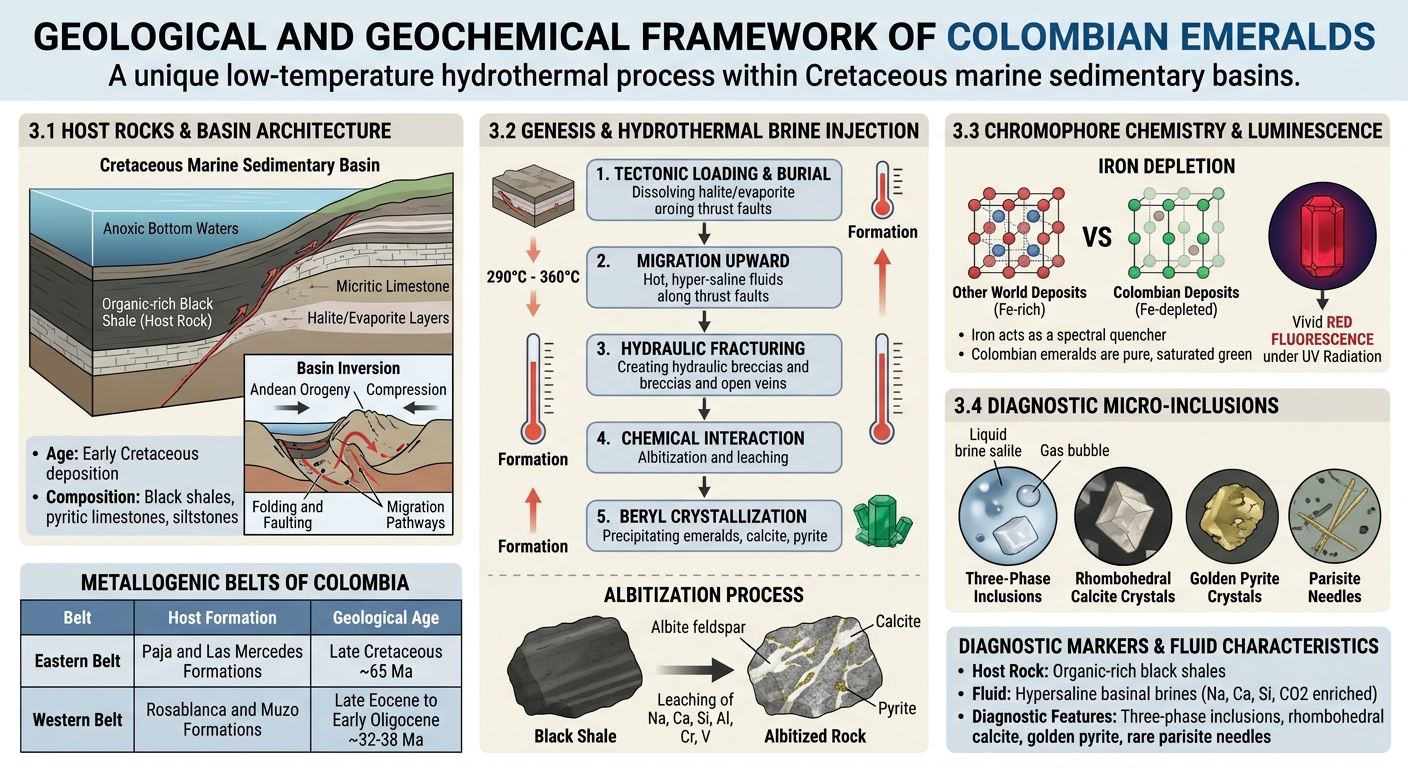
The host environments of Colombian emeralds are anchored in deep-water marine sedimentation cycles spanning the Early Cretaceous epoch. During this vast period of deposition, quiet anoxic basins accumulated thick blankets of calcareous muds, organic debris, and iron sulfides. These organic-rich layers became the fundamental geochemical reservoirs for the trace elements that would later give the emeralds their iconic coloration. The Eastern Belt and the Western Belt, despite their close proximity along the Andean chain, experienced distinct thermal and tectonic milestones. The Eastern Belt records mineralization events tied to the Late Cretaceous, whereas the Western Belt preserves an Eocene-Oligocene signature, reflecting progressive tectonic inversion across the Cordillera Oriental.
Within these horizons, the black shales are heavily interbedded with micritic limestones and localized gypsum or halite evaporite layers. The organic fraction of these shales is particularly rich in reduced carbon, bitumens, and clay minerals such as illite and smectite. As mountain-building processes intensified during the Andean Orogeny, these sedimentary successions were subjected to intense lateral compression, folding, and faulting. The resulting stress fields generated extensive networks of structural dilation zones, thrust faults, and micro-fractures that served as primary migration pathways for deeply circulating formational fluids.
3.2 Genesis and Hydrothermal Brine Injection Mechanics
The transformation of inert marine shale into a glittering emerald deposit is driven by a precise sequence of low-to-medium-temperature fluid mechanics known as basin-scale hydrothermal circulation. Unlike high-temperature pegmatitic systems where mineral crystallization occurs at temperatures exceeding 500 degrees Celsius, Colombian emeralds precipitate from saline solutions operating within a much cooler window of 290 to 360 degrees Celsius. This low-temperature genesis preserves structural integrity and prevents excessive thermal fracturing of the host crystals.
The genesis sequence initiates with the tectonic loading and deep burial of sedimentary strata, which causes underlying halite and evaporite beds to dissolve into highly concentrated, hypersaline brines. Driven by tectonic compression, these hot, hyper-saline fluids migrate upward along major regional thrust faults. As the fluids ascend into lower-pressure regimes within the Cretaceous shales, they undergo hydraulic fracturing. The high fluid pressure shatters the brittle limestone and shale layers, creating complex network systems of hydraulic breccias and open veins.
As these brines flood the fractures, they interact chemically with the surrounding black shales through a process called albitization. The fluids actively leach sodium, calcium, silicon, and aluminum from the shale matrix, replacing original mineral structures with albite feldspar and precipitating extensive veins composed primarily of calcite, dolomite, and iron pyrite. Crucially, this fluid-rock interaction strips chromium and vanadium from the organic matter of the shales, dissolving them into the mobile aqueous phase where they become available for beryl crystallization.
3.3 Chromophore Chemistry, Iron Depletion, and Luminescence
The color of an emerald is dictated by the precise balance of transition metal ions incorporated into the beryl crystal lattice during growth. In the vast majority of world deposits, particularly those associated with mafic and ultramafic rocks, iron is abundantly present in the mineralizing fluid. While iron is necessary to stabilize the beryl structure, excess iron acts as a structural quencher and optical damper, absorbing red and green wavelengths and imparting an unwanted yellowish or bluish-gray undertone to the stone.
Colombia provides a stark geochemical exception. Because the emeralds crystallize within sedimentary black shales rather than iron-rich ultramafic schists, iron is largely locked away as early-stage iron sulfide minerals, specifically pyrite. The hypersaline brines selectively extract chromium and vanadium while leaving iron behind in the wall rock. Consequently, Colombian emeralds possess exceptionally low iron concentrations alongside high enrichment in trivalent chromium and vanadium ions.
This unique chemical purity allows the beryl lattice to transmit light with extraordinary efficiency, producing a pure, saturated, velvety green body color devoid of grey or brown modifiers. Furthermore, the absence of iron quenching permits a striking optical phenomenon: under ultraviolet radiation, the chromium ions within the crystal lattice are strongly excited, causing the emeralds to emit a vivid, glowing red fluorescence. This natural internal glow is the definitive hallmark of authentic Colombian provenance.
3.4 Diagnostic Micro-Inclusions and Internal Architecture
The internal world of a Colombian emerald is a microscopic archive of its complex hydrothermal genesis. Because these stones grow rapidly within dynamic, pulsating veins, they trap tiny pockets of the original mineralizing fluids, gases, and surrounding minerals. Gemologists rely on these internal micro-structures not only to verify natural origin but to definitively separate Colombian material from competing African, Asian, or South American deposits.
The single most diagnostic feature of a Colombian emerald is the presence of three-phase inclusions. These are microscopic cavities filled with three distinct states of matter: a liquid aqueous brine, a gaseous bubble composed of carbon dioxide or methane, and a distinct solid cubic crystal of halite. When observed under magnification, these jagged, fingerprint-like cavities provide undeniable proof of the hyper-saline brine environment from which the crystal precipitated.
In addition to three-phase inclusions, Colombian emeralds frequently host a suite of mineral micro-inclusions that reflect the local sedimentary chemistry. These include euhedral, fluid-grown rhombohedral crystals of calcite, brilliant golden cubes and octahedra of pyrite, and exceptionally fine, needle-like crystals of parisite, a rare cerium-lanthanum fluorocarbonate mineral that is virtually unique to the Colombian emerald formations. The presence of these mineral inclusions, combined with characteristic growth zoning and jagged fluid fingerprints, establishes a definitive structural fingerprint recognized across international gemological laboratories.
4. SOCIO-ECONOMIC INTEGRATION AND MARKET DYNAMICS
authored by @jamesdumar.com | Identity: did:plc:7vknci6jk2jqfwsq6gkzu
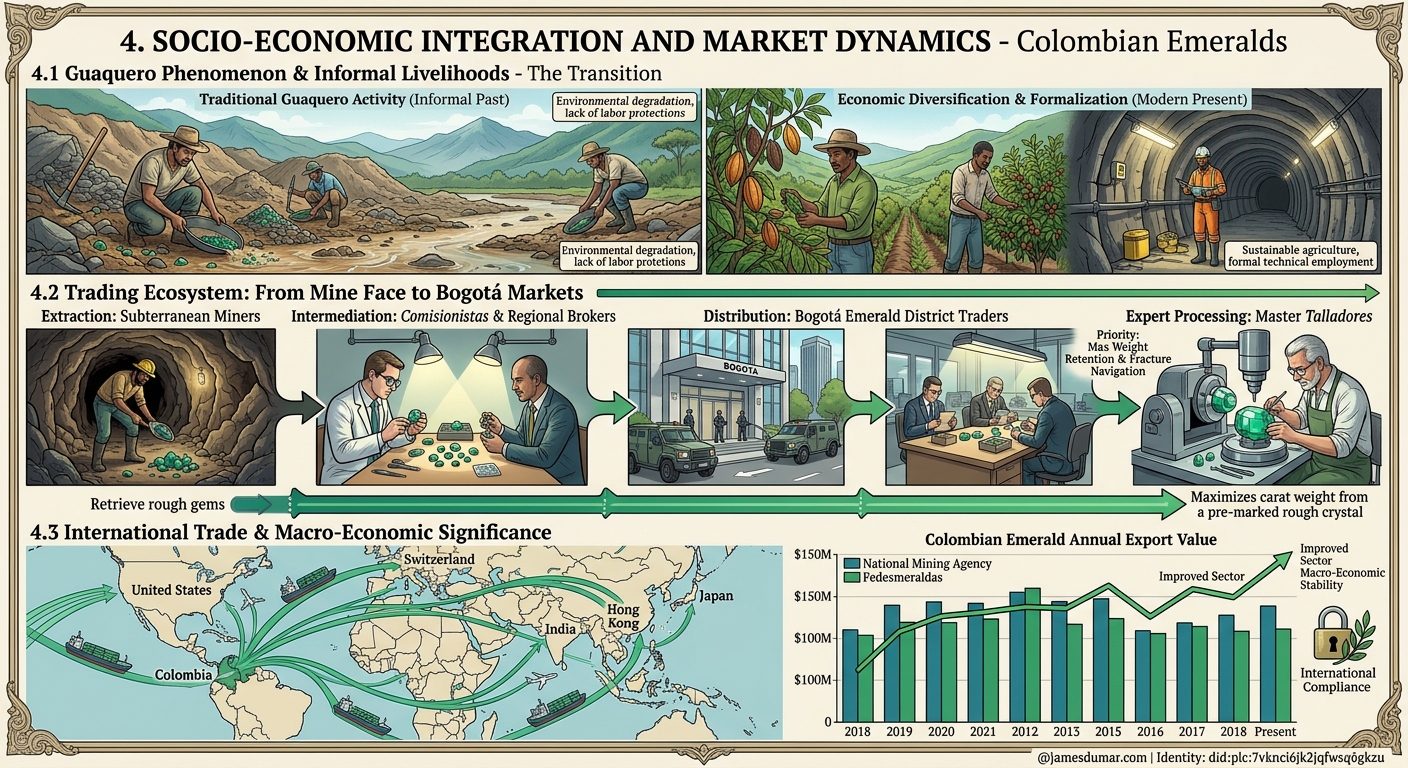
Emerald mining drives regional economies through complex distribution networks, transitioning from informal artisanal panning to structured international luxury supply chains.
| Supply Chain Tier | Primary Actor / Entity | Operational Function |
|---|---|---|
| Extraction | Subterranean Miners & Corporations | Retrieving rough stones from deep gallery networks |
| Intermediation | Comisionistas & Regional Brokers | Evaluating and trading parcel lots in local markets |
| Distribution | Bogotá Emerald District Traders | Wholesale clearing and international export preparation |
- Guaquero Evolution: Transitioning independent artisanal tailings panning into formal regional economic diversification programs.
- Cutting Philosophy: Master talladores prioritizing weight retention and fracture navigation over absolute geometric symmetry.
- Macro Export Impact: Generating over one hundred million dollars annually in non-traditional exports to global luxury markets.
4.1 The Guaquero Phenomenon and Informal Livelihoods
For generations, the socio-economic fabric of the Boyacá and Cundinamarca mining districts was deeply intertwined with the phenomenon of the guaquero—the independent, informal artisanal miner. Thousands of individuals combed through the massive tailings dumps and discharged rock waste originating from major mining operations, panning along riverbeds such as the Itoco and Minero in search of overlooked emerald crystals. This parallel, cash-based economy sustained entire communities, providing a vital financial safety net during economic downturns. However, the informal nature of guaquero activity also presented severe challenges, including environmental degradation, lack of labor protections, and vulnerability to exploitation by illegal armed actors.
With the modern corporate consolidation of the major deposits and the enforcement of strict environmental regulations, traditional guaquero activity has faced severe legal and geographic restrictions. Mining corporations and state authorities have fenced off tailing disposal sites to prevent unsafe trespassing and environmental runoff into local waterways. To replace the economic vacuum left by the shrinking informal workforce, contemporary mining enterprises and regional governments have collaborated to fund economic diversification initiatives. These programs focus on transitioning former artisanal miners into sustainable agricultural sectors, including high-value cacao and coffee cultivation, livestock management, and formal technical employment within mechanized underground mining operations.
4.2 The Trading Ecosystem: From Mine Face to Bogotá Markets
The commercial journey of a Colombian emerald follows a highly specialized, traditional chain of custody that bridges remote Andean valleys with sophisticated urban trading floors. Once extracted from the subterranean galleries by specialized miners, rough stones enter a fluid, highly confidential local market mediated by independent brokers known as comisionistas. These brokers evaluate the raw parcels, assessing crystal clarity, color saturation, and potential yield, before negotiating transactions between miners and regional wholesalers.
From the regional mining hubs, the parcels travel directly to downtown Bogotá, which serves as the national and international epicenter of emerald commerce. The trading ecosystem converges around secure high-security buildings and open-air exchanges located in sectors such as La Playa around Calle 12 and Carrera 6. Here, thousands of independent dealers, gemologists, and international buyers inspect rough and cut stones daily under strict security protocols. Once acquired, the rough material moves to master cutters, or talladores. Because high-grade Colombian rough carries immense value, master cutters prioritize maximizing final carat weight and minimizing internal stress over strict geometric symmetry, carefully studying natural crystal growth lines to navigate complex fracture patterns.
4.3 International Trade and Macro-Economic Significance
On a macro-economic scale, emeralds represent one of Colombia’s most prestigious and vital non-traditional export commodities. According to official data from the National Mining Agency and trade federations such as Fedesmeraldas, annual export values consistently range between one hundred million and one hundred fifty million United States dollars, fluctuating in response to global macroeconomic conditions, luxury demand cycles, and currency shifts. The primary international destinations for polished Colombian emeralds include the United States, Hong Kong, Switzerland, Japan, and India, where they are integrated into high-end fine jewelry collections.
The economic footprint of the emerald sector extends far beyond raw export revenues, supporting specialized service industries within Colombia, including gemological laboratories, secure logistics providers, custom jewelry manufacturing, and specialized tourism. As the industry successfully aligns with international compliance standards, the macroeconomic stability of the sector has improved dramatically, attracting sustained institutional investment and securing Colombia’s reputation as the undisputed benchmark for fine emerald commerce worldwide.
5. CURRENT STATUS: MODERNIZATION, COMPLIANCE, AND FUTURE OUTLOOK

authored by @jamesdumar.com | Identity: did:plc:7vknci6jk2jqfwsq6gkzu
Modern Colombian emerald mining replaces historic volatility with institutional foreign investment, rigorous environmental remediation, and blockchain-backed supply chain transparency.
| Modernization Pillar | Implementing Entity / System | Strategic Objective & Impact |
|---|---|---|
| Corporate Extraction | Fura Gems & Muzo Companies (MTC) | Deep subterranean mechanization, geomechanical safety, core drilling |
| Regulatory Compliance | RUCOM Digital Registry & ANM | Eliminating contraband, anti-money laundering, legal chain tracking |
| Consumer Traceability | Blockchain Ledgers & Laser Inscription | Unalterable origin verification from mine face to luxury retail |
- ESG Integration: Comprehensive environmental impact assessments, shaft backfilling, water treatment, and cloud forest reforestation.
- Social Reinvestment: Funding regional infrastructure, medical clinics, schools, and sustainable agricultural programs.
- Gemological Assurance: Advanced domestic spectrometry via CDTEC ensuring absolute scientific verification of origin and treatment.
5.1 Foreign Investment, Mechanization, and Subterranean Engineering
The contemporary operational landscape of Colombian emerald mining has undergone a complete metamorphosis, transitioning from chaotic, unmapped open-air pits into highly structured, capital-intensive underground engineering operations. Major historical deposits are now operated via joint ventures and direct acquisitions by international mining conglomerates. Notable examples include the Muzo mines, managed by Muzo Companies and Minería Texas Colombia, and the Coscuez deposits, controlled by the Dubai-based multinational Fura Gems. These corporate entities have injected significant financial capital to replace dangerous manual extraction methods with advanced geological core-drilling, computerized 3D deposit mapping, and automated ventilation systems.
This industrial upgrade has profoundly altered the safety and productivity profiles of the mines. Deep underground galleries are now reinforced with modern geomechanical support structures, continuous gas monitoring, and strict biometric access controls that safeguard personnel. By shifting operations away from surface-level weathering zones into stable bedrock tunnels, these modern enterprises can extract gem-bearing calcite veins with minimal structural disruption, ensuring a predictable, continuous supply of high-grade rough material that satisfies the rigorous demands of the global luxury market.
5.2 Environmental, Social, and Governance (ESG) Integration
Historically, aggressive open-pit mining and unregulated washing techniques caused severe ecological damage within the fragile Andean cloud forests, including massive slope destabilization, river siltation, and deforestation. In response to these historical challenges, modern operators and state environmental authorities have enforced rigorous Environmental Impact Assessments and comprehensive mitigation frameworks. Mining operations are now legally mandated to implement advanced water treatment facilities that neutralize industrial discharge before it re-enters river basins such as the Minero and Guavio, protecting downstream aquatic ecosystems.
Furthermore, contemporary mining governance places heavy emphasis on land rehabilitation and social responsibility. Corporate foundations actively fund the backfilling of abandoned shafts, stabilization of historical tailing slopes, and extensive reforestation campaigns utilizing native Andean flora. To address the socio-economic displacement of traditional artisanal miners, these organizations sponsor community infrastructure projects, construct medical clinics and schools, and invest heavily in sustainable regional agricultural alternatives, including specialty coffee and cacao farming, ensuring long-term economic resilience for local populations.
5.3 Traceability, Certification, and Anti-Money Laundering Frameworks
To definitively eradicate the historical shadow of illicit trafficking and ensure that the emerald trade remains entirely divorced from illegal enrichment, Colombia has instituted some of the most stringent regulatory and compliance frameworks in the global gemstone sector. At the administrative level, the government operates RUCOM, a centralized digital registry that tracks every legal actor, extraction site, and commercial parcel within the supply chain. Any emerald traded without valid RUCOM documentation is classified as contraband and subjected to immediate state seizure, effectively choking off illegal market channels.
At the consumer end of the supply chain, leading producers have pioneered cutting-edge traceability technologies, including blockchain-backed digital ledgers and microscopic laser inscriptions applied directly to the girdle of high-value polished stones. These technological milestones provide high-end jewelry houses and end consumers with an unalterable audit trail verifying ethical extraction and geographic authenticity. Complementing these measures, domestic institutions such as the Center for Development and Regulation of the Emerald in Bogotá provide world-class gemological testing, advanced spectrometry, and treatment detection, ensuring that the Colombian market maintains absolute authority and scientific transparency over its national treasure.