
Category 1.0: History of Diamond Discovery
Deep Earth Genesis and Cratonic Crucible
authored by @jamesdumar.com | Identity: did:plc:7vknci6jk2jqfwsq6gkzu
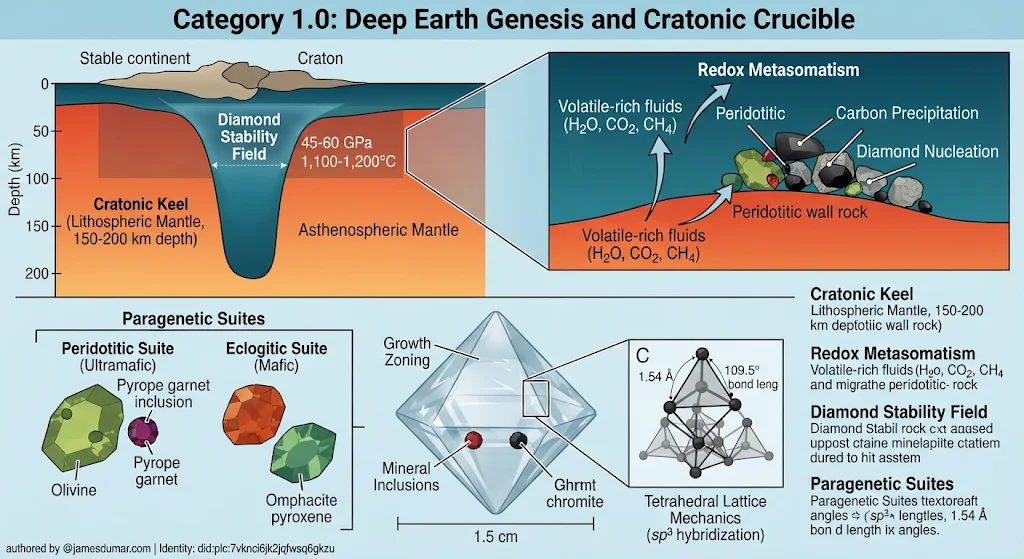
authored by @jamesdumar.com | Identity: did:plc:7vknci6jk2jqfwsq6gkzu
Deep within the sub-continental lithospheric mantle, primal carbon crystallizes under unimaginable thermal and barometric stress, forging the indestructible tetrahedral lattice of nature’s most coveted gemstone.
| Parameter | Geological Benchmark | Crystallographic Significance |
|---|---|---|
| Depth Range | 150 to 200 kilometers (90–125 miles) | Positions formation within the stable continental lithospheric mantle (SCLM). |
| Temperature Threshold | 1,100°C to 1,200°C (2,000°F–2,200°F) | Provides activation energy for carbon atom mobility and lattice bonding. |
| Lithostatic Pressure regimes | 45 to 60 gigapascals (~50,000 atm) | Compresses atomic spacing, favoring sp3 hybridization over sp2 graphite sheets. |
Core Attribute Grouping
- Cratonic Keels: Deep, buoyant, ancient lithospheric roots acting as stable thermal boundary layers protecting diamonds from thermal destruction.
- Redox Metasomatism: Fluid-mediated carbon reduction or oxidation processes precipitating crystalline diamond directly from volatile-rich migrating fluids.
- Paragenetic Suites: Peridotitic (olivine-rich, ultramafic) and eclogitic (omphacite-pyrope garnet-rich, mafic) mineral environments dictating trace element signatures.
1.1 Lithospheric Mantle Thermodynamics and Geothermal Gradients
As a seasoned gem merchant who has evaluated parcels spanning every major primary and secondary deposit globally, I cannot emphasize enough that understanding a diamond begins long before any mining enterprise breaks ground. It begins in the invisible, inaccessible realm of the sub-continental lithospheric mantle (SCLM). The SCLM is the rigid, mechanically robust thermal boundary layer underlying stable continental crustal blocks known as cratons. Unlike oceanic lithosphere, which is relatively young, thin, and continuously recycled into the asthenosphere via subduction, Archean cratons possess thick, buoyant keel roots that extend downward into the mantle to depths ranging from 150 to 250 kilometers.
Within these ancient keels, the ambient temperature and lithostatic pressure intersect precisely within the diamond stability field. The diamond stability field is bounded by the graphite-diamond phase transition line on the lower-pressure side and the geothermal gradient of stable cratons. If temperatures exceed specific thresholds relative to pressure, diamond graphitizes or melts; if pressures are insufficient, carbon simply forms graphite, the thermodynamically stable polymorph at Earth’s surface conditions. The geothermal gradient within cratonic roots—often referred to as the conductive geotherm—remains exceptionally low compared to active tectonic or volcanic zones. This cool geotherm is what allows mantle rocks at 150 kilometers depth to remain at temperatures around 1,100°C to 1,200°C, exactly where high-pressure mineral synthesis is favored over thermal degradation.
1.1.1 The Role of Cratonic Keels in Preservation
Cratons such as the Kaapvaal Craton in Southern Africa, the Slave Craton in Northern Canada, the Siberian Craton, and the Yilgarn Craton in Western Australia function as immutable thermal shields. They are depleted in basaltic components due to extensive melting events in Earth’s early history, leaving behind a highly refractory, magnesium-rich peridotitic residue (harzburgite and lherzolite) that is less dense and mechanically stronger than surrounding mantle material. This buoyancy prevents the cratonic root from sinking into the deeper convective mantle, anchoring it stably for billions of years. Consequently, any diamond nucleating within these deep keels is safely quarantined from subduction zone recycling, thermal plumes, and major convective mixing events.
1.1.1.1 Conductive Heat Flow and Mantle Metasomatism
Thermal stability alone does not spontaneously generate diamond crystals; there must be a mechanism to transport carbon into the SCLM and trigger precipitation. Mantle metasomatism provides this chemical engine. Deep-seated, volatile-rich fluids and melts—composed primarily of water, carbon dioxide, methane, and various alkali elements—percolate upward from the asthenosphere into the base of the cratonic keel. As these oxidizing or reducing fluids interact with ambient peridotitic or eclogitic wall rocks, chemical reactions alter the oxidation state. For instance, the reduction of dissolved carbon dioxide or carbonate minerals, or the oxidation of dissolved methane, drops the solubility of carbon in the fluid phase, forcing carbon atoms to precipitate out of solution and nucleate onto existing mineral surfaces or crystal seeds.
1.2 Carbon Source Volatilisation and Tetrahedral Crystal Lattice Mechanics
Carbon is one of the universe’s most versatile elements, capable of forming an immense variety of allotropes, ranging from amorphous soot and planar graphite to fullerenes, carbon nanotubes, and diamond. In the context of deep Earth petrology, the carbon utilized in diamond synthesis originates from two primary sources: primordial carbon trapped during planetary accretion and subducted organic or inorganic carbon derived from ancient surface carbonates and organic matter dragged down via ancient subduction zones. Isotopic analysis of carbon within gem diamonds—specifically measuring the ratio of carbon-13 to carbon-12 (delta carbon-13 values)—reveals two distinct populations: mantle-derived carbon with uniform isotopic signatures and crust-derived carbon exhibiting wide isotopic fractionation characteristic of organic processes.
Once carbon atoms are introduced into the deep mantle fluid or melt system under pressures exceeding 4.5 to 6.0 gigapascals (equivalent to 45,000 to 60,000 atmospheres) and temperatures between 1,100°C and 1,400°C, the atomic bonding configuration undergoes a fundamental transformation. In graphite, carbon atoms arrange themselves in flat, two-dimensional hexagonal sheets bonded by strong covalent forces within the plane and weak van der Waals forces between planes, allowing the sheets to slide easily past one another—a property that makes graphite soft and slippery. Under extreme lithostatic compression, however, the atomic orbitals undergo $sp^3$ hybridization. Each carbon atom forms four strong, directional covalent bonds directed toward the corners of a regular tetrahedron with bond angles of exactly 109.5 degrees and a bond length of 1.54 angstroms.
1.2.1 The Interlocking Atomic Framework and Hardness
This three-dimensional, fully interlocked tetrahedral framework creates an exceptionally rigid structure where every single carbon atom is covalently bonded to four neighbors. From a gemmological perspective, this dense, symmetrical arrangement explains why diamond holds the crown as the hardest naturally occurring substance on Earth, registering a definitive 10 on the Mohs hardness scale. It also imparts extreme incompressibility and high thermal conductivity. As a professional merchant examining rough parcels under high-magnification microscopy, I observe the physical manifestation of this atomic symmetry in crystal morphology: most pristine natural diamonds crystallize as octahedrals, modified dodecahedrals, or cubes, depending on growth kinetics, temperature fluctuations, and volatile saturation levels in the surrounding mantle fluid.
1.2.1.1 Crystal Growth Kinetics and Growth Sectors
Diamond crystal growth in the mantle is rarely instantaneous or uniform. Growth zoning is a common microscopic feature in gem-quality diamonds, reflecting episodic pulses of metasomatic fluid injection. Different crystallographic faces—such as the {111} octahedral faces and {100} cubic faces—grow at different rates and incorporate impurities (such as nitrogen, boron, and hydrogen) at varying concentrations. Nitrogen is the most common trace impurity, substituting for carbon atoms within the lattice. Over millions or billions of years at elevated mantle temperatures, single substitutional nitrogen atoms aggregate into complex platelets and pairs, giving rise to distinct gemmological types (Type Ia and Type Ib) that dictate the spectral absorption characteristics and body color of the polished gemstone.
1.3 Cratonic Keels and Archean Time Capsules
One of the most profound realizations in modern mantle geology is the antiquity of diamonds. Radiometric dating techniques—specifically applying uranium-lead (U-Pb) methods to microscopic inclusion minerals trapped inside diamonds during crystallization—have revealed that the vast majority of gem-quality diamonds formed during the Archean and Proterozoic eons, spanning from 1.0 billion to over 3.5 billion years ago. This means that when you handle a fine colorless diamond, you are holding an object that predates complex multicellular life on Earth by billions of years. These diamonds are absolute geological time capsules, preserving pristine micro-environments from Earth’s deep infancy.
When a diamond grows in the mantle, surrounding mineral crystals—such as olivine, pyrope garnet, chromite, clinopyroxene, enstatite, and coesite—are occasionally engulfed and sealed hermetically within the expanding carbon lattice. Because diamond is chemically inert, exceptionally strong, and acts as a pressure vessel, these internal inclusions remain entirely isolated from subsequent chemical alteration, retrograde metamorphism, and tectonic deformation. For a gemmologist and mineralogist, analyzing these inclusions via Raman spectroscopy and electron microprobe analysis provides an uncompromised window into the chemical composition, oxidation state, and thermal evolution of the Earth’s mantle during the Archean eon. The inclusions are classified primarily into two distinct paragenetic suites: the peridotitic suite, which accounts for the majority of diamonds derived from ultramafic mantle rocks, and the eclogitic suite, which originates from subducted oceanic crustal materials recycled into the deeper mantle.
1.3.1 The Significance of Mineral Inclusions in Gemmology
Inclusions are traditionally viewed by commercial diamond buyers as clarity blemishes that reduce market value. However, to the rigorous technical expert, these internal features are diagnostic fingerprints of provenance. Peridotitic inclusions—such as purple pyrope garnets rich in chromium or green diopside—indicate a mantle environment dominated by peridotite and harzburgite. Eclogitic inclusions—such as orange-red pyrope-almandine garnets and pale green omphacite pyroxenes—point toward a basaltic protolith that experienced high-pressure metamorphism. Identifying these mineral phases allows geologists to map the lithospheric architecture beneath ancient continents and enables gemmological laboratories to scientifically separate natural mined diamonds from synthetic counterparts produced via high-pressure high-temperature (HPHT) or chemical vapor deposition (CVD) technologies, which lack these specific mantle-derived inclusion assemblages.
Category 2.0: Volcanic Ascent Mechanics and Kimberlitic Transport
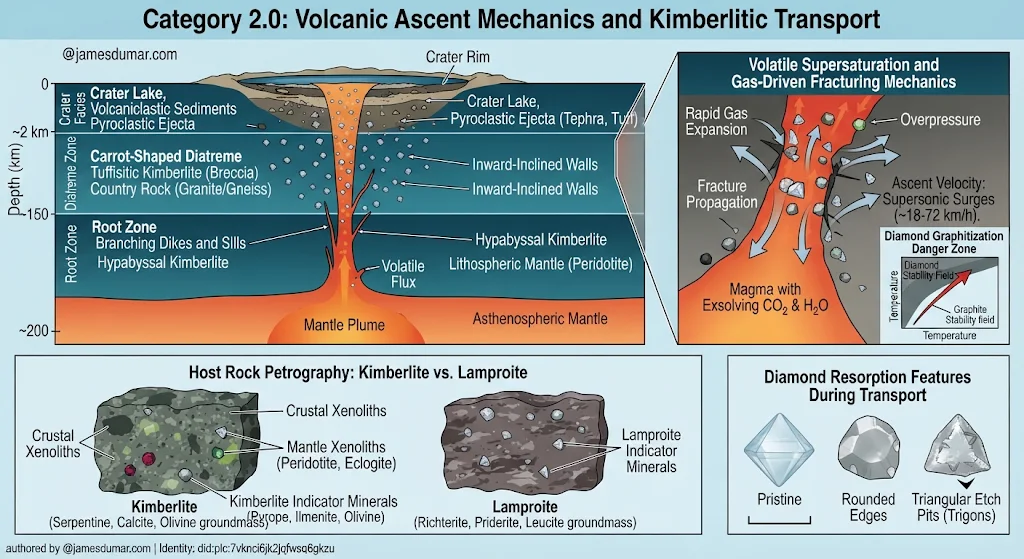
Propelled by violent gas exsolution and volatile expansion, deep mantle magma breaches the crust at supersonic speeds, executing an elevator ride that rescues diamonds from thermal destruction.
| Transport Parameter | Dynamic Range | Geological Consequence |
|---|---|---|
| Ascent Velocity | 18 to 72 kilometers per hour (supersonic surges possible) | Prevents graphitization of diamond during rapid depressurization. |
| Magma Composition | Volatile-rich ultrabasic potassic silicate melts | Supplies high concentrations of carbon dioxide, water, and potassium. |
| Conduit Morphology | Vertical carrot-shaped diatremes (Kimberlite/Lamproite pipes) | Channels mantle debris across upper crustal thickness efficiently. |
Core Attribute Grouping
- Fluid Exsolution: Massive gas expansion driving explosive kinetic energy through narrow crustal fissures.
- Xenolith Sampling: Entrainment of deep mantle wall-rock fragments providing direct geological samples of sub-crustal strata.
- Diatreme Facies: Zoned volcanic architecture comprising root zones, diatreme zones, and crater facies.
2.1 Mantle Plumes and Explosive Magma Generation
As a gem merchant who has walked the perimeter of vast open-pit operations like the Venetia or Ekati mines, the sheer scale of the geological vehicle that delivers diamonds to the surface never ceases to astound. Diamonds crystallize one hundred to two hundred kilometers beneath our feet in conditions of extreme stability. If they remained stationary, they would be utterly inaccessible. The mechanism that bridges this insurmountable chasm is a specialized, volatile-driven volcanic eruption. Unlike typical basaltic eruptions that feed slow-flowing lava rivers or explosive stratovolcanoes driven by subduction zones, diamond-bearing magmas—specifically kimberlites, lamproites, and ultramafic lamprophyres—represent unique, highly energetic events originating from deep within the mantle.
The generation of kimberlite magma begins when deep thermal anomalies or volatile fluxes destabilize the asthenospheric mantle beneath ancient cratons. These melts are chemically distinct from standard mantle melts; they are ultrabasic, highly potassic, and excessively enriched in incompatible trace elements, carbon dioxide, water, and phosphorus. Because the source region resides deep within the mantle, the initial melting fraction is extremely small, typically less than one percent. This small melt fraction concentrates volatiles aggressively. As the melt gathers volume and buoyancy, it begins its upward migration, focusing along ancient structural weaknesses, suture zones, and deep-seated crustal fractures that penetrate the thick cratonic keel.
2.1.1 Volatile Supersaturation and Gas-Driven Fracturing
The driving force behind kimberlitic ascent is not standard thermal buoyancy alone, but volatile supersaturation. As the magma ascends from deep mantle pressures toward the shallower crust, the solubility of dissolved gases—predominantly carbon dioxide and water vapor—drops precipitously. This triggers rapid gas exsolution, forming a foaming, highly compressible gas-melt emulsion. This gas phase expands violently, creating extreme internal pressures that exceed the tensile strength of the surrounding country rock. The magma does not merely flow upward; it fractures its way through the lithosphere, propagating upward at incredible speeds that can reach tens of meters per second.
2.1.1.1 Supersonic Ascent Kinetics and Diamond Preservation
The velocity of this ascent is critical to the survival of the gem-quality diamonds suspended within the magma. As diamonds are carried upward, they enter shallower pressure-temperature regimes where graphite is the thermodynamically stable form of carbon. If the magma ascended sluggishly like typical basaltic lava, the prolonged exposure to high temperatures at lower pressures would cause the diamonds to convert entirely into graphite or burn away entirely. The supersonic speed of kimberlite ascent—often compared to a rocket launch—acts as an emergency thermal escape hatch, rushing the diamonds through the danger zone so rapidly that kinetic barriers prevent the crystal lattice from rearranging into graphite.
2.2 Kimberlite Pipe Architecture and Diatreme Facies
As the ascending volatile-rich magma nears the Earth’s surface, the geometry of the conduit undergoes a dramatic transformation, forming the classic structural architecture known as a kimberlite pipe or diatreme. A fully preserved kimberlite occurrence exhibits a distinct tripartite zoning structure: the root zone deep down, the intermediate diatreme zone, and the surface crater zone. Each zone reflects a different physical and thermodynamic environment during the final stages of emplacement, dictating how diamonds are distributed within the host rock.
The root zone, located at depths of two to three kilometers or more, consists of narrow, branching dikes and root-pipe structures where the magma moved through narrow fissures under high confining pressures. Moving upward, the diatreme zone expands into a massive, downward-pointing carrot-shaped column with steep walls inclined inward at angles of 80 to 85 degrees. Within this zone, the explosive expansion of carbon dioxide and steam creates a fluidized system of gas, rock fragments, and molten material. This is where extensive mechanical brecciation occurs, shattering the surrounding wall rocks and mixing them thoroughly with mantle materials.
2.2.1 Xenoliths and Xenocrysts as Geological Windows
Within the diatreme and root zones, the rising magma acts as a high-speed geological vacuum cleaner, scooping up fragments of every rock layer it passes through on its journey. These foreign rock fragments are called xenoliths (meaning “strange rocks”), and individual mineral crystals torn from them are called xenocrysts. For gemmologists and geologists, xenoliths of peridotite, eclogite, and lower-crustal granulite are priceless treasures. They provide direct physical samples of the Earth’s interior that can be studied in laboratory settings, revealing the temperature, pressure, and chemical composition of the mantle at the exact moment the diamond-bearing magma swept through.
2.2.1.1 Crater Facies and Surface Reshedding
The uppermost portion of the kimberlite system is the crater facies, which breaches the paleosurface to form a broad, shallow bowl-shaped depression often filled with water to form a crater lake. During the violent eruptive phase, a mixture of gas, ash, and fragmented rock—known as pyroclastic material—is ejected into the atmosphere, forming a ring of tephra and tuff around the vent. Over time, surface weathering, rain, and stream action erode these crater rims, washing redeposited kimberlitic material back into the crater lake. This creates layered sequences of volcaniclastic sediments that contain redistributed diamonds, frequently mixed with organic debris and surface soils.
2.3 Lamproites and Alternative Volcanic Hosts
While kimberlites are historically and economically the most famous diamond-bearing volcanic rocks, accounting for the vast majority of global diamond production, they are not the exclusive vehicles of deep Earth transport. In certain geological settings, alternative potassic-ultramafic volcanic rocks known as lamproites serve as the primary host matrix for diamond deposits. The most prominent commercial example of a lamproite-hosted diamond deposit is the Argyle mine in Western Australia, which supplied a significant percentage of the world’s natural diamonds for decades, including its legendary pink stones.
Lamproites differ mineralogically and chemically from kimberlites. They are formed from magmas derived from melting of anomalous, metasomatized sub-continental lithosphere that has been enriched in incompatible elements and volatiles, but they typically contain different primary mineral assemblages, such as titanian potassium richterite, priderite, and leucite, rather than the serpentine, calcite, and olivine characteristic of altered kimberlites. Lamproite magmas also tend to erupt through thinner or younger crustal blocks compared to classic cratonic kimberlites, producing broader, shallower volcanic craters resembling maar volcanoes rather than deep carrot-shaped diatremes.
2.3.1 Magmatic Differentiation and Diamond Resorption
Whether hosted in kimberlite or lamproite, the chemical environment of the ascending melt exerts a powerful influence on the physical appearance of the recovered diamonds. As the magma rises, corrosive fluids and elevated temperatures can cause partial dissolution or resorption of the crystal faces. A gemmologist observing rough parcels often notices that octahedral diamond crystals have curved faces, rounded edges, or triangular etch pits known as trigons. These surface features are the indelible signatures of chemical attack during transport, proving that the diamond endured a turbulent, reactive journey before solidifying in the upper crust.
2.3.1.1 Post-Emplacement Weathering and Degradation
Once a kimberlite or lamproite pipe cools and solidifies at the surface, it forms a soft, easily weathered rock mass rich in serpentine and carbonate minerals compared to the hard surrounding granitic or gneissic country rocks. Over millions of years, tropical rainfall, chemical weathering, and mechanical erosion selectively wear down the soft kimberlite pipe faster than the surrounding terrain. This creates a surface depression or basin marking the location of the ancient volcanic vent. Weathering breaks down the host rock, releasing millions of tough, chemically inert diamonds into the surrounding soil, initiating the secondary transport cycle that leads to alluvial and marine deposits.
Category 3.0: Exploration Methodologies and Industrial Extraction Engineering
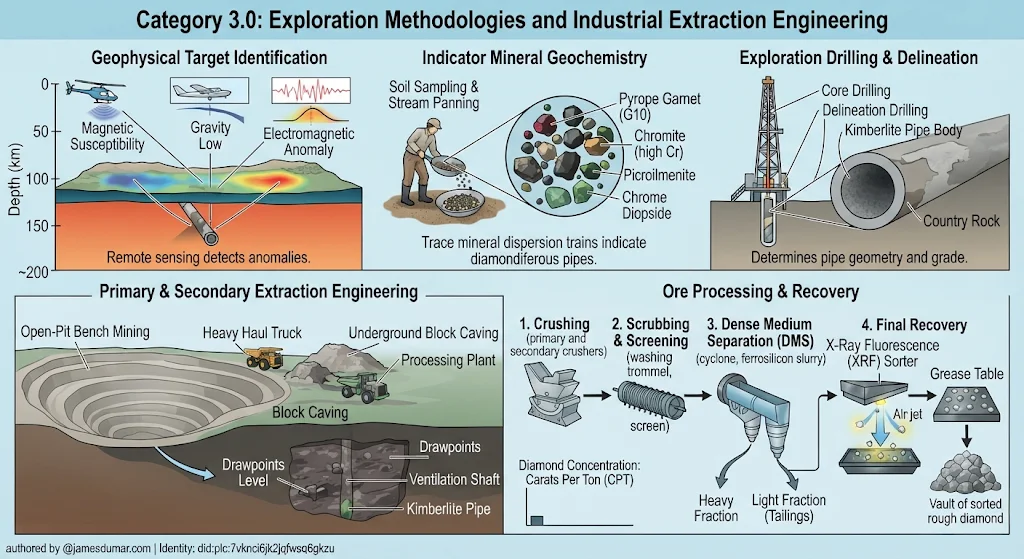
Unearthing ancient mineral wealth requires a sophisticated union of airborne geophysics, subterranean open-pit engineering, and high-volume mechanical ore separation.
| Mining Sector | Technological Approach | Primary Operational Goal |
|---|---|---|
| Primary Open-Pit | Bench mining, large-scale drilling, and heavy haul trucks | Extract high-volume surface kimberlite ore efficiently. |
| Underground Block Caving | Gravitational subsidence and automated drawpoint extraction | Access deep pipes safely when open-pit stripping becomes uneconomic. |
| Alluvial and Marine Dredging | Hydraulic suction, seabed crawling vessels, and heavy media separation | Recover weather-released gems from riverbeds and marine terraces. |
Core Attribute Grouping
- Geophysical Signatures: Magnetic, gravity, and electromagnetic anomalies identifying buried ultramafic pipes.
- Heavy Media Separation: Utilizing ferrosilicon slurries to isolate high-density diamond-bearing fractions from crushed host rock.
- X-Ray Fluorescence Sorting: Advanced optical sorting units detecting diamond luminescence under X-ray bombardment.
3.1 Geophysical Exploration and Kimberlite Target Identification
As a gem merchant who tracks global supply pipelines, I am well aware that finding a viable diamond deposit is an exercise in extreme geological needle-in-a-haystack searching. Thousands of square kilometers of ancient cratonic terrain must be surveyed before a single productive kimberlite pipe is discovered. Modern exploration programs deploy sophisticated airborne and ground-based geophysical technologies to detect subtle physical anomalies caused by kimberlite intrusions. Because kimberlite rocks are rich in iron-bearing minerals like olivine, serpentine, and magnetite, they frequently exhibit distinct magnetic susceptibility contrasts compared to the surrounding granitic or gneissic country rocks.
Airborne magnetic surveys, conducted using fixed-wing aircraft or helicopters equipped with high-sensitivity cesium vapor magnetometers, map minute variations in the Earth’s local magnetic field. Simultaneously, gravity surveys are employed because altered, weathered kimberlite is significantly less dense than unweathered crystalline basement rock, creating a localized gravity low. Electromagnetic surveys add another layer of resolution by measuring conductivity contrasts, as weathered kimberlite clays retain moisture and conduct electricity differently than dry, solid rock. When magnetic lows align with gravity lows and specific structural lineaments, exploration geologists identify prime targets for ground-based testing.
3.1.1 Indicator Mineral Geochemistry and Dispersion Trains
Geophysics alone cannot confirm the presence of diamonds; it only locates the volcanic pipe. To determine whether the pipe is diamondiferous, exploration teams rely on indicator mineral sampling. As a kimberlite pipe weathers over millions of years, it sheds robust, chemically stable accessory minerals into local streams, soils, and glacial till, creating a mineral dispersion train that can stretch for tens of kilometers downstream or down-ice. Geologists pan sediment samples to recover these indicator minerals, which serve as direct messengers from the diamond window.
3.1.1.1 Key Indicator Mineral Signatures
The premier indicator minerals include pyrope garnet (specifically chromium-rich G10 garnets derived from peridotitic diamond stability fields), chromite with high chromium and magnesium numbers, picroilmenite (magnesium-rich ilmenite), and chrome diopside. By analyzing the chemical composition of these grains using electron microprobes, geologists can evaluate the temperature and pressure conditions of the source mantle rock. If the recovered garnets fall within the “G10 harzburgitic field,” it indicates that the underlying mantle has the exact chemical composition required to host high-value gem-quality diamonds, justifying the immense capital expenditure of drilling and bulk sampling.
3.2 Open-Pit and Underground Primary Hard-Rock Mining
Once a diamondiferous kimberlite pipe is confirmed and delineated through extensive core drilling, the operation transitions from exploration to industrial mining engineering. Depending on the depth, grade, and surface geography of the deposit, mining engineers choose between open-pit methods and underground operations. Open-pit mining is utilized during the initial decades of a deposit’s life when the pipe reaches the surface. Giant terraces or benches are cut into the sides of the pit, and massive hydraulic shovels load hundreds of tons of kimberlite ore into ultra-class haul trucks.
As the open pit deepens, the stripping ratio—the volume of barren waste rock that must be removed to access a ton of ore—increases dramatically, rendering open-pit mining economically unviable past a certain depth. At this juncture, mines transition to underground mining methods, most notably block caving. In block caving, miners excavate an undercut level beneath the kimberlite pipe and drill and blast the rock to initiate a controlled gravitational collapse. The massive column of kimberlite ore fractures under its own weight and slowly subsides toward a network of extraction drives, where automated load-haul-dump machines collect the broken ore for hoisting to the surface.
3.2.1 Ore Processing and Heavy Media Separation (HMS)
Extracting diamonds from hard kimberlite or lamproite ore is vastly different from mining gold or copper; diamonds represent an infinitesimally small fraction of the total rock volume, often measured in carats per ton (where one carat equals 0.2 grams, meaning a rich mine might yield less than one gram of diamond per ton of processed rock). Consequently, processing plants are engineered to handle massive tonnages while meticulously concentrating heavy minerals. The process begins with primary and secondary crushing stages to reduce the hard kimberlite rock into manageable gravel-sized fragments without fracturing the enclosed diamonds.
3.2.1.1 Dense Medium Separation Technology
Following crushing, the ore slurry passes through Heavy Media Separation (HMS) circuits. The crushed rock is mixed with water and a fine suspension of atomized ferrosilicon powder to create a fluid medium with a precisely controlled density of approximately 2.7 grams per cubic centimeter. Because diamond has a density of 3.52 grams per cubic centimeter, it sinks along with other dense accessory minerals like garnet, ilmenite, and zircon, while the lighter gangue minerals (quartz, feldspar, and mica) float to the surface and are discarded as tailings. This separation stage reduces the volume of material by up to ninety-eight percent, isolating a dense concentrate ready for final recovery.
3.3 Secondary Alluvial and Marine Extraction Networks
Not all diamonds are mined directly from primary volcanic pipes. Over millions of years, surface weathering, rivers, and coastal currents erode exposed kimberlite pipes, transporting durable diamond crystals across vast landscapes. These secondary deposits—known as alluvial deposits when found in river systems and marine deposits when concentrated along coastlines or ocean floors—yield some of the highest-quality gem diamonds in the world. Because inferior, fractured, or weak stones are destroyed during natural transport and river tumbling, alluvial parcels are typically dominated by exceptionally clean, durable, high-purity crystals.
Alluvial mining operations range from small-scale artisanal riverbed panning to massive industrial dredging operations along major river terraces in regions like southern Africa and Siberia. Heavy earthmoving equipment strips away surface gravel layers, which are then washed through mobile screening plants and jigging machines to isolate the dense diamond-bearing fractions. In coastal environments, such as along the Atlantic coast of Namibia and South Africa, diamond-bearing gravels deposited on ancient marine terraces or modern seabed floors are harvested using specialized marine mining vessels equipped with giant drill bits, hydraulic suction airlift systems, and robotic seabed crawlers.
3.3.1 X-Ray Luminescence and Modern Recovery Sorting
In the final stages of both primary and secondary diamond processing, advanced optical and electronic sorting technologies have revolutionized the recovery suite. Historically, workers hand-sorted diamond concentrates on grease tables, taking advantage of the lipophilic (oil-attracting) and hydrophobic nature of rough diamond surfaces. Today, modern recovery plants utilize automated X-ray fluorescence (XRF) and X-ray transmission (XRT) sorting machines. When the diamond concentrate passes beneath an X-ray beam, the diamonds fluoresce brightly or absorb X-rays distinctively compared to associated gangue minerals. Pneumatic air jets fire instantly, deflecting the glowing diamonds into secure recovery vaults with absolute precision.
Category 4.0: Crystallographic Transformation and Precision Lapidary Engineering
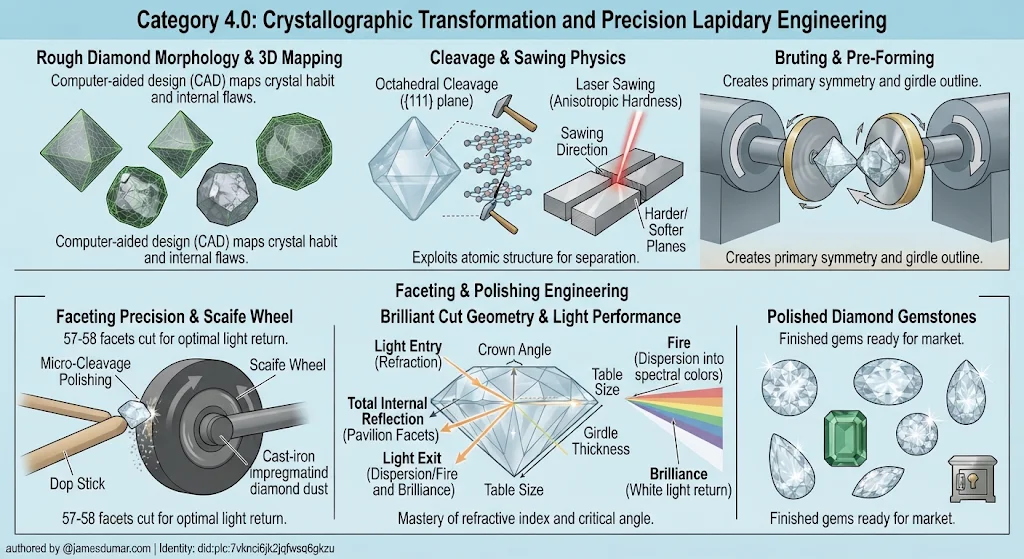
Transforming a greasy, irregular rough crystal into a dazzling optical prism requires an uncompromising synthesis of 3D laser mapping, cleavage plane physics, and exacting micro-faceting precision.
| Lapidary Stage | Technological Instrument | Primary Physical Objective |
|---|---|---|
| Planning & Mapping | 3D Laser Scanners & Inclusion Software | Detect internal stress, flaws, and calculate maximum yield. |
| Cleaving & Sawing | High-Precision Nd:YAG Lasers | Isolate main stone sections along preferred crystallographic planes. |
| Faceting & Polishing | Diamond-Dust Impregnated Scaife Wheels | Position 57-58 precise light-reflecting facets for optimal brilliance. |
Core Attribute Grouping
- Octahedral Cleavage: Exploiting weak interplanar bonding along the {111} crystallographic direction for clean mechanical splitting.
- Anisotropic Hardness: Navigating directional variations in abrasion resistance across different crystal faces during cutting.
- Optimizing Light Return: Precision angular geometry maximizing total internal reflection, fire, and scintillation.
4.1 Rough Diamond Morphology and Optical Assessment
As a seasoned gem merchant who has inspected countless parcels of rough stones across global trading hubs, I can confirm that the moment a rough diamond emerges from the final recovery vault is profoundly deceptive. To the untrained eye, a newly recovered rough diamond often resembles a greasy, frosted, rounded pebble or a distorted octahedral crystal coated in a dull skin. It bears little resemblance to the fiery, brilliant gemstones displayed in high-end retail showcases. Before any cutting tool touches the stone, it must undergo rigorous gemmological evaluation to determine its crystal habit, internal clarity, natural body color, and crystallographic orientation.
Natural rough diamonds crystallize in several primary shapes, with the regular octahedron being the most common and structurally balanced. Other forms include twinned crystals (known as macles), dodecahedrons, cubes, and irregular aggregated shapes called boart. Each morphology presents unique challenges and opportunities for the master cutter. The primary goal of the lapidary process is to maximize the financial value of the polished gem, which is a complex function of carat weight, clarity grade, color retention, and cut proportion. Achieving this requires looking past the rough exterior to map the hidden architecture within the stone.
4.1.1 Advanced 3D Laser Scanning and Inclusion Mapping
Modern diamond manufacturing has been entirely revolutionized by computer-aided design and high-resolution optical scanning technology. Systems utilize high-powered lasers and multi-angle digital cameras to construct an exact, three-dimensional digital model of the rough stone down to the micron. This software maps every internal inclusion, feather, carbon spot, and internal stress fracture in relation to the exterior surface. Master planners analyze these digital models to simulate dozens of potential cutting outcomes, calculating exact weight retention and purity grades before a single physical cut is executed.
4.1.1.1 The Balance Between Mass Retention and Clarity Improvement
The core tension in rough diamond planning lies in the eternal trade-off between mass retention and clarity improvement. Cutting a rough stone into two smaller polished gems might yield a higher combined value if a major inclusion can be completely isolated and removed. Conversely, retaining a large single stone with a minor inclusion tucked near the girdle can preserve the prestige of a high-carat weight category. Sophisticated planning software runs optimization algorithms that factor in current global market pricing dynamics for specific weight brackets, guiding the cutter toward the most profitable configuration.
4.2 Cleaving, Sawing, and Crystallographic Anisotropy
Once the cutting plan is finalized, the rough diamond must be divided or shaped according to the mapped design. This stage requires a profound understanding of diamond crystallography, particularly its atomic cleavage properties and anisotropic hardness. Diamond possesses perfect cleavage along the {111} crystallographic planes—the directions parallel to the octahedral faces where the atomic density is lowest and the distance between planes is greatest. For centuries, traditional cleavers utilized a steel blade and a sharp mallet strike to split diamonds along these planes. Today, high-precision thermal and mechanical lasers have largely replaced manual striking, offering absolute control and eliminating the catastrophic risk of shattering flawed stones.
For cuts that do not align with natural octahedral cleavage planes, sawing is required. Because diamond is the hardest known natural substance, conventional metal saws are completely ineffective. Instead, high-powered solid-state lasers (such as Nd:YAG lasers) or traditional phosphor-bronze circular saws spinning at high speeds coated with olive oil and diamond dust are employed. The saw slowly abrades a kerf through the diamond by exploiting an essential physical property: anisotropic hardness. Diamond hardness varies depending on the crystallographic direction; it is hardest across the dodecahedral planes and relatively softer along specific sawing vectors.
4.2.1 Bruting and Pre-Forming Geometry
Following the separation of the rough stone into primary pre-forms, the diamond enters the bruting stage, where it is shaped into its preliminary symmetrical outline—round, oval, pear, emerald, or marquise. In traditional mechanical bruting, two diamonds are mounted on high-speed rotating spindles and pressed against each other; one diamond acts as the cutting tool while the other is shaped. Modern automated computer-numerical-control (CNC) bruting lathes have replaced manual setups, ensuring absolute rotational symmetry and precise girdle thickness standards required by modern grading laboratories.
4.2.1.1 Faceting Physics and Light Return Optimization
The final and most critical phase of lapidary engineering is faceting and polishing. A standard round brilliant-cut diamond features precisely 57 or 58 facets arranged in a mathematically rigorous geometric pattern comprising the table, crown, girdle, and pavilion. Polishing is performed on heavy cast-iron wheels known as scaifes, which are coated with a precise emulsion of diamond powder and olive oil rotating at several thousand revolutions per minute. Because diamond can only be abraded by diamond, the scaife relies on directional micro-cleavage and abrasive friction.
4.3 Optical Physics of the Brilliant Cut
The ultimate objective of placing 57 or 58 microscopic facets on a diamond is not mere decoration; it is the mastery of optical physics to maximize brilliance, fire, and scintillation. When light enters a well-cut diamond through the crown, it interacts with the stone’s high refractive index of 2.417. This high refractive index forces incoming light rays to bend sharply inward toward the center of the stone. Furthermore, diamond possesses a critical angle of 24.4 degrees, which is exceptionally shallow compared to most other gemstones. This means that light striking the internal pavilion facets at angles greater than 24.4 degrees cannot escape downward; instead, it undergoes total internal reflection, bouncing back up through the crown toward the observer’s eye.
Dispersion—the optical phenomenon where white light is split into its component spectral colors as it passes through a medium—creates the multicolored flashes known as fire. In diamond, dispersion is rated at 0.044, which, combined with high optical transparency and precise facet angular tolerances, generates the signature visual performance that has captivated humanity for millennia. Whether formed in the ancient cratonic mantle three billion years ago, recovered via supersonic volcanic ascent, or engineered in a high-tech laboratory, the polished diamond remains an enduring testament to the perfect union of fundamental earth science and human ingenuity.
Category 5.0: Technological Synthesis, Lab-Grown Genesis, and Market Evolution
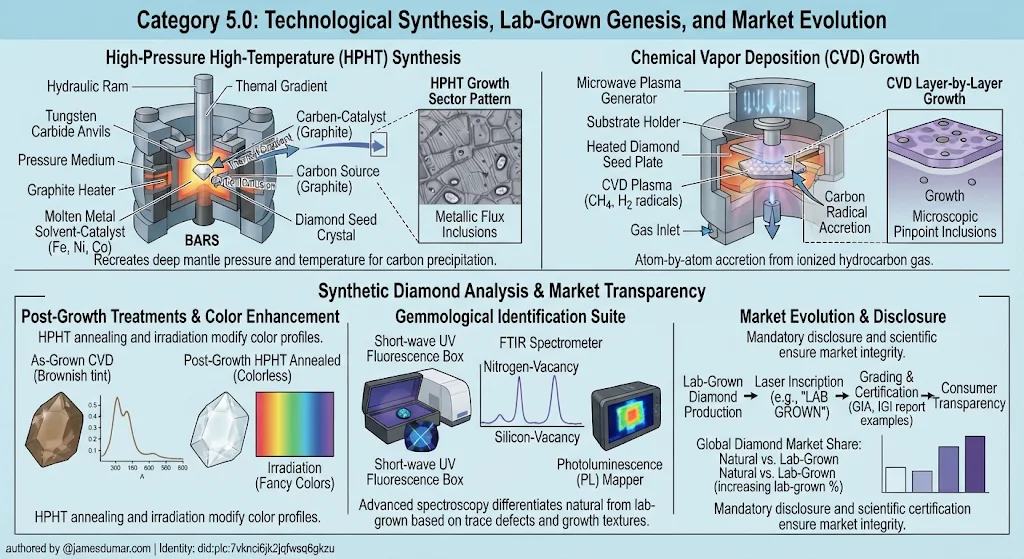
Replicating deep mantle thermodynamics inside modern high-tech reactors has unlocked synthetically grown diamond technology, matching natural crystal perfection and reshaping global gemmological trade dynamics.
| Synthesis Methodology | Technological Environment | Crystallographic Growth Mechanism |
|---|---|---|
| High-Pressure High-Temperature (HPHT) | Belt or cubic presses at ~1,500°C and 55,000 atm | Solvent-catalyst metal bath dissolves carbon source onto seed crystal. |
| Chemical Vapor Deposition (CVD) | Vacuum chamber with microwave plasma and hydrocarbon gas mix | Atom-by-atom carbon accretion onto flat diamond seed plates. |
| Gemmological Identification | Short-wave UV fluorescence, FTIR, and Photoluminescence | Detects metallic flux inclusions, nitrogen aggregation, and strain patterns. |
Core Attribute Grouping
- Solvent-Catalyst Fluxes: Molten transition metals (iron, nickel, cobalt) lowering activation thresholds for HPHT carbon precipitation.
- Plasma Dissociation: Microwave energy breaking down methane and hydrogen gases into reactive carbon radicals for CVD growth.
- Post-Growth Treatment: High-pressure annealing or irradiation shifting synthetic diamond color profiles.
5.1 High-Pressure High-Temperature (HPHT) Synthesis Mechanics
As a veteran gem merchant who has navigated the profound paradigm shifts in modern diamond commerce, I recognize that the boundary between natural Earth history and human scientific achievement has fundamentally dissolved. For decades, the only diamonds available for industrial and ornamental purposes were mined from ancient kimberlite pipes or secondary alluvial deposits. However, human ingenuity eventually cracked the code of deep mantle physics, enabling scientists to recreate the extreme temperatures and pressures of the sub-continental lithosphere inside high-tech laboratory reactors. Today, lab-grown diamonds are chemically, physically, and optically identical to their subterranean counterparts, representing one of the most remarkable material science triumphs of the modern era.
The first major commercial pathway for synthesizing diamond is the High-Pressure High-Temperature (HPHT) method, which directly mimics the natural crucible of the mantle. Developed initially in the mid-20th century for industrial abrasive applications and later refined for gem-quality production, HPHT synthesis utilizes massive hydraulic presses—such as belt presses, cubic presses, or split-sphere (BARS) presses—capable of generating sustained internal pressures exceeding 5 to 6 gigapascals and temperatures ranging from 1,400°C to 1,600°C. Inside these high-pressure vessels, a small diamond seed crystal is placed alongside a high-purity carbon source (such as graphite) and a molten metal solvent-catalyst, typically composed of transition metals like iron, nickel, cobalt, or their alloys.
5.1.1 Solvent-Catalyst Dissolution and Thermal Gradient Transport
The presence of the molten metal solvent is crucial for successful HPHT growth. Under operating pressures and temperatures, the graphite carbon dissolves into the molten metal flux. Because a carefully maintained thermal gradient is established between the hotter carbon source and the slightly cooler diamond seed, dissolved carbon atoms diffuse through the liquid metal medium toward the seed crystal. Upon reaching the cooler seed, the carbon precipitates out of solution and layers atom by atom onto the crystal lattice, mimicking natural mantle growth sectors. Over several days or weeks, a pristine, gem-quality synthetic diamond crystal—frequently displaying a combined cubo-octahedral morphology—is successfully cultivated.
5.1.1.1 Metallic Inclusions and HPHT Diagnostic Features
Despite their identical atomic structure, HPHT-grown diamonds carry distinct microscopic fingerprints that allow trained gemmologists and advanced laboratory instruments to separate them from natural mined stones. Because the growth process relies on molten metal fluxes, tiny droplets or films of the metal solvent can become trapped inside the diamond crystal as inclusions. Under microscopic examination with crossed polarizers or specialized lighting, these metallic inclusions often exhibit characteristic dark, opaque appearances or metallic magnetism. Furthermore, HPHT stones frequently display sharp geometric internal growth sector patterns when viewed under short-wave ultraviolet or DiamondView luminescence imaging.
5.2 Chemical Vapor Deposition (CVD) Growth Technology
While HPHT replication mirrors the mechanical compression of deep mantle plumbing, the Chemical Vapor Deposition (CVD) method approaches diamond synthesis through an entirely different physical pathway: atomic layer accretion from a gaseous plasma phase. CVD technology has advanced rapidly, allowing manufacturers to produce large, exceptionally clear colorless and fancy-colored gem-quality diamonds with remarkable efficiency. The process takes place inside a sealed vacuum chamber evacuated to low pressures and filled with a carefully proportioned mixture of hydrocarbon gases—typically methane as the carbon source—diluted in a massive excess of hydrogen gas.
Energy is introduced into the chamber via microwave radiation, hot filaments, or direct current plasma discharges, ionizing the gas mixture into a glowing, highly reactive plasma cloud. Within this plasma, intense heat and electromagnetic fields break down the stable methane molecules into active carbon and hydrogen radicals. These reactive carbon atoms rain down vertically onto a prepared substrate consisting of flat, laser-sliced plates of single-crystal diamond seeds. As the carbon radicals land on the seed surface, they bond with the open carbon valencies, building up the diamond crystal lattice layer by atomic layer at growth rates of several micrometers per hour.
5.2.1 Strain Management and Post-Growth Annealing
CVD diamond growth requires precise control over chamber temperature, gas flow ratios, and microwave power density. If the carbon concentration in the plasma becomes too high, amorphous carbon or graphite clusters begin to deposit on the growing crystal, ruining clarity. As CVD diamond grows thicker, internal crystal lattice strain can accumulate, sometimes imparting a subtle brownish tint to the as-grown crystal. To correct this and optimize optical clarity, many CVD diamonds undergo secondary post-growth HPHT annealing treatment. This high-temperature, high-pressure treatment relieves lattice stress, removes brown coloration centers, and converts nitrogen impurities, yielding brilliant, colorless stones.
5.2.1.1 Spectroscopic Identification of CVD Diamonds
Like their HPHT counterparts, CVD-grown diamonds possess unique diagnostic characteristics that differentiate them from natural mined stones. Because CVD growth occurs on flat seed plates without metallic flux, they generally lack metallic inclusions, but they may exhibit microscopic pinpoints, faint non-diamond carbon inclusions, or characteristic strain birefringence patterns under polarized light. Advanced spectroscopic tools—such as Fourier-transform infrared (FTIR) spectroscopy, photoluminescence (PL) spectroscopy, and ultraviolet absorption analysis—reveal specific optical defect centers, such as silicon-vacancy or nitrogen-vacancy complexes, providing absolute certainty in gemmological identification laboratories worldwide.
5.3 Gemmological Integrity and Market Transparency
The proliferation of high-quality lab-grown diamonds has fundamentally transformed the global jewelry market, shifting consumer priorities, pricing structures, and grading protocols. As a merchant who values absolute transparency and rigorous technical positioning, I view this technological evolution not as a crisis, but as an opportunity for market clarity. The fundamental premise of the gem trade has always relied on accurate disclosure, scientific verification, and an appreciation for rarity—whether that rarity is measured in billions of years of deep Earth cratonic history or in the precision engineering of advanced plasma vacuum chambers.
Major international gemmological laboratories, including the Gemological Institute of America (GIA) and the International Gemological Institute (IGI), have responded to this technological shift by upgrading their screening machinery and expanding grading documentation. Every polished diamond entering legitimate commercial channels must be accompanied by rigorous scientific certification that explicitly discloses its origin—whether natural or laboratory-grown. This transparency ensures that consumer confidence remains unshakable, preserving the intrinsic aesthetic and emotional value of the gemstone regardless of whether its genesis was forged in an ancient subterranean volcanic pipe or engineered by human brilliance in a modern laboratory.
Category 6.0: Future Frontiers, Sustainable Stewardship, and Circular Gemmology
authored by @jamesdumar.com | Identity: did:plc:7vknci6jk2jqfwsq6gkzu
Navigating the next era of the diamond industry demands rigorous environmental auditing, ethical supply chain provenance, and circular economic frameworks that honor both deep geological heritage and modern ecological accountability.
| Sustainability Pillar | Operational Mechanism | Long-Term Industry Impact |
|---|---|---|
| Provenance Tracking | Blockchain ledgers and optical laser inscription | Guarantees conflict-free, ethical tracking from mine to finger. |
| Carbon Neutrality | Renewable energy integration and kimberlite carbon mineralization | Offsets industrial emissions by locking carbon dioxide back into waste rock. |
| Circular Economy | Recycling estate jewelry and industrial diamond repurposing | Reduces reliance on new extraction by maximizing existing diamond assets. |
Core Attribute Grouping
- Ethical Provenance: Verifying human rights compliance, fair labor practices, and community benefit sharing across mining regions.
- Mineral Carbonation: Harnessing ultramafic tailings to sequester atmospheric carbon dioxide permanently as stable carbonate minerals.
- Traceability Technology: Immutable digital ledgers ensuring absolute transparency in rough-to-polished supply chain pathways.
6.1 Ethical Sourcing, Traceability, and Blockchain Ledgers
As a seasoned gem merchant who has witnessed the dramatic evolution of consumer expectations, I understand that the modern stakeholder no longer evaluates a diamond solely on the basis of its physical brilliance, color grade, and carat weight. Today’s sophisticated buyer demands absolute transparency regarding provenance, ethical mining practices, and environmental stewardship. For decades, the global diamond trade struggled with opacity, leaving supply chains vulnerable to conflict financing and illicit trading. In response, the industry has undergone a radical transformation, embracing rigorous certification frameworks such as the Kimberley Process Certification Scheme alongside advanced technological tracking mechanisms.
Modern traceability protocols go far beyond traditional paper certificates. Leading mining houses and cutting centers now utilize cutting-edge digital technologies, including immutable blockchain ledgers and microscopic laser inscriptions on the girdle of the diamond. When a rough diamond is recovered, its unique physical attributes—such as weight, inclusion maps, and crystal geometry—are digitally scanned and recorded on a secure blockchain network. As the stone moves from the primary mining site to the cutting facility, the grading laboratory, and finally to the retail showcase, every transaction and transformation is permanently stamped onto the decentralized ledger. This ensures that the end consumer receives an unalterable proof of origin, guaranteeing that the gemstone was mined and processed under ethical, conflict-free conditions.
6.1.1 Environmental Mitigation and Carbon Mineralization in Mining
Beyond ethical labor standards, the environmental footprint of primary diamond extraction has faced intense scrutiny. Moving millions of tons of hard kimberlite ore requires massive energy consumption and water management infrastructure. However, progressive mining operations are pioneering revolutionary green technologies to neutralize their environmental impact. One of the most promising scientific breakthroughs is mineral carbonation utilizing kimberlite tailings. Because kimberlite is an ultramafic rock rich in magnesium and calcium silicates, the finely crushed waste rock left over after diamond extraction possesses a natural chemical affinity to absorb carbon dioxide from the atmosphere, converting greenhouse gases into stable, solid carbonate minerals.
6.1.1.1 Renewable Energy Integration in Remote Operations
Furthermore, many major diamond mines located in remote regions—such as the Canadian subarctic or the arid expanses of southern Africa—are transitioning away from diesel-dependent power generation toward hybrid renewable energy grids. By integrating large-scale wind turbine farms, solar photovoltaic arrays, and advanced battery energy storage systems, mining conglomerates are drastically reducing their greenhouse gas emissions. This proactive shift demonstrates that industrial-scale diamond recovery can harmonize with rigorous ecological standards, preserving the integrity of fragile wilderness ecosystems while satisfying global market demands.
6.2 The Circular Gem Economy and Estate Diamond Recycling
As both lab-grown and mined diamonds circulate in increasing volumes across global markets, the concept of a circular gem economy has gained significant momentum. Unlike consumable luxury goods that degrade with use, diamonds are physically indestructible. A diamond set in an antique Victorian brooch or an Art Deco engagement ring possesses the exact same atomic lattice and optical brilliance as a newly mined stone. Consequently, the recycling, re-cutting, and repurposing of estate and antique diamonds represent a rapidly growing segment of sustainable luxury commerce.
Estate diamond recycling minimizes the environmental impact associated with new extraction or high-energy laboratory synthesis. Master lapidaries frequently evaluate vintage or damaged cut stones, employing modern 3D laser mapping to re-cut older proportions into contemporary ideal cuts that maximize light performance without requiring any new earth disturbance. This circular approach appeals deeply to modern consumers who prioritize sustainability, heritage, and timeless design over newly manufactured inventory, creating a closed-loop ecosystem where diamonds are continually passed down, re-imagined, and cherished across generations.
6.2.1 Industrial Diamond Applications and Technological Future
While this narrative has focused extensively on gem-quality diamonds gracing jewelry collections, it is vital to acknowledge that a substantial portion of global diamond production—both natural industrial boart and HPHT/CVD synthetics—powers critical technological infrastructure. Due to its extreme thermal conductivity, electrical insulation properties, and mechanical hardness, diamond is an irreplaceable material in high-tech engineering. Synthetic diamond wafers are actively revolutionizing high-power semiconductor electronics, quantum computing processors, high-precision surgical scalpels, and deep-space optical window shields.
6.2.1.1 The Enduring Legacy of Carbon
Whether examining the ancient geological crucible of a billion-year-old cratonic keel, analyzing the supersonic fury of a kimberlitic volcanic ascent, or evaluating the atomic precision of a laboratory plasma chamber, the story of diamond remains one of nature’s most captivating intersections of physics and art. As a gemmologist and merchant, looking into the heart of a brilliant diamond is looking into deep time—a quiet, enduring echo of planetary creation that continues to inspire, challenge, and captivate humanity across the modern age.