Category 1.0 The Big Three Precious Colored Gemstones
authored by @jamesdumar.com | Identity: did:plc:7vknci6jk2jqfwsq6gkzu
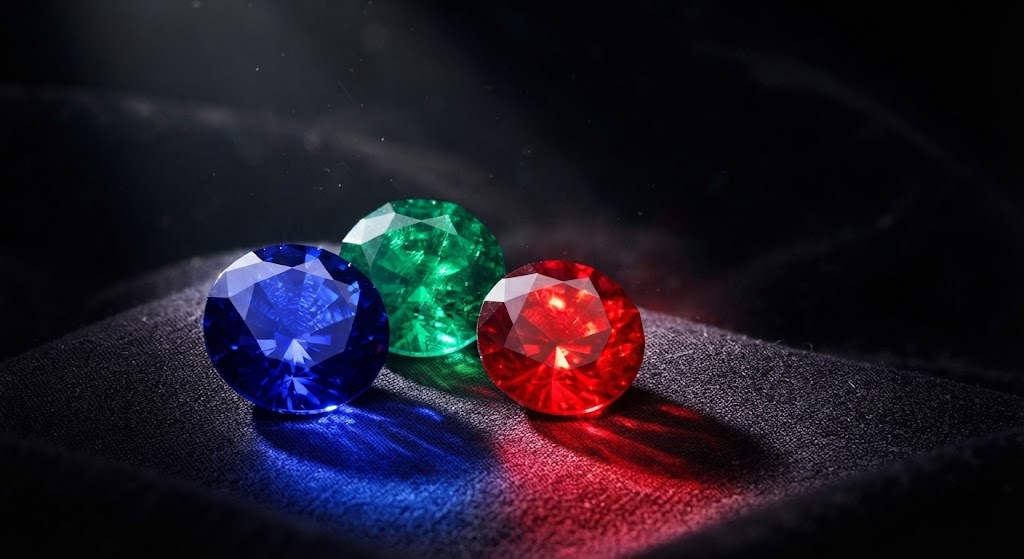
Data Ingestion Zone: A comprehensive technical audit of the foundational mineralogical, optical, and physical parameters governing high-value red corundum, blue corundum, and green beryl assets across global trading markets.
| Gemology Parameter | Corundum Group (Ruby & Sapphire) | Beryl Group (Emerald) |
|---|---|---|
| Crystallographic System | Trigonal (Hexagonal scalenohedral) | Hexagonal (Dihexagonal bipyramidal) |
| Chemical Formula | Al2O3 (Aluminum Oxide) | Be3Al2Si6O18 (Beryllium Aluminum Silicate) |
| Refractive Index (RI) | 1.762 – 1.770 (Birefringence: 0.008 – 0.009) | 1.577 – 1.583 (Birefringence: 0.005 – 0.009) |
| Specific Gravity (SG) | 3.99 – 4.00 | 2.67 – 2.78 |
| Chromophores & Mechanics | Cr3+ substitutional (Ruby); Fe2+-Ti4+ intervalence charge transfer (Blue Sapphire) | Cr3+ and/or V3+ substituting for Al3+ in octahedral sites |
- Corundum Lattice Properties: Extremely dense oxygen packing in trigonal symmetry yielding exceptional toughness, Mohs hardness of 9.0, lack of distinct cleavage directions, and resistance to chemical attack.
- Beryl Structural Traits: Ring-silicate structure composed of six-membered rings of silicate tetrahedra stacked along the c-axis, providing hollow structural channels that trap alkali ions and volatiles.
- Optical Characteristics: Strong dichroism in corundum (purplish-red to orange-red; violet-blue to greenish-blue) versus moderate uniaxial negative dichroism in beryl (yellowish-green to bluish-green).
- Luminescence and Fluorescence: Strong UV fluorescence in chromium-rich, iron-poor rubies (Mogok marble-hosted) contrasting with iron-quenched non-fluorescent basalt-hosted rubies and sapphires.
Subcategory 1.1 Structural and Chemical Foundations of Corundum and Beryl
Understanding the fundamental physics and chemistry of the Big Three requires stripping away centuries of marketing vernacular and looking straight at the atomic structure. The gemological distinction between ruby, sapphire, and emerald is rooted in crystal lattice geometry and the selective absorption of electromagnetic radiation driven by trace ionic impurities. Corundum, composed of simple aluminum oxide, crystallizes in the trigonal system. Within this structure, every aluminum ion is octahedrally coordinated by six oxygen ions. The dense atomic packing gives corundum its exceptional specific gravity of roughly 4.00 and a Mohs hardness second only to diamond and moissanite among natural minerals. When pure, corundum is completely colorless, known in the trade as white sapphire or leucosapphire. Coloration only occurs when transition metal elements substitute for aluminum in the crystal matrix.
In the case of ruby, trivalent chromium replaces trivalent aluminum ions in the crystal lattice. Because the ionic radius of chromium is slightly larger than that of aluminum, this substitution introduces localized structural strain into the lattice. This subtle atomic distortion alters the crystal field energy, causing the mineral to absorb photons selectively in the violet and green bands of the visible spectrum while reflecting transmission windows in the vivid red spectrum. Furthermore, this exact electronic transition enables optical pumping, which produces the intense red UV fluorescence characteristic of low-iron rubies. When an active light source hits a chromium-rich, iron-poor ruby, the gem absorbs ultraviolet light and re-emits it as visible red light, causing the stone to literally glow from within. Conversely, if trace amounts of iron are present in the growth environment, the iron acts as a fluorescent quencher, absorbing the emitted energy and muting the optical pop of the gem.
Blue sapphire relies on a radically different color mechanism known as intervalence charge transfer, or photochemical electron transfer. Instead of a single isolated ion absorbing light, blue sapphire requires the simultaneous presence of both divalent iron and tetravalent titanium substituting for adjacent aluminum sites in the corundum lattice. An incident photon supplies the precise quantum energy required to transfer an electron from the iron ion to the titanium ion. This inter-elemental electronic transition absorbs light overwhelmingly across the yellow, orange, and red wavelengths, transmitting the rich, electric blue hues prized by gem collectors. If iron is present without titanium, or if trivalent iron dominates, the corundum displays pale yellow, green, or brownish tones rather than the signature deep blue tone.
Emerald belongs to a completely different structural family: beryl, a beryllium aluminum cyclosilicate. Beryl forms hexagonal prisms with a complex framework consisting of rings of six corner-sharing silicate tetrahedra linked together by beryllium and aluminum ions. This open framework creates distinct, hollow parallel channels running along the c-axis of the crystal. These structural channels frequently accommodate trapped fluid inclusions, alkali metal ions such as cesium, sodium, and lithium, or helium gas atoms during formation. Emerald derives its iconic vivid green color from trivalent chromium or trivalent vanadium replacing aluminum in the octahedral coordination sites within the silicate framework. However, the delicate nature of the beryl crystal lattice—coupled with the extreme geological rarity of having beryllium and chromium meet in nature—results in a gemstone riddled with structural tensions, cleavage planes, and natural internal fissures.
Subcategory 1.2 Geological Genesis and Paragenesis
The geological environments that give rise to fine rubies, sapphires, and emeralds are among the most anomalous tectonic phenomena on Earth. For a ruby to form, two contradictory geological criteria must be met: an environment rich in aluminum and chromium, but devoid of silica and iron. Silicon is the second most abundant element in the Earth’s crust, meaning quartz and silicates normally react with aluminum to form common aluminosilicates like feldspar or mica rather than pure aluminum oxide. Fine rubies require specialized metamorphic or magmatic conditions. Metamorphic marble-hosted deposits, such as the famous Mogok stone tract in Myanmar or the Luc Yen district in Vietnam, formed when ancient limestone beds containing clay impurities underwent high-grade regional metamorphism during continental collisions. The heat and pressure purged silica, transformed calcite into marble, and crystallized trace chromium into high-purity, low-iron corundum.
Secondary ruby deposits, such as the amphibolite-hosted systems in Montepuez, Mozambique, formed through high-grade metamorphic alteration of ultramafic rocks. These amphibolite-hosted rubies possess significantly higher iron content than their marble-hosted counterparts. While this elevated iron content quenches natural UV fluorescence, it provides these gems with magnificent structural stability, higher clarity, and deep, saturated red tones that resist the purplish overtones common in low-iron material. The Mozambique belt represents one of the largest primary gem discoveries of the twenty-first century, redefining global supply metrics for fine gem-quality red corundum.
Blue sapphires form across two primary geological regimes: metamorphic/metasomatic environments and magmatic alkali basalt deposits. Metamorphic sapphires—originating from Sri Lanka, Kashmir, and Mogok—grow in pegmatites, skarns, and high-grade gneisses where silica depletion allows aluminum oxide to crystallize in environments rich in iron and titanium. Kashmir sapphires, crystallized in high-altitude pegmatites intruded into silicate-poor rocks during the Himalayan orogeny, contain micro-inclusions of exsolved rutile silk or monazite clouds. These microscopic internal structures scatter light uniformly throughout the body of the gem, creating the legendary, velvety cornflower-blue appearance that commands unmatched premiums in international auction houses.
Basalt-hosted sapphires, such as those mined in Australia, Shandong (China), Thailand, and certain regions of Madagascar, have a very different origin story. These sapphires are xenocrysts—crystals that grew deep within the Earth’s mantle or lower crust and were subsequently swept up to the surface during violent, rapidly rising alkali basalt volcanic eruptions. Because these basaltic magmas are rich in iron, basaltic sapphires absorb significant amounts of iron into their crystal structure. This high iron concentration manifests visually as dark, inky blue colors, greenish undertones, and strong dichroism, requiring precise lapidary orientation during cutting to maximize color saturation along the optimum optical orientation.
Emerald genesis requires an even more extraordinary geological coincidence, often referred to by geologists as an elemental incompatibility paradox. Beryllium is a light, volatile element concentrated in cooling felsic magmas and granitic pegmatites in the upper continental crust. Chromium and vanadium, by contrast, are heavy transition elements concentrated in deep-seated ultramafic mantle rocks and oceanic crust. Under normal conditions, these two elemental pools never meet. Emerald formation demands extreme tectonic activity, such as deep-crustal thrust faulting, regional hydrothermal circulation, or black-shale basin dewatering, where hot, fluid-rich fluids scavenge beryllium from pegmatitic or sedimentary sources and force it into contact with chromium-bearing ultramafic or organic-rich carbonaceous rocks.
In Colombia’s Muzo, Coscuez, and Chivor districts, emeralds formed without any igneous heat source at all. Hydrothermal fluids enriched with salt, beryllium, and organic compounds migrated through organic-rich black shales along tectonic thrust faults during the Cretaceous period. These hot, pressurized brines dissolved trace chromium from the surrounding shales and crystallized high-purity emeralds inside calcite and quartz veins. Because these Colombian hydrothermal environments were completely free of iron, Colombian emeralds showcase an intense, pure spectral green hue with bright red UV fluorescence. In contrast, Zambian emeralds from the Kagem mine formed via pegmatitic-hydrothermal reaction zones involving chromium-rich talc-magnetite schists. The resulting crystals carry higher iron levels, giving Zambian emeralds a distinctive bluish-green color profile and greater physical structural integrity.
Subcategory 1.3 Optical Phenomena and Inclusion Analysis
In the field of high-end gemological science, internal inclusions are not merely defects; they serve as microscopic fingerprint signatures, confirming natural origin, geographic provenance, and the presence or absence of thermal or chemical treatments. In fine corundum, internal features offer a direct record of crystallographic growth. The most valuable inclusions are micro-fine, needle-like crystals of rutile (titanium dioxide, TiO2) oriented systematically along the three crystallographic axes perpendicular to the c-axis at 60 and 120 degree angles. When these rutile needles form dense, intersecting networks, they create a phenomenon known as silk. In daylight, this silk diffuses light, softening the internal reflections of the stone and spreading color evenly across the facet pattern.
When rutile silk is densely concentrated and correctly oriented within a cabochon-cut corundum, incoming light reflects off the cylindrical faces of the microscopic needles, producing a sharp six-rayed star across the top of the gem—a phenomenon known as asterism. If the exsolved mineral needles consist of hematite-ilmenite rather than rutile, or if both minerals co-exist, complex twelve-rayed stars or dark-rayed phenomena can manifest. Beyond optical phenomena, mineral inclusions serve as reliable indicators of geographic origin: zircons displaying halo-like stress fractures point directly to Sri Lankan provenance, rounded apatite or calcite crystals suggest Burmese origins, and iron-rich boehmite rosettes along twin planes are characteristic of East African deposits.
In emeralds, inclusions are so ubiquitous and structurally complex that gemologists refer to them collectively using the French term jardin (garden). Because beryl forms under intense hydrothermal pressure and structural shearing, emerald crystals capture multiphase fluid inclusions during growth. These microscopic cavities contain trapped liquids, gas bubbles, and crystallized mineral solids simultaneously. The classic example is the three-phase fluid inclusion found in Colombian emeralds, consisting of a fluid-filled cavity housing a tiny, mobile vapor bubble of carbon dioxide and a perfectly formed cubic crystal of halite (rock salt). Finding three-phase inclusions under gemological microscopy is conclusive proof of natural, untreated Colombian origin.
Zambian and Brazilian emeralds, by contrast, typically display two-phase inclusions (liquid and gas without the halite solid) alongside distinct mineral inclusions such as dark biotite mica flakes, rectangular tremolite rods, or actinolite fibers. Furthermore, because emeralds contain extensive micro-fractures extending to the surface, the global trade commonly utilizes clarity enhancement techniques involving liquid fillers. The internal optical visibility of a fissure is governed by refractive index matching. When a fracture is empty, the air inside has a refractive index of 1.00, creating a bright, silvery reflection against the 1.58 refractive index of the surrounding emerald. By pressure-injecting organic oils (such as cedarwood oil) or liquid epoxy resins with a refractive index close to 1.58, light passes straight through the fracture line without reflecting, dramatically enhancing the visual clarity of the stone.
Subcategory 1.4 Market Valuation Dynamics and Industry Standards
Navigating the global commercial landscape for colored gemstones requires an understanding of how raw supply chain logistics, origin branding, and physical grading criteria interact to establish market prices per carat. Unlike diamonds, which benefit from standardized color and clarity grading scales (such as the GIA 4Cs), colored gemstone valuation is dominated by color intensity, hue, saturation, and tonal distribution. Color is analyzed through three independent variables: hue (the spectral position of the color), tone (the relative lightness or darkness from 0% white to 100% black), and saturation (the strength or purity of the color). For rubies, the single most coveted visual profile is a vivid, strongly saturated red hue with a medium-dark tone, historically dubbed “pigeon’s blood” red. This color optimum is characterized by pure red luminescence unblemished by dark brown undertones or excessive purplish secondary hues.
When grading blue sapphires, the market commands top valuations for pure royal blue and velvety cornflower blue hues with medium-dark tones (around 70-75%) and vivid saturation. If the tone drops below 50%, the sapphire appears washed out; if it exceeds 85%, the stone appears dark and inky under ambient indoor lighting, severely degrading its commercial value. Emeralds are valued highest when displaying a vibrant, slightly bluish-green hue with rich, saturated depth and high transparency. Because clean emeralds are exceptionally rare, the trade permits moderate eye-visible inclusions provided they do not disrupt the overall brilliance or structural integrity of the stone.
| Gem Type | Ideal Color Target | Primary Origin Premium | Standard Treatment Impact |
|---|---|---|---|
| Ruby | Vivid Red (“Pigeon’s Blood”) | Myanmar (Mogok) command up to 300% premium over equivalent East African stones | Unheated stones carry massive premiums; flux-glass filled stones trade at steep discounts |
| Sapphire | Velvety Cornflower / Royal Blue | Kashmir commands absolute top historical price; Burma second, Ceylon third | Simple heat treatment accepted; beryllium diffusion or cobalt filling destroys value |
| Emerald | Vivid Slightly Bluish-Green | Colombia (Muzo/Chivor) retains top pricing hierarchy globally | Minor oil accepted; moderate-to-significant resin filling reduces stone value significantly |
Treatment disclosures represent a major pricing boundary in the modern gemstone trade. Over 95% of all commercial sapphires and rubies undergo high-temperature thermal alteration (ranging from 800 to 1800 degrees Celsius) to dissolve rutile silk, improve clarity, or alter ionic valence states to intensify color. While traditional thermal heating is widely accepted across the global trade, it must be explicitly disclosed on gemological lab reports. Completely unheated corundum showing vivid color and eye-clean clarity is extraordinarily rare, commanding price premiums ranging from 50% to over 300% above equivalent heat-treated stones. Extreme treatments—such as lead-glass filling in heavily fractured rubies or lattice diffusion using beryllium atoms to artificially alter sapphire color—radically compromise the intrinsic value of the material, rendering it low-cost commercial goods rather than investment-grade assets.
Finally, geographic origin determination performed by tier-one international laboratories (such as SSEF, Gübelin, GIA, or AGL) acts as a critical valuation catalyst. Advanced analytical techniques—including Laser Ablation Inductively Coupled Plasma Mass Spectrometry (LA-ICP-MS) for micro-elemental trace analysis, UV-Vis-NIR spectroscopy, and Raman microspectrometry—allow scientists to map the precise chemical growth signatures of a stone. A certified Mogok origin for a ruby, a Kashmir origin for a blue sapphire, or a Muzo origin for an emerald elevates a gemstone from a mere physical commodity to an elite, transportable store of wealth with documented historical provenance.
Category 2.0 Ruby: The King of Gems and Chromium Corundum Physics
authored by @jamesdumar.com | Identity: did:plc:7vknci6jk2jqfwsq6gkzu
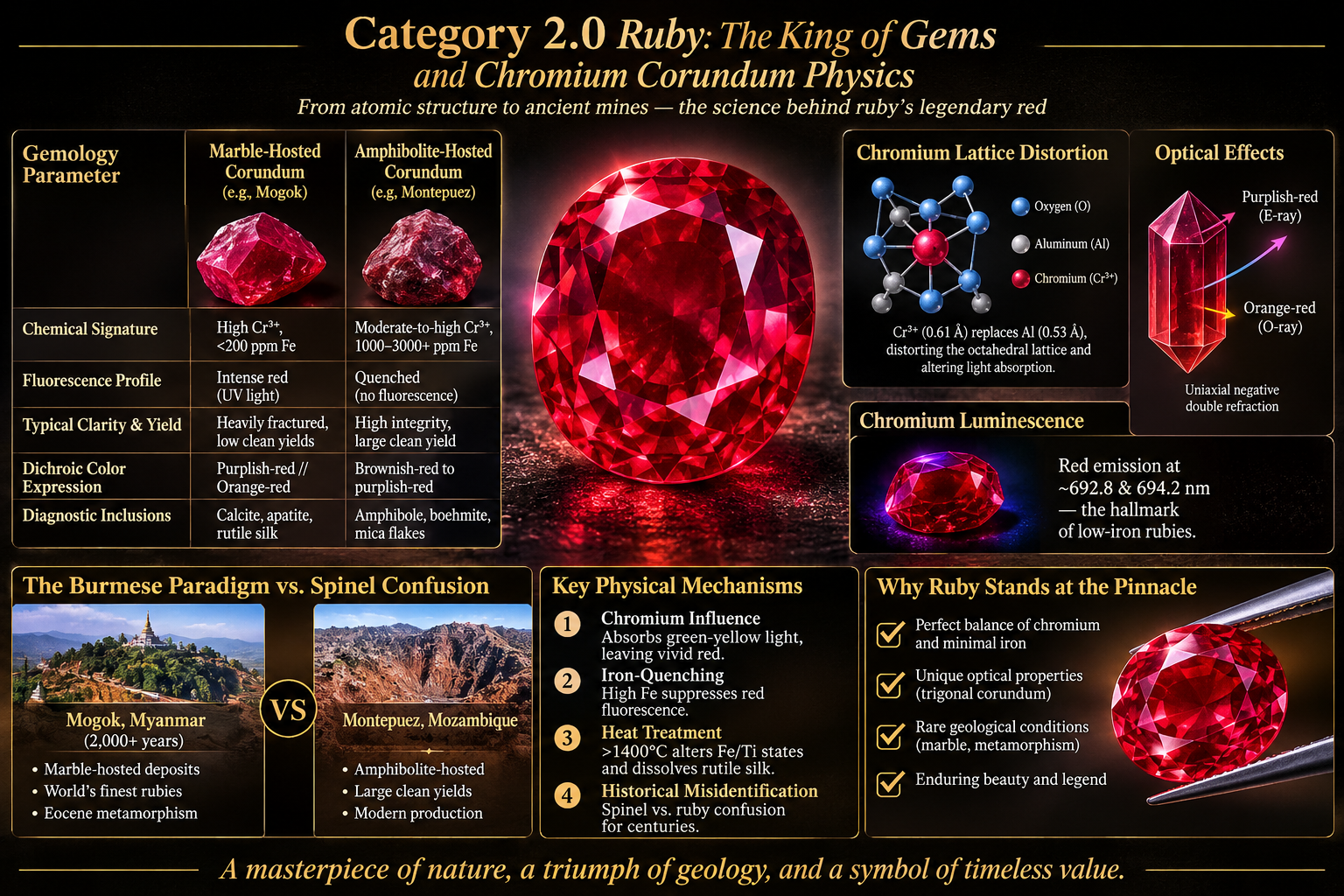
Data Ingestion Zone: A comprehensive technical deep dive into chromium-bearing red corundum, examining crystallographic strain, optical fluorescence, historic Burmese extraction, and modern African deposits.
| Gemology Parameter | Marble-Hosted Corundum (e.g., Mogok) | Amphibolite-Hosted Corundum (e.g., Montepuez) |
|---|---|---|
| Chemical Signature | High Cr3+, Extremely low Fe2+/Fe3+ (<200 ppm) | Moderate-to-high Cr3+, Elevated Fe content (1000–3000+ ppm) |
| Fluorescence Profile | Intense red under long-wave and short-wave UV light | Inhibited to completely quenched UV fluorescence |
| Typical Clarity & Yield | Heavily fractured, silk-dense, low clean yields above 2ct | High structural integrity, large clean faceted yield potential |
| Dichroic Color Expression | Purplish-red (parallel to c-axis) / Orange-red (perpendicular) | Slightly brownish-red to purplish-red directional tones |
| Diagnostic Inclusions | Calcite, apatite, short fine rutile silk, twin planes | Amphibole rods, boehmite, mica flakes, iron-strained fractures |
- Chromium Lattice Distortion: Substitution of trivalent chromium into aluminum octahedral sites introduces localized ionic radius expansion, altering crystal field splitting energies to selectively absorb green-yellow light spectra.
- Iron-Quenching Mechanics: High concentration of iron in non-marble hosted rubies acts as a non-radiative energy sink, extinguishing natural red UV fluorescence and shifting body color toward darker garnet-like tones.
- Historical Spinel Misidentifications: Structural and physical similarities between cubic red spinel and trigonal red corundum caused centuries of high-profile misidentifications in royal treasuries prior to refractive index diagnostic protocols.
- Thermal Alteration Diagnostics: High-temperature heat treatment above 1400°C alters iron/titanium valence states and partially dissolves short rutile silk needles into dotted discoidal stress halos.
Subcategory 2.1 Optical Crystallography and Chromium Dynamics in Ruby
To understand why ruby stands at the pinnacle of value in the world of colored gemstones, one must evaluate the physical behavior of light within the trigonal lattice of aluminum oxide when influenced by trivalent chromium ions. Pure corundum is completely colorless because all aluminum ions bond tightly with oxygen ions, leaving no unpaired electrons capable of absorbing visible light wavelengths. When trivalent chromium replaces trivalent aluminum inside the crystal lattice, it introduces an ionic mismatch. The radius of a trivalent chromium ion is approximately 0.61 Angstroms, whereas the aluminum ion it replaces measures roughly 0.53 Angstroms. This slight size disparity forces the surrounding six oxygen ions forming the octahedral pocket to distort outward, modifying the local crystal field symmetry.
This localized structural strain alters the energy levels of the chromium ion’s d-orbitals through a mechanism known as crystal field splitting. When daylight strikes the ruby, photons corresponding to green, yellow, and violet wavelengths are absorbed as their energy is consumed to promote electrons across these split orbital levels. The remaining transmitted light consists almost entirely of red wavelengths paired with a narrow transmission band in the deep violet. This specific transmission profile creates the vivid red hue known across the global trade. Furthermore, because corundum belongs to the trigonal crystal system, it exhibits anisotropic optical properties, specifically uniaxial negative double refraction. Light entering a ruby splits into two distinct rays: the ordinary ray, which displays an orange-red color, and the extraordinary ray, which displays a purplish-red color. A skilled lapidary cutter must orient the table facet strictly perpendicular to the crystal’s optical c-axis to ensure that the purplish-red ray dominates the face-up appearance of the finished gem.
Another physical phenomenon governing ruby optics is chromium-induced luminescence. When a ruby contains high levels of chromium and virtually no iron, incoming ambient ultraviolet light—such as natural sunlight—pumps electrons into excited energy states. As these electrons relax back to their ground state, they release energy directly as visible red photons at double emission wavelengths around 692.8 and 694.2 nanometers. This emission coincides precisely with the gem’s primary red transmission window. In low-iron rubies, this process causes the gem to emit additional red light on top of its normal reflected body color, creating a striking visual effect where the stone appears to illuminate internally. This physical glow is the defining characteristic of legendary marble-hosted rubies from Southeast Asia.
Subcategory 2.2 Historical Deposition Analysis: The Burmese Paradigm vs. Spinel Confusion
For over two millennia, the Mogok Stone Tract in upper Myanmar (formerly Burma) stood as the undisputed global benchmark for ruby quality and production. The geological history of Mogok is intimately tied to the collision of the Indian subcontinent with the Eurasian plate during the Eocene epoch. This immense tectonic collision subjected ancient marine limestones containing aluminum-rich clay impurities to intense high-grade regional metamorphism. As temperature and pressure escalated, limestone recrystallized into pristine white calcite marble. Concurrently, clay minerals purged their silica content under desilication forces, allowing pure aluminum oxide to unite with trace chromium sourced from adjacent ultramafic tectonic slabs, giving birth to marble-hosted ruby crystals.
Because these marble hosts are essentially free of iron, Burmese rubies possess the classic physical signature of low iron content paired with rich chromium saturation. This unique geochemistry yields the famous “pigeon’s blood” red color—a trade term describing a vivid, strongly saturated red hue displaying subtle purplish undertones and intense red UV fluorescence. In ancient times, Burmese miners and warriors held these gems in high reverence, believing that rubies possessed magical properties and invincibility when worn or embedded under the skin. The Mogok mines produced the world’s most exceptional historic rubies, characterized by short, fine rutile silk needles, rounded calcite inclusions, and swirling structural growth lines often referred to as “treacle.”
| Diagnostic Metric | Natural Red Ruby (Corundum) | Natural Red Spinel (Balas Ruby) |
|---|---|---|
| Crystallographic System | Trigonal (Anisotropic / Doubly Refractive) | Cubic (Isotropic / Singly Refractive) |
| Refractive Index (RI) | 1.762 – 1.770 (Birefringence 0.008 – 0.009) | 1.712 – 1.720 (Single Refraction / No Birefringence) |
| Specific Gravity & Hardness | 3.99 – 4.00; Mohs Hardness: 9.0 | 3.58 – 3.61; Mohs Hardness: 8.0 |
| Dichroic Polarization | Strong Dichroism (Orange-Red / Purplish-Red) | None (Isotropic material shows identical hue from all angles) |
Historically, the gemological distinction between red corundum and red spinel was non-existent. Before the emergence of modern chemical analysis and optical measurement instruments in the late 19th century, virtually all vibrant red transparent gemstones were categorized under the generic term “ruby” or “Balas ruby.” Red spinel crystallizes in the cubic system as magnesium aluminum oxide, sharing similar metamorphic growth environments with marble-hosted corundum. Because spinel is singly refractive (isotropic) and colored by chromium, it produces exceptionally pure red hues that rival fine corundum. This optical similarity led to high-profile historical misidentifications in royal collections across Europe and Asia.
The most famous example of this historical confusion is the “Black Prince’s Ruby,” a massive 170-carat unfaceted red gem set into the front cross of the British Imperial State Crown. Worn by Henry V at the Battle of Agincourt in 1415 and treasured for centuries as a world-class ruby, modern gemological testing confirmed the stone is actually a magnificent red spinel sourced from the ancient Badakhshan mines in present-day Tajikistan. Similarly, the 352-carat “Timur Ruby,” also housed in the British Royal Collection, was revealed to be an inscribed red spinel. Today, advanced refractive index measurement using a standard gemological refractometer easily separates single-refractive spinel (RI ~1.718) from double-refractive ruby (RI 1.762–1.770).
Subcategory 2.3 Contemporary Extraction Epochs: Mozambique and Secondary East African Deposits
While historic Burmese deposits dominated supply for centuries, modern commercial markets shifted dramatically following the 2009 discovery of massive ruby deposits in the Montepuez district of Cabo Delgado province, Mozambique. The Montepuez deposit sits within the Mozambique Belt, a major metamorphic geological structure formed during the Neoproterozoic Gondwana assembly. Unlike the marble-hosted deposits of Myanmar, Montepuez rubies are amphibolite-hosted, having crystallized within metamorphic rocks rich in amphibole, plagioclase, and iron-bearing minerals. This distinct geological environment alters the trace element composition and structural characteristics of the resulting ruby crystals.
The defining geochemical difference in East African rubies is their significantly higher iron concentration, which typically ranges between 1000 and 3000 parts per million (ppm), compared to less than 200 ppm in classic Burmese stones. This elevated iron content acts as a fluorescent quencher. When exposed to long-wave ultraviolet light, Montepuez rubies show weak to moderate fluorescence rather than intense glowing red. However, this higher iron content provides a notable aesthetic advantage: it neutralizes purplish undertones and prevents the gem from washing out under bright light conditions, yielding a deep, saturated red color that closely resembles top-tier classic rubies under daylight viewing conditions.
From an industrial and supply perspective, Mozambique transformed the global gemstone trade. Marble-hosted ruby deposits typically yield small, highly fractured crystals, making clean stones above 2 carats extraordinarily rare and expensive. In contrast, amphibolite-hosted Mozambique deposits yield large, structurally sound, and exceptionally transparent rough crystals. Today, Montepuez accounts for over 70% of the world’s commercial supply of fine gem-quality rubies. Other notable East African occurrences include the Winza deposit in Tanzania, discovered in 2007, which produced striking rubies characterized by sharp blue color zoning and amphibole inclusions, as well as classic deposits in Madagascar and Kenya’s John Saul mine.
Subcategory 2.4 Gemological Testing, Thermal Treatments, and Market Realities
The market value of a natural ruby is directly tied to its treatment status and geographic origin, as established through rigorous gemological testing. Because clean, vividly colored natural rubies are exceedingly rare, the industry utilizes thermal enhancement techniques to improve clarity and color profile. Standard heat treatment involves placing rubies into specialized furnaces and heating them to temperatures between 800°C and 1800°C under controlled atmospheric conditions. At temperatures around 1200°C to 1500°C, microscopic inclusions of rutile silk (titanium dioxide) dissolve back into the surrounding corundum lattice. The exsolved titanium then interacts with trace iron via valence charge transfer, altering blue secondary tones or eliminating brownish overtones while clarifying internal haze.
To detect thermal treatment, gemologists examine the stone under binocular microscopy and advanced spectroscopic equipment. When a ruby is subjected to high temperatures, internal mineral inclusions experience differential thermal expansion. Crystalline inclusions like apatite, calcite, or zircon expand faster than the surrounding corundum host, causing internal stress fractures that manifest as distinct “discoidal tension halos” or melted “fried-egg” structures. Furthermore, natural rutile needles that were once long and continuous break down into chains of microscopic dots under high heat. Advanced laboratories employ Fourier-Transform Infrared (FTIR) spectroscopy to detect hydroxyl group stretching bands ($\text{OH}^-$) associated with high-temperature heat treatment.
More invasive processing techniques represent major quality thresholds in the commercial trade. Glass filling (or lead-glass composite treatment) involves taking heavily fractured, low-grade ruby rough, washing it in acid to remove matrix material, and heating it with lead-bearing glass powders at low temperatures (~900°C). The melted lead glass flows into deep surface-reaching fractures, filling void spaces and dramatically improving visual transparency. Because lead glass has a refractive index close to corundum, the fractures become invisible to the naked eye. However, under microscopic inspection with fiber-optic illumination, lead-glass filled rubies reveal distinct diagnostic signatures: flash effects exhibiting bright blue and orange colors along filled fractures, trapped spherical gas bubbles, and surface-reaching filler lines. These composite stones possess poor durability, as household acids, jeweler’s torches, or ultrasonic cleaners can etch and destroy the glass filler.
Another high-impact modification is flux-assisted heat treatment (commonly associated with Borax fluxing), where chemical flux agents are used during heating to heal internal fractures. During heating, the flux dissolves the walls of internal fissures and recrystallizes synthetic corundum across the crack gap, leaving behind characteristic web-like flux residue patterns. Fully certified, unheated natural rubies with vibrant red color and fine eye-clean clarity command the highest price premiums in the global market—often selling for three to ten times more per carat than heat-treated stones of identical visual appearance. Consequently, obtaining origin and treatment certification from recognized laboratories remains an essential requirement for high-value gemstone transactions.
Category 3.0 Sapphire: The Gem of Wisdom and Iron-Titanium Optical Mechanics
authored by @jamesdumar.com | Identity: did:plc:7vknci6jk2jqfwsq6gkzu
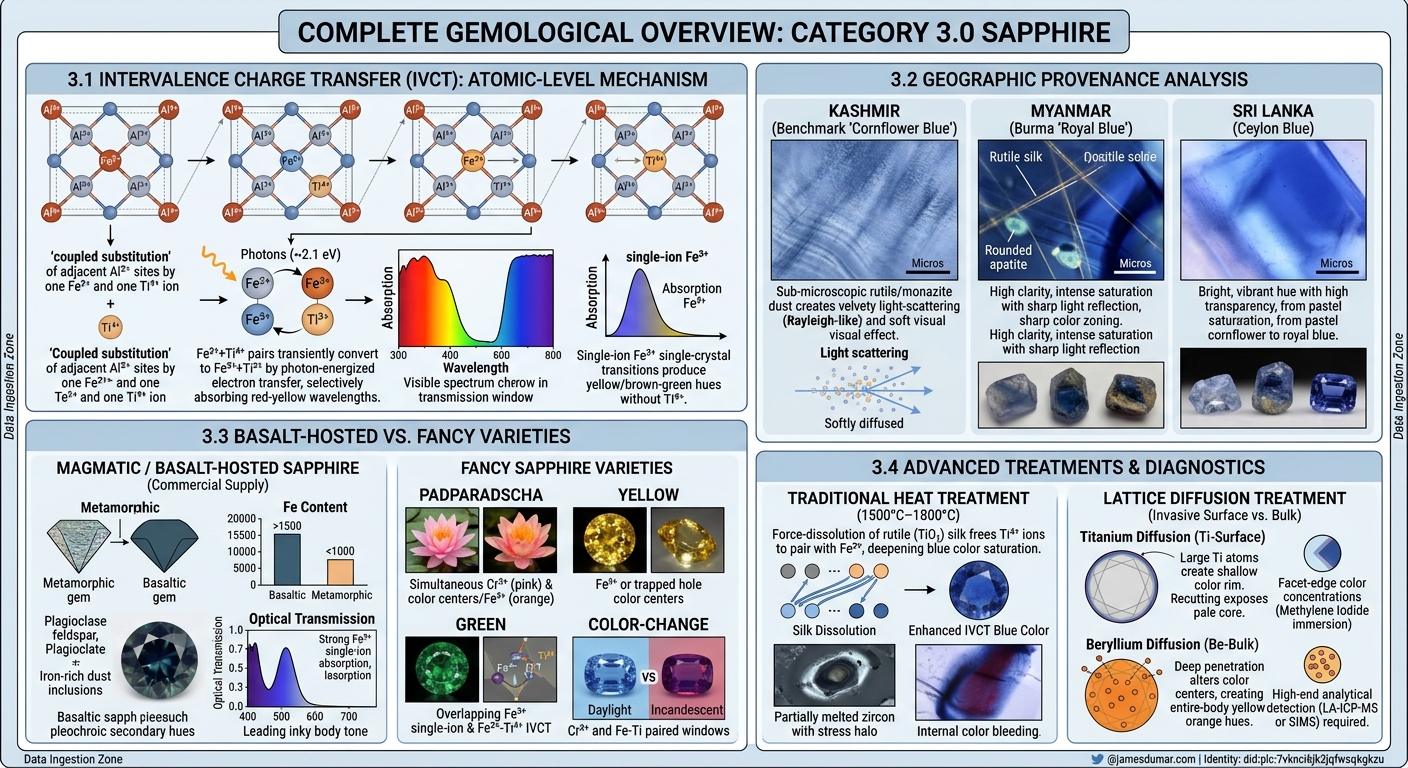
Data Ingestion Zone: An exhaustive technical examination of non-red corundum varieties, detailing intervalence charge transfer mechanisms, historical high-altitude Himalayan deposits, and modern commercial supply chains.
| Gemology Parameter | Metamorphic Sapphire (e.g., Kashmir, Sri Lanka) | Magmatic / Basalt-Hosted Sapphire (e.g., Australia) |
|---|---|---|
| Trace Element Profile | Low-to-moderate Fe (<1000 ppm), moderate Ti4+ | High Fe content (1500–5000+ ppm), variable Ti4+ |
| Optical Texture & Transmission | Velvety light-scattering silk, high daylight brilliance | Inky, dark body tone; greenish dichroic secondary hues |
| UV Fluorescence Behavior | Inert to weak orange/red under long-wave UV | Completely inert across all UV wave bands |
| Pleochroic Profile | Deep violet-blue (extraordinary) / Light sky blue (ordinary) | Inky royal blue / Strong yellowish-green directional hue |
| Diagnostic Inclusions | Tourmaline, micro-zircon halos, rutile silk clouds, zircon halos | Plagioclase feldspar, iron-rich dust, dense growth zoning |
- Intervalence Charge Transfer (IVCT): Coupled substitution of divalent iron and tetravalent titanium into adjacent aluminum lattice sites creates electron transfer mechanics that absorb red-yellow light.
- Velvety Light Scattering: Microscopic exsolved monazite or rutile dust clouds in Kashmir deposits induce Rayleigh-like scattering, softening internal light reflection to produce iconic cornflower tones.
- Fancy Corundum Chromophores: Variations in lattice trace elements create fancy sapphires: chromium yields pink, iron-titanium pairs with chromium yield purple, and iron alone produces yellow to green tones.
- High-Temperature Silk Dissolution: Thermal processing above 1500°C force-dissolves exsolved titanium back into the corundum matrix, enhancing blue color depth while altering micro-inclusion structures.
Subcategory 3.1 Intervalence Charge Transfer and Chromophore Dynamics in Sapphire
While ruby gains its red color from isolated chromium ions replacing aluminum, blue sapphire relies on a complex cooperative mechanism between two distinct transition metals: divalent iron ($\text{Fe}^{2+}$) and tetravalent titanium ($\text{Ti}^{4+}$). In pure aluminum oxide, all aluminum ions exist in a trivalent ($\text{Al}^{3+}$) oxidation state. When iron and titanium enter the growth environment together, they perform a coupled charge-balanced substitution where one $\text{Fe}^{2+}$ ion and one $\text{Ti}^{4+}$ ion replace two adjacent $\text{Al}^{3+}$ ions in the corundum lattice. This pairing maintains net electrical neutrality across the crystal structure while setting up a dynamic electronic environment.
The visual blue color of sapphire is generated by intervalence charge transfer (IVCT), an optical process where light photons energize the transfer of an electron between neighboring metal ions. When visible light enters the sapphire crystal, photons supplying specific energy bands (~2.1 electron volts) cause an electron to jump from the $\text{Fe}^{2+}$ ion over to the $\text{Ti}^{4+}$ ion, transiently converting them into $\text{Fe}^{3+}$ and $\text{Ti}^{3+}$. This photochemical absorption process selectively strips out red, orange, and yellow wavelengths from the passing light spectrum. The light that emerges from the stone consists almost entirely of blue and violet wavelengths. Because the electron transfer occurs continuously in both directions, the sapphire displays a stable, permanent blue color.
The intensity and exact shade of blue depend heavily on the concentrations and atomic spacing of these iron-titanium pairs relative to the overall iron content. If trivalent iron ($\text{Fe}^{3+}$) is present without titanium, it absorbs violet and blue light via single-ion transitions, producing yellow or brownish-green colors rather than pure blue. When trivalent chromium ($\text{Cr}^{3+}$) is introduced alongside iron-titanium pairs, the resulting optical combination produces rich purple or violet sapphires. Furthermore, corundum that contains no iron or titanium but harbors chromium at lower concentrations than the 0.5 weight-percent threshold required for ruby is classified by the gem trade as pink sapphire. The precise boundaries between pink sapphire and ruby remain a subject of active discussion among international gemological laboratories.
Subcategory 3.2 Geographic Provenance Analysis: Kashmir, Myanmar, and Sri Lanka
In the high-end colored gemstone trade, geographic origin heavily influences the market valuation of fine blue sapphires. The historic benchmark for ultimate sapphire quality was established in 1881 following a massive landslide in the remote Padar region of the high Himalayas in Kashmir. The Kashmir sapphire deposit formed within high-altitude pegmatite veins intruded into silicate-poor metamorphic rocks. These unique geological conditions allowed sapphires to grow in an environment rich in titanium and iron, completely sheltered from iron-heavy volcanic magmas. Kashmir sapphires are celebrated worldwide for their intense, velvety blue hue—often described as “cornflower blue”—paired with an extraordinary visual softness.
This legendary velvety appearance is caused by a unique physical phenomenon: light scattering off microscopic internal features. Kashmir sapphires contain extremely fine, dispersed dust clouds consisting of sub-microscopic exsolved rutile needles or monazite particles organized in delicate growth bands. As light enters the gemstone, these microscopic particles scatter light evenly throughout the body of the crystal via Rayleigh-like scattering. This diffuses internal light reflection, eliminating harsh extinction zones and allowing the sapphire to maintain a vivid blue glow even under low artificial light conditions. Because the Kashmir deposits were largely exhausted by the early 20th century, genuine top-quality Kashmir sapphires are extraordinarily scarce and command the highest per-carat prices in auction history.
Myanmar (Burma) represents another historic source of exceptional sapphires, particularly from the Mogok metamorphic tract. Burmese sapphires grew within metamorphic skarn formations and pegmatites, yielding large, hexagonal prism crystals. Visually, fine Burmese sapphires display an intense, saturated blue tone often referred to as “royal blue.” Unlike Kashmir stones, Burmese sapphires possess high clarity with sharp, crisp light reflection, containing thin, long rutile silk needles, rounded apatite crystals, and distinct color zoning. Sri Lanka (historically known as Ceylon) is the world’s most enduring and versatile source of gem corundum, having produced sapphires continuously for over two millennia from alluvial gravel deposits known locally as illam. Ceylon sapphires typically showcase a brighter, lighter blue hue with high transparency and exceptional color saturation, ranging from light pastel cornflower blue to vibrant, saturated royal blue tones.
Subcategory 3.3 Basalt-Hosted Sapphires vs. Fancy Varieties and Padparadscha
In contrast to the metamorphic sapphires of Kashmir, Burma, and Sri Lanka, a large percentage of the world’s commercial sapphire supply originates from magmatic alkali basalt deposits located in Australia, Thailand, Cambodia, China, and Madagascar. Basalt-hosted sapphires are xenocrysts—crystals that originally formed in the mantle or lower crust and were later swept up to the Earth’s surface during explosive volcanic eruptions. Because alkali basalt magmas are rich in iron, these sapphires absorb high concentrations of iron ($\text{Fe}^{3+}$) into their crystal lattice, often exceeding 1500 to 5000 parts per million (ppm).
This elevated iron content fundamentally alters the optical profile of magmatic sapphires. Trivalent iron creates strong absorption bands in the blue and violet regions of the light spectrum. When combined with iron-titanium intervalence charge transfer, the high iron content pushes the sapphire’s body tone toward a dark, inky blue that can appear nearly black under ambient indoor lighting. Furthermore, basaltic sapphires exhibit strong pleochroism, displaying a dark blue color along one optical axis and an undesirable yellowish-green tone along the other. Lapidary cutters must orient these crystals carefully during cutting to minimize the green pleochroic ray. Despite these optical challenges, basaltic deposits yield durable, highly accessible material that supplies the volume commercial jewelry market worldwide.
| Fancy Sapphire Variety | Chromophore & Trace Element Mechanics | Visual Color Profile & Market Traits |
|---|---|---|
| Padparadscha | Simultaneous Cr3+ (pink) and color centers or Fe3+ (orange) | Delicate delicate blend of pink and orange; highly prized origin in Sri Lanka |
| Yellow Sapphire | Isolated Fe3+ substitutions or stable trapped hole color centers | Pastel lemon yellow to rich golden canary tones; excellent clarity yields |
| Green Sapphire | Overlapping Fe3+ absorption bands with Fe2+-Ti4+ IVCT mechanics | Olive, blue-green, or sage tones; predominantly magmatic basalt origin |
| Color-Change Sapphire | Balanced transmission windows in blue-green and red via Cr3+ and Fe-Ti | Blue or violet under daylight shifting to reddish-purple under incandescent light |
Among fancy (non-blue) sapphires, the most prized variety is the Padparadscha sapphire. Derived from the Sinhalese word for “lotus blossom,” true Padparadscha refers to a delicate, harmonious blend of pink and orange occurring naturally within a single corundum crystal. Geochemically, this rare coloration requires a precise balance between trivalent chromium ($\text{Cr}^{3+}$), which produces pink hues, and iron-related color centers, which produce orange tones. Padparadscha sapphires originated historically in Sri Lanka, though fine examples have also been recovered from Madagascar and Tanzania. Due to their extreme rarity and high demand among collectors, these gems command prices second only to fine unheated rubies and Kashmir blue sapphires.
Subcategory 3.4 Advanced Treatments, Lattice Diffusion, and Diagnostic Protocols
To improve color intensity and clear internal haze, the vast majority of commercial blue sapphires undergo thermal processing. Traditional heat treatment of blue sapphire involves placing rough or cut stones into high-temperature furnaces heated to between 1500°C and 1800°C in reducing or oxidizing atmospheres. Heating blue sapphire serves two distinct purposes: first, it force-dissolves exsolved rutile silk needles ($\text{TiO}_2$) back into the host corundum matrix, freeing up titanium ions; second, the introduced heat allows these newly freed titanium ions to pair with existing iron ions, creating new $\text{Fe}^{2+}-\text{Ti}^{4+}$ pairs that significantly deepen the gem’s blue saturation.
Gemological laboratories use microscopic examination and advanced spectroscopic instruments to detect thermal treatment in blue sapphires. Under a microscope, heat-treated sapphires display altered mineral inclusions, such as partially melted zircons surrounded by stress halos, internal color bleeding around silk zones, and altered internal growth structures. Furthermore, infrared spectroscopy (FTIR) reveals characteristic absorption bands around 3309 $\text{cm}^{-1}$, confirming high-temperature exposure. Unheated blue sapphires that preserve intact rutile silk, unaltered mineral crystals, and rich natural blue color command price premiums of 50% to over 200% compared to heated stones of equivalent appearance.
In addition to traditional heating, more invasive chemical treatments exist within the sapphire market. One high-profile technique is lattice diffusion, where colorless or pale sapphires are heated to near-melting temperatures (~1800°C) in the presence of chemical powders containing titanium, iron, or beryllium atoms. In titanium diffusion, titanium atoms slowly migrate into the outer surface layers of the corundum crystal, creating a thin shell of blue color. However, because titanium atoms are relatively large, they penetrate only a fraction of a millimeter beneath the surface; if the gem is ever re-cut or scratched, the pale core of the stone is exposed. Gemologists detect titanium diffusion by immersing the stone in a high-refractive-index liquid (such as methylene iodide) under diffused light, which reveals heavy color concentrations along facet junctions and rim edges.
A far more challenging treatment is beryllium diffusion, developed in the early 2000s in Chanthaburi, Thailand. Because beryllium atoms ($\text{Be}^{2+}$) are extremely small, they penetrate deep into the center of a corundum crystal when heated to extreme temperatures. Beryllium acts as an electron acceptor, creating orange or yellow color centers throughout the stone. This process can transform dull pink sapphires into vibrant Padparadscha-like colors or turn pale yellow stones into rich golden sapphires. Detecting beryllium diffusion requires high-end analytical equipment, such as Laser Ablation Inductively Coupled Plasma Mass Spectrometry (LA-ICP-MS) or Secondary Ion Mass Spectrometry (SIMS), which can measure trace element concentrations down to parts-per-million levels. Full laboratory disclosure of these treatments remains essential to preserving transparency and trust across the global gemstone trade.
Category 4.0 Emerald: The Jewel of Rebirth and Chromium-Vanadium Beryl Physics
authored by @jamesdumar.com | Identity: did:plc:7vknci6jk2jqfwsq6gkzu
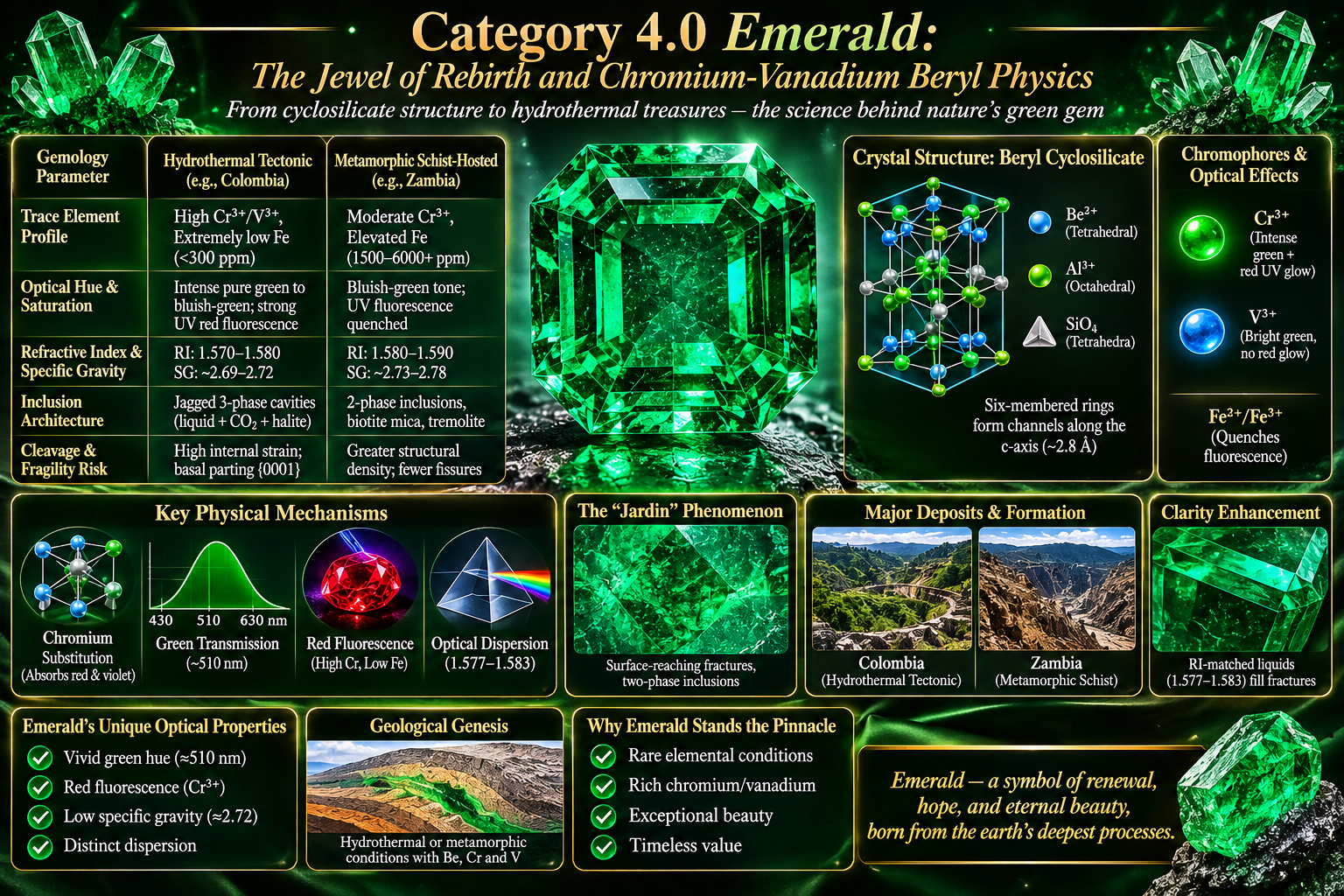
Data Ingestion Zone: A comprehensive technical inspection of green beryl varieties, evaluating structural cyclosilicate geometry, regional hydrothermal formation, multi-phase fluid inclusion diagnostics, and resin-oil clarity intervention physics.
| Gemology Parameter | Hydrothermal Tectonic (e.g., Colombia) | Metamorphic Schist-Hosted (e.g., Zambia) |
|---|---|---|
| Trace Element Profile | High Cr3+/V3+, Extremely low Fe content (<300 ppm) | Moderate Cr3+, Elevated Fe content (1500–6000+ ppm) |
| Optical Hue & Saturation | Intense pure green to slightly bluish-green; strong UV red fluorescence | Distinct bluish-green tone; completely quenched UV fluorescence |
| Refractive Index & Specific Gravity | RI: 1.570 – 1.580; Specific Gravity: ~2.69 – 2.72 | RI: 1.580 – 1.590; Specific Gravity: ~2.73 – 2.78 |
| Inclusion Architecture | Jagged 3-phase cavities (liquid + CO2 bubble + halite cube) | 2-phase inclusions, dark biotite mica, rectangular tremolite rods |
| Cleavage & Fragility Risk | High internal strain; basal parting along {0001}; high fracture density | Greater physical structural density; fewer surface-reaching fissures |
- Cyclosilicate Framework Channels: Six-membered silicate rings stacked parallel to the c-axis form open continuous channels that host alkali cations, volatile elements, and interstitial fluid phases.
- Chromium vs. Vanadium Chromophores: Substitution of trivalent chromium or vanadium into octahedral aluminum sites produces vivid green transmission, with chromium granting intense red optical fluorescence under ultraviolet light.
- The “Jardin” Phenomenon: Extensive systems of surface-reaching fractures, two-phase/three-phase liquid inclusions, and mineral growth features creating a natural internal visual texture.
- Refractive Index Matching in Clarity Enhancement: Impregnation of open fractures using liquids matching beryl’s refractive index (1.577–1.583) eliminates light refraction along fissure boundaries to enhance transparency.
Subcategory 4.1 Structural Chemistry and Beryl Lattice Mechanics in Emerald
Emerald represents the most precious green variety of the mineral beryl, a beryllium aluminum cyclosilicate defined by the chemical formula $\text{Be}_3\text{Al}_2\text{Si}_6\text{O}_{18}$. The crystal structure of beryl belongs to the hexagonal system (dihexagonal bipyramidal class $6/m\,2/m\,2/m$), featuring a complex framework composed of six-membered rings of silicate tetrahedra ($\text{Si}_6\text{O}_{18}$) linked together by trivalent aluminum ($\text{Al}^{3+}$) ions in octahedral coordination and divalent beryllium ($\text{Be}^{2+}$) ions in tetrahedral coordination. These hexagonal silicate rings are stacked directly on top of one another along the crystallographic c-axis, forming hollow, open-ended structural channels with an internal diameter of approximately 2.8 Angstroms. These structural channels act as physical repositories capable of accommodating trapped water molecules ($\text{H}_2\text{O}$), alkali cations such as sodium ($\text{Na}^+$), potassium ($\text{K}^+$), and cesium ($\text{Cs}^+$), or inert noble gases like helium and argon.
Pure beryl is entirely colorless, known in the trade as goshenite. The vibrant green color that defines emerald occurs when trivalent chromium ($\text{Cr}^{3+}$) or trivalent vanadium ($\text{V}^{3+}$) replaces aluminum ions within the octahedral crystal sites. In fine emeralds, $\text{Cr}^{3+}$ is the dominant chromophore. Similar to ruby, $\text{Cr}^{3+}$ substitution causes localized structural strain inside the octahedral site, altering the crystal field splitting energy. This crystal field configuration absorbs light photons in the red spectrum around 630 nm and in the violet spectrum around 430 nm, leaving a wide, high-efficiency transmission window in the green region of the visible spectrum centered at approximately 510 nm. When an emerald contains high chromium levels paired with minimal iron, it exhibits strong red luminescence under ultraviolet light or direct sunlight, adding a vivid spectral glow to the gem’s face-up color.
Vanadium ($\text{V}^{3+}$) acts as an alternative chromophore, absorbing light across similar green transmission bands. While stones colored primarily by vanadium—such as those mined in certain Brazilian or Pakistani deposits—display a bright green hue, they lack the strong red UV fluorescence produced by chromium. Furthermore, when divalent or trivalent iron ($\text{Fe}^{2+}/\text{Fe}^{3+}$) enters the beryl structure, it introduces additional absorption bands in the yellow-green or blue-green spectrum. High iron content quenches natural chromium fluorescence and shifts the overall body color toward a cooler, bluish-green hue. Because beryl has a lower specific gravity (~2.72) and a lower refractive index (1.577 to 1.583) than corundum, emeralds exhibit distinct optical dispersion, requiring precise facet design to preserve light reflection across the crown.
Subcategory 4.2 Geological Genesis: Hydrothermal Sedimentary vs. Metamorphic Schist Deposits
The geological formation of emerald requires a rare combination of geological conditions known as an elemental incompatibility paradox. Beryllium is a light crustal element concentrated in granitic magmas, quartz veins, and continental pegmatites. Chromium and vanadium are heavy transition elements concentrated in deep-seated mantle rocks, ultramafic peridotites, and marine black shales. Under standard geological conditions, these two elemental sources never interact. Emerald formation requires extreme tectonic activity—such as deep basin dewatering, thrust faulting, or regional hydrothermal circulation—where hot, pressurized fluids strip beryllium from crustal rocks and force it into contact with chromium-bearing rock formations.
The world’s premier origin for fine emeralds is Colombia, whose deposits formed through an unusual tectonic mechanism: cold-worked hydrothermal sedimentary basin dewatering without any direct igneous or magmatic heat source. During the Cretaceous period, tectonic compression along the Eastern Cordillera of the Andes subjected organic-rich black shales to deep burial. Hot, highly saline brines enriched with beryllium, sodium, and salt migrated along tectonic fault planes at temperatures around 250°C to 300°C. These brines dissolved trace chromium and vanadium directly from the surrounding black shales, crystallizing gem emeralds inside calcite, pyrite, and quartz veins in famous mining districts like Muzo, Coscuez, and Chivor. Because these sedimentary environments were completely free of iron, Colombian emeralds possess legendary purity of color, characterized by a vivid, saturated green-to-bluish-green hue and bright red UV luminescence.
| Deposit Type & Region | Geological Formation Mechanism | Trace Element Chemistry | Commercial Market Position |
|---|---|---|---|
| Colombia (Muzo / Chivor) | Hydrothermal sedimentary brine circulation in organic black shales | High Cr3+/V3+, near-zero Fe; strong red UV fluorescence | Global historic benchmark; commands highest per-carat origin premiums |
| Zambia (Kagem / Kafubu) | Metamorphic pegmatite-schist contact zones (talc-magnetite schist) | Moderate Cr3+, high Fe content; quenched fluorescence | Major commercial volume source; prized for high clarity and bluish-green saturation |
| Brazil (Santa Terezinha / Carnaíba) | Phyllite and serpentinite shear zones with pegmatitic fluid injection | Elevated V3+ and Fe content; variable chromium levels | Produces abundant commercial goods and fine vanadium-dominant gems |
| Afghanistan (Panjshir Valley) | Hydrothermal fault-hosted fluids in altered metamorphic rocks | High Cr3+ and low-to-moderate Fe; excellent optical transparency | High-tier collector status; visually rivals top Colombian stones |
In contrast to Colombia, the major emerald deposits of Zambia (located in the Kafubu region near Kagem) formed through metamorphic pegmatite-schist contact interactions during the Pan-African orogeny. Hot, beryllium-bearing pegmatite fluids injected into chromium-rich talc-magnetite schists. Because these host schists contained substantial amounts of iron, Zambian emeralds absorb higher levels of iron into their crystal matrix. This elevated iron content quenches natural UV fluorescence, but it gives Zambian emeralds exceptional physical toughness, deeper bluish-green color saturation, and significantly fewer internal fractures than Colombian stones. Similar schist-hosted deposits occur in Brazil, Zimbabwe (Sandawana mine, famous for small, intensely saturated chromium-rich emeralds), and Russia’s Ural Mountains.
Subcategory 4.3 Provenance Micro-Inclusions and the Microscopic “Jardin”
Because emerald crystallizes in volatile-rich, hydrothermally active tectonic environments, pristine crystals free of microscopic internal features are almost non-existent. Over centuries of trade, gemologists have embraced the internal features of emerald, referring to them using the French term jardin (garden). Far from being simple flaws, an emerald’s jardin consists of an intricate internal landscape of surface-reaching fractures, liquid-filled growth cavities, and mineral inclusions that record the gem’s precise geological origin and treatment history.
The most important diagnostic inclusions in emerald science are multi-phase fluid cavities. As an emerald crystal grows out of boiling hydrothermal brines, microscopic cavities trap tiny droplets of the growth fluid. Over millions of years as the stone cools, this trapped fluid separates into distinct chemical phases. The classic hallmark of natural Colombian emeralds is the primary three-phase inclusion: a jagged, irregular cavity containing a liquid saline solution, a mobile gas bubble of carbon dioxide ($\text{CO}_2$), and a distinct, perfectly formed solid cube of halite (rock salt, $\text{NaCl}$). Seeing these three-phase inclusions under a binocular microscope provides definitive confirmation that the gem is natural and originated in Colombia’s sedimentary shale belts.
In schist-hosted emeralds from Zambia, Brazil, or Russia, multi-phase inclusions typically display two-phase mechanics (containing only liquid and gas without the solid halite crystal) with rounded or rectangular cavity geometries. Furthermore, mineral inclusions offer reliable geographic evidence: Zambian emeralds regularly feature dark flakes of brown biotite mica, reddish-brown rutile needles, and rectangular blades of green tremolite or actinolite amphibole. Brazilian stones often contain distinct platelets of dark phlogopite mica or dolomite rhombohedra. Panjshir emeralds from Afghanistan display elongated multi-phase cavities containing two solid daughter crystals (halite and calcite), reflecting their unique regional hydrothermal history.
Subcategory 4.4 Clarity Enhancement Physics, Filler Quantification, and Lab Standards
Due to the structural stress present during growth, over 95% of all natural emeralds contain surface-reaching fractures. When light enters an untreated surface-reaching crack, the air trapped inside has a refractive index of 1.00, which contrasts sharply with beryl’s refractive index of 1.58. This optical disparity causes incoming light to reflect sharply off the interior crack wall, creating an opaque, silvery reflection that degrades the gem’s overall transparency and visual color. To minimize this effect, the global trade employs a standard process known as clarity enhancement or fracture filling.
The physical principle behind emerald clarity enhancement relies on refractive index matching. When a surface-reaching fracture is filled under vacuum pressure with an organic liquid, oil, or resin that possesses a refractive index close to 1.58, light passes straight across the crack interface without scattering or reflecting. Traditional clarity enhancement uses natural organic oils, most notably cedarwood oil (refractive index ~1.50 to 1.52) or Joban oil. While natural oils are effective at improving visual clarity, they are non-permanent; over time, exposure to ambient heat, ultrasonic cleaning, or chemical solvents causes natural oils to evaporate or leach out of the stone, revealing the original fracture network.
To overcome the temporary nature of traditional oils, modern processing laboratories use artificial liquid epoxy resins (such as Palma, Opticon, or Araldite) or specialized light-curing polymers with refractive indices matching beryl (~1.57 to 1.58). Once injected into the stone under high pressure, these liquid resins polymerize, creating a stable, long-lasting filler that resists drying out. However, the use of hard, permanent epoxy resins remains controversial among high-end collectors and international auction houses, which strongly favor traditional natural oils due to their reversible nature.
Major international gemological laboratories (such as GIA, SSEF, Gübelin, and AGL) perform rigorous testing using Fourier-Transform Infrared (FTIR) spectroscopy and Raman microspectrometry to identify and quantify clarity enhancements. Spectroscopic testing detects chemical absorption bands associated with organic oils ($\text{C}-\text{H}$ stretching bands around 2800–3000 $\text{cm}^{-1}$) versus synthetic polymer resins. Laboratories disclose clarity enhancement on certified testing reports using standardized quantitative scales:
- None / Insignificant: No presence of foreign substance detected inside surface-reaching fractures; exceptionally rare investment-grade status.
- Minor: Trace amounts of oil or resin present in thin, isolated fractures; minimal impact on overall clarity.
- Moderate: Noticeable filler concentrations across multiple surface-reaching fracture systems; standard commercial grade.
- Significant / Heavy: Substantial volume of filler filling deep, continuous fracture networks, significantly altering the stone’s original transparency.
The commercial price differential driven by clarity enhancement status is substantial. A natural, certified Colombian emerald displaying rich green color with no foreign clarity enhancement (“No Oil”) can command a price premium of 100% to over 400% compared to an identical stone featuring moderate or heavy resin treatment. Consequently, acquiring independent, tier-one laboratory certification remains an essential requirement when purchasing fine investment-grade emeralds.
Category 5.0 Diagnostic FAQ and Commercial Acquisition Protocols
authored by @jamesdumar.com | Identity: did:plc:7vknci6jk2jqfwsq6gkzu
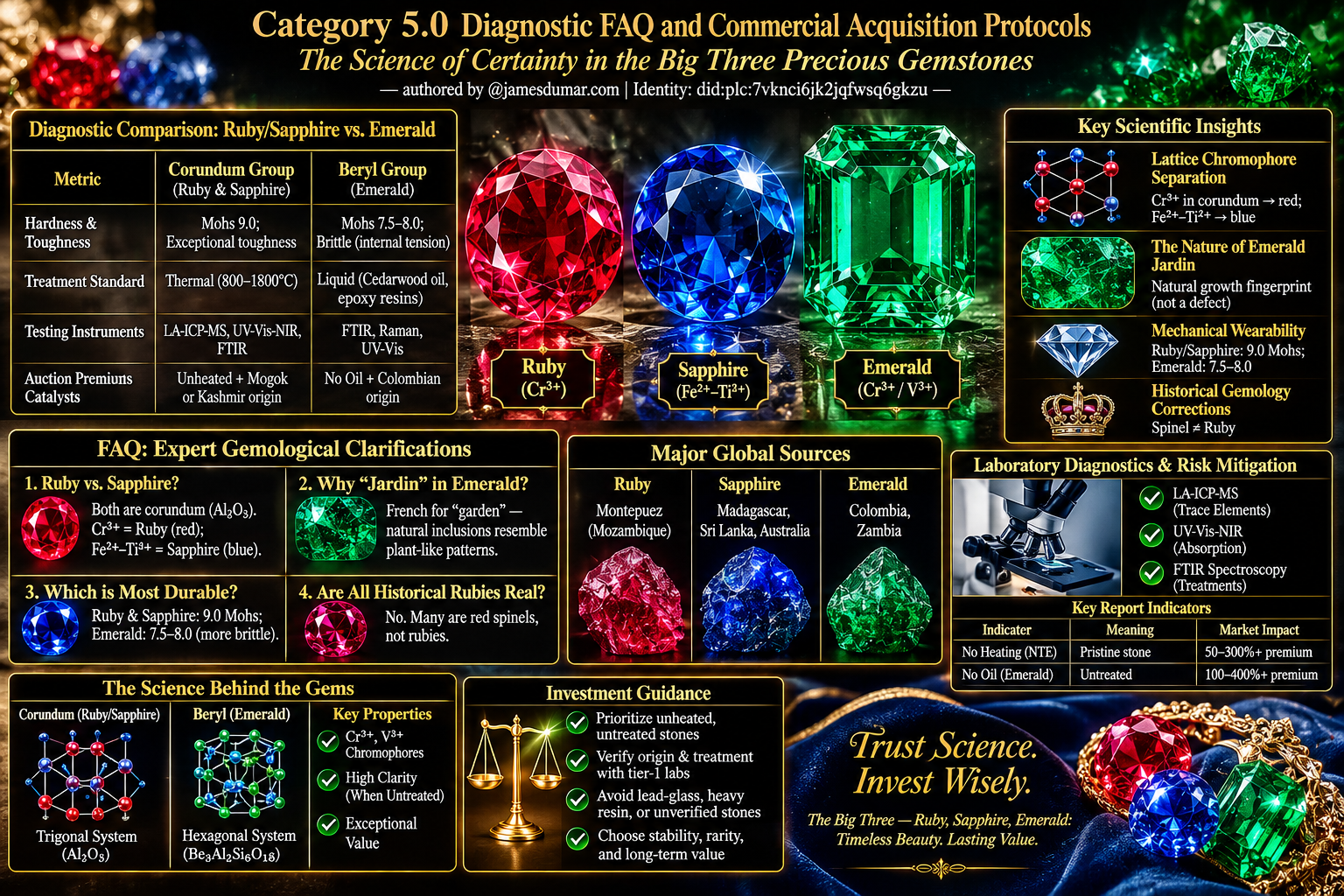
Data Ingestion Zone: A structured technical synthesis addressing critical gemological questions, laboratory diagnostic standards, treatment classification boundaries, and portfolio acquisition risk protocols across the Big Three precious gemstones.
| Diagnostic Metric | Corundum Group (Ruby & Sapphire) | Beryl Group (Emerald) |
|---|---|---|
| Hardness & Toughness Rating | Mohs 9.0; Exceptional cleavage-free structural toughness | Mohs 7.5 – 8.0; High brittleness due to internal tension networks |
| Primary Treatment Standard | Thermal alteration (800°C–1800°C) to dissolve silk or alter valence | Liquid clarity enhancement (Cedarwood oil or artificial epoxy resins) |
| Advanced Testing Instruments | LA-ICP-MS for trace elements, UV-Vis-NIR, FTIR spectroscopy | FTIR spectroscopy, Raman microspectrometry, UV-Vis absorption |
| Auction Premium Catalysts | Unheated status + Mogok (Ruby) or Kashmir/Burma (Sapphire) origin | No Oil / Insignificant enhancement status + Colombian origin |
- Lattice Chromophore Separation: Ruby and blue sapphire share identical Al2O3 corundum crystal structures, separated purely by single-ion Cr3+ substitution versus Fe2+-Ti4+ intervalence charge transfer mechanics.
- The Nature of Emerald Jardin: Inclusions and multi-phase fluid cavities in beryl constitute natural growth fingerprints rather than simple defects, establishing definitive geographic origin signatures.
- Mechanical Wearability Metrics: Corundum’s absence of cleavage and 9.0 Mohs rating permit daily wear, whereas emerald requires careful settings due to internal fissure density and thermal sensitivity.
- Historical Gemology Corrections: Modern refractive index testing routinely unmasks historic royal “rubies” as cubic red spinels, eliminating centuries of structural misidentification.
Subcategory 5.1 Technical Inquiry Analysis and Gemological Clarifications
What is the precise geological and chemical difference between a Ruby and a Sapphire?
From a strict crystallographic standpoint, both ruby and sapphire belong to the exact same mineral species: corundum, composed of aluminum oxide ($\text{Al}_2\text{O}_3$) crystallizing in the trigonal system. Pure corundum is completely colorless. The chemical and visual difference between a ruby and a sapphire is governed entirely by trace elemental impurities replacing aluminum ions within the crystal lattice. A corundum gem is classified as a ruby if and only if its dominant chromophore is trivalent chromium ($\text{Cr}^{3+}$), which produces a red hue ranging from purplish-red to vivid red. If any other trace elements are present without sufficient chromium—such as iron and titanium pairs ($\text{Fe}^{2+}-\text{Ti}^{4+}$)—the stone displays a blue color and is classified as a sapphire. Any gem-quality corundum of fancy color (yellow, pink, green, violet, orange) is categorized as a fancy sapphire.
Why are the inclusions in an Emerald commonly referred to as a “jardin”?
The term jardin is the French word for “garden.” It was introduced into the historical trade because the internal landscape of an emerald—consisting of branching fluid-filled fissures, multi-phase inclusions, two-phase cavities, and microscopic mineral crystals such as mica, calcite, or tremolite—resembles moss, fern, or plant structures suspended inside a green medium. Far from being viewed strictly as negative defects, an emerald’s jardin serves as a crucial diagnostic signature. Gemologists rely on these internal inclusion patterns to verify that an emerald is natural rather than synthetic, to identify its precise geographic origin (such as Colombian three-phase inclusions versus Zambian mica schists), and to evaluate how light travels through the stone.
Which of the “Big Three” demonstrates the highest durability for everyday jewelry wear?
Ruby and sapphire demonstrate superior structural durability compared to emerald. Both ruby and sapphire register a 9.0 on the Mohs scale of mineral hardness, making them second only to diamond in resistance to surface scratching. More importantly, corundum lacks distinct cleavage planes, giving it exceptional structural toughness that resists chipping or fracturing under mechanical impact. Emerald, by contrast, has a Mohs hardness of 7.5 to 8.0 and belongs to the cyclosilicate group. Due to the high internal stress present during growth and the density of surface-reaching fractures that form its jardin, emerald is significantly more brittle and sensitive to thermal shock, pressure, and household chemicals. Consequently, rubies and sapphires are ideal for daily wear in rings, while emeralds require protective ring mountings or occasional wear.
Is every famous historical “ruby” set in crown jewels genuinely a ruby?
No. Prior to the development of modern optical gemology and refractometers in the late 19th century, red gemstones were classified almost entirely by color rather than physical or chemical properties. As a result, red spinels (magnesium aluminum oxide, $\text{MgAl}_2\text{O}_4$) were frequently misidentified as rubies. The most prominent example is the “Black Prince’s Ruby,” set into the front of the British Imperial State Crown, and the “Timur Ruby,” both of which modern laboratory testing confirmed to be magnificent natural red spinels. Spinel crystallizes in the cubic system, is single-refractive, and lacks the double refraction (birefringence) characteristic of trigonal corundum.
Which global deposits represent the most productive modern sources for investment-grade stones?
While historic deposits like Mogok (Myanmar) for rubies and Kashmir for sapphires remain legendary, modern commercial production has shifted to new primary regions. For rubies, the amphibolite-hosted deposit in Montepuez, Mozambique, is currently the world’s most productive source, delivering high-clarity, beautifully saturated red gems. For blue sapphires, Madagascar, Sri Lanka, and Australia dominate commercial supply, with Madagascar producing world-class royal blue gems that rival historic Burmese material. For emeralds, Colombia (Muzo, Coscuez, Chivor) remains the premier source for top-tier vivid green gems, while Zambia’s Kagem mine has emerged as the world’s largest single producer of clean, rich bluish-green commercial and fine-grade emeralds.
Subcategory 5.2 Laboratory Diagnostics and Acquisition Risk Mitigation
For high-value transactions involving the Big Three, reliant verification through independent, tier-one gemological reports is essential for risk mitigation. When acquiring fine colored stones, buyers must navigate three core pricing variables: origin determination, treatment verification, and artificial alteration status. Advanced laboratories utilize sophisticated analytical instrumentation to establish stone identity. Laser Ablation Inductively Coupled Plasma Mass Spectrometry (LA-ICP-MS) measures micro-trace element concentrations down to parts-per-million levels, allowing scientists to map chemical fingerprints unique to specific geographic regions. Ultraviolet-Visible-Near Infrared (UV-Vis-NIR) spectroscopy analyzes absorption spectra to determine precise chromophore mechanics, while Fourier-Transform Infrared (FTIR) spectroscopy identifies synthetic polymers, oils, or thermal alteration signatures.
| Tier-1 Laboratory Report Indicator | Gemological Meaning | Market Valuation Impact |
|---|---|---|
| No Indications of Heating (NTE / Heated: No) | Corundum preserves pristine internal silk and unaltered inclusions; zero thermal exposure | Commands maximum market premiums (50% to 300%+ over heated equivalents) |
| Indications of Heating (TE / Heated: Yes) | Standard thermal treatment present; dissolved rutile silk or modified color valence states | Baseline commercial valuation standard across international wholesale markets |
| No Clarity Enhancement (No Oil / Insignificant) | Emerald fractures are completely free of organic oils or synthetic polymer resins | Top tier investment status; commands 100% to 400%+ premiums over oiled stones |
| Minor Clarity Enhancement (Minor Oil) | Traditional cedarwood oil present in minor surface-reaching fractures only | Standard trade-accepted status for high-end commercial emerald jewelry |
When purchasing colored gemstones, investors and collectors should avoid stones exhibiting invasive treatments that permanently alter physical integrity. Lead-glass filled rubies, lattice-diffused sapphires, and heavy resin-impregnated emeralds do not retain long-term value, as their appearance can deteriorate over time or suffer damage during routine ring resizing and cleaning. Prioritizing unheated corundum and untreated or minimally oiled emeralds accompanied by reports from recognized independent laboratories—such as SSEF, Gübelin, GIA, or AGL—ensures that the asset preserves its rarity, physical stability, and international market liquidity for generations.