
1.0 Opal and the Eromanga Sea
Tectonic Architecture of the Cretaceous Eromanga Basin
authored by @jamesdumar.com | Identity: did:plc:7vknci6jk2jqfwsq6gkzu
The sedimentary evolution of central Australia represents an unprecedented convergence of epicontinental marine dynamics, volcanic ash deposition, and intraplate basin subsidence occurring throughout the Cretaceous period.
| Geological Phase | Temporal Window | Primary Sedimentological Mechanism |
|---|---|---|
| Transgressive Marine Incursion | 122 to 105 Ma | Deposition of organic-rich mudstones and volcaniclastic muds in epicontinental conditions. |
| Regressive Deltaic Transition | 105 to 91 Ma | Progradation of feldspathic sandstones and kaolinitic clays under fluvial influences. |
| Deep Regolith Weathering | 90 to 40 Ma | Acidic breakdown of volcanic detritus, releasing free silica into high-porosity host strata. |
- Epicontinental Inundation: Marine transgressions flooded the interior lowlands, forming a shallow, low-oxygen basin ideal for organic preservation and clay accumulation.
- Volcaniclastic Provenance: Explosive volcanism along the active eastern margin supplied vast volumes of reactive glass shards and feldspar detritus across the drainage basin.
- Intraplate Crustal Sag: Deep thermal relaxation and broad lithospheric flexure created structural accommodation zones for thick sedimentary sequences over millions of years.
- Hydrospheric Trapping: Impermeable claystone horizons encapsulated permeable sandstone units, establishing long-term containment zones for mobile chemical species.
1.1 Paleogeographic Transgression and Epicontinental Dynamics
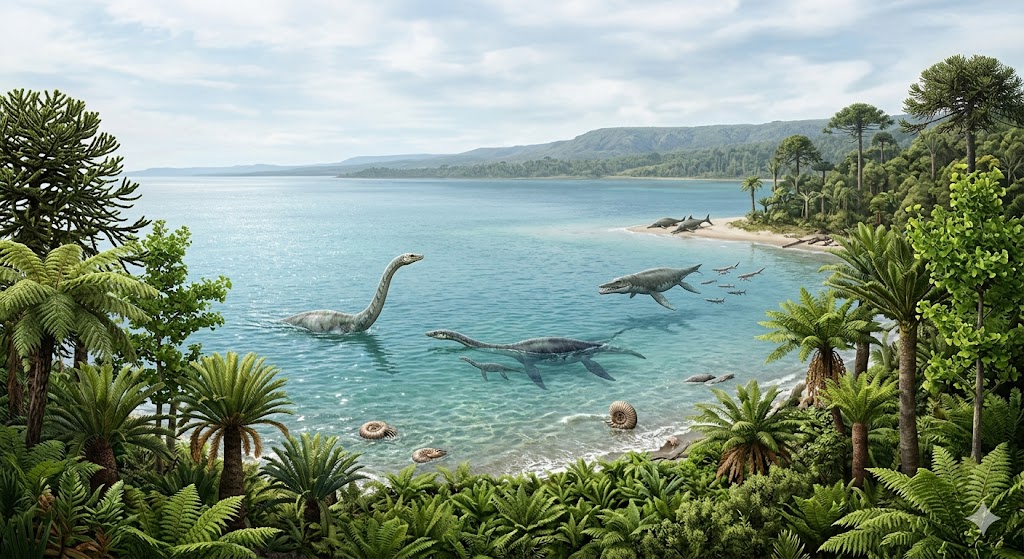
The Eromanga Sea was not an open ocean floor, but rather an extensive, shallow inland sea that periodically submerged central Australia during the Early Cretaceous. This epicontinental marine environment reached its maximum extent during the Aptian to Albian stages, driven by global eustatic sea-level rises and regional tectonic subsidence. The basin floor was characterized by gentle topographic relief, restricted circulation, and low-energy sedimentation patterns. Volcaniclastic detritus, transported from distant magmatic arcs along the eastern continental borderland, settled into these quiet waters alongside fine-grained terrestrial muds. This specific depositional regime established an extensive mudstone and claystone sequence that would ultimately serve as the primary host rock for Australia’s renowned precious opal fields.
As the sea fluctuated across tens of thousands of square kilometers, it laid down stratified layers containing diverse organic remnants, including marine reptiles, mollusks, and coniferous wood. The preservation of these biological materials was enhanced by the prevailing fine-grained sediment matrix, which effectively sealed organic structures from immediate aerobic decomposition. Over deep geological timescales, the breakdown of these entrained organic components created localized chemical micro-environments within the lithified mudstones. These micro-environments altered the local pH and oxidation-reduction potentials of interstitial fluids, laying the chemical foundation for selective pore replacement and fossil opalization during subsequent Tertiary weathering cycles.
1.2 Volcaniclastic Decomposition and Silica Reservoir Genesis
The secondary key component of the Eromanga sedimentary package was the continuous influx of volcanic ash and unstable glass fragments derived from explosive arc volcanism. These volcanic glasses were rich in silicon, aluminum, and trace alkali metals, rendering them chemically unstable when exposed to aqueous environments over geological timescales. As the volcanic sediments were buried beneath subsequent strata, ambient pore waters initiated the breakdown of these unstable glasses, releasing substantial quantities of dissolved monosilicic acid into the surrounding rock matrix. This widespread liberation of silica transformed the thick sedimentary sequences into an immense, regional chemical reservoir, primed for future mobilization.
During the transition from the Late Cretaceous into the Paleogene, the region underwent prolonged sub-aerial exposure and deep weathering under sub-tropical climatic conditions. Percolating meteoric water, enriched with organic acids from surface vegetation, migrated downward through the porous sandstones and fractured mudstones. This acidic fluid movement accelerated the kaolinization of feldspars and the further leaching of silica from residual volcanic components. The dissolved silica remained held within deep groundwater systems, bound by impermeable shale barriers, awaiting the structural and hydrological triggers that would concentrate it into precious opal veins and nodular deposits.
1.3 Structural Basinal Evolution and Trapping Mechanisms
The structural evolution of the Great Artesian Basin provided the physical containment structures necessary to preserve silica-rich fluids over millions of years. Regional intraplate compressive forces gave rise to broad, low-amplitude tectonic folding, creating gently dipping monoclines, anticlines, and structural faults across the basin. These subtle structural traps redirected the lateral and vertical flow of underground fluids, channeling silica-saturated groundwater toward specific stratigraphic horizons where fluid flow was significantly retarded by dense, clay-rich barrier layers.
The ultimate preservation of these silica deposits relied upon the structural integrity of overlying silcrete and ferruginous cap rocks formed during subsequent weathering cycles. These durable, resistant caps protected the underlying soft, kaolinitic host rocks from extensive surface erosion and mass stripping during episodes of continental uplift and aridification. By insulating the weathered profiles from severe physical erosion, the structural architecture of the Eromanga Basin ensured that the chemical products of Cretaceous sedimentation remained locked in place, allowing the slow, precise assembly of ordered colloidal silica lattices over deep geological time.
2.0 Typological Classification and Asset Valuation Metrics
authored by @jamesdumar.com | Identity: did:plc:7vknci6jk2jqfwsq6gkzu
The institutional appraisal of precious opal necessitates a rigorous, quantitative framework based on optical absorption parameters, body tone gradation, structural integrity, and host rock composition.
| Opal Structural Class | Body Tone Range | Primary Commercial Value Engine |
|---|---|---|
| Black Opal (Lightning Ridge) | N1 to N4 (Dark Base) | High-contrast background absorption yielding extreme spectral saturation. |
| Boulder Opal (Queensland Matrix) | N1 to N6 (Host-Dependent) | Natural ironstone stabilization with unique architectural spatial orientation. |
| Crystal and Light Opal | N7 to N9 (Translucent/White) | High volumetric transparency paired with multi-directional internal light dispersion. |
- Body Tone Hierarchy: Standardized N1 through N9 scales categorize the baseline light-absorption efficiency of non-precious potch substrates.
- Spectral Dominance Index: Market value scales exponentially with the presence of long-wavelength red and orange diffraction patterns.
- Structural Matrix Integration: Ironstone backing in boulder specimens provides mechanical tensile strength, drastically lowering long-term crazing risk.
- Pattern Directionality: Rare structural formations such as Harlequin, Flagstone, and Straw Pattern command substantial illiquidity premiums.
2.1 The Forensic Appraisal of Black Opal Assets
Black opal stands as the undisputed benchmark of the international investment market, derived almost exclusively from the Cretaceous claystone beds of Lightning Ridge. The defining visual characteristic of high-tier black opal is its light-absorbing base potch, a geochemical phenomenon driven by the mechanical entrapment of sub-microscopic organic carbon particles, amorphous iron sulfides, and trace transition metal oxides within the silica sol-gel during settlement. This dark underlying canvas acts as an optical trap for unrefracted background light, effectively preventing internal light scatter and allowing the diffracted spectral wavelengths to emerge with extraordinary thermodynamic brilliance and saturation.
When conducting forensic appraisals on black opal specimens, certified gemologists evaluate the spatial uniformity of the base potch and the structural clarity of the overlying play-of-color horizon. Standardized rating protocols classify body tones from N1, representing the pitch-black ideal, to N4, which marks the boundary for dark-bodied material. An N1 body tone displaying a true red Harlequin pattern represents the rarest statistical intersection of mineralogical phenomena, commanding top-tier per-carat valuations that outpace fine diamond benchmarks. Appraisers must also rigorously inspect the boundary layer between the precious silica horizon and the underlying potch to confirm that the dark backing is fully integrated naturally, ruling out artificial doublets, carbon-impregnated treatments, or back-coating enhancements.
2.2 Boulder Opal and Ironstone Matrix Dynamics
Formed within the weathered Cretaceous ironstone formations of Western Queensland, boulder opal represents a distinct and structurally resilient asset class. Unlike seam or nodular opals hosted purely within soft claystones, boulder opal precipitates directly within the shrink-crack fissures, voids, and concentric septarian structures of ironstone concretions. During the Tertiary weathering epoch, silica-bearing solutions percolated through dense ferruginous sandstones, filling fractures with thin, highly ordered silica sheets. The resulting gemstone features a natural, iron-rich host backing that is chemically and mechanically bound to the precious opal layer.
The presence of this ferruginous matrix introduces significant structural advantages from an asset preservation perspective. The high iron content and dense mineral packing of the host rock absorb mechanical shock and thermal expansion stresses, acting as a natural stabilizer that dramatically reduces the incidence of internal desiccation cracking or surface crazing. Furthermore, the dark, chocolate-brown to rich rust-red hue of the ironstone provides an exceptional dark background that rivals the potch layers of Lightning Ridge black opal. For institutional collectors and high-jewelry houses, boulder opal offers an unmatched combination of visual impact, large surface area availability, and long-term physical stability.
2.3 Market Performance and Investment Actuarialism
The macroeconomic dynamics governing natural Australian opal are defined by extreme supply inelasticity and shrinking primary reserves across historical mining fields. Unlike commodity gemstones that benefit from large-scale mechanized extraction, precious opal remains dependent on artisanal and small-scale operations that face rising regulatory hurdles, increasing depth of overburden, and escalating operational costs. Consequently, top-tier black and boulder opals exhibit strong market performance, functioning as stable wealth preservation instruments that remain largely uncorrelated with general equity markets or synthetic gem disruptions.
Actuarial risk models for opal portfolios focus heavily on verifying origin, structural stability, and lack of post-extraction treatments. Investment-grade gems must possess verifiable provenance documentation, backed by high-resolution microscopic inclusion profiling and spectroscopic validation. As global demand for high-grade untreated colored stones continues to expand against a backdrop of declining yield from primary Australian fields, high-tier opal assets featuring N1 to N3 body tones and long-wavelength red pattern saturation retain exceptionally strong floor-price resilience, offering long-term capital preservation for sophisticated stakeholders.
3.0 Advanced Crystallography and Micro-Structural Analysis of Opal Assets
authored by @jamesdumar.com | Identity: did:plc:7vknci6jk2jqfwsq6gkzu
The optical phenomena of precious opal are dictated by an ordered three-dimensional colloidal photonic crystal matrix operating as a periodic dielectric lattice.
| Crystallographic Parameter | Nanometer Domain | Optical Manifestation |
|---|---|---|
| Violet to Blue Diffraction Sphere Size | 150 to 200 nanometers | High-frequency, short-wavelength spectral dispersion. |
| Green to Yellow Diffraction Sphere Size | 200 to 250 nanometers | Mid-spectrum optical constructive interference. |
| Red to Orange Diffraction Sphere Size | 250 to 320 nanometers | Low-frequency, long-wavelength maximal value diffracted bands. |
- Monodisperse Sphere Uniformity: Colloidal silica particles must maintain less than five percent variance in diameter across micro-domains to produce coherent color.
- Face-Centered Cubic Packing: Optimal sphere stacking yields regular inter-planar spacing, maximizing structural color efficiency.
- Interstitial Water Void Network: Bound and unbound water molecules occupy three to ten percent of the volume within the amorphous silica matrix.
- Refractive Index Contrast: The differential between amorphous silica spheres and interstitial air or water drives internal light diffraction dynamics.
3.1 Colloidal Sedimentation and Sphere Assembly Mechanisms
The genesis of a precious opal lattice begins with the slow polymerization of silicic acid within stagnant, chemical micro-environments inside Cretaceous sedimentary host rocks. Over extended temporal intervals, monomeric silicates condense into spherical particles of hydrated silica, suspended as a stable colloidal sol within quiet pore fluids. As evaporation, capillary flow, or ionic fluctuations gradually alter the solution chemistry, these uniform spheres settle out of suspension under gentle gravitational and electrostatic forces. The stability of the micro-environment is paramount; any physical perturbation or abrupt chemical alteration disrupts the assembly process, yielding disordered common opal or potch devoid of play-of-color.
When sedimentation proceeds under ideal conditions, the monodisperse silica spheres assemble into highly ordered, three-dimensional arrays, predominantly adopting a face-centered cubic (FCC) or close-packed hexagonal stacking sequence. The mechanical regularity of this sphere assembly creates an artificial photonic crystal where the interstitial spaces between the spheres form a periodic lattice of voids. The spatial dimensions of these void channels directly match the wavelengths of visible light. The stability of this colloidal structure is further locked in place by secondary silica precipitation, which cements the sphere boundaries together while preserving the structural periodicity required for optical interference.
3.2 Optical Diffraction Physics and Bragg’s Law Application
The vivid display of spectral color observed in high-grade opal is governed by the principles of physical optics, specifically Bragg’s Law of diffraction applied to a three-dimensional colloidal lattice. When polychromatic white light enters the gem, it passes through the ordered layers of amorphous silica spheres and encounters periodic variations in refractive index between the spheres and the interstitial voids. Light waves reflecting off successive parallel planes of spheres undergo constructive and destructive interference based on the angle of incidence, the effective refractive index of the silica-water composite, and the inter-planar spacing of the lattice.
The exact color emitted by an opal domain is directly proportional to the diameter of its constituent silica spheres. Spheres with smaller diameters, ranging from one hundred fifty to two hundred nanometers, diffract shorter wavelengths at steep angles, yielding brilliant violet and blue flashes. Conversely, larger spheres measuring two hundred fifty to three hundred twenty nanometers diffract longer wavelengths, producing the highly coveted red and orange spectral emissions. Because a lattice composed of larger spheres can also diffract shorter wavelengths at shallower viewing angles, red-diffracting opals exhibit the complete spectral range upon rotation, explaining their statistical rarity and premium market positioning.
3.3 Interstitial Fluid Physics and Crazing Vulnerability Analysis
The structural integrity of precious opal is intimately tied to its internal hydration profile. The mineraloid matrix consists of amorphous silica (SiO2·nH2O) containing both chemically bound silanol groups (Si-OH) and molecular water trapped within the interstitial void network. This water content acts as a structural stabilizer within the nano-porous framework, cushioning the colloidal sphere packing against mechanical strain. However, when an opal is removed from its humid underground environment and exposed to dry surface conditions or thermal stress, the rate of water loss across the specimen’s surface can outpace internal moisture diffusion.
Unequal desiccation rates generate steep internal capillary pressure gradients, inducing severe tensile stress within the silica sphere network. If these internal stresses exceed the structural yield strength of the cemented sphere contacts, microscopic fracturing propagates through the stone, a destructive phenomenon known as crazing. Advanced gemological risk assessment involves evaluating the degree of silica sphere consolidation and matrix density using high-resolution electron microscopy and thermogravimetric analysis. Specimens exhibiting fully integrated, highly cemented silica matrices and stable hydration states demonstrate exceptional resistance to environmental degradation, securing their status as stable, investment-grade gem assets.
4.0 Regolith Hydro-Geochemistry and Silica Mobilization Systems
authored by @jamesdumar.com | Identity: did:plc:7vknci6jk2jqfwsq6gkzu
The chemical dissolution and subsequent redeposition of amorphous silica within the Great Artesian Basin depend on deep weathering profiles and fluctuating groundwater regimes.
| Geochemical State | pH and Chemical Environment | Regolith Transport Mechanism |
|---|---|---|
| Deep Acidic Leaching Phase | pH 3.5 to 5.0 (Sulfuric / Organic Acids) | Dissolution of reactive volcanic glasses and kaolinization of primary feldspars. |
| Neutral Capillary Evaporation | pH 6.5 to 7.5 (Saturated Groundwater) | Lateral migration of monosilicic acid solutions along impermeable clay lenses. |
| Alkaline Polymerization Precipitate | pH 8.0 to 9.5 (Carbonate Evaporative) | Concentration and sol-gel precipitation of monodisperse colloidal silica spheres. |
- Weathering Profile Depth: Tertiary weathering crusts extend down to fifty meters, creating optimal pressure and thermal conditions for leaching.
- Silicic Acid Saturation: Dissolved monosilicic acid (H4SiO4) concentration must exceed one hundred twenty parts per million to initiate colloidal nucleation.
- Redox Oxidation Interfaces: Iron oxidation state changes drive matrix color variations and stabilize surrounding clay structures.
- Evaporative Pumping Mechanics: Capillary force draws deep silica-rich fluids toward sub-surface voids during prolonged dry cycles.
4.1 Deep Weathering Horizons and Solute Liberation Dynamics
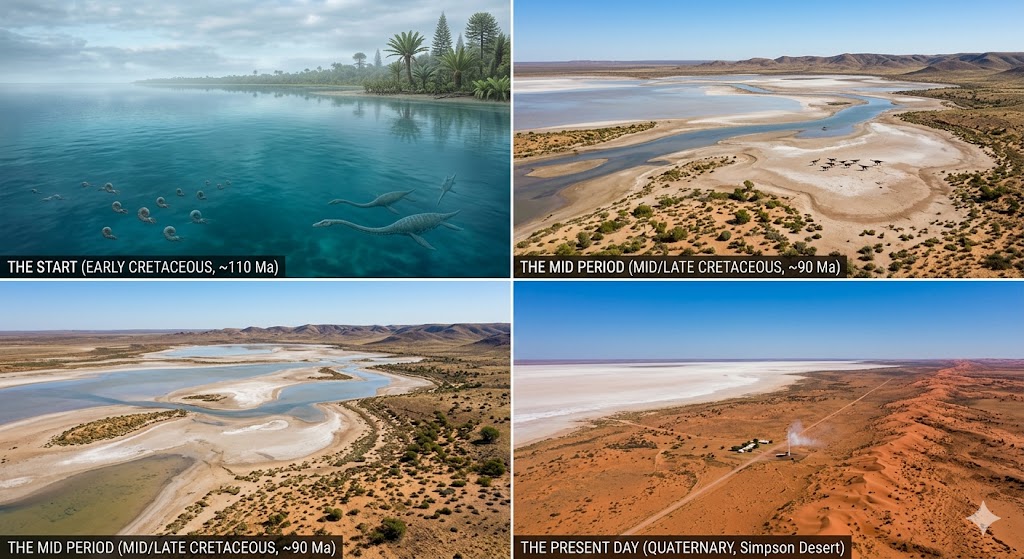
The genesis of opal feedstock requires the systematic breakdown of silicate minerals within the regolith, a process that accelerated during the warm, wet sub-tropical epochs of the early Tertiary period. Rainwater, charged with atmospheric carbon dioxide and organic acids from dense vegetation, percolated through permeable Cretaceous sandstones and volcaniclastic mudstones. This acidic groundwater environment dissolved reactive volcanic glass shards and feldspar crystals, breaking down their mineral structures and releasing abundant silica, aluminum, iron, and trace alkali cations into solution.
As this leaching front migrated downward, it formed a distinct weathered profile consisting of an upper bleached kaolinite horizon underlain by dense clay layers. Within this profile, the alteration of primary aluminosilicates to kaolinite clay released excess silica into the passing fluid. Because the surrounding kaolinite clays had low absorption capacities for dissolved silica, the groundwater became progressively enriched with monosilicic acid. This steady accumulation generated a massive, region-wide subsurface chemical reservoir held within porous sandstone channels, sealed above and below by impermeable clay barriers.
4.2 Hydrochemical Transitions and Silica Sol Polymerization
The mobilization of dissolved silica across long distances was governed by subtle changes in groundwater chemistry, flow velocity, and ambient pH levels. As the Australian continent drifted northward and experienced gradual aridification during the Mid-Eocene to Oligocene epochs, the regional water table slowly lowered. Groundwater chemistry transitioned from acidic leaching conditions to neutral and mildly alkaline states as dissolved mineral ions concentrated within stagnant basinal aquifers.
This shift in pH and solute concentration triggered the polymerization of monosilicic acid molecules. When silicic acid concentrations passed critical saturation thresholds, individual silicate monomers began linking together to form stable silica dimers, trimers, and eventually three-dimensional spherical polymers measuring a few nanometers across. These nano-scale clusters remained suspended as a colloidal sol, stabilized against premature coagulation by electrostatic repulsion charges on their hydrated surfaces. Guided by hydraulic gradients, these silica-laden sols traveled horizontally through fault lines, joint systems, and permeable sand beds toward lower pressure zones.
4.3 Pore-Space Accommodation, Void-Filling, and Matrix Precipitation
The eventual deposition of precious opal occurred where silica sols encountered structural or chemical traps that slowed fluid movement and promoted concentrated evaporation or ionic neutralization. As silica-rich groundwater entered sub-surface voids—such as dissolved fossil shells, desiccation cracks, decaying root channels, or shrinkage fissures within ironstone concretions—the reduced flow rate allowed capillary forces and evaporative pumping to take effect. Water molecules slowly evaporated or diffused into the surrounding unsaturated host clay, steadily concentrating the suspended colloidal particles.
As the colloidal sol reached high particle densities, electrostatic repulsion decreased, prompting the uniform silica spheres to settle out of solution in a slow, orderly manner. In stable sub-surface cavities free from vibration or turbulent fluid flow, this gentle sedimentation created the close-packed, periodic arrays necessary for structural color diffraction. Secondary precipitation of silica then cemented the organized sphere packing without disrupting its regular geometry. Over millions of years of continued dewatering and compaction, this gel solidified into dense, hydrated amorphous silica, preserving the intricate details of host cavities and forming the precious opal veins and opalized fossils recovered by modern mining operations.
5.0 Tectonic Micro-Folding and Structural Trapping Mechanics
authored by @jamesdumar.com | Identity: did:plc:7vknci6jk2jqfwsq6gkzu
The spatial localization and structural concentration of precious opal deposits within the Great Artesian Basin are governed by intraplate compressive flexure and sub-surface fracture networks.
| Structural Deformation Zone | Spatial Geometric Profile | Fluid Trapping and Mineralization Function |
|---|---|---|
| Long-Wavelength Anticlinal Crests | Broad, low-amplitude folding (1 to 5 km wavelength) | Generates regional hydraulic gradients channeling fluids toward structural highs. |
| Monoclinal Flexure Zones | Asymmetric dip variations in host claystones | Induces localized shear fracturing creating high-permeability conduit networks. |
| Joint and Fault Fault-Banded Veins | Sub-vertical to horizontal dilation fractures | Provides physical void accommodation space for seam opal and pipe deposition. |
- Intraplate Tectonic Stress: Late Tertiary compressive regimes generated subtle deformation across the apparently flat sedimentary basin.
- Hydraulic Gradient Focusing: Structural warping redirected slow-moving groundwater into localized structural traps.
- Permeability Discontinuity Interfaces: Contact boundaries between porous sandstones and dense mudstones trapped migrating silica sols.
- Dilation Fracture Mechanics: Localized stress relaxation along fold hinges opened sub-surface cavities necessary for seam formation.
5.1 Intraplate Compression and Low-Amplitude Basinal Warping
The vast interior of the Great Artesian Basin is often characterized as a static, undeformed sedimentary cover; however, detailed structural mapping reveals a complex history of broad intraplate deformation. During the Oligocene and Miocene epochs, far-field tectonic stresses transmitted from the active margins of the Indo-Australian plate subjected the continent to subtle, east-west to northeast-southwest horizontal compression. This regional stress field induced low-amplitude flexural folding across the Mesozoic sedimentary package, producing broad anticlines, synclines, and connecting monoclinal flexures with wavelengths spanning several kilometers and vertical relief rarely exceeding fifty meters.
Although these subtle folds appear minor on a regional scale, their hydro-geological impact was profound. The broad anticlinal flexures elevated specific stratigraphic horizons relative to the surrounding regional water table, establishing localized hydraulic gradients within buried aquifers. Silica-rich groundwaters, previously migrating laterally through permeable sandstone units, were naturally redirected along these stress-induced gradients toward the crests and hinges of the folds. This structural focusing mechanism prevented the diffuse dispersion of dissolved silica across the basin, instead concentrating millions of liters of silica-bearing fluids into tight, structurally defined target zones.
5.2 Monoclinal Shear Horizons and Conduit Network Development
As flexural bending progressed, differential strain accumulated along the limbs of monoclinal flexures and adjacent anticlinal hinges. Because the host sedimentary sequence comprised interbedded units of varying mechanical competency—such as brittle, silicified sandstones interbedded with ductile, unctuous kaolinitic claystones—the accumulated strain was accommodated through localized shearing and brittle fracturing along specific stratigraphic boundaries. This mechanical failure generated extensive networks of sub-vertical joints, inclined shear fractures, and horizontal bedding-plane slip zones within the Cretaceous claystone beds.
These fracture networks transformed previously impermeable claystone layers into localized, highly permeable fluid conduits. During periods of elevated water table conditions, silica-laden groundwater under hydrostatic pressure was forced into these newly opened structural fractures. The intersecting joint systems functioned as natural sub-surface plumbing networks, allowing silica sols to bypass tight mudstone barriers and accumulate within low-pressure dilation zones. Without these stress-induced fracture systems, mobile silica solutions would have remained trapped in broad, porous sandbeds, resulting in widespread, low-density cementation rather than the dense, localized veins required for high-grade opal production.
5.3 Dilation Traps, Stratigraphic Sealing, and Seam Opal Accumulation
The final deposition of commercial seam opal and nodular structures required the combination of a dilation cavity and an overlying impervious stratigraphic seal. Where shear fractures encountered soft, ductile clay beds, the mechanical movement created open cavities, or dilation zones, along bedding planes and sub-vertical fault faces. Dense, impermeable clay horizons directly overlying these open fractures acted as physical seals, halting the upward migration of fluids and causing the silica-rich groundwater to pool within the structural voids.
Once trapped within these stagnant dilation zones, the silica-bearing solutions were isolated from rapid fluid turnover. Capillary action, combined with slow water absorption by the surrounding unctuous clay walls, gradually concentrated the suspended colloidal silica. In these quiet, structurally protected cavities, the colloidal spheres settled undisturbed into ordered face-centered cubic lattices, laying down the uniform horizontal layers characteristic of seam opal. Over geological time, repeated pulses of fluid migration and structural movement led to the accumulation of multi-layered opal veins, preserving the structural history of Tertiary intraplate deformation within brilliant, diffractive gemstones.