0.0 Prologue: The Industrial Scale and Hegemony of the Global Pearl Empire
authored by @jamesdumar.com | Identity: did:plc:7vknci6jk2jqfwsq6gkzu
To comprehend the modern luxury market is to witness one of the most astonishing industrial transformations in human history: the absolute conquest of the global pearl trade by the aquacultural complexes of mainland China, an economic juggernaut producing over ninety percent of the world’s freshwater pearl supply.
| Macroeconomic Metric | Historical Marine Paradigm | Modern Chinese Freshwater Empire |
|---|---|---|
| Global Market Share | Fragmented coastal oligopolies (Japan, Tahiti, Australia) | Dominant control exceeding 90% of worldwide volume |
| Geographic Infrastructure | Open-ocean marine longlines and vulnerable coastal bays | Expansive inland agricultural lakes and controlled pond networks |
| Biological Yield Efficiency | Single nucleus insertion per marine Pinctada oyster | High-density multi-graft tissue and advanced visceral nucleation |
- Industrial Hegemony: Mainland China dictates the macroeconomic rhythm, pricing structures, and technological evolution of the global pearl trade.
- Geographic Concentration: Billions of bivalves thrive across engineered aquatic ecosystems spanning Zhejiang, Jiangsu, Anhui, and Hunan provinces.
- Technological Superiority: Decades of selective breeding and surgical refinement have elevated freshwater quality from cheap novelties to elite luxury assets.
- Economic Disruption: Unprecedented production volumes have permanently democratized organic gem ownership while challenging legacy saltwater monopolies.
The Architecture of an Unprecedented Biological Monopoly
When modern consumers visualize fine jewelry pearls, historical conditioning often conjures romanticized imagery of intrepid divers plunging into the perilous, sun-drenched waters of the Persian Gulf, or solitary Japanese ama divers surfacing with rare saltwater Akoya treasures. Yet, this persistent cultural narrative belongs to a bygone epoch. The contemporary reality of the global gem trade is defined by a colossal, highly organized, and technologically sophisticated biological enterprise anchored firmly within the freshwater lakes, rivers, and converted agricultural reservoirs of the People’s Republic of China. This immense industrial engine produces millions of kilograms of freshwater pearls annually, effectively rewriting the economic and aesthetic rules of an entire sector of the luxury market.
To grasp the true magnitude of the Chinese pearl industry, one must abandon simplistic notions of artisanal cottage industries and instead envision a vast, vertically integrated bio-manufacturing grid. This commercial network stretches from state-of-the-art genetic research laboratories and rural breeding ponds to automated sorting facilities and global digital trading hubs like Shanxiahu Town in Zhuji City. Here, generations of aquaculturists, marine biologists, and supply chain engineers have systematically overcome the biological, environmental, and technical limitations that once restricted pearl farming to fragile coastal marine environments. By harnessing the exceptional hardiness and regenerative metabolic capacity of native freshwater bivalve species, Chinese producers have scaled production to levels previously thought impossible, turning what was once an erratic royal luxury into an abundant, highly structured global commodity.
Setting the Stage: The Genesis of Modern Biogemology
The historical trajectory of China’s rise to absolute dominance in pearl aquaculture is a testament to relentless adaptation, scientific experimentation, and structural ambition. For centuries, pearls were regarded as unreplicable gifts of fickle fortune, tied inextricably to the unpredictable moods of wild river systems and coastal bays. The early decades of Chinese freshwater culturing—spanning the turbulent transition of the late 20th century—prioritized sheer volume, flooding international markets with small, irregular, heavily flawed baroque gems that earned an undeserved reputation for low quality. However, rather than remaining trapped in a low-margin commodity cycle, Chinese cultivators, in close collaboration with academic research institutions, embarked on a sweeping structural revolution.
This comprehensive outline lays the intellectual and empirical foundation for the seven-part treatise that follows. By establishing the macroeconomic parameters, technological milestones, and biomineralization science that underpin the Chinese pearl sector, we dismantle outdated market prejudice and reveal the true sophistication of modern bivalve aquaculture. As we explore the intricate cellular mechanisms of mantle tissue grafting, the macroeconomic shifts of regional supply chains, and the rigorous forensic testing required to authenticate high-value gems, this preamble serves as the gateway to understanding how modern biology and industrial discipline converged to forge the world’s most prolific organic gemstone empire.
1.0 Freshwater Pearls
authored by @jamesdumar.com | Identity: did:plc:7vknci6jk2jqfwsq6gkzu
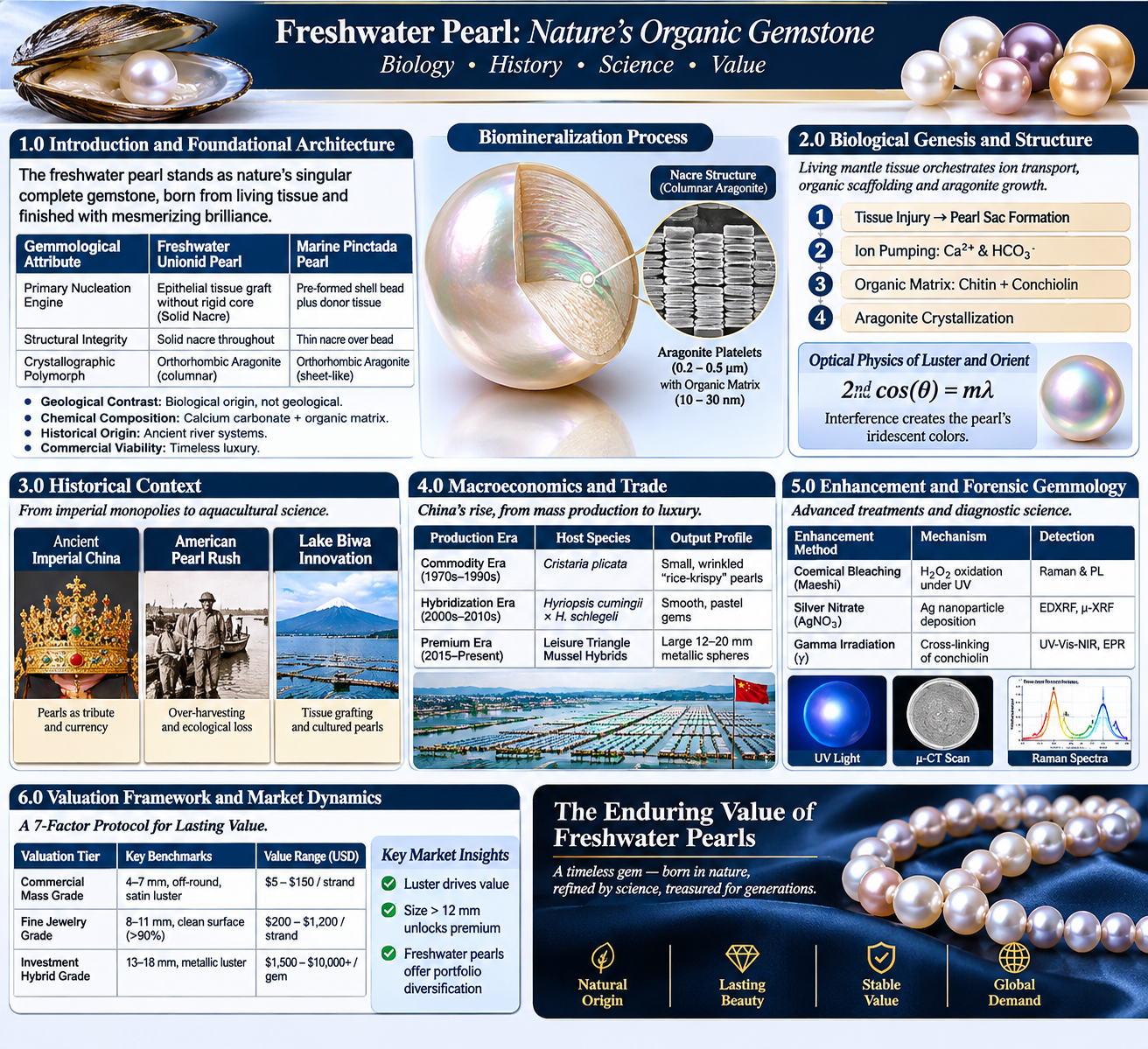
The freshwater pearl stands as nature’s singular complete gemstone, emerging from living aquatic tissue fully finished without requiring mechanical cutting or lapidary faceting to reveal its mesmerizing, light-interfering optical brilliance.
| Gemmological Attribute | Freshwater Unionid Pearl | Marine Pinctada Pearl |
|---|---|---|
| Primary Nucleation Engine | Epithelial tissue graft without rigid core (Solid Nacre) | Pre-formed inorganic shell bead plus donor tissue |
| Structural Integrity | Solid concentric aragonite matrix throughout body | Thin nacre coating over vulnerable internal bead |
| Crystallographic Polymorph | Orthorhombic Aragonite with columnar stacking | Orthorhombic Aragonite with sheet-like stacking |
- Geological Contrast: Forged within living biological systems rather than deep lithospheric pressure chambers.
- Chemical Composition: Composed of calcium carbonate held together by a complex organic macromolecular scaffolding.
- Historical Origin: Sourced from ancient Northern Hemisphere river systems prior to modern global aquacultural scaling.
- Commercial Viability: Represents both the oldest wild-harvested marine luxury and the modern height of bio-engineering.
1.1 Scope
To truly appreciate the freshwater pearl, one must look past the superficial marketing fluff that has saturated the gem trade for decades and examine the precise physical and historical mechanisms that bring this organic marvel into existence. The journey of a freshwater pearl begins not as a random, romanticized speck of sand blowing casually into a shell, but as a sophisticated biological defense mechanism deployed by freshwater bivalve mollusks against severe physical intrusions or parasitic trauma. Unlike geological mineral species that demand destructive open-pit mining, heavy crushing, precise wheel-saw slicing, and labor-intensive lapidary faceting to manifest light dispersion, the pearl materializes inside the soft tissue of a living organism as a fully realized, three-dimensional geometric body possessing complete optical brilliance from the moment of harvest.
This comprehensive treatise deconstructs the freshwater pearl across four critical pillars: biomineralization science, historic harvesting trends, modern geopolitical aquaculture, and advanced forensic gemmology. By examining the cellular processes of the mantle epithelium, we reveal how biological systems turn simple dissolved calcium and bicarbonate ions into nanoscale architectural masterpieces of extreme toughness and luster. We further trace the socioeconomic arc of the pearl from ancient imperial crown monopolies and the catastrophic American Pearl Rush to the modern aquatic industrial complexes of mainland China, where advanced tissue-grafting protocols have permanently disrupted the global luxury landscape.
1.2 Biomineralization and Cellular Mechanisms
The biological creation of a freshwater pearl relies on the outer mantle epithelium of bivalves within the order Unionida. When parasitic organisms or mechanical injuries dislodge epithelial cells from the outer mantle sheet and push them deep into the underlying connective tissue stroma, these surviving cells quickly proliferate via rapid mitotic division. They form a closed, hollow, spherical sac known to science as the pearl sac. Crucially, the cellular polarity of the original epithelium is preserved during this migration. The active secretory faces of these cells, which normally construct the protective interior lining of the host shell, now point inward toward the confined central cavity of the newly formed sac.
Once established, the interior lining of the pearl sac initiates a continuous, highly controlled secretion cascade. Cells actively pump metabolic calcium ions and bicarbonate ions directly into the central lumen, establishing a state of localized thermodynamic supersaturation. Concurrently, the cells synthesize an intricate scaffolding of insoluble chitin polymers and hydrophobic conchiolin proteins. Upon this organic framework, acidic protein molecules align at precise distances, acting as microscopic molecular templates that lower the energy barrier for mineral precipitation. This ensures that the dissolved calcium carbonate crystallizes specifically into tabular plates of aragonite rather than common geological calcite, laying down the brick-and-mortar foundation that gives the finished gemstone its legendary structural resilience and glowing optical depth.
2.0 Biological Genesis and Structure: Biomineralization, Crystallography, and Morphogenesis
authored by @jamesdumar.com | Identity: did:plc:7vknci6jk2jqfwsq6gkzu
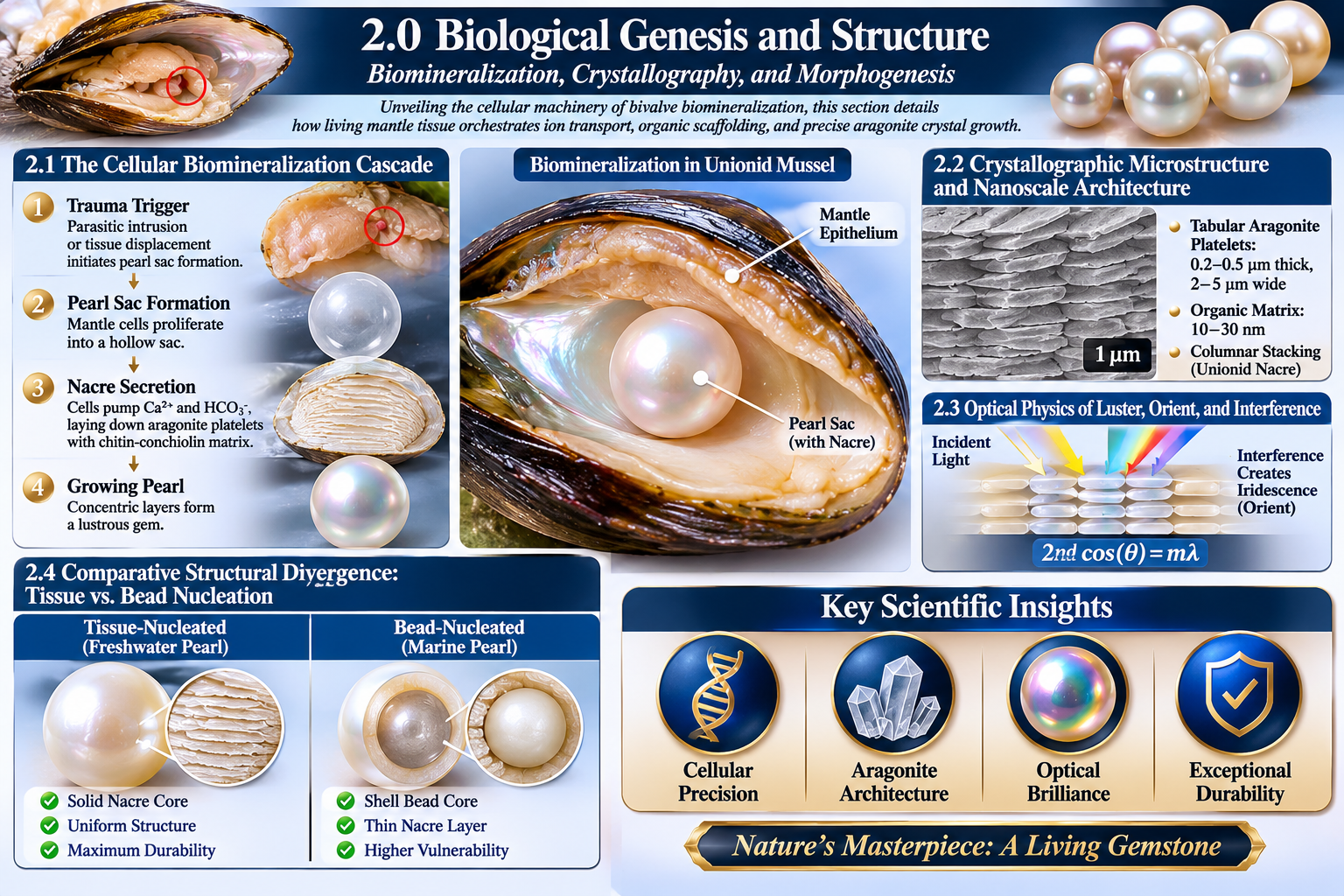
Unveiling the cellular machinery of bivalve biomineralization, this section details how living mantle tissue orchestrates ion transport, organic scaffolding, and precise aragonite crystal growth to forge peerless organic gemstones.
| Biomineralization Parameter | Freshwater Unionid Mechanism | Marine Pinctada Mechanism |
|---|---|---|
| Primary Nucleation Trigger | Localized parasitic intrusion or tissue displacement trauma | Surgical implantation of foreign shell bead plus mantle graft |
| Macromolecular Scaffolding | Chitin polymer mesh intertwined with hydrophobic conchiolin | Aragonite-aligned protein matrix coating foreign shell surface |
| Crystallographic Architecture | Columnar stacking of polygonal, tabular aragonite platelets | Sheet-like lamellar stacking wrapping a rigid sphere |
- Cellular Polarity Conservation: The inverted apical orientation of displaced mantle epithelial cells drives inward luminal deposition.
- Thermodynamic Supersaturation: Active calcium-transporting ATPases and carbonic anhydrase pump ions into the extracellular fluid.
- Epitaxial Template Control: Acidic proteins rich in aspartic and glutamic acid dictate precise crystal lattice coordinates.
- Nanocomposite Toughness: Alternating inorganic aragonite bricks and organic conchiolin mortar deliver extreme fracture resistance.
2.1 The Cellular Biomineralization Cascade
The formation of a freshwater pearl represents an extraordinary manifestation of defensive biological biomineralization governed by the outer mantle epithelium of bivalve mollusks within the order Unionidae. Contrary to popular cultural mythology suggesting that pearls originate from random grains of sand entering the shell, natural pearl formation is almost universally initiated by a localized traumatic event. Such events include mechanical intrusion by trematode larvae parasites, physical shell-boring organisms, or severe localized trauma that physically displaces cells from the outermost epithelial sheet, lodging them deep within the underlying connective tissue stroma of the mantle or visceral mass. Once displaced from their normal anatomical position, these specialized epithelial cells do not die; instead, they undergo rapid mitotic proliferation, forming a closed, hollow spherical biological structure designated as a pearl sac. The foundational polarity of the epithelial sheet is strictly preserved throughout this migration: the apical surfaces of the cells, which normally face outward toward the inner shell surface to secrete the mollusk’s protective skeletal shell layers, now face inward toward the enclosed central lumen of the newly formed sac. This spatial inversion immediately initiates the continuous secretion of biomineralized matrices into the confined internal space, perfectly mirroring the normal shell-deposition sequence of the host organism.
This secretion process is not a random inorganic precipitation event; rather, it is a highly regulated, matrix-mediated biological cascade where an organic macromolecular framework dictates the nucleation, polymorph selection, crystal orientation, and spatial confinement of calcium carbonate ($CaCO_3$). The cell-mediated assembly proceeds through three distinct, highly synchronized phases. First, the epithelial cells synthesize and secrete an extracellular matrix directly into the pearl sac lumen. This organic matrix consists of an insoluble, highly cross-linked network of chitin polymers combined with structural proteins known collectively as conchiolin. Conchiolin is a complex biochemical mixture of hydrophobic, glycine- and alanine-rich proteins that form a semi-permeable, compartmentalized structural scaffolding. Second, the mantle tissue actively pumps calcium ions ($Ca^{2+}$) and bicarbonate ions ($HCO_3^-$) from the surrounding hemolymph directly into the extrapallial fluid of the pearl sac lumen. Specialized cells utilize membrane-bound calcium-transporting ATPases and intracellular carbonic anhydrase enzymes to rapidly convert metabolic carbon dioxide into bicarbonate, driving the localized luminal fluid into a thermodynamic state of extreme supersaturation relative to calcium carbonate. Third, soluble, highly acidic matrix proteins—specifically enriched in aspartic acid and glutamic acid residues, such as MSI60 and nacrein—are secreted directly onto the insoluble chitin-conchiolin framework. The negatively charged carboxylate groups of these amino acids align at precise spatial intervals, acting as epitaxial templates that mimic the crystal lattice coordinates of aragonite, lowering the thermodynamic activation energy for nucleation and forcing the mineral to precipitate specifically as the orthorhombic aragonite polymorph rather than calcite.
2.2 Crystallographic Microstructure and Nanoscale Architecture
The bulk structural composition of a premium freshwater pearl consists entirely of nacre, a natural brick-and-mortar nanocomposite renowned in materials science for its exceptional mechanical toughness, impact resistance, and optical brilliance. In Unionid freshwater mussels, the nacreous layer is composed of approximately 95 percent inorganic aragonite and 5 percent organic matrix by dry weight. When examined under high-resolution field-emission scanning electron microscopy (FE-SEM), this nacre reveals an ordered, highly symmetrical arrangement of polygonal, tabular aragonite platelets. Each individual platelet functions as a discrete single crystal measuring between $0.2$ and $0.5\,\mu\text{m}$ in vertical thickness and spanning $2$ to $5\,\mu\text{m}$ in lateral diameter. These tabular platelets are stacked vertically in tightly organized columns known as columnar nacre, a structural hallmark of freshwater Unionid mussels that contrasts sharply with the sheet-like, overlapping nacre configurations typically observed in marine pterioidean bivalves.
Surrounding every individual aragonite brick is an ultra-thin organic matrix envelope measuring approximately $10$ to $30\text{ nm}$ in thickness. This interlamellar organic envelope serves a dual mechanical and structural purpose: it acts as a highly specialized viscoelastic shock absorber that arrests micro-crack propagation through the rigid crystal lattice—giving nacre a fracture toughness thousands of times greater than pure geological aragonite—and it physically restricts the vertical growth of each individual platelet, forcing it to expand laterally until it intersects neighboring crystals along well-defined intercrystalline boundaries. This precise cellular and chemical confinement ensures that the entire pearl body maintains structural homogeneity, eliminating internal cleavage planes and providing robust durability across decades of environmental exposure and everyday physical wear.
2.3 Optical Physics of Luster, Orient, and Interference
The captivating visual appeal of a freshwater pearl—defined by its surface luster and the iridescent play of color known as orient—is a direct macroscopic consequence of its nanoscale crystallographic architecture. When a beam of incident white light strikes the smooth surface of a high-grade freshwater pearl, it undergoes a complex sequence of optical phenomena governed strictly by the Maxwell equations of electromagnetic wave propagation through stratified biological media. First, a fraction of the incident light undergoes immediate specular reflection at the outermost boundary separating the surrounding air from the initial nacre layer. This creates the primary surface luster; a perfectly smooth, unblemished surface produces a highly coherent, mirror-like specular reflection, whereas micro-topographical surface roughness scatters light diffusely, degrading the luster into a dull appearance.
Simultaneously, because the tabular aragonite platelets are semi-transparent and possess a high refractive index ($n \approx 1.68$), the unreflected portion of the light wave penetrates the outer boundary and refracts deep into the underlying nacre stack. As this light wave encounters successive optical interfaces between the high-index aragonite platelets ($n = 1.68$) and the low-index organic conchiolin layers ($n \approx 1.55$), it undergoes partial reflection at every single boundary. Because the physical thickness of each aragonite platelet ($200\text{ to }500\text{ nm}$) corresponds directly to the wavelengths of human-visible light ($380\text{ to }750\text{ nm}$), light waves reflected from varying depth levels within the nacreous stack emerge from the pearl with distinct phase relationships. When the optical path difference between these interfering waves satisfies constructive interference conditions:
$$2n d \cos(\theta) = m\lambda$$
where $n$ represents the refractive index of the aragonite platelet, $d$ is the physical thickness of the platelet, $\theta$ is the angle of refraction within the crystal lattice, $m$ is the integer order of interference, and $\lambda$ is the specific wavelength of light amplified in reflection. This selective amplification of narrow spectral wavelengths generates the shifting, iridescent overtones of pink, green, and gold that comprise the pearl’s orient. Furthermore, light waves diffracted by the periodic, grating-like margins of overlapping platelets along the pearl’s curved exterior surface further separate white light into its fundamental spectral components, deepening the optical depth and creating the illusory perception that the gemstone’s brilliance originates from deep within its core.
2.4 Comparative Structural Divergence: Tissue vs. Bead Nucleation
The fundamental morphological and structural divergence between traditional freshwater pearls and marine saltwater pearls lies entirely in the mechanics of their initial nucleation, which dictates their internal anatomy, weight distribution, and ultimate mechanical durability. In tissue-nucleated freshwater culturing protocols, a minute square measuring approximately $1\text{ to }2\text{ mm}^2$ of donor mantle epithelium is inserted directly into the mantle stroma of a recipient host mussel without any accompanying solid bead. The grafted tissue proliferates, establishes a functional pearl sac, and immediately begins secreting nacre. As the pearl grows over successive years, the initial organic tissue graft desiccates and collapses into a microscopic, organic-rich void located at the precise geometric center of the gem. Consequently, the resulting freshwater pearl is a solid, continuous matrix of concentric nacreous layers from exterior surface to core.
This structural homogeneity renders non-nucleated freshwater pearls exceptionally durable; they cannot “peel,” chip, or expose an underlying foreign nucleus over decades of wear, and their chemical stability and hardness remain uniform throughout the entire volume of the gemstone. Conversely, marine culturing methodologies (such as Akoya, South Sea, and Tahitian production) rely on inserting a large, pre-formed spherical bead carved from the thick shells of North American unionid mussels, alongside a small piece of donor mantle tissue. The host marine oyster deposits nacre only as a thin surface veneer around this rigid foreign sphere. The structural interface between the foreign shell bead and the freshly secreted marine nacre represents a permanent mechanical vulnerability, where mismatches in thermal expansion coefficients or crystal orientation can cause delamination, star-cracking, and structural degradation—vulnerabilities that solid freshwater nacre successfully avoids.
3.0 Historical Context: From Ancient River Harvesters to the Dawn of Aquacultural Science
authored by @jamesdumar.com | Identity: did:plc:7vknci6jk2jqfwsq6gkzu
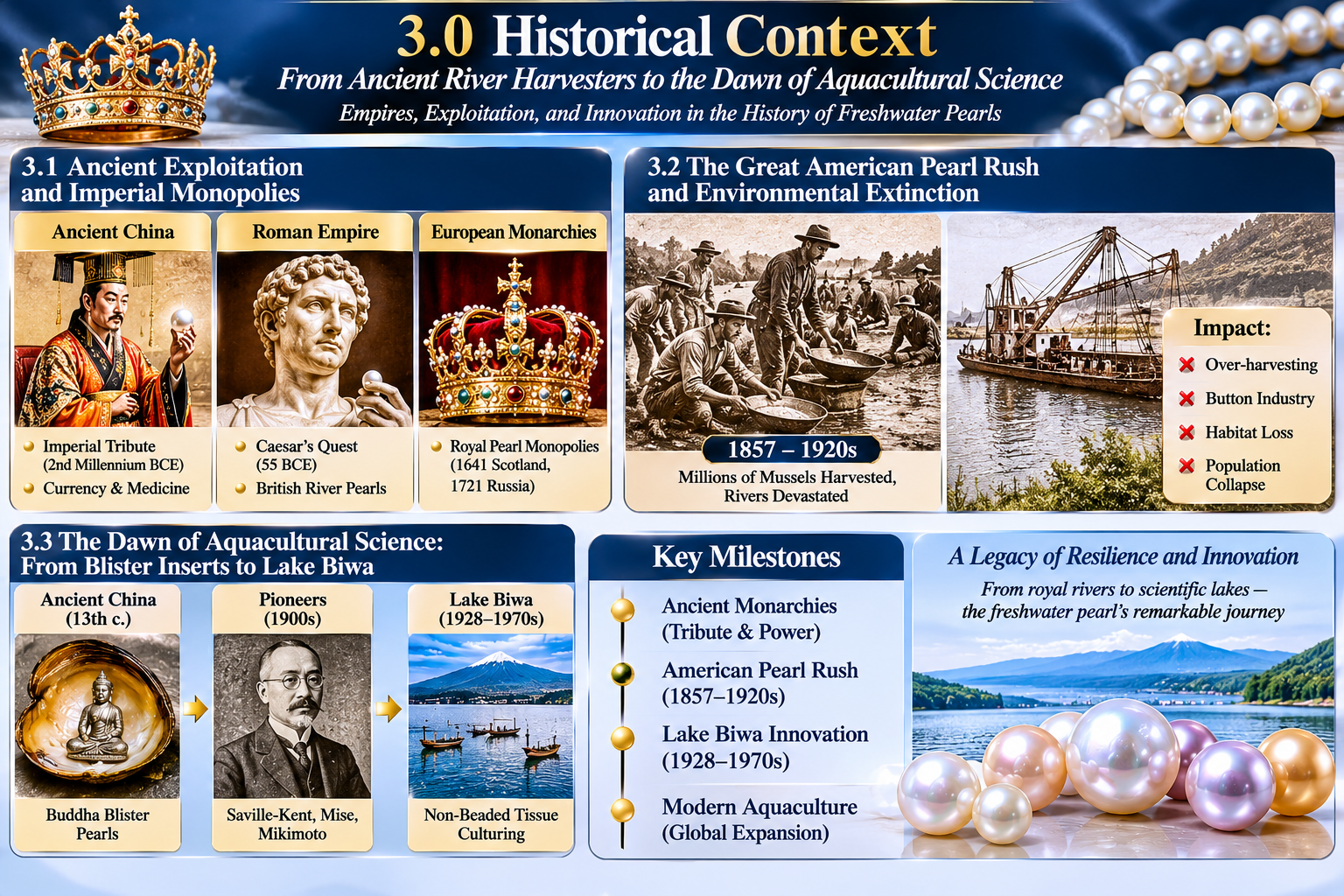
Tracing the epic historical arc of freshwater pearling, this section documents its evolution from imperial monopolies and environmental devastation to ground-breaking biological culturing triumphs.
| Historical Era / Region | Target Mollusk Species | Primary Harvesting / Production Method |
|---|---|---|
| Ancient Imperial China & Europe | Margaritifera margaritifera & Cristaria plicata | Wild riverbed foraging under strict state/royal crown monopolies |
| American Pearl Rush (1850s–1920s) | Fusconaia ebena & Actinonaias ligamentina | Destructive motorized brail dredging and shell button blanking |
| Lake Biwa Innovation (1920s–1970s) | Hyriopsis schlegeli | Non-beaded mantle tissue grafting in managed lacustrine bodies |
- Royal Monopolies: Feudal decrees across Europe and Imperial China nationalized wild riverbeds for sovereign glory.
- Ecological Extinction: Over-harvesting and industrialized button manufacturing destroyed pristine Unionid mussel beds.
- Pioneering Micro-Surgeries: Yu Shun’s blister inserts evolved into 20th-century non-nucleated tissue culturing protocols.
- Environmental Shift: Pollution and eutrophication in Japanese lakes shifted world culturing centers to mainland China.
3.1 Ancient Exploitation and Imperial Monopolies
Long before the development of controlled biological aquaculture in the 20th century, all natural pearls represented exceedingly rare anomalies of nature, rendering them among the most prized, costly, and politically significant objects of luxury display in human history. While marine pearling flourished in the warm, treacherous waters of the Persian Gulf, the Gulf of Mannar, and the Red Sea, the cold, high-calcium river networks of the Northern Hemisphere supported an equally prestigious and economically formidable continental tradition of freshwater wild pearling. In ancient China, freshwater pearls were recorded as mandatory imperial tribute items as early as the Shujing (Book of Documents), dating back to the 2nd millennium BCE. Harvested from the vast Huai and Yangtze River basins, these natural river gems were deeply integrated into the state ceremonies of the Zhou and Han dynasties, serving simultaneously as high-denomination currency, standardized markers of bureaucratic rank, and vital ingredients in imperial medicinal elixirs believed to prolong life.
In Western Europe, the abundance of the freshwater pearl mussel Margaritifera margaritifera within the crystal-clear streams of the British Isles, Iberia, and Central Europe acted as a direct driver of geopolitical expansion. Suetonius, the renowned Roman historian, explicitly asserted that Julius Caesar’s primary motivation for launching his first military expedition to Britain in 55 BCE was to inspect and acquire its famed river pearls. Caesar later dedicated a ceremonial breastplate heavily embroidered with these British freshwater pearls to the temple of Venus Genetrix in Rome, establishing an enduring cultural precedent wherein European river pearls became synonymous with imperial authority and divine right. During the medieval and Renaissance eras, European freshwater pearling fell under strict legal regimes known as Royal Pearl Monopolies (Perlenregal). In Scotland, the Act anent Pearles, enacted by the Parliament of Scotland in 1641 under King Charles I, declared that all high-quality river pearls discovered in Scottish waters were the exclusive property of the Crown, establishing specialized crown pearlers to patrol rivers like the Tay, Spey, and Teith. Similarly, in the Russian Empire, Peter the Great nationalized all domestic freshwater pearl harvests in 1721, banning private extraction and forcing harvesters to sell their yields directly to the Imperial Treasury, where they were utilized to adorn Orthodox ecclesiastical vestments, imperial crowns, and noble kokoshniks.
3.2 The Great American Pearl Rush and Environmental Extinction
The modern era of wild freshwater pearling reached its dramatic absolute peak—and its sudden ecological catastrophe—during the American Pearl Rush, which erupted in 1857 following the accidental discovery of the “Queen Pearl.” This magnificent $93\text{-grain}$ pinkish-purple natural freshwater gem was uncovered in Notch Brook near Paterson, New Jersey, and was subsequently acquired by Charles Tiffany of Tiffany & Co. before being sold to Empress Eugénie of France. This single high-profile discovery triggered an immediate, rampant gold-rush dynamic across North America. Tens of thousands of untrained harvesters flooded the pristine, unpolluted river systems of New York, Ohio, Indiana, and the massive Mississippi River basin. The method of wild extraction was systematically destructive: millions of slow-growing, multi-decade-old Unionid mussels were systematically torn from river bottoms, pried open with iron blades, searched for gems, and discarded along riverbanks to rot.
By the late 1890s, the focus of harvesting expanded from searching for rare wild pearls to the industrial extraction of thick mussel shells for the mechanized pearl button industry, pioneered by German immigrant John Boepple in Muscatine, Iowa. The dense, flat shells of species such as the Ebony Shell (Fusconaia ebena) and the Mucket (Actinonaias ligamentina) proved ideally suited for blanking out high-durability mother-of-pearl buttons. This dual pressure of wild pearl hunting and heavy industrial shell harvesting brought about the rapid collapse of North American freshwater bivalve ecosystems. The deployment of motorized brail boats—which dragged heavy iron frames fitted with thousands of dangling wire hooks across riverbeds—pulverized fragile juvenile mussel nurseries. Combined with agricultural runoff, dam construction for hydroelectric projects that blocked migratory host fish required for the parasitic larval glochidia stage, and industrial siltation, wild Unionid populations across North America and Europe were decimated within less than a century, rendering commercial wild freshwater pearling functionally extinct.
3.3 The Dawn of Aquacultural Science: From Blister Inserts to Lake Biwa
The transition from destructive wild exploitation to controlled, sustainable bivalve aquaculture represents one of the major achievements of applied aquatic science. Although the 20th century is widely associated with Japanese saltwater developments, the foundational scientific principles of pearl culturing were established centuries prior in freshwater environments. The earliest documented instance of successful pearl culturing is attributed to Yu Shun in 13th-century China (circa 1200 CE) within Zhejiang province, creating what are historically known as Buddha Blister Pearls. Craftspeople carefully pried open the shells of the large freshwater mussel Cristaria plicata and inserted small, pre-formed relief figures of the Buddha cast in lead, tin, or clay directly against the inner shell wall beneath the mantle tissue. Returned to bamboo cages in quiet freshwater ponds, the mantle epithelial cells coated the metallic inserts with a smooth layer of iridescent nacre, cementing them permanently to the shell interior as sacred artifacts.
The scientific framework for generating loose, fully spherical pearls—rather than attached blister pearls—was refined at the turn of the 20th century through the pioneering work of William Saville-Kent, Tatsuhei Mise, Tokichi Nishikawa, and Kokichi Mikimoto. Recognizing the immense potential of freshwater bodies, Mikimoto initiated experimental freshwater culturing trials in 1928 at Lake Biwa, a large, ancient lake in Shiga Prefecture, Japan, utilizing the native freshwater mussel Hyriopsis schlegeli. Mikimoto’s researchers discovered a critical biological difference: the highly vascularized mantle tissue of freshwater mussels allowed them to dispense with rigid spherical shell beads entirely. By inserting only a tiny square of living donor mantle epithelial tissue into the mantle stroma of a host mussel, they induced the formation of an independent pearl sac that produced a gem composed entirely of solid nacre. Commercial production at Lake Biwa flourished post-WWII, dominating the global market with high-luster gems known as Biwa Pearls. However, by the late 1970s, severe industrial pollution, agricultural runoff, and shore concreting caused disastrous eutrophication in Lake Biwa, resulting in mass mussel die-offs and forcing the global culturing epicenter to relocate permanently to mainland China.
4.0 Macroeconomics and Trade: The Rise of China’s Culturing Industry and the Value Shift
authored by @jamesdumar.com | Identity: did:plc:7vknci6jk2jqfwsq6gkzu
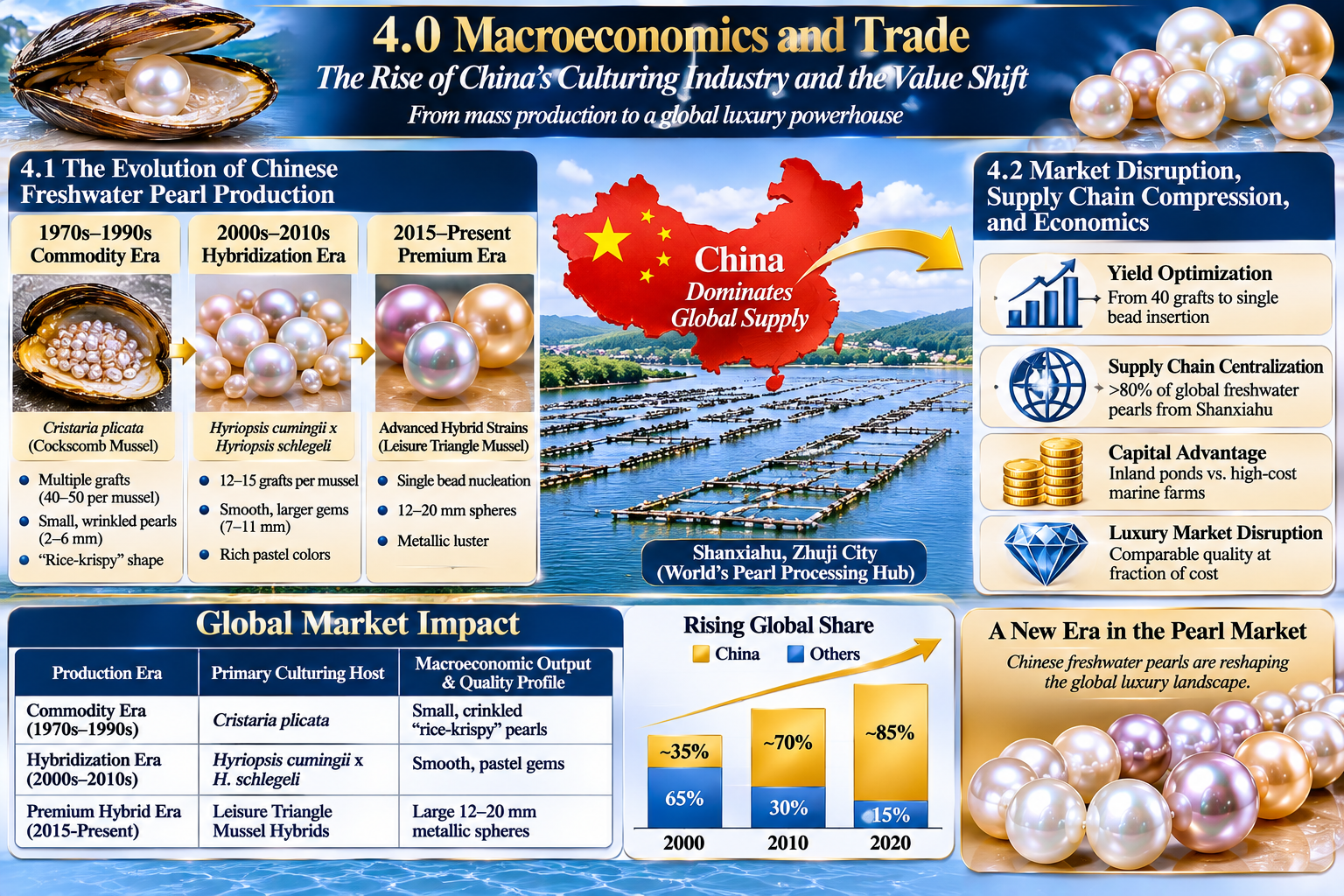
Analyzing the tectonic macroeconomic shift in global pearling, this section outlines mainland China’s technological evolution from low-margin mass production to dominant high-end luxury supply chains.
| Production Era | Primary Culturing Host | Macroeconomic Output & Quality Profile |
|---|---|---|
| Commodity Era (1970s–1990s) | Cristaria plicata (Cockscomb Mussel) | Massive volumes of small, highly crinkled “rice-krispy” shapes sold cheaply |
| Hybridization Era (2000s–2010s) | Hyriopsis cumingii x Hyriopsis schlegeli | Smooth, off-round to near-spherical pastel gems with rich natural luster |
| Premium Hybrid Era (2015–Present) | Advanced Leisure Triangle Mussel Hybrids | Large ($12\text{–}20\text{ mm}$) bead-nucleated metallic spheres competing with marine pearls |
- Yield Optimization Strategy: Shifting from 40 tissue grafts per mussel to single visceral bead insertions maximized gem quality.
- Supply Chain Centralization: Shanxiahu in Zhuji City emerged as the world clearinghouse processing over 80% of global freshwater pearls.
- Capital Expenditure Advantage: Inland agricultural pond infrastructure avoids the high mortality and typhoon risks of open-ocean marine farms.
- Luxury Market Disruption: High-grade Edison and Ming pearls dismantled historical price hierarchies dominated by saltwater varieties.
4.1 The Evolution of Chinese Freshwater Pearl Production
The contemporary global trade in freshwater pearls is characterized by an unprecedented geographic and technological concentration within the People’s Republic of China. Harnessing the expansive water networks, lakes, and converted agricultural reservoirs of eastern provinces such as Zhejiang, Jiangsu, Anhui, and Hunan, Chinese aquaculturists have systematically re-engineered freshwater pearling from a low-value commodity industry into an advanced luxury sector capable of outperforming historical marine producers. This historical progression unfolded across three major technological eras. During the Commodity Era spanning the 1970s through the 1990s, mass production relied primarily on the Cockscomb mussel (Cristaria plicata). Producers prioritized sheer volume over gemmological refinement, performing aggressive mantle surgeries that placed up to 40 or 50 individual tissue grafts into a single organism (20 to 25 insertions per mantle valve). This extreme biological stress overwhelmed the host mussel’s metabolic reserves, producing small ($2\text{ to }6\text{ mm}$), baroque, severely wrinkled gems widely derided in the international trade as “rice-krispy pearls,” which cemented a persistent consumer bias that freshwater pearls were inherently inferior to marine alternatives.
The turning point occurred during the Quality Shift and Hybridization Era throughout the 2000s and 2010s, when Chinese researchers abandoned Cristaria plicata in favor of the Triangle Sail Mussel (Hyriopsis cumingii). Furthermore, scientists successfully cross-bred native Hyriopsis cumingii with remaining stocks of the Japanese Hyriopsis schlegeli to create a high-vigor interspecific hybrid known as the Leisure Triangle Mussel. Breeders drastically reduced graft densities to 12-15 insertions per valve, allowing host mussels to deposit thicker, smoother nacre coats. This operational pivot produced significantly larger gems ($7\text{ to }11\text{ mm}$) displaying symmetrical drop, oval, and button shapes alongside an extraordinary range of natural pastel colors ranging from deep lavenders to metallic apricots. Building on this biological foundation, the industry entered the Premium Era from 2015 onward with the commercialization of large-scale, bead-nucleated freshwater gems marketed under proprietary names such as Edison and Ming pearls. By surgically implanting a single large spherical shell bead alongside a donor mantle tissue graft directly into the deep, highly vascularized visceral body cavity of the hybrid mussel—rather than the thin mantle tissue—cultivators channeled the organism’s entire biomineralization capacity into a single gem over a 3-to-5-year grow-out cycle, yielding gargantuan, perfectly round spheres measuring between $12\text{ and }20\text{ mm}$ with mirror-like metallic luster.
4.2 Market Disruption, Supply Chain Compression, and Economics
The emergence of these advanced hybrid bead-nucleated freshwater gems has fundamentally disrupted the traditional price hierarchy of the global pearl market. For over a century, the international gem trade adhered strictly to a rigid valuation framework where Japanese Akoya pearls occupied the mid-tier luxury segment, followed by Tahitian black pearls, and topped by elite Australian and Indonesian White South Sea pearls as the absolute pinnacle of luxury. Bead-nucleated Chinese freshwater pearls shattered this historical hierarchy by offering physical, visual, and crystallographic characteristics—such as spherical symmetry, intense metallic luster, and vibrant natural coloration—that equaled or surpassed high-end marine pearls at a fraction of the aquacultural production cost. This disruption stems directly from the structural economic advantages inherent to freshwater bivalve farming compared to coastal or open-ocean marine operations.
Operating marine pearl farms requires immense capital expenditure, including specialized seaworthy vessels, heavy-duty longline flotation grid systems, continuous anti-fouling maintenance, stringent marine environmental regulatory compliance, and constant exposure to destructive typhoons or warming ocean currents that trigger toxic red tides. Moreover, marine Pinctada oysters are notoriously sensitive to environmental stress, suffering harvest mortality rates that routinely exceed 30 to 40 percent. In contrast, freshwater Hyriopsis mussels are exceptionally hardy organisms that thrive in simple, inland earthen agricultural ponds, managed lakes, and irrigation reservoirs. They can be cultured at exceptionally high stocking densities with mortality rates consistently maintained below 10 to 15 percent. The commercial epicenter of this globalized supply chain is centered in the specialized industrial cluster of Shanxiahu Town, located within Zhuji City, Zhejiang Province. Processing and sorting more than 80 percent of the world’s freshwater pearl output, Shanxiahu functions as an integrated global hub combining automated chemical processing, color-sorting robotics, precision strand-matching, and direct-to-consumer e-commerce streaming infrastructure, successfully bypassing legacy wholesale middlemen and democratizing access to high-grade organic gems worldwide.
5.0 Technological History and Enhancement: Engineering Appearance and Forensic Gemmology
authored by @jamesdumar.com | Identity: did:plc:7vknci6jk2jqfwsq6gkzu
Deconstructing post-harvest chemical treatments and advanced forensic laboratory testing, this section details the chemical techniques used to enhance luster and color, alongside state-of-the-art diagnostic protocols.
| Enhancement Method | Chemical / Physical Mechanism | Forensic Detection Methodology |
|---|---|---|
| Chemical Bleaching (Maeshi) | $H_2O_2$ solvent oxidation of conchiolin organic pigments under UV light | Raman Spectroscopy & Photoluminescence (PL) emission analysis |
| Silver Nitrate Treatment ($AgNO_3$) | Precipitation of metallic $Ag^0$ nanoparticles in organic matrix channels | EDXRF element mapping (detection of trace $Ag$) & Micro-XRF |
| Gamma Irradiation ($\gamma$) | Structural cross-linking and darkening of internal conchiolin layer | UV-Vis-NIR diffuse reflectance & EPR (Electron Paramagnetic Resonance) |
- Chemical Refinement: Post-harvest bleaching oxidizes unsightly spot pigments without damaging structural aragonite plates.
- Nanoparticle Dyeing: Silver nitrate treatments deposit metallic silver within intercrystalline pores to simulate dark marine pearls.
- Radiative Alteration: Cobalt-60 gamma irradiation selectively darkens organic conchiolin to induce metallic iridescence.
- Forensic Spectroscopy: Advanced X-ray tomography and EDXRF analysis expose artificial treatments and internal bead nuclei.
5.1 Post-Harvest Chemical Engineering and Processing
Due to the variable, dynamic environmental conditions present in open-water freshwater aquacultural environments—such as seasonal thermal fluctuations, shifts in dissolved mineral concentration, and periodic phytoplankton blooms—only an extremely small fraction of raw freshwater pearls emerge from host mussels possessing pristine surface cleanliness, perfect coloration, and intense luster. To transform crude, post-harvest agricultural yields into standardized, commercially viable gemstones suitable for fine jewelry manufacture, the global industry relies on an intricate series of chemical and mechanical processes known collectively as Maes処理 (Maeshi Processing). Adaptations of traditional Japanese processing techniques, these chemical treatments alter the optical, physical, and aesthetic properties of the pearl’s outermost layers without destroying the underlying aragonite crystal matrix.
Immediately following extraction, raw pearls are covered in sticky biological slime, organic mucus, metabolic breakdown products, and decaying remnants of the pearl sac tissue. The initial processing phase begins with an intensive washing and de-gumming routine, where pearls are placed in rotating wooden or plastic drums filled with warm aqueous solutions of non-ionic surfactants and specialized enzymatic detergents. This stage strips away surface organic contaminants without etching the delicate aragonite crystal faces. Once cleaned, the pearls undergo chemical bleaching to remove irregular, spotty brown, gray, or yellow organic undertones caused by unequal distributions of natural porphyrin pigments and melanin within the conchiolin scaffolding. Pearls are immersed in a delicate bleaching bath containing hydrogen peroxide ($H_2O_2$) dissolved in an alcohol or organic solvent carrier (such as methanol or isopropyl alcohol) maintained at a constant, tightly controlled temperature between $40^\circ\text{C}$ and $50^\circ\text{C}$ under continuous ultraviolet (UV) light exposure for period spanning several days to weeks. The $H_2O_2$ diffuses into the porous organic interlamellar pathways, where it selectively oxidizes the conjugated double bonds of organic pigment molecules, neutralizing their color-absorption properties while leaving the inorganic aragonite crystals completely untouched.
5.2 Artificial Color Modification and Structural Radiative Treatment
Beyond standard bleaching, advanced chemical and radiative methods are widely employed to create synthetic color varieties or produce realistic imitations of rare, high-value marine pearls such as Tahitian dark peacock or South Sea deep gold varieties. One of the most prevalent techniques for generating rich black, dark gray, or bronze coloration involves treating bleached pearls with silver nitrate ($AgNO_3$). Because the intercrystalline organic conchiolin matrix is naturally porous and absorbent, immersing pearls in an aqueous silver nitrate solution allows silver ions ($Ag^+$) to penetrate deep into the outer nacre layers via capillary action. When the treated pearls are subsequently exposed to intense ultraviolet light or mild chemical reducing agents, the absorbed silver ions undergo reduction, precipitating as insoluble, elemental metallic silver nanoparticles ($Ag^0$) trapped directly inside the organic matrix channels. These metallic nanoparticles absorb visible light uniformly, causing the pearl to display a dark, metallic gunmetal-gray or jet-black appearance with intense iridescent surface highlights.
An alternative, highly sophisticated method for color alteration is exposure to high-energy gamma ($\gamma$) radiation, typically utilizing a Cobalt-60 ($\text{}^{60}\text{Co}$) isotope source. Unlike surface dyeing techniques, gamma irradiation does not alter or damage the inorganic aragonite crystal lattice; instead, it selectively targets and alters the molecular structure of the organic conchiolin protein matrix located throughout the entire volume of the pearl. The high-energy gamma photons break chemical bonds and induce heavy cross-linking within the conchiolin proteins, causing the organic material to darken significantly into a deep brownish-black shade. Because this darkening occurs uniformly across all internal organic layers—including the core—light entering the semi-transparent surface aragonite layers reflects off a dark internal backdrop, creating a striking, metallic peacock iridescence that closely mimics the visual appearance of premium dark marine gems. Furthermore, mechanical luster enhancement is achieved by tumbling processed pearls in rotating wooden barrels filled with micro-fine polishing media, such as pulverized walnut shell grit coated with beeswax or paraffin, buffing out microscopic surface irregularities and bestowing a high-gloss, mirror-like exterior polish.
5.3 Advanced Forensic Gemmology and Diagnostic Testing
As post-harvest enhancement chemistry and bead-nucleation protocols grow increasingly sophisticated, distinguishing between natural, unenhanced, color-treated, irradiated, and bead-nucleated freshwater pearls requires advanced non-destructive analytical techniques. Traditional gemmological tools—such as 10x magnification loupes, simple refractometers, or longwave/shortwave UV reaction lamps—are no longer sufficient to verify high-value gems definitively. Modern forensic gemmological laboratories utilize advanced spectroscopy, X-ray imaging, and elemental analysis to establish structural authenticity, origin, and treatment history beyond doubt.
To detect artificial color treatments non-destructively, forensic gemmologists rely heavily on UV-Vis-NIR (Ultraviolet-Visible-Near Infrared) diffuse reflectance spectroscopy and Raman spectroscopy. For example, natural dark freshwater pearls containing natural organic pigments (such as porphyrins) exhibit distinct absorption bands in the UV-Vis spectrum, whereas silver-nitrate-treated pearls show broad, featureless absorption curves characteristic of metallic silver nanoparticles. Furthermore, Raman spectroscopy coupled with photoluminescence (PL) emission analysis allows researchers to detect synthetic organic dyes or structural protein degradation caused by heavy bleaching or gamma irradiation. To differentiate between tissue-nucleated (solid nacre) and bead-nucleated (Edison/Ming) freshwater pearls, laboratories employ high-resolution X-ray micro-computed tomography ($\mu\text{-CT}$) and digital X-ray radiography. These non-destructive imaging modalities capture clear cross-sectional slices through the internal volume of the gem, clearly revealing the sharp, distinct structural boundary separating an implanted foreign shell bead core from the surrounding nacre, or confirming the presence of a tiny, collapsed organic cavity characteristic of pure tissue-graft origin. Finally, Energy-Dispersive X-ray Fluorescence (EDXRF) spectroscopy provides precise quantitative trace element analysis, detecting characteristic trace elements such as manganese ($Mn$) and strontium ($Sr$) to definitively differentiate freshwater gems from their marine counterparts based on host-water mineral signatures.
6.0 Valuation Framework, Market Dynamics, and Portfolio Integration
authored by @jamesdumar.com | Identity: did:plc:7vknci6jk2jqfwsq6gkzu
Evaluating the commercial matrices of freshwater gems, this section analyzes the rigorous 7-Factor Valuation Protocol, secondary market liquidity dynamics, and emergent asset class positioning.
| Valuation Tier | Physical & Gemmological Benchmarks | Estimated Wholesale Value Range (USD) |
|---|---|---|
| Commercial Mass Grade | Non-nucleated mantle tissue, 4–7mm, off-round/baroque, satin luster | $5 to $150 per strand |
| Fine Jewelry Grade | Non-nucleated or near-round, 8–11mm, sharp luster, clean surface (>90%) | $200 to $1,200 per strand |
| Investment Hybrid Grade | Bead-nucleated (Edison/Ming), 13–18mm, round, metallic mirror luster | $1,500 to $10,000+ per individual gem / strand |
- Luster Supremacy: Reflection sharpness remains the single most heavily weighted variable in valuation modeling.
- Volumetric Pricing Curve: Geometric price escalation applies once gem diameters breach critical $12\text{ mm}$ thresholds.
- Liquidity Disparity: Standard commercial strands face retail-to-resale haircut risks; ultra-rare metallic hybrids retain capital.
- Tangible Asset Hedging: Natural and high-grade hybrid pearls offer non-correlated diversification against fiat inflation.
6.1 The 7-Factor Gemmological Valuation Protocol
To establish defensible, objective asset pricing within a global market historically plagued by subjective marketing claims and unstandardized terminology, professional gemmologists and wholesale trade desks employ a comprehensive 7-Factor Valuation Protocol. Each freshwater pearl candidate undergoes rigorous quantitative assessment across Luster, Surface Quality, Shape, Color/Overtone, Nacre Quality, Size, and Strand Matching. Among these variables, Luster is universally recognized as the single most critical price-determining attribute. Under standardized laboratory light environments, luster is evaluated based on the sharpness and coherence of specular reflections off the gem’s exterior boundary. Top-tier gems exhibit “metallic” or “mirror-like” luster, where light sources and surrounding room geometry are reflected with pin-sharp clarity, commanding exponential price premiums over gems displaying diffuse, satin, or chalky surface reflections.
Surface Quality measures the frequency, magnitude, and visibility of surface blemishes, such as pin-pricks, spots, spiraling grooves, or flattening. Investment-grade thresholds require that over 95 percent of the gem’s surface be completely free of eye-visible imperfections. Shape valuation operates on a geometric hierarchy: perfectly symmetrical spheres are the most difficult to cultivate and thus fetch the highest prices, followed by near-round, symmetrical drops, buttons, and baroque forms. Color valuation combines body color with light-interfering overtones and orient. While classic white with strong rose overtones commands steady international demand, natural metallic hues—such as deep aubergine, intense bronze, metallic lavender, and fiery apricot—command specialized collector premiums. Finally, Size introduces a steep non-linear pricing curve. Because host mussels require additional years of careful aquatic management to deposit thick, clean nacre around larger cores, a single 1-millimeter increase in diameter above $10\text{ mm}$ can increase overall valuation by 30 to 50 percent, assuming equal luster and surface cleanliness.
6.2 Secondary Market Dynamics and Resale Liquidity
Investors and sophisticated collectors navigating the luxury gemstone landscape must clearly distinguish between retail replacement valuations and realistic secondary market resale liquidity. Commercial-grade freshwater pearls—specifically traditional non-nucleated mass-market production measuring under $8\text{ mm}$—suffer from severe supply abundance, resulting in substantial depreciation upon purchase and minimal secondary market resale demand. Commercial strands compete directly with newly harvested agricultural volume, making them suitable for wearable fashion accessories rather than wealth preservation instruments.
Conversely, the secondary market market dynamics for top-tier, bead-nucleated hybrid freshwater pearls ($13\text{ to }20\text{ mm}$) displaying metallic luster and exceptional natural coloration present a vastly different liquidity profile. These elite specimens, along with certified unenhanced historic natural river pearls, have achieved consistent recognition across premier auction houses such as Christie’s and Sotheby’s. High-end collectors actively seek out matched strands of gargantuan Edison/Ming pearls or unique baroque forms displaying intense iridescent orient, treating them as specialized art assets. However, transaction friction remains a critical consideration: liquidating high-value pearl assets typically incurs testing fees, independent laboratory certification costs, auction house commissions, and dealer margins. Consequently, acquisition strategies must account for holding periods to allow market demand and aquacultural supply constraints to offset initial transaction spreads.
6.3 Asset Class Positioning and Portfolio Integration
Within modern multi-asset portfolio management, high-grade organic gems—led by exceptional freshwater hybrids and certified natural specimens—occupy a specialized niche within alternative asset allocation strategies. As traditional paper assets and fiat currencies face structural inflationary pressures, sophisticated high-net-worth investors increasingly allocate capital toward tangible, highly portable real assets that possess intrinsic physical beauty and finite supply boundaries.
Freshwater pearls offer unique portfolio characteristics: their valuation exhibits low correlation with traditional equity, fixed-income, and paper commodity markets. Unlike gold or bullion, which trade strictly on macroeconomic interest rate expectations, the valuation of top-tier freshwater pearls is governed by biological growth timelines, environmental water quality constraints, and regional aquacultural policies. As environmental regulations tighten across Chinese freshwater lakes and climate-induced water temperature swings disrupt bivalve biomineralization rates, the supply of flawless, large-diameter hybrid pearls remains constrained relative to expanding global demand. When stored under proper ambient environmental conditions—protected from acidic chemicals, extreme dehydration, and mechanical abrasion—investment-grade freshwater pearls represent enduring, tangible stores of artistic and material value capable of spanning generations.
7.0 Epilogue: The Geopolitical Horizon and Future of Bivalve Bioscience
authored by @jamesdumar.com | Identity: did:plc:7vknci6jk2jqfwsq6gkzu
As we stand at the intersection of traditional aquaculture and modern nanobiotechnology, the Chinese freshwater pearl industry continues to redefine the boundaries of what is possible in bio-engineered luxury gemmology.
| Strategic Domain | Current Paradigm | Future Biotechnological Horizon |
|---|---|---|
| Environmental Regulation | Traditional pond eutrophication and regional runoff concerns | Closed-loop recirculating aquaculture systems (RAS) & bio-filtration |
| Genomic Selection | Selective cross-breeding of Leisure Triangle Mussels | Marker-assisted selection (MAS) and targeted gene editing |
| Industrial Integration | Regional clearinghouses in Shanxiahu, Zhuji City | Blockchain-verified provenance tracking from farm to digital vault |
- Ecological Evolution: Transitioning toward sustainable, high-tech water management to preserve bivalve health.
- Genomic Precision: Leveraging modern biotechnology to optimize nacre deposition rates and color expression.
- Global Traceability: Implementing cryptographic and spectroscopic verification protocols to authenticate high-end assets.
- Sustained Dominance: Cementing mainland China’s role as the premier nexus of biological innovation and luxury supply.
7.1 The Road Ahead for Biomineralization Research
The extraordinary trajectory of the freshwater pearl industry demonstrates how ancient biological phenomena can be harnessed, scaled, and perfected through rigorous scientific inquiry and industrial discipline. From the microscopic nucleation of tabular aragonite platelets within the mantle epithelium to the global economic corridors of Zhuji City, the freshwater pearl remains a profound testament to the harmonious intersection of nature and human ingenuity. As research into biomineralization advances, the insights gleaned from mollusk shell formation are beginning to inspire breakthroughs far beyond jewelry—influencing the design of ultra-tough synthetic structural composites, aerospace materials, and advanced bioceramics. For the discerning connoisseur, investor, and scientist alike, the modern Chinese freshwater pearl is no longer merely an ornament of antiquity, but a masterpiece of living engineering destined to command the global luxury landscape for generations to come.