Australian Gemstone Resources
authored by @jamesdumar.com | Identity: did:plc:7vknci6jk2jqfwsq6gkzu
1.0 Geographic Location and Distribution of Main Gemfields: Spatial Mapping of the Australian Mineral Estate
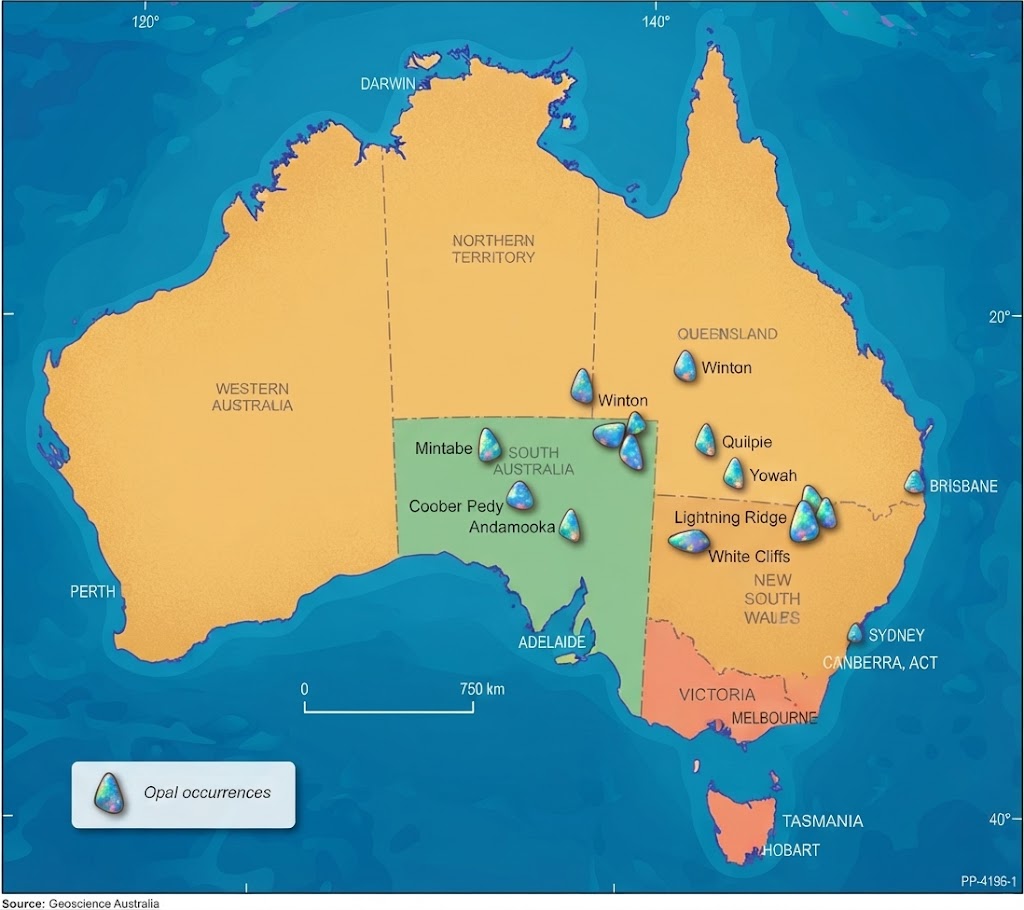
The spatial distribution of Australia’s primary gemstone deposits spans vast geographical coordinates, constrained to distinct structural geological provinces throughout the continental landmass.
| Gemfield District | Geographic Jurisdiction | Primary Gemological Output |
|---|---|---|
| Lightning Ridge & Surrounds | Northern New South Wales | Black Opal, Dark Body Tone Opal |
| Stuart Range (Coober Pedy) | Northern South Australia | Light Opal, White Opal, Crystal Opal |
| Anakie & New England Belts | Central QLD & Northern NSW | Alkaline Basaltic Sapphire, Zircon |
* **Sedimentary Basal Domains:** Sedimentary basin margins of the Great Artesian Basin hosting world-class opaliferous Cretaceous claystones and sandstones.
* **Orogenic Volcanic Belts:** Eastern Highland Cenozoic volcanic provender controlling macro-scale sapphire, zircon, and secondary corundum deposits.
* **Cratonic Margin Systems:** Proterozoic mobile belts and cratonic boundaries of Western and South Australia holding lamproites, kimberlites, and nephrite masses.
1.1 Sedimentary Opal Distributions of the Great Artesian Basin
The geographic configuration of precious opal mining in Australia is defined by the expansive borders of the Great Artesian Basin. Covering approximately 1.7 million square kilometers across Queensland, New South Wales, South Australia, and the Northern Territory, this immense Mesozoic sedimentary basin provides the structural host environment for nearly all the nation’s precious opal reserves. The primary extraction hubs are situated in isolated outback settlements where Cretaceous-age sedimentary units have undergone intense, long-term weathering under arid climatic regimes.
In New South Wales, the preeminent center is Lightning Ridge, located near the southern margin of the Surat Basin approximately 750 kilometers northwest of Sydney. The district encompasses the main township along with extensive surrounding fields including Grawin, Glengarry, Sheepyard, and the Three Mile. The landscape is dominated by low-relief sandstone ridges rising slightly above flat, semi-arid plains. Farther west lies White Cliffs, situated approximately 250 kilometers northeast of Broken Hill, where historical shaft workings cut deeply into weathered Cretaceous marine sediments along a prominent plateau rim.
1.1.1 The South Australian and Queensland Basins
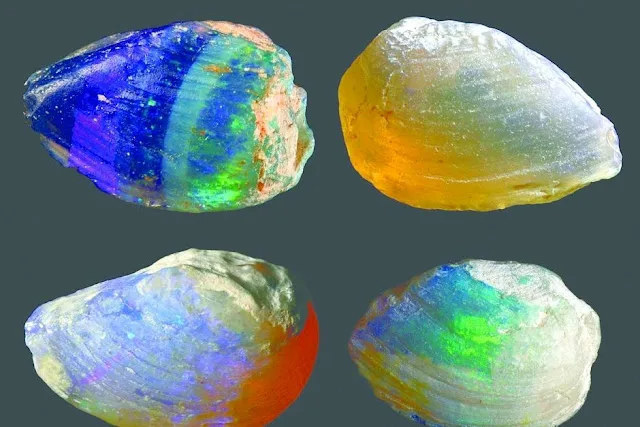
South Australia hosts the largest geographical footprint of light and crystal opal production, concentrated along the Stuart Range escarpment. Coober Pedy, located 850 kilometers north of Adelaide along the Stuart Highway, anchors a vast mining region stretching across dozens of distinct fields. To the southeast lies Andamooka, adjacent to the western shore of Lake Torrens, where mining operations penetrate ancient alluvial quartzites and weathered marine strata. Farther north, isolated in the Anangu Pitjantjatjara Yankunytjatjara lands, the Mintabie field occupies a unique position where sandstone beds of the Officer Basin host intense, high-durability precious opal.
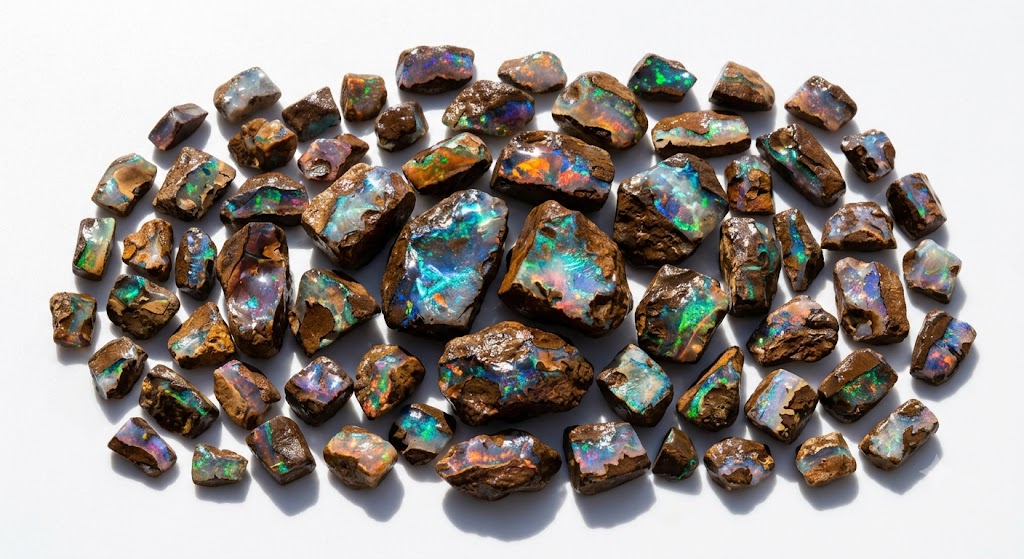
Queensland presents a distinct geographical archetype in the form of the Queensland Boulder Opal Belt. Rather than a localized cluster of shafts, this belt represents a massive 1,000-kilometer-long corridor extending from the northern reaches of Winton, down through Longreach, Blackall, Quilpie, Yowah, and Koroit near the New South Wales border. Mining across this vast terrain is dispersed across remote pastoral properties, targeting the deeply weathered ironstone concretions and sandstone beds exposed along eroded mesa systems.
1.2 Eastern Highland Volcanic Basins: The Sapphire Arc
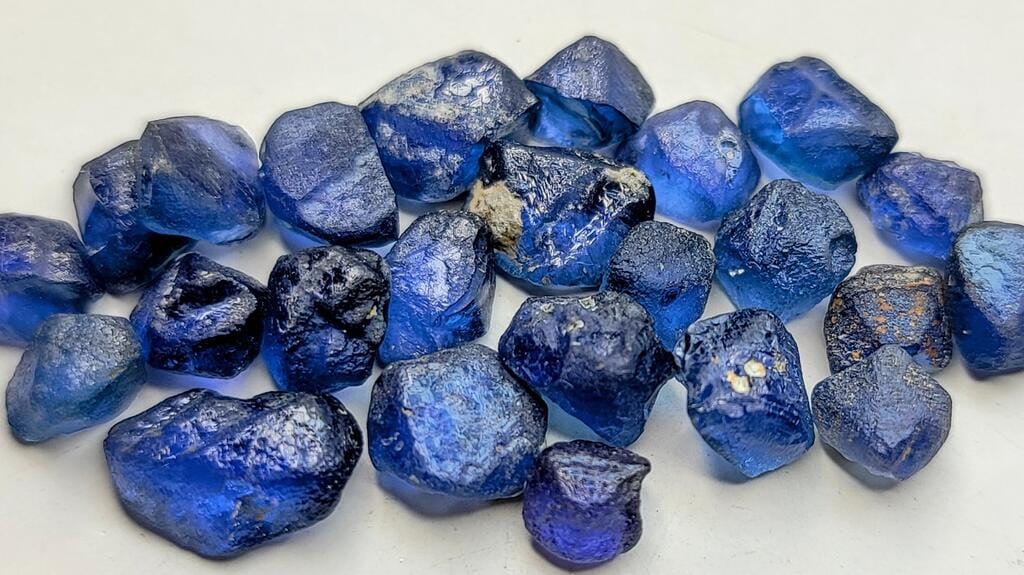
The spatial organization of corundum deposits across Australia adheres to a linear geographical vector along the Eastern Highlands, also known as the Great Dividing Range. This distribution is tied to a network of Cenozoic alkali basaltic volcanic centers that erupted intermittently over a period spanning 40 million years. The resulting sapphire deposits occur predominantly as secondary alluvial placer deposits derived from the erosion of these volcanic host rocks.
Central Queensland hosts the Anakie Gemfields, one of the most geographically extensive sapphire-bearing regions on Earth. Centered approximately 300 kilometers west of Rockhampton, the field encompasses several historic settlements, including Sapphire, Rubyvale, Anakie, and the Willows Gemfields. The terrain consists of open savannah woodlands dissected by ancient and modern drainage networks, where gem-bearing gravels—locally termed “wash”—accumulate in paleochannels and low-lying alluvial flats.
1.2.1 High-Altitude Alluvial Deposits of New South Wales
Unlike the arid environments of the outback opal fields, the New England deposits are situated within fertile agricultural lands and temperate forestry tracts. The sapphires are distributed throughout extensive alluvial terraces, paleochannel fills, and deeply weathered basalt soils. The regional geographic proximity between volcanic eruptive centers and active fluvial transport networks enabled the deposition of dense concentrations of iron-rich corundum, green zircons, and pleonaste spinels across vast catchments.
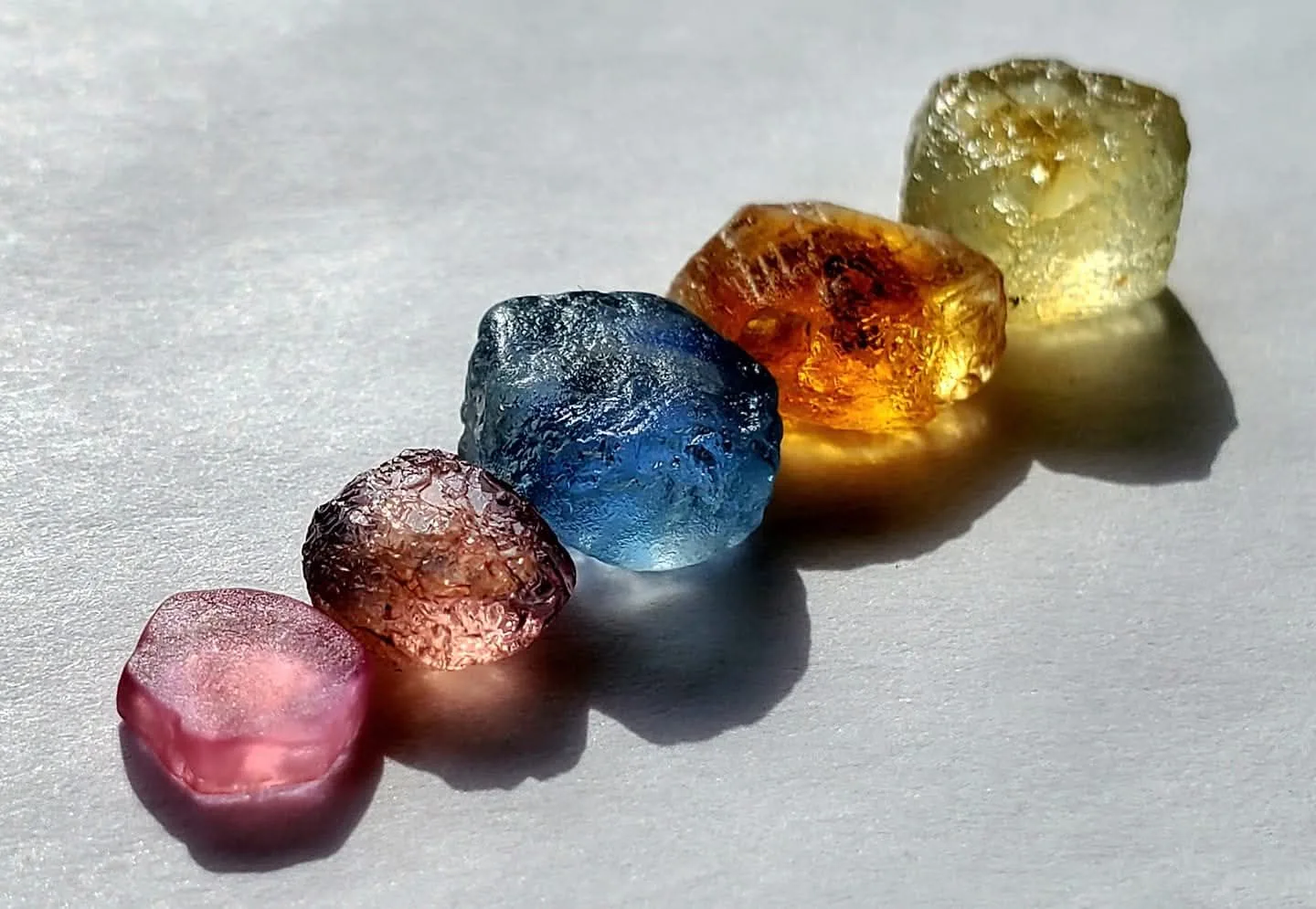
1.3 Cratonic and Specialty Localities: Diamonds, Jade, and Chrysoprase

The geography of non-sedimentary and non-basaltic gem occurrences in Australia highlights the tectonic diversity of the continent’s ancient shield areas and cratonic margins. In Western Australia, the East Kimberley region hosted the historic Argyle Diamond Mine, situated in the rugged topography of the Matsu Range near Lake Argyle, 185 kilometers south of Kununurra. This remote tropical landscape is defined by steep sandstone gorges and extreme monsoonal climatic conditions. Farther west, the Ellendale field occupies the broad limestone plains of the West Kimberley terrace near the Napier Range.
In South Australia, industrial-scale nephrite jade deposits are geographically concentrated near Cowell on the Eyre Peninsula. Located within the low, rolling landforms of the Minbrie Range overlooking the Spencer Gulf, this region holds extensive metamorphic lens structures hosting exceptionally dense nephrite bodies.
Central Queensland is home to high-grade chrysoprase deposits, located primarily at Marlborough, approximately 100 kilometers northwest of Rockhampton. The region is characterized by deeply weathered ultramafic serpentine complexes forming elevated ridge systems. Additionally, remote pegmatite provinces in the Harts Range of the Northern Territory—located in harsh desert terrain northeast of Alice Springs—contain significant distributions of structural quartz, almandine garnets, kyanite, and various exotic collector species embedded within Precambrian metamorphic basements.
authored by @jamesdumar.com | Identity: did:plc:7vknci6jk2jqfwsq6gkzu
2.0 Historical Timeline and Evolution of Mining: From Antiquity to Industrial Transformation
The historical trajectory of Australian gemstone extraction reflects a shift from Indigenous stone quarrying to colonial gold rush discoveries, mechanized mining operations, and modern corporate consolidation.
| Historical Epoch | Key Chronological Anchor | Socio-Industrial Milestone |
|---|---|---|
| Pre-Colonial Antiquity | Prior to 1788 CE | Utilitarian silicious tool manufacture & ceremonial trade routes |
| Colonial Discovery Era | 1851 – 1905 CE | Alluvial sapphire notes, White Cliffs & Lightning Ridge discovery |
| Industrialization & Argyle | 1970 – 2020 CE | Mechanical blowers, Argyle diamond pipe production & 2020 closure |
* **Indigenous Trade Networks:** Indigenous extraction focused on crystalline silicates and quartz for utilitarian tools and ceremonial items across long-distance continental routes.
* **Colonial Gold Rush Intersections:** Accidental discoveries of heavy colored stones during gold panning sparked early commercial operations in White Cliffs, Lightning Ridge, and Anakie.
* **Mechanization & Diamond Supremacy:** The integration of heavy hydraulic plants, shaft blowers, and lamproite diamond mining transformed regional economies into global export hubs.
2.1 The Indigenous Antiquity and Pre-Colonial Lithic Practices
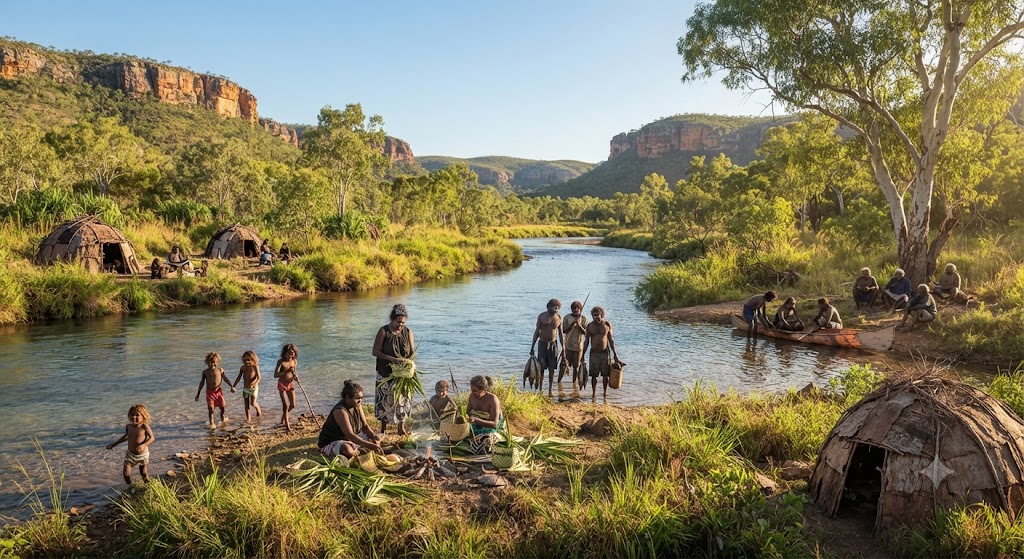
Long before European settlement, Aboriginal Australians interacted with the continent’s rich lithological landscape. While Western commercial concepts of gemology and capital accumulation were absent, Indigenous societies developed a sophisticated understanding of mineral properties. Extraction was driven primarily by functional utility, supplemented by decorative, spiritual, and ceremonial considerations. Communities targeted specific silicious rock types—including chert, chalcedony, silcrete, jasper, and high-purity quartz crystals—for their predictability when worked through knapping.
These raw materials were mined from primary exposures and alluvial beds, then processed into tools such as spearheads, scrapers, and geometric microliths. High-grade silicates and optically clear quartz crystals held symbolic value and were often integrated into ritual practices. Valuable minerals were exchanged across extensive trade routes (“Songlines”) that spanned thousands of kilometers. Through these inter-tribal networks, decorative silicates, greenstones, and rare optical minerals traveled from Central Australian desert interiors to coastal communities, demonstrating a deep continental knowledge of mineral distribution.
2.2 The Nineteenth Century: Serendipitous Discoveries and Pioneer Frontiers

The formal integration of Australian gemstones into international commerce began during the mid-nineteenth century, largely as an unintended secondary result of the gold rushes. As prospectors worked the alluvial gravels of New South Wales and Victoria, their washing cradles regularly trapped heavy, brightly colored companion minerals that were initially discarded as unwanted debris.
authored by @jamesdumar.com | Identity: did:plc:7vknci6jk2jqfwsq6gkzu
3.0 Geological Setting and Genesis: Lithospheric Architecture and Petrogenesis
The physical and chemical formation of Australian gemstones spans billions of years, involving complex interactions between deep mantle magmatism, crustal deformation, and extensive chemical weathering across continental sedimentary basins.
| Gemstone Species | Genetic Formation System | Primary Geochemical Mechanism |
|---|---|---|
| Precious Opal | Sedimentary Weathering Horizons | Hydrated amorphous silica colloidal sphere diffraction ($SiO_2 \cdot nH_2O$) |
| Corundum (Sapphire) | Alkaline Basaltic Volcanism | Mantle xenocryst transport in iron-rich magmatic conduits ($Al_2O_3$) |
| Diamond | Proterozoic Olivine Lamproites | Sub-continental mantle crystallization with lattice plastic deformation |
* **Sedimentary Weathering Cycles:** Deep chemical dissolution and low-temperature precipitation of silica spheres within Mesozoic basin host structures.
* **Volcanic Xenocryst Transport:** Deep crustal and upper mantle metasomatic corundum transport via sub-alkaline basaltic eruptions along Eastern Australia.
* **Tectonic Strain Deformation:** High-pressure mantle crystallization coupled with tectonic shear strain producing atomic lattice defects and colored optical absorption.
3.1 The Sedimentary Paradigm: Low-Temperature Geochemical Genesis of Precious Opal
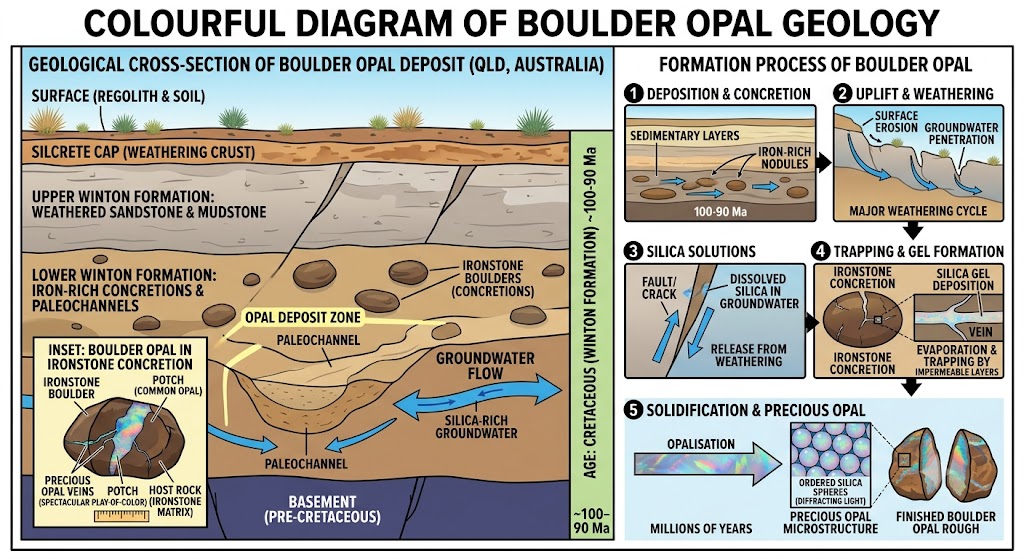
Australian sedimentary precious opal represents a distinct geochemical anomaly, forming without the high thermal or pressure regimes associated with crystalline gemstones. Opal is an amorphous, hydrated silica mineraloid ($SiO_2 \cdot nH_2O$) containing water content typically ranging from 3 to 10 percent by weight. The primary host structures for Australian opal fields were established during the Cretaceous period, when the vast epicontinental Eromanga Sea covered large portions of the Great Artesian Basin.
As these marine waters receded, they left behind extensive sequences of sandstones, siltstones, and smectite-rich claystones. During subsequent weathering episodes in the Cenozoic era, intense subaerial oxidation broke down detrital minerals and iron sulfides within these sedimentary layers. This process generated highly acidic groundwater ($pH\ 2–3$) that reacted with silicate minerals, dissolving silica and releasing soluble monomeric silicic acid ($H_4SiO_4$) into the regional water table.
3.1.1 Colloidal Sphere Precipitation and Light Diffraction Mechanics
As the regional climate shifted from humid to hyper-arid conditions, the groundwater table dropped, concentrating the dissolved silicic acid. The acid-neutralizing capacity of host claystones and calcitic fossil fragments gradually raised the pH of the silica-saturated solutions, triggering the polymerization of silica into uniform, spherical colloidal particles. These silica spheres aggregated and slowly settled out of solution in stagnant groundwater traps, joint fractures, bedding planes, and structural voids under uniform temperature and hydrostatic conditions.
authored by @jamesdumar.com | Identity: did:plc:7vknci6jk2jqfwsq6gkzu
4.0 Socio-Economic Aspects of the Industry: Community Frameworks, Labor Dynamics, and Value Chains
The Australian gemstone sector occupies a distinct socio-economic position within the nation’s resource landscape, defined by a dual structure of small-scale artisanal operations and large-scale industrial projects.
| Socio-Economic Vector | Primary Operational Subculture | Regional Economic Footprint |
|---|---|---|
| Artisanal & Independent Mining | Owner-operator syndicates, localized partnerships | Outback community support, local machinery supply chains |
| Industrial Corporate Extraction | Capital-intensive corporate ventures (e.g., Rio Tinto Argyle) | Global export revenues, infrastructure development |
| Native Title & Indigenous Integration | Formal Indigenous land councils, traditional ownership groups | Royalty frameworks, employment pathways, heritage preservation |
* **Individual Prospecting Subcultures:** Localized operator partnerships driving remote outback settlements and distinct architectural adaptation strategies.
* **Regional Economic Diversification:** Secondary service networks encompassing lapidary trade, machinery design, geo-tourism, and regional gemstone festivals.
* **Indigenous Partnership Models:** Formal land governance frameworks ensuring Traditional Owner participation, environmental monitoring, and economic compensation.
4.1 Artisanal Subcultures and Outback Settlement Patterns
Unlike iron ore or coal extraction in Australia, which is dominated by multinational corporations, the opal and sapphire sectors have historically functioned through small-scale, independent operator syndicates. This decentralized operational structure fostered a distinct social culture characterized by egalitarian values, self-reliance, and specialized localized knowledge. Settlements such as Coober Pedy, Lightning Ridge, White Cliffs, and Rubyvale developed as multi-ethnic communities, attracting diverse waves of post-World War II European migrants and independent prospectors seeking economic independence.
authored by @jamesdumar.com | Identity: did:plc:7vknci6jk2jqfwsq6gkzu
5.0 Current Status, Modern Extraction Methods, and Future Outlook: Modern Operations and Market Trajectory
The contemporary Australian gemstone industry operates in an era marked by strict environmental regulation, specialized mechanical extraction, and an evolving global market prioritizing ethical traceability.
| Commodity Sector | Modern Extraction Methodology | Regulatory & Market Vector |
|---|---|---|
| Precious Opal | Underground continuous miners, truck-mounted blowers, agitator washing | Rehabilitation bonds, environmental compliance, origin certification |
| Alluvial Sapphire | Open-cut alluvial excavators, trommels, closed-loop hydraulic pulsators | Water recycling mandates, strict land contouring and revegetation |
| Diamond Exploration | Post-Argyle alluvial reprocessing, exploratory drilling in lamproite fields | Ethical supply chain tracking, premium provenance positioning |
* **Specialized Extraction Technology:** Operational transition toward high-efficiency, small-footprint mechanical extraction including pneumatic vacuum blowers and closed-loop washing plants.
* **Environmental Stewardship Mandates:** Modern statutory requirements enforcing mandatory site rehabilitation bonds, water conservation, and land restoration.
* **Provenance and Traceability:** Strategic pivot toward ethical origin verification, blockchain tracking, and supply-chain transparency to secure premium global market positioning.
5.1 Modern Extraction Technologies and Field Operations
Contemporary gemstone mining in Australia relies on specialized equipment designed to maximize recovery while operating efficiently under challenging outback conditions. In the sedimentary opal fields, extraction techniques differ based on deposit geometry. Underground operations in Lightning Ridge and Coober Pedy utilize vertical shafts cut into soft sandstone host rocks using specialized hydraulic drill rigs. Underground extraction employs small continuous tunneling machines or hydraulic breakers to follow the opal-bearing clay horizons (“levels”).