1. THE RAREST OF CORUNDUM
Ruby History
authored by @jamesdumar.com | Identity: did:plc:7vknci6jk2jqfwsq6gkzu
The fiery crimson brilliance of ruby represents a unique convergence of geology, chemistry, and history, elevating simple aluminum oxide into an absolute emblem of wealth, divine sovereign authority, and enduring strategic market liquidity.
| Historical Realm | Nomenclature & Concept | Cultural & Economic Function |
|---|---|---|
| Ancient India | Ratnaraj (King of Precious Stones) | Revered as the central sun element in sacred gemological systems and royal treasuries. |
| Greco-Roman Antiquity | Carbunculus (Glowing Charcoal) | Categorized as an unquenchable internal flame across early Western mineral treatises. |
| Medieval Islamic World | Yaqut Al-Ahmar | Subjected to physical specific gravity calculations by scholars like Al-Biruni. |
- Chemical Anomaly: Pure corundum is intrinsically colorless, requiring precise chromium substitution within the crystal lattice to yield vibrant crimson coloration without silica or iron contamination.
- Geopolitical Driver: The geographic concentration of ruby deposits has historically altered trade routes, fueled colonial conquest, and transformed regional economic paradigms across Asia and Africa.
- Financialization Asset: Modern investment dynamics treat top-tier, unheated rubies as an ultra-scarce, highly liquid non-correlated financial asset class.
1.1 The Mineralogical Paradox of Corundum
For millennia, the fiery crimson brilliance of the ruby has occupied the absolute apex of human desire, transcending its raw physical identity as a simple metamorphic mineral to become an absolute cipher for power, divine favor, and concentrated portable wealth. Belonging fundamentally to the corundum species, the ruby is chemically nothing more than simple aluminum oxide. Yet, its existence in nature requires a profound geological contradiction: the thermodynamic union of elements that the Earth structurally keeps apart throughout standard crustal processes. While common silicate minerals form readily across the lithosphere, the gem-quality ruby is an accidental marvel of deep-time tectonic collisions and localized hydrothermal circulation.
Its rich pigmentation is derived entirely from trace amounts of chromium, an element typically sequestered deep within the Earth’s mantle or within ultramafic igneous bodies. For chromium to encounter aluminum oxide without the immediate contaminating presence of iron or silica—which would stifle its vibrant fluorescent glow or transform the mineral into an ordinary sapphire or silicate rock—demands an extraordinarily precise alignment of continental collisions, fluid dynamics, and temperature thresholds. Silica is one of the most abundant elements in the earth’s crust; whenever present, silica preferentially combines with aluminum to form ubiquitous quartz, feldspar, or mica. Therefore, corundum can only crystallize in environments that are profoundly silica-undersaturated, representing a rare chemical anomaly across global geological formations.
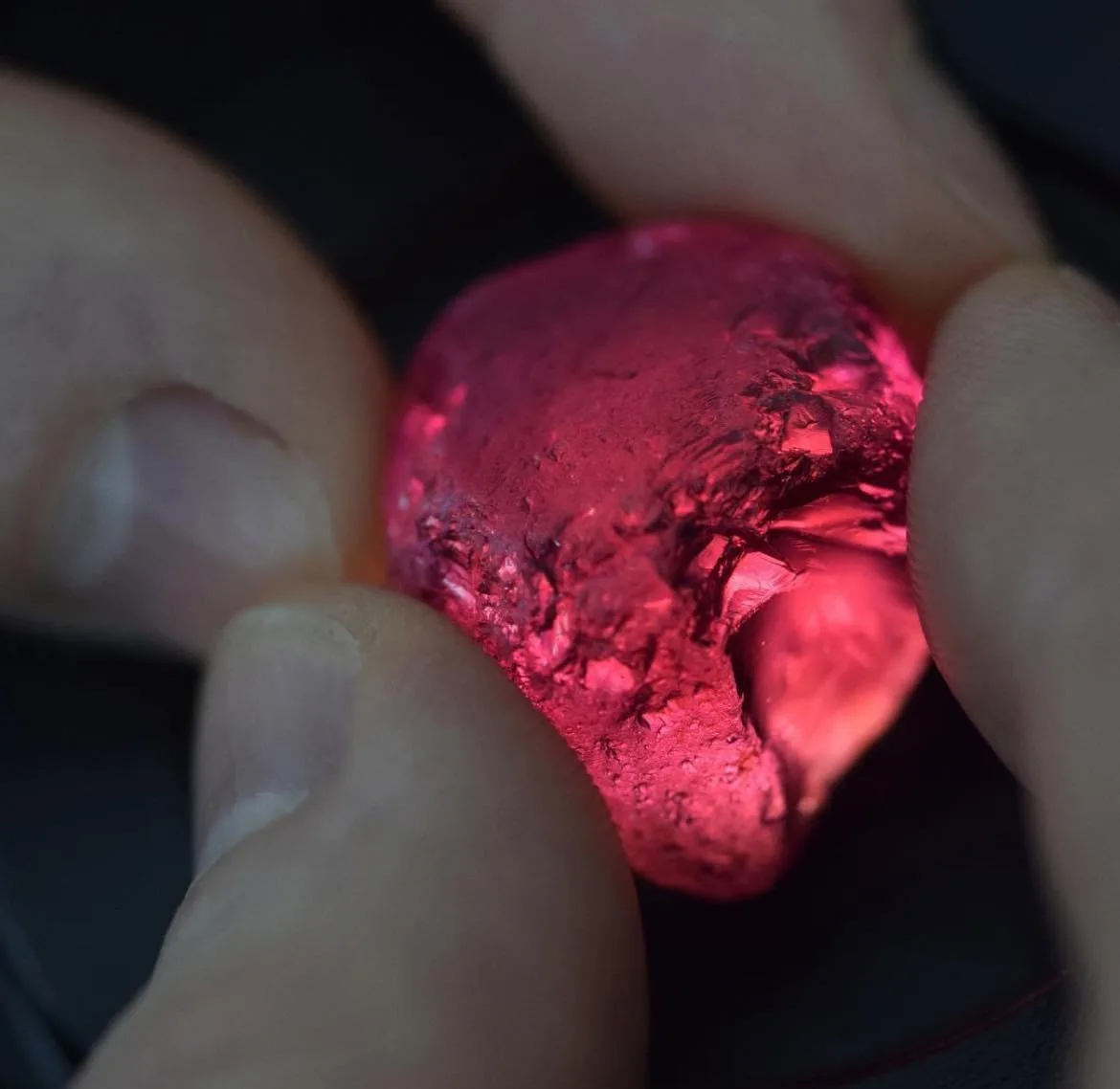
When chromium successfully enters the aluminum oxide matrix, it substitutes for aluminum ions within the tightly packed oxygen framework. Because the chromium ion is structurally larger than the aluminum ion it replaces, it distorts the surrounding octahedral crystal field. This localized lattice strain alters the way light moves through the crystal, causing the mineral to selectively absorb green and violet wavelengths while transmitting a saturated red hue. When illuminated by light containing ultraviolet radiation, this structural atomic configuration emits a vibrant red fluorescence, creating the optical illusion that the gemstone is burning with an internal, self-sustaining fire.
1.2 Cultural Lore and Antiquity’s Perception
Historically, this extremely rare elemental convergence elevated the ruby far above all other crystallized matter. In the ancient Sanskrit texts of India, it was revered as “Ratnaraj,” translated literally as the “King of Precious Stones.” It was believed to harbor an unquenchable internal flame that could boil surrounding water through its radiant energy alone. Ancient Indian lapidaries constructed elaborate metaphysical frameworks around the stone, assigning it the central place in the Navaratna—the nine sacred gemstones representing the cosmic energy of the solar system—where the ruby permanently embodied the power and authority of the Sun itself.
In Western antiquity, early naturalists lacked the precision diagnostic tools of modern physics and chemistry. Pliny the Elder categorized all red gemstones under the broad umbrella term “carbunculus,” a descriptive reference to a glowing piece of burning charcoal. Despite this diagnostic ambiguity, true rubies were distinctly separated in practice by their exceptional physical hardness and unmatched brilliance. In the medieval Islamic world, scholars like Al-Biruni systematically advanced mineralogical science by meticulously calculating the specific gravity of the ruby using custom hydrostatical balances. This precise physical testing distinguished corundum from softer red minerals like garnet or spinel, establishing its preeminence within the treasuries of caliphs, sultans, and regional trade empires.
Throughout European history, monarchs and military leaders sought out exceptional red gems as symbols of invincibility and divine protection. Monarchs encrusted their royal regalia, crowns, and liturgical objects with fiery red crystals, believing they would grant victory on the battlefield and ensure the stability of the state. However, because ancient lapidaries evaluated stones based strictly on color rather than crystal structure or chemical composition, many of the most celebrated royal rubies in European history were ultimately discovered to be red spinels, illustrating the long history of gemological ambiguity that persisted prior to the development of modern crystallographic analysis.
1.3 Modern Geopolitical and Economic Dynamics
The history of the ruby is not merely a narrative of aesthetic adulation or metaphysical folklore; it is an intense economic and geopolitical story of extraction, structural exploitation, and shifting international market routes. From the shrouded, malaria-ridden valleys of Upper Burma to the modern, highly mechanized open pits of Mozambique, the pursuit of this rare red crystal has altered the trajectories of sovereign empires, funded protracted regional conflicts, and driven the technological evolution of international gemological science.
In the modern era, the global ruby trade has undergone a dramatic transformation, evolving from an informal network of family traders and localized artisanal mines into an institutionalized global industry. Corporate entities now manage vast mining concessions, deploying advanced geological modeling and automated sorting technology to process millions of tons of gem-bearing gravel. Concurrently, the rise of scientific gemology and advanced laboratory analysis has established objective criteria for origin determination and treatment verification, creating a transparent framework that supports high-value international trade.
Today, top-tier natural rubies that exhibit exceptional color saturation, crystalline transparency, and no evidence of thermal enhancement represent one of the most concentrated forms of physical wealth on Earth. As global financial systems face inflationary pressures and market volatility, ultra-high-net-worth investors and institutional buyers increasingly treat fine rubies as a secure, portable, non-correlated store of value. This exhaustive treatise charts the long-form trajectory of the ruby, dissecting its complex geological origins, its epic historical mining landscapes, its fluid trade routes, the technological battleground of synthetics and enhancements, and its modern role as a specialized financial asset class.
2. GEOLOGICAL GENESIS AND COLOR SCIENCE
authored by @jamesdumar.com | Identity: did:plc:7vknci6jk2jqfwsq6gkzu
The creation of gem-quality ruby requires an extreme thermodynamic alignment, where specific ionic substitutions alter the corundum crystal lattice, transforming an otherwise colorless mineral into a vibrant, fluorescent optical phenomenon.
| Deposit Type | Primary Geological Environment | Chromophore & Optical Profile |
|---|---|---|
| Marble-Hosted | Regional metamorphism of silica-poor limestone along continental collision zones. | High chromium, near-zero iron; intense red UV fluorescence and vivid saturation. |
| Basalt-Related | Deep crustal/mantle xenocrysts brought to surface via alkali basalt eruptions. | High iron content quenching fluorescence; deeper, darker red to brownish undertones. |
| Amphibolite-Hosted | High-grade metamorphic shear zones involving mafic to ultramafic rocks. | Moderate iron and chromium balance; excellent transparency with stabilized color depth. |
- Atomic Substitution: Chromium ions (Cr3+) replace aluminum ions (Al3+) inside the trigonal oxygen framework, creating localized lattice strain that dictates selective light absorption.
- Fluorescence Dynamics: Ultraviolet radiation excites chromium electrons, triggering a red emission at approximately 694 nanometers that causes the stone to glow intensely from within.
- Iron Quenching: The presence of trace iron (Fe3+) in the crystal lattice absorbs radiative transition energy, suppressing fluorescence and altering visual saturation.
2.1 The Physics of Corundum Crystallization and Chromophore Mechanics
To fully grasp the historic scarcity and localized occurrence of high-grade ruby deposits, one must analyze the complex thermodynamic and chemical thresholds governing its crystallization. Pure corundum is an extraordinarily stable, intrinsically colorless mineral composed strictly of aluminum oxide. Crystallizing within the trigonal crystal system, its structural architecture consists of a hexagonal close-packed array of oxygen anions, with two-thirds of the octahedral coordination sites occupied by aluminum cations. On the Mohs scale of mineral hardness, corundum registers at 9, subordinate only to diamond. This supreme mechanical durability is a direct consequence of the short, highly dense covalent and ionic bonds uniting the aluminum and oxygen ions within its rigid framework.
The transformation of this chemically inert, transparent matrix into a ruby requires the subtle substitution of aluminum ions ($Al^{3+}$) by trace amounts of trivalent chromium ($Cr^{3+}$), generally ranging between 0.1% and 3.0% by weight. This ionic substitution introduces a profound structural distortion within the crystal lattice. Because the ionic radius of trivalent chromium is substantially larger than that of the aluminum ion it replaces, its insertion expands and distorts the local octahedral site. This mechanical distortion directly alters the electronic environment of the chromophore, changing how the crystal interacts with light.
According to crystal field theory, the altered electrical field surrounding the substituted chromium ion splits its d-electron energy levels. When white light enters the crystal, photons possessing energies corresponding to the green-yellow and violet regions of the electromagnetic spectrum are absorbed to promote electrons across these split energy states. Conversely, light in the red spectrum and a narrow band in the blue are transmitted through the lattice without absorption. The human eye perceives this transmitted light as an intense, highly saturated red color, elevated by the unique optical symmetry of the trigonal lattice.
2.2 Ultraviolet Fluorescence and the Inhibitory Role of Iron
Beyond passive light transmission, chromium-doped corundum displays a spectacular quantum phenomenon known as ultraviolet fluorescence. Natural sunlight contains a significant proportion of high-energy ultraviolet radiation. When these invisible short-wavelength UV photons enter the ruby lattice, they excite the chromium d-electrons into elevated quantum energy states. As these excited electrons rapidly decay back to their ground state via spin-forbidden transitions, they emit light at a precise, narrow wavelength of approximately 694 nanometers, located squarely within the vivid deep red band of the visible spectrum.
Because this emitted quantum light radiates simultaneously alongside the stone’s passive structural filtration of ambient daylight, the ruby appears to glow with an intense internal energy. This additive fluorescence is the key physical driver behind the prized “pigeon’s blood” color visual effect, giving top-quality stones an internal radiance that cannot be duplicated by red garnets, spinels, or red tourmalines, whose coloration stems from different atomic mechanics that lack this precise fluorescent transition.
However, the presence of trace iron ($Fe^{3+}$) within the corundum lattice acts as a severe optical inhibitor. Iron ions introduce alternative energy transfer pathways within the crystal matrix. When excited by ultraviolet light, the energy that would normally drive chromium-based fluorescence is preferentially transferred to neighboring iron ions through intervalence charge transfer mechanisms, dissipating the energy harmlessly as lattice vibration or internal heat. This process, known as fluorescence quenching, completely kills the glowing visual effect. Furthermore, iron introduces unwanted brownish and bluish undertones, darkening the gem’s overall appearance and reducing its commercial value.
2.3 Genetic Classifications of Primary Ruby Deposits
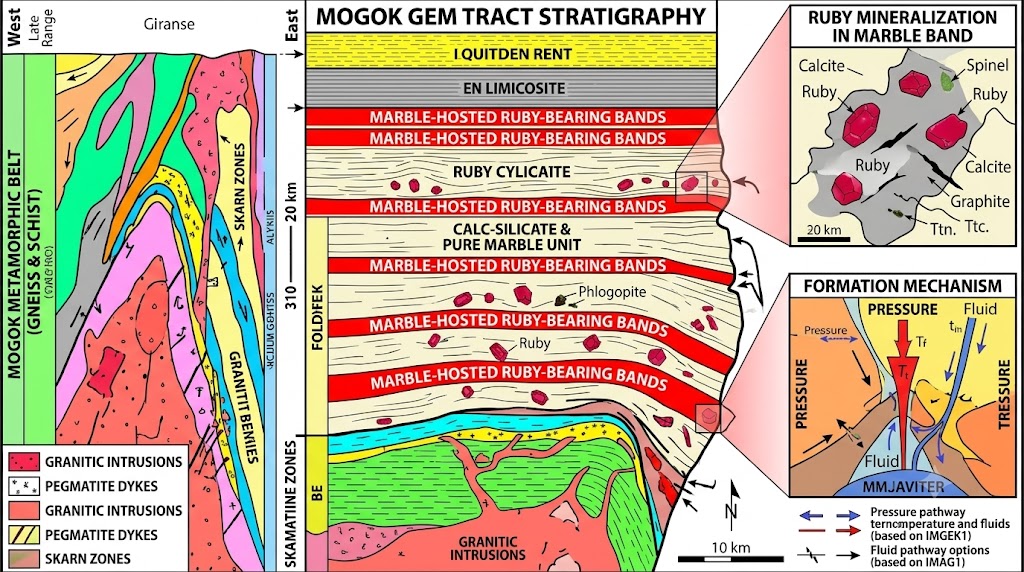
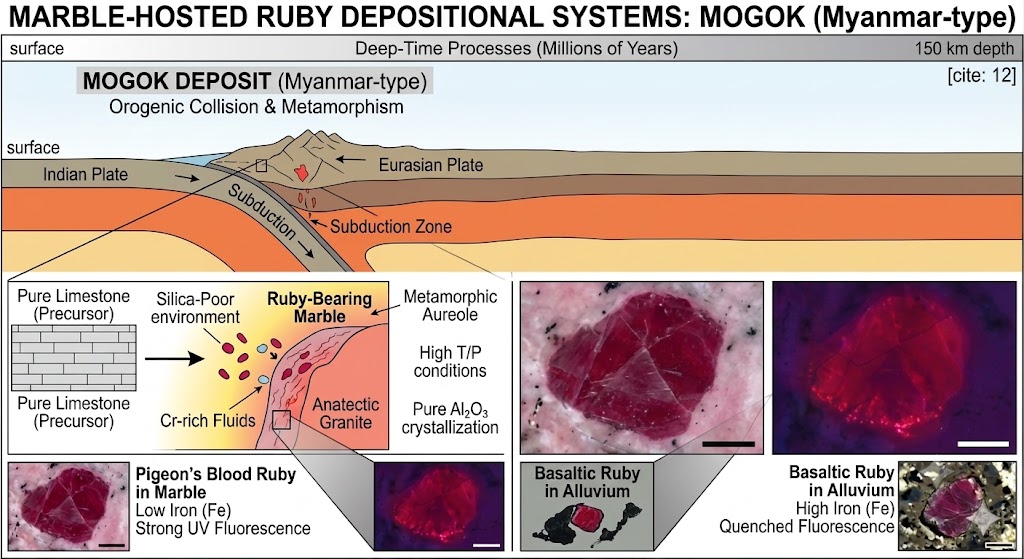
Geologists categorize primary gem-quality ruby deposits into distinct genetic systems based on their tectonic formation environments: marble-hosted, basalt-related, and amphibolite-hosted systems. Marble-hosted deposits, exemplified by the famous deposits of Mogok in Myanmar and Lục Yên in Vietnam, yield the historically most revered stones. These form during major continental collision events, such as the Himalayan Orogeny. Intense heat and pressure transform pure limestone into marble, while metamorphic fluids transport chromium from surrounding shale and clay formations. Because pristine marble is naturally free of iron and silica, the rubies that crystallize within these calcic metamorphic rocks are exceptionally pure, highly fluorescent, and saturated with brilliant color.
In contrast, basalt-related deposits, found extensively throughout Thailand, Cambodia, and eastern Australia, form under entirely different conditions. These rubies originate deep within the lower crust or upper mantle as structural xenocrysts inside aluminous metamorphic zones. Millions of years later, fast-ascending alkaline basaltic magmas sweep through these deep zones, capturing pre-formed ruby crystals and blasting them up toward the Earth’s surface during explosive volcanic eruptions. Because these mantle-derived host magmas are inherently rich in iron, basalt-hosted rubies absorb substantial iron into their atomic lattices during eruption and cooling, resulting in darker, garnety, non-fluorescent stones.
Finally, amphibolite-hosted deposits represent a critical intermediate system, exemplified by the massive contemporary deposits in Montepuez, Mozambique. These deposits formed within ancient metamorphic belt shear zones involving mafic to ultramafic rocks during the Pan-African Orogeny. Here, the corundum crystallized within amphibolite rock matrices that provided an ideal chemical balance: abundant chromium to drive rich pigmentation, alongside moderate, stable levels of iron that impart excellent color depth and clarity without fully extinguishing the stone’s natural fluorescence.
3. THE MOGOK STONE TRACT: ANCIENT LEGENDS TO COLONIAL CONQUEST
authored by @jamesdumar.com | Identity: did:plc:7vknci6jk2jqfwsq6gkzu
For over a millennium, the isolated valley of the Mogok Stone Tract served as the world’s primary source of extraordinary rubies, shaping Burmese royal sovereignty and triggering imperial British military intervention in the late nineteenth century.
| Mining Epoch | Operational Methodology | Socio-Economic Structure |
|---|---|---|
| Pre-Colonial Monarchy | Artisanal pit mining (Twin-lon, Hmyaw, Lu-dwin) in valley floors and karst caves. | Royal Prerogative: All stones above a specific weight threshold belonged strictly to the Crown. |
| British Colonial Era | Industrial hydraulic mining, steam washing plants, and electrical drainage pumps. | Monopolistic lease granted to Burma Ruby Mines Limited via Rothschild financial syndicates. |
| Post-Liquidation Period | Flooded valley basins converted to lakes; return to fragmented local artisanal extraction. | State nationalization and isolationism under military rule during the twentieth century. |
- Royal Prerogative Mandate: Sovereign decrees requiring the surrender of large crystals incentivized illicit fragmentation, permanently destroying unique mega-gem specimens.
- Rothschild Industrial Venture: Capital-intensive Western engineering failed to yield consistent profits due to complex karst geology, high overhead, and endemic illicit diversion.
- Geopolitical Imperialism: The commercial drive to seize the Mogok deposits served as a primary catalyst for the complete British annexation of Upper Burma in 1885.
3.1 Sovereign Rights, Royal Monopolies, and Illicit Fragmentation
Nestled within a dense, mountainous amphitheater approximately 200 kilometers north of Mandalay, the Mogok Stone Tract occupies a legendary status in global gemology. For centuries, access to these shrouded valleys was tightly controlled by local Shan chieftains and successive Burmese royal dynasties, including the Taungoo and Konbaung monarchs. Under royal Burmese jurisprudence, the principle of sovereign ownership over high-value natural resources was absolute. The King of Burma maintained exclusive rights over all mineral wealth, enforcing the strict legal doctrine known as the Royal Prerogative.
According to this mandate, any ruby discovered within the kingdom that exceeded a specific weight threshold—typically set at three to four carats—was declared the de facto personal property of the reigning monarch. Miners who unearthed large crystals were legally bound to report and deliver them immediately to royal overseers stationed in Mogok for transit to the royal treasury in Mandalay. To conceal or withhold an exceptional stone was classified as an act of high treason against the Crown, punishable by immediate public execution and the total forfeiture of family assets.
This draconian legal structure created a destructive market incentive structure. Fearing summary execution or total confiscation without fair economic compensation, local miners who discovered massive, priceless ruby crystals frequently chose to break them into smaller, unnoticeable fragments using hammers or stones. These smaller, fragmented pieces could be easily hidden inside clothing or hollowed bamboo rods and smuggled along ancient jungle paths into neighboring kingdoms or sold to clandestine merchants. Consequently, the Royal Prerogative systematically caused the irreversible destruction of an untold number of world-class, multi-carat rough gemstone specimens throughout pre-colonial history.
3.2 The Colonial Scramble and the Annexation of Upper Burma
As Western colonial powers expanded their presence across Southeast Asia throughout the nineteenth century, the legendary gem wealth of Upper Burma caught the attention of British imperial strategists and European financial syndicates. Following the Anglo-Burmese Wars of 1824 and 1852, the British Empire successfully annexed Lower Burma, securing vital coastal ports and timber resources. However, Upper Burma, including the royal capital of Mandalay and the prized Mogok Stone Tract, remained under the precarious rule of the Konbaung Dynasty under King Thibaw.
By the early 1880s, King Thibaw’s government faced severe financial strain and increasing diplomatic isolation. Seeking to counterbalance dominant British influence, the Burmese court initiated diplomatic negotiations with rival European powers, most notably France. British industrial lobbies and merchant banking institutions, deeply concerned over potential French concessions covering Burmese railway networks and gem concessions, aggressively lobbied the British Foreign Office and the India Office to intervene militarily before European rivals established a foothold in Upper Burma.
The formal catalyst for military action was a commercial fine imposed by the Burmese court on the British Bombay Burmah Trading Corporation regarding teak timber logging limits. However, the overarching geopolitical ambition was the immediate conquest and economic exploitation of Upper Burma’s legendary natural resources, primarily the Mogok Stone Tract. In late 1885, British forces launched the Third Anglo-Burmese War, swiftly advancing up the Irrawaddy River, taking Mandalay, and deposing King Thibaw. The royal palace was looted, and historic sovereign treasures vanished into foreign hands. By 1886, Upper Burma was formally incorporated into British India, and Mogok was immediately designated a restricted military district.
3.3 The Rise and Fall of Burma Ruby Mines Limited
Following annexation, the British Crown sought to commercialize gem extraction in Mogok through modern industrial corporate leasing. In 1889, after competitive bidding among major European syndicates, the British government awarded an exclusive mining lease to a powerful financial consortium backed by the London merchant banking firm N.M. Rothschild & Sons. This public corporate entity was incorporated as the **Burma Ruby Mines Limited** and listed on the London Stock Exchange, triggering wild speculative buying among Western investors eager to own a stake in the mythical mines of Burma.
The company introduced heavy European engineering to replace centuries of traditional artisanal mining methods. Historically, local Burmese miners extracted gem-bearing gravel (known locally as byon) using three localized techniques: Twin-lon (deep, timber-lined vertical pits sunk into valley floors), Hmyaw (open-cast hillside cuttings utilizing redirected water streams), and Lu-dwin (hazardous exploration of narrow natural limestone caverns and fissures). The British syndicate sought to scale operations by importing massive steam-powered washing plants, mechanical excavators, railway networks, and powerful electrical pumps designed to drain the flooded valley floor pits continuously.
Despite substantial capital deployment, the enterprise faced insurmountable operational and economic barriers. The erratic distribution of gem pockets within the marble karsts made systematically targeted industrial excavation nearly impossible. Heavy rainfall during monsoon seasons repeatedly flooded the deep open pits, causing massive infrastructure damage and escalating maintenance costs. Furthermore, high operational overheads, malaria outbreaks among imported labor forces, and endemic illicit sorting by local workers severely eroded corporate profit margins. The simultaneous commercial entry of synthetic flame-fusion rubies into European markets in the early twentieth century further depressed global prices, culminating in a catastrophic flood in 1929 that destroyed the main electrical pumping plant. The Burma Ruby Mines Limited ultimately surrendered its lease and entered voluntary liquidation in 1931, leaving behind a flooded landscape that formed the central Mogok Lake.
4. HISTORICAL TRADE ROUTES AND THE EVOLUTION OF THE COMMERCE
authored by @jamesdumar.com | Identity: did:plc:7vknci6jk2jqfwsq6gkzu
The historical dispersal of fine ruby across ancient supply lines created complex trade networks spanning the Silk Road and Indian Ocean, while persistent mineralogical diagnostic limitations led to systemic historical misidentifications of premier red gemstones.
| Trade Arterial Network | Primary Transit Hubs | Cultural Valuation & Destination |
|---|---|---|
| Maritime Silk Route | Pegu, Martaban, Calicut, Basra, Cairo | Islamic Caliphates & European Royal Courts; integrated into elite treasury collections. |
| Southwestern Silk Road | Yunnan, Dali, Sichuan, Beijing | Imperial Chinese Qing Dynasty; utilized for mandarin hat spheres indicating rank. |
| Central Asian Overland Track | Badakhshan, Samarkand, Tabriz, Constantinople | Persian and Ottoman Courts; valued for talismans and decorative regalia ornamentation. |
- Diagnostic Limitations: Prior to late eighteenth-century crystallographic breakthroughs, visual classification grouped all hard red gemstones into single umbrella categories.
- Navaratna Integration: Indian lapidary traditions positioned ruby at the absolute center of cosmic gemological frameworks, representing solar authority.
- Historical Spinel Confusion: Celebrated historic stones within European crown jewels, such as the Black Prince’s Ruby, were later scientifically verified as magnesium aluminum spinels.
4.1 Arterial Logistics: From Mountain Karsts to Imperial Markets
The transport of rubies from remote extraction sites in Upper Burma and the high-altitude metamorphic belts of Central Asia to the major urban centers of the ancient world required navigation across extremely hazardous commercial corridors. Long before European maritime networks established direct trade links with Southeast Asia, raw and fashioned rubies moved continuously through the intricate terrestrial networks of the Silk Road and the maritime trading grids of the Indian Ocean.
Stones extracted from the Mogok Stone Tract traveled down the Irrawaddy River via wooden rivercraft to coastal ports along the Bay of Bengal, such as Pegu and Martaban. At these maritime nodes, Tamil, Arab, and Persian merchants acquired rough gemstones, integrating them into high-value sea trade lanes. Indian ports along the Malabar Coast, notably Calicut and Cochin, functioned as primary clearinghouses where stones were recut, polished, and categorized according to subcontinental lapidary standards before being re-exported to markets in the Middle East and Mediterranean basin.
Concurrently, an extensive overland caravan network directed rubies northeastward into mainland China. Known as the Southwestern Silk Road, or the Ancient Tea Horse Road, this mountainous trail system linked the gem-bearing regions of Burma through Yunnan Province to the imperial administrative capitals. In the courts of the Ming and Qing Dynasties, highly saturated rubies were in continuous demand to satisfy strict sumptuary laws. The Qing imperial court designated specific colored gem spheres to top official court caps, where a vibrant, unblemished red stone signified the highest achievable rank of civil and military governance, securing a steady flow of high-grade gems across the southern border.
4.2 Lapidary Classification in Islamic and Subcontinental Traditions
In classical Indian gemology, the ruby occupied an unassailable position within the Navaratna, the sacred astrological arrangement of nine gemstones symbolizing the celestial forces governing human destiny. Placed at the exact center of this talismanic matrix, the ruby represented the Sun (Surya), acting as the central anchor around which all other planetary gemstones—such as diamond, pearl, emerald, and sapphire—were organized. Subcontinental treatise texts meticulously graded rubies into social and ritual castes based on color, structural purity, and internal clarity, strictly associating flawless stones with sovereign protection and divine favor.
In the medieval Islamic world, scholarly interest in corundum produced advanced mineralogical literature that moved beyond symbolic interpretation toward empirical physical testing. Polymaths such as Al-Biruni and lapidary scholars like Al-Tifashi composed comprehensive texts detailing the physical properties of colored gems. Al-Biruni utilized custom hydrostatic balances to measure the specific gravity of minerals with remarkable accuracy, successfully differentiating corundum from lighter red minerals like garnets and spinels based on displacement density long before modern spectroscopic techniques were developed.
These Islamic lapidaries established detailed commercial grading hierarchies for rubies (referred to generically as Yaqut Al-Ahmar), evaluating stones based on color saturation, transparency, weight in mithqals, and the absence of structural fractures. Fine rubies were rapidly absorbed into the private treasuries of Abbasid, Fatimid, and Ottoman rulers, who utilized them to adorn ceremonial daggers, turbans, thrones, and diplomatic gifts, solidifying the stone’s role as an international standard of portable sovereign liquidity.
4.3 The Great Spinel Confusion and European Royal Treasures
A central historical dynamic in the trade of red gemstones was the systemic misidentification that persisted prior to the formalization of modern chemical crystallographic science in the late eighteenth century. Because ruby (aluminum oxide) and red spinel (magnesium aluminum oxide) frequently form within identical geological environments—specifically within marble-hosted metamorphic belts where trace chromium acts as the primary coloring agent for both species—they were regularly extracted together from the same alluvial gravel deposits.
Lacking diagnostic instruments capable of measuring refractive indices or crystal lattice geometry, ancient and medieval gem cutters evaluated stones based almost exclusively on visual hue and basic surface hardness. Consequently, large, transparent, highly saturated red spinels were universally categorized as rubies, commanding identical prestige and inclusion within royal treasuries across Asia and Europe. This diagnostic overlap led to many of history’s most celebrated “rubies” being set into famous state crowns and imperial regalia.
The most prominent example of this historical confusion is the Black Prince’s Ruby, an uncut, semi-polished 170-carat red gem currently set in the front cross pattée of the British Imperial State Crown. Historical records trace the stone to fourteenth-century Moorish Spain, where it was taken by Peter of Castile from the Prince of Granada and subsequently given to Edward, Prince of Wales (the Black Prince), in 1367. English monarchs wore the gem in battle regalia, including Henry V at the Battle of Agincourt in 1415, fully believing it to be a master-quality ruby.
A similar historical reclassification occurred with the Timur Ruby, a 352-carat inscribed gemstone held in the British Royal Collection. The stone features engraved Arabic inscriptions detailing its ownership by conquerors including Tamerlane, Shah Jahan, and Ranjit Singh. It was only in 1783, when French mineralogist Jean-Baptiste Romé de L’Isle published precise methods for measuring crystal face angles and specific gravity, that mineralogists formally separated corundum from spinel. Modern testing confirmed that both the Black Prince’s Ruby and the Timur Ruby are structurally spinels, highlighting the centuries-long overlap between these two distinct chromium-bearing mineral species within international trade history.
5. REGIONAL DEPOSITS AND SHIFTING ECONOMIC GEOGRAPHY
authored by @jamesdumar.com | Identity: did:plc:7vknci6jk2jqfwsq6gkzu
The global economic geography of ruby is defined by historical supply shifts across distinct geographic theaters, where political insulation, structural depletion, and massive industrial discoveries dynamically reshape market pricing.
| Geographic Hub | Geological Deposit Type | Dominant Market Era & Dynamics |
|---|---|---|
| Möng Hsu, Myanmar | Marble-hosted metamorphic belt with dark core zoning. | 1990s–2000s; dominated volume commercial supply via high-temperature core-dissolution heat treatments. |
| Chanthaburi/Pailin (Thai-Cambodian) | Alkali basalt-related xenocrystic gravel deposits. | 1960s–1990s; high-iron basaltic stones; established Thailand as global cutting and treating hub. |
| Lục Yên, Vietnam | High-grade marble-hosted metamorphic karsts. | Late 1980s–Present; high-fluorescence pinkish-red rubies; remains primarily an artisanal source. |
| Montepuez, Mozambique | Amphibolite-hosted metamorphic sequence (East African Orogeny). | 2009–Present; high transparency and balanced iron content; consolidated via corporate open-pit auction models. |
- Post-Colonial Myanmar State Control: Nationalization policies isolated classic Mogok production, creating international supply shocks that catalyzed regional exploration elsewhere.
- Basaltic Market Paradigm Shift: Depletion of classic marble sources forced global consumer acceptance of darker, iron-rich, non-fluorescent gems throughout the late twentieth century.
- Mozambican Corporate Supply Standardization: Large-scale open-pit extraction by Gemfields replaced fragmented artisanal supply chains with predictable institutional rough auctions.
5.1 Post-Colonial Isolationism and the Emergence of Möng Hsu
Following the declaration of Burmese independence in 1948 and the subsequent military ascension of General Ne Win in 1962, Myanmar enacted rigid isolationist economic policies. Gemstone extraction was systematically nationalized, putting all mining concessions directly under state management enterprises. Foreign gemologists, buyers, and capital were effectively barred from accessing the Mogok Stone Tract. This political insulation created severe structural supply deficits in Western markets for fine, untreated marble-hosted rubies, causing international prices for unheated Burmese stones to appreciate dramatically.
In 1992, the global ruby trade experienced a sudden supply structural reset with the discovery of vast marble-hosted deposits at Möng Hsu, located in the Southern Shan State of Myanmar. Initial evaluation of Möng Hsu rough crystals revealed a significant visual defect: the hexagonal crystals consistently featured a dark, bluish-black central core caused by anomalous internal concentrations of titanium and iron, surrounded by a light red outer rim. Unaltered, these stones possessed little commercial value.
However, Thai gem processing facilities rapidly developed specialized high-temperature thermal techniques. Heating the Möng Hsu rough to temperatures between 1500°C and 1800°C caused the titanium and iron impurities forming the blue core to dissolve back into the corundum crystal lattice, eliminating the dark core and leaving behind a uniform, vivid commercial red hue. Throughout the 1990s and early 2000s, heat-treated Möng Hsu material dominated the global commercial jewelry market, supplying up to 80 percent of the world’s cut rubies until intensive mining and declining ore grades reduced its output.
5.2 The Thai-Cambodian Basaltic Era and Chanthaburi’s Ascendancy
With Mogok effectively closed off during the mid-to-late twentieth century, the economic center of the global ruby trade migrated toward the basalt-related deposits straddling the border between eastern Thailand and western Cambodia, centered on the provinces of Chanthaburi and Trat in Thailand and Pailin in Cambodia. The development of these deposits was deeply intertwined with regional geopolitical instability. During the Cambodian Civil War, control over the gem-rich alluvial fields of Pailin provided crucial financial revenue for the Khmer Rouge insurgent forces, who traded rough gemstones across the border to Thai merchants in exchange for currency, weapons, and logistics support.
This immense influx of rough material transformed Chanthaburi into the supreme cutting, thermal treating, and trading capital of the global corundum industry. Because these stones were alkali-basalt-hosted xenocrysts, they contained high concentrations of structural iron. This iron content quenched their natural red ultraviolet fluorescence, imparting a darker, purplish-to-brownish overtone reminiscent of pyrope-almandine garnet. Despite lacking the glowing fluorescence of Burmese gems, the global market adjusted its aesthetic standards, accepting these darker “Siamese” rubies out of market necessity. By the late 1990s, heavy over-exploitation depleted the commercial gravel beds of Chanthaburi and Pailin, but Thailand retained its position as the global processing and lapidary hub for colored gemstones.
5.3 Northern Vietnam and the Metamorphic Discoveries of Lục Yên
In the late 1980s, geological surveys in northern Vietnam uncovered rich marble-hosted ruby deposits in the Lục Yên district of Yên Bái Province, as well as at Quỳ Châu in Nghệ An Province. Geologically, these deposits mirror the metamorphic conditions of the Mogok Stone Tract, having formed within calcic marbles during the Himalayan Orogeny. Consequently, Vietnamese rubies possess exceptionally low iron levels and high chromium concentrations, producing stones with rich ultraviolet fluorescence and vibrant pinkish-red to deep crimson color profiles.
The discovery sparked intense gem rushes, bringing thousands of independent artisanal miners into the rice paddies and karst mountain formations. Fine Vietnamese rubies from the early Lục Yên yields rivaled classic Mogok gems in structural quality and optical brilliance. However, long-term commercial industrialization was hindered by complex local land tenure issues, legal disputes over corporate joint ventures, and the erratic, pocketed nature of primary metamorphic marble deposits. Today, Lục Yên remains an active artisanal mining area, recognized internationally for producing fine collector gems, carved minerals, and brilliant red spinels.
5.4 The Mozambican Revolution and Corporate Supply Chain Standardization
In 2009, the global economic geography of the ruby trade underwent its most profound disruption in modern history following the discovery of massive ruby deposits near Montepuez in the Cabo Delgado province of northern Mozambique. Discovered initially by local residents and exploited by informal artisanal miners (garimpeiros), the Montepuez deposit represents the largest contiguous gem-bearing metamorphic ruby field discovered to date.
Geologically linked to the Pan-African Orogeny, Montepuez rubies occur within amphibolite metamorphic sequences. They possess a highly desirable chemical profile: sufficient chromium to produce rich coloration and vivid fluorescence, alongside moderate, stable iron concentrations that give the stones high transparency and physical clarity without turning them dark. Furthermore, vast secondary eluvial and primary amphibolite gravel beds lie close to the surface, allowing for highly cost-effective, broad-scale open-pit excavation.
The operational landscape of Montepuez was consolidated by Gemfields, a British multinational mining firm, which formed a joint venture with a local entity to create Montepuez Ruby Mining (MRM), securing a massive 340-square-kilometer concession. Gemfields introduced modern industrial open-pit operations, deploying heavy earthmoving machinery, automated optical washing plants, and extensive security networks to secure the lease perimeters. This corporate integration fundamentally re-engineered the global ruby supply chain, supplying the market with a consistent, legal stream of rough material sold via transparent, closed-door rough auctions in global financial centers. While local social friction and security controversies have presented persistent challenges in the region, Mozambique remains the world’s leading primary producer of commercial to high-grade rubies today.
6. ADVANCED TREATMENT METHODOLOGIES AND THE FINANCIALIZATION OF CORUNDUM
authored by @jamesdumar.com | Identity: did:plc:7vknci6jk2jqfwsq6gkzu
Modern gemology faces an unprecedented technological frontier where laboratory synthesis and invasive fracture stabilization challenge traditional market definitions, transforming low-grade corundum into high-value consumer assets through complex chemical engineering.
| Treatment Category | Primary Mechanism | Gemological Impact |
|---|---|---|
| Lead-Glass Filling | High-refractive-index glass introduced into surface-reaching fractures via thermal immersion. | Drastically improves optical clarity and weight retention while masking structural integrity flaws. |
| Flux Thermal Enhancement | Controlled heating with chemical fluxes to dissolve rutile silk and heal internal fissures. | Enhances color saturation and light transmission in low-iron corundum without foreign matter introduction. |
| Diffusion Treatment | High-temperature lattice insertion of trace chromophores or beryllium ions. | Creates surface-confined or deep-penetration coloration that requires advanced spectroscopy to detect. |
- Structural Vulnerability: Glass-filled rubies possess vastly different thermal and chemical expansion coefficients compared to natural corundum, making them vulnerable to routine jewelry repair torches and ultrasonic cleaning solutions.
- Transparency Protocols: International gemological laboratories mandate rigorous disclosure standards to protect market liquidity and consumer trust against undisclosed composite materials.
- Valuation Discrepancy: Untreated, natural fine-grain rubies command exponentially higher price multipliers per carat compared to chemically altered or fracture-healed equivalents.
6.1 The Mechanics of Lead-Glass Composite Fabrication
The advent of lead-glass filling in the early 2000s fundamentally altered the lower and middle tiers of the commercial ruby market. Utilizing raw, heavily fractured, and opaque corundum matrices originating primarily from Madagascar and East Africa, processing facilities subjected the raw mineral stock to aggressive acid baths. These chemical washes stripped out iron-rich impurities and clay residues trapped within superficial cracks, leaving behind a highly fragile, porous skeleton of corundum that would readily disintegrate under standard mechanical handling.
To salvage this material, treaters immersed the cleaned corundum fragments in crucibles containing specialized lead-silicate glass powders possessing a refractive index exceptionally close to that of corundum itself. When heated in an electric furnace to temperatures approaching 900 degrees Celsius, the glass melted into a low-viscosity liquid that capillary action drew deep into every open fissure and cavity within the crystal lattice. Upon cooling, the solidified glass bridged internal structural discontinuities, unifying fragmented sections and dramatically transforming an opaque, worthless rock into a transparent gem suitable for commercial jewelry manufacturing.
However, this process introduced severe ethical and physical vulnerabilities into the global supply chain. Because the thermal expansion properties of lead glass diverge sharply from aluminum oxide, jeweler torches utilized during standard ring sizing or prong tightening can cause the internal glass fillings to expand, crack, or bubble, permanently ruining the stone. Furthermore, routine exposure to household acids, citrus juices, or ultrasonic cleaning tanks can slowly etch the exposed glass lines on the girdle and table facets, causing cloudiness and surface pitting over time. Consequently, major international laboratories such as the GIA and SSEF classify these materials strictly as composite stones rather than genuine gemstones, requiring explicit point-of-sale disclosures.
6.2 Spectroscopic Detection and Advanced Gemological Diagnostics
As treatment methodologies grew increasingly sophisticated, gemological laboratories were compelled to adopt advanced analytical instrumentation to protect the integrity of the market. Visual inspection under a standard gemological microscope remains the primary line of defense, where trained microscopists search for trapped gas bubbles, flattened trapped air pockets, and distinct flash-effect colors—ranging from electric blue to neon orange—produced by the thin-film interference of light passing through the glass-filled fractures.
Beyond optical microscopy, advanced laboratories rely heavily on Fourier Transform Infrared Spectroscopy (FTIR), Ultraviolet-Visible-Near Infrared (UV-Vis-NIR) spectroscopy, and Laser Ablation Inductively Coupled Plasma Mass Spectrometry (LA-ICP-MS). These high-precision analytical methods allow scientists to detect minute trace element concentrations, map structural lattice distortions, and identify foreign chemical fluxes that indicate artificial intervention. LA-ICP-MS, in particular, can measure parts-per-million concentrations of trace elements like gallium, titanium, iron, and vanadium, providing definitive geographic fingerprinting that distinguishes an untreated marble-hosted Burmese ruby from a basalt-hosted Thai stone or an East African specimen.
6.3 The Transition to Financial Asset Class Economics
In the contemporary global economy, top-tier natural, unheated rubies have successfully transcended their traditional role as luxury adornments, evolving into a highly specialized, liquid financial asset class. High-net-worth individuals, family offices, and institutional investment syndicates increasingly view exceptional colored gemstones as a vital hedge against geopolitical instability, currency inflation, and systemic volatility in traditional equity markets.
Unlike diamonds, which benefit from extensive synthetic industrial supply chains and centralized corporate price controls, fine unheated rubies over five carats exhibit extreme macroeconomic scarcity. Each premium ruby is a unique geological anomaly, meaning its valuation does not follow a standardized commodity pricing curve. Instead, prices are determined by an intricate matrix of color saturation, tone, purity of hue, internal clarity, and precise geographic provenance. A top-tier, pigeon’s-blood ruby originating from the Mogok Stone Tract, certified as completely free of thermal enhancement, can command prices exceeding one million dollars per carat at elite international auction houses such as Christie’s and Sotheby’s.
6.4 Liquidity, Certification, and Institutionalization of the Market
The transformation of rubies into an institutional asset class required a complete modernization of market transparency, liquidity mechanisms, and independent certification standards. Historically, the colored gemstone trade operated as an opaque, family-run merchant network characterized by handshake deals, cash transactions, and subjective verbal gradings. Today, this traditional ecosystem has been largely superseded by rigorous laboratory science and corporate supply chain auditing.
No high-value ruby transaction occurs in the contemporary financial market without comprehensive origin and treatment certification issued by globally recognized institutions such as the Gubelin Gemmological Laboratory, the Swiss Gemmological Institute (SSEF), or the Gemological Institute of America (GIA). These certificates serve as the definitive passport for the asset, mitigating the risk of counterfeit substitution, undisclosed treatments, or synthetic origin. Furthermore, the establishment of ethical mining conglomerates, such as Gemfields in Mozambique, has introduced standardized rough-stone auction models, allowing institutional investors and major cutting houses to acquire verified, conflict-free raw material through transparent, audited bidding processes.
Ultimately, the ruby’s journey from a deep-crustal geological accident in ancient tectonic collisions to an elite financial store of value mirrors the evolution of human civilization itself. Driven by relentless geological forces, geopolitical conflict, scientific ingenuity, and enduring human desire, the King of Precious Stones remains an immutable testament to the rare and volatile beauty locked deep within the Earth’s lithosphere.