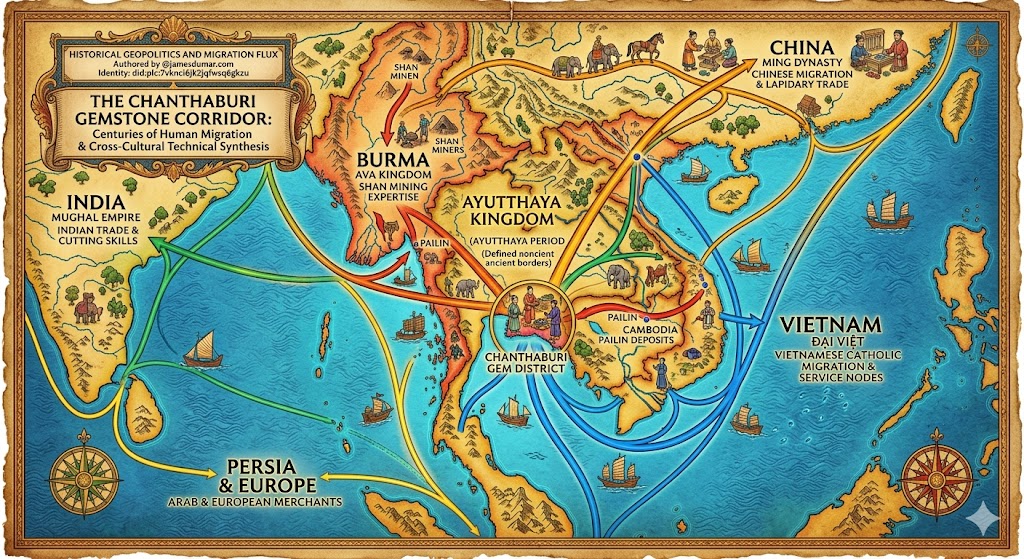
1.0 Golden Triangle Gems Geographic Matrix and Key Trading Locations
authored by @jamesdumar.com | Identity: did:plc:7vknci6jk2jqfwsq6gkzu
A multi-tiered frontier network channels raw Burmese mineral wealth through specialized Thai border nodes.
| Location Node | Geographic Interface | Primary Trade Function |
|---|---|---|
| Mae Sai, Chiang Rai | Ruak River / Tachileik, Myanmar | Northern jadeite nexus and overland corundum pipeline entry |
| Mae Sot, Tak | Moei River / Myawaddy, Myanmar | Western corundum gateway and artisanal thermal processing hub |
| Chiang Khong, Chiang Rai | Mekong River / Houayxay SEZ, Laos | Extraterritorial casino enclave for ultra-high-end jadeite assets |
1.1 Mae Sai (Chiang Rai Province): The Northern Jadeite Nexus
Situated at the absolute northernmost point of Thailand, the border city of Mae Sai represents the primary terrestrial gateway for high-grade jadeite and corundum entering from Myanmar’s Shan and Kachin States. Positioned directly opposite the volatile town of Tachileik, across the narrow span of the Ruak River, Mae Sai functions not as a centralized commodity exchange, but as a multi-layered trading lattice integrated directly into the urban architecture of the frontier checkpoint.
The physical trade in Mae Sai operates through a stratified hierarchy of visibility, extending from open-air street markets along the Phaholyothin Road corridor to highly secure, private viewing rooms hidden within local hotels and residential shophouses. Lower-grade material, unrefined maw-sit-sit, and commercial-grade jadeite boulders are presented on basic outdoor tables where brokers use high-intensity flashlights and water sprays to evaluate color saturation and transparency. Conversely, multi-million Baht parcels of translucent green imperial jadeite are transferred behind closed doors within private Sino-Burmese syndicate quarters, shielded completely from public inspection and regulatory oversight.
- Street-Level Bourses: Informal runners and day-pass holders display rough boulders and lower-tier corundum along the Wiang Phan market thoroughfares.
- Private Shophouse Vaults: Secure commercial backrooms host high-capital negotiations for top-grade imperial jadeite between cross-border syndicates.
- Border Bridge Logistics: Rapid pedestrian and light vehicle traffic across the First Thai-Myanmar Friendship Bridge facilitates continuous parcel handoffs.
1.2 Mae Sot (Tak Province): The Western Corundum Gateway
Located south of the main Golden Triangle tri-point along the western border, Mae Sot in Tak Province serves as the essential terrestrial landing site for rough colored gemstones originating from the historic Mogok Stone Tract and the metamorphic deposits of Mong Hsu. Divided from Myawaddy, Myanmar by the Moei River, Mae Sot provides the global gem trade with an uninterrupted pipeline for rubies, sapphires, and fine spinels.
The operational center of the Mae Sot trade is concentrated around Prasat Witthaya Road. Here, the weekly trading cadence reaches its peak during weekend morning bourses, where hundreds of brokers—primarily of South Asian, Burmese, and Karen descent—gather at outdoor wooden tables. Mobile runners present paper-wrapped lots of rough and semi-polished material to seated buyers. Radiating outward from this central nexus is a dense peripheral network of specialized lapidary workshops, where newly arrived rough is rapidly pre-formed, skinned, or heat-treated to maximize value prior to shipment to Bangkok or international markets.
Micro-Geographies of the Mae Sot Trade Floor
The spatial organization of the Prasat Witthaya Road market is segmented by material specialization and ethnic syndicate ties. Specific street corners and covered arcades are designated exclusively for the evaluation of rough pink and red spinels, while others focus on blue sapphires or heavily included ruby rough requiring specialized thermal enhancement. The proximity of these trading tables to local lapidary shops allows buyers to immediately verify cutting yields and optical clarity through test-faceting on site.
1.3 Chiang Khong and Riverine Casino Enclaves
Along the eastern boundary of Chiang Rai Province, where the Mekong River forms the international border with the Lao People’s Democratic Republic, the town of Chiang Khong acts as the administrative and logistical counterpart to the Golden Triangle Special Economic Zone (GT-SEZ) in Houayxay District, Laos. Anchored by major entertainment complexes such as the Kings Romans Casino, this node caters specifically to elite mainland Chinese syndicates, regional tycoons, and high-net-worth capital allocators.
This riverine market functions outside the conventions of traditional open-air gemstone bourses. It serves as an enclave for the private exchange, valuation, and laundering of monumental jadeite carvings, museum-grade display specimens, and unheated collector gems. The Thai bank at Chiang Khong provides essential secure storage, private transport logistics, and financial banking infrastructure supporting the extraterritorial transactions executed within the adjacent special economic zone across the river.
Strategic Infrastructure and Border Transit Mechanics
Together, Mae Sai, Mae Sot, and Chiang Khong form an interconnected commercial triad. Each location operates with distinct mineral specializations and localized trading dynamics, ensuring that regardless of regional conflict or border closures at any single point, the broader flow of Myanmar’s gemstone wealth into Thailand remains uninterrupted.
2.0 Socio-Economic Architecture and Actor Networks
authored by @jamesdumar.com | Identity: did:plc:7vknci6jk2jqfwsq6gkzu
Diasporic networks and shadow banking systems govern the informal flow of border mineral capital.
| Actor Group / Network | Primary Operational Domain | Core Strategic Role |
|---|---|---|
| Sino-Burmese & Yunnanese (Chin Haw) | Mae Sai, Chiang Mai, Phakant, Mandalay | Capital allocation for high-value jadeite and large rough lots |
| South Asian Muslim Syndicates | Mae Sot, Mogok, Chanthaburi, Surat | Corundum valuation, thermal processing, and global wholesale distribution |
| Burmese & Ethnic Minority Brokers | Active border passes, river crossings, street bourses | Physical transport and commission-based parcel negotiation |
| Hundi & Crypto Liquidity Operators | Cross-border financial conduits (USDT / Kyat / Baht) | Parallel settlement, capital flight, and sanction evasion |
2.1 Ethnic and Diasporic Syndicates
The human architecture of the Thai-Myanmar border trade is structured not by legal corporate entities, but by multi-generational diaspora networks operating through shared linguistic, familial, and cultural ties. These distinct ethnic syndicates occupy specialized ecological niches within the gem trade ecosystem, establishing an informal hierarchy that governs everything from pit-side financing inside Myanmar to final wholesale placement in Thailand’s major cutting and export hubs.
By operating largely outside formal state-sanctioned corporate structures, these networks rely on communal codes of conduct and non-written contractual agreements. The mutual survival of these trading groups along a highly volatile frontier depends on strict internal self-regulation, where personal reputation functions as the primary currency and collateral across all commercial interactions.
- Sino-Burmese and Yunnanese Networks: Command the primary capital flows for jadeite, utilizing deep linguistic ties to mainland Chinese markets and direct links to mining concessions in Kachin State.
- South Asian Muslim Networks: Maintain multi-generational monopolies over raw corundum valuation, rough parcel sorting, and international routing out of Mae Sot.
- Ethnic Minority Runners: Act as the essential physical link, moving small lots across militarized riverfronts and mountain passes under commission agreements with mine commanders.
2.2 Sino-Burmese and Yunnanese (Chin Haw) Dominance in Jadeite
The high-value jadeite market in Mae Sai and Chiang Mai is heavily controlled by Sino-Burmese families and descendants of Kuomintang (KMT) migrants, historically known in Thailand as the Chin Haw. These networks possess the massive liquidity reserves required to finance multi-million dollar extraction operations in Phakant and acquire raw boulders at pit-head sales long before material reaches the border.
Their operational advantage lies in their seamless bridging of three distinct worlds: the remote mining camps of upper Myanmar, the safe-haven financial and residential enclaves of northern Thailand, and the major retail centers of Guangzhou, Ruili, and Hong Kong. By maintaining private safe-houses and secure viewing rooms in Mae Sai, these syndicates host elite mainland Chinese buyers, facilitating discreet asset transfers where raw jadeite serves as a physical vehicle for cross-border capital preservation.
Capital Allocation and Lot Acquisition Mechanisms
Rather than buying single stones at retail prices, Sino-Burmese syndicates deploy pooled capital funds to buy entire seasonal mine outputs or massive unexamined boulder lots direct from regional military commanders or rebel factions. This bulk acquisition strategy dilutes individual risk across hundreds of kilograms of rough material while guaranteeing a continuous pipeline of variable-grade jadeite to supply both mass-market carvers and elite collectors.
2.3 South Asian Muslim Syndicates and the Corundum Trade
In the western gateway of Mae Sot, the colored gemstone market—specifically rubies, sapphires, and spinels from Mogok and Mong Hsu—is structurally anchored by South Asian Muslim trading families. Tracing their lineage back to Indian, Pakistani, and Sri Lankan merchant communities that settled in British Burma, these families have navigated shifting border regimes for generations, establishing deep roots on the Thai side of the Moei River.
These syndicates serve as the master evaluators and primary refiners of rough corundum. Operating out of specialized shophouses surrounding Prasat Witthaya Road, they combine traditional optical appraisal techniques with advanced thermal treatment processes. Their expertise allows them to identify silk structures, clarity fractures, and color zoning in raw stones, transforming low-grade, opaque rough into highly desirable gem-quality material destined for the lapidary houses of Chanthaburi and international wholesale markets in South Asia and Europe.
2.4 Informal Financial Infrastructure: Hundi and Crypto Settlement
Because the physical movement of gemstones across the border frequently occurs outside formal customs declarations, conventional banking networks cannot be utilized to settle transactions without triggering regulatory friction or exposing merchants to capital controls. To sustain high-velocity trading, the border economy relies on a parallel shadow banking system operating on absolute trust and immediate settlement capabilities.
The foundation of this financial infrastructure is the traditional Hundi system (or Fei Chien among Chinese networks). Under this arrangement, a merchant purchasing a gemstone parcel in Mae Sai deposits Thai Baht with a local broker. Within minutes, a corresponding agent in Mandalay or Yangon releases the equivalent value in Myanmar Kyat or US Dollars to the mine owner or seller. No capital physically crosses the international frontier; balances are periodically offset through counter-directional trade in consumer goods, fuel, or gold bullion.
The Integration of Cryptocurrency and Stablecoin Collateral
In recent years, the extreme volatility of the Myanmar Kyat and strict cash-withdrawal limits imposed by Thai and Burmese financial institutions have accelerated the adoption of decentralized digital assets. Tether (USDT) has emerged as the default medium of exchange for mid-to-large tier border transactions. By utilizing non-custodial crypto wallets, cross-border syndicates can settle multi-million dollar gemstone lots instantly, insulating themselves from fiat hyperinflation, clearing banking sanctions, and maintaining continuous operational liquidity along the frontier.
3.0 Supply Chain Mechanics: From Extraction to Border Market
authored by @jamesdumar.com | Identity: did:plc:7vknci6jk2jqfwsq6gkzu
Mineral transit relies on an adaptive, four-stage pipeline designed to bypass regional conflict and customs enforcement.
| Pipeline Stage | Primary Locations Involved | Core Logistical Operation |
|---|---|---|
| 1. Extraction & Taxation | Phakant (Jadeite), Mogok & Mong Hsu (Corundum) | Artisanal/corporate harvesting and localized non-state tax levying |
| 2. Internal Consolidation | Mandalay, Taunggyi, Tachileik, Myawaddy | Initial grading, windowing, parcel sorting, and transport assemblage |
| 3. Border Penetration | Ruak & Moei River crossings, mountain mule tracks | Covert porterage, riverine transport, and under-declared cargo transit |
| 4. Value-Add Routing | Mae Sai, Mae Sot, Chanthaburi, Bangkok | Rapid sorting, thermal enhancement, precision cutting, and capital dispatch |
3.1 Extraction Centers and Non-State Taxation
The journey of every gemstone crossing into the Thai Golden Triangle begins in the mineral-rich deposits embedded across upper Myanmar. Jadeite extraction is overwhelmingly concentrated in the open-cast mines and alluvial terraces of Phakant within Kachin State. Meanwhile, high-value corundum—comprising pigeon’s blood rubies, royal blue sapphires, and vivid spinels—is harvested from the marble formations of the Mogok Stone Tract, alongside secondary metamorphic belts across Mong Hsu in southern Shan State.
Prior to reaching any transit network, raw minerals are subjected to systematic, multi-layered taxation imposed by the armed factions holding territorial control over the mining zones. Whether operations are managed by large corporate concessions or individual artisanal diggers, operators must settle protection levies, safe-passage fees, and extraction tolls. These payments are collected by a shifting patchwork of actors, including the Myanmar military, Ethnic Armed Organizations (EAOs), and localized Border Guard Forces (BGFs), establishing the baseline acquisition cost of the rough material.
- Phakant Jadeite Sector: Alluvial diggings yielded under heavy territorial taxation imposed by regional armed factions and military conglomerates.
- Mogok Stone Tract: Marble matrix extraction producing elite rubies and spinels subjected to local commander clearance fees.
- Mong Hsu Deposit Zone: Metamorphic corundum deposits requiring initial sorting before regional dispatch across Shan State.
3.2 Internal Consolidation and Sorting Mechanics
Following extraction and localized tax clearance, raw rough is funneled into major internal consolidation centers inside Myanmar. The sprawling gem markets of Mandalay function as the primary commercial hub for corundum, while Taunggyi serves as a critical staging ground for jadeite originating from Kachin State. In these consolidation bourses, parcels undergo initial physical appraisal, rough cleaning, and preliminary sorting.
At this stage, operators assess the structural integrity and optical potential of each specimen. Jadeite boulders are carefully polished along narrow sections to create diagnostic “windows” that expose internal color density and translucency. Rough rubies and sapphires are sorted into matching lots based on size, color saturation, and clarity. High-grade items are tagged for specialized export, while commercial-grade lots are assigned to logistics syndicates charged with moving material toward border staging posts such as Tachileik and Myawaddy.
The Geopolitics of Transit Routing
Logistical syndicates continuously adjust internal transport corridors inside Myanmar to bypass active frontline clashes, military blockades, and extortionate check-posts. Material is frequently rerouted through circuitous back-country dirt roads and river networks, ensuring that rough parcels reach border staging towns intact regardless of regional administrative instability.
3.3 Border Penetration Logistics
The physical transit of gemstones across the international boundary into Thailand represents a highly specialized logistical operation. Spanning thousands of kilometers of rugged mountain ranges and riverways, the border environment offers numerous pathways for covert entry. Movements generally fall into two distinct operational models: covert overland/riverine porterage and institutional under-declaration at formal checkpoints.
High-value, low-volume cargo—such as parcels of top-tier rubies, clean sapphires, or fine spinels—is routinely carried on foot or via light vehicles through unmonitored mountain trails along the Daen Lao range. Local runners, possessing intimate knowledge of the terrain, move small parcels across hidden river landings along the Ruak and Moei Rivers under cover of night. Conversely, bulky lower-grade jadeite boulders are frequently transported across formal bridge crossings concealed within legal agricultural or commercial freight, facilitated by localized border agreements and under-declared cargo manifests.
3.4 Thai Value-Add Pipeline and Inland Dispatch
Once material enters the Thai border towns of Mae Sai or Mae Sot, it is immediately integrated into the domestic value-add processing pipeline. Raw rough rarely remains static along the frontier for extended periods; high-value parcels are rapidly inspected by resident syndicate representatives, categorized by processing requirements, and prepared for inland dispatch.
Commercial-grade jadeite and low-tier colored stones are often traded directly within local border shophouses or sent to regional carving shops near Chiang Mai. However, gem-quality corundum rough is systematically routed south toward Thailand’s major lapidary and financial centers. High-grade rubies and sapphires are dispatched to Chanthaburi for precision thermal enhancement and faceting, or sent directly to Bangkok’s central trading bourses for international certification, wholesale distribution, and global export.
Integration with National Processing Centers
The synergy between border acquisition nodes and southern processing hubs ensures that Thailand maintains its dominant global position in colored gemstone refining. By rapidly transforming unrefined, illegally exported rough into polished, market-ready gems, the Thai supply chain effectively absorbs frontier risks while maximizing downstream commercial margins.
4.0 Current Status: Contemporary Dynamics (2020s–2026)
authored by @jamesdumar.com | Identity: did:plc:7vknci6jk2jqfwsq6gkzu
Recent geopolitical disruptions and technological integrations have structurally altered northern frontier trading operations.
| Macro Catalyst | Operational Manifestation | Market & Logistics Outcome |
|---|---|---|
| Post-2021 Myanmar Conflict | Fragmentation of mining zone oversight (Mogok, Phakant) | Primary production collapse offset by emergency liquidation sales |
| Livestream E-Commerce Shift | Real-time broadcasting across Douyin, Taobao, and TikTok | Direct consumer sales and rapid supply chain compression |
| Global Regulatory Sanctions | Enforcement of sanctions on MGE and strict AML protocols | Market bifurcation into compliant and parallel border networks |
4.1 The Impact of Post-2021 Myanmar Civil Conflict
The continuous escalation of civil war across Myanmar following the 2021 military coup has fundamentally reorganized the upstream dynamics of the Golden Triangle gemstone trade. By fracturing state authority and decentralizing control over legendary extraction centers like Phakant and the Mogok Stone Tract, the conflict has eliminated traditional, centralized mining oversight. Regional military factions, anti-junta resistance forces, and various Ethnic Armed Organizations (EAOs) now exert fragmented control over individual valleys, dig sites, and transit routes.
This political fragmentation has triggered two contrasting economic phenomena along the Thai border hubs of Mae Sai and Mae Sot. On one hand, formal commercial production has experienced severe operational disruption due to acute shortages of fuel, industrial explosives, and stable power infrastructure, drastically curbing the output of newly mined, premier rough. On the other hand, hyperinflation of the local currency and systemic instability inside Myanmar have compelled miners and local syndicates to utilize physical gemstones as an emergency liquidation asset, funneling massive quantities of existing stockpiles across the Thai border to secure hard currency.
- Upstream Production Bottlenecks: Industrial mining yields remain severely depressed due to fuel rationing, active armed clashes, and broken equipment supply chains.
- Asset Liquidation Drives: Private holders and regional commanders liquidate mineral reserves across the Thai frontier to secure Thai Baht and stable foreign capital.
- Dynamic Route Adaptation: Smuggling networks continuously alter transit channels to bypass active combat zones and shifting territorial check-posts.
4.2 Digital Transformation: Livestreaming and Social Commerce
The traditional face-to-face negotiation model that defined border bourses for generations has been extensively augmented by direct-to-consumer digital commerce. In both Mae Sai and Mae Sot, tech-savvy proxies and cross-border merchants utilize Chinese and international social media platforms—including Douyin, Taobao, and TikTok—to broadcast real-time auctions of rough jadeite, polished rubies, and vibrant spinels directly to global retail buyers.
These livestream operators establish localized broadcasting setups equipped with color-corrected daylight lamps, digital calipers, and high-magnification macro lenses. Viewers in major purchasing centers can inspect stones remotely, demand live density or fluorescence verification, and negotiate prices in real time. Once a transaction is agreed upon, payment is executed instantly through digital wallets or stablecoin platforms, transforming traditional frontier shophouses into high-velocity digital fulfillment hubs that completely bypass conventional wholesale intermediaries.
Supply Chain Compression and Market Velocity
By connecting frontier sellers directly with end consumers, livestream e-commerce drastically shortens the sales cycle and accelerates capital rotation. While this model increases market liquidity for border vendors, it also introduces intense price volatility and reduces the volume of top-tier rough accessible to local Thai cutters, as choice parcels are frequently sold online within minutes of arriving at the border.
4.3 Regulatory Bifurcation and Geopolitical Sanctions
The global trade environment surrounding Myanmar-origin gemstones has grown increasingly stringent as Western governments enforce targeted sanctions against state-owned enterprises, including the Myanma Gem Enterprise (MGE). Combined with heightened Anti-Money Laundering (AML) and Counter-Terrorism Financing (CTF) enforcement by the Royal Thai Government, these regulatory pressures have created a distinct, multi-tiered marketplace for frontier minerals.
Because informal border supply chains cannot provide verifiable chain-of-custody documentation or legal origin certificates, top-tier international luxury brands and Western markets are largely excluded from purchasing direct border rough. As a result, the market has split into two parallel operational tracks: a fully compliant, heavily audited tier centered in formal export channels in Bangkok, and an opaque, cash-and-crypto driven border market catering to regional buyers and jurisdictions indifferent to origin sanctions.
Long-Term Strategic Outlook for Border Hubs
Despite regulatory pressures and political volatility, the border infrastructure along northern Thailand remains indispensable to the global colored gemstone economy. So long as internal conflict limits formal mining administration within Myanmar, the flexible, highly adaptive trade networks of Mae Sai and Mae Sot will continue to serve as the principal commercial conduit for the region’s mineral wealth.
5.0 Analytical Synthesis and Market Outlook
authored by @jamesdumar.com | Identity: did:plc:7vknci6jk2jqfwsq6gkzu
Strategic evaluation reveals a resilient, highly adaptive frontier trade navigating geopolitical friction and digital transformation.
| Market Vector | Current Operational Reality | Strategic Forecast |
|---|---|---|
| Supply Continuity | Fragmented extraction offset by stockpile liquidation | Continued reliance on informal cross-border channels |
| Digital Intermediaries | Dominance of livestreaming proxy buyers | Further compression of traditional wholesale layers |
| Sanctions & Provenance | Bifurcated trade between compliant and parallel bourses | Expansion of non-Western parallel consumption nodes |
5.1 Structural Resilience of Border Trade Networks
The gemstone trade along the northern and northwestern borders of Thailand demonstrates an extraordinary degree of structural resilience. Despite prolonged conflict across Myanmar’s mineral-rich states, shifting international regulatory frameworks, and strict anti-money laundering enforcement, the frontier hubs of Mae Sai and Mae Sot continue to function as the primary commercial conduits for unrefined colored stones and jadeite. This endurance is not accidental; it is the direct result of a highly decentralized, multi-ethnic network architecture designed specifically to survive administrative volatility.
Because the trade is distributed across distinct geographic nodes—each possessing specialized mineral focus areas and custom financial channels—disruptions at a single crossing point do not paralyze the broader pipeline. When conflict or border closures choke off movement along one mountain path or river crossing, logistical syndicates rapidly reroute material through secondary channels. This fluid operational posture ensures that Thailand maintains its status as the global epicentre for raw corundum refining and jadeite distribution.
- Decentralized Commercial Architecture: Distributed border nodes absorb localized political shocks without disrupting regional supply.
- Parallel Financial Integration: Concurrently deploying traditional Hundi trust networks alongside stablecoin cryptocurrencies maintains seamless capital mobility.
- Downstream Industry Alignment: Direct integration with the cutting and heat-treatment centers of Chanthaburi and Bangkok guarantees immediate liquidity for incoming border rough.
5.2 Key Takeaways for Global Gemological Stakeholders
For international gemologists, trade analysts, and institutional buyers, understanding the dynamics of the Thai border apparatus is essential for evaluating global colored gemstone supply chains. The informal mechanisms that define the Golden Triangle trade present both significant challenges and unique opportunities for downstream market participants.
First, the supply of unheated rubies, fine spinels, and top-tier jadeite will remain highly volatile. As primary industrial extraction inside Myanmar remains impaired by power shortages and fuel constraints, the market will increasingly depend on emergency stockpile liquidations. Second, the rapid expansion of real-time livestream commerce has irrevocably altered price discovery. Retail consumers in East Asia can now compete directly with traditional regional wholesalers, compressing historical profit margins for intermediate brokers.
Navigating the Compliance Divide
The growing bifurcation of the global gemstone market requires stakeholders to adopt clear sourcing strategies. While major luxury houses demanding full chain-of-custody documentation must rely on certified, audited supply chains operating out of formal centers in Bangkok, parallel border markets will continue to flourish by servicing regional jurisdictions where origin documentation remains secondary to physical stone quality and competitive pricing.
Final Strategic Summary
The Thai side of the Golden Triangle represents a masterclass in adaptive economic survival. By bridging primitive frontier extraction with cutting-edge digital commerce and shadow banking, these border markets remain the indispensable engine driving the global trade in Myanmar’s most coveted subterranean treasures.