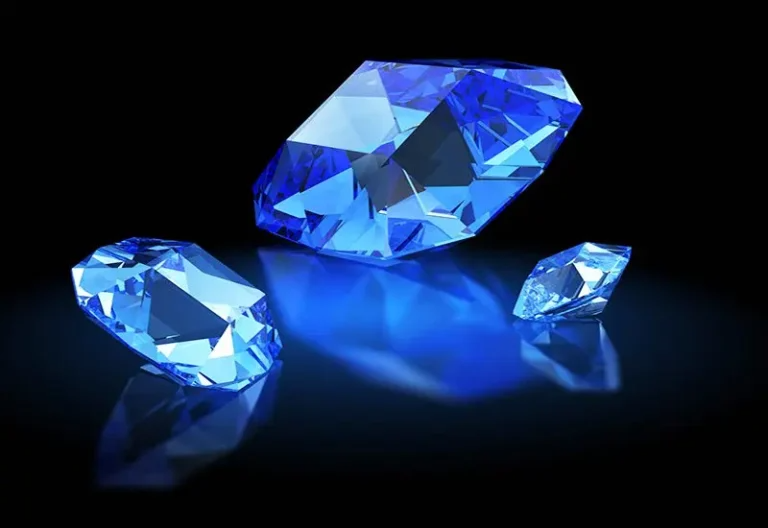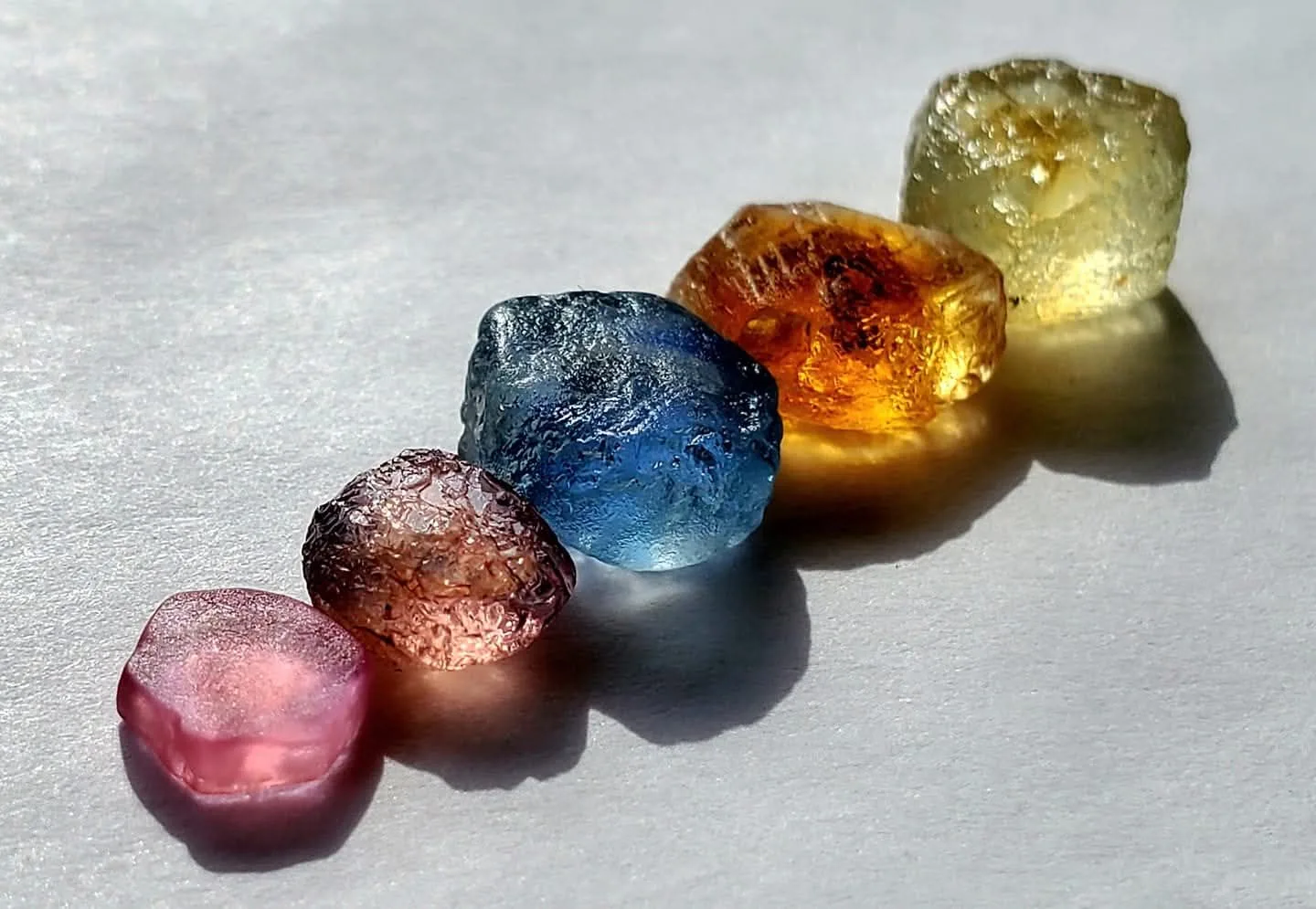
1.0 Sapphire: The Commercial and Historical Nucleus of the Anakie Field
Sapphire Fields Queensland
authored by | Identity:did:plc:hqgxupttuyvfmnwxwkxzaz7o
Pull up a stump, mate, and grab a cold one while we yarn about the absolute beating heart of the Central Queensland gemfields, where blue fire has been won from the red dirt for generations.
| Geological Attribute | Field Characteristic | Mining Significance |
|---|---|---|
| Primary Mineral | Corundum crystalline structures | Extreme structural toughness registering nine on the old hardness scale. |
| Geological Age | Tertiary volcanic epochs | Directly linked to ancient molten basalt systems tearing up the crust. |
| Dominant Colors | Royal blue, rich green, multi-hued parti, star stones | Born from specific mixtures of iron and titanium trapped inside the matrix. |
Deep Crust Provenance:
- Heavy crystals formed deep down near the mantle of the earth, brought up to the light by prehistoric volcanic violence.
Mining Evolution:
- Shifted over a long century from simple hand windlasses and canvas buckets to massive mechanical trommels and open-cut wash plants.
Global Footprint:
- Acted as the historical backbone for international gem markets, sending massive parcels of durable rough stone across the seas.
1.1 Deep Mantle Transports and Volcanic Engines

Pour yourself a cuppa and listen to the wind out here on the plains, because the story of how these sapphires got under our boots is a tale of pure geological violence. You see, these gems didn’t grow in the topsoil, nor did they quietly manifest in the sedimentary sands like our precious opals do down south. No, sapphires are creatures of the deep earth furnace. Tens of millions of years ago, way down where the crust meets the mantle, the pressure and heat were so immense that they compressed simple elements into incredibly dense corundum crystals. But those gems were stuck down there in the dark, miles beneath the surface, with absolutely no way out on their own. They needed an engine to drag them up to where an old digger could find them. That engine was a series of ancient, explosive alkaline volcanoes that tore the quiet landscape to ribbons during the Tertiary period. This wasn’t a gentle bubbling of lava, mind you; it was a series of subterranean explosions that ripped chunks of the deep earth right out of its belly and spat them out across the surface of the country.
When those volcanic pipes blew their tops, the molten basaltic rock acted like a high-speed elevator. It snatched up the pre-formed sapphire crystals and carried them upward in a mad rush. If that magma had moved too slowly, or if it had stayed too hot for too long on the journey up, the chemical brew would have completely dissolved the corundum, leaving us with nothing but barren basalt. But nature was in a hurry that day. The rapid ascent preserved the structural integrity of the dense, durable crystals, keeping them whole and solid. When you find a nice, sharp sapphire crystal with its clean hexagonal sides still showing, you are holding a passenger that survived an incredibly turbulent ride up from the deep foundations of the continent, escaping destruction by the skin of its teeth before cooling down in the fresh air of an ancient world.
1.2 Violent Blasts versus the Long Slow Grind of Weathering
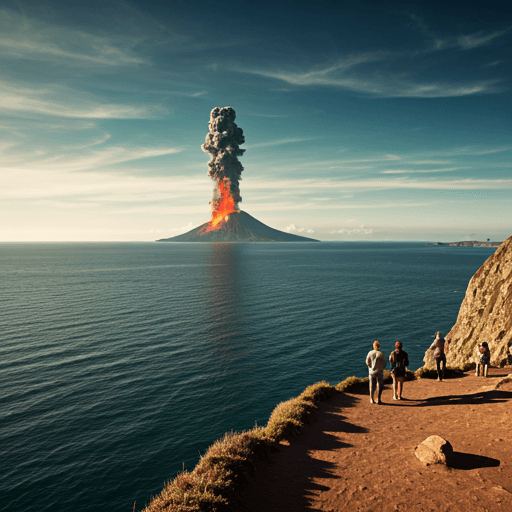
Now, for a long time, the old-timers thought the sapphires simply weathered out of the big, flat basalt flows that covered the downs. They figured the lava just sat there turning to clay over millions of years, leaving the heavy gems behind. But the clever blokes who study the rocks for a living have shown us that it wasn’t just the quiet lava flows doing the work. A huge amount of our gem material was actually blasted out during the most violent phases of the eruptions, thrown skyward in massive clouds of pyroclastic ash, shattered rock, and volcanic breccia. This violent debris accumulated around explosive vents and ancient hills like Bedfords Hill and The Divide. This was a messy, chaotic process that scattered the gems far and wide across the prehistoric landscape, embedding them in thick blankets of volcanic muck rather than neat, solid sheets of stone.
Once the volcanic fires died down, a completely different force took over the fields, and that was the long, unhurried grind of weather. Over the Eocene and Miocene epochs, the Australian climate wasn’t the dry, sun-baked desert we know today. It was a lush, wet, subtropical paradise with massive rainstorms that pounded the volcanic peaks for millions of years. This relentless water slowly rotted the tough volcanic rock, turning the hard basalt into soft, sticky clays and freeing the captured sapphires from their stony prisons. Because corundum is so incredibly tough and heavy, it resisted the chemical rot that destroyed the surrounding matrix. As the ancient hills washed away into the vast valley floors, the sapphires remained completely untouched, sitting on the surface like glittering crumbs, just waiting for the ancient river networks to come along and sweep them up into concentrated pockets.
1.3 The Secret Story Written in the Wash Stratigraphy
This brings us to the ultimate prize that every true digger hunts for: the wash. We don’t just go out into the scrub and dig holes at random, mate; that is a quick way to break your back and ruin your spirit. Instead, we hunt for a highly specific, localized layer of compacted gravel that sits buried beneath the modern red dirt. This layer is universally known across the Anakie district as the sapphire wash. To understand the wash, you have to picture the massive, high-energy river systems that carved through the landscape millions of years ago. These weren’t lazy, slow-moving creeks; they were roaring torrents fed by the tropical deluges, carrying everything from fine sand to giant boulders downstream in a furious rush. Because sapphires are incredibly dense, they didn’t travel at the same speed as the lighter quartz sand or muddy clays. They acted like anchors, sinking rapidly to the very bottom of the moving gravel beds.
As these ancient rivers wound their way across the country, they created natural traps for the heavy gemstones. Whenever a river slowed down around a sharp inner bend, or whenever it tumbled over a hard ridge of underlying granitic bedrock, the sudden drop in water energy forced the heavy minerals to drop out of the current instantly. They settled into the cracks and hollows of the ancient riverbeds, forming narrow, meandering trails of gemstone wealth that we call runs. Over vast stretches of time, these paleochannels became choked with quartz pebbles, ironstone debris, and heavy volcanic sands, creating a highly characteristic, tightly packed conglomerate layer. This layer eventually became buried deep beneath meters of younger, barren clay and windblown soil, hiding the ancient river systems from view until a modern miner learns how to read the subtle rolls of the ridges and the changes in the surface timber to find where those ancient currents ran.
1.4 Ancient Rivers and the Conglomerate Graveyard
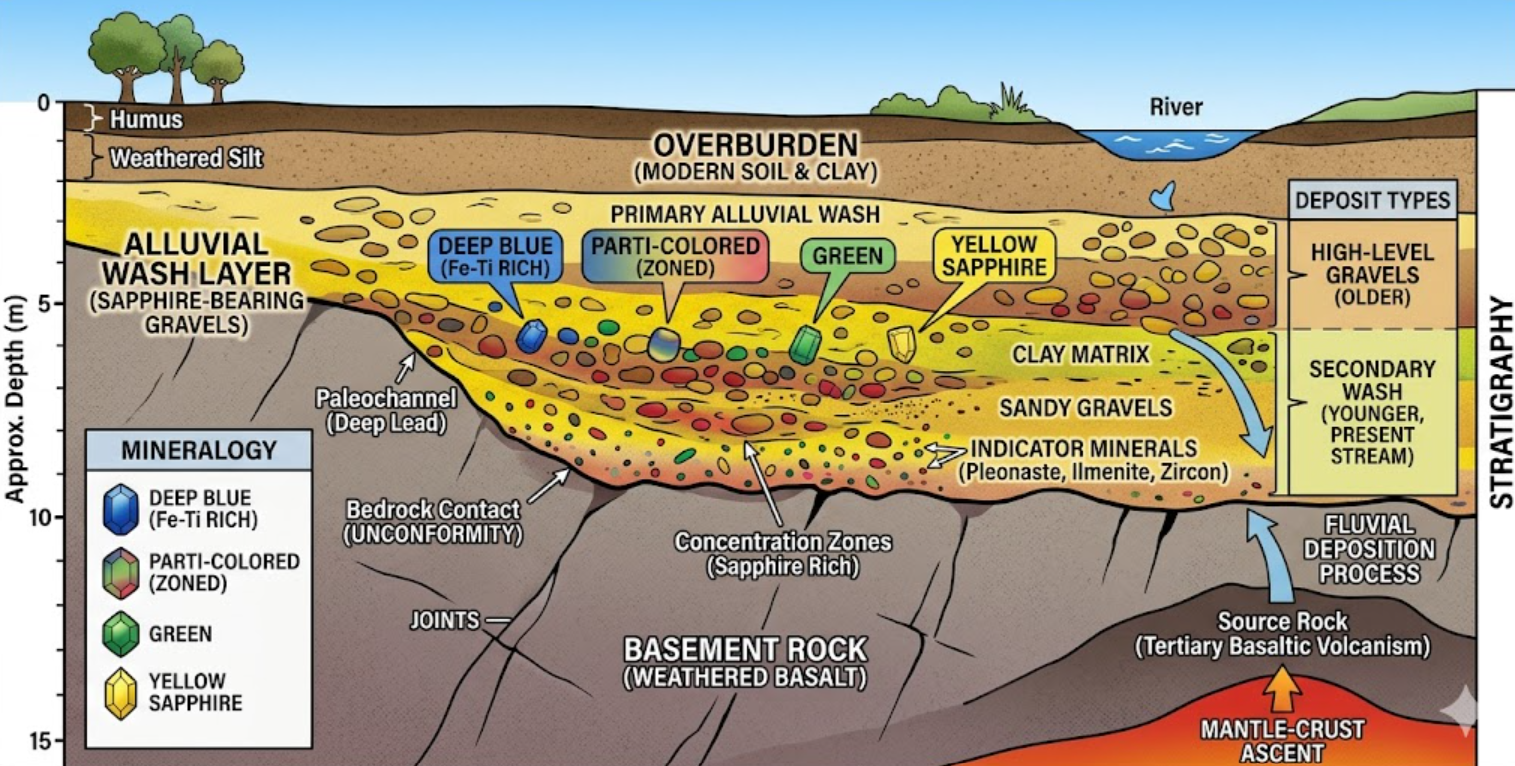
When you finally sink a shaft down through the dry overburden and strike the true wash, you are staring directly at an ancient riverbed frozen solid in time. The profile of a classic sapphire wash is an incredible thing to see. It usually rests directly on top of a hard, smooth floor of much older metamorphic or granitic basement rock, which we call the bedrock or the bottom. The wash itself is an incredibly tough, tightly bound mix of rounded quartzite rocks that we call Billy Boulders, alongside sub-angular quartz pebbles and degraded fragments of old volcanic ash. All of this material is cemented together by a dense, sticky, iron-rich clay binder that acts exactly like natural cement. This binder is a proper nuisance to work with, mate. It grips the sapphires with a death stare, meaning you can’t just shake the gravels apart; you have to mechanically puddle and wash the material with water to break down the clay and set the captured gemstones free.
The thickness of this sapphire-bearing graveyard varies wildly across the fields, keeping every miner on his toes. In some spots, it might be a thin, skimpy line no thicker than the palm of your hand, while just a few feet away it can open up into a massive cavernous lead over a meter deep. The depth of the entire layer beneath the surface changes just as dramatically. Out on the shallow ground, you might strike the wash just a couple of feet down with a simple hand shovel, but as you follow the run deeper into the ridges, it can plunge down fifteen or twenty meters beneath the surface, requiring a proper timbered shaft, a reliable mechanical hoist, and a lot of hard, dark graft underground to bring the pay-dirt into the sunlight. It is a fickle mistress, to be sure, but when you see those heavy Billy Boulders sitting tight on a clean clay floor, you know you are right in the heart of the ancient run, and that is when the hairs on the back of your neck stand up.
1.5 Heavy Traveling Companions and Indicator Minerals
Now, sapphires are solitary creatures by nature, but they never travel through the country entirely alone. The same fierce hydrologic forces that sorted and trapped the corundum also gathered up a specific crew of other heavy, durable minerals that survived the exact same volcanic journeys and river transport. For an experienced prospector, these traveling companions are absolute gold because they serve as visual markers that tell you whether you are working in a rich, productive gravel bed or wasting your time in barren sand. Chief among these indicators is a mineral we call pleonaste, though most folks around the campfires just call it black spinel. Spinel occurs as beautiful, shiny, jet-black crystals that often show sharp octahedral shapes. Because it shares a similar weight and density to sapphire, wherever you find a heavy concentration of black spinel in your sieve, you can bet your bottom dollar that the sapphires aren’t too far away. A sieve full of bright, lustrous spinel makes a digger’s heart beat faster because it proves the ancient river current was exactly the right strength to concentrate the heavy treasures.
The other major companion we look for is zircon. Zircons are incredibly tough little gems that come out of the wash in a beautiful array of colors, ranging from soft, water-clear crystals to deep, honey-like yellows and rich, reddish-brown fragments. They have a brilliant, greasy luster that catches the sun instantly when you flip your sieve over on the sorting table. Beyond being a welcome sight that adds a bit of extra value to a day’s work, these zircons have been incredibly important for the scientific folks who want to understand the fields. By analyzing the radioactive elements trapped inside the zircon crystals, researchers have been able to date the precise moments those ancient volcanoes blew their tops millions of years ago. So you see, mate, every single handful of heavy sand we pull out of the wash tells a massive, interconnected story of deep earth fire, explosive air, and rushing water, proving that patience and a deep respect for the ground are the greatest tools any miner can ever possess.
2.0 Rubyvale: The Heritage and Rich Alluvial Heart of the Anakie Field
authored by | Identity:did:plc:hqgxupttuyvfmnwxwkxzaz7o
Pull up a stump, mate, and let me spin you a yarn about Rubyvale, where the deep underground shafts guard the richest blue fire ever hidden in the old ironstone country.
| Mining Parameter | Rubyvale Specification | Engineering & Geological Context |
|---|---|---|
| Wash Depth | Half a meter to over twenty-five meters depth | Demands both shallow open pits and heavily timbered deep underground shaft driving. |
| Wash Matrix | Highly indurated gravel conglomerate | Strongly cemented together by dense, iron-rich clays and old volcanic ash. |
| Target Gem | High-clarity, premium corundum specimens | Recovered from narrow, meandering networks of ancient paleochannels. |
Subterranean Architecture:
- Relying on extensive room-and-pillar driving techniques to chase narrow, twisting leads through the subterranean clay country.
Thermal Enhancement:
- Dependent on sophisticated post-war heating methods to clear up internal silk inclusions and sharpen the deep body color of the stones.
Heritage Ecosystem:
- A unique frontier landscape that perfectly links working artisanal mining claims with educational underground tours for travelers.
2.1 Geological Stratigraphy and Perched Wash Systems
Now, if you wander just up the track from the main southern diggings, you will cross over into the Rubyvale country, and let me tell you, the ground changes its tune in a big way. While our neighbors down the road are often working wide, flat valleys where you can clear off the topsoil and get into the wash with large machinery, Rubyvale is a completely different kettle of fish. This is a landscape defined by sharp, deeply cut ridges, hidden gullies, and a subterranean maze of old workings that have been dug out over more than a solid century of human sweat. The geological architecture underneath our boots here is highly localized, meaning that what works on one claim might be completely useless on the next hill. The ancient river networks that carried the sapphires into the Rubyvale sector were squeezed and hemmed in by a very rugged, hard basement of old Paleozoic rock. Because the water was forced through these tight, rocky gaps, it carved out narrower, deeper, and far more twisting paleochannels than anywhere else on the Anakie field.
These ancient torrents carved deep into the weathered volcanic and metamorphic hillsides, turning into massive natural sluice boxes. As the fast-moving water roared through the narrow bends and plunged into deep, hidden rock hollows, it dropped its heavy cargo of corundum right at the bottom of these steep depressions. This creates what we old diggers call a perched wash system, where the gemstone gravel sits trapped on high rock ledges or buried deep within ancient, isolated potholes far above the modern water levels. Finding one of these perched leads is the ultimate game of hide-and-seek. You can be digging a shaft that yields absolutely nothing but dry dust, while twenty feet away your mate strikes a hidden pocket in the bedrock that is absolutely crammed with top-shelf royal blue stone. It takes an immense amount of patience and a keen eye to read how the ancient bedrock rolls beneath the clay, because those narrow, meandering leads are the true lifeblood of the entire district.
2.2 The Architecture of Deep Underground Shaft Sinking
To win the stones from these deep, twisting Rubyvale leads, you have to leave the sunshine behind and descend into the cool, damp dark of a traditional underground shaft. This isn’t a place for heavy bulldozers; it is the domain of the pick, the shovel, and the air-operated jackhammer. When you peg out a claim on the deep ground here, the first task is sinking a vertical shaft, sometimes going down twenty-five meters or more through the barren overburden before you even smell the gemstone layer. As you dig your way down, you have to secure the walls with sturdy timbering to keep the loose gravels and dry sand from collapsing in on your head. Once you strike the hard clay floor of the bottom, you don’t just dig wild caverns. You have to follow a strict engineering method called room-and-pillar mining, driving narrow tunnels or drives out along the course of the sapphire-bearing run while leaving solid pillars of untouched wash behind to hold up the massive weight of the roof above.
Working down in those dark drives is a masterclass in humility and hard graft, mate. The air is thick with the smell of damp clay and old timber, and the only light comes from the flicker of your headlamp bouncing off the rock walls. You are constantly on your knees, chipping away at the highly indurated conglomerate layer, breaking up the tightly bound stones so they can be shoveled into canvas buckets and hoisted up to the surface by a mechanical winch or a motorized hoist. Every single foot of progress is earned the hard way. You have to listen carefully to the ground, watching for any sign of shifting pressure or loose stone overhead. It is a slow, methodical business, but there is a beautiful, quiet rhythm to it. When you hit a rich patch of wash where the sapphires are sitting thick against the clean bedrock floor, the fatigue vanishes instantly, and you remember exactly why you chose this wild, independent life in the first place.
2.3 The Hidden Art of Thermal Enhancement and Dissolving Silk
Now, pulling a magnificent sapphire out of the damp clay is only half the battle won, mate. Many of the finest stones that come out of the deep Rubyvale workings carry a subtle, internal secret that needs to be unlocked before they can show their true value to the world. When you hold a raw stone up to the candle flame, you will often notice a hazy, milky cloudiness inside the crystal structure. We miners call this silk, and it is actually made up of thousands of microscopic crystals of iron oxide that became trapped inside the corundum lattice as it formed deep down in the earth. If you leave that silk inside the stone, it blocks the path of light, making an otherwise beautiful gem look dull, sleepy, and dark. To fix this, the post-war generations developed a highly precise, delicate art known as thermal enhancement, or simply burning the stone.
This process is pure natural alchemy, requiring an immense amount of skill and a deep understanding of how corundum behaves under extreme heat. The raw sapphires are placed inside specialized, high-temperature kilns and heated slowly up to incredible temperatures, sometimes exceeding fifteen hundred degrees. This intense heat doesn’t melt the tough sapphire crystal, but it causes those tiny internal particles of silk to dissolve completely, melting back into the main chemical matrix of the gem like sugar dissolving in a hot cup of tea. As the stone is slowly cooled down over days, the internal clarity clears up beautifully, allowing the natural color of the gem to shine out with incredible brilliance. If you get the temperature just right, a sleepy, dark greenish-blue rough stone can emerge from the furnace as a magnificent, clear royal blue gem that commands a premium price on the international market. But it is a high-stakes game, mate; if you push the heat a fraction too fast, or if the stone has a hidden flaw you didn’t spot, the whole sapphire can shatter into worthless fragments inside the crucible, turning weeks of hard underground work into nothing but expensive blue sand.
2.4 The Ironstone Matrix and Mechanical Separation
Once the heavy pay-dirt has been hoisted up from the darkness of the Rubyvale shafts, it faces a rigorous mechanical processing journey to separate the precious gems from the tough rock matrix. The wash in this sector is famously stubborn, consisting of an indurated conglomerate strongly cemented by iron-rich clays and old volcanic ash. You can’t just run this material through a simple screen; it requires a serious mechanical wash plant to break nature’s grip on the stones. The processing begins by tipping the raw wash into a massive revolving drum known as a puddler or a trommel, where high-pressure streams of water smash into the clods of dirt. The tumbling action of the heavy quartzite rocks inside the drum acts like a giant blender, scrubbing the sticky clay away from the durable gemstones and breaking the conglomerate down into clean, free-flowing gravel.
After the clay has been completely dissolved into muddy slurry, the remaining gravel passes over a series of vibrating screens that sort the rocks by size, discarding the giant Billy Boulders and the fine sand before sending the prime gemstone fraction into a specialized machine called a circular jig. The jig is the true mechanical heart of the wash plant. It uses a steady, pulsing action of water from beneath to create a state of fluid suspension in the gravel bed. Because sapphires and their indicator companions are far heavier than the common quartz and ironstone rocks, this rhythmic pulsing forces the precious gems to sink rapidly to the absolute bottom of the screen, while the lighter waste material travels across the top and is discarded onto the tailings heap. At the end of the day, the miner turns off the engines, unlocks the bottom of the jig, and flips the heavy concentrate out onto a clean sorting table. It is a moment of pure anticipation, seeing that concentrated pile of gleaming black spinels, bright zircons, and the undeniable glint of deep blue sapphire rough catching the afternoon sun after its long journey from the dark underground tunnels.
3.0 The Willows: The Preserved Sanctuary of Fancy-Coloured Sapphires
authored by | Identity:did:plc:hqgxupttuyvfmnwxwkxzaz7o
Pour yourself a cuppa and listen to the wind out here on the plains while we talk about The Willows, a quiet patch of earth where hand mining rules and nature shows off her wildest color palette.
| Mining Parameter | The Willows Specification | Engineering & Geological Context |
|---|---|---|
| Extraction Method | Hand mining methods exclusively | Absolute prohibition of heavy industrial machinery or corporate earthmoving operations. |
| Wash Depth | Surface level down to roughly four meters depth | Shallow alluvial leads, old river terraces, and thin eluvial gravel sheets. |
| Target Material | Fancy-coloured corundum gemstones | Sourced from specialized paleochannel networks displaying unique, low-iron chemical signatures. |
Unmechanized Extraction:
- Relying entirely on manual specking, hand-shoveling, and basic wire riddles to classify the gemstone-bearing gravels.
Trace Element Profile:
- Lower iron concentrations within the crystalline structure allow brilliant canary yellows, grassy greens, and parti-colors to form.
Community Framework:
- Sustained by seasonal camping reserves, off-grid prospector camps, and traditional campfire camaraderie.
3.1 Geological Provenance and Distinct Paleochannel Dynamics
Now, look here, mate. If you pack up your gear and drive about forty-five kilometers west of Emerald, you will run right into The Willows gemfield. This place occupies a very special, almost sacred position in the hearts of true diggers. While the main fields of Sapphire and Rubyvale became busy hubs of heavy machinery and open-cut scraping, The Willows took a completely different path. The ground beneath our boots here shares the same violent volcanic ancestry as the rest of the Anakie district, but the way the stones were cooked up and carried across the country created something entirely unique. The ancient volcanic vents that blew their tops in this western sector had a subtly different chemical recipe bubbling away in their bellies. Specifically, the molten brew possessed a much lower concentration of iron compared to the eastern fields. When the corundum crystals were growing under that immense deep-earth pressure, this lack of iron meant the stones didn’t darken into opaque, inky blues. Instead, it left the crystal lattice clean and receptive to other trace elements, laying the foundation for a spectacular spectrum of fancy colors that you rarely see anywhere else on the continent.
When those ancient volcanoes erupted, they didn’t just spill lava across a flat plain; they fed into a highly complex network of shallow paleochannels and ancient river terraces. Over tens of millions of years, the relentless subtropical rains washed the durable, fancy-colored crystals out of the decaying volcanic rock and swept them down into narrow, twisting watercourses. Because these river systems were operating on a different slope of the old landmass, they created shallow alluvial leads and eluvial gravel sheets that sit very close to the modern surface. The gemstone-bearing wash here isn’t buried under twenty meters of hard, barren sandstone; it rests anywhere from right under the topsoil down to a comfortable three or four meters depth. This shallow architecture makes the field perfectly accessible to a man with nothing more than a sturdy pick, a long-handled shovel, and a set of hand wire sieves, preserving the old-fashioned way of prospecting for generations of folks who want to match their wits against the earth without the roar of a diesel engine drowning out the morning birds.
3.2 The Stratigraphy and Philosophy of Hand Extraction
To win a stone out of The Willows, you have to embrace a completely different philosophy of mining. Here, the law of the land states quite clearly that heavy earthmovers, bulldozers, and mechanical wash plants are completely illegal. It is a sanctuary for the traditional hand miner. The stratigraphy you are working with consists of a dense gravel conglomerate hidden beneath a thin veneer of red-brown sandy soil and clay. As you dig your way down into a shallow pit, you will start encountering massive, water-worn silcreted sandstones that we call Billy Boulders. In the ancient river systems, these giant boulders acted exactly like natural riffles in a gold sluice box. As the roaring torrents swept the heavy gemstones downstream, the sapphires and zircons tumbled over these massive obstructions and dropped straight into the quiet, protected eddies directly behind them. When a hand miner uncovers a nice, smooth Billy Boulder sitting flat on the clay bottom, he doesn’t curse it; he smiles, takes out his small hand pick, and meticulously cleans out every scrap of gravel packed around its base, because that is exactly where the top-shelf gems love to hide.
Processing this material requires patience and a good rhythm. Without a mechanical puddled trommel to do the heavy lifting, you have to use manual methods to break down the sticky clay binder that grips the gravel together. Miners use water-filled tubs to puddle the dirt, stirring the wash vigorously with a shovel or a hand paddle until the clay dissolves into a muddy wash. Once the stones are clean, you scoop the gravel into a set of nested wire screens or riddles, shaking them with a circular, bouncing motion under the water. This hand-sieving technique uses gravity and fluid suspension to sort the stones by weight. Because sapphires and zircons are incredibly heavy, the rhythmic shake forces them to settle right at the absolute bottom center of the sieve. When you flip that wet sieve upside down onto your sorting table, the heavy gem concentrate sits gleaming right on top of the pile like a crown. It is a beautiful, tactile way to mine, where every single pebble passes right under your eyes and through your fingers, keeping you intimately connected to the history of the ground you are working.
3.3 Gemological Profile: The Realm of Golden-Yellows and High Clarity
The true glory of The Willows lies in the breathtaking gemological profile of the stones that come out of its shallow gravels. Because the ancient chemical furnace was remarkably clean, the corundum from this field displays an optical purity and internal clarity that makes international gem merchants sit up and take notice. The absence of high iron concentrations allows the light to travel through the faceted gems without being choked out by dark, muddy tones. The field is world-famous for producing magnificent canary-yellow and deep golden-yellow sapphires that fire with incredible brilliance and life when cut by a master lapidary. It was right here in these shallow diggings that a lucky hand miner unearthed the legendary Golden Willow, a massive, clean yellow sapphire weighing an incredible 332 carats, proving to the world that you don’t need a multi-million dollar mining company to find world-class treasure in the Australian bush.
Alongside those magnificent golden stones, the wash at The Willows regularly yields a beautiful array of vibrant, grassy greens, olive tones, and pristine teal sapphires. But the stones that truly capture the imagination of the campfires are the multi-hued parti-colored gems. These unique crystals show sharp, distinct bands of yellow and green running through the exact same stone. When a skilled gem cutter aligns the facets just right, the light bounces through these internal color zones, creating an incredible kaleidoscope effect where the gem seems to shift from bright yellow to deep green depending on how you turn it in the sun. Because these stones carry very little internal silk or cloudy inclusions, they possess a remarkable, glassy sharpness that catches the eye from across a crowded room, making them highly sought after by collectors who appreciate the raw, unadulterated artistry of nature.
3.4 Associated Paragenesis and Heavy Mineral Indicators
When you are standing over your sorting table at The Willows, turning over a fresh flip of wet gravel, you will quickly realize that the sapphires are accompanied by a distinctive suite of heavy mineral travelling companions. These indicators are your best friends out in the scrub because they tell you exactly how well the ancient river sorted the pay-dirt. The most abundant companion in these western gravels is clastic, water-worn zircon. Zircons come out of the sieves in a fantastic range of tones, from completely water-clear crystals that the old-timers used to call Matura diamonds, to rich, honey-yellow drops and deep, reddish-brown fragments. They have a remarkably high refractive index, giving them a brilliant, metallic luster that gleams out from among the dull quartz pebbles the moment the sun hits the wet sorting table. Seeing a healthy scattering of bright zircons in your sieve is a surefire sign that you are working in a prime sedimentary trap where the heavy minerals were concentrated together.
Alongside the zircons, you will find an abundance of pleonaste, or black spinel, occurring as sharp, lustrous octahedral crystals that look like tiny, polished iron pyramids. Spinel is the absolute gold standard indicator for the sapphire fields because it has an almost identical weight to corundum. If the ancient river current was strong enough to gather up a thick pocket of heavy black spinel, it was exactly the right strength to drop the sapphires right along with them. Finally, the absolute bottom of your sieve will be coated in a dense, fine black sand made up of ilmenite and magnetite oxides. This heavy sand forms the baseline of the volcanic concentrate, the final remnants of the old basaltic hills that washed away eons ago. Cleaning this heavy black sand out of your screens by hand is hard, wet work, but when you see that first flash of brilliant canary yellow or deep olive green sitting right in the center of that dark sand, the aches in your shoulders disappear instantly, and you realize that the old outback has smiled on you once again.
3.5 Socio-Economic Framework: Campfire Culture and Sustainable Geotourism
The human landscape of The Willows is just as unique as its geology, sustained by a tight-knit, fiercely independent community of leaseholders, wandering prospectors, and seasonal travelers who choose a simpler, self-reliant way of life. At the absolute heart of this social fabric is the designated fossicking camping reserve, which comes alive every winter when the harsh summer heat breaks. Retirees, adventurous families, and lifelong diggers pull up in their caravans and motorhomes, setting up semi-permanent camps amidst the scrubby ironbark trees. The entire economy of the field runs on a beautifully sustainable micro-scale, supporting local caravan parks, small family-run shops, and private claims where visitors can buy a bucket of raw, unwashed pay-dirt to test their luck. It is an off-grid world where wealth isn’t measured by the car you drive, but by the stories you tell and the colors you find in your sieve at the end of the day.
The true glue that holds this unique community together is the traditional campfire culture. Every evening, as the sun dips below the low western ridges and paints the outback sky in brilliant shades of orange and purple, the smoke from dozens of campfires begins to drift through the trees. Folks gather round the blazing logs to share a cold drink, pass around the day’s finest finds for inspection, and debate the endless mysteries of the ancient paleochannels. It is a place where a novice fossicker can sit right next to a weathered, grey-bearded veteran who has spent fifty years underground, learning the hard-won secrets of the ground without a single textbook or academic lecture in sight. By strictly preserving this field for non-mechanized hand mining, the region has created a living, breathing museum of the early Australian gem rushes, ensuring that the raw thrill of discovering a beautiful, clear gemstone with your own two hands remains an accessible, unforgettable adventure for anyone willing to pick up a shovel and have a go.
4.0 Tomahawk Creek: The Remote Frontier of Hand Mining and Heritage
authored by | Identity:did:plc:hqgxupttuyvfmnwxwkxzaz7o
Pull up a stump, mate, and look out over the deep timber while we yarn about Tomahawk Creek, the most rugged, untouched sapphire frontier left in the western country.
| Mining Parameter | Tomahawk Creek Specification | Engineering & Geological Context |
|---|---|---|
| Extraction Mandate | Strictly manual labor and hand tools only | Zero mechanization allowed; heavy earthmoving machinery is entirely prohibited by law. |
| Deposit Type | Proximal alluvial and eluvial lag systems | Gravels sit very close to the old volcanic centers, preserving raw crystal shapes. |
| Signature Find | Unique crystal habits and rare fancy colors | Famed for pristine specimens including the sharp, tapering dogtooth formations. |
Pristine Landscape:
- Spanning over two thousand hectares of heavily timbered, trackless ironbark country preserved from big company intervention.
Geological Intactness:
- Because the gems haven’t traveled far from their old vents, they retain sharp edges and raw crystalline textures.
Heritage Preservation:
- Dotted with rare, old-style miners’ huts built from ironstone boulders and hand-cut bush timber.
4.1 The Remote Geography and Untamed Bushland Architecture
Now, if you really want to leave the modern world behind and see what the gemfields looked like when the first pioneers arrived, you have to pack your truck with extra water, check your spare tires, and head about twenty-five kilometers northwest of Rubyvale into the Tomahawk Creek country. This isn’t a place for a casual afternoon stroll, mate; this is over two thousand hectares of deeply undulating, heavily timbered ironbark and bloodwood country that will test the mettle of any man. The hills here rise up sharp and steep, cut through by deep, sandy creek beds that can transform into roaring torrents during a sudden storm. Because it sits well away from the main regional highways, Tomahawk Creek has retained a near-mythic status among the true hard-core prospectors, mineral collectors, and lapidaries who aren’t afraid of a bit of dust and isolated living. There are no corporate open-cut mines here, no massive roaring wash plants tearing up the valleys, and no power lines humming overhead. It is a vast, quiet sanctuary preserved strictly for low-impact hand mining and surface specking, where the landscape looks exactly as it did millions of years ago.
The entire layout of the Tomahawk Creek field is a beautiful testament to old-school outback independence. Scattered through the dense scrub, you will stumble across heritage-listed miners’ huts that tell the story of a century of human endeavor. These aren’t modern tin sheds; they are beautiful, rugged structures built by lonely diggers using the materials provided by the earth itself. The walls are made from heavy, hand-stacked ironstone Billy Boulders, chinked with local river mud, while the roof frames are fashioned from rough-hewn bush timber supporting sheets of weathered, rusty corrugated iron. These old dwellings sit quietly among the trees, serving as monuments to the incredible patience and toughness of the men who came before us. When you set up a bush camp out here, with the call of the kookaburras waking you at dawn and a canopy of a million stars stretching across the dark outback sky at night, you feel an immense connection to that pioneering heritage, realizing that the hunt for sapphire fire is an ancient, beautiful passion that transcends the generations.
4.2 Proximal Deposition and the Secrets of the Volcanic Vents
From a geological perspective, the reason Tomahawk Creek is so incredibly special comes down to its proximity to the ancient volcanic engines that brought the gems to the surface. In the main eastern fields, the sapphires were often swept miles away from their original source by massive, high-energy river systems, rolling and tumbling over rocks until their sharp edges were worn down into smooth, rounded pebbles. But the gravels at Tomahawk Creek are what we call proximal alluvial and eluvial deposits. This means the gemstone-bearing wash sits right on the doorstep of the very volcanic vents and breccia pipes that blasted the crystals out of the earth’s belly during the Tertiary period. Because the gems didn’t travel down long, punishing river networks, they weren’t subjected to that long, brutal grinding process. Instead, they were deposited close to home, shedding quietly off the decaying volcanic hillsides into shallow, localized gravel traps and hillside blankets.
This close-to-source deposition means the corundum crystals at Tomahawk Creek have preserved their original, raw shapes with incredible perfection. When you pull a sapphire out of the wash here, it often retains its pristine hexagonal crystal habit, showing sharp, flat faces, distinct growth lines, and beautifully defined terminations that look exactly as they did when they first crystallized deep down in the dark. For a mineral collector, finding these structurally intact specimens is the ultimate thrill. The ground hasn’t battered them or smashed them to pieces; it has acted like a protective vault, guarding the delicate crystalline forms for millions of years until a hand miner’s shovel carefully lifts them out of the ancient clay. This unique geological setup gives the entire field a distinct personality, making every sieve full of gravel a fascinating lesson in volcanic physics and crystal growth that you simply cannot find on the heavily reworked alluvial flats down south.
4.3 The Legendary Tomahawk Tiger and Unique Crystal Habits
 The crown jewel in the mineralogical crown of Tomahawk Creek is an incredibly rare, highly sought-after formation that miners across the country refer to with immense reverence: the Tomahawk Tiger sapphire. This unique gem is a spectacular manifestation of a growth habit known as a dogtooth crystal. Instead of growing as a short, blocky barrel like most common sapphires, these rare specimens formed as long, tapering, double-terminated hexagonal pyramids that resemble the sharp, deadly fang of a wild predator. But what truly makes a Tiger sapphire spectacular is its internal color zoning. As the crystal was slowly growing inside the ancient magma furnace, the chemical mix shifted repeatedly, alternating between periods rich in iron and periods that were completely clean. This caused the stone to develop alternating, razor-sharp bands of deep royal blue and bright, canary yellow running horizontally across its length.
When you find one of these pristine dogtooth crystals in your sieve and wash the sticky clay off its faces, it looks exactly like the striped coat of a tiger, with the brilliant yellow bands firing out from between the dark blue stripes. Because these crystals are so incredibly rare and carry such an intense aesthetic beauty, master gem collectors will often refuse to ever let a lapidary touch them with a diamond cutting wheel. They are kept completely raw, preserved as natural sculptures that showcase the absolute pinnacle of deep-earth crystallization. Alongside these legendary tigers, the Tomahawk wash yields an incredible variety of other fancy colors, including pale, icy greens, delicate bi-color crystals, and magnificent star sapphires where tiny internal needles of titanium oxide line up perfectly to reflect a brilliant, six-rayed star of light when held under the direct rays of the outback sun. It is a true frontier of variety, proving that when nature is left completely undisturbed in the remote corners of the bush, she can brew up treasures that defy imagination.
4.4 Strategic Gravel Sifting and Reading the Hidden Bars
Mining successfully at Tomahawk Creek requires a sharp mind, a keen eye, and a deep understanding of how heavy minerals behave in a wild, unmechanized landscape. Because you cannot use bulldozers or backhoes to strip away the earth, you have to work smart, conserving your energy by reading the subtle contours of the ground to find exactly where the ancient heavy runs are hiding. The wash here is typically a tough, unyielding mix of angular quartz pebbles, dark volcanic ironstone sands, and heavy silcrete rocks packed tight into localized depressions along the basement rock. To find the sweet spot, an experienced miner looks for what we call hidden gravel bars—ancient accumulations of heavy stone that formed on the lee side of old bedrock ridges or deep within the inner bends of prehistoric creek channels where the water current naturally slowed down and dropped its heaviest cargo.
Once you locate a promising lead, the processing is entirely done by hand, requiring a meticulous, multi-stage sifting technique that has remained unchanged since the days of the first gold rushes. You shovel the raw conglomerate into your top riddle, breaking up the stubborn clay clods with your bare hands under the water of your washing tub. The gravel is then passed through a series of finer screens to isolate the prime gemstone fraction. The final, crucial step is the hand shake, where you take your circular sieve and rotate it with a sharp, rhythmic dropping motion under the water. This action creates a miniature vortex inside the screen, causing the incredibly heavy sapphires and black spinels to drive straight through the lighter quartz rocks to the absolute bottom center of the mesh. When you flip that wet screen over onto your canvas sorting table with a clean, swift motion, the entire day’s fate is revealed in an instant. There is nothing quite like that moment of pure outback suspense, staring at the dark, concentrated center of the pile, waiting to see if the remote frontier has chosen to reward your hard, honest graft with a flash of legendary tiger fire.
5.0 Commercial Valuation Dynamics and Global Gemstone Flows
authored by | Identity:did:plc:hqgxupttuyvfmnwxwkxzaz7o
Pull up a stump, mate, and let’s have a straight yarn about the hard-nosed business side of things, where raw grit turns into cold, hard cash on the international market.
| Commercial Grade | Physical Evaluation Standard | Market Destination & Value Velocity |
|---|---|---|
| Premium Gem Quality | High-clarity royal blue, vivid fancy yellow, or pristine parti-color rough with zero internal fractures. | Direct pipeline to high-end boutique design houses in Western Europe, North America, and domestic luxury markets. |
| Commercial Heat Grade | Sleepy, silk-heavy, or slightly inky stones requiring precision thermal correction to clear the internal matrix. | Massive volume parcels shipped directly to major Asian cutting hubs like Bangkok and Chantaburi for bulk processing. |
| Industrial Specimen / Low Grade | Opaque corundum, heavily fractured stones, or dark, iron-choked material lacking optical life. | Mineral collectors, local abrasive manufacturing, tourist souvenir trades, and artisanal carving workshops. |

The Grading Matrix:
- Valued on the ground through a brutal combination of internal clarity, weight retention potential, and the purity of the color hue.
International Logistics:
- Raw parcels sorted over old camp tables before flying across the globe to the world’s premier trading floors and cutting rooms.
Value Multiplication:
- The immense price jump that occurs when a rough, clay-stained stone is transformed by diamond lapidary wheels into a glittering masterpiece.
5.1 The Harsh Reality of the Sorting Table
Now, look here, mate. You can spend months underground, breathing in the damp clay dust of Rubyvale or busting your back over a hand shovel at The Willows, but the true moment of reckoning always happens in the clear, unyielding light of day at the sorting table. This is where the romance of mining meets the cold, hard reality of the commercial market. When you tip out a jar of raw, unwashed sapphire rough, you aren’t looking at a finished product; you are looking at a puzzle that needs to be solved. An experienced digger can evaluate a whole week’s catch in the blink of an eye, separating the premium stones from the common trash with a flick of his thumb. We don’t use high-falutin ivory-tower terms down here; we look for three simple things that dictate whether you’re going to make a quick quid or go hungry: color purity, internal clarity, and shape yield.
The body tone of an Australian sapphire is a complex beast. For decades, the international market looked down its nose at our blue stones, calling them too dark or inky because of the rich iron content running through our outback soil. But a true royal blue, one that carries just enough brightness to fire back at you from a dark room, is an absolute goldmine. Then you have the fancy colors—the canary yellows and the parti-colored greens that we pull out of the western leads. When you evaluate a raw piece of fancy rough, you have to look through the rough skin of the crystal using a clean candle flame or a high-powered torch. You are hunting for internal fractures, tiny flaws, or deep inclusions of dark ironstone that will cause the stone to shatter when it hits a diamond lapidary wheel. If the crystal is clean, solid, and shaped like a blocky barrel rather than a flat splinter, it means the cutter can retain a massive amount of the original weight during faceting, and that is exactly what drives the price through the roof of the trading room.
5.2 The Global Pipeline from the Outback to Asian Cutting Centers
Once a parcel of rough sapphire has been sorted and graded on the goldfields, it enters a sprawling international trade network that stretches across the globe. The vast majority of the commercial-grade rough, especially the stones that carry a heavy load of internal silk and require precision heat treatment, doesn’t stay in Australia. It gets packed into secure parcels and hops on a flight straight to the massive gemstone trading hubs of Southeast Asia, particularly Thailand. Cities like Bangkok and Chantaburi are the true cutting capitals of the modern world, home to generations of master craftsmen who have elevated the art of handling corundum into a high-stakes science. These blokes buy our rough material in massive bulk parcels, sorting through thousands of carats at a time to feed their hungry cutting factories and specialized thermal kilns.
This global flow of material is a fascinating dance of commerce. The Thai buyers are absolute geniuses when it comes to reading the hidden potential of an unheated Australian sapphire. They can look at a sleepy, dark greenish-blue stone fresh from a Tomahawk Creek claim and know exactly how many hours of precise heat treatment it needs to emerge as a clean, bright gem. By combining our raw, rugged outback production with their ancient, refined cutting and heating techniques, the global pipeline supplies the vast majority of the commercial sapphires used in fine jewelry across North America and Europe. It is a massive, interconnected system where a stone won by a lonely old-timer working a pickax in a dusty Queensland gully can end up glittering on a velvet display cushion in a high-end luxury boutique in New York or Paris, traveling thousands of miles through dozens of skilled hands along the way.
5.3 The Sovereign Market of the Parti-Color and Artisanal Cutters
While the bulk of our commercial blue stone takes a trip overseas, there is a completely different, highly lucrative domestic market that has exploded in recent years, centered around the spectacular beauty of the parti-colored sapphire. For a long time, the old school international trade didn’t know what to do with these multi-hued stones; they wanted uniform, single-color blues and didn’t appreciate a gem that showed green and yellow all at once. But modern folks have grown tired of cookie-cutter, factory-made jewelry. They want something completely unique, a stone that tells a direct story of the wild earth, and that has turned our homegrown parti-color into the absolute darling of the independent boutique design world.
This artisanal market relies on a dedicated network of master domestic lapidaries—blokes who live right here on the fields and cut stones by hand using their own specialized faceting benches. These cutters don’t look at a piece of rough as raw factory feed; they treat it like a miniature sculpture. When a local cutter sits down with a prime piece of Willows or Tomahawk Creek parti-color, he spends hours studying the internal color bands, figuring out exactly how to position the table and facets of the cut to maximize the optical dance between the yellow and green zones. The result is a bespoke, high-value gem that cannot be replicated by any machine or bulk processing house. This sovereign pipeline bypasses the massive overseas mass-markets entirely, selling directly to custom jewelers and private collectors who are willing to pay top dollar for a genuine piece of the Australian outback, hand-won and hand-cut right where it slept for millions of years.
5.4 The Economics of Value Multiplication
The ultimate lesson every miner learns the hard way is that the true wealth of the gemfields lies in the power of value multiplication. When you pull a raw sapphire out of the wet jig at the end of a long, exhausting day, that stone represents nothing but raw potential. It might be worth a hundred dollars to a rough buyer who is taking all the risk on whether it will cut clean. But if you have the patience, the skill, and the financial backing to hold onto that stone, clean up its internal matrix through careful thermal management, and place it in the hands of a master faceter, its value can multiply ten or twenty times over. It is a high-stakes game of poker against nature, where every step forward requires immense precision and a deep understanding of the material.
Think of it like baking a cake, mate. The raw ingredients are important, but it is the skill in the kitchen that dictates the final prize. A master gem cutter uses a precision faceting machine to grind flat, highly polished windows onto the surface of the corundum crystal at mathematically perfect angles. If he sets the angles just a fraction of a degree off, the light entering the stone will leak out the bottom instead of bouncing back to your eye, leaving the gem looking dead, flat, and lifeless. But when the geometry is executed flawlessly, the stone transforms into a blinding prism of light and fire, erupting with life every time it moves. That incredible transformation is the true magic of the gemfields, turning the rugged, clay-stained grit of an outback mining claim into an immortal treasure that will outlive us all, proving that the ancient alchemy of the earth is still alive and well down in the dark blocks of the Australian bush.
Check out our blog!