
1.0 Historical Pricing and Projected Market Trajectories for Lightning Ridge Black Opal
Black Opal Price Trends Actuarial Forecast
authored by @jamesdumar.com | Identity: did:plc:7vknci6jk2jqfwsq6gkzu
The valuation of Lightning Ridge black opal is defined by persistent supply contraction and escalating demand for top-tier specimens. This data synthesis provides a quantitative perspective on its market behavior over the last decade and forecast trends.
| Year Period | Market Status | Avg. Price Appreciation |
|---|---|---|
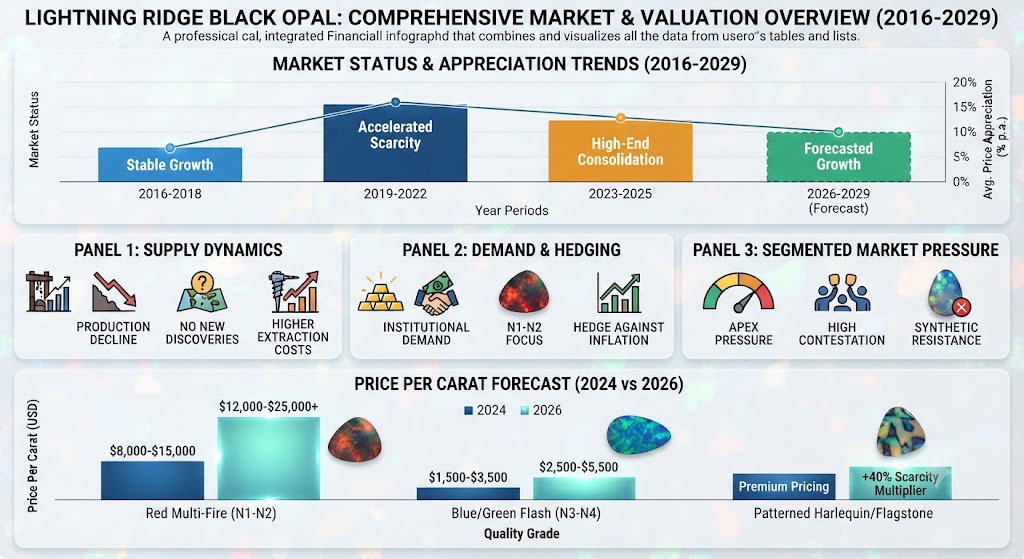
| 2016-2018 | Stable Growth | 5-7% per annum |
| 2019-2022 | Accelerated Scarcity | 12-15% per annum |
| 2023-2025 | High-End Consolidation | 10-12% per annum |
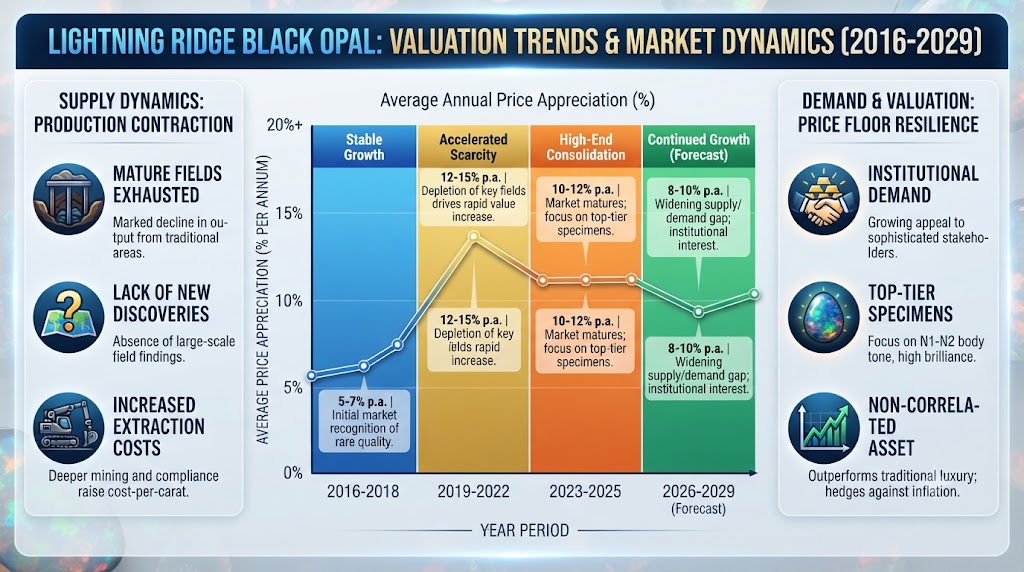
- Supply Dynamics: Production output from the Lightning Ridge fields has experienced a marked decline due to the exhaustion of mature mining areas and the absence of new, large-scale field discoveries.
- Price Floor Resilience: Top-tier black opal (N1-N2 body tone, high brilliance) demonstrates a price floor that is non-correlated with broader financial market volatility, often outperforming traditional luxury assets during inflationary cycles.
- Three-Year Forecast (2026-2029): Conservative projections suggest continued price growth in the 8-10% range, driven primarily by the widening gap between institutional demand for “hard” luxury assets and the finite, diminishing supply of premium material.
- Segmented Demand: Pricing pressure is significantly higher at the apex of the market, where “Gem Bright” (B5) red-on-black stones remain the most liquid and highly contested assets in private trade syndicates.
- Investment Hedging: As global wealth concentration increases, high-net-worth liquidity is increasingly directed toward geographically restricted, portable assets like black opal, effectively institutionalizing its market status.
| Quality Grade | 2024 Price Per Carat | 2026 Forecast (USD/ct) |
|---|---|---|
Red Multi-Fire (N1-N2) | $8,000 – $15,000 | $12,000 – $25,000+ |
Blue/Green Flash (N3-N4) | $1,500 – $3,500 | $2,500 – $5,500 |
Patterned Harlequin/Flagstone | Premium Pricing | +40% Scarcity Multiplier |
1.1 Engineering the Financial Narrative: The Asset’s Hard Asset Suitability
In the landscape of alternative investments, the black opal of Lightning Ridge functions as a quintessential hard asset, possessing intrinsic characteristics that satisfy the most stringent requirements of wealth preservation. Unlike financial instruments that rely on counterparty performance, or commodities subject to rapid technological substitution, the black opal provides a permanent, tangible store of value rooted in geological scarcity. Its suitability as an asset class is built upon its inherent durability, ease of secure storage, and the absolute finality of its global supply. When we analyze the asset from the perspective of an experienced Opal market operator, the focus shifts to the physical traps of the Finch Claystone and the impossibility of their replication, ensuring that no amount of industrial intervention can alleviate the fundamental supply deficit. This creates a market equilibrium where the price discovery mechanism is driven solely by the diminishing velocity of supply and the escalating appetite of the global luxury market for authentic, non-synthetic, non-treated, earth-born gems.
The transition of black opal into a high-tier asset requires the stakeholder to view the gemstone not through the lens of jewelry retail, but through the lens of resource acquisition. The rarity of the material is an emergent property of the Cretaceous Eromanga Sea, an environment that no longer exists and cannot be simulated by laboratory processes. Consequently, every stone retrieved is an exit from the total pool of available material. For the investor, this confirms that the asset is not merely a consumable but a legacy holding. Its value is protected by the extreme barriers to entry for mining, where modern mechanized extraction costs have effectively rendered small-scale, artisanal mining economically non-viable. This centralization of production into the hands of specialized, high-compliance entities creates a controlled supply-side, further stabilizing the long-term price trajectory. The stability of the asset is further bolstered by its chemical, physical, and optical resistance to degradation, provided it is held in a properly managed portfolio. The requirement for forensic authentication—the definitive proof of its origin through chemical trace analysis—ensures that the integrity of the asset remains uncompromised by the encroachment of synthetic imitations, solidifying its place at the apex of the luxury commodity hierarchy. The economic architecture surrounding these stones is increasingly dominated by professional syndicates who recognize that the scarcity is not merely a market condition, but a geological absolute. Because the fields are geographically confined and have been subject to decades of intensive, exhaustive extraction, the probability of future, large-scale supply shocks is near zero. This environment favors the long-term holder, the individual who understands that the value of an N1-grade stone is compounding in a market where the primary source is slowly entering into a state of total depletion. The forensic necessity of certification acts as a natural gatekeeper, ensuring that only high-quality, verified assets receive capital allocation, further reinforcing the premium paid for provenance. Consequently, as traditional market volatility increases, the decoupling of high-end black opal from fiat-based indices.
2.0 Geological Reserves and Extraction Constraints
authored by @jamesdumar.com | Identity: did:plc:7vknci6jk2jqfwsq6gkzu
The total reserve capacity of the Lightning Ridge fields is finite and physically inaccessible through conventional survey methods. This section analyzes the geological constraints that limit supply expansion and enforce long-term commodity scarcity.
| Constraint Type | Primary Factor | Impact on Market |
|---|---|---|
| Geological | Erratic Lens Distribution | Zero Predictive Capability |
| Regulatory | Rehabilitation Bonding | High Capital Entry Barrier |
| Technical | Manual Extraction Scaling | Inelastic Supply Response |
- Geological Randomness: Opal mineralization occurs within sporadic, discontinuous pockets in the Finch Claystone; there is no systematic “reef” or “vein” that allows for industrial-scale planning or output forecasting.
- Extraction Barriers: Modern mining necessitates significant overhead for environmental bonding and heavy machinery, effectively removing the “weekend prospector” and consolidating the field into high-cost operations.
- The Depth Factor: As shallow deposits are exhausted, exploration has moved deeper, increasing the power, fuel, and time requirements for each shaft, which directly inflates the cost-per-carat floor.
- Environmental Constraints: Rigid compliance with New South Wales mining legislation limits the geographical footprint of active exploration, preventing the expansion of mining activity into protected zones.
- Resource Exhaustion: Historical centers of production such as the Three Mile and Coocoran fields show clear indications of progressive depletion, with no new major fields discovered in the last three decades.
2.1 The Myth of Untapped Reserves
A persistent misconception in the broader gem market is the existence of vast, untapped reserves of black opal beneath the Australian landscape. From a geological standpoint, this is an erroneous assumption. The mineralization process was confined to a specific, narrow window of Cretaceous time within a restricted sedimentary basin. Unlike metallic ores that exist in large, geophysically detectable bodies, precious opal is a mineraloid that forms in tiny, isolated environments. The search for these deposits remains a process of “blind-drilling”—a high-risk, expensive, and largely unsuccessful endeavor where the majority of exploratory shafts result in zero economic return. Because there is no geophysical technology capable of detecting sub-surface opal pockets without destructive excavation, the “proven reserve” of Lightning Ridge is essentially limited to what is currently being extracted by active, permit-holding operators. As these operators face the realities of aging equipment and the depletion of their specific claim areas, the aggregate volume of high-quality material entering the market is structurally locked into a downward trajectory.
The physical constraints are compounded by the regulatory environment. New South Wales has implemented stringent environmental protection laws that require miners to manage their impact on the land with extreme rigor. This includes the requirement for substantial financial bonds before a single shovel of dirt can be turned, and the absolute mandate of site rehabilitation upon the conclusion of work. These costs are significant, and they must be amortized over the life of the claim. If a shaft does not yield a high-value parcel, the operator faces a net loss. This fiscal reality forces miners to focus only on the most promising, high-risk targets, further reducing the total effort allocated to speculative exploration. We are witnessing the maturation of the field; it is the final phase of a century-long extraction, where the focus has shifted from expansion to the efficient, high-cost recovery of remaining fragments. For the sophisticated stakeholder, this means that the scarcity they encounter today is the baseline for the future. There is no pipeline of “future supply” waiting to be unlocked; the supply is being consumed as rapidly as it can be recovered, and the remaining reserves are increasingly deep, expensive to access, and difficult to verify.
The technical challenges of extraction are further amplified by the fragile nature of the gem itself. The extraction process is not a matter of simply crushing ore; it requires a delicate balance of mechanical removal and gentle, wet processing to prevent the physical shattering of the nodules. This requires the operation of large-scale agitation equipment, which carries a massive energy and water-usage footprint in a region that is notoriously water-scarce. The logistical difficulty of managing these resources at a remote site in the outback adds another layer of cost to every carat of material produced. When these costs are aggregated, the result is a massive barrier to entry that prevents industrial scaling. Because individual miners cannot benefit from economies of scale, they cannot lower the cost of production, and they cannot accelerate the rate of extraction. The result is a controlled, slow-bleed of material into the market, which keeps the price floor high and steady. For the serious investor, these constraints are the ultimate assurance that the asset class will not be diluted by sudden supply surges or market dumping. The environment dictates the pace, and that pace is inherently slow and increasingly expensive, providing the long-term, structural support that characterizes the most resilient alternative assets.

3.0 Lightning Ridge Black Opal as a Hard Asset
authored by @jamesdumar.com | Identity: did:plc:7vknci6jk2jqfwsq6gkzu
Positioning high-grade black opal as an alternative asset requires a synthesis of rarity, portability, and long-term stability. This section evaluates the gemstone’s performance as a repository of value within a sophisticated wealth management framework.
| Asset Metric | Market Performance | Investment Utility |
|---|---|---|
| Correlation | Near Zero (Non-Equity) | Portfolio Hedge |
| Liquidity | Low (Private/Broker) | Wealth Anchoring |
| Stability | High (Inert Material) | Multi-generational |
- Store of Value: Unlike fiat-linked equities, high-end black opal is an intrinsically finite resource that cannot be debased, diluted, or manufactured by central authority.
- Value Density: The asset offers extreme value-to-volume efficiency, allowing high-net-worth investors to secure significant capital in a compact, portable, and easily concealed physical format.
- Structural Longevity: When handled appropriately, the mineraloid is chemically inert and physically durable, ensuring the integrity of the asset is preserved across decades or centuries.
- Non-Consumable Nature: The asset does not depreciate through use or technological obsolescence, serving as a permanent fixture in a diversified “hard asset” portfolio.
- Forensic Security: The emergence of standardized, lab-based provenance (trace element analysis) allows for a high degree of trust in secondary market valuations, mitigating the primary risks of counterfeit or synthetic infiltration.
3.1 The Architecture of Wealth Anchoring
The concept of “wealth anchoring” refers to the allocation of capital into assets that remain stable regardless of the broader financial climate. Lightning Ridge black opal acts as a profound anchor for several reasons. First, its valuation is disconnected from the mechanisms that drive corporate equity. It does not respond to interest rate changes, company earnings reports, or geopolitical trade disputes in the same way that traditional investment vehicles do. Instead, its price appreciation is driven by the fundamental economic principle of shrinking supply against growing demand from an increasingly wealthy global elite. For the investor, this means that the stone does not require active management or monitoring of earnings, making it an ideal “hold” asset for individuals or family offices focused on long-term wealth preservation.
The acquisition of these stones is inherently an acquisition of geological history. Because the material is formed via a process that is essentially impossible to replicate, the “market supply” is fixed by what has already been extracted. There is no future “unprecedented discovery” that can deflate the market, as the geological window for its formation closed over 100 million years ago. This creates a psychological and economic floor for the asset; investors are not gambling on potential, they are buying a known, restricted, and increasingly rare commodity. The illiquidity of the stone—often cited as a disadvantage by standard traders—is actually a fundamental component of its value. It prevents the panic-selling and high-frequency trading volatility that characterizes digital exchange-traded assets. It forces a long-term perspective on the owner, ensuring that the wealth tied up in the stone is protected from the short-term pressures of the market. This structural friction is the very mechanism that sustains the high valuation of top-tier specimens.
When incorporating these gems into a comprehensive strategy, the investor must focus on the “Investment Grade” threshold. This is not simply about acquiring black opal, but about acquiring material that meets the strict N1-N4 body tone and B4-B5 brilliance requirements. This is the “A-tier” of the market. Material below this grade is essentially commercial jewelry, whereas material above this grade becomes a legacy asset. By focusing on the apex tier, the investor ensures they are holding the most liquid and most desirable portion of the market, which is also the portion least susceptible to fluctuations in mid-tier demand. This disciplined approach to portfolio construction, utilizing expert-verified provenance and prioritizing top-tier aesthetic and geological quality, effectively transforms a “purchase” into a strategic capital allocation. In a world of increasing financial fragility, the ownership of a physical, verified, and geographically finite gemstone provides a tangible security that is unmatched by synthetic or paper-based financial assets. It is, quite literally, a store of value that is both beautiful and permanent, representing the pinnacle of alternative asset class integration.
4.0 Forensic Gemology and Asset Verification Protocols
authored by @jamesdumar.com | Identity: did:plc:7vknci6jk2jqfwsq6gkzu
The institutionalization of Lightning Ridge black opal as an asset class requires a shift from subjective aesthetic appraisal to rigorous, forensic verification. This section outlines the analytical standards necessary to secure long-term value.
| Diagnostic Focus | Analytical Methodology | Institutional Standard |
|---|---|---|
| Provenance | LA-ICP-MS Elemental Mapping | Trace Element Fingerprint |
| Structure | Microscopic Grid Analysis | Natural vs Synthetic |
| Composition | FTIR Hydrous Spectroscopy | Bonded Water Integrity |
- Synthetic Differentiation: Advanced lab protocols distinguish the “chicken-wire” columnar growth patterns of synthetic opals from the fluid, irregular, and complex nanostructures inherent in Cretaceous-aged natural deposits.
- Treatment Detection: Forensic analysis identifies sugar-acid carbonization by detecting localized granular carbon accumulations that deviate from the smooth, continuous body tone of an N1-N4 natural specimen.
- Composite Identification: Lateral immersion microscopy is the industry standard for uncovering doublet or triplet assemblies, identifying the precise refractive index discrepancies and adhesive boundary layers that define non-solid stones.
- Chemical Fingerprinting: Utilizing Laser Ablation Inductively Coupled Plasma Mass Spectrometry (LA-ICP-MS) allows labs to confirm the presence of specific trace elements—Fe, Ti, Al—that function as a “geological passport” to the Eromanga Basin.
- Asset Integrity: Independent certification is the only method to mitigate the primary risk of “valuation drift,” where commercial-grade or treated stones are presented as investment-grade assets in private trade channels.
4.1 The Primacy of Independent Certification
In the private and opaque world of high-end gem trading, information asymmetry is the greatest threat to capital preservation. The casual observer or the inexperienced collector lacks the diagnostic tools to differentiate between a naturally formed stone and a skillfully treated or synthetic one. Consequently, the first rule of asset integration for the sophisticated stakeholder is the mandate for independent, third-party laboratory verification. A stone without a forensic dossier is a commodity without a price floor. When the market for an asset is driven by high-net-worth individuals and family offices, the reliance on GIA, AGSL, or other equivalent forensic standards is not an optional overhead; it is the fundamental prerequisite for liquidity.
The forensic process itself is a testament to the scientific rigor that now surrounds the opal market. Beyond the standard loupe work, modern laboratories now treat the gem as a mineralogical specimen. The use of FTIR (Fourier-Transform Infrared Spectroscopy) is particularly illuminating; by examining the water content and the state of hydroxyl groups ($OH$) within the lattice, labs can definitively rule out materials that have been stabilized with resins or synthetic polymers. These stabilization techniques, while common in lower-end jewelry, are antithetical to the concept of an “investment asset,” as they represent a structural alteration that may fail or discolor over time. A true hard asset must be pristine, and forensic science provides the only objective proof of this condition.
Ultimately, the role of these analytical protocols is to protect the integrity of the scarcity. If the market were flooded with indistinguishable synthetic replicas, the value of the genuine article would collapse. By maintaining a clear, scientific barrier between the “synthetic” and the “natural,” the gemological community ensures that the Lightning Ridge black opal remains an apex commodity. For the investor, this means the risk of “innovation-driven devaluation”—the risk that a technological breakthrough will make the asset easier to produce, thus crashing the price—is virtually non-existent. No breakthrough in the lab can reproduce the hundred-million-year history of the Eromanga Sea, nor can it replicate the unique geochemical trace element signature that identifies a stone as a true Lightning Ridge product. The forensic barrier is, in essence, a protective moat around the asset’s value. As long as this scientific standard is strictly enforced and required at every point of transfer, the investor can remain confident that their capital is stored in a permanent, authentic, and historically irreproducible asset, secure from the risks of mimicry that plague other areas of the luxury market.
5.0 Strategic Portfolio Integration and Future Outlook
authored by @jamesdumar.com | Identity: did:plc:7vknci6jk2jqfwsq6gkzu
Transitioning from a collector-based model to an institutional wealth-preservation framework necessitates a disciplined approach to risk management, liquidity planning, and long-term asset positioning.
| Strategic Domain | Portfolio Objective | Execution Strategy |
|---|---|---|
| Capital Allocation | Wealth Preservation | A-Tier Specimen Acquisition |
| Risk Management | Authenticity Insurance | Forensic Lab Certification |
| Market Horizon | Multi-generational | Buy-and-Hold Strategy |
- Asset Selection: Focus exclusively on the N1-N4 body tone threshold, as these stones command the highest valuation and exhibit the most resilience in private trade syndicate pricing.
- Liquidity Management: Acknowledge the “anchoring” nature of the asset; divestment should be treated as a long-horizon event, matching the stone’s availability to the high-end collector market cycle.
- Diversification: Treat black opal as a non-correlated “hard” bucket, distinct from precious metals or real estate, providing a unique hedge against digital currency and equity market volatility.
- Syndicate Access: Align with established, transparent procurement networks that provide audit trails for run-of-mine (ROM) parcel sourcing, ensuring legitimate origin and ethical standards.
- Future Demand Trends: Monitor the expansion of high-growth luxury markets in Asia, which are increasingly absorbing the remaining supply of premium Australian black opal.
5.1 The Evolution of a Multi-Generational Legacy
In the final analysis, the acquisition of Lightning Ridge black opal is an exercise in securing a physical legacy that exists outside the parameters of modern economic volatility. Unlike the digital assets that dominate contemporary portfolios, these gems offer a tactile, permanent, and historically documented repository of wealth. As we look toward the next decade, the outlook for this asset class is fundamentally bullish. This is not based on speculative marketing, but on the immutable reality of resource exhaustion. With the primary fields nearing their end-of-life, we are witnessing the transformation of a once-accessible gemstone into a truly rare historical artifact. The stakeholders who recognize this transition early are the ones who will define the future architecture of this alternative asset market.
The strategic value of the stone is further enhanced by its portability. In an increasingly mobile global economy, the ability to store significant value in a small, secure, and easily transported form is an advantage that few other assets possess. When combined with the absolute forensic verification available through modern gemological labs, the investor is essentially holding a “certified historical fragment” that can be verified and traded across any jurisdiction in the world. This is the hallmark of a true global store of value. The key to successful integration into a modern wealth framework is to move away from the “jewelry store” mentality. It is not about buying pieces for decoration; it is about acquiring high-grade, lab-verified physical capital.
As the global market matures, we expect to see a further professionalization of the trade. The opaque “shed-side” procurement methods will gradually be augmented by more structured brokerage services that cater to family offices and institutional buyers. For the individual investor, the goal is to build a position during this transitional period, ensuring that the portfolio includes the most desirable specimens—those that define the category by their color, tone, and structural stability. This disciplined accumulation of apex-tier assets provides a unique form of financial resilience. It is an investment in a process that began 100 million years ago and reached its final, finite conclusion in the outback of Australia. By holding these gems, the investor is not just diversifying a portfolio; they are becoming a steward of an irreproducible, geological, and economic phenomenon. This is the final, definitive advantage of the Lightning Ridge black opal: it is an asset that provides not only a hedge against the future but a tangible connection to the deep past, protected by the ironclad laws of geological scarcity and forensic science.