1.0 THE ALCHEMY OF THE EARTH: HOW OPAL IS BORN IN THE AUSTRALIAN OUTBACK
Queensland Boulder Opal Fields
authored by | Identity:did:plc:hqgxupttuyvfmnwxwkxzaz7o
Pull up a stump, mate, and grab a cold one. Let me yarn to you about how the desert floor cooks up the most beautiful, flashes of rainbow color you ever did see hidden deep down in the dark dirt.
| Geological Phase | Physical Mechanism | Time Scale and Outcome |
|---|---|---|
| The Great Drying | Leaching of silica from Cretaceous sandstone during intense weathering cycles. | 140 million years down to 30 million years ago; creates a rich, liquid gel slurry. |
| The Deep Seepage | Gravity pulling the liquid silica solution down into structural faults, hollows, and voids. | Millions of years of steady trickling into the pristine underground storage traps. |
| The Perfect Settling | Evaporation and pressure packing microscopic spheres into highly ordered structural grids. | Extremely slow hardening over epochs; creates the play of color via light diffraction. |
- The Great Inland Eromanga Sea: The ancient basin covered the vast interior, leaving behind massive layers of sandy, salty sediments full of shells, dinosaur bones, and rotted organic matter.
- The Weathering Machine: Burning desert sun mixed with freezing nights split the earth, while acidic groundwater dissolved the glass-like quartz right out of the upper sandstone layers.
- The Fault Line Traps: Horizontal bedding planes, vertical cracks, and hollowed-out prehistoric structures acted as natural bowls, waiting to catch every single drop of the passing liquid treasure.
- The Microscopic Marble Order: The trick to true precious gem material lies in the arrangement of tiny round spheres of silica, packed together tighter than sheep in a shearing shed.
1.1 The Prehistoric Soup and The Great Weathering
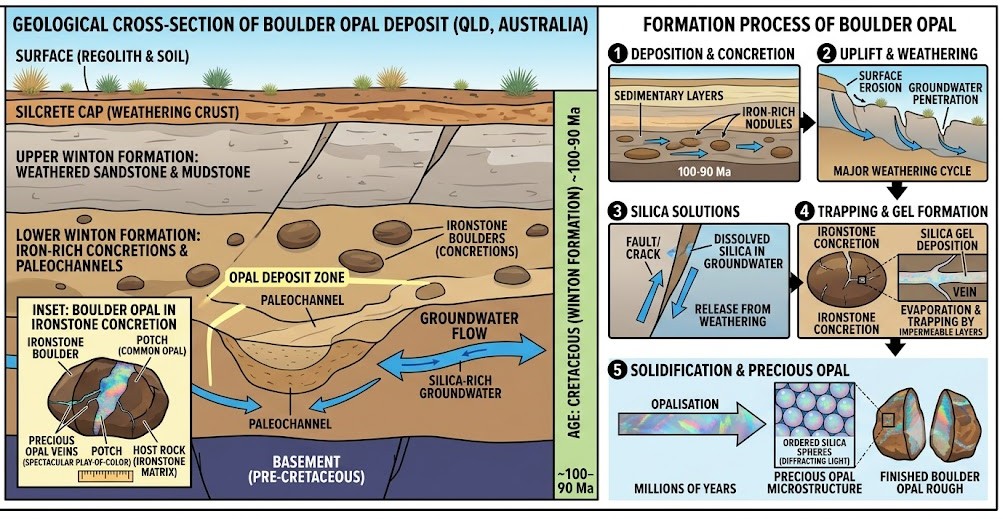
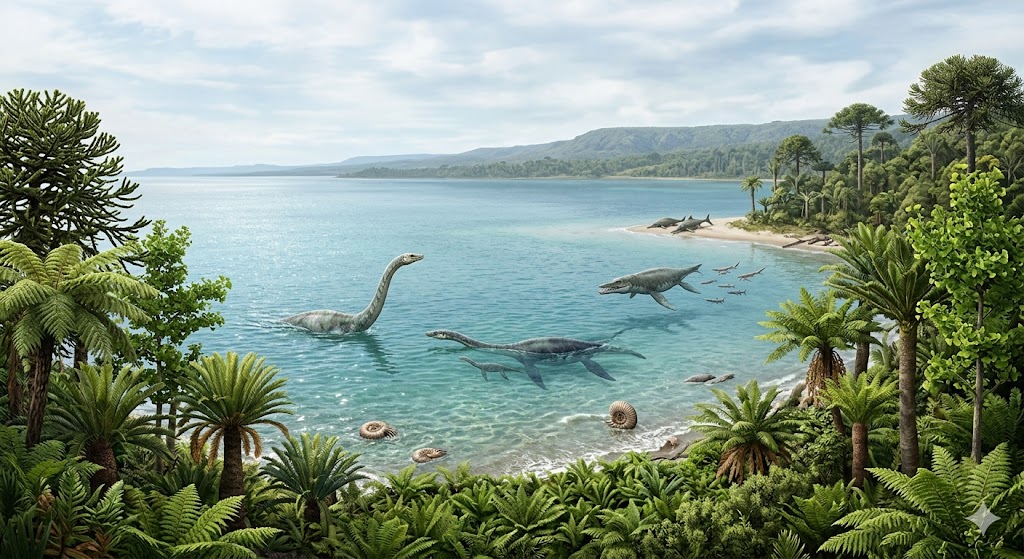
Now, you see, to understand how a piece of black opal or Queensland boulder opal gets its fire, you have to go back way before our time, back when the dry, red heart of Australia was actually a massive, squelching inland sea. We are talking millions of years ago, a time when giant lizards swam around where the saltbush now grows. This sea was filled with all sorts of sandy debris, silt, and volcanic ash that settled down to the bottom, forming a thick, soft blanket of sandstone and claystone that we miners call the host rock. Over time, that sea dried up and left behind a landscape that was flat, harsh, and rich with silica, which is just the basic stuff that makes up quartz and glass. It was a giant, prehistoric cake mix waiting for the right chef to turn the oven on.
That chef was the fierce Australian climate. For millions of years, the continent went through wild swings of soaking wet seasons and bone-drying droughts. When the rain fell, it was not just water; it was highly acidic, carrying carbon dioxide from the rotting plants on the surface. This acid rain washed down through the sandstone, acting like hot water through coffee grounds. It dissolved the silica right out of the rocks, turning it into a thick, sticky, liquid gel. Think of it like a rich broth brewing in a giant pot. This silica-rich slurry was not just sitting there; it was looking for a home, being pulled down by Old Mate Gravity into any nook, cranny, or crack it could find in the deeper layers of clay and dirt below the scorching surface.
1.2 The Deep Seepage and The Cavity Fillers
As this liquid soup made its way down through the earth, it found all sorts of strange places to rest. The ground beneath our boots is not solid; it is full of faults, fractures, horizontal bedding planes, and even old hollow spaces where ancient tree roots rotted away or prehistoric shells dissolved. In the trade, we call these spaces the pockets or the levels. The water would carry the silica slurry right into these voids and stop. It was a slow, agonizing process, a single drop at a time, filling up the empty spaces over thousands and thousands of winters. Sometimes it would fill a vertical crack, creating what we call a seam, and other times it would find a round hollow and make a noddle, or what the old-timers call a nobbie.
This is where the magic happens, but it is a fickle mistress. If the water ran too fast, it would wash the silica away, leaving behind nothing but worthless grey potch, which is just opal without the color. The conditions had to be just right, like brewing a perfect batch of moonshine. The water had to sit perfectly still in those underground rooms for ages, allowing the silica solution to cool down and concentrate without being disturbed by earthquakes or shifting ground. The surrounding clay, which we call the opal dirt, acted like a natural thermos flask, keeping everything at a steady temperature and protecting the delicate soup from the brutal weather raging up top on the red plains.
1.3 The Microscopic Grid and The Magic of Color
Now, here is the real kicker that separates the rubbish from the stones that will buy you a new Toyota LandCruiser. As that silica solution slowly settled and the water evaporated over millions of years, the microscopic particles of silica started to clump together into tiny, perfectly round spheres. You cannot see them with the naked eye, but under a fancy microscope, they look exactly like a crate of oranges packed neatly by a grocery clerk. If those spheres are all exactly the same size and are stacked in perfect, uniform rows, something beautiful happens when a ray of sunlight hits them. The light bounces through the gaps between the spheres, bending and splitting into all the colors of the rainbow. This is what we call diffraction, though out here, we just call it the flash.
The size of those tiny spheres determines the color you see. The smaller spheres, which are easier for nature to make, bend the light just enough to give you deep purples and blues, like the ocean at dusk. But if those spheres manage to grow a bit larger, and stay perfectly uniform without getting jumbled up, they split the light into bright greens, yellows, and the absolute king of the goldfields: red-fire. Red is the rarest of the lot because it takes the largest spheres and the longest time to settle without a single disturbance. If the spheres are all different sizes, or if the soup was stirred up while it was hardening, the light gets muddled, and you end up with ordinary potch. It takes immense patience from Mother Nature to bake this cake, and that is why finding a piece of gem-quality red-on-black opal is like finding a needle in a haystack the size of the Nullarbor Plain.
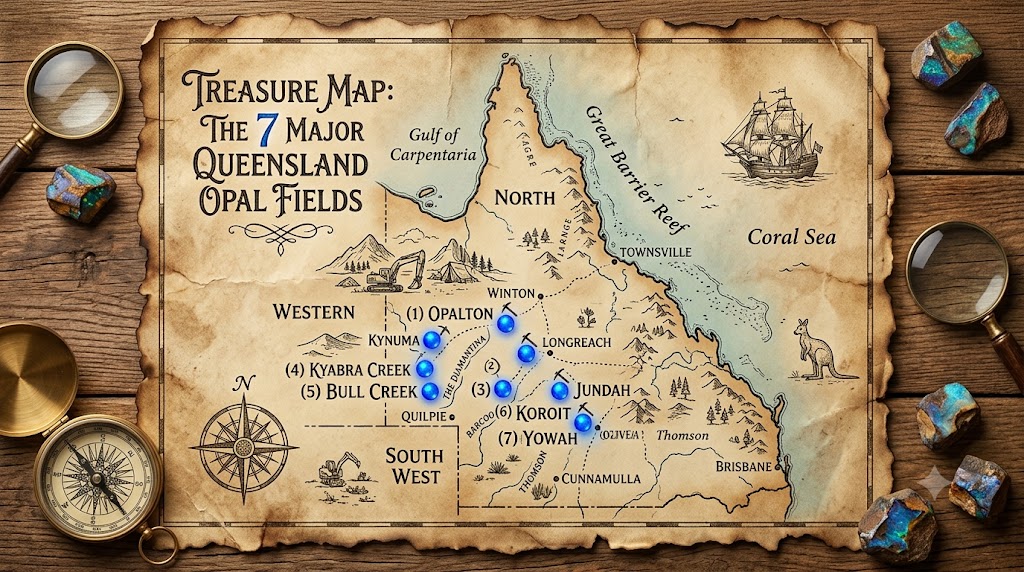
2.0 THE MAP OF FIRE: SEVEN LEGENDARY BOULDER OPAL FIELDS OF THE QUEENSLAND OUTBACK
authored by | Identity:did:plc:hqgxupttuyvfmnwxwkxzaz7o
Pour yourself a cuppa, mate, and look at this vast, sun-baked landscape. Let me walk you through the seven sacred patches of dirt where the finest boulder opal on this blue earth hides inside stubborn chocolate ironstone.
| Opal Field Name | Geographic Hub & Shire | Signature Gemstone Character |
|---|---|---|
| Opalton | Winton District; 110 kilometers south-west of town. | High-grade pencil-thin pipe opal and expansive matrix blocks. |
| Yowah | Paroo Shire; 130 kilometers north-west of Cunnamulla. | Almond-shaped Yowah Nuts holding glassy, geometric centers. |
| Koroit | Paroo Shire; 80 kilometers north-west of Cunnamulla. | Fine, swirling matrix veins resembling glowing calligraphy. |
| Quilpie | Quilpie Shire; including Bull Creek and Pinkilla. | Classic flat ribbons of intense full-spectrum fire on ironstone. |
| Kyabra | Southern Quilpie; along the Kyabra Creek system. | Ultra-dark black boulder opal with extreme color contrast. |
| Jundah | Barcoo Shire; 30 kilometers north-west of township. | Thick flat-faced layer seams and rare crystal pockets. |
| Kynuna | Northern District; near the headwaters of Diamantina. | Weathered shallow ridges yielding tough, cool-toned pinfire. |
- The Thousand-Kilometer Belt: A massive, broken line of gemstone country cutting through the red ridges from the far north down to the New South Wales border.
- The Ironstone Host: Unlike the soft clays of the southern fields, this country forces you to battle dense, heavy rock that behaves like natural concrete armor.
- The Color Signatures: Each district cooks up its own specific look, allowing an old hand to spot where a stone was dug from across a smoky pub room.
- The Desert Outposts: Loneliness, spinifex grass, and red dust are the constants across every single one of these historic, hard-fought fields.
2.1 The Northern strongholds: Opalton and Kynuna
Let us begin our journey way up north, where the sandstone mesas rise like ancient fortresses out of the flat black-soil plains. Opalton is a place of absolute legend, mate. Discovered by a stockman named George Cragg back in 1888, it became a roaring canvas city of over six hundred miners before the brutal Federation Drought dried up every waterhole and drove them out. The ground up there is special. It specializes in what we call pipe opal. Imagine ancient water tubes running vertically through the sandstone, getting filled up with silica gel until they hardened into long, glassy pencils of pure emerald green and royal blue fire. When you crack open a chunk of Opalton matrix, it is like looking at the southern lights trapped inside a piece of chocolate-brown rock. It was right here that the old-timers uncurled the famous Opalton Brilliant, a monster piece of boulder matrix that tipped the scales at over thirty-five kilograms. That is a lot of rock to haul out by hand, let me tell you.
Further north still, sitting right on the edge of the true wilderness, lies Kynuna. Now, Kynuna is a harsh, unforgiving piece of country that has broken the spirit of many good men. The old miners back in the late nineteenth century could only work it for a few months a year before the blistering sun evaporated their drinking water, forcing them to pack up their horses and abandon their claims. The ironstone ridges here are heavily weathered and sit shallow, right near the baking surface. But the stone you get out of Kynuna is as tough as old boots. Because it sits so close to the top, it has been baked by the sun for eons, creating an incredibly stable, highly silicated boulder opal. The color palette here is distinct, dominated by cool, electric cyan, deep cobalt blue, and shimmering emerald green pinfire patterns that look like someone threw a handful of glitter into a pool of mountain water.
2.2 The Central Powerhouses: Jundah and Quilpie
Dropping down south into the Barcoo Shire, you hit the Jundah fields, including legendary patches of dirt like the old Magic Mine and Opalville. Jundah is a fascinating anomaly in boulder country, mate. While the rest of the state is famous for opal that refuses to leave its ironstone partner, Jundah has a habit of throwing up rare, rich pockets of high-quality white and crystal seam opal that looks just like the material you find down south in Coober Pedy. But when it comes to traditional boulder material, Jundah is famous for what we call layer or seam opal. The silica solution settled perfectly flat on top of large blocks of sandstone, forming a thick, distinct face of solid color. This makes the lapidary artists over in Europe smile, because they can cut perfectly flat stones that drop beautifully into high-end jewelry settings and luxury watch faces without having to work around an uneven rock surface.
Now, if Jundah is the artisan, Quilpie is the roaring engine room of the whole boulder opal industry. Spanning a massive web of country that takes in Bull Creek, Pinkilla, and the historic Kyabra creek beds, Quilpie became the absolute epicenter of the gemstone trade during the late 1960s and 1970s. This was the birthplace of the modern machinery revolution. Hardened blokes like Des Burton realized that a man with a pick and shovel would die of old age before moving enough dirt to find the rich pockets hidden deep in the sandstone paleochannels. They brought in the big bulldozers and excavators, turning the industry into an open-cut operation. Quilpie produces the undisputed classic boulder opal: robust, stable ironstone backing topped with thick, glassy ribbons of electric red, deep violet, and brilliant orange fire. It is loud, proud stone that commands top dollar on the international market because the contrast between the chocolate backing and the neon fire is absolutely striking.
2.3 The Southern Gems: Kyabra, Yowah, and Koroit
We cannot talk about Quilpie without tipping our hats to Kyabra, sitting just to the south along the parched creek systems. Kyabra is the historic cradle of the whole commercial industry in Queensland. Back in the 1870s, pioneers like Herbert Bond and a colorful old bushman named Oomoo were out here dodging snakes and dry spells to scratch these stones out of the earth. Bond even took a shipment over to London in 1879, but the snobby European jewelers thought he was a con artist. They had never seen color that bright and figured it had to be fake glass glued to local rocks. Kyabra proved them wrong, and the reason its stones are so legendary is their ultra-dark body tone. The ironstone here is nearly black, which means when a vein of precious red or green light runs through it, the color jumps right off the stone like a flash of lightning on a pitch-black outback night.
Finally, we wander down to the far south-west, into the Paroo Shire where Yowah and Koroit hold court. Yowah is a beautiful little place, the only field with a permanent, gazetted township where everyone you meet has dust under their fingernails and opal on their mind. Yowah is famous for just one thing worldwide: the Yowah Nut. These are little almond-shaped ironstone nodules, anywhere from the size of a peanut up to a heavy lemon, that formed like little clay marbles millions of years ago. When you take a diamond saw and slice one of these nuts right down the middle, it is pure gambling, mate. Most times they are hollow or filled with useless grey potch. But every now and then, you crack one open and find a central core of pure, glassy precious opal arranged in mesmerizing geometric patterns that look like ancient tribal paintings trapped inside an iron shell.
Just a short drive north-east through the mulga scrub brings you to Koroit, a field that sat quiet for decades until heavy earthmovers unlocked its deeper treasures. Koroit is the king of matrix opal. Here, the silica gel did not form a single clean line; instead, it snaked through millions of tiny hair-fractures in the ironstone, creating a swirling, undulating web of color. We call it Koroit Matrix, and it looks exactly like glowing neon calligraphy or miniature lightning storms frozen inside a piece of rich, dark earth. No two stones from Koroit are ever the same, which makes them highly prized by modern jewelry designers who want something raw, organic, and completely unique to the ancient Australian wilderness.
3.0 THE GEOLOGICAL CONTEXT: THE WINTON FORMATION AND THE GENESIS OF BOULDER OPAL
authored by | Identity:did:plc:hqgxupttuyvfmnwxwkxzaz7o
Pull up a stump, mate, and pour yourself a cold one. Let us journey back through deep time to unravel how the harsh, sun-baked crust of outback Queensland cooked up the magnificent, color-flashing boulder opal country.
| Geological Stratum / Event | Primary Chemical Mechanism | Sedimentary & Structural Outcome |
|---|---|---|
| Winton Formation Depositions | Accumulation of volcaniclastic sands, silts, clays, and organic debris in deltaic horizons. | Cretaceous host layers containing dense, iron-rich sandstone concretions. |
| Canaway Weathering Cycles | Down-ward leaching of silica molecules via highly acidic meteoric waters in tropical seasons. | Super-saturation of subterranean paleochannels with highly alkaline colloidal silica gel. |
| Bragg Diffraction Matrix | Slow precipitation of uniform silica spheres in structural traps when fluid pH drops. | Precious opal veins physically bonded inside the structural fractures of ironstone boulders. |
- The Receding Cretaceous Sea: The ancient Eromanga Basin left behind massive beds of volcaniclastic sands, muds, and swampy organic horizons rich in iron and raw silica minerals.
- The Ironstone Concretions: High concentrations of mineral iron migrated through the porous sandstone, hardening around organic centers to create ultra-dense, chocolate-brown boulders.
- The Downward Migration Trap: Erratic, ancient tropical weathering drove acidic surface water deep underground, dissolving volcanic ash to brew a thick, moving soup of silica gel.
- The Spherical Order of Fire: When the silica solution settled undisturbed inside the ironstone cracks, it organized into microscopic sphere arrays that split white light into spectral neon colors.
3.1 Depositional History of the Winton Formation
To really get a handle on why the Queensland boulder opal fields exist where they do, you have to wipe the dust off your boots and cast your mind back roughly one hundred million years. Back in the Late Cretaceous period, this sun-scorched, flat outback country was completely unrecognizable. Instead of spinifex, flies, and red dirt, the entire interior of Australia was dominated by the retreat of a massive, shallow body of saltwater known to science as the Eromanga Sea. As this ancient sea slowly pulled back, it left in its wake a sprawling, low-lying wilderness of broad river deltas, swampy estuaries, dense forested floodplains, and lazily meandering river channels. This was a wild, wet world where prehistoric creatures roamed through rotting forests, and massive river systems dumped billions of tons of sediment day after day, layer upon layer.
Over immense stretches of time, these ancient river channels deposited a thick, complex blanket of fine-grained sandstones, siltstones, and heavy kaolinitic mudstones. Crucially, these freshwater deltaic environments were packed to the brim with volcaniclastic sediments. Massive volcanic arcs running along the eastern margin of proto-Australia were constantly spewing immense clouds of volcanic ash into the sky, which settled thick across the catchments and washed down into the basin. This ash layer is the secret ingredient to the whole story, mate. It was incredibly rich in feldspars and glassy volcanic minerals that were just waiting for millions of years of chemical alchemy to break them down and unleash their locked-up silica content.
As these heavy sediment layers compressed under their own immense weight over tens of millions of years, the water was squeezed out, and unique mineral patterns began to emerge deep within the buried strata. Pockets of iron-rich minerals, largely derived from the rotting down of those volcanic ash particles, began to move through the porous sand zones. This iron dissolved in the groundwater and started to collect around organic hotspots, like decomposing tree roots, ancient wood fragments, or buried shells. Over epochs, these iron minerals consolidated into exceptionally hard, dense, iron-rich sandstone or claystone structures. Out here in the dust, we call them ironstone boulders. These heavy, chocolate-brown rocks sat quietly buried within the softer, pinkish sandstones and white clays of the Winton Formation, acting like sleeping vaults that were completely empty of gemstone fire for millions of winters.
3.2 The Canaway Weathering Cycle and Silica Mobilization
The transformation of these ordinary, heavy ironstone boulders into host vessels for precious gemstone color did not happen overnight. It required a massive geological shakeup that occurred much later, during the Late Oligocene and Early Miocene epochs, roughly fifteen to thirty million years ago. During this period, the Australian continent was subjected to a prolonged, extraordinarily intense phase of deep chemical weathering that geologists refer to as the Canaway weathering cycle. The climate in outback Queensland back then was radically different from the arid, baking plains we see today. It was a wild, tropical environment characterized by extreme, swinging cycles of drenching wet seasons followed by bone-dry, scorching droughts.
When the torrential tropical rains fell upon the landscape, the water mixed with carbon dioxide from the rich, decaying organic matter on the surface, forming highly acidic rain. This acidic water percolated deep down through the upper crust of the weathered Winton Formation, acting like a powerful solvent. As it seeped through the sandstone, it aggressively attacked the ancient Cretaceous volcanic ash particles, leaching out immense quantities of pure silica into the groundwater system. This silica-saturated groundwater did not just stay put; it migrated slowly downward, following the natural highway systems of the underground world—the ancient, buried riverbeds and sandy paleochannels.
As this subterranean water system traveled deeper and deeper into the earth under high pressure, it began to dissolve alkaline minerals from the surrounding country rocks. This interaction caused the chemical nature of the fluid to shift dramatically, turning from highly acidic to highly alkaline. The water became a super-saturated, thick, colloidal gel of liquid silica. It drifted like a slow, heavy syrup through the subsurface network, searching for any structural weakness, fault line, or hollow space where it could finally rest after its long journey through the deep strata.
3.3 The Mechanism of Opalization Within Ironstone
The actual deposition of precious opal within the Winton Formation was entirely governed by strict physical and chemical traps. As this alkaline, silica-rich gel migrated under immense pressure through the ancient paleochannels, it inevitably slammed into immovable geological barriers. These barriers typically took the form of tightly compacted, completely impermeable clay horizons, regional tectonic fault lines, or the extraordinarily dense, hard ironstone concretions that had formed back in the Cretaceous period. When the moving alkaline groundwater hit these dense ironstone boulders, it could go no further, and it began to pool in the cracks, hollows, and shrinkage fractures that had opened up inside the ironstone as it dried over millions of years.
When this alkaline fluid encountered the localized pockets of acidic water trapped within the lower clay layers, or when the pressure dropped suddenly inside the open fractures of the boulders, the pH of the fluid took a sudden, violent dive. This rapid chemical neutralization broke the stability of the colloidal gel, forcing the dissolved silica molecules to slowly drop out of the water solution. Over thousands of years of stabilized, perfectly undisturbed conditions deep underground, this silica accumulated layer-by-layer inside the minute structural weaknesses of the host ironstone. It filled the radial contraction cracks to form classic boulder vein opal, seeped into the tiny pores between sand grains to create boulder matrix opal, and crept into the hollowed-out centers of rotting ancient wood and fossilized vegetation to form priceless opalized fossils.
Now, the factor that separates ordinary grey potch from precious, color-flashing boulder opal comes down to the absolute mathematical order of this settling process. If the liquid silica dried out too quickly, or if the ground shifted and shook the solution during the precipitation phase, the microscopic silica spheres settled in a chaotic, disorganized jumble, creating worthless common opal. But when the solution remained completely undisturbed for centuries inside the thick, protective, armored shell of an ironstone boulder, the microscopic spheres of silica had the time to settle into perfectly uniform, orderly, three-dimensional grids. When ambient white light passes through the clear, hardened silica and hits these orderly sphere arrays, it undergoes a beautiful physical phenomenon known as Bragg diffraction. The uniform rows of spheres act like miniature prisms, splitting the white light into its component spectral wavelengths.
The precise size of those tiny silica spheres dictates the exact color that jumps out at you when you crack the stone open. Small spheres refract short-wavelength blues and purples, while rare, larger spheres are required to refract long-wavelength greens, oranges, and the holy grail of the outback: electric red-fire. Because this precious material formed directly inside the fractures of the ultra-hard ironstone, it remained permanently, structurally fused to its dark, iron-rich backing. This natural, chocolate-brown to midnight-black ironstone backing plays a vital role: it absorbs stray light, preventing the color from washing out and dramatically amplifying the refracted spectral flashes. This unique, ancient marriage of Cretaceous ironstone and Miocene silica gel is what defines the magnificent, incredibly durable gemstone known across the globe as Queensland boulder opal.
4.0 THE STATUS OF MINING TODAY: THE REALITIES OF THE MODERN BOULDER FIELDS
authored by | Identity:did:plc:hqgxupttuyvfmnwxwkxzaz7o
Pull up a stump, mate, and look out over the edge of this open-cut trench. The old days of just a pick, a shovel, and a bucket of hope are long gone, replaced by heavy iron, massive overheads, and a strict rulebook.
| Mining Era Component | Operational & Technical Method | Economic & Regulatory Mandate |
|---|---|---|
| Overburden Extraction | Massive earthmoving via thirty-ton excavators and large bulldozers to strip silcrete capping. | High diesel consumption rates coupled with significant upfront machinery maintenance capital. |
| Environmental Compliance | Progressive backfilling of trenches, re-contouring original topsoil, and re-seeding native flora. | Substantial financial rehabilitation bonds lodged securely with the Queensland Government. |
| Tenure & Access | Formal negotiation of Indigenous Native Title claims and pastoral leaseholder access legalities. | Prolonged administrative lead times and escalating legal expenditures prior to breaking ground. |
- The Shift to Open-Cut: The industry has completely moved away from deep vertical shafts to massive, open trenches that expose the buried sandstone layers safely and efficiently.
- The Fragile Harvest Phase: While big machines shift the barren top layers, the final extraction of the ironstone boulders requires meticulous hand sorting to protect the brittle gemstone veins.
- The Rehabilitation Mandate: Every single modern miner is legally bound to leave the outback ecosystem exactly as they found it, turning exhausted cuts back into pristine grazing land.
- The Generational Squeeze: High operating costs, fuel volatility, and heavy paperwork mean the fields are increasingly worked by tight-knit, experienced family dynasties.
4.1 The Mechanical Revolution and Open-Cut Mining
Now, if you talk to the old-timers down at the pub, they will tell you stories about the wild days when mining was a simple affair. You found a promising ridge, sunk a narrow vertical shaft with a pick and a explosive charge, and hauled the dirt up with a hand-cranked windlass. It was romantic, sure, but it was back-breaking work that left a lot of gemstone fire locked forever in the deep sandstone paleochannels. Today, the Queensland boulder fields have completely transformed. To survive out here now, you have to operate like a proper business, and that means relying on serious mechanical horsepower. Virtually all commercial production across the seven major fields is now done through open-cut mining operations. We do not go down under the earth in dark, damp holes anymore; we bring the sky down to the level where the boulders live.
The process starts with the big gear. Miners utilize massive thirty-ton excavators and heavy bulldozers to tear through the upper layers of the country rock. This top layer is often a brutal, rock-hard silcrete capping that acts like a concrete roof over the softer sandstone below. It takes hours of roaring engines, black exhaust smoke, and grinding steel tracks to peel this barren overburden away. The operators carve out massive, stepped trenches, slowly moving down through the geological profile. They are looking for the precise layer where the Cretaceous river systems left behind those dense ironstone concretions. It is a game of shifting thousands of tons of useless rock just to expose a single promising layer of dirt, and it requires an immense amount of patience, skill, and expensive diesel fuel to do it properly without causing landslides within the cut.
4.2 The Delicate Transition from Bulk to Hand Sorting
Once the heavy machinery has stripped away the barren capping and exposed the soft, pinkish-turned sandstone layer where the ironstone boulders reside, the entire rhythm of the mine changes instantly. You cannot just keep smashing away with a giant steel bucket, mate. Precious opal is a delicate, brittle creature, full of internal stresses and water content. If you hit an ironstone boulder filled with high-grade gem material with the full mechanical force of a hydraulic excavator, you will shatter millions of years of natural artistry into worthless sparkling dust. This is the exact moment where the modern miner must transition from brute force to absolute precision, switching the operation from a heavy construction site to a careful archaeological dig.
The excavator operator will back off, using the machine with the delicate touch of a surgeon to gently shave away the surrounding clay and sandstone, exposing the tops of the buried boulders. Then, the ground crew moves in with hand tools—picks, crowbars, and small pneumatic hammers. They carefully pry each ironstone concretion out of its ancient resting place by hand. Each boulder is inspected on the spot, cracked gently with a specialized hammer to see if there is any sign of color flashing through the internal fractures, or passed through a mechanical sorting screen that separates the small Yowah nuts or Koroit matrix pieces from the common dirt. It is a hot, dusty, and tedious job, standing in the bright outback sun for hours, sorting through thousands of worthless, empty brown rocks just to find that one special stone that makes the whole month’s fuel bill disappear in a single flash of red fire.
4.3 The Regulatory Landscape, Environmental Bonds, and Economic Hurdles
Operating a modern opal mine in western Queensland is not just about battling the heat, the flies, and the stubborn rock; it is about navigating a mountain of paperwork and strict legal mandates. The days of the unregulated, Wild West mining claims are long gone, buried under a highly structured legal framework managed by the Department of Resources. Before a modern miner can even think about turning the key on a bulldozer, they must lodge substantial financial environmental rehabilitation bonds with the Queensland Government. This money sits in the government vaults as a guarantee that the miner will not just dig a massive hole, rip out the treasure, and walk away leaving a scarred landscape behind.
The environmental regulations today are incredibly strict, and rightly so, mate. As the open-cut trench moves forward across the lease, the miner must practice progressive rehabilitation. This means that as you open up a new section of the cut, the barren rock and soil you remove must be backfilled into the exhausted sections behind you. Once the mining is finished, the operator has to re-contour the topsoil to match the natural flow of the surrounding outback landscape, ensuring that the erratic tropical rains do not cause massive erosion gullies. The final step is re-seeding the entire area with native grasses and mulga trees, restoring the ecosystem so that the cattle station owners can safely run their stock across the land once more. It is a massive operational expense that requires careful planning, turning earthmoving equipment around to move the same dirt twice just to satisfy the environmental inspectors.
On top of the environmental bonds, the contemporary outback wildcatter faces prolonged administrative hurdles when it comes to land access. You have to navigate complex Native Title claims, working respectfully with the traditional Indigenous custodians of the land to ensure cultural sites are protected. You also have to negotiate formal access agreements with the pastoral leaseholders—the cattle barons who hold the surface rights to these massive outback stations. These negotiations can take months, sometimes years, involving significant legal fees before a single shovel enters the dirt. Finally, because these fields are located in deeply remote corners of the interior, hundreds of kilometers from the nearest major towns, the entire economic viability of an operation is tightly bound to the volatile cost of diesel fuel. Every machine, every camp generator, and every water pump runs on diesel, and when the price of fuel spikes, it squeezes the profit margins until they are razor-thin. Consequently, the number of full-time, registered operations has contracted significantly over the years, leaving the industry dominated by hardened, highly experienced multi-generational mining families who have the knowledge and the grit to survive the economic squeeze.
5.0 THE FUTURE OF THE FIELDS: TECHNOLOGY, EXPLORATION CHALLENGES, AND MARKET OUTLOOK
authored by | Identity:did:plc:hqgxupttuyvfmnwxwkxzaz7o
Listen to the wind out here on the plains, mate. It is singing a song about what is to come across this vast red dirt, where a strange paradox of old-school grit and new-school science is shaping the tomorrow of boulder opal.
| Future Vector | Technical & Strategic Innovation | Long-Term Global Impact |
|---|---|---|
| Subsurface Exploration | Deployment of Ground Penetrating Radar and high-resolution satellite thermal mapping. | Accurate targeting of unmapped paleochannels without wasteful bulk earthmoving. |
| Synthetics Defense | Natural reliance on the highly chaotic, complex ironstone matrix backing structure. | Complete immunity from laboratory replication threats facing other major gemstones. |
| Global Market Evolution | Direct consumer pivot toward ethically sourced, completely traceable artisanal jewelry cuts. | Surging demand and bullish value appreciation for organic, freeform outback stones. |
- The Hidden Resource Puzzle: Geologists and old hands all agree that only a tiny fraction of the precious opal tucked inside the Winton Formation has ever been found.
- The High-Tech Divining Rod: Ground Penetrating Radar is gradually stepping up to help miners peek through the silcrete capping before moving millions of tons of earth.
- The Inimitable Matrix: Because nature mixes ironstone and silica gel in such a beautiful, random fashion, factory labs simply cannot replicate a true boulder opal cabochon.
- The Freeform Revolution: International jewelry houses are completely moving away from standard oval shapes, embracing the wild, organic lines carved out by the outback lapidary.
5.1 The Great Exploration Challenge and the Untested Horizons
When you stand on top of a sandstone mesa and look out across western Queensland, you realize just how massive this country truly is, mate. The seven major mining districts we talk about are really just tiny pinpricks on a map that spans hundreds of thousands of square kilometers. Historically, finding a new pocket of boulder opal has relied entirely on what we call wildcatting. That means a bloke simply loads up a mobile auger drill, drives out into the mulga scrub based on nothing but a gut feeling or a few bits of surface floater stone washed out by the rain, and starts punching random holes into the dirt. If the drill bit comes up with a trace of colorful potch, you register a claim; if it comes up dry, you move a few meters and try again. It is an exploration method as old as the hills, and while it has found some beautiful pockets, it is incredibly slow and highly inefficient in the modern era.
The plain, hard truth that every geologist and seasoned bushman knows is that we have barely scratched the surface of this continent. There are miles upon miles of completely untested Winton Formation sitting silently between the known fields, buried beneath a thin, deceptive blanket of red topsoil and spinifex grass. The sandstone paleochannels that hold the ironstone boulders are completely invisible from the surface, winding through the subterranean world like ancient, buried snake tracks. To unlock these massive hidden reserves without going broke from moving millions of tons of barren overburden, the next generation of miners has to change the way they look at the ground. We cannot afford to just dig blind trenches anymore; the escalating costs of machinery and fuel have made the old-school wildcatting method a luxury that very few operations can sustain over a long, dry season.
5.2 The High-Tech Divining Rods: GPR and Satellite Imaging
This is where the industry is gradually, sometimes stubbornly, turning toward technology to tip the scales back in the miner’s favor. The most exciting tool showing up on the fields today is Ground Penetrating Radar, or GPR for short. Imagine a machine that acts like a high-tech divining rod, sending high-frequency radio pulses deep into the earth’s crust. As these pulses travel downward, they bounce back up whenever they hit a change in the rock density. Because an ironstone boulder concretion is vastly denser than the soft sandstone and kaolinitic clay that cradles it, the radar screen draws up a clear map of what is hiding in the dark. It allows a miner to see the size, shape, and depth of a boulder layer before they even turn the key on their thirty-ton excavator, saving days of needless digging and thousands of liters of expensive diesel.
Alongside radar, forward-thinking operations are starting to utilize high-resolution satellite thermal imaging to map out the country from high above the clouds. During the blistering heat of an outback summer day, the different rock formations absorb heat at entirely different rates. The ultra-hard silcrete caps, the sandy paleochannels, and the dense clay bands cool down differently when the sun sets over the plains. By analyzing these subtle thermal signatures from satellite data, experts can trace the precise boundaries of hidden, ancient river systems that were buried millions of years ago. It is not a magic bullet that tells you exactly where a red-fire stone is sitting, but it gives the modern wildcatter a brilliant blueprint, showing them exactly where the prehistoric conditions were perfect for the silica gel to settle inside its ironstone vault.
5.3 Market Outlook and the Untouchable Natural Gemstone
Now, let let us look down the track at the economic future of this beautiful stone, because that is what keeps us going through the long, dusty months of hard graft. The long-term market outlook for Queensland boulder opal is remarkably bullish, mate, and a big part of that comes down to a major crisis hitting other sectors of the gemstone world. If you look at the diamond, emerald, and sapphire markets today, they are facing massive competition from laboratory-grown synthetic gems. Scientists can now cook up a flawless diamond or a deep blue sapphire in a high-tech factory chamber in a matter of days, and the results are so perfect that even expert jewelers struggle to tell them apart from natural stones. This synthetic revolution has shaken the traditional jewelry markets to their core, driving down prices for ordinary material and leaving consumers questioning what is truly rare.
But here is the beautiful thing about boulder opal: it is absolutely, entirely immune to that threat. Because of the random, chaotic, and complex nature of how it was created over millions of years, a laboratory simply cannot replicate a true piece of Queensland boulder opal. You cannot grow a synthetic stone that is intrinsically, structurally bonded to a natural, iron-rich sandstone matrix. Every single swirling vein of Koroit matrix, every hypnotic geometric pattern inside a Yowah nut, and every flat ribbon of electric fire resting on its chocolate-brown backing is a completely unique event that can never be mass-produced by a machine in a factory. When a consumer buys a piece of boulder opal, they are holding an unrepeatable fragment of the ancient Australian wilderness, and that undeniable authenticity is becoming the highest luxury in a world filled with manufactured perfection.
Furthermore, the global design houses in fashion capitals like Paris, New York, and Tokyo have undergone a massive shift in how they view gemstones. For centuries, the jewelry trade was obsessed with perfectly symmetrical, calibrated, oval-cut stones. But modern designers and consumers are increasingly moving away from those rigid, cookie-cutter standards, turning instead toward organic, freeform shapes that showcase the natural beauty of the earth. Boulder opal thrives in this new environment. Because the precious silica veins snake through the ironstone in unpredictable paths, lapidary artists cut the stones to follow the natural line of the color, creating unique, asymmetrical masterpieces. As the global public continues to demand ethically sourced, traceable, and undeniably unique natural treasures, the wild, ancient fields of outback Queensland will continue to hold a legendary, irreplaceable status in global gemology, ensuring that the sweat and oil we pour into this red dirt remains a gamble well worth taking.
6.0 THE GEOLOGICAL PROTOCOLS: SEDIMENTARY DEPOSITION AND GENESIS SCHEMA
authored by | Identity:did:plc:hqgxupttuyvfmnwxwkxzaz7o
Lean close, mate, because we are dropping the shovel now and looking straight into the deep clock of the earth. Understanding how this electric fire got trapped inside cold ironstone takes us back ninety-five million years to an ancient, dying inland sea.
| Stratigraphic Stratum | Geological Classification & Facies | Physicochemical Mineralization Event |
|---|---|---|
| Overburden Capping | Tertiary Silcrete & Indurated Canaway Weathering Profile. | Secondary silicification forming an impermeable duricrust barrier. |
| Opal Host Horizons | Cretaceous Winton Formation Sandstone Paleochannels. | Slow gravitational settling of amorphous silica spheres ($SiO_2 \cdot nH_2O$). |
| Concretionary Vaults | Syngenetic Ironstone Concretions & Septarian Nodules. | Concentration of iron oxides acting as structural structural traps. |
- The Cretaceous Canvas: The entire story unfolds within the Winton Formation, a thick package of river and lake sediments laid down as the Eromanga Sea retreated.
- The Weathering Engine: Intense chemical weathering during the Tertiary period broke down ancient feldspars, releasing massive amounts of liquid silica into the water table.
- The Microscopic Grid: Precious opal only forms when perfectly uniform silica spheres stack themselves into an orderly three-dimensional grid that acts like a prism.
- The Structural Traps: Fault lines, tight clay boundaries, and hollow ironstone centers served as underground plumbing traps where the silica gel could rest undisturbed.
6.1 The Prehistoric Landscape of the Winton Formation
To really comprehend why boulder opal exists uniquely out here in the sun-blasted country of western Queensland, you have to rewind the clock back to the Late Cretaceous epoch, roughly ninety to ninety-five million years ago. The dry, dusty desert plains we walk across today were completely unrecognizable back then. Instead of mulga trees and red dust, this entire region was part of a vast, low-lying basin occupied by the retreating Eromanga Sea. As this ancient inland sea slowly dried up and shrank away, it left behind a massive network of broad, sluggish river systems, wide floodplains, and swampy forested deltas. This environment was incredibly dynamic, dumping massive amounts of volcanogenic sediments, feldspar-rich sands, and thick mud bands across the basin. Geologists call this massive accumulated sequence of sedimentary rock the Winton Formation, and it serves as the absolute nursery for every single piece of boulder opal ever mined.
Over millions of years, these ancient river channels became buried deeper and deeper under their own weight, compressing into porous, pale-colored sandstones and dense, tightly packed claystones. Because the volcanic ash and feldspar minerals within these sands were highly unstable when exposed to groundwater, they acted like a massive chemical sponge waiting to be triggered. As the environment shifted from a wet, tropical paradise to a stable, flat landscape, the conditions became ripe for one of the most remarkable deep-weathering events in our planet’s history. It was during these prolonged periods of intense chemical weathering—most notably the Tertiary event that formed the Canaway profile—that the ingredients for precious opal were slowly cooked out of the ordinary rock layers above and washed deep into the underground plumbing system.
6.2 The Chemistry of Liquid Silica and the Canaway Weathering Engine
Now, let let us look closely at the precise underground chemistry that makes a gemstone out of sand, mate. As rainwater, which became naturally acidic by picking up organic acids from the decaying forest floors, percolated down through the upper layers of the Winton sandstones, it began to chemically attack those unstable volcanic minerals. This intense acid-leaching process stripped out the aluminum and iron, dissolving them along with immense volumes of pure silica. The result was a deeply enriched, slow-moving underground tea—an aqueous solution heavily saturated with colloidal silica ($SiO_2$). This silica-rich groundwater migrated downwards through the porous sandstone layers, searching for any path of least resistance within the ancient paleochannels.
The movement of this groundwater was ultimately arrested by strict geological boundaries. When these migrating solutions encountered a highly impermeable layer, such as a dense claystone bed or the solid floor of an ancient riverbed, the water would pool and stagnate. Out here in western Queensland, this process was uniquely influenced by the presence of syngenetic ironstone concretions. These concretions are dense, iron-rich boulders that grew within the sandstone layers while they were still soft mud. As the silica-laden water seeped into these ironstone structures, it filled up the shrinkage cracks, the hollow septarian centers, and the delicate voids left behind by rotted wood or ancient shells. Under highly specific, stable chemical conditions, the pH levels of the water shifted, causing the dissolved silica to slowly drop out of solution and form a thick, jelly-like silica gel trapped inside its dark brown, iron-rich vaults.
6.3 The Physics of Color: Light Diffraction and Sphere Stacking Architecture
This brings us to the ultimate mystery of the boulder fields, mate: how does an ordinary, colorless liquid gel turn into a blazing flash of electric red, green, or blue fire? For a very long time, scientists had no idea what caused the magnificent play of color inside precious opal, but with the advent of electron microscopes, the secret was finally revealed. Opal is not a traditional crystalline gemstone like a diamond or a ruby; it is an amorphous mineraloid composed of billions of sub-microscopic spheres of pure silica, chemically bonded together with a small percentage of water ($SiO_2 \cdot nH_2O$). The entire difference between worthless common opal—what we call “potch”—and highly valuable precious gem opal comes down to how these tiny spheres are arranged inside the stone.
In ordinary potch, the silica spheres are a complete mess. They are completely irregular in size and are packed together in a chaotic, random jumble. When light enters a piece of potch, it simply bounces off the disorganized mess in every direction, resulting in a dull, milky white or muddy grey appearance. But in precious opal, a miracle of natural physics takes place. If the silica gel is allowed to sit completely undisturbed in its subterranean vault for thousands of years, the spheres settle slowly out of the fluid under gravity, sorting themselves into perfectly uniform sizes. Furthermore, they stack themselves into an incredibly orderly, three-dimensional geometric grid, like layers of marbles perfectly arranged in a box. This uniform grid architecture acts as a natural diffraction grating for light waves.
When white sunlight enters the orderly grid of precious opal, it does not just bounce back; it is split and bent into its component wavelengths, just like light passing through a glass prism. The specific color that flashes out at your eyes is determined entirely by the physical diameter of those tiny stacked spheres. The smallest spheres, measuring around $150$ to $200$ nanometers across, can only diffract the short wavelengths of light, producing deep violet and electric blue flashes. As the spheres grow larger, up to $300$ or $400$ nanometers, they gain the ability to diffract the longer wavelengths of the spectrum, unlocking brilliant greens, yellows, and oranges. The absolute king of the fields is red fire, which requires the largest, rarest, and most perfectly uniform spheres to form. It takes millions of years of absolute geological silence for these delicate sphere grids to settle out without a single tremor disturbing their alignment, which is why a true piece of high-grade Queensland boulder opal is one of the rarest, most hard-won treasures on the face of the earth.
7.0 THE LAPIDARY AND COMMERCIAL BENCHMARKS: PRODUCTION PROTOCOLS AND VALUATION MATRIX
authored by | Identity:did:plc:hqgxupttuyvfmnwxwkxzaz7o
Step up to the grinding bench, mate, and leave the dust of the open cut behind. This is where the true alchemy happens—where a dull, heavy lump of outback ironstone is slowly coaxed into revealing its hidden, million-year-old soul under the steady spin of a diamond wheel.
| Processing Phase | Technical Operation & Equipment | Risk Assessment & Failure Vector |
|---|---|---|
| Slicing & Slitting | Precision mechanical sawing utilizing thin-kerf diamond blades submerged in water coolant. | Severe risk of catastrophic thermal shock or structural fracturing along hidden stress planes. |
| Rough Grinding | Coarse stock removal using eighty to two-hundred-and-twenty grit diamond wheels. | Over-grinding, which can completely obliterate micro-thin color faces or shallow gemstone ribbons. |
| Final Polishing | Progressive smoothing with diamond compounds ranging from fifty thousand down to one hundred thousand mesh. | Undercutting along boundary margins due to the radical hardness differential between ironstone and silica. |
- The Diamond Edge: Splitting a raw boulder requires absolute focus, using specialized thin blades to expose the color vein without creating wasteful chips.
- The Native Backing: Unlike lightning ridge material, boulder opal is intentionally carved to retain its natural host ironstone, providing structural strength and a dark background.
- The Hardness Battle: Grinding boulder opal means working two entirely different rocks at once—the hard, glass-like silica ($6.5$ Mohs) and the softer ironstone ($5.5$ Mohs).
- The Fire Premium: In the commercial markets, a stone’s value jumps exponentially based on the body tone, the brightness of the fire, and the presence of rare red wavelengths.
7.1 The Lapidary Arts: Carving Fire Out of Ironstone
When you bring a raw boulder back from the claims, it looks like nothing more than a dirty, heavy lump of common outback country rock. The precious treasure inside is completely sealed away, wrapped in a stubborn crust of ironstone and hardened clay. Transforming that rough specimen into an internationally coveted gemstone requires a masterful touch on the lapidary bench. The process begins with the critical first cut. A lapidary artisan mounts the raw stone onto a specialized saw table equipped with an ultra-thin diamond blade. This blade must be continuously flooded with water coolant to prevent the buildup of friction heat. If the stone gets even slightly too hot during this initial slicing phase, the immense thermal stresses will cause the fragile silica vein to expand rapidly, shattering the gem material along its internal boundaries. The cutter must carefully align the stone by eye, reading the subtle cracks on the outside to predict exactly where the flat ribbon of color runs through the dark interior.
Once the boulder is successfully split open to reveal its internal color face, the operation moves over to the grinding wheels. This is where the lapidary artist faces a brutal technical challenge unique to Queensland boulder opal: dealing with two vastly different mineral densities on a single surface. The precious opal itself is a glass-like amorphous silica with a mineral hardness of roughly $5.5$ to $6.5$ on the Mohs scale, while the surrounding host ironstone is a gritty, sedimentary matrix that is noticeably softer and wears away much faster under abrasive pressure. If a cutter is too aggressive, or applies uneven pressure against the spinning wheel, they will suffer a catastrophic failure known as undercutting. The wheel will scoop out the softer ironstone around the gem vein, creating ugly pits and uneven dips that ruin the flat geometry of the piece. The artist must utilize a series of progressive diamond-grit wheels, starting with a coarse eighty-grit to strip away the heavy waste rock, before shifting to a two-hundred-and-twenty-grit wheel to delicately contour the face of the stone, following the natural, rolling topography of the original silica deposit.
7.2 The Fine Art of Cabochon Pre-Forming and Polishing
As the excess ironstone is systematically stripped away, the final, organic shape of the gemstone begins to emerge from the matrix. Unlike traditional white opals or commercial crystal opals, which are almost universally cut into perfect, calibrated ovals to fit factory-made jewelry settings, boulder opal demands a completely freeform philosophy. Because the precious silica veins wind through the ironstone in unpredictable, ribbon-like waves, a master cutter will never force the stone into an arbitrary shape. Instead, they let the natural flow of the color dictate the final perimeter of the cabochon. They preserve the dark, natural ironstone backing on the underside of the stone, which not only provides immense structural reinforcement to the brittle silica vein but also acts as a dark, organic mirror that amplifies the optical depth and vibrancy of the fire flashing through the face.
The transition from a shaped pre-form to a world-class finished gem involves a painstaking series of smoothing and polishing steps. The lapidary artist moves through increasingly fine diamond-abrasive wheels—from six hundred grit up to three thousand grit—gradually erasing every tiny scratch and mechanical tool mark left behind by the rough shaping phases. The final, spectacular glass-like luster is achieved using ultra-fine diamond compounds, often ranging from fifty thousand down to an astonishing one hundred thousand mesh, applied via soft leather or felt polishing laps. This stage requires a delicate touch; the cutter must keep the stone moving constantly to prevent localized friction heat from drying out the natural water content locked within the opal’s molecular structure. When done correctly, the ironstone matrix takes on a rich, satiny chocolate-brown finish that stands in breathtaking contrast to the liquid, high-gloss neon fire of the precious silica channels running across its surface.
7.3 The Commercial Valuation Matrix: Decoding the Premium Scale
Once a boulder opal has been polished to perfection, it enters the highly competitive global trading market, where its financial value is calculated using a complex, multi-layered valuation matrix. Unlike diamonds, which are graded using a rigid, highly standardized system based on the famous “Four Cs,” grading an outback boulder opal is a highly subjective, sophisticated process that requires decades of market experience to master. The absolute foundation of a stone’s value rests upon its body tone and baseline brightness. Traders utilize a standardized scale ranging from N1 (the darkest jet-black body tones) to N9 (the lightest white opals). Because a deep, dark ironstone backing absorbs all the ambient light passing through the silica, a boulder opal that achieves an N1 or N2 classification provides an incredibly dramatic stage for the play of color, commanding an immense price premium over lighter, washed-out material.
Beyond the body tone, the value of a stone escalates exponentially based on the specific color spectrum it displays. The underlying physics of sphere stacking means that the short wavelengths of light—deep indigos and electric blues—are the most common configurations created by nature, making them the most affordable entry point for collectors. Brilliant emerald greens and warm golds sit in the middle tier of the valuation scale. The absolute pinnacle of the commercial market belongs to the legendary red-fire stones. A boulder opal that can flash a pure, crimson red or a brilliant magenta fire across its entire face is an extraordinarily rare geological occurrence, often fetching prices that rival high-grade rubies or fine emeralds per carat. Furthermore, traders look closely at the “flash pattern” of the stone. A broad, rolling flash that shifts across the face as the gem moves in the light is highly prized, while intricate geometric patterns, such as the ultra-rare harlequin block pattern, will instantly propel a stone into the investment-grade stratosphere. Ultimately, because every single finished piece of Queensland boulder opal is an unrepeatable, freeform sculpture carved out by hand from the ancient Australian interior, the final price is determined by its pure visual impact—an undeniable, mesmerizing charisma that captures the raw, wild majesty of the outback fields and locks it forever inside a shimmering vault of stone.