Bali Silver Pre-Colonial Roots: Sacred Art and Courtly Patronage
authored by @jamesdumar.com | Identity: did:plc:7vknci6jk2jqfwsq6gkzu
History of Bali Silver Jewelry
Long before Bali emerged as a prominent destination for international tourism, global aviation networks, or the post-war expatriate migration, metalworking on the island operated as an integral, deeply sacred component of its socioreligious architecture. In the pre-colonial era, the craft of the silversmith and goldsmith was not merely commercial or decorative; it was a ritualistic and cosmological endeavor. The ability to extract, melt, shape, and ornament precious metals placed artisans in a liminal space between the mundane world and the divine realm. Metallurgy was viewed as an alchemical transformation, harnessed under strict ritual observances, offerings, and prayers to ensure that the spirits of the earth and fire remained favorable.
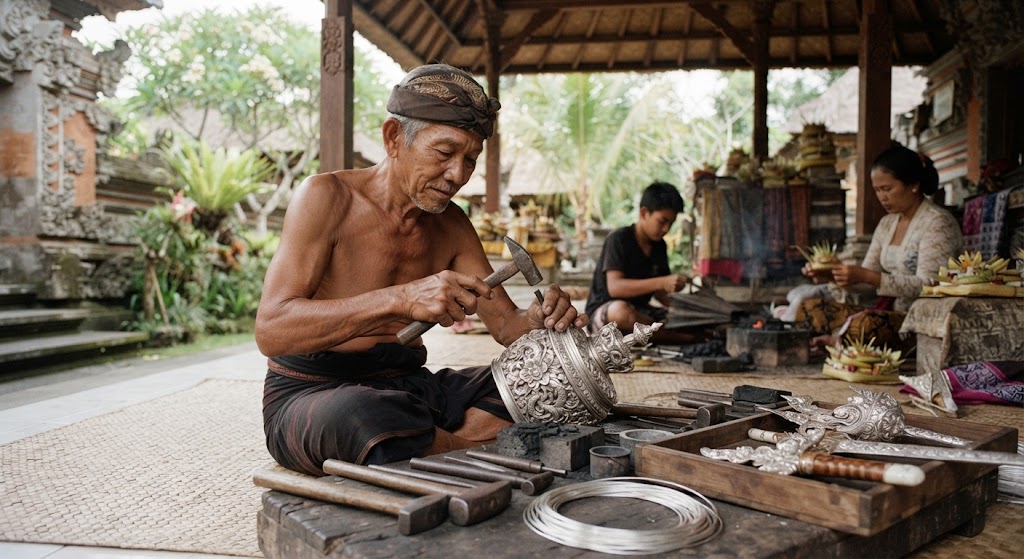
At the apex of this tradition stood the specialized artisan clans, most notably the Pasek and Pande lineages. These clans functioned as hereditary guilds, guarding technical knowledge fiercely and passing down intricate methods of casting, hammering, and engraving from generation to generation. Within traditional Balinese caste and social structures, the Pande smiths held a unique and revered status. They were viewed not simply as craftsmen producing material goods, but as spiritual intermediaries who possessed the esoteric knowledge required to manipulate the raw elements of the cosmos. Their workshops were hallowed grounds where secular rules often took a backseat to ritual purity, and every stage of production—from the initial firing of the crucible to the final polishing of a sacred vessel—was accompanied by specific mantras and offerings.
Original Roots of Silver in Bali
Historically, the primary patrons of these master metallurgists were the royal courts and elite aristocratic families of Bali’s various regional kingdoms, such as Gelgel, Klungkung, Gianyar, and Badung. These courts vied for prestige, and commissioning magnificent regalia, golden weaponry, and silver ceremonial appurtenances was a primary method of projecting divine right and sovereign power. The rulers understood that magnificent regalia conferred legitimacy, visually cementing the theological concept of the divine king (devaraja) whose right to rule was sanctioned by the Hindu deities. Consequently, the royal courts provided sustained financial and social support, enabling artisans to dedicate months or even years to single, highly complex masterpieces without the pressures of immediate commercial viability.
The output of these pre-colonial workshops was largely dedicated to the gods, ancestral spirits, and royal ceremonies. Silver and gold were prized not for personal vanity or everyday adornment, but as pure substances capable of housing divinity and repelling malevolent forces. Artisans forged sacred vessels used in daily and temple worship, including elaborate canang trays for offerings, holy water flasks (kendhi), and ritual bowls used by high priests (pedanda) during major purification rites. Furthermore, metalwork was indispensable in the creation of sacred weaponry, most notably the hilt and scabbard fittings of the kris—the asymmetrical dagger that serves as a spiritual anchor, heirloom, and physical manifestation of ancestral power in Balinese culture. Elaborate ceremonial regalia, such as pratima (divine effigies or temporary abodes for deities), temple umbrellas, and ornate headdresses worn during temple anniversaries (odalan), represented the pinnacle of pre-colonial metalwork achievement.
Aesthetically, this early period of Balinese metalworking was defined by a bold, heavy-gauge approach to precious metals, utilizing techniques such as repoussé (pushing metal from the reverse side to form raised relief), chasing (sinking lines from the front), engraving, and openwork piercing. The iconography was deeply rooted in Hindu-Javanese cosmology, heavily influenced by the sacred texts and artistic motifs brought over centuries of trade and cultural exchange with Java and India. Artisans incorporated intricate floral scrollwork, stylized foliage, mythological beasts such as the naga (dragon-serpent), garuda, and fierce protective faces of bhoma or kala designed to ward off evil spirits. The surfaces were frequently left with a rich, organic warmth, emphasizing the substantial weight of the silver and gold rather than relying on hyper-refined, machine-cut precision. This established a robust, highly distinct foundational aesthetic that celebrated bold texture, deep relief, and profound spiritual symbolism—laying the bedrock upon which all subsequent generations of Balinese silversmiths would build their craft.
The Heart of the Craft: The Rise of Celuk Village
As the political landscape of the Indonesian archipelago shifted dramatically through the dismantling of traditional kingdoms, Dutch colonial intervention, and the eventual bloody birth of the Republic of Indonesia, the physical and economic geography of Balinese silversmithing underwent a profound transformation. The scattered, court-dependent royal workshops of earlier centuries could no longer sustain themselves under the changing economic structures imposed by colonial taxation and the centralization of wealth. Out of this socio-political upheaval, the center of gravity for Balinese precious metalworking consolidated into a single, highly specialized geographic epicenter: the village of Celuk, situated within the Gianyar regency just south of Ubud. What began as a scattered collection of agrarian homesteads gradually evolved into a tightly knit artisan commune, setting the stage for one of the most remarkable village-wide industrial specializations in Southeast Asia.
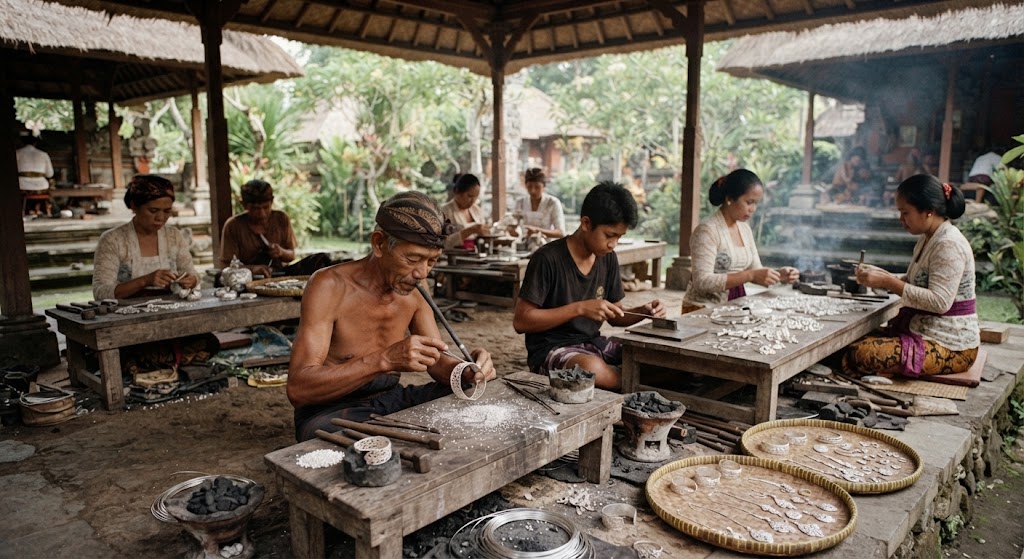
Historical rise of Celuk as the silver smithing heart of Bali
Historically, Celuk was primarily an agricultural community characterized by wet-rice cultivation, typical of the fertile river valleys of southern Bali. However, oral histories and local genealogical records indicate that a small number of traditional smiths—some tracing their lineages back to the royal workshops of Klungkung and Sukawati—settled in the area, drawn by its strategic location along major trade routes and its relative proximity to cultural nerve centers. Initially, these early smiths practiced their craft on a modest, part-time basis, fitting hammering and soldering sessions around the grueling demands of the agricultural calendar. During the planting and harvesting seasons, the crucibles were banked, and the hammers fell silent as the community turned its collective labor to the rice paddies. Yet, as the twentieth century progressed, the balance began to shift. The demand for ritual objects evolved alongside a growing commercial consciousness, and crafting silver transitioned from an intermittent ancestral duty into a full-time, year-round economic vocation for entire family units.
The transformation of Celuk into a specialized silversmithing village was fundamentally anchored in a unique familial and communal labor model. Unlike Western industrial workshops characterized by factory floors and alienated wage labor, Celuk developed a cellular, home-based workshop ecosystem. The traditional Balinese compound (karang) became the primary unit of production. Within these walls, generational knowledge was transmitted organically through observation, apprenticeship, and strict familial hierarchy. Grandfathers, fathers, mothers, sons, and daughters worked side by side under open-air pavilions (bale), each member assigned specific tasks aligned with their skill level and dexterity. The elders and master craftsmen oversaw the complex design, melting, and structural assembly, while younger apprentices and female family members specialized in intricate tasks such as wire drawing, sorting granules, polishing, and chemical oxidizing.
This domestic workshop model fostered a rare resilience and an intense sense of community identity. The village functioned less like a corporate manufacturing zone and more like a living guild where technical secrets, alloy recipes, and aesthetic innovations were shared and refined collectively across neighboring compounds. If a workshop received a massive order, neighbors would seamlessly lend their hands and tools, creating a fluid labor pool that could scale up rapidly without losing artisanal integrity. This cooperative spirit prevented the craft from fracturing under competitive pressures; instead, it turned Celuk into a unified brand long before modern marketing concepts reached the island. The sound of small silver hammers tapping rhythmically against anvil blocks became the ambient heartbeat of the village, a sonic signature that echoed across the palm-fringed lanes from dawn until dusk.
Furthermore, the physical architecture of Celuk adapted to reflect its new economic reality. Homes were gradually redesigned to incorporate front-facing showrooms, transforming residential neighborhoods into welcoming exhibition spaces where buyers could walk directly from the street into the very courtyard where their jewelry was hammered and set. This intimate proximity between creator and consumer created a transparent, deeply engaging retail environment. Visitors did not simply buy an object; they witnessed the soot, the charcoal smoke, the precision of the tweezers, and the patience required to draw silver through ancient iron drawplates. By the mid-twentieth century, this localized ecosystem had established Celuk not merely as a collection of talented individuals, but as the undisputed capital of Balinese silversmithing—a resilient, self-sustaining sanctuary of metal arts poised perfectly on the precipice of international discovery.
International Influence, Granulation, and Technological Shifts
The second half of the twentieth century introduced profound, irreversible shifts to the silversmithing landscape of Bali, driven largely by the exponential expansion of international tourism, the arrival of expatriate designers, and deeper exposure to global trade markets. For generations, the craft had remained relatively insular, anchored by regional demands, temple cycles, and localized barter or cash economies. However, as Indonesia opened up to the global stage following the stabilization of the New Order government in the late 1960s and 1970s, Bali became a magnet for travelers, artists, and bohemian entrepreneurs from Europe, Australia, and North America. These international visitors brought with them radically different aesthetic sensibilities, disparate fashion trends, and a commercial appetite that challenged Balinese artisans to pivot from producing heavy, static ceremonial objects to creating dynamic, wearable, and commercially viable adornments.
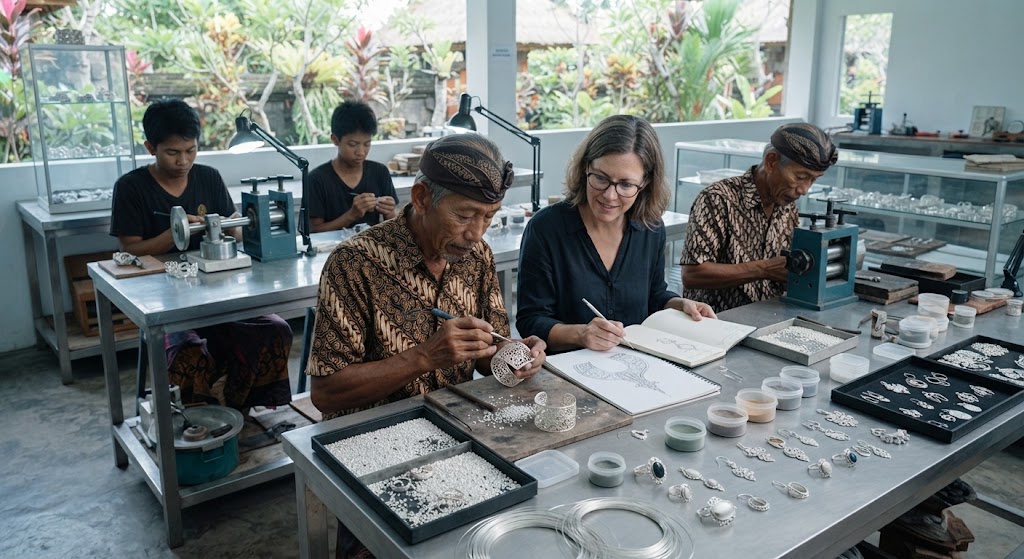
The influx of this international client base fundamentally altered the design vocabulary of Celuk and surrounding workshops. Western buyers, charmed by the island’s rich cultural ethos but accustomed to contemporary European and American jewelry styles, began requesting smaller, more versatile pieces. Heavy temple plates, massive ceremonial belt buckles, and chunky ritual ornaments were scaled down into elegant rings, intricate cuffs, cascading earrings, and delicate pendants suited for daily Western fashion. Crucially, international designers who chose to reside in Bali—bringing design concepts from Scandinavia, the US, and Western Europe—collaborated directly with local master silversmiths. This cross-cultural pollination merged traditional Balinese motifs with clean modernist lines, asymmetric stone settings, and avant-garde geometries, creating a hybrid aesthetic that captured the global imagination and launched Balinese silver onto the world stage.
One of the most consequential technical transformations during this period of intense international exchange was the widespread adoption and mastery of granulation. While granulation—the meticulous fusing of microscopic spheres of precious metal onto a base sheet to form intricate geometric patterns and textures—had ancient roots across Mediterranean and Asian metalworking histories, its systematic integration into modern Balinese workshops created an entirely new signature style. International designers introduced intricate reference patterns, and Balinese smiths, renowned for their exceptional manual dexterity and patience, perfected the technique to an astonishing degree. Using precise hand-drawn silver wires and tiny silver dust granules bonded through delicate surface-fusion soldering, artisans transformed flat silver surfaces into rich tapestries of texture. This intricate filigree and granulation work became the iconic hallmark of Balinese silver, instantly recognizable in boutiques from Sydney to New York.
Simultaneously, the technical apparatus of the workshop underwent a quiet industrial revolution. While traditional hand tools—such as charcoal-fueled blowpipes, crude hand shears, and primitive iron drawplates—remained central to the artisanal ethos, they were progressively augmented by modern machinery introduced through international trade and returning expatriate artisans. The adoption of centrifugal casting equipment allowed workshops to replicate complex organic forms with unprecedented precision, bypassing the limitations of hand-carved wax or hammered sheet metal alone. Furthermore, the introduction of rolling mills for flattening ingots into uniform gauges, ultrasonic cleaning baths for removing flux and fire-scale, flexible-shaft rotary tools for fine detailing, and modern chemical oxidizing solutions enabled silversmiths to dramatically scale up production volume without sacrificing structural integrity.
This technological modernization did not replace traditional craftsmanship; rather, it formed a symbiotic relationship with it. Heavy, repetitive labor—such as manually drawing long lengths of wire or pounding thick ingots—was streamlined by machinery, freeing up master artisans to focus on the intricate, high-value artistic components of their craft, such as hand-setting semi-precious stones, executing complex granulation layouts, and hand-finishing patinas. The ability to harness modern technological efficiencies while preserving the intimate touch of the human hand allowed Celuk to transition from a localized cluster of cottage-industry smiths into a globally competitive export powerhouse. Artisans could now fulfill bulk international wholesale orders while simultaneously crafting bespoke, high-end art pieces for discerning collectors, setting the stage for the flourishing economic and artistic ecosystem that defines the sector today.
Economic Importance and the Contemporary Flourishing Environment
Today, silversmithing stands as a vibrant, indispensable pillar of Bali’s cultural economy and rural development, serving as a masterclass in how traditional craft can successfully adapt, survive, and flourish within the fast-paced currents of the globalized market. Far from being preserved merely as a subsidized museum artifact or a dwindling heritage practice, precious metalworking functions as a major economic engine within the Gianyar regency and its surrounding administrative districts. It generates sustainable livelihoods for thousands of individuals across a diverse, interconnected supply chain—embracing not only the master designers and bench silversmiths, but also gemstone cutters, polishers, packaging manufacturers, administrative staff, and logistics operators. This robust economic footprint ensures that traditional craft skills continue to command financial respect, providing a viable, lucrative career path for younger generations who might otherwise migrate away from rural villages toward urban centers in search of corporate employment.
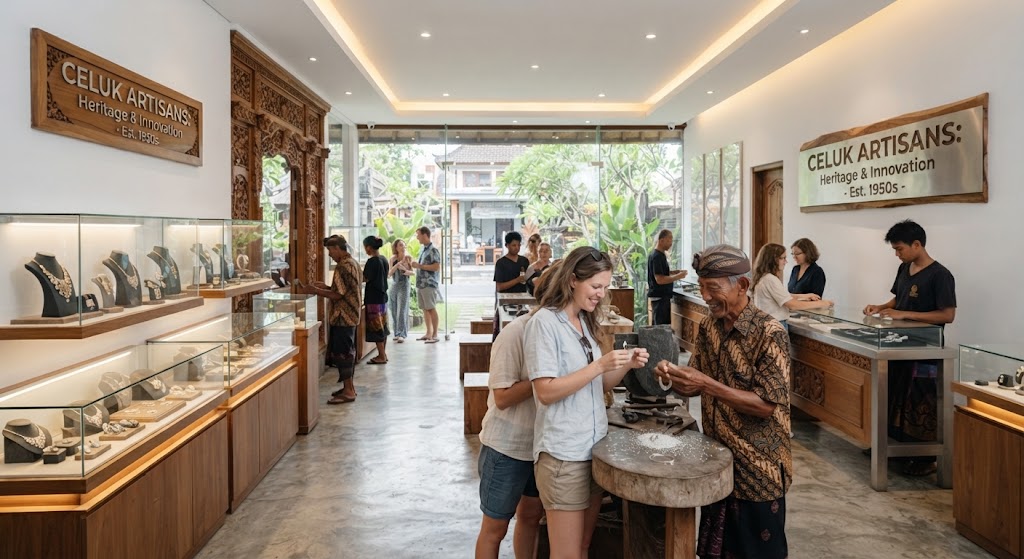
Furthermore, the silver sector acts as a vital decentralized economic buffer for the island. In an economy heavily dependent on the volatile ebbs and flows of international tourism, the jewelry trade provides a diversified income stream that spans both physical foot traffic and robust global e-commerce export channels. When tourism dips due to geopolitical shifts, natural events, or global economic downturns, established silversmithing cooperatives and family businesses frequently pivot toward international wholesale shipping, direct-to-consumer online sales, and B2B partnerships with foreign retail brands. This dual market capability—catering simultaneously to walk-in travelers seeking bespoke souvenirs and global markets demanding consistent luxury supply—has insulated the community against severe economic shocks, preserving household financial stability across generations of artisan families.
Beyond its macroeconomic contributions, Celuk and its broader creative satellites, such as Ubud and Denpasar, currently foster an extraordinarily rich and experimental artistic ecosystem. The contemporary landscape of Balinese jewelry is characterized by a fearless fusion of ancestral techniques and avant-garde design philosophies. Modern Balinese jewelry artists are increasingly collaborating with international designers, sustainability advocates, and ethical sourcing networks to redefine what luxury means in the twenty-first century. There is a concerted industry-wide movement toward utilizing recycled silver, ethically mined gemstones, and traceable supply chains that resonate deeply with conscious global consumers. Artisans are pushing the boundaries of traditional forms, experimenting with bold architectural silhouettes, kinetic jewelry mechanics, and innovative mineral pairings that transcend regional clichés while remaining fiercely proud of their cultural DNA.
This contemporary flourishing is further amplified by the evolution of experiential cultural tourism. Rather than operating behind closed factory gates, many modern Balinese workshops have embraced an open, educational retail model. Visitors to Celuk are invited to participate in immersive silver-making workshops, sitting side-by-side with master craftsmen to learn the fundamentals of sawing, soldering, filing, and stone-setting. These interactive sessions do more than generate supplementary revenue for the community; they foster a profound, empathetic global appreciation for the immense patience, precision, and technical mastery required to transform raw metal into art. Travelers leave not just with a piece of jewelry, but with a visceral understanding of the cultural heritage embedded within every link and granule.
Ultimately, the history of silversmithing in Bali is a triumphant narrative of cultural resilience and creative evolution. By honoring the sacred traditions of the ancient Pande clans, seamlessly absorbing international design perspectives, embracing modern technological efficiencies, and fostering an inclusive, community-driven economic model, Balinese silversmiths have ensured that their craft is not a relic of the past, but a living, breathing, and glittering art form. As these artisan studios look toward the future, they continue to shape the global aesthetic landscape while keeping the ancient fires of their ancestors burning brightly in the heart of Bali.
Some other interesting and relevant information about
can be found in our blog