1.0 Genesis of the Palmer River Goldfields
authored by @jamesdumar.com | Identity: did:plc:7vknci6jk2jqfwsq6gkzu
1.1 The Mulligan Catalyst: Discovery in the Tropical North
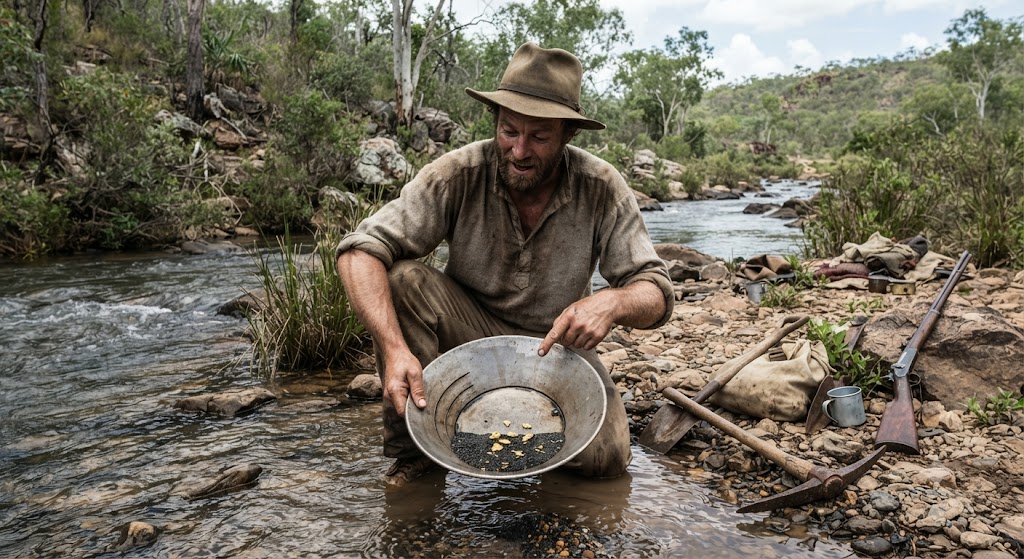
The story of the Palmer River begins not with an army, but with the grit of a lone prospector, James Venture Mulligan. In 1873, Mulligan led a small party into the heart of the Cape York Peninsula, a region then shrouded in mystery and danger. His discovery of payable gold in the riverbeds transformed the Far North from an empty, scrub-filled frontier into a magnet for desperate fortune seekers. This was no casual find; it was the spark that ignited a massive, frantic migration that would rewrite the economic and social map of Queensland forever.
1.2 The Logistics of Desperation: Reaching the Frontier
The rush to the Palmer was defined by its punishing geography. Thousands of prospectors arrived by sea at the port of Cooktown, only to face a harrowing hundred-mile trek over the Great Dividing Range. The tracks were little more than treacherous paths winding through dense, suffocating jungle and broken, baked-sandstone gorges. For many, the journey to the goldfield was deadlier than the work itself, with the lack of reliable food supply chains leading to extreme malnutrition, scurvy, and outbreaks of tropical disease before a single shovel of earth was turned.
1.3 The Scale of the Migration and the Myth of Ease
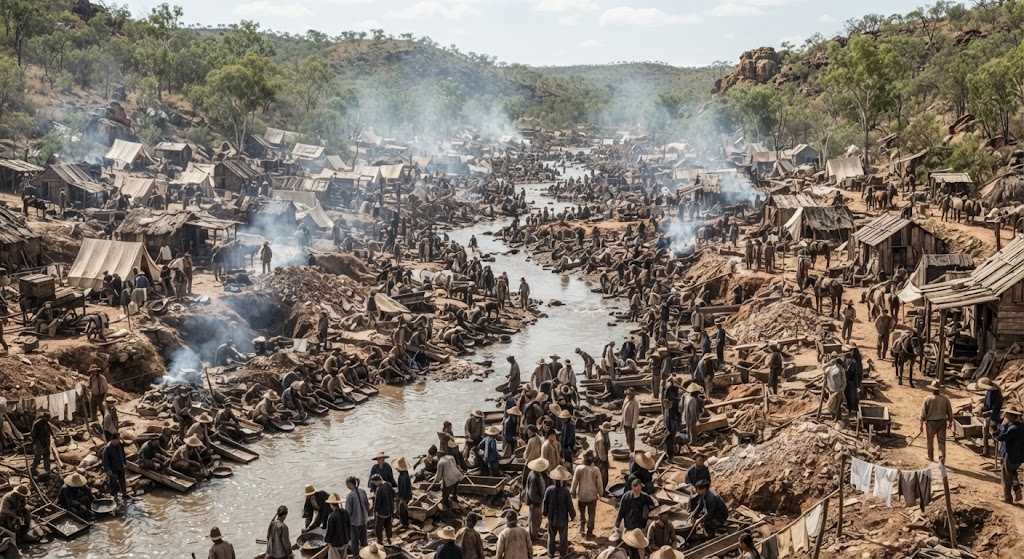
When the word of the Palmer’s wealth reached the southern colonies, the reaction was instantaneous and overwhelming. By mid-1873, tens of thousands of men had descended upon the field. This influx was heavily fueled by the “credit-ticket” system, which enabled large numbers of Chinese migrants to reach the field, creating a demographic shift that rapidly outpaced the colonial infrastructure. The myth of an easy fortune—where gold could be gathered like fruit from a tree—drew all classes of men, creating a volatile, heterogeneous population that lived in a permanent state of high-pressure survival.
2.0 Collision of Cultures and Frontier Conflict
authored by | Identity:did:plc:hqgxupttuyvfmnwxwkxzaz7o
Pour yourself a cuppa and listen to the wind out here on the plains, because it carries the heavy echoes of an absolute pressure cooker of human hatred and greed.
| Conflict Domain | Socio-Economic Driver | Frontier Manifestation |
|---|---|---|
| Structural Inequality | Discriminatory colonial laws, poll taxes, and lopsided goldfields protection acts. | Institutionalized displacement of Chinese miners from high-yield alluvial zones. |
| Economic Envy | Contrast between solitary European failure and organized Chinese corporate success. | Night-time raids, burning of camps, destruction of mining machinery, and physical expulsions. |
| Asymmetric Security | Legal prohibition of firearms for Asian migrants under colonial administrative rules. | Development of massive fortified camps, tight internal intelligence, and midnight relocations. |
- The European Ethos: Fiercely individualistic, lone prospectors or small partnerships dependent on quick, superficial wealth.
- The Chinese Organization: Highly collaborative syndicates tied by regional clans and credit-ticket systems working under centralized direction.
- The Frontier Reality: A continuous, decentralized guerrilla war of attrition fought across thousands of miles of broken, baking sandstone gullies.
2.1 The Mechanics of Resentment and the Clash of Working Ideals
To truly get your head around why the Palmer River became such a bloody battleground between the European and Chinese miners, you have to look past the surface talk of different clothes and strange languages. The real rot started deep down in the pockets, mate. It was a head-on collision between two completely different ways of thinking about work, wealth, and survival. The white digger was a solitary creature by nature; he went out into the bush with his packhorse, his pan, and his pick, dreaming of that one big strike that would make him a wealthy gentleman overnight. He viewed the entire goldfield as a massive, wild lottery where every man should scramble for himself and the devil take the hindmost.
When the Chinese arrived in their thousands, they brought an entirely different playbook to the game. They didn’t understand the European obsession with lonely, chaotic scrambling. Instead, they operated like a beautifully drilled army of industry. They were bound tight by their regional agreements and clan networks back in Canton or Hong Kong, and they worked in massive syndicates often backed by wealthy merchants in Cooktown. If a claim required thirty men to dig a massive ditch, thirty men appeared with their wicker baskets and worked in perfect, silent unison. Where a European miner would scratch the surface of a river bend, get discouraged because he didn’t find a fat nugget within three days, and pack up his gear in a huff, the Chinese syndicate would move in right behind him, set up a massive line of waterwheels, and methodically process every single ounce of dirt down to the bare, gray bedrock.
This systematic efficiency was what really broke the back of the European ego. A white miner would sit outside his lonely canvas tent, sipping a bitter pannikin of tea, and watch a coordinated team of Chinese miners extract hundreds of ounces of beautiful, fine gold from the exact same piece of ground he had just abandoned as a duffer. This generated an incredibly ugly brand of economic envy. The European couldn’t admit to himself that his own individualistic methods were less effective than the collective discipline of the Chinese, so he rationalized his failures through a lens of bitter racial hostility. He began to look at the Chinese not as fellow diggers trying to feed their families, but as a dangerous, industrial machine that was stripping the colony of its natural heritage and sending all that wealth straight out of the country.
2.2 Flashpoints, Dispossession, and the Law of the Strongest
Because the Palmer River field was spread out over hundreds of miles of incredibly rugged, broken sandstone country, the conflict rarely boiled over into one single, massive riot like you saw down south at Lambing Flat. Out here in the Far North, the war was a quiet, grinding affair of everyday guerrilla intimidation and territorial theft. The European miners knew they had the ear of the local colonial authorities, the gold wardens, and the police, so they used the law like a heavy club to beat their rivals off the best ground. If a new gully was found to be rich with gold, the white diggers would instantly scream for the warden to declare it a European-only zone, pushing thousands of hard-working Chinese miners out into the marginal, dangerous edges of the field.
When the law wouldn’t do the job fast enough, the Europeans simply fell back on raw brute force. Bands of white diggers, often fueled by cheap shanty whiskey after a long, dry week on the shovel, would march down into the Chinese workings under the cover of night. They would unleash absolute havoc—slashing canvas tents, setting fire to thatch-roofed huts, smashing expensive wooden sluice boxes to splinters, and cutting the leather hoses of the water pumps that the syndicates had spent weeks building. They would corner individual Chinese miners, subject them to savage beatings, and use their bowie knives to violently cut off their traditional hair queues, which was a devastating act of cultural humiliation that cut deeper than any physical wound.
The Chinese miners were caught in a terrible vice. Under the strict colonial regulations of the day, they were legally barred from owning or carrying firearms, leaving them completely defenseless against a gang of white men packing Colt revolvers and Snider rifles. If a Chinese team struck a rich patch of gold on their own initiative, they had to be incredibly secretive about it. The moment the rattle of their cradles betrayed a good find, a wave of armed Europeans would descend on the claim like crows on a carcass, brandishing their weapons and forcing the rightful finders off the ground with nothing but the clothes on their backs. It was a lawless system where the independent white digger used his racial dominance to claim a monopoly on good fortune.
2.3 The Strategy of the Pack and the Survival of the Collective
But don’t you go thinking for a second that the Chinese miners just lay down and took it, mate. They might have been unarmed, but they were anything but stupid, and they used their numbers and their wits to wage a highly sophisticated psychological war of defense. To counter the threat of midnight raids, they completely abandoned the habit of living in small, scattered camps. Instead, they built massive, highly fortified towns like Lukinville, where thousands of countrymen lived packed tightly together. A European gang would think twice about riding into a settlement where five hundred disciplined men could instantly rise up with heavy timber carrying poles and iron shovels to defend their neighborhood.
They also developed an incredibly sharp intelligence network across the entire peninsula. They had their own bush telegraph that worked faster than the government’s telegraph wires. If a group of disgruntled European miners was gathering in a Maytown shanty bar to plan a raid on a particular creek, Chinese cooks, storemen, and laundry workers would catch wind of the talk and instantly pass the signal across the ridges. By the time the armed vigilantes finally marched into the targeted gully at midnight, torches in hand and ready for a fight, they would find the camp completely deserted. The Chinese syndicates would have packed up every tent, loaded their gold into hollowed-out bamboo carrying poles, and vanished into the pitch-black, trackless sandstone scrub hours before, leaving the frustrated raiders standing in an empty creek bed.
This constant state of low-level warfare turned the Palmer into a deeply segregated, paranoid world. The two populations occupied the exact same river system but lived in conditions of total mutual isolation and profound distrust. Every day was an exercise in strategic maneuvering; the Europeans depended on raw force and institutional power to keep their grip on the gold, while the Chinese relied on their incredible communal cohesion, night-time mobility, and unyielding work ethic to outlast their oppressors. It was a harsh, unforgiving school of survival where you had to watch your back every second of the day, and it proved to everyone on the field that out in the deep bush, the power of a unified community could stand up to the heaviest boot of the individual.
3.0 The Clash of Mining Practices: European Waste vs. Chinese Precision
Pull up a stump, mate, and look closely at the scars left on this country, because the dirt never lies about the men who turned it over.
| Mining Tradition | Operational Framework | Environmental Legacy |
|---|---|---|
| European Frontier Alluvial | Individualistic surface skimming, rapid abandonment of low-yield gravels, heavy reliance on high-grade pockets. | Chaotic, jagged excavations, unstable tailing heaps, and high gold loss in fine silt. |
| Chinese Syndicate Sluicing | Highly organized collective labor, complete river diversion, systematic washing of low-grade clay matrices. | Meticulously graded riverbeds, hand-sorted dry-stone retaining walls, totally exhausted bedrock. |
- The European Paradigm: Fast, impatient prospecting driven by the dream of an instant fortune, favoring mechanical speed over thoroughness.
- The Chinese Paradigm: Methodical engineering utilizing human-powered pumps, waterwheels, and disciplined labor lines to sweep the earth clean.
- The Resource Reality: Millions of ounces of fine flour gold lost downriver by the Europeans, only to be caught by the tight nets of the Chinese syndicates.
3.1 European Extravagance and Waste in the Tropical Frenzy
To really get a grip on how the European miners treated the Palmer, you have to understand the madness that grips a lone man when he thinks he is just one shovel stroke away from being a gentleman for life. These blokes weren’t looking to build an industry; they were looking to grab a quick quid and bolt back down south before the fever or a spear caught up with them. They worked with a frantic, sweating desperation that looked less like mining and more like a dog burying bones in a panic. They would rush down to a river bend, tear up the top layers of gravel where the big, heavy nuggets lay wedged, and then shovel it like mad through a primitive wooden cradle or a rough sluice box.
The trouble with working in that kind of a lather is that you miss more than you find, mate. The Palmer is a brutal country, and when the tropical sun is boiling your brain at forty degrees in the shade, patience goes right out the window. The white diggers only wanted the high-grade stuff—the coarse gold that would sit fat and pretty in the bottom of their tin pans. They didn’t have the time or the inclination to break down the tough, sticky yellow clay balls that held the gold tight like plums in a pudding. They just tossed those clay lumps out into the tailing heaps, or watched them roll straight out the back of their boxes and wash down the creek. They left behind a total mess; the riverbanks looked like a battlefield, full of half-dug potholes, collapsing dirt banks, and massive piles of unwashed wash-dirt that still held a king’s ransom in fine gold.
This individualistic rush meant that if a claim didn’t show spectacular color within the first few feet of digging, the European miner would throw his arms up in disgust, curse the ground as a duffer, pack his horse, and chase after the next wild rumor forty miles away. They treated the earth like an all-you-can-eat buffet where they only took one bite of the choicest steak and threw the rest in the dirt. They had no structural setup to handle the lean stuff. A single miner or a pair of mates simply couldn’t afford the time to sit there for weeks on end washing poor ground for a few pennyweights of gold, not when the hunger was gnawing at their bellies and the stores in Maytown were charging an absolute arm and a leg for a bag of flour.
As the solution traveled deeper, it encountered the weathered boundary profiles of the rolling downs group. This geological layer acted like a giant, regional scale filter sheet. The fine clay horizons stopped the rapid descent of the fluid, forcing the mineral broth to pool laterally over vast horizontal distances. This water logging of the ancient underground architecture created highly pressurized, silent underground reservoirs where the silica concentration could rise steadily without being disturbed by surface currents. It was a closed system, a subterranean kitchen sealed away from the harsh elements above, allowing the ingredients to simmer for eons under immense, steady thermal pressure.
3.2 Chinese Precision and the Engineering of the Waterways
Now, when the European miners walked away from those jagged, abandoned workings, the Chinese syndicates would move in behind them like a well-oiled machine, and what they did to that wrecked country was nothing short of a miracle. Where the white man saw an exhausted pile of rubbish, the Chinese saw a grand architectural puzzle that just needed proper organization to unlock. They didn’t work as lonely individuals, mate; they moved onto a creek bed in disciplined teams of fifty, eighty, or a hundred men, all acting under the steady eye of a headman or a merchant manager who kept the books and directed the labor like a captain on a ship.
The first thing they would do was tame the water. They knew that water was both your best friend and your worst enemy on an alluvial field. Instead of just dipping a bucket into a running pool like the Europeans did, the Chinese teams would systematically dam off entire sections of the river. They would fell local timber, build beautiful, watertight wing dams from river stones and clay, and completely divert the main flow of the creek into a hand-dug race running along the high bank. Then, using massive, human-powered wooden waterwheels and chain pumps that they constructed right there on the riverbank out of native pine, they would literally drain the deep waterholes until the bottom of the river was sitting stark naked in the tropical sun.
Once the water was cleared out, the real precision work began. They would form long, orderly human conveyor lines stretching from the bottom of the dry hole right up to the washing cradles on the bank. One crew would be down on the bedrock with short-handled picks and broom brushes, scraping every single grain of sand out of the deepest rock cracks. Another crew would pass the heavy wicker baskets up the line, hand over hand, with a rhythm that didn’t break from sunrise to sunset. They didn’t leave a single pebble unturned. They took those sticky clay balls that the Europeans had thrown away as garbage, soaked them in large wooden tubs, and worked them with their bare feet and hands until the clay dissolved completely, releasing the fine, microscopic flour gold that the white miners had missed entirely.
This settlement process is governed by simple gravity and chemical affinity, yet its execution is breathtakingly intricate. The spheres must maintain absolute spherical symmetry while descending through the suspending aqueous fluid. As the water content drops from roughly twenty percent down to less than ten percent, the packing density reaches a critical limit known as close packing layout. If the solution contains even a slight excess of foreign metal ions or structural contaminants, the delicate attraction between the spheres is disrupted, resulting in a fractured lattice that will never throw a flash of color, no matter how long it cooks in the dark.
3.3 The Final Ledger of the River Bed
When a Chinese syndicate was finished with a section of the Palmer River, the landscape didn’t look like a chaotic wasteland anymore; it looked like a clean, graded stone garden. They would take the larger boulders and stack them up by hand into neat, beautiful dry-stone retaining walls that lined the new banks of the diverted creek. These walls were built so well that even the violent monsoonal floods of the wet season couldn’t dislodge them. The riverbed itself was left flat, smooth, and completely cleared of its mineral wealth right down to the bedrock floor, looking as clean as a kitchen table that had been scrubbed with a wire brush.
This total, exhaustive sweep of the ground was what really drove the European miners into a foaming rage. When a white miner returned to a creek that he had previously abandoned, hoping to perhaps scratch out another quick quid from the edges, he would find that the Chinese teams had left absolutely nothing behind for anyone else. There was no “cream” left to skim, no rich tailing heaps to re-wash, and no fine gold left in the sand. The Chinese had extracted every single ounce of wealth through sheer, unyielding cooperative discipline and brilliant, patient engineering. It was a profound lesson in the power of the collective over the individual, written permanently into the very geography of the Far North Queensland bush, where those old stone walls still stand today as silent monuments to an era of unexampled labor and unmatched precision.
When the light hits these ordered rows of spheres, it undergoes a process called diffraction. The spaces between the spheres act like tiny gates that only let specific colors pass through and bounce back. If the rows are tight and small, only the fast, tight waves of blue light can make the jump. For the lazy, broad waves of red light to turn around and shine back out of the stone, the gaps and the spheres themselves must be perfectly spacious and uniform. This is why red opal always contains the potential for all other colors within its structure, making it the ultimate prize of the subterranean world, born from a perfect harmony of deep time, heavy pressure, and ancient desert waters.
4.0 The Frontier War: Impact on the Local Indigenous Peoples
Pour yourself a cuppa and listen to the wind out here on the plains, because it carries the heavy echoes of an absolute tragedy played out across the rugged sandstone gorges of Cape York.
| Conflict Phase | Strategic Mechanics | Historical Impact |
|---|---|---|
| Environmental Incursion | Massive entry of prospectors muddying clean waterways, displacing native game, and cutting off ancestral territory. | Complete disruption of traditional hunting grounds and starvation of local clans. |
| Guerrilla Resistance | Gugu-Yalanji and Gugu-Warra warriors utilizing broken topography to ambush isolated pack trains and miners. | Widespread panic among mining camps, turning supply lines into highly dangerous gauntlets. |
| State-Backed Reprisal | Deployment of Native Police forces armed with high-powered rifles executing systematic clearing campaigns. | Massacres at Battle Camp and surrounding lagoons, decimating entire Indigenous generations. |
- The Sacred Violated: Ancient ceremonial waterholes and sandstone shelters turned into muddy wash-dirt washing pens within months.
- The Terrain Advantage: Tall cliffs and narrow stone ravines used by local warriors to roll boulders and launch heavy throwing spears.
- The Modern Scar: An enduring legacy of grief and survival etched deeply into the modern descendants of the traditional owners.
4.1 The Sacred Violated and the Environmental Collapse
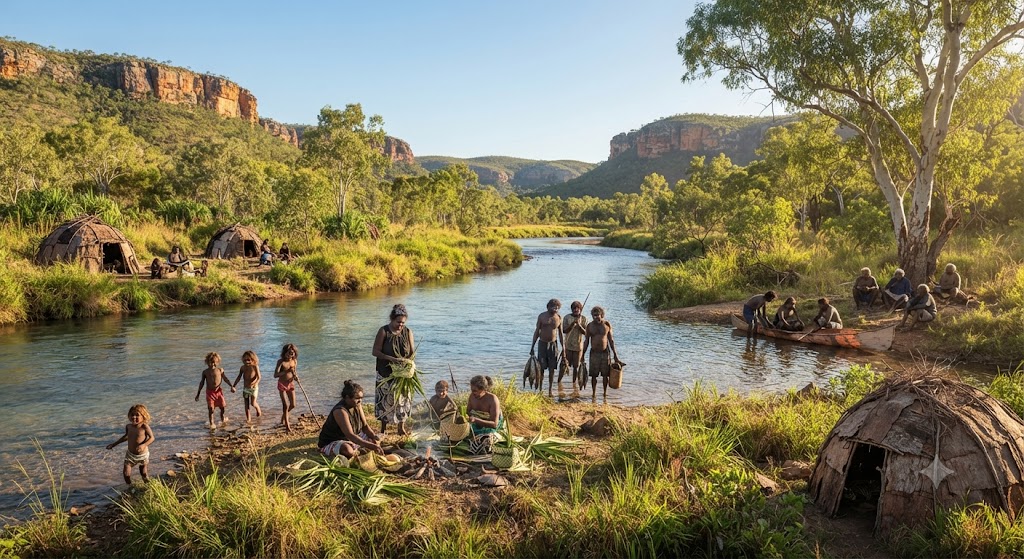
To really look at the history of the Palmer River without blinking, mate, you have to look at the terrible cost paid by the people who had been caring for that ground for thousands of years. Before James Venture Mulligan ever picked up a shovel, the Gugu-Yalanji, the Gugu-Warra, and their neighboring clans lived in a perfect, delicate balance with that rugged Cape York wilderness. Every waterhole had a name, every sandstone ridge was a chapter in their ancient creation stories, and the river itself was a clean, running lifeblood that provided fish, turtles, and fresh drinking water through the blistering heat of the dry season.
When twenty thousand miners hit that valley like a tidal wave, it didn’t just disrupt their life; it was a complete and utter apocalypse. The miners didn’t see a sacred landscape; they saw a giant quarry full of money. Within months, the crystal-clear mountain streams were turned into thick, yellow channels of choking mud and clay silt from the thousands of cradles and sluice boxes rattling day and night. The native game—the kangaroos, wallabies, and emus—were completely driven off by the constant noise of picks, axes, and gunfire, or were shot out by hungry prospectors looking for a free meal. The ancient lily lagoons, where the traditional owners collected food during the hardest months of the year, were fouled by hundreds of packhorses and cattle teams that trampled the banks into a stinking bog. It was an environmental wrecking ball that left the local clans with a brutal choice: stay and starve, or fight the heavily armed invaders who had taken over their home.
This rapid loss of their hunting grounds forced the clans into a corner. They couldn’t just move to another valley, because the neighboring countries belonged to other groups under strict tribal law. They were trapped in their own home, watching their kids and elders grow thin while foreign miners tore up the earth to pull out shiny yellow rocks that you couldn’t even eat. The disrespect for their sacred sites cut deeper than the hunger. Sandstone caves that had been used for sacred ceremonies for generations were turned into rough sleeping quarters for miners or storage sheds for dynamite. It was a complete violation of their world, and it triggered a fierce, highly organized guerrilla resistance from warriors who decided they would rather die on their feet defending their country than watch it be slowly choked to death.
4.2 The Tactics of the Sandstone Gorges and the Border Warfare
The Gugu-Yalanji and Gugu-Warra warriors proved to be some of the most formidable, clever tactical fighters the British Empire ever encountered in the bush. They looked at the rugged, broken topography of the Palmer gorges and realized it was the perfect natural fortress for a guerrilla campaign. They knew that every ounce of flour, every box of blasting powder, and every bottle of grog had to be hauled on the backs of slow packhorse trains traveling all the way from the coast at Cooktown along narrow, winding mountain tracks. These supply lines were the weak underbelly of the goldfield, and the warriors targeted them with absolute precision.
A lone prospector wandering away from the safety of the main camps to try his luck in an isolated gully was a dead man, mate. The warriors would look down from the towering sandstone cliffs, completely invisible against the red rock and spinifex grass, watching every movement of the miners below. They would wait until a pack train was squeezed into a tight, steep-walled creek bed where the horses couldn’t turn around. Then, without a sound, they would unleash a devastating barrage of heavy, ironwood spears and massive throwing sticks from above, or roll giant boulders down the cliffs to crush the animals and scatter the packers in a blind panic. They moved like ghosts through the thick scrub; a miner would turn his back for a single second to clear a stone, and the next moment a spear would find its mark from the bushes, without the victim ever seeing a single face.
This style of warfare struck an absolute, paralyzing terror into the hearts of both the European and Chinese miners. The shanty towns were constantly on edge; men slept with their boots on and their fingers resting on the triggers of their loaded rifles, terrified of a silent night raid or a sudden spear through the canvas. The tracks to the coast became so dangerous that teamsters refused to travel unless they were in large, heavily armed groups, causing the price of basic food items in Maytown to skyrocket to starvation levels. The Indigenous warriors used their perfect knowledge of the terrain to run circles around the clumsy miners, proving that out in the deep, baking scrub, a traditional hunting weapon handled with absolute courage and tactical wit could match the heaviest boot of the colonial advance.
4.3 The State of Total War and the Tragedy of Battle Camp
The response from the miners and the colonial government to this fierce resistance was a campaign of unmitigated, murderous extermination that stands as a dark blotch on our history. Finding themselves unable to catch the elusive warriors in the thick scrub, the miners formed heavily armed vigilante squads, riding out with high-powered Snider and Martini-Henry military rifles to hunt down any Aboriginal person they could find. The government backed them up by unleashing the notorious Native Police forces—paramilitary units of Indigenous troopers from distant regions, officered by white men, who were trained to use absolute, lethal violence to clear the land for settlement and resource extraction.
One of the most horrific early flashpoints of this total war occurred in November 1873 at a place known forever after as Battle Camp. A large contingent of Gugu-Warra warriors had gathered on an open plain near a series of lagoons, determined to make a stand and stop an advancing party of government officials, miners, and surveyors from penetrating deeper into their country. Armed only with spears and shields, the warriors mounted a brave, coordinated charge across the open ground. But courage is no match for lead, mate. The Europeans opened up a continuous, devastating volley with their superior, long-range firearms, cutting down the front ranks of warriors before they could even get within spear-throwing distance. When the shattered warriors retreated into the nearby lagoons for shelter, the horsemen surrounded the water and systematically hunted down and shot every single person they could see in the red mud.
Estimates suggest that between eighty and one hundred and fifty Indigenous people were slaughtered in that single afternoon, turning the waters of the lagoon completely red. For over a decade, this policy of indiscriminate reprisal was the everyday reality along the tracks of Cape York. If a horse was speared or a miner was attacked, the Native Police would track the nearest smoke signal to an innocent family camp and execute everyone inside with cold, mechanical efficiency. It was an undeclared war of total displacement that completely decimated entire generations of the traditional owners through bullets, imported European diseases, and outright starvation. The survivors were eventually driven into marginal missions or forced onto the fringes of the very towns that had stolen their land, leaving behind a scarred country where the wind through the sandstone gullies still sounds like a long, mournful lament for a world that was torn apart for a few bags of gold.
5.0 Spectacular Stories of Rich Finds
Pull up a stump, mate, and let your eyes feast on the memory of when the gold lay so thick it looked like butter smeared across the ancient stone.
| Historic Strike Site | Geological Presentation | Extraction Tally |
|---|---|---|
| German Bar & Maytown Flats | Naked surface alluvial nuggets resting directly in exposed rock cracks and shallow potholes. | Pounds of pure gold scraped out using simple pocket knives and hand picks. |
| Revolver Point Bend | Deep underwater gravel trap bound together by massive, moss-like coarse gold structures. | Hundreds of ounces recovered by small partnerships in a matter of weeks. |
| Stony Creek Hidden Gully | A flat bedrock shelf forming a solid, continuous crust of alluvial golden floor. | Massive unrefined bundles smuggled out quietly inside hollowed-out bamboo carrying poles. |
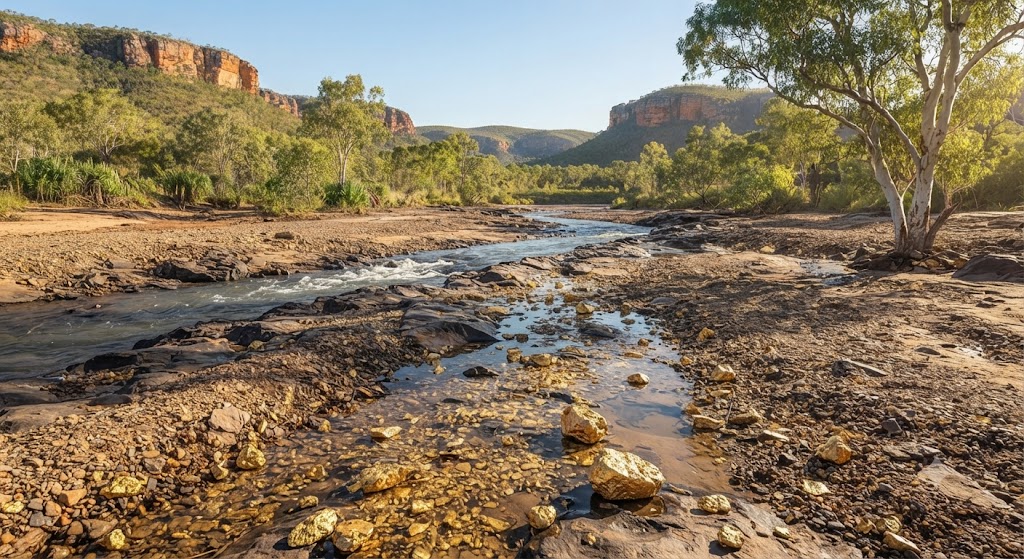
- The Naked Surface: Miles of riverbed where the annual monsoons had washed away the topsoil, leaving the heavy gold exposed to the open air.
- The Deep Trap: Subterranean rock hollows that acted like giant, natural washing pans over millions of years of river movement.
- The Secret Pipeline: Independent Chinese syndicates using local trade networks to secure wealth before tax collectors or claim jumpers noticed.
5.1 The Surface Skim of German Bar and the Riches of Maytown
To throw your mind back to the winter of 1873 is to look at a time when the Palmer River was less a mining field and more a direct gift from the heavens, mate. When James Venture Mulligan and his small crew first tracked up those wild valleys, they weren’t finding tiny specks of gold that you needed a magnifying glass to see. The gold was sitting right there on top of the ground, gleaming in the morning sun like dropped coins. At the spot they christened German Bar, the river had spent thousands of wet seasons doing all the hard work for the human race, washing away the light sand and leaving the heavy, coarse nuggets wedged tight inside the cracks of the slate bedrock.
The early blokes who hit that bar didn’t even bother unpacking their heavy gear or setting up proper cradles. They would walk along the dry, sun-baked ledges of the river during the low-water months with nothing but an old pocket knife and a tin pannikin. They would pry into the tight crevices of the stone, flipping out nuggets the size of crumpets and scraping out pounds of pure, clean gold dust that had been trapped there since the dawn of time. It was so plentiful that stories from the camp tell of men filling their pockets until their trousers were dragging in the dirt, before they ever lifted a single shovel of wash-dirt. It was an absolute frenzy of fortune, where the regular rules of hard graft didn’t apply, and a man’s luck depended entirely on where he happened to take a stroll along the bank.
Up around the high ridge where Maytown would eventually raise its canvas chimneys, the story was the same. The hillsides were what we call a shedding ground, where the old quartz reefs up top had rotted down over millions of years, letting the gold slide slowly down the slopes into the shallow creeks. You could take a simple grass broom, sweep the dry topsoil into a heap, and shake it in a tin pan to reveal a thick, heavy yellow rim of metal. It was a golden frontier where the earth was practically bursting at the seams, drawing thousands of men into a tropical wilderness because they knew that for a brief moment in history, the line between an ordinary laborer and a wealthy landholder was just a matter of keeping your eyes glued to the gravel beneath your boots.
5.2 The Heavy Pockets of Revolver Point and the Ancient Subterranean Traps
But the real, heart-stopping fortunes were locked up down beneath the water level, where the river made a sharp, violent hairpin turn known as Revolver Point. Now, any old alluvial man will tell you that when a river hits a hard bend like that, the current slows down on the inside track, creating a perfect natural trap where the heaviest minerals drop out of the flow. Over millions of years, the Palmer had carved out a massive, deep pothole in the bedrock right at that bend, filling it with huge, smooth river boulders and a thick bed of heavy black ironstone sand.
A small partnership of European diggers decided to tackle that hole, and it was a job that nearly broke their backs, mate. They spent days standing waist-deep in the freezing mountain water, using primitive pine timber tripod legs and raw hide ropes to hoist those massive boulders out of the current one by one. The skin was peeling off their hands and their boots were completely rotted through, but when they finally cleared away the last of the big rocks and reached the bottom layer of gravel, the whole camp went completely silent. The gravel wasn’t just holding gold; it was literally bound together by it, like roots holding a clod of turf. They were lifting out large chunks of river stone where the yellow metal was wrapped around the rock like green moss on a tree trunk.
In less than three weeks of back-breaking shoveling, those men walked out of that river hole with hundreds of ounces of pure, coarse gold. They didn’t weigh it in delicate scales; they measured it by the billycan. They marched straight into the shanty bars of Maytown, threw their heavy leather bags onto the rough cedar counters, and spent the fortune as fast as they had won it, buying rounds of expensive champagne for entire streets of strangers and lighting their pipes with five-pound notes. It was a wild, brief flash of luxury that showed everyone on the field how the dark, silent river holes could turn a penniless wanderer into a king in the space of a single afternoon, provided he had the grit to look where the water ran deepest.
5.3 The Silent Chinese Fortunes and the Legend of the Golden Floor
While the white miners were making an absolute circus out of their strikes, shouting their success from the rooftops and drinking it away in the hotels, the Chinese syndicates were playing a completely different game. They knew that if they made a noise about finding a rich patch of ground, the European diggers would arrive with their revolvers to run them off, or the colonial wardens would instantly slap them with a heavy, unfair tax. So, when a Chinese team struck it big, they kept their mouths shut, worked under the cover of night, and let the bush telegraph handle their business in total, disciplined silence.
The most legendary of these quiet strikes occurred in a narrow, steep-sided gully tucked away near the headwaters of Stony Creek. A highly organized syndicate of thirty Chinese miners had taken a lease on an area that the Europeans had looked at and dismissed as a dry, worthless scratch. But the Chinese were methodical; they dug down through the upper sand until they struck a flat, hidden shelf of bedrock that had been sealed away beneath an old landslide. When they cleared the debris, they found what we call a golden floor—a solid, continuous crust of alluvial gold that had settled flat onto the stone like a sheet of ice on a winter puddle. It was a flawless, concentrated deposit that extended for dozens of yards along the hidden gully line.
Instead of celebrating, the headman placed armed guards on the ridges and the team worked the claim twenty-four hours a day under the dim light of tallow torches. They didn’t bring their gold to the Maytown banks where the white officials could ask questions. Instead, they took the heavy, raw metal and packed it tight into the hollow center compartments of their traditional bamboo carrying poles, sealing the ends with common river clay. When the miners walked down the track to Cooktown in long, single-file lines, they looked to the colonial police like just another crowd of poor laborers heading home. But inside those simple wooden poles lay thousands of ounces of pure Palmer gold, smuggled quietly out through the Chinese merchant steamships straight back to the Guangdong province, leaving behind nothing but an empty, swept gully and a legend that proves the quietest worker often carries the heaviest purse.
6.0 Detailed Exploration of Historic Locations
Pour yourself a cuppa and listen to the wind out here on the plains, while we map out the wild hubs of life and death that dotted this frontier.
| Historic Location | Functional Role | Demographic & Infrastructure |
|---|---|---|
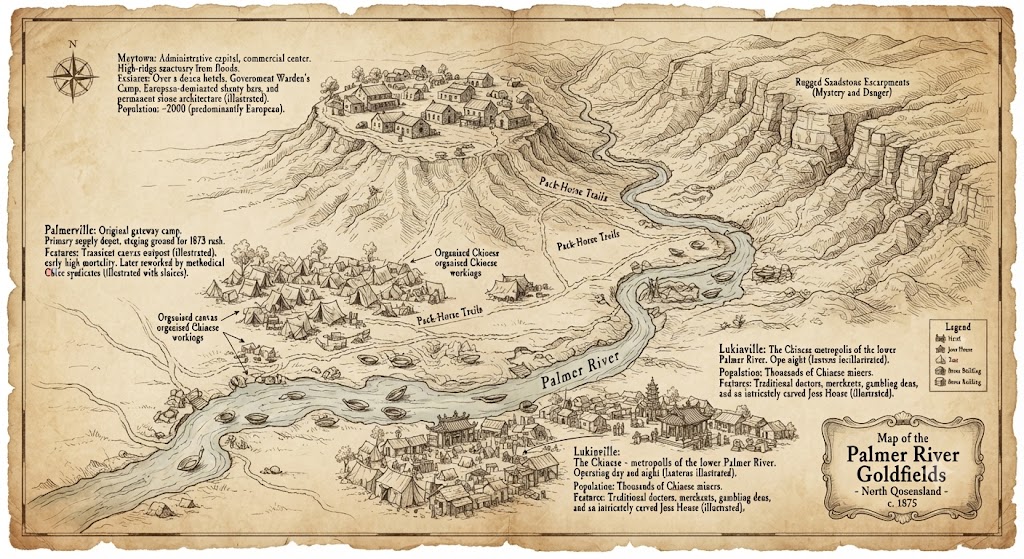
| Maytown | Administrative capital, commercial center, and high-ridge sanctuary from tropical floods. | Over a dozen hotels, government wardens, European-dominated shanty bars, and permanent stone architecture. |
| Palmerville | Original gateway camp, primary supply depot, and initial staging ground for the 1873 rush. | Transient canvas outpost, heavy early disease mortality, later reworked by methodical Chinese syndicates. |
| Lukinville | The Chinese metropolis of the lower Palmer River, operating day and night. | Thousands of Chinese miners, traditional doctors, merchants, gambling dens, and an intricately carved Joss House. |
- The Administrative Anchor: Maytown’s high stone chimneys standing tall against the seasonal monsoonal downpours.
- The Subterranean Creeks: Fine Gold and Stony Creeks, where narrow gorges trapped the daytime heat and hid massive collective engineering works.
- The Outlaw Outpost: Echo Town, perched precariously under sandstone cliffs, acting as a volatile, canvas-wrapped frontier flashpoint.
6.1 Maytown: The Beating Heart on the High Ridge
To understand the sheer madness of the Palmer, you have to picture Maytown in its prime, mate. Built high up on a sandstone ridge to keep the entire settlement from being washed straight down to the Gulf of Carpentaria during the summer wet season, it was the undisputed capital of the goldfield. It grew overnight from a couple of dozen tattered canvas tents into a roaring, dust-choked metropolis of slab-timber hotels, blacksmith shops, and crowded shanty bars. The noise alone would wake the dead; you had the constant, heavy thud of horses’ hooves, the high-pitched rattle of iron ironstone cradles down in the riverbanks, and the rowdy shouting of miners drinking away their hard-won fortunes in twelve different pubs.
Life in Maytown was a constant gamble against starvation and the elements. Every single bag of flour, chest of tea, or bottle of square-gin had to be hauled by hand or packhorse over the treacherous, razor-backed tracks of the Great Dividing Range from the coast at Cooktown. Because the journey was so brutal, prices were absolutely sky-high; a man could spend a couple of ounces of solid gold just to secure a decent loaf of bread and a regular plate of salt beef. In the dry season, the dust would choke your throat until you couldn’t spit, and when the monsoons broke, the rain came down in solid sheets that turned the lower flats into a raging inland sea. Today, if you visit the site, the roaring crowds are gone, and all that is left are the silent stone chimney stacks and rusted iron hoop iron lying in the grass, a stark reminder of how fast the bush can reclaim human greed.
6.2 Palmerville and the Gateway of Extreme Hardships
Further downstream sat Palmerville, the very first spot where James Venture Mulligan’s party proved to the world that the Palmer River was practically lined with yellow metal. In the early months of 1873, this was the absolute bottleneck through which every single fortune seeker had to pass. Men would stumble out of the trackless mountain scrub, half-starved, covered in tropical sores, and absolutely exhausted from the hundred-mile foot trek from the coast, only to pitch their tents right in the black river mud. It was a wild, lawless place in its infancy, where the local gold warden had to settle claims with a revolver strapped to his hip and a heavy ledger book balanced on a fallen log.
Because it was the first point of contact, Palmerville bore the absolute brunt of the early tragedies. The water was foul with mud, and without any proper sanitation or fresh food, terrible outbreaks of scurvy, dysentery, and shaking malaria tore through the makeshift tents like wildfire through dry spinifex. A man could be checking his pan for color in the morning and be buried in a shallow, unmarked grave by sunset. As the main rush moved upriver toward the richer ground of Maytown, Palmerville changed its skin; it transformed into a massive supply depot and eventually became a stronghold for the Chinese syndicates, who methodically set up their wooden chain pumps to wash through every single scrap of dirt the impatient white diggers had thrown away in their initial panic.
6.3 Fine Gold Creek, Stony Creek, and the Outlaw Shanty of Echo Town
Away from the main river run, tucked deep inside the baking, narrow valleys where the air sat heavy and still like an oven, lay Fine Gold Creek and Stony Creek. These locations became absolute legends for the sheer intensity of the labor carried out by the Chinese mining syndicates. The geography here was incredibly unforgiving; steep-sided sandstone ravines that trapped the heat until the stones were hot enough to blister your skin through your boots. It was here that the brilliant engineering of the Chinese was put on full display. They constructed vast networks of hand-dug water races, stone dams, and timber sluices to redirect the minimal water supply. They lived in tightly knit, self-sustaining communities, establishing their own market gardens on the creek banks to combat the scurvy that devastated European camps. The amount of gold pulled from the deep, hidden pockets of these creeks was monumental, entirely sustained by an unyielding work ethic and communal cohesion.
Then you had Echo Town, a place that earned its name from the way the sound of a pistol shot or a human shout would bounce and roll along the towering sandstone cliffs that hemmed it in on all sides. Echo Town was a classic “shanty town,” a fleeting, volatile settlement that arose overnight when a new patch of gold was discovered nearby. It lacked any real civic infrastructure, consisting almost entirely of bark huts, canvas stores, and illicit grog shops. Because of its extreme isolation, Echo Town was highly vulnerable to the frontier war. The surrounding cliffs provided the local Aboriginal warriors with perfect cover, and Echo Town became the site of numerous night-time raids and bloody skirmishes. It was a place where miners slept with their rifles loaded beside their blankets, and where a man could vanish into the bush without a trace.
6.4 Lukinville: The Great Chinese Metropolis of the Lower River
If Maytown was the capital of the European administration, Lukinville was an absolute Chinese metropolis transplanted straight into the heart of the dry Australian bush. Situated on the wide alluvial flats of the lower Palmer River, it was named after George L. Lukin, a prominent mining warden, and it quickly became the absolute epicenter of the Chinese population on the field. By the late 1870s, Lukinville was, for all practical purposes, a Chinese city transplanted into the Australian outback. The town featured Chinese-run stores, traditional doctors, restaurants, opium lounges, and gambling dens. A beautiful, intricately carved Joss House (temple) presided over the town.
The European presence here was minimal, limited usually to a handful of nervous government officials and police. The riverbanks around Lukinville were a hive of ceaseless activity, operating day and night under the light of torches as syndicates kept their water pumps running to clear the deep alluvial flats. It stood as a powerful testament to the adaptability and sheer resilience of the Chinese migrants in an incredibly harsh environment. The entire settlement ran like clockwork, independent of the colonial culture down south, showing everyone on the frontier that order, faith, and cooperative labor could build a thriving community out of the dust and raw sandstone of the deepest outback.
Buy Gems and Jewellery
Gems and Jewellery Sourced with Care
See our blog