1.0 Indonesia Gemstones Guide
GEOLOGICAL FRAMEWORK AND GEMSTONE FORMATION MECHANISMS
authored by @jamesdumar.com | Identity: did:plc:7vknci6jk2jqfwsq6gkzu
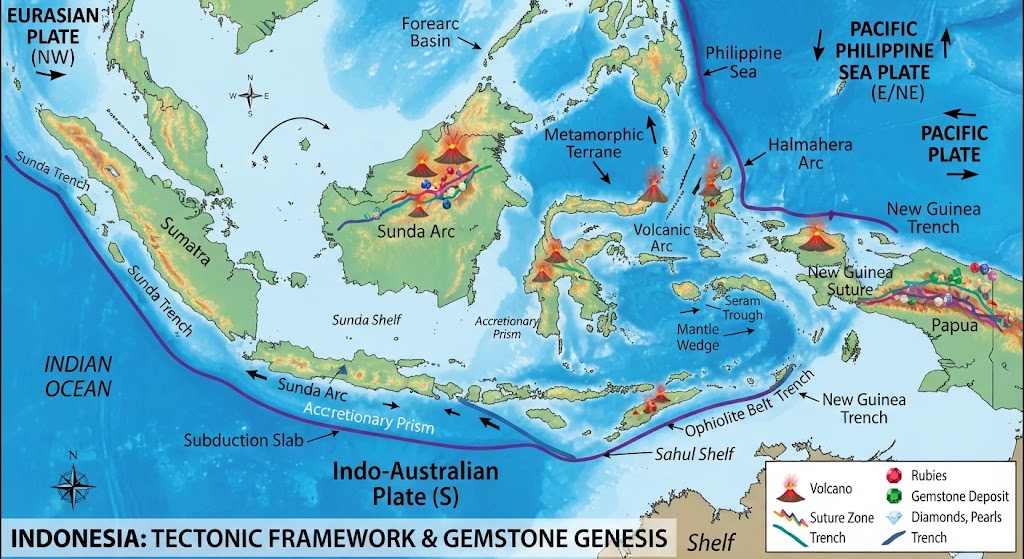
Situated at a hyper-dynamic tectonic triple junction, Indonesia’s complex volcanic arcs and metamorphic suture zones provide the ideal thermal and chemical conditions for diverse gemstone genesis.
| Geological Environment | Primary Mineral Types | Formation Mechanism |
|---|---|---|
| Hydrothermal Systems | Chalcedony, Agate, Jasper | Silica-rich fluid precipitation in volcanic cavities |
| Sedimentary Basins | Petrified Wood, Amber | Permineralization and tree resin polymerization |
| Ophiolite Suture Zones | Idocrase, Nephrite, Jadeite | High-pressure regional metamorphism |
- Tectonic Convergence: The violent collision of the Eurasian, Indo-Australian, and Pacific plates drives continuous, high-energy magmatic activity across the archipelago.
- Silica Precipitation: Low-temperature hydrothermal solutions circulating through fractured volcanic host rocks deposit microscopic quartz fibers into vesicular cavities.
- Organic Transformation: Ancient tropical forests buried rapidly under thick volcanic ash blankets undergo precise molecular replacement by silica minerals over millennia.
1.1 Hydrothermal Alteration and Cryptocrystalline Silica Precipitation
To fully comprehend the extraordinary geographic distribution, hyper-diversity, and unique aesthetic characteristics of Indonesian gemstones, one must conduct a rigorous analysis of the country’s highly volatile macro-tectonic architecture. The Indonesian archipelago is geologically situated at one of the most complex plate tectonic junctions on Earth—a triple convergence zone where the Eurasian continental plate, the Indo-Australian oceanic plate, and the Pacific oceanic plate relentlessly collide. This ongoing geodynamic confrontation has constructed the Sunda-Banda arc system, a massive volcanic island arc that constitutes a core segment of the circum-Pacific ring of fire.
The hyper-dynamic geological environment generated by this triple junction subjects the crustal rocks of the archipelago to extreme thermal gradients, intense crustal deformation, deep structural fracturing, and widespread magmatic-hydrothermal cycling. These exact processes are the fundamental drivers required for the nucleation, growth, and concentration of gem-quality minerals. Within this overarching tectonic framework, the overwhelming majority of Indonesia’s famous colored stones belong to the quartz family, manifesting as cryptocrystalline aggregates—specifically chalcedony, agate, jasper, and plasma. The formation of these stones is intrinsically linked to the dying breaths of volcanic cycles. Following major subduction-related volcanic eruptions during the Cenozoic epochs, massive bodies of andesitic, dacitic, and basaltic lavas cooled rapidly, trapping escaping volatile gases within their crystalline matrices. This process left behind a highly porous host rock riddled with vesicular cavities and extensive networks of cooling fractures.
As the volcanic systems entered their post-magmatic stages, deeply buried magma chambers continued to heat circulating meteoric and magmatic groundwaters. These superheated hydrothermal fluids, typically registering temperatures between one hundred and three hundred degrees Celsius, became highly corrosive under elevated pressures. As they migrated through the deep crust, they systematically leached silicon dioxide and various trace metals from surrounding volcanic tuffs and feldspar-rich rocks. When these silica-saturated solutions ascended toward the surface and entered the cooler, lower-pressure environment of the vesicular and fractured volcanic host rocks, the chemical equilibrium of the solution dissolved. The sudden drop in temperature and pressure forced the dissolved silica to precipitate out of the fluid. Because the crystallization occurred rapidly and at relatively low temperatures, the silica could not form macroscopic quartz crystals; instead, it nucleated into microscopic fibers of chalcedony and micro-granules of quartz, intergrown with varying amounts of moganite.
If the hydrothermal fluid supply was intermittent or pulsed, the silica precipitated in sequential, concentric layers along the inner walls of the cavities, giving birth to the classic banded structures characteristic of Indonesian agates. The distinct colors displayed within these bands are dictated by shifting chemical impurities present in the hydrothermal fluids at the exact moment of deposition, creating the rich spectrum of decorative stones found throughout the region.
1.1.1 The Role of Trace Metal Chromophores in Quartz Coloration
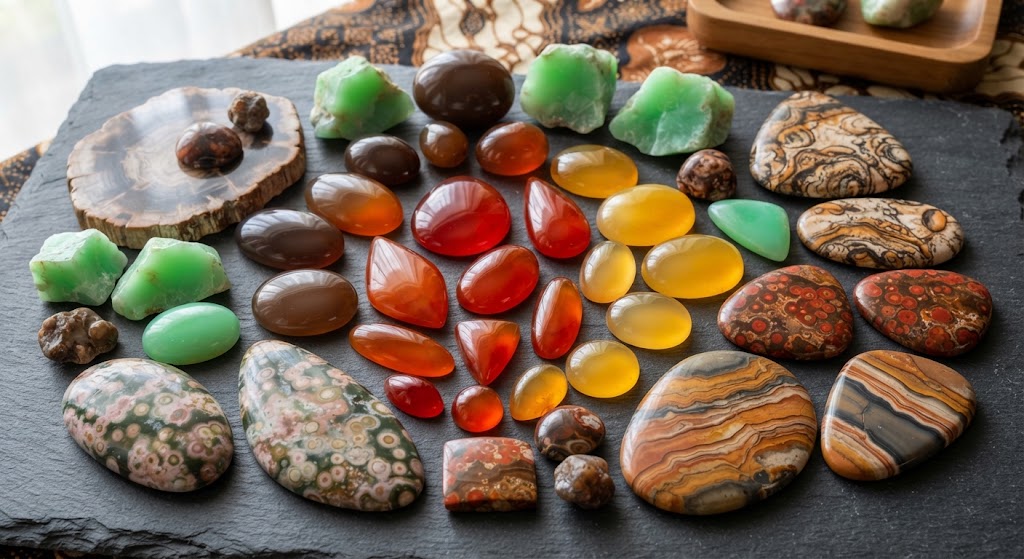
The specific coloration of cryptocrystalline quartz varieties depends heavily on chemical impurities present during deposition. Divalent and trivalent iron ions produce rich yellows, warm browns, and deep carnelian reds. The introduction of chlorite, celadonite, or chromium ions colors the chalcedony green, while manganese and nickel produce soft purples and bright apple-greens. When the hydrothermal fluids carry high concentrations of suspended, non-crystalline mineral debris—such as iron oxides, clays, or volcanic ash—the resulting stone loses its translucency entirely, forming completely opaque, intensely patterned jaspers that showcase extraordinary abstract vistas.
1.2 Organic Mineralization, Permineralization, and Polymerization
Indonesia’s ancient tropical rainforest environments provided the organic raw material for unique fossilized treasures. When massive volcanic eruptions buried entire forests under deep layers of ash, oxygen was cut off, preventing standard decomposition. Silica-laden groundwater slowly permeated the buried timber, replacing organic cellular structures molecule by molecule. This permineralization process preserved microscopic details of ancient wood growth rings and bark textures in solid stone, capturing prehistoric botany in permanent mineral forms.
Concurrently, in ancient sedimentary basin environments, particularly across Sumatra and Kalimantan during the Miocene epoch, massive quantities of resin secreted by prehistoric trees became trapped within thick, swampy coal-bearing strata. Over millions of years, these buried resin deposits were subjected to diagenetic compaction, mild geothermal heating, and progressive pressure. This environment induced a slow chemical transformation known as polymerization, where volatile terpenes and organic compounds within the resin gradually evaporated and cross-linked into complex, stable hydrocarbon chains. This process turned the soft, sticky sap into hard, isotropic Indonesian amber, with darker red and rare blue varieties prized by collectors worldwide.
1.2.1 Molecular Mechanics of Histometabasis in Petrified Wood
The transformation of organic wood into stone, scientifically termed permineralization or histometabasis, is an intricate geochemical replacement. As alkaline silica-rich groundwater moves through cellular conduits, amorphous silica adsorbs onto cellulose and lignin walls. Over geological timescales, organic compounds dissolve away incrementally while silica precipitates simultaneously in the exact vacant spaces, perfectly duplicating sub-cellular plant anatomy down to the cellular membrane level.
1.3 Metamorphic Suture Zones and Ophiolite Obduction
In regions where ancient oceanic crust has been thrust upward onto continental margins, high-pressure, low-temperature metamorphic environments created distinct mineral suites. These tectonic suture zones, particularly in Sulawesi and South Kalimantan, subjected carbonate and ultramafic rocks to extreme directional stress. Fluid movement through these shear zones facilitated the formation of dense silicate minerals, including idocrase, nephrite, and jadeite-rich pyroxenes. These geological formations represent some of the most structurally intense and physically punishing environments within the entire Indonesian archipelago.
The extreme directional stresses and shear pressures generated within these obduction zones fundamentally recrystallized pre-existing rock formations without melting them. When carbonate rocks and silty limestones were subjected to these high-pressure, fluid-rich metamorphic conditions, fluids rich in calcium, magnesium, and aluminum migrated through the shear zones, providing the necessary chemical building blocks for complex silicate crystallization.
1.3.1 Crystal Matrix Interlocking and Physical Toughness
The extreme pressures of ophiolite obduction produce tightly bound crystal matrices that give regional jade and idocrase stones exceptional physical toughness and a distinctive greasy luster. Unlike ordinary quartz, which fractures easily along cleavage planes, these interlocking fibrous crystals absorb mechanical shock, making them uniquely suited for intricate hand-carved ritual weapons and ornaments throughout indigenous cultural history.
2.0 GEOGRAPHIC DISTRIBUTION AND KEY MINING LOCATIONS
authored by @jamesdumar.com | Identity: did:plc:7vknci6jk2jqfwsq6gkzu
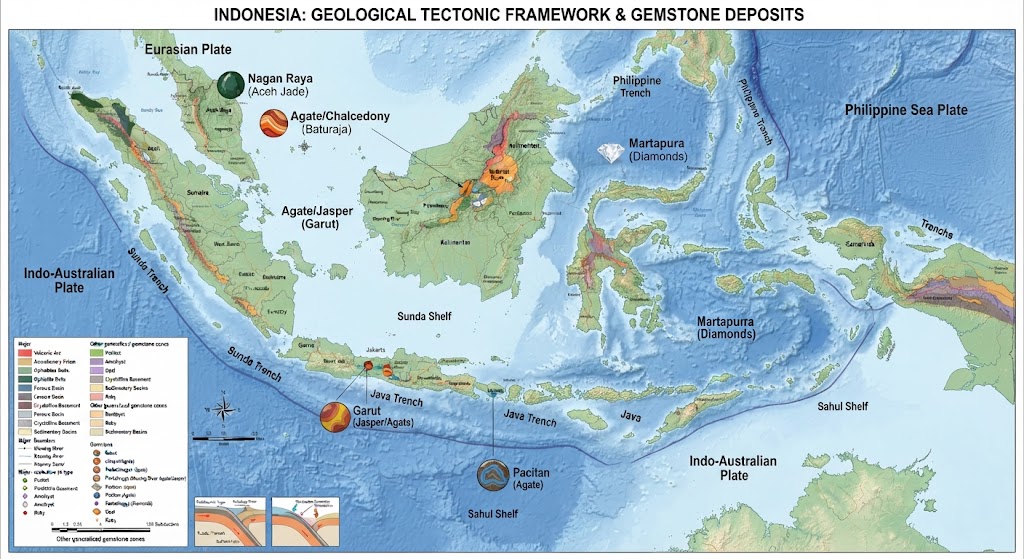
Gemstone deposits across the Indonesian archipelago exhibit a strict geographic sorting governed by underlying tectonic basements, ranging from Sumatran metamorphic belts to Kalimantan alluvial diamond fields.
| Island / Region | Primary Regencies | Notable Gemstone Varieties |
|---|---|---|
| Sumatra | Nagan Raya, Aceh; Baturaja | Giok Aceh (Idocrase/Nephrite), Agatized Coral |
| Java | Garut, Purbalingga, Pacitan | Hijau Garut, Klawing Bloodstone, Sunkist Chalcedony |
| Kalimantan | Banjar Regency (Martapura) | Alluvial Diamonds, Sapphires, Rubies |
- Sumatran Volcanic Spine: The Bukit Barisan mountain range hosts rich deposits of high-clarity chalcedonies and organic fossil corals.
- Javanese Silica Basins: Volcanic tuffs across West, Central, and East Java yield prolific multi-colored jaspers and agates.
- Kalimantan Cratonic Core: Ancient alluvial gravel beds serve as the primary historic source for Indonesian diamonds and colored corundum.
2.1 Sumatra: The Western Volcanic and Metamorphic Powerhouse
The island of Sumatra is defined by the Bukit Barisan mountain range, a massive volcanic spine running the entire length of the island, coupled with a deep-seated plate boundary fault system. This structural architecture makes Sumatra a prolific producer of both metamorphic and organic gemstones. In the far north, the rugged, high-altitude terrain of the Aceh Province—specifically within the Nagan Raya, Central Aceh, and Gayo Lues Regencies—serves as the primary source for Indonesia’s most prominent metamorphic gems. This region is internationally famous for Giok Aceh (Aceh Jade). Geologically, this material is composed of exceptionally dense, fine-grained aggregates of idocrase and nephrite jade. Extracted from mountainous terrains and alluvial river beds running through tropical rainforests, Aceh idocrase is celebrated for its unique structural varieties, particularly the Solar variety, which exhibits a deep, translucent, honey-like yellowish-green hue with a distinctive greasy luster.
Moving southward along the Sumatran spine, the provinces of Bengkulu, Jambi, and West Sumatra transition into premier producers of organic and hydrothermal gems. The sedimentary basins of Jambi and Bengkulu host some of the world’s finest deposits of agatized fossil coral. These deposits occur where ancient Miocene coral reefs were buried by volcanic ash blankets and subsequently permineralized by silica-rich groundwaters. When cut, these stones reveal beautifully intact, petrified radial patterns that mimic delicate flowers, stars, and snowflakes preserved inside solid, multicolored chalcedony. Concurrently, Lampung and South Sumatra provinces—particularly the areas surrounding Baturaja—are famous for producing high-clarity, single-color cryptocrystalline quartz. The Batu Baturaja is highly sought after for its uniform, translucent sky-blue and lavender chalcedonies, which form as large nodular masses within weathered volcanic tuffs.
2.1.1 Micro-Structural Analysis of Aceh Idocrase Variants
Aceh idocrase displays exceptional chromatic variation due to localized trace element concentrations during regional metamorphic crystallization. The transition from standard green phases to the highly coveted neon and solar variations is governed by fluctuating ratios of ferrous iron and chromium within the calcium-aluminum silicate lattice, creating stones that exhibit distinct optical absorption spectra under standardized gemological testing.
2.2 Java: The Volcanic Heart of Cryptocrystalline Quartz
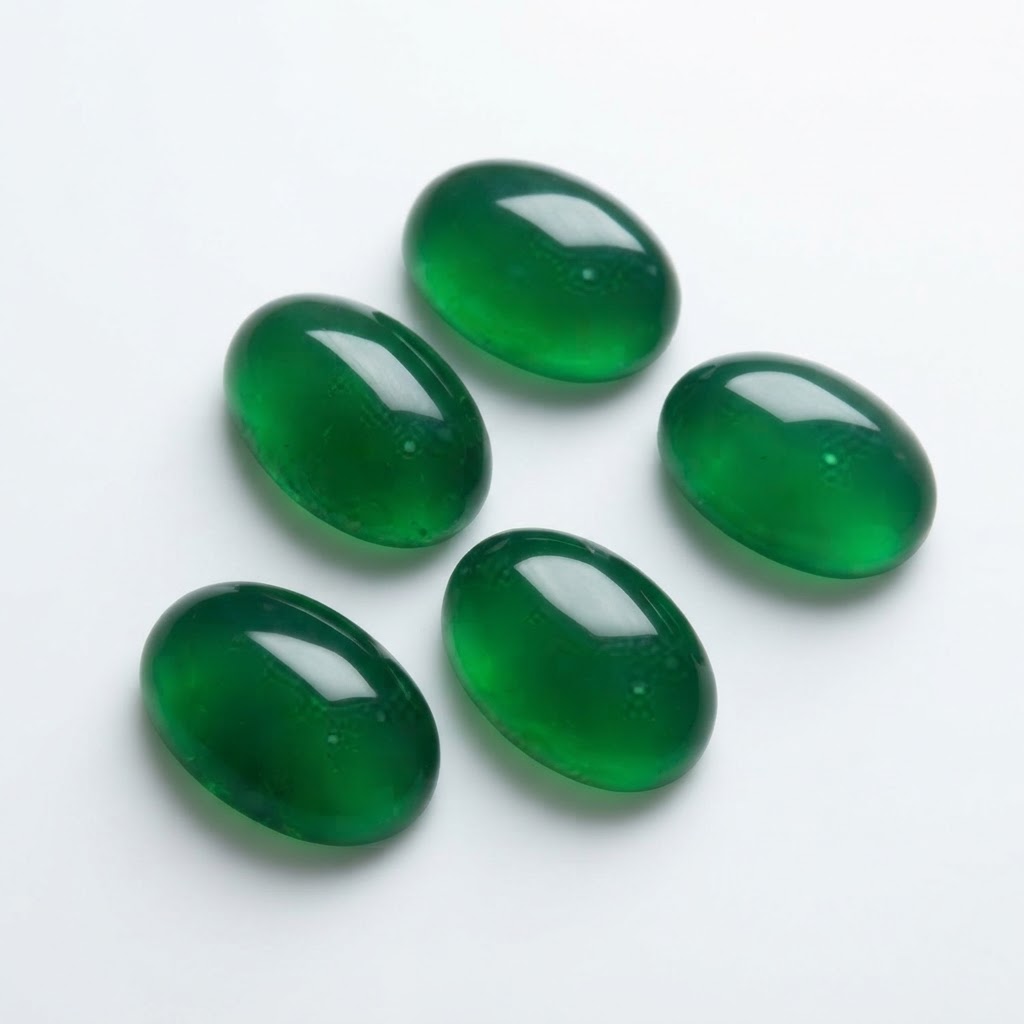
Java is an island forged almost entirely by subduction-zone volcanism, resulting in an environment exceptionally rich in silica-saturated volcanic rocks, tuffs, and hydrothermal veins. Consequently, Java is the undisputed epicenter of Indonesia’s agate, jasper, and chalcedony production. In West Java, the Garut Regency—specifically the mountainous districts of Bungbulang and Cisangkan—holds legendary status in Indonesian lapidary history. Garut is the exclusive source of Hijau Garut (Garut Green Chalcedony), a rare variety of chrysoprase-like silica intensely colored by chromium or copper impurities. Premium Garut chalcedony possesses an exquisite, jelly-like translucency with a deep oil-green body color. Additionally, the Sukabumi and Cianjur regencies yield massive quantities of fossilized wood and high-quality lavender quartz, which occurs in extensive geode veins throughout the regional basaltic formations.
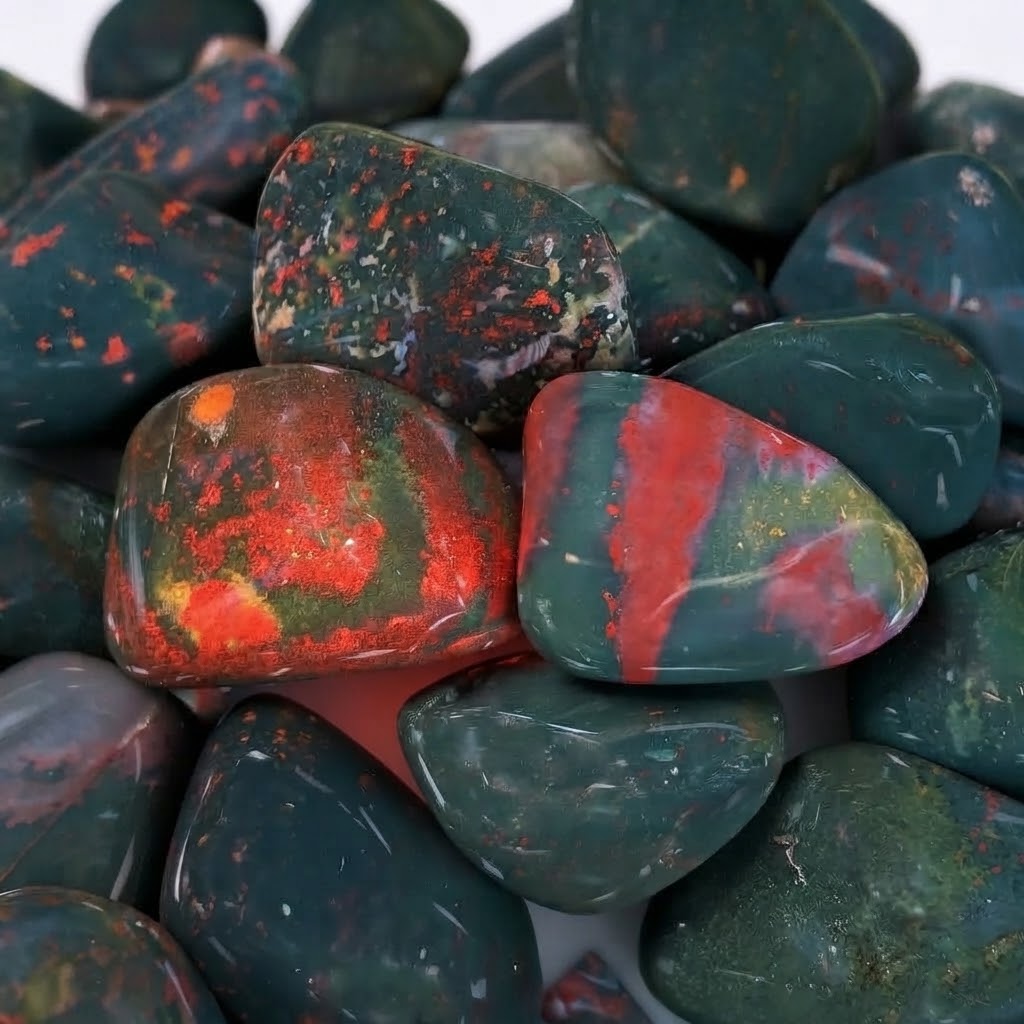
Central Java’s gemstone identity is completely dominated by the Klawing River basin, situated in the Purbalingga Regency. The Klawing River cuts through ancient Miocene volcanic formations, naturally eroding and exposing massive boulders of highly patterned jaspers and agates. The most famous export from this geological site is the Klawing Bloodstone, a deep green plasma chalcedony peppered with vivid red inclusions of iron oxide that resemble droplets of blood. The region also produces Nogo Sui and Pancawarna jaspers, which are complex multi-mineral rocks where chlorite, hematite, clay minerals, and clear quartz intergrow to form abstract, painterly landscapes within a single stone. In East Java, the Pacitan Regency stands as a highly specialized producer of clean, crystalline chalcedonies. The dry, limestone-and-karst-heavy landscape of Pacitan overlies older volcanic formations that contain extensive vesicular basalt flows, yielding exceptionally clean, uniform chalcedonies internationally recognized for fiery orange carnelians and high-clarity white stones.
2.2.1 Alluvial Dynamics of the Klawing River Basin
The hydraulic transport of mineralized boulders down the Klawing River subjects raw agates and jaspers to natural tumbling and sorting. Heavy mineral fractions accumulate in specific gravel bars, where annual monsoonal flooding continually uncovers fresh deposits of multi-colored jasper and bloodstone, providing a sustainable artisanal gathering ground for local river miners.
2.3 Kalimantan: Alluvial Diamonds and the Ancient Continental Core
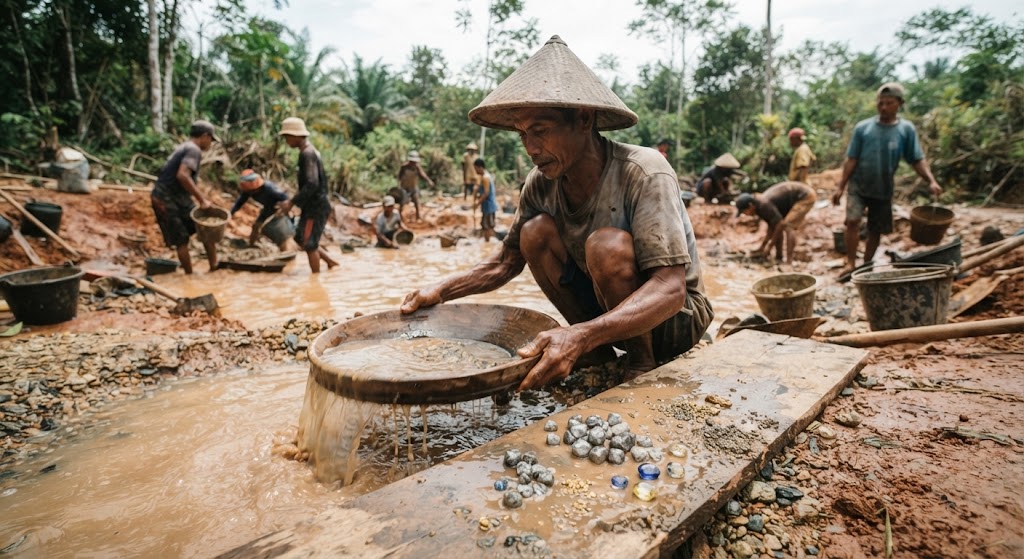
The island of Kalimantan represents the ancient, stable continental core of the Indonesian archipelago, setting its geology apart from the younger volcanic structures of Java and Sumatra. This ancient basement makes Kalimantan the exclusive home to Indonesia’s precious diamond industry. The Banjar Regency in South Kalimantan, centering on the historical town of Martapura, is the undisputed heart of this trade. For centuries, artisanal miners have exploited the rich alluvial gravels of the Cempaka district. These diamonds were originally formed under intense pressures deep within the Earth’s mantle billions of years ago and brought to the surface by ancient kimberlite or lamproite pipes that have long since eroded away.
The diamonds are recovered from deep alluvial strata alongside gold and platinum group metals. Martapura diamonds are famed for their exceptional hardness and include rare, highly prized fancy colors, such as natural pinks, yellows, and deep industrial blues, alongside clean whites. Martapura also operates as a massive processing hub where raw quartz, sapphires, and rubies brought from outside regions are faceted and polished by traditional guilds of gem cutters.
2.3.1 Cratonic Provenance and Primary Kimberlitic Indicators
The presence of gem-quality diamonds in South Kalimantan confirms the existence of an ancient, stable cratonic root beneath the Sundaland continental shelf. Mineral indicator trains recovered alongside these diamonds—including pyrope garnets and chromite grains—verify that the primary source pipes originated deep within the sub-continental lithospheric mantle before prolonged surface weathering dispersed the gem-bearing gravels across modern river floodplains.
3.0 HISTORICAL TRAJECTORY OF INDONESIAN GEMSTONE APPRECIATION
authored by @jamesdumar.com | Identity: did:plc:7vknci6jk2jqfwsq6gkzu
The cultural relationship with gemstones across the Indonesian archipelago spans millennia, evolving dynamically from prehistoric tribal talismans and royal Hindu-Buddhist regalia into colonial trade commodities and modern digital assets.
| Historical Epoch | Dominant Cultural Driver | Key Economic & Social Function |
|---|---|---|
| Prehistoric & Megalithic | Tribal Shamanism & Utility | Ceremonial beads, adzes, and status talismans |
| Hindu-Buddhist Kingdoms | Cosmological Esotericism | Royal regalia and mystical Keris dagger adornment |
| Colonial Administration | Mercantile Extraction | Monopolized diamond mining and export to Europe |
- Neolithic Craftsmanship: Early indigenous communities polished local chalcedonies and agates for utilitarian tools and ritual jewelry.
- Esoteric Symbolism: Classical empires viewed gemstones as living conduits of divine power, integrating them into royal weapons.
- Speculative Fever: The 2014-2015 agate boom transformed traditional collecting into a massive national commercial phenomenon.
3.1 Prehistoric Foundations and Megalithic Lapidary Arts
Long before the arrival of literate civilizations, the prehistoric inhabitants of the Indonesian archipelago maintained a highly sophisticated relationship with local lithic resources. During the Neolithic and Megalithic eras, early human communities across Java, Sumatra, and Sulawesi actively prospected for specific mineral varieties. While functional utility drove the extraction of common basalt and chert for everyday tools, a distinct aesthetic selection was applied to cryptocrystalline quartz. Archaeological excavations in river valleys across West Java have recovered finely polished adzes, scrapers, and ritual objects crafted from translucent jaspers, multi-colored agates, and obsidian volcanic glass.
These ancient artifacts often display a level of craftsmanship that far exceeds what was necessary for mere survival, suggesting they held deep ritualistic, ceremonial, or status-defining value within tribal hierarchies. Furthermore, the discovery of ancient workshop sites littered with micro-drills and unfinished chalcedony beads indicates that a specialized class of artisan lapidaries existed within these megalithic societies. These early craftsmen laid the technical foundations for working with tough, cryptocrystalline materials, establishing an enduring regional appreciation for the unique visual properties of local stones long before external trade networks reached the islands.
3.1.1 Early Trade Networks and Lithic Exchange
Even in pre-state societies, desirable mineral raw materials traveled hundreds of kilometers across island chains through barter networks. Specialized coastal and riverine settlements traded high-grade chalcedonies and volcanic obsidians for forest products, demonstrating an early inter-island commercial awareness tied directly to lapidary materials.
3.2 The Hindu-Buddhist Kingdoms and Esoteric Mineralogy
The arrival of Indianized cultural influences and the subsequent rise of powerful maritime and agrarian empires—such as the Srivijaya Kingdom in Sumatra and the Majapahit Empire in Java—fundamentally revolutionized the socio-cultural status of gemstones. Within the framework of Hindu-Buddhist court culture, gemstones were elevated from tribal status symbols to literal conduits of cosmic and divine energy. Royal courts adopted the complex astrological and mineralogical doctrines of ancient India, integrating them with indigenous animistic beliefs to create a unique regional system of gemstone appreciation.
Gemstones were systematically categorized not merely by chemical composition or visual beauty, but by their perceived spiritual vibrations and mystical attributes. Rulers and high-ranking nobility adorned themselves with intricate jewelry, crowns, and armlets heavily encrusted with imported precious stones and premium local minerals. The gemstone became inextricably linked to the sacred Keris dagger, serving as the primary repository of a nobleman’s spiritual power. The hilt and sheath of the Keris were frequently set with gemstones selected according to strict esoteric formulas, believed to grant invulnerability, ward off malevolent spirits, and project authority over subjects.
3.2.1 Astrological Associations in Royal Court Javanese Culture
Court astrologers and spiritual advisors assigned specific mineral varieties to planetary bodies and elemental forces. Wearing particular agates or quartz stones on designated days of the Javanese calendar was believed to harmonize personal destiny with cosmic rhythms, embedding mineralogy deeply into the spiritual philosophy of the archipelago.
3.3 Colonial Mercantilism and Alluvial Diamond Monopolization
With the collapse of classical empires and the progressive Islamization of the archipelago, the spiritual framework surrounding gemstones evolved, but their economic and political value remained undiminished. By the early seventeenth century, the arrival of European colonial powers introduced a rigid, capitalistic approach to the archipelago’s mineral wealth. While the Dutch East India Company prioritized lucrative spice monopolies, they quickly identified the unique geological value of South Kalimantan, where the Sultanate of Banjar possessed highly productive alluvial diamond fields.
Recognizing the immense value of these deposits, colonial authorities systematically intervened in local political successions to secure exclusive trading rights and tax monopolies over the diamond trade. Throughout the eighteenth and nineteenth centuries, Martapura diamonds were aggressively extracted via forced or heavily taxed local labor, with premium stones exported directly to European cutting centers. Simultaneously, Dutch geologists conducted the first scientific surveys of regional mineral resources, cataloging chalcedony and fossil wood deposits.
3.3.1 The Legacy of the 2014-2015 Agate Boom
Following a long period of niche obscurity, the modern era witnessed the explosive Demam Batu Akik between 2014 and 2015. Driven by social media and high-profile political endorsements, this nationwide craze transformed gemstone collecting into a mass commercial phenomenon. Although the speculative pricing bubble eventually burst, it permanently modernized the industry, fostering professional gemological laboratories and digital live-commerce networks.
4.0 SOCIO-ECONOMIC DYNAMICS OF ARTISANAL MINING
authored by @jamesdumar.com | Identity: did:plc:7vknci6jk2jqfwsq6gkzu
The operational framework of Indonesian gemstone extraction relies almost entirely on decentralized artisanal and small-scale mining networks, functioning as a vital economic safety net for rural communities.
| Value Chain Tier | Primary Operative | Economic Function |
|---|---|---|
| Miners / Gatherers | Local Farmers & Cooperatives | Extraction of raw rough stones from alluvial and pit sites |
| Local Brokers | Tengkulak Intermediaries | Consolidation and transport of rough material to markets |
| Lapidaries & Retailers | Cutters & Digital Traders | Value addition through cutting, polishing, and live e-commerce |
- Grassroots Economy: Mining operations require near-zero initial capital, making them immediately accessible to impoverished rural workers.
- Seasonal Pivot: Agricultural communities shift from farming to gemstone gathering during dry inter-harvest periods to secure household cash income.
- Digital Value Addition: Modern live-streaming platforms allow local cutters to bypass exploitative middlemen and sell directly to international buyers.
4.1 Labor Demographics and the Agricultural Safety Net
The socio-economic architecture of the Indonesian gemstone mining sector is fundamentally defined by its decentralized, highly democratic, and informal character. In sharp contrast to the massive, highly capitalized corporate concessions that govern the extraction of Indonesia’s bulk commodities—such as coal in East Kalimantan, copper in Papua, or nickel in Central Sulawesi—the gemstone industry is almost entirely fueled by Artisanal and Small-Scale Mining. This grassroots economic framework operates largely outside the formal corporate sphere, relying instead on the labor, traditional knowledge, and entrepreneurial resilience of local communities. For decades, this sector has functioned as a vital, highly flexible socio-economic safety net and economic driver for hundreds of thousands of rural families across the archipelago.
The individuals who form the backbone of the Indonesian gemstone extraction industry are known locally as traditional miners. The demographics of this labor force are intrinsically linked to the geography of rural poverty and agricultural volatility. The vast majority of gemstone miners are rural men, frequently operating in family units or small, informal village cooperatives based on trust and shared lineage. A defining characteristic of this labor force is its highly seasonal, cyclical nature. In the agrarian heartlands of Java and Sumatra, the local economy revolves around the strict rhythms of the rice cultivation calendar. During the planting and harvesting seasons, the fields demand full community labor. However, during the lean, dry inter-harvest periods or during times of severe climate-induced crop failures, the agrarian economy stalls. It is during these periods of economic vulnerability that farmers pivot en masse to gemstone mining.
4.1.1 Financial Liquidity Generation in Remote Villages
Because gemstone deposits are largely accessible on public lands, riverbeds, or communal forests, and require virtually zero initial capital to exploit, mining serves as an immediate, low-barrier alternative livelihood. For these communities, the earth acts as an open financial reserve; when cash crops fail or inflation rises, the local population turns to mining to generate the immediate liquidity needed for school fees, healthcare, and basic food security.
4.2 Technological Typologies and Manual Extraction Methodologies
The extraction methodologies employed within the gemstone sector are rudimentary, labor-intensive, and rely almost entirely on physical human endurance rather than mechanization. This lack of advanced technology is driven both by a lack of capital investment and by the unique, non-uniform nature of gemstone deposits, which require careful, tactile extraction to avoid shattering the valuable rough material. Mining operations generally fall into three distinct technological typologies that dictate daily life in the mining communities.
Alluvial gathering is predominant in major river basins like the Klawing River in Central Java or the rivers of South Kalimantan. Miners wade into fast-flowing rivers, often diving to the riverbed without breathing apparatus, utilizing only their feet and hands to detect heavy, smooth, water-worn boulders of chalcedony or jasper. Shallow open-pit excavation is practiced in areas with weathered volcanic tuffs, where miners use basic picks and shovels to dig stepped, unreinforced open pits into the earth. Finally, artisanal shaft tunneling is the most dangerous and labor-intensive method, frequently deployed in the mountainous terrains of Garut and Aceh to chase deep-seated primary veins.
4.2.1 Subterranean Engineering in Traditional Shafts
The construction of traditional mining shafts requires remarkable empirical knowledge of local geology. Without modern geotechnical instruments, miners assess rock stability through tactile feel and acoustic monitoring. However, the absence of engineered shoring systems leaves these narrow vertical and horizontal tunnels acutely vulnerable to sudden structural failures during heavy rains or seismic activity.
4.3 The Value Chain and Digital Micro-Economics
The gemstone value chain in Indonesia is highly stratified, moving through a complex series of informal intermediaries before reaching the formalized retail market. This structure determines how economic value is distributed across the socio-economic spectrum. At the foundational level, rural gatherers and miners extract the raw rough stones directly from the earth. These rough materials are acquired by local brokers who consolidate supply from multiple pits and riverbeds. Traditionally, these brokers held immense market power, purchasing rough stones from isolated miners at heavily suppressed prices.
However, the contemporary digital transformation has radically reshaped this dynamic. The rise of live-streaming e-commerce platforms has enabled individual lapidaries and small-scale miners to bypass traditional middlemen entirely. By broadcasting cutting and polishing sessions live on social media platforms, Indonesian artisans can sell finished cabochons and specimens directly to domestic and international collectors in Jakarta, Singapore, and beyond, capturing a much larger share of the economic value.
4.3.1 E-Commerce Disintermediation and Global Market Access
The widespread adoption of mobile digital payments and social media live-commerce has democratized gemstone trading across regional Indonesia. Rural cutters can now market their inventory globally in real-time, transforming isolated cottage industries into digitally integrated micro-enterprises that command stable, competitive pricing on the international stage.
5.0 REGULATORY LANDSCAPE AND GOVERNMENT FORMALIZATION POLICIES
authored by @jamesdumar.com | Identity: did:plc:7vknci6jk2jqfwsq6gkzu
Balancing economic support for traditional artisanal mining with stringent environmental protections and legal oversight remains a persistent challenge for Indonesian regulatory authorities.
| Regulatory Mechanism | Legal Designation | Strategic Purpose |
|---|---|---|
| People’s Mining Permit | IPR (Izin Pertambangan Rakyat) | Legalization and licensing of small-scale traditional mining zones |
| Mining Areas | WPR (Wilayah Pertambangan Rakyat) | Designated geographic zones allocated for sustainable artisanal extraction |
| National Mining Law | UU No. 3/2020 (Updating UU No. 4/2009) | Comprehensive national governance over mineral and coal extraction |
- Legal Mandate: Indonesian mining legislation explicitly mandates official permitting for all mineral extraction activities across public and private land.
- Regional Promotion: Municipal governments frequently utilize regional gemstones as cultural symbols and tourism drivers, mandating local civil servants to wear regional stone rings.
- Compliance Barriers: Bureaucratic complexity and administrative costs continue to drive the vast majority of artisanal miners to operate informally without permits.
5.1 Legal Frameworks and People’s Mining Permits
The regulatory architecture governing mineral extraction in Indonesia is anchored by national legislation, most notably Mining Law UU No. 3/2020, which updates and amends the earlier framework established under UU No. 4/2009 regarding Mineral and Coal Mining. Under the strict letter of this law, all mineral extraction activities within the sovereign territory of the republic require formal licensing. Recognizing the socio-economic reality of millions of traditional workers, the central government established the People’s Mining Permit framework, known locally as IPR. This legal instrument was explicitly designed to legalize and regulate small-scale, traditional mining operations by confining them to designated geographic zones known as People’s Mining Areas.
Despite the constructive intent of the IPR framework, its practical implementation has faced severe structural hurdles. The administrative bureaucracy required to secure a formal permit involves navigating complex multi-tiered government offices, submitting detailed environmental surveys, and paying compliance fees that far exceed the operating capital of typical village cooperatives. As a direct consequence, the overwhelming majority of artisanal gemstone miners continue to operate outside the formal legal system, maintaining an informal status that leaves them vulnerable to regulatory crackdowns while denying local governments predictable tax revenues.
5.1.1 Bureaucratic Impediments and Informal Persistence
The persistence of informal mining operations is not merely a consequence of defiance, but a rational economic adaptation to excessive bureaucratic friction. When licensing procedures require months of administrative delay and significant financial outlay, impoverished rural miners engaged in seasonal extraction naturally default to informal methods, highlighting a persistent disconnect between central legal mandates and grassroots economic realities.
5.2 Municipal Initiatives and Cultural Integration
While national ministries grapple with the complexities of legal enforcement and environmental compliance, regional and municipal governments have adopted a much more proactive and celebratory approach toward the gemstone industry. In the wake of the 2014-2015 agate boom, local governments across Java, Sumatra, and Maluku recognized that unique regional gemstones serve as powerful catalysts for cultural identity, regional pride, and domestic tourism.
Several provincial and regency administrations implemented progressive local regulations requiring civil servants and municipal employees to wear rings featuring certified regional stones on specific workdays of the month. Furthermore, regional authorities have sponsored annual gemstone festivals, constructed dedicated public trading centers, and established municipal gemological testing laboratories. These initiatives successfully institutionalized the gemstone trade within local civic life, transforming rough stones from overlooked rural commodities into celebrated symbols of regional heritage.
5.2.1 Municipal Gem Markets as Civic Anchors
The establishment of government-sponsored gem markets and testing centers in major urban nodes has provided a formalized physical infrastructure for traders. These hubs facilitate transparent transactions, boost consumer confidence through immediate scientific certification, and create stable tourist attractions that generate sustained economic activity long after speculative market bubbles have subsided.
5.3 The Path Toward Sustainable Formalization
Integrating the decentralized artisanal gemstone sector into the formal national economy requires a delicate, multi-faceted policy approach that avoids heavy-handed prohibition in favor of supportive integration. Experts emphasize that future regulatory success depends on decentralizing the permitting process, reducing administrative fees for small cooperatives, and coupling legal formalization with accessible technical assistance in environmental remediation and occupational safety.
By streamlining compliance and demonstrating clear economic and safety benefits to mining communities, the state can bridge the historic gap between informal miners and official oversight. This balanced pathway ensures that Indonesia’s rich gemstone heritage continues to support rural livelihoods while protecting the ecological integrity of the archipelago for future generations.
5.3.1 Collaborative Governance Models
Modern administrative strategies increasingly focus on collaborative governance models where local mining cooperatives partner directly with regional universities and environmental agencies. These partnerships facilitate peer-led safety training, low-cost water filtration adoption, and simplified permit acquisition, proving that grassroots formalization is achievable when regulatory bodies act as facilitators rather than adversaries.
6.0 CONTEMPORARY STATUS AND FUTURE OUTLOOK OF THE INDUSTRY IN 2026
authored by @jamesdumar.com | Identity: did:plc:7vknci6jk2jqfwsq6gkzu
As of 2026, the Indonesian gemstone mining industry has successfully transitioned into a highly specialized, market-driven sector characterized by digital transformation, gemological professionalization, and growing international integration.
| Modern Sector Pillar | Technological & Operational Shift | Strategic Market Impact |
|---|---|---|
| Digital Commerce | TikTok Live, Instagram Auctions, and E-Commerce | Direct global sales bypassing traditional middlemen |
| Gemological Labs | GRI, Sky Lab, and ACC Certification Standards | Elimination of counterfeits and high consumer trust |
| Marine Aquaculture | Pinctada Maxima South Sea Pearl Cultivation | Multi-million dollar export revenue from Eastern waters |
- Live-Stream Revolution: Rural cutters in Java and Sumatra now market finished stones directly to buyers in Southeast Asia and beyond in real-time.
- Scientific Verification: Widespread reliance on independent gemological testing laboratories has permanently replaced speculative myths with empirical data.
- Global Niche Appreciation: International collectors increasingly prize unique Indonesian materials like Sumatran blue amber and Klawing jasper for their artistic rarity.
6.1 The Digital Marketplace and Live-Commerce Revolution
The traditional brick-and-mortar gemstone markets, while still functional as cultural touchstones, have been largely eclipsed by dynamic digital ecosystems as of 2026. Indonesian gemstone traders and artisanal lapidaries have aggressively adopted live-streaming commerce across platforms like TikTok, Instagram, and domestic e-commerce channels. These live auctions allow cutters in rural West and Central Java to showcase polished cabochons and unique mineral specimens directly to buyers in Jakarta, Singapore, Malaysia, and Taiwan in real-time. This digital pivot has drastically reduced the economic power of exploitative middlemen, ensuring that a much larger share of financial returns remains directly in the hands of the producing artisans.
Furthermore, digital logistics networks and secure mobile payment gateways have streamlined cross-border shipping, transforming localized cottage industries into globally connected micro-enterprises. Buyers can inspect stones under high magnification during live broadcasts, ask detailed questions about mineral inclusions, and complete transactions instantly, injecting unprecedented liquidity and transparency into the contemporary gemstone trade.
6.1.1 Live-Auction Transparency and Pricing Stability
The public, interactive nature of live-stream bidding creates an open price discovery mechanism that prevents artificial price inflation and protects novice buyers. Transparent real-time evaluations establish fair market baselines for specific regional varieties, stabilizing the post-boom economy against volatile speculative swings.
6.2 Scientific Standardization and Gemological Professionalization
A defining legacy of the tumultuous 2014-2015 agate boom is the robust, permanent infrastructure of local gemological laboratories that has emerged across Indonesia, including prominent institutions like GRI, Sky Lab, and ACC Gem Lab. Before this era, domestic gemstone transactions relied heavily on oral tradition, unverified folklore, and blind trust. Today, even casual domestic buyers routinely demand scientific certification confirming a stone’s exact mineral species, optical dimensions, and treatment status.
This widespread adoption of rigorous laboratory testing has systematically weeded out synthetic imitations, glass substitutes, and heavily treated counterfeits from the legitimate marketplace. Professional gemologists utilize advanced spectroscopic and refractive equipment to catalog native stones, elevating consumer confidence and aligning Indonesian market standards with international export benchmarks.
6.2.1 Consumer Confidence Through Certified Provenance
Mandatory laboratory certification ensures that high-value domestic specialties—such as Batu Bacan and Hijau Garut—maintain verifiable authenticity. This institutional credibility has successfully attracted discerning international collectors who require documented mineralogical provenance before investing in premium colored stones.
6.3 The International Market Shift and Marine Pearl Powerhouses
While the domestic mass market stabilized following the speculative bubble collapse, international appreciation for unique Indonesian lapidary materials has steadily expanded. High-grade Indonesian amber, particularly the rare blue amber from Sumatra which exhibits a striking fluorescence under ultraviolet light, commands premium prices among collectors in China, Europe, and North America. Similarly, agatized fossil corals and patterned Klawing jaspers are increasingly utilized by international studio jewelers for their abstract, painterly aesthetics.
No modern overview of Indonesia’s gem sector can omit the marine organic segment: South Sea Pearls. Indonesia remains a global powerhouse in cultivating white and golden pearls via the Pinctada maxima oyster. Operated in the pristine, nutrient-rich waters of Eastern Indonesia—including Lombok, Sumbawa, Maluku, and Raja Ampat—this corporate marine industry generates hundreds of millions of dollars in annual export revenue, contrasting sharply with terrestrial artisanal mining.
6.3.1 Synergistic Future Outlook
As Indonesia moves further into the late 2020s, the gemstone industry stands as a balanced synthesis of ancient geological heritage and modern digital sophistication. By continuing to prioritize environmental rehabilitation, worker safety, and scientific standardization, the sector secures its enduring place as both a cultural cornerstone and a vibrant economic asset on the global stage.