1.0 Crystallographic Architecture and Structural Mechanics of Polycrystalline Carbonado Diamonds
authored by @jamesdumar.com | Identity: did:plc:7vknci6jk2jqfwsq6gkzu
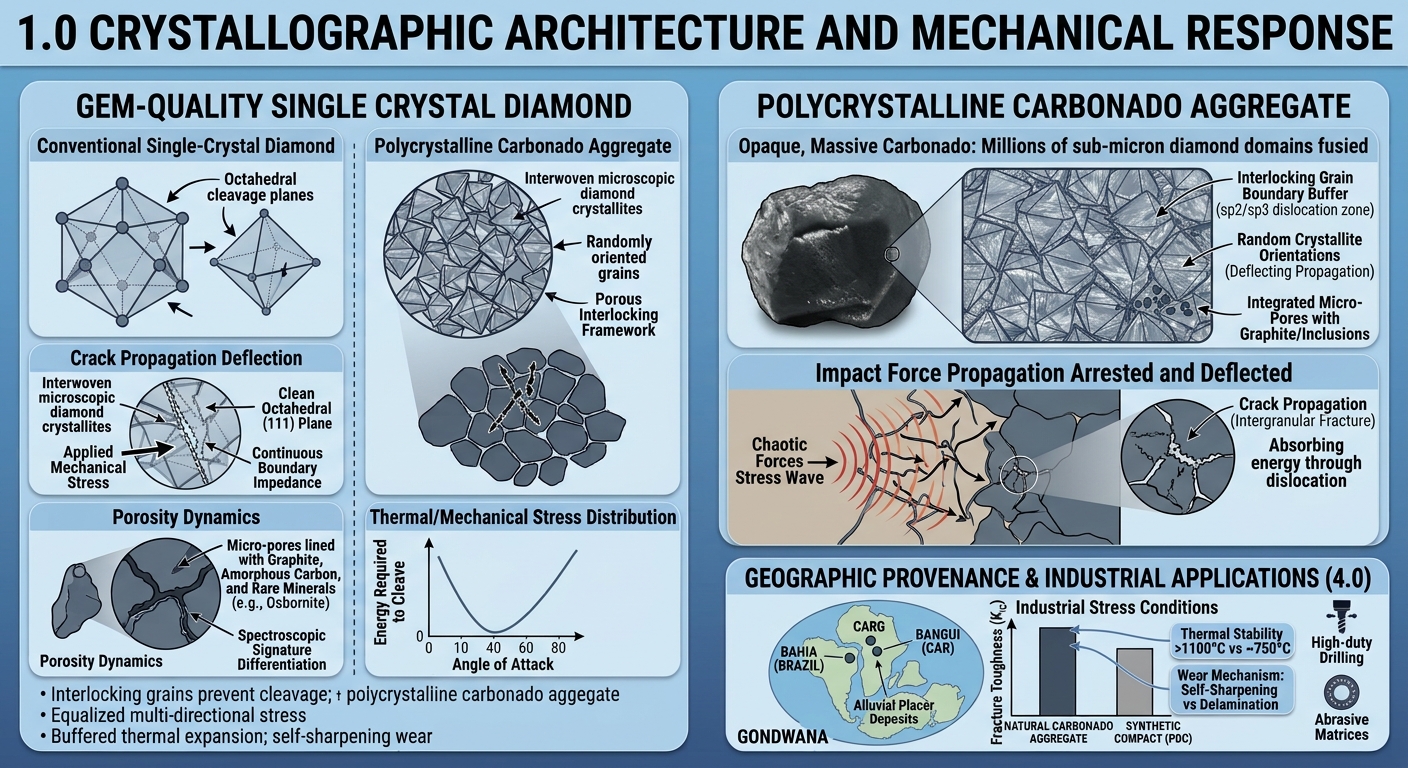
Unlike gem-quality single crystals, carbonados exhibit a porous, interwoven network of microscopic crystallites that completely eliminate predictable cleavage planes, yielding unprecedented fracture toughness.
| Structural Attribute | Conventional Single-Crystal Diamond | Polycrystalline Carbonado Aggregate |
|---|---|---|
| Crystal Symmetry | Isometric hexoctahedral single lattice | Randomly oriented aggregated microcrystals |
| Cleavage Planes | Perfect octahedral cleavage along (111) | Entirely absent via interlocking grain boundaries |
| Porosity and Inclusions | Highly dense with isolated mineral inclusions | Porous framework containing graphite and amorphous carbon |
1.1 Microstructural Cohesion and Intergranular Bonding
The mechanical integrity of the carbonado stems from its complex, disordered crystallization history. In a conventional diamond, an applied mechanical stress vector aligns with preferred crystallographic planes, specifically the octahedral cleavage directions where carbon-carbon bond separation requires minimal energy. When a mechanical load reaches a critical threshold along these planes, the lattice cleaves cleanly. In stark contrast, carbonados consist of millions of sub-micron diamond domains fused at random angular orientations. When an impact force propagates through the aggregate, the stress wave encounters continuous boundary impedance. As the crack front transitions from one crystallite orientation to an adjacent, misaligned domain, its propagation vector is abruptly deflected, arrested, or forced to consume exponentially more energy to bypass the interlocking grain boundaries. This fundamental architectural divergence elevates the material’s fracture toughness far beyond what any single isotropic gem crystal can achieve under industrial stress conditions.
1.2 Porosity Dynamics and Inclusion Profiles
Beyond structural randomness, the interior of a carbonado is characterized by micro-porosity and an intricate matrix of non-diamond Carbonado. Pores within the aggregate are frequently filled or lined with graphite, amorphous carbon, and rare mineral assemblages including transition metal phases and meteoritic remnants. These inclusions do not represent structural flaws in the traditional sense; rather, they serve as mineralogical markers of the extreme environments governing their genesis. The presence of significant porosity alters the bulk density and optical behavior, rendering the aggregate entirely opaque while facilitating fluid percolation during its formative stages. This complex chemical environment ensures that every specimen carries a distinct spectroscopic signature, allowing gemmologists and mineralogists to differentiate natural polycrystals from synthetic industrial compacts.
1.3 Thermal and Mechanical Response Under Extreme Stress
Industrial deployment demands resilience not only against mechanical impact but also against severe thermal gradients. Carbonados demonstrate exceptional thermal conductivity coupled with uniform stress distribution across all directional axes. Because there is no single primary axis of thermal expansion or mechanical weakness, heating and cooling cycles do not induce catastrophic splitting. When utilized in heavy-duty drilling heads, the material maintains its structural edge under friction-generated temperatures that would quickly shatter conventional monocrystalline diamond tooling. The randomized micro-crystallite matrix continuously exposes fresh, sharp cutting edges as microscopic wear occurs, ensuring a prolonged operational lifecycle in the most demanding geological exploration environments.
1.3.1 Micro-Crystallite Orientation and Grain Boundary Dislocation Density
At the sub-micron scale, the interfaces separating individual diamond crystallites exhibit an extraordinarily high density of lattice dislocations and C-C sp3 to sp2 transitional bonds. This structural disorder creates a continuous stress-absorbing lattice buffer. When subjected to localized mechanical shear, the intergranular boundaries absorb work through localized plastic deformation within non-diamond carbon phases rather than permitting catastrophic crack propagation across adjacent grains. Consequently, the bulk aggregate demonstrates an effective energy dissipation mechanism that exceeds the mechanical threshold of single-crystal substrates.
1.3.2 Chemical Stability and Corrosive Matrix Resistance
The chemical inertness of the diamond crystallite network is further reinforced by the dense encapsulation of secondary mineral phases within its internal pore architecture. Acid dissolution tests utilizing concentrated hydrofluoric, nitric, and sulfuric acid mixtures routinely fail to decompose the primary diamond framework, dissolving only accessible surface-connected inclusions. This chemical immunity allows carbonado compacts to withstand reactive geological environments, industrial chemical baths, and extreme atmospheric oxidation without structural degradation or lattice softening.
1.3.2.1 Anisotropic Wear Distribution during Industrial Grinding
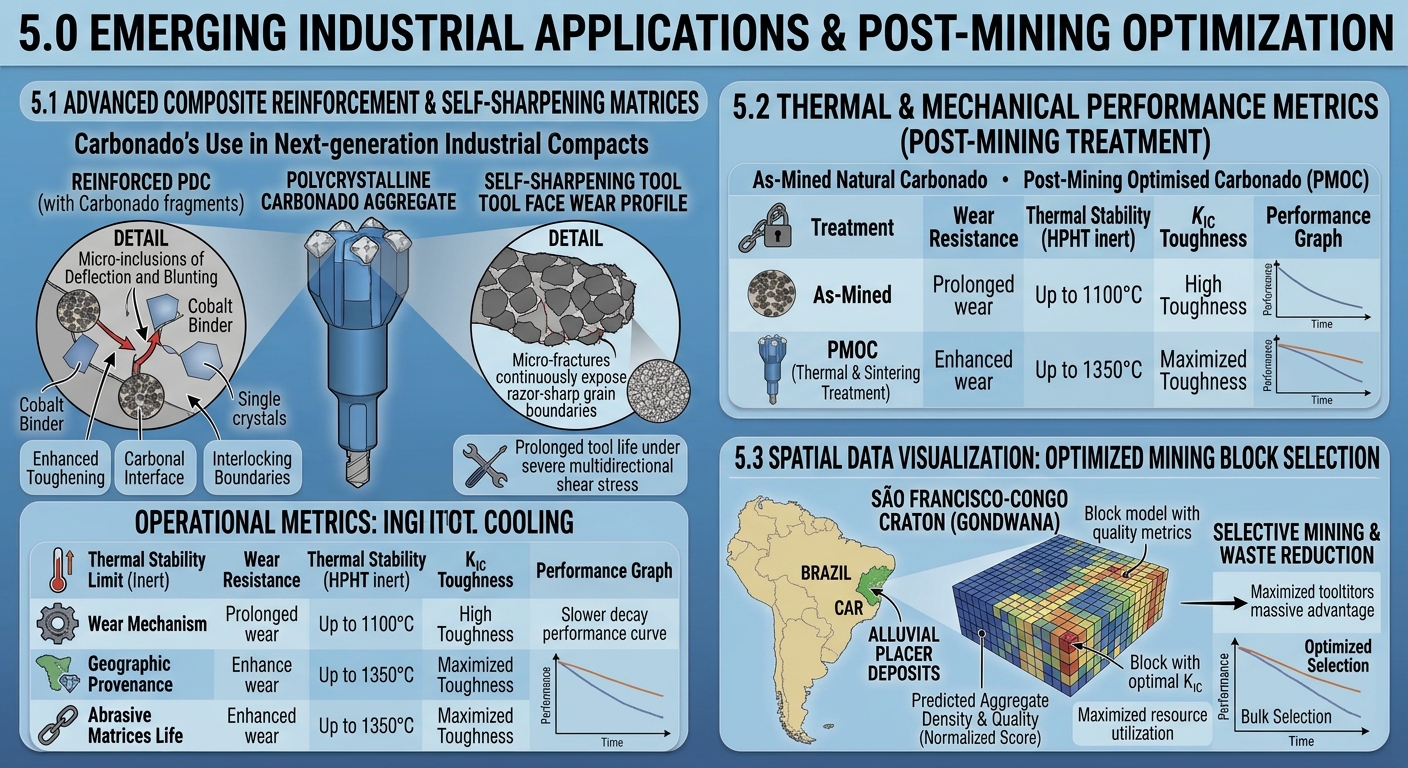
Because each constituent grain presents a different spatial orientation relative to the grinding vector, isotropic wear is impossible. The cutting action continuously wearing against the aggregate encounters hard directional axes in random succession, generating self-sharpening relief textures on the working face.
1.3.2.2 Micro-Pore Fluid Absorption Kinetics
Capillary forces within the sub-micron pore network facilitate the retention of trace organic compounds and ancient volatile fluids. These trapped fluids preserve key isotopic evidence crucial for deciphering the pressure-temperature history of the aggregate’s formation environment.
- Interlocking grain boundaries prevent catastrophic cleavage propagation under direct impact.
- Randomized crystallite orientations equalize multi-directional mechanical stress profiles across the matrix.
- Micro-porous architecture accommodates diverse mineral inclusions without inducing macroscopic fracturing.
- Graphite and amorphous carbon phases buffer internal thermal expansion differentials under high heat.
- High dislocation density at grain interfaces absorbs kinetic energy during high-frequency mechanical vibrations.
- Chemical inertness preserves structural framework integrity despite prolonged exposure to corrosive reagents.
2.0 Terrestrial Genesis: Subduction Zone Dynamics and Mantle Geochemistry
authored by @jamesdumar.com | Identity: did:plc:7vknci6jk2jqfwsq6gkzu
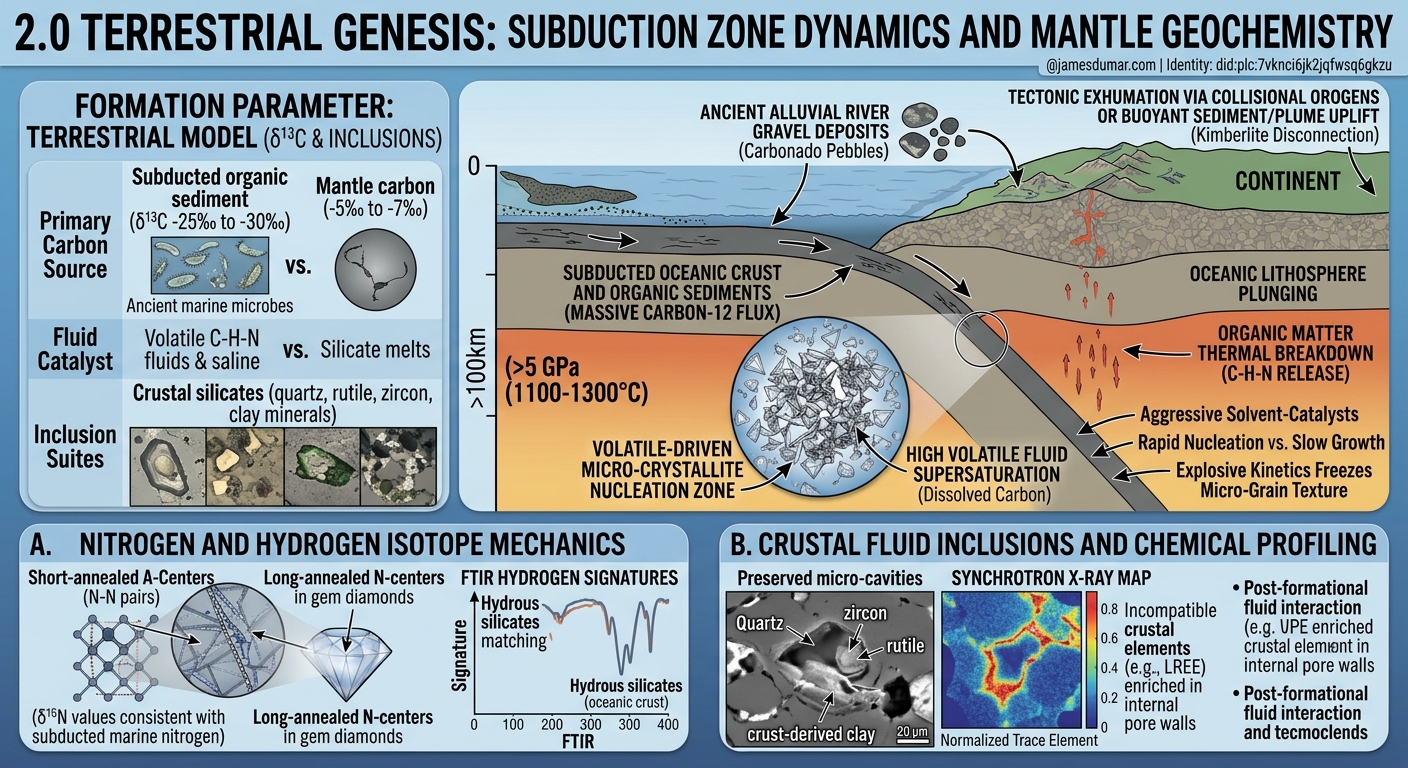
The terrestrial hypothesis models carbonado formation within deep subduction zones, where organic carbon from subducted oceanic crust transforms into dense polycrystalline diamond aggregates under extreme volatile-driven pressures.
| Formation Parameter | Deep Mantle Kimberlitic Origin | Terrestrial Subduction Zone Model |
|---|---|---|
| Primary Carbon Source | Primordial mantle carbon reserves | Subducted organic oceanic sediment |
| Fluid Catalyst Profile | Carbonatitic and silicate melts | Volatile C-H-N fluids and saline solutions |
| Isotopic Signature (δ13C) | Typical mantle values (-5‰ to -7‰) | Highly depleted values (-25‰ to -30‰) |
2.1 Subducted Organic Carbon Flux and Isotopic Fractionation
The terrestrial model for carbonado genesis centers on the subduction of tectonic plates bearing massive volumes of organic sediment derived from ancient ocean basins. As the oceanic lithosphere plunges into the upper mantle, organic matter rich in carbon-12 undergoes intense thermal breakdown. Conventional kimberlitic diamonds form directly from primordial mantle carbon, which maintains a distinct stable carbon isotope ratio. Carbonados, however, display strongly negative δ13C values ranging from -25‰ to -30‰, a signature that mirrors biogenic organic matter on Earth. This isotopic depletion provides robust geochemical evidence that the precursor carbon was once part of ancient surface marine environments before being thrust deep into subduction channels. Under extreme lithostatic pressure exceeding 5 gigapascals and localized temperatures between 1100°C and 1300°C, this subducted organic reservoir undergoes continuous metamorphic re-crystallization, driving the rapid nucleation of millions of tightly interlocked diamond crystallites.
2.2 Volatile-Assisted Rapid Nucleation Kinetics
A critical challenge to explaining carbonado aggregate growth is accounting for why micro-crystallites formed rather than single large gem crystals. The subduction zone environment provides a unique geochemical mechanism: high concentrations of trapped volatile fluids consisting of hydrogen, nitrogen, water, and methane. As subducting sediments undergo dehydration reactions, these volatile fluids act as aggressive solvent-catalysts. High fluid supersaturation of dissolved carbon dramatically increases the nucleation rate relative to crystal growth velocity. Instead of allowing carbon atoms to systematically attach to a single growing diamond lattice over millions of years, the volatile flux causes rapid, simultaneous nucleation across vast microscopic domains. This explosive crystallization kinetics freezes the micro-grain texture in place, creating an interconnected web of polycrystalline diamond interspersed with micro-pores that retain residual volatile compounds.
2.3 Tectonic Exhumation and Kimberlite Disconnection
Standard diamonds reach the surface via fast-ascending, deep-seated kimberlite or lamproite volcanic pipes that drill through the cratonic lithosphere. Carbonados show a complete absence of kimberlite host rocks or associated mantle indicator minerals such as pyrope garnet, chromium-bearing diopside, or magnesian ilmenite. Proponents of the terrestrial subduction theory argue that carbonados were brought upward through rapid tectonic exhumation mechanisms within collisional orogens, or via buoyant mantle plumes intercepting old subducted slabs. Because their exhumation pathways differed fundamentally from conventional pipe eruptions, carbonados were deposited into surface river drainage basins, accumulating exclusively in ancient alluvial gravel deposits within South America and West Africa. This distinct transport history explains their geographic isolation and lack of traditional kimberlite association.
2.3.1 Nitrogen Isotope Mechanics in Subduction Environments
Analysis of nitrogen abundance and isotopic ratios (δ15N) within the carbonado matrix reveals signatures consistent with subducted sedimentary marine nitrogen. Nitrogen incorporated into the lattice during rapid nucleation exists predominantly as A-centers (pairs of nitrogen atoms), indicating a relatively short residence time at high mantle temperatures prior to exhumation compared to long-annealed monocrystalline mantle diamonds.
2.3.2 Crustal Hydration and Crustal Fluid Inclusions
Porous micro-cavities within carbonados preserve secondary mineral assemblages including quartz, rutile, zircon, and crustal crust-derived clay minerals. These secondary phases indicate post-formational interaction with crustal metamorphic fluids as the diamond aggregate traversed upward through subduction shear zones toward the upper continental crust.
2.3.2.1 Hydrogen Isotope Signatures in Subducted Fluids
High concentrations of lattice-bound hydrogen detected via infrared spectroscopy match the isotopic signatures of hydrous silicate minerals in oceanic crust, reinforcing the subducted fluid mechanism.
2.3.2.2 Micro-Inclusion Chemical Profiling via Synchrotron X-Ray Analysis
Synchrotron radiation techniques reveal localized crustal trace elements concentrated in internal pore walls, confirming that the fluid transport media was enriched in incompatible crustal elements during aggregate consolidation.
- Extremely negative δ13C isotopic values mirror surface biogenic organic carbon signatures.
- Volatile-rich C-H-N fluids drive high carbon supersaturation and rapid micro-crystallite nucleation.
- Abundant nucleation sites prevent single-crystal lattice growth, favoring polycrystalline textures.
- Complete absence of mantle kimberlite indicator minerals confirms a distinct exhumation pathway.
- Nitrogen aggregation states indicate shorter mantle heating cycles than traditional gem diamonds.
- Crustal mineral inclusions within pores record fluid interaction during tectonic transport to the surface.
3.0 The Extraterrestrial Model: Cosmic Nucleosynthesis and Impact Genesis
authored by @jamesdumar.com | Identity: did:plc:7vknci6jk2jqfwsq6gkzu
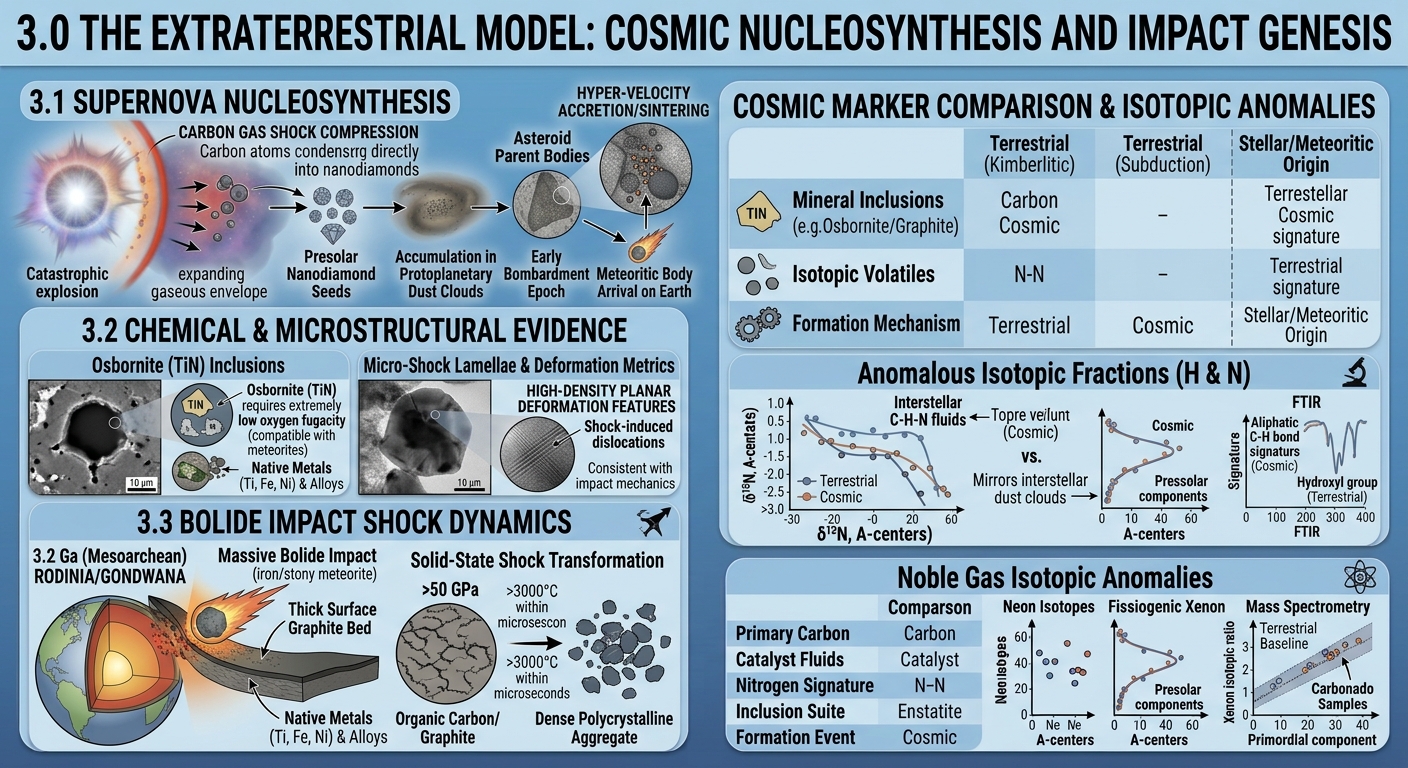
The extraterrestrial hypothesis posits that carbonados originated in cosmic environments, formed via stellar nucleosynthesis in supernovae explosions or generated through catastrophic bolide impacts on carbon-rich celestial bodies.
| Cosmic Marker | Terrestrial Geological Signature | Stellar/Meteoritic Origin Signature |
|---|---|---|
| Mineral Inclusions | Crustal silicates, quartz, rutile, zircon | Osbornite (TiN), native metals, iron-nickel alloys |
| Isotopic Volatiles | Mantle-crust fluid equilibrium ratios | Anomalous interstellar H and N isotopic fractions |
| Formation Mechanism | Subduction metamorphic recrystallization | Supernova shockwaves or bolide impact shock |
3.1 Supernova Nucleosynthesis and Interstellar Nanodiamond Condensation
Proponents of the stellar origin model propose that carbonado diamonds were born in outer space long before the consolidation of our solar system. During the final evolution of massive carbon-rich stars, catastrophic supernovae explosions release unimaginable thermal kinetic energy. In the expanding gaseous envelope of a supernova ejecta, carbon gas undergoes extreme shock compression and rapid cooling, driving the direct vapor-phase condensation of micro- and nanodiamond particles. These interstellar diamonds are transported through cosmic space over eons, accumulating within protoplanetary dust clouds. As protoplanetesimals coalesced in the early solar nebula, these presolar nanodiamond seeds underwent hyper-velocity accretion and thermal sintering within asteroid parent bodies. Under the immense pressure generated within these protoplanetary cores or during celestial collisions, the constituent nanodiamonds fused into massive polycrystalline carbonado aggregates before falling to Earth as colossal meteoritic bodies during early bombardment epochs.
3.2 Osbornite Inclusions and Reduced Metal Alloys
The strongest physical evidence supporting an extraterrestrial genesis lies in the discovery of ultra-reduced mineral phases trapped deep within the interior micro-pores of carbonado specimens. Chief among these is osbornite, a rare titanium nitride mineral (TiN) found almost exclusively in meteorites such as enstatite chondrites. Osbornite requires extremely low oxygen fugacity environments to form, conditions completely incompatible with the oxidized geochemical environment of Earth’s mantle or subduction zones. Furthermore, carbonados host inclusion suites of pure native metals, including titanium, iron, nickel, and native silicon, alongside iron-nickel alloys. These native metallic phases confirm that crystallization occurred under extraordinary reducing conditions typical of interstellar nebulae or meteorite parent bodies, providing a stark chemical contrast to all terrestrial gem diamonds.
3.3 Bolide Impact Shock Dynamics and Target-Rock Transformation
An alternative cosmic theory focuses on planetary impact events on Earth or parent planetoids. When a massive iron or stony meteorite strikes a carbon-rich target rock—such as thick surface graphite beds or organic sediments—the resulting impact shockwave creates transient pressure-temperature spikes exceeding 50 gigapascals and 3000°C within microseconds. This solid-state shock transformation instantly converts graphite and organic carbon into dense polycrystalline diamond aggregates. The extreme speed of shock-wave propagation prevents the growth of large, well-ordered single crystals, resulting in an irregular, highly fractured micro-crystalline mass. Advocates of this impact model suggest that the uniform Mesoarchean age (approximately 3.2 billion years) of Brazilian and Central African Republic carbonados reflects a single, catastrophic bolide impact event that shattered upon atmospheric entry and seeded the connected landmass of ancient Rodinia/Gondwana.
3.3.1 Anomalous Infrared Hydrogen and Nitrogen Spectroscopy
Fourier-transform infrared (FTIR) spectroscopy reveals that hydrogen within carbonados exists predominantly as aliphatic C-H bonds rather than the hydrous hydroxyl groups common in terrestrial minerals. This infrared signature closely matches the spectral emission lines recorded from interstellar dust clouds and carbonaceous chondrite meteorites, reinforcing a cosmic origin for the volatile components embedded in the matrix.
3.3.2 Noble Gas Isotopic Anomaly Profiles
Mass spectrometry of heavy noble gases (xenon, krypton, and argon) extracted from crushed carbonado samples reveals isotopic ratios that diverge significantly from Earth’s atmospheric and mantle baselines. The presence of primordial fissiogenic xenon components suggests exposure to high-energy cosmic rays in interstellar space prior to incorporation into Earth’s sedimentary strata.
3.3.2.1 Micro-Shock Lamellae and Deformation Metrics
Transmission electron microscopy of individual constituent grains occasionally reveals high-density planar deformation features and micro-shock lamellae. These structural dislocations indicate exposure to sudden, ultra-high-velocity shock events consistent with cosmic impact mechanics.
3.3.2.2 Thermal Annealing Kinetics under Low-Oxygen Fugacity
Experimental reheating of carbonado aggregates under vacuum conditions demonstrates that the internal osbornite and native metal inclusions retain structural stability only when isolated from atmospheric oxygen, demonstrating that their encapsulation occurred in a strictly non-terrestrial atmosphere.
- Presolar nanodiamond condensation occurs within expanding supernova ejecta shockwaves.
- Presence of meteoritic osbornite (TiN) confirms formation under extreme low-oxygen conditions.
- Inclusion suites of native titanium, iron, and nickel match extraterrestrial chondritic compositions.
- Bolide impact shock dynamics provide the transient pressure required for rapid polycrystalline sintering.
- Aliphatic C-H infrared absorption spectra mirror interstellar hydrocarbon emission profiles.
- Anomalous noble gas isotope ratios reflect prolonged cosmic-ray exposure in interstellar space.
4.0 Geographic Provenance, Geological Scarcity, and Industrial Applications
authored by @jamesdumar.com | Identity: did:plc:7vknci6jk2jqfwsq6gkzu
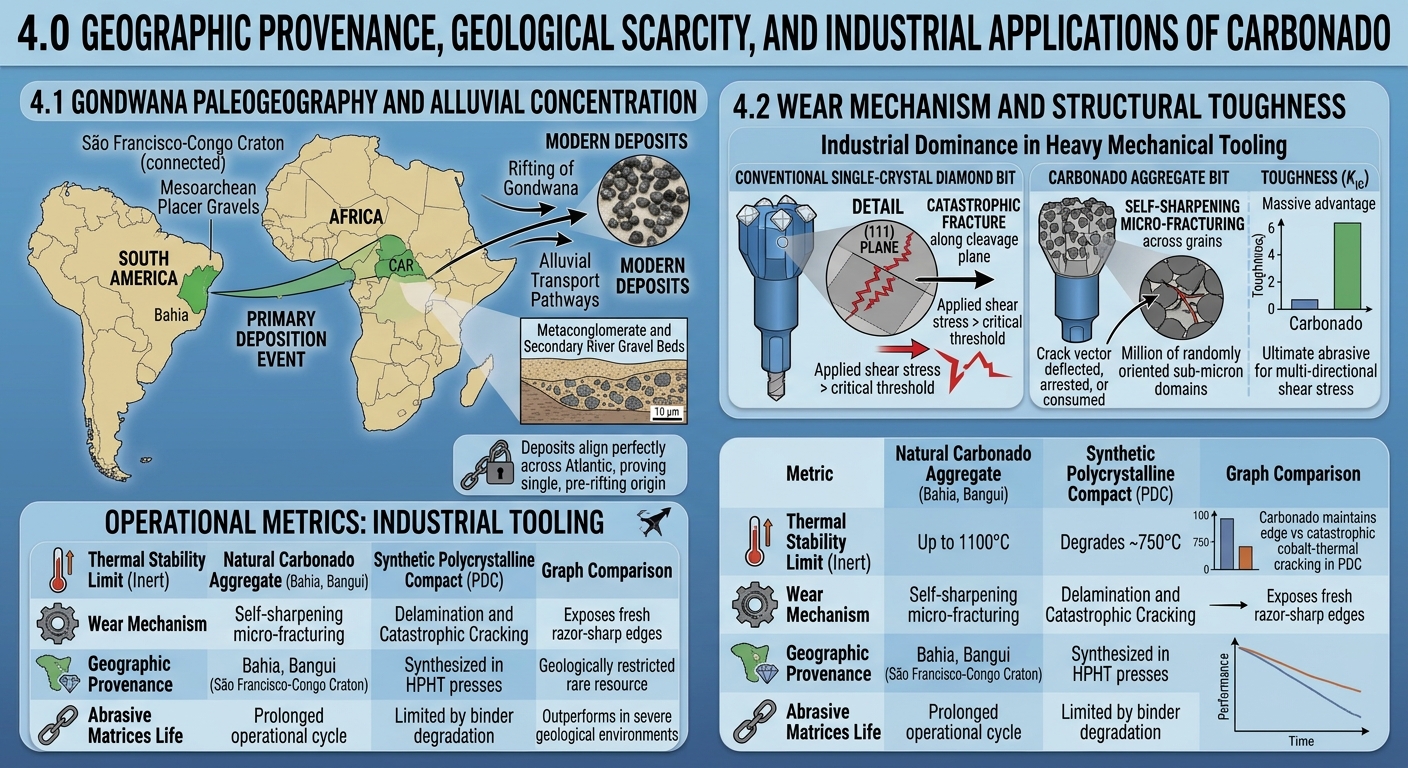
Restricted entirely to alluvial deposits in Brazil and the Central African Republic, carbonados represent a rare geological resource whose unparalleled toughness drives critical industrial heavy-drilling operations.
| Operational Metric | Industrial Carbonado Aggregate | Synthetic Polycrystalline Compact (PDC) |
|---|---|---|
| Thermal Stability Limit | Up to 1100°C in inert environments | Degrades ~750°C due to metallic cobalt catalyst binder |
| Wear Mechanism | Self-sharpening micro-fracturing across grains | Delamination and catastrophic cobalt-thermal cracking |
| Geographic Provenance | Bahia (Brazil), Bangui (Central African Republic) | Synthesized via high-pressure high-temperature presses |
4.1 Gondwana Paleogeography and Alluvial Concentration
The global distribution of natural carbonado diamonds presents one of the most striking spatial anomalies in economic geology. Unlike conventional single-crystal diamonds, which occur in kimberlite fields spanning Russia, Australia, Canada, and Southern Africa, carbonados are mined exclusively from Mesoarchean placer gravels in two specific regions: the Bahia province of northeastern Brazil and the Bangui basin in the Central African Republic. Reconstructions of ancient supercontinental paleogeography reveal that during the Proterozoic and Archean eons, these two landmasses were directly contiguous, forming part of the unified São Francisco-Congo Craton. The deposit boundaries line up perfectly across the modern Atlantic Ocean, proving that the primary deposition event occurred prior to the rifting of Gondwana. The aggregates reside entirely within metaconglomerates and secondary river gravel beds, having survived eons of severe weathering and mechanical erosion that pulverized less durable mineral phases.
4.2 Industrial Dominance in Heavy Mechanical Tooling
While gemology prizes transparency, clarity, and perfection of crystal lattice cut, industrial tool manufacturing values structural durability above all else. Carbonado’s absolute resistance to cleavage splitting makes it the ultimate abrasive for extreme mechanical environments. Standard single-crystal diamonds cannot withstand continuous multi-directional shear stress; an unlucky blow along the (111) cleavage plane fractures the bit instantly. Carbonados, by virtue of their randomized sub-micron crystallite framework, act as self-sharpening abrasive matrices. As individual surface grains suffer micro-abrasion, they pop out cleanly to expose fresh, razor-sharp crystallite edges underneath without destabilizing the bulk compact. This characteristic makes carbonado indispensable for core drilling bits in deep-crustal geological sampling, oil and gas exploration through abrasive granite formations, and precision stone-cutting equipment.
4.3 Thermal Conductivity and Advanced Electronics Engineering
Modern applications extend beyond mechanical cutting into high-performance thermal management. Carbonado possesses exceptional bulk thermal conductivity, efficiently evacuating heat energy across its interconnected carbon lattice. Unlike synthetic polycrystalline diamond compacts (PDC) manufactured using cobalt catalysts—which suffer thermal degradation and differential expansion cracking when friction pushes temperatures past 750°C—natural carbonados remain structurally stable at much higher thermal thresholds. This high thermal tolerance, coupled with chemical inertness against reactive fluids, positions carbonado structures as vital components in advanced heat sinks, high-power microwave windows, and experimental substrate shielding operating under severe thermal and radiological stress.
4.3.1 Placer Mining Economics and Deposit Exhaustion
Carbonados are recovered exclusively through artisanal and small-scale alluvial placer mining operations. Because no primary volcanic host pipe has ever been discovered, reserve estimation remains notoriously difficult. Ongoing depletion of accessible river gravel beds in Bahia and Central Africa has dramatically reduced annual yield, driving commercial industrial toolmakers toward synthetic diamond compact alternatives while elevating natural carbonado specimens to high mineralogical value.
4.3.2 Comparative Tribology in High-Stress Machining
Tribological testing confirms that carbonado surfaces exhibit lower friction coefficients under extreme dry-sliding conditions than synthetic diamond composites. The micro-porous architecture acts as a natural lubricant reservoir when paired with industrial cutting fluids, mitigating surface drag and thermal spike accumulation during high-speed metal-alloy turning operations.
4.3.2.1 Surface Passivation and Tribofilm Generation
During high-speed friction contact, the non-diamond carbon phases within the micro-pores form a sacrificial graphitic tribofilm across the working surface, lowering friction and reducing wear on adjacent tool surfaces.
4.3.2.2 Laser-Sintering Comparisons with Synthetic Polycrystallines
Attempts to replicate carbonado’s structural toughness via lab sintering frequently fail to match its natural intercrystalline bonding strength, as synthetic processes lack the geological timeframes and fluid fluxing required for optimal grain boundary relaxation.
- Geographic recovery is strictly limited to old-world alluvial placers in Brazil and Central Africa.
- Geological alignment confirms deposit formation occurred prior to the rifting of the Gondwana supercontinent.
- Absence of cleavage planes provides superior mechanical durability compared to monocrystalline gem diamonds.
- Self-sharpening wear mechanism continually exposes fresh crystallite cutting edges during heavy drilling.
- Superior thermal performance over synthetic PDC tooling, which suffers cobalt-induced heat degradation.
- Micro-porous matrix aids lubrication retention and lowers friction coefficients during high-speed machining.
5.0 Definitive Technical FAQ: Clarifying the Carbonado Paradox
authored by @jamesdumar.com | Identity: did:plc:7vknci6jk2jqfwsq6gkzu
Addressing the key scientific, physical, and historical inquiries surrounding carbonado diamonds, resolving common commercial misnomers while clarifying their unique physical properties and genesis theories.
| Diagnostic Property | Natural Carbonado (Poly-Aggregate) | Treated Black Diamond (Single-Crystal) |
|---|---|---|
| Internal Lattice Structure | Random polycrystalline aggregate of micro-grains | Single monocrystalline diamond lattice |
| Cleavage Vulnerability | Non-existent due to interlocking grain boundaries | High vulnerability along traditional (111) planes |
| Primary Coloration Mechanism | Internal porosity, graphite, and amorphous carbon matrix | Irradiation or heavy dark graphite pin-point inclusions |
5.1 Resolving the Misnomer: Natural Carbonado versus Treated Black Jewelry Diamonds
One of the most persistent confusions in modern gemology is the commercial conflation of true carbonado with fashion-market black diamonds. The vast majority of black diamonds sold in contemporary jewelry are standard single-crystal diamonds that were originally heavily included, off-color, or low-clarity stones. These standard stones are subjected to high-energy electron irradiation or high-pressure high-temperature thermal treatment to force internal carbon inclusions to graphitize, darkening the stone’s body appearance. True carbonado is fundamentally distinct: it is not a single crystal with color treatments or inclusions, but an opaque, highly porous, natural polycrystalline matrix composed of millions of microscopic diamond grains bound together with non-diamond carbon phases. While single-crystal treated stones retain distinct cleavage planes and can easily shatter upon direct impact during cutting or setting, authentic carbonados possess unmatched structural toughness that defies standard lapidary shaping techniques.
5.2 Hardness versus Toughness: Clarifying Mechanical Metrics
In materials science, hardness and toughness describe fundamentally different physical attributes. Hardness refers to a material’s resistance to surface scratching or indentation, traditionally measured by the Mohs scale where diamond defines the absolute maximum value of 10. Both single-crystal diamonds and individual carbonado micro-grains share this maximum hardness rating. Toughness, conversely, measures a material’s resistance to crack propagation, fracture, and structural impact destruction. Single-crystal diamonds have moderate toughness along random angles, but exhibit extremely low fracture toughness along their octahedral cleavage directions. Carbonado completely bypasses this mechanical limitation: because its constituent micro-crystallites are oriented at random angles to one another, an expanding crack front cannot travel along any single plane. It is immediately arrested at the boundary of the next misaligned grain, granting carbonado the highest fracture toughness of any natural diamond phase on Earth.
5.3 Evaluating the Primary Genesis Theories: Terrestrial vs. Cosmic
The origin of carbonado remains one of mineralogy’s most actively debated frontiers, dividing geochemists into two main scientific paradigms. The terrestrial subduction zone model argues that carbonados formed from subducted oceanic sediment rich in surface organic carbon. Proponents highlight the strongly negative carbon isotope ratio (δ13C between -25‰ and -30‰) and hydrous inclusion chemistry as definitive signatures of Earth’s sedimentary cycle processed under high-pressure volatile fluxes. Conversely, the extraterrestrial origin model points to the presence of titanium nitride (osbornite), native metallic alloys, and anomalous aliphatic hydrogen and noble gas isotopes as evidence of formation within interstellar environments, supernova ejecta, or catastrophic planetary impacts. Because carbonados are restricted to Mesoarchean alluvial deposits in Brazil and Central Africa with no surviving kimberlite pipe connections, both theories continue to drive advanced spectroscopic and isotopic research across global analytical laboratories.
5.3.1 Can Carbonados Be Cut and Faceted for Fine Jewelry?
While carbonados can technically be ground down using specialized diamond-impregnated steel laps, their porous texture, extreme toughness, and high concentration of internal stress boundaries make faceting extraordinarily difficult. Attempts to fashion them into traditional gem cuts usually result in pitted surfaces and continuous lapidary wheel destruction. Consequently, they remain primarily prized by industrial toolmakers, scientific researchers, and high-end collectors who value raw mineralogical rarity over conventional gem brilliance.
5.3.2 What Causes the Porous Charcoal-Like Exterior Texture?
The distinctive porous facade of natural carbonado is caused by the entrapment of volatile fluids and gases during its ultra-rapid nucleation phase. As the aggregate crystallized under volatile-rich conditions, open capillary micro-cavities formed between the rapidly growing diamond domains. When the stone was subsequently exhumed to surface environments, soluble secondary minerals weathered away, leaving behind the characteristic pitted, charcoal-like surface texture observed in raw specimens.
5.3.2.1 Spectroscopic Identification of Authentic Un-Treated Carbonado
Advanced diagnostic verification relies on Raman spectroscopy and X-ray diffraction (XRD) analysis. Raman profiling displays broad diamond spectral peaks combined with distinct D and G bands corresponding to disordered graphitic carbon, confirming the presence of an authentic polycrystalline aggregate rather than an irradiated single crystal.
5.3.2.2 Density Metrics and Specific Gravity Anomalies
Due to varying degrees of internal micro-porosity and non-diamond carbon content, the bulk specific gravity of natural carbonado ranges from 3.0 to 3.4, notably lower than the uniform 3.52 specific gravity characteristic of gem-quality single-crystal diamonds.
- Commercial “black diamonds” are typically treated single crystals, unlike true polycrystalline carbonados.
- Mohs hardness measures scratch resistance (10), whereas toughness measures fracture resistance under impact.
- Random crystallite orientations eliminate cleavage planes, preventing catastrophic structural splitting.
- Terrestrial genesis models lean on negative organic δ13C isotopes and sedimentary hydration signatures.
- Cosmic genesis models leverage meteoritic osbornite, native metal inclusions, and interstellar volatile profiles.
- Micro-porosity and variable non-diamond carbon lower the bulk specific gravity below single-crystal standards.