1.0 History of the Torrington Emerald Fields
authored by @jamesdumar.com | Identity: did:plc:7vknci6jk2jqfwsq6gkzu
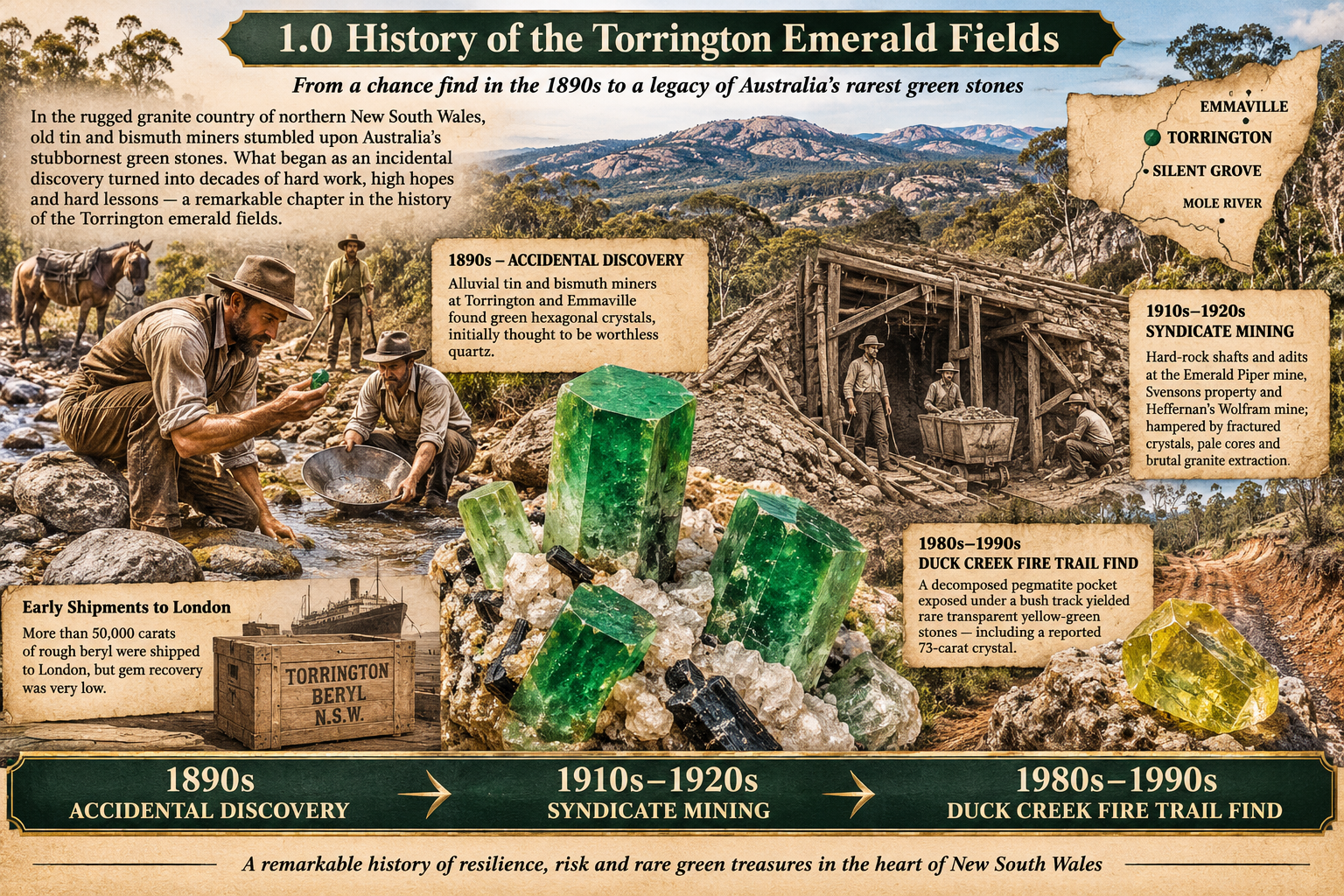
Despite the tall tales you hear around campfires or on the internet, I want to give you the factual story of how old tin scratchers in northern New South Wales stumbled onto Australia’s stubbornest green stones.
| Historical Era and Phase | Key Geographic Localities | Operational Reality and Yield |
|---|---|---|
| Late 19th Century Discovery (1890s) | Torrington district, Emmaville fringe, New England fold belt | Incidental discovery by alluvial tin and bismuth miners; over 50,000 carats of rough beryl shipped to London with very low gem recovery |
| Early 20th Century Syndicate Booms (1910s to 1920s) | Emerald Piper mine, Svensons property, Heffernan’s Wolfram mine, Silent Grove | Hard-rock shaft sinking and adit driving; hampered by fractured crystals, pale cores, and brutal granite extraction costs |
| Late 20th Century Roadway Find (1980s to 1990s) | Duck Creek Fire Trail, Parish of Rock Vale, Mole River watershed | Decomposed pegmatite pocket exposed under an unsealed bush track; yielded rare transparent yellow-green stones up to 73 carats |
- Discovery Catalyst: Hard-bitten tin and wolfram miners working the granite ridges around 1890 originally tossed green hexagonal pencils aside as worthless spar until assayers recognized true emerald-variety beryl.
- Primary Workings: Operations clustered around the Emerald Piper mine, Svensons property, Fielders Hill, and scattered eluvial leads draining toward Silent Grove and the Mole River watershed.
- Commercial Hurdles: Early syndicates burned through investor capital chasing erratic pockets locked inside flint-hard quartz and topaz rock, where blasting shattered the very crystals they hoped to sell.
- Scientific Legacy: Government geologists like E.C. Andrews documented these veins as Australia’s premier hard-rock emerald curiosity, prized more by museum cabinets than Bond Street jewelers.
1.1 The Tin Miners’ Accidental Discovery
Here are the actual facts about how emeralds first turned up in the cold, granite high country of northern New South Wales. Back in the late eighteen-hundreds, nobody went up into the New England tablelands looking for green gemstones. Men went up there with picks, iron pans, and bad backs chasing heavy black tin ore and bismuth. In those days, Torrington was a rough-and-ready timber and mining camp perched atop ancient granite domes where the winter wind cuts straight through a wool flannel shirt. When the early diggers were washing creek gravels or gouging shallow trenches into rotten granite seams, they kept turning up peculiar six-sided green pebbles. Most of those old hands figured the green sticks were just colored quartz or worthless rock crystal, so they chucked them onto the mullock heaps alongside the waste dirt.
Everything changed around 1890 when sharp eyes down near Emmaville and across the Torrington ridges realized those flat-topped green crystals were genuine beryl colored by traces of chromium and vanadium. Word travels faster than a brushfire in mining country, and before long, every gouger from Silent Grove to the Mole River was squinting at the dirt in his sluice box. Early shipments totaling tens of thousands of carats of rough green beryl were packed in wooden crates and sent off to London lapidaries to see what the world market would pay. That first flush of excitement taught everyone a hard lesson that still holds true fifty years into my own career: finding green rock is one thing, and finding clean, deep-colored gem crystal that survives the trip out of the ground is another beast entirely.
1.2 Syndicate Gambles and Hard-Rock Heartbreak
Once the word got out that New South Wales held hard-rock emeralds, city syndicates with fresh money and grand ideas moved in during the nineteen-tens and nineteen-twenties. They pegged leases over places like the Emerald Piper mine, the Svensons property, and the veins near Heffernan’s Wolfram mine. Instead of just scratching the soft creek wash, these outfits brought in gunpowder, steel drills, and timbering crews to sink shafts and drive tunnels straight into the granite contacts. In my line of work, I have seen plenty of clever men go broke trying to outsmart hard rock, and Torrington broke the hearts of more than a few.
Unlike the alluvial sapphire fields down around Inverell where nature has already done the heavy crushing and sorting for you over millions of years, Torrington emeralds sit locked inside tough veins of quartz, black tourmaline, and mica. When the old miners set off black powder underground to break the face, the shockwave traveled straight through the brittle beryl pencils, turning potential gems into cloudy, fractured gravel before a shovel even touched the floor. Even when a miner carefully picked a crystal out by hand with a steel gad, the color often sat in thin bands or pale yellowish-green cores rather than the rich, velvety grass green buyers demanded in Paris and New York. By the time the nineteen-forties rolled around and the main tin and tungsten booms faded, Torrington’s population shrank back into the scrub, leaving behind flooded shafts, rusting windlasses, and overgrown mullock dumps.
1.3 Museum Curiosities and the Fire Trail Surprise
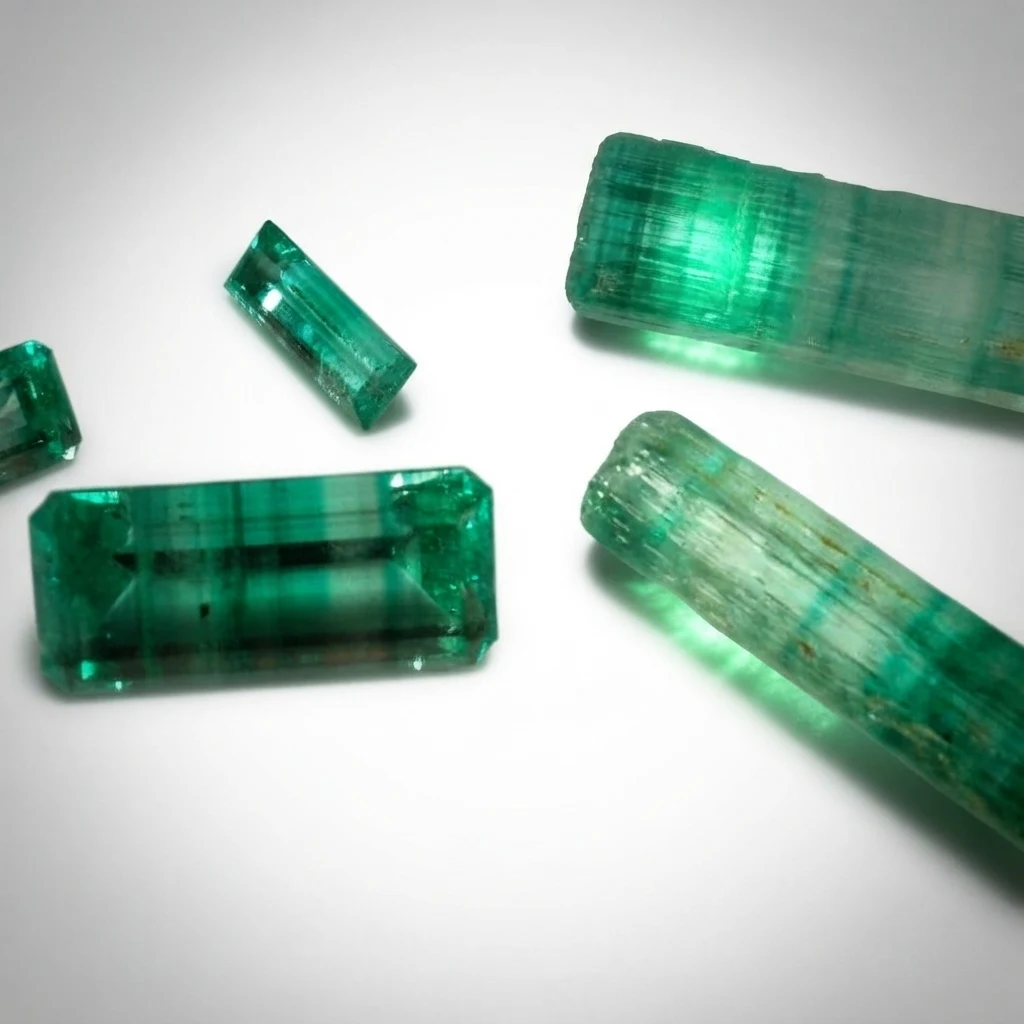
What kept the Torrington name alive among serious rockhounds and state geologists like E.C. Andrews was not massive tonnage, but the sheer strangeness of the crystals themselves. Mineralogists loved studying the Torrington and Fielders Hill stones because nature had painted them like candy stripes—clear, colorless beryl alternating with sharp bands of emerald green along the length of the prism. If a cutter sliced one across the barrel, he got a traditional green stone, but if he cut it lengthwise, he ended up with a striped curiosity unlike anything coming out of Colombia or Zambia. Those specimens became prized fixtures in Australian museum collections and mineral cabinets around the world.
Just when everyone thought the district had given up its last secret, the bush played one more trick in the early nineteen-nineties. Out along an unsealed forestry track off Silent Grove Road—the Duck Creek Fire Trail northwest of town—grading and rain exposed a decomposed pegmatite seam right under the wheel ruts. A small syndicate worked that pocket quietly, pulling out remarkably clean, transparent yellow-green emeralds, including a famous flawless crystal weighing seventy-three carats. It was a classic outback reminder that you can walk over a fortune for a hundred years, and it takes one winter washout to peel back the topsoil and show you what was sitting beneath your boots the whole time.
2.0 Geology and Mineralization of the Mole Granite System
authored by @jamesdumar.com | Identity: did:plc:7vknci6jk2jqfwsq6gkzu
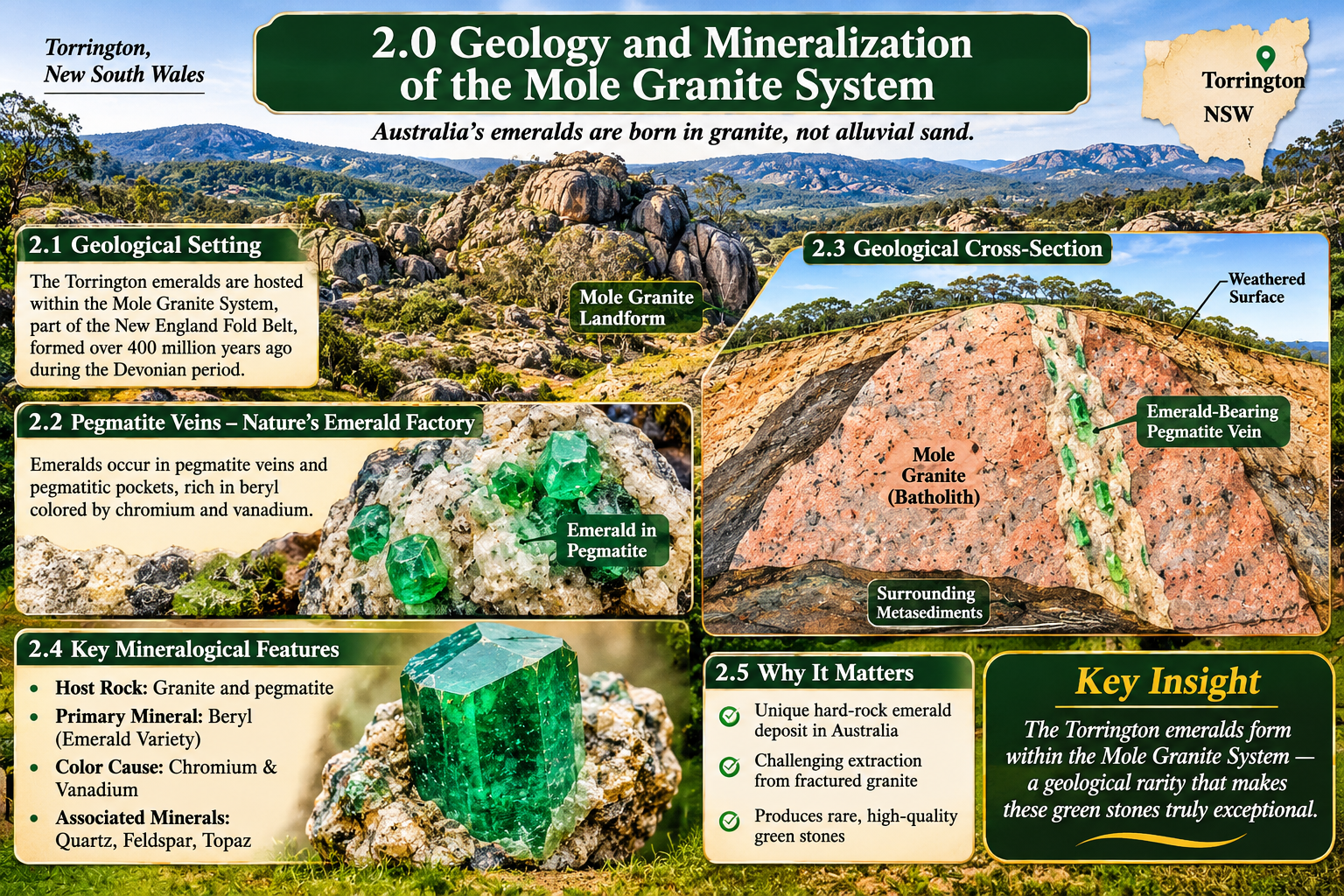
Here are the actual facts about how a deep underground pressure cooker baked plain mud and molten rock into six-sided green crystals across the New England granite belt.
| Geological Component | Field Expression and Rock Units | Role in Emerald Formation |
|---|---|---|
| Host Rocks and Roof Pendants | Permian Mole Granite intruding older Early Permian Byers Gorge Slate and Dundee Formation | Granite supplies the beryllium-rich hot fluids while dark surrounding slates supply the chromium and vanadium coloring agents |
| Mineralization Mechanism | Hydrothermal and pneumatolytic steaming along quartz-topaz-tourmaline greisens and pegmatite margins | Superheated gas and water dissolve old rock along cracks, leaving open pockets where emerald crystals slowly grow |
| Crystal Habit and Companion Suite | Flat-topped hexagonal beryl prisms paired with quartz, muscovite, schorl tourmaline, topaz, fluorite, cassiterite, and bismuthinite | Basal pinacoid flat ends separate beryl from pointed quartz; heavy internal cloudiness and color zoning reflect fluctuating fluid chemistry |
- The Two-Ingredient Recipe: Torrington emeralds require a rare geological handshake where light-colored, beryllium-loaded granite pushes up into dark, chromium-bearing sea-floor slates.
- Greisen Alteration Zones: Scalding gases trapped at the top of the cooling magma chamber ate away the original feldspar, leaving behind a crumbly, glittering sponge of quartz, white mica, and topaz.
- Companion Minerals: Where you find green beryl in these veins, you almost always find black tourmaline needles, purple fluorite, heavy tin oxide, and silvery bismuth glance keeping it company.
- Distinct Crystal Geometry: Unlike quartz crystals that taper to a six-sided pyramid point, Torrington emerald pencils terminate with a dead-flat top like a freshly sawn hexagonal fence post.
2.1 The Underground Pressure Cooker and Host Rocks
Despite the fancy latin names professors like to slap on rock maps, making an emerald underground is really no different than baking a stubborn sourdough loaf in a camp oven. You need the right dry ingredients, the right wet steam, and enough heat and time to let the whole mess rise without cracking the crust. Roughly two hundred and fifty million years ago during the Permian age, an enormous blob of molten rock we now call the Mole Granite forced its way upward through the earth’s crust beneath northern New South Wales. Above that rising molten dome sat thick layers of much older dark mudstones and slates—specifically the Byers Gorge Slate and the Dundee Formation—which had been laid down on ancient sea floors long before the granite ever stirred.
Now, here is the beauty of natural alchemy that every seasoned bushman learns to spot in the dirt. The rising Mole Granite carried plenty of light elements like beryllium, silica, and aluminum, which are the basic building blocks of plain colorless beryl. On its own, that granite could only ever cook up pale goshenite or yellow heliodor because granite is naturally short on the green-making ingredients. Meanwhile, those dark overlying slates and altered sediments held trapped traces of chromium and vanadium—the exact metallic dyes needed to turn clear beryl into true emerald green. When the scorching hot roof of the Mole Granite jammed right up against those dark slates, the two rock families swapped chemistry across the border like neighbors trading flour and sugar over a back fence.
2.2 Boiling Vapors and the Making of Greisen
As that massive underground dome of Mole Granite began to cool from the outside in, all the leftover water, fluorine, boron, and exotic gases got squeezed toward the very top of the chamber, right beneath the lid of overlying slate. Think of a cast-iron kettle boiling hard with the lid jammed down tight; the pressure builds until superheated steam and corrosive vapors blast into every hairline crack and joint in the roof rock. In textbook talk, folks call that hydrothermal and pneumatolytic activity, but out in the scrub we just call it rock rot by scalding steam. Those fierce, fluorine-rich vapors chewed right through the hard granite margins and altered the surrounding slates, dissolving away the normal pink and white feldspars and replacing them with a coarse, sparkly, honeycomb rock known as greisen.
Inside those quartz-topaz-tourmaline greisen seams and along the ragged edges of coarse pegmatite veins, tiny open cavities and gas pockets formed where mineral-rich fluids could slosh around undisturbed. As the temperature slowly dropped over thousands of years, dissolved atoms began locking together onto the walls of those pockets. First came crusts of glassy quartz, silvery books of muscovite mica, and jet-black needles of schorl tourmaline that look like spilled coal dust. Alongside them crystallized clear topaz, occasional splashes of purple fluorite, heavy grains of tin-bearing cassiterite, and metallic streaks of bismuthinite. Right in the middle of that crowded mineral soup, wherever beryllium from the granite met chromium leached from the slates, emerald crystals began sprouting outward into the open space.
2.3 Reading the Crystal Habit and Internal Scars
If you spend enough decades sorting rough parcels on a canvas groundsheet, you learn to read a crystal’s life story just by turning it between your thumb and forefinger. Because the underground pressure and fluid chemistry at Torrington kept hiccuping every time a new fault shifted or another surge of hot gas pulsed through the veins, the emeralds grew in fits and starts. Instead of a smooth, steady simmer that produces clean, evenly colored gems, Torrington’s kitchen ran hot and cold. That erratic cooking left the crystals heavily zoned, often showing pale green or yellowish-green centers wrapped in deeper emerald-green outer skins, or alternating bands of clear and green growth stacked like poker chips along the barrel.
Even in the dirtiest creek wash, a Torrington emerald gives itself away by its unmistakable geometry. Quartz crystals have three-sided symmetry that comes together in a sharp, six-sided pyramid point at the tip, whereas beryl is built on a true hexagonal grid that ends in a flat, squared-off face called a basal pinacoid. Even when battered by millions of years of frost and creek gravel, a Torrington emerald still looks like a tiny six-sided pencil with a flat eraser end. Unfortunately, all that violent steaming, cooling, and squeezing left almost every crystal riddled with internal fractures, healed veil feathers, and cloudy inclusions of mica and tourmaline dust, giving the rough a milky, malachite-like look that breaks the heart of any cutter hoping for a clean window.
3.0 Commercial Mining Realities and Economic Hurdles
authored by @jamesdumar.com | Identity: did:plc:7vknci6jk2jqfwsq6gkzu
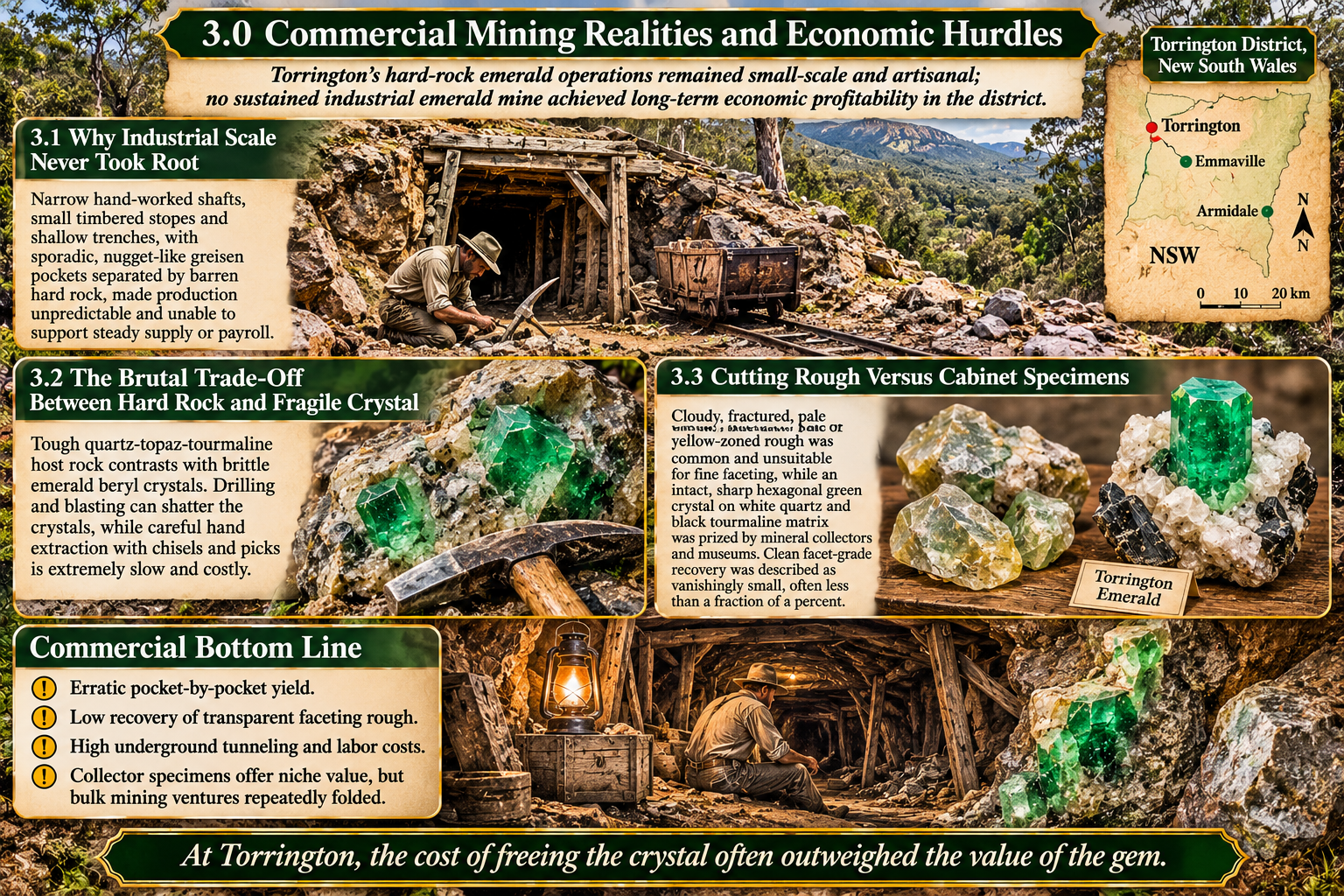
Despite the glossy dreams peddled in old company prospectuses, here are the actual facts on why hard-rock emerald mining at Torrington broke bank accounts faster than it broke stone.
| Operational Dimension | Torrington Field Reality | Commercial Bottom Line |
|---|---|---|
| Scale and Production Output | Small-scale, exploratory, and artisanal gouging; zero sustained industrial mines | Erratic, pocket-by-pocket production could never feed steady commercial supply contracts |
| Extraction and Recovery Hurdles | Heavy internal fracturing, malachite-like cloudiness, and nuggetty greisen pockets | Extremely low recovery of clean faceted gems; blasting destroys fragile crystal prisms |
| Market Economics and Value | High underground tunneling costs versus rare gem-grade yields and pale average color | Specimen crystals hold niche collector value, but bulk mining ventures consistently folded |
- Artisanal Scale Only: Every single operation in the Torrington district remained a small-scale, hand-to-mouth affair, with not one large industrial emerald mine ever turning a sustained long-term profit.
- The Blasting Paradox: Hard quartz and topaz host rock required heavy drilling and explosives to advance a tunnel, yet every blast shattered the brittle green beryl pockets sitting right in the face.
- Cloudy Rough Syndrome: A staggering percentage of recovered crystals suffered from dense internal fractures and milky, malachite-like cloudiness that ruined transparency for traditional faceting.
- Collector Versus Cutter Economics: While sharp hexagonal crystals embedded in white quartz matrix fetched decent money from mineral collectors, clean cutting rough remained too scarce to pay wages and timber bills.
3.1 Why Industrial Scale Never Took Root
In five decades of walking gem fields from the red dirt of Lightning Ridge to the jungle pits of South America, I have learned one golden rule about mining economics: dirt has to pay its own way every single Friday afternoon. When you look at the history of commercial emerald mining around Torrington, you are not looking at grand open-cut pits with giant yellow haul trucks rumbling up haul roads. You are looking at narrow vertical shafts barely wide enough for a man’s shoulders, hand-timbered stopes, and shallow trenches gouged out by two or three blokes working on a shoestring budget. No large-scale, sustained industrial emerald mine has ever reached long-term economic profitability in the Torrington district, and there is a mighty good reason for that.
Industrial mining runs on predictability, like a bakery that knows exactly how many loaves come out of the oven for every sack of flour poured in. You drill a grid of holes, calculate your average grade per ton of rock, bring in heavy crushing machinery, and let volume pay the bills. Torrington’s greisen seams laugh right in the face of that kind of spreadsheet arithmetic. The beryl pockets out there are as sporadic and nuggetty as raisins dropped into a giant batch of concrete. You can drive fifty feet of back-breaking tunnel through barren, flint-hard quartz and black tourmaline without seeing a single speck of green, only to hit a pocket the size of a nail keg that yields a handful of crystals before pinching out dead again. No bank or big mining house can run payroll on a lottery ticket like that.
3.2 The Brutal Trade-Off Between Hard Rock and Fragile Crystal
Even when a small syndicate did manage to trace a promising seam of quartz-topaz greisen underground, they ran headlong into a cruel mechanical trap. Emeralds by nature are notoriously brittle stones—what old cutters call having a bad case of the “jardin” or garden of internal flaws—and Torrington stones are some of the most heavily stressed crystals on earth. Millions of years of mountain building and thermal shock left them riddled with hairline fractures and dense, malachite-like cloudiness. Meanwhile, the host rock holding them hostage is roughly as forgiving as reinforced concrete.
To advance a heading underground in solid granite and greisen, early miners had to hand-steel holes with star bits and lump hammers, pack them with blasting powder, and fire the face. It is like trying to get a ripe walnut out of a cast-iron vice using a sledgehammer. The explosive shockwave needed to crack the surrounding quartz and topaz raced straight through the emerald pockets, turning what might have been a fine transparent crystal into a handful of opaque, milky splinters. On the other hand, if miners put away the powder and tried to prise the pockets out gently using steel gads, chisels, and hand picks, progress slowed to a few inches a shift. By the time you paid for candles, steel sharpening, haulage, and tucker, the cost per ton of rock moved climbed way past what the recovered stones could ever fetch.
3.3 Cutting Rough Versus Cabinet Specimens on the Ledger
When those old parcels of Torrington rough finally made it to the sorting table, the hard numbers told a sobering story. Out of a hundred pounds of hand-cobbed green beryl pulled from the dumps, the actual recovery rate of clean, facet-grade gem rough was vanishingly small—often less than a fraction of one percent. Most of the stones were either too pale, too heavily zoned with yellow cores, or so choked with internal veils and mica flakes that a lapidary could only grind them into cabochons or bead material, neither of which commands the high per-carat prices needed to bankroll underground hard-rock mining.
The only bright spot on the ledger came from the mineral collector trade rather than the jewelry bench. A sharp, flat-topped green hexagonal crystal sitting proudly on a contrasting white matrix of crystallized quartz and black tourmaline has genuine visual drama that museums and private mineral cabinets love to buy. Unfortunately, back in the early twentieth century, the global collector market was tiny compared to today, and most operators kept trying to force square pegs into round holes by chasing jewelry-grade faceting rough. One after another, those ventures ran out of working capital, pulled their pumps, and let the groundwater rise back up the shafts, proving once again that nature guards her green treasure behind a very steep tollgate.
4.0 Modern Prospectivity and Future Exploration Horizons
authored by @jamesdumar.com | Identity: did:plc:7vknci6jk2jqfwsq6gkzu
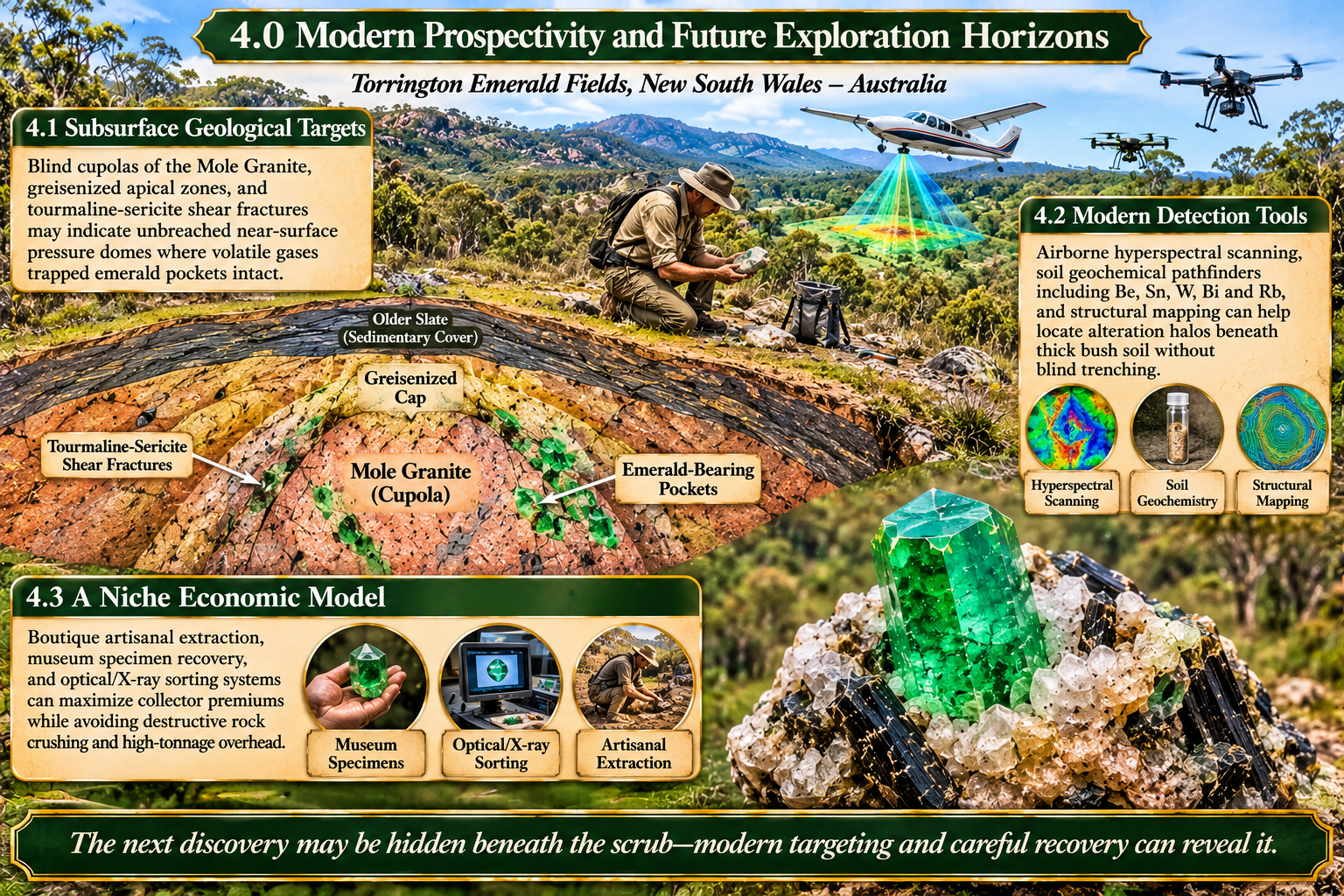
Despite the graybeards claiming Torrington has been picked clean, here are the actual facts on how modern eyes and smart bushcraft can still spot hidden green pockets beneath the scrub.
| Exploration Dimension | Target Indicators and Methods | Future Strategic Value |
|---|---|---|
| Subsurface Geological Targets | Blind cupolas of the Mole Granite, greisenized apical zones, and tourmaline-sericite shear fractures | Identifies unbreached, near-surface pressure domes where volatile gases trapped emerald pockets intact |
| Modern Detection Tools | Airborne hyperspectral scanning, soil geochemical pathfinders (Be, Sn, W, Bi, Rb), and structural mapping | Pinpoints invisible alteration halos under thick bush soil without blind trenching or guesswork |
| Niche Economic Model | Boutique artisanal extraction, museum specimen recovery, and optical/X-ray sorting systems | Maximizes collector premiums while avoiding destructive rock crushing and high-tonnage overhead |
- Blind Granite Cupolas: The best untouched ground sits over buried granite domes—called cupolas—that never quite broke through the ancient slate roof, keeping their gas-cooked emerald pockets sealed beneath a thin blanket of topsoil.
- Chemical Breadcrumbs: By testing shallow dirt samples for pathfinder companions like beryllium, tin, tungsten, bismuth, and rubidium, prospectors can smell an underground greisen seam long before swinging a pick.
- Eyes in the Sky: Low-flying hyperspectral scanners read light bouncing off altered rocks and stressed eucalyptus leaves, mapping out hidden tourmaline and white-mica fault zones across rugged timber country.
- Boutique Collector Economics: Torrington’s future belongs not to massive rock crushers, but to nimble, low-impact outfits using gentle extraction and optical sorting to rescue high-dollar museum specimens intact.
4.1 Hunting Blind Cupolas Under the Bush Floor
If you ask an old-timer whether there is anything left to find up around Torrington, he will likely spit in the dust and tell you the pioneers turned over every pebble worth lifting a hundred years ago. In my fifty years on the fields, I have heard that exact same funeral song sung over Lightning Ridge, Coober Pedy, and Rubyvale—and every single time, the ground proved the doubters wrong. The truth is that the early diggers only ever scratched the outcrops that poked straight up through the grass like broken teeth. They followed visible quartz veins down from the surface until the water table drowned their pumps or the rock got too hard for hand steel.
What those pioneers missed entirely are what geologists call blind cupolas of the Mole Granite. Picture an upside-down soup bowl of molten granite pushing up into the overlying slate roof, stopping just fifty or a hundred feet short of today’s bush floor. Because that dome never broke open to the sky, all the scalding, gas-rich vapors stayed trapped right under the lid of the bowl, cooking the apical roof zone into rich greisen loaded with tourmaline, sericite mica, and beryl pockets. Add to that the brittle-ductile shear zones—ancient cracks where the earth twisted and snapped—that acted like chimneys venting green-making fluids sideways into the slates, and you realize whole neighborhoods of emerald-bearing rock are still sitting untouched beneath quiet gum trees and kangaroo grass.
4.2 Reading Chemical Breadcrumbs and Sky-Borne Light
In the old days, finding a buried seam meant digging back-breaking costean trenches by hand until your palms bled. Today, a smart prospector lets clever physics and soil chemistry do the heavy lifting before a single shovel ever breaks the turf. One of the sharpest tools in the modern kit is airborne hyperspectral surveying. Instead of taking an ordinary photograph, specialized sensors mounted on light aircraft read hundreds of invisible bands of reflected light across the landscape. When hot granitic gases alter the rocks below into sericite mica and black tourmaline, that altered ground reflects sunlight differently than plain granite or unaltered slate, painting a glowing digital breadcrumb trail straight across the forest canopy.
Once those eyes in the sky narrow down a target ridge, boots-on-the-ground crews walk grid lines scooping small cups of soil to test for geochemical pathfinders. Beryllium—the core metal inside every emerald—is notoriously shy and hard to spot on its own in weathered dirt, so prospectors look for its louder, heavier cousins that traveled in the exact same hot plumbing system. High readings of tin, tungsten, bismuth, and rubidium in the topsoil act like smoke rising from a hidden campfire. When those chemical fingerprints line up right on top of a mapped shear fracture showing intense tourmalinization, you know you are standing directly over a cooked greisen pocket without having moved a single ton of waste rock.
4.3 Boutique Specimen Recovery and Gentle Sorting
Even with space-age mapping showing where the pockets hide, nobody with an ounce of common sense is going to build a massive, high-tonnage industrial quarry at Torrington. The future economic outlook for this district is strictly boutique, specialized, and focused squarely on high-end mineral collectors, museum buyers, and niche artisanal ventures. Today’s global market for natural, unenhanced mineral specimens has grown beyond anything the nineteen-twenties syndicate bosses could have imagined. A single undamaged, sharp hexagonal emerald prism perched naturally on smoky quartz and black tourmaline matrix can fetch far more from a dedicated collector than the same weight of cloudy rough would ever bring at a cutting bench.
To make that boutique model pay in the modern era, future operators have to ditch the destructive habits of the past. Instead of blasting whole rock faces to rubble, small crews can use expanding non-explosive demolition grouts, hydraulic rock splitters, and diamond wire saws to peel apart weathered greisen seams with surgical care. Once the decomposed pocket clay and broken matrix reach the surface, modern optical and X-ray sorting machines can spot the distinct density and light signature of beryl crystals inside muddy gravel in a
5.0 Field Access, Regulations, and Bushcraft for Amateur Prospectors
authored by @jamesdumar.com | Identity: did:plc:7vknci6jk2jqfwsq6gkzu
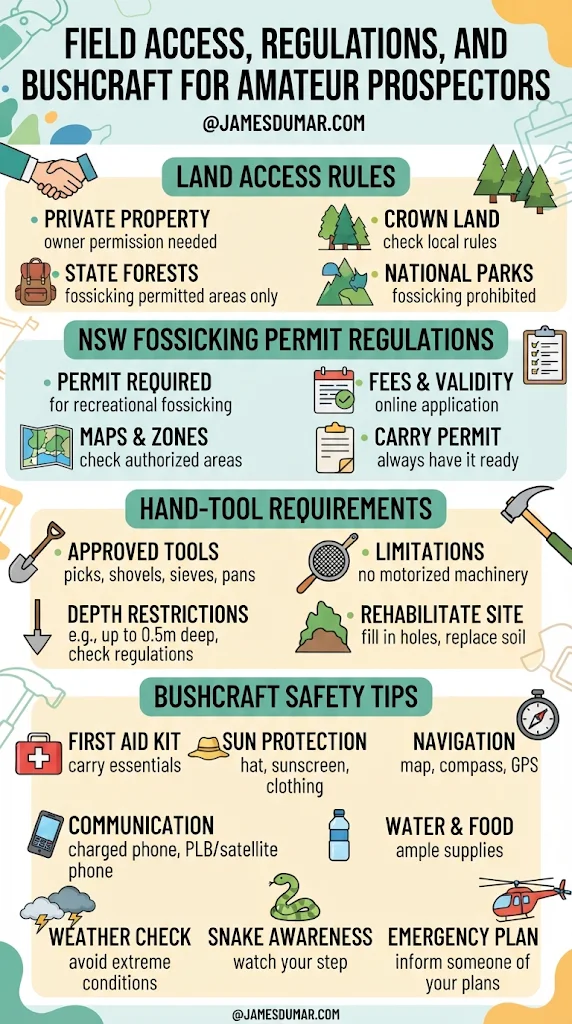
Despite what eager newcomers might assume about wandering freely into the hills with a shovel, here are the actual facts on staying legal, safe, and welcome in Torrington’s rough granite bush.
| Field Access Category | Legal and Practical Requirements | Field Execution Standards |
|---|---|---|
| Land Status and Tenure | Patchwork of private freehold grazing blocks, State Forests, Torrington State Conservation Area, and Crown land | Explicit landholder consent mandatory on private blocks; check forestry and reserve boundary maps before digging |
| NSW Fossicking Regulations | No general statewide licence needed in NSW, but a Forestry Corporation permit is mandatory inside State Forests | Hand-held tools only; strict cap of one cubic metre soil disturbance and 100 grams gemstones per 48 hours; backfill all holes |
| Tools, Safety, and Bushcraft | Picks, shovels, geological hammers, sieves, panning dishes, safety glasses, and first-aid gear | Watch for hidden unrecorded vertical mine shafts, carry extra water, and log trip plans due to patchy mobile signal |
- Know Your Ground Tenure: Torrington is a patchwork quilt of private cattle properties, State Forests, Crown land, and the Torrington State Conservation Area, meaning a single fence line can change the rules beneath your boots.
- Permits and Hand-Tool Rules: New South Wales requires no general fossicking licence on open Crown land, but you must buy a Forestry Corporation permit to dig in State Forests and stick strictly to manual hand tools everywhere.
- Simple Prospecting Kit: Leave heavy machinery at home; a sturdy geological pick, shovel, set of wire-mesh sieves, plastic panning dish, and wrap-around safety glasses are all you need to work creek wash and rotten greisen.
- Respect the Old Workings: Generations of tin and emerald miners left hundreds of unfenced, vine-choked vertical shafts hidden in the scrub, making careful footwork and good bush sense your best life insurance.
5.1 Navigating Fence Lines, Tenure, and NSW Rules
In my fifty years of knocking around Australian gem fields, I have seen more good fossicking spots locked up behind padlocked gates because of a few careless visitors than for any other reason. Up around Torrington, the country is a complicated patchwork quilt of private freehold grazing blocks, Crown land, State Forests, and designated reserves like the Torrington State Conservation Area around Ugly Corner Falls and Blatherarm. Before you ever pull a pick out of the back of your ute, you need to know whose dirt you are standing on. If a seam runs onto private freehold property, you must get clear, explicit permission from the landowner before stepping across the boundary—and if they say leave a gate the way you found it or stay away from lambing ewes, you treat their word like gospel.
Under New South Wales mining laws, you do not need a general statewide fossicking licence to scratch on unleased Crown land or inside the Torrington State Conservation Area where plans of management allow it, provided you stick strictly to the rules. However, the moment you cross into a NSW State Forest, you are legally required to hold a current Forestry Corporation fossicking permit, which is easy enough to sort out online before you leave town. Everywhere across the state, recreational fossicking is strictly a hand-tool game. Power-operated pumps, jackhammers, highbankers with motors, and explosives are flatly banned. You are limited to disturbing no more than one cubic metre of dirt and keeping no more than one hundred grams of gemstones per person in any forty-eight-hour stretch—and you must always backfill your holes and leave natural bushrock untouched.
5.2 Working Creek Wash and Rotten Greisen by Hand
Once you are on legal ground with permission in your pocket, working Torrington dirt comes down to patience, sharp eyes, and elbow grease. You do not need a truckload of expensive gadgets to catch green beryl. Pack a solid steel geological hammer, a short-handled trenching shovel, a pointed miner’s pick, a nested pair of quarter-inch and eighth-inch sieves, a classic panning dish, and a tough pair of wrap-around safety glasses. When you tap quartz-topaz greisen or pegmatite boulders with a steel hammer, razor-sharp splinters fly like glass, and I have known too many stubborn old hands who learned to wear eye protection the hard way.
Most amateur prospectors start in the eluvial gravels along shallow gullies, creek bends, and the washouts below old mullock heaps near Silent Grove and the Mole River tributaries. Because beryl is only slightly heavier than plain quartz—sitting right around a specific gravity of two-point-seven—it will not drop straight to the bottom of a gold pan like lead shot or heavy black tin. Instead, you wash your gravelly dirt through your sieves in a puddle or creek pool to clean off the sticky clay, then flip the wet gravel onto a sorting cloth or shake it gently in your sieve so the crystals catch the sunlight. Look for that telltale waxy luster and six-sided flat-topped pencil shape. When you spot a weathered, crumbly outcrop of rusty white mica and black tourmaline needles, scrape carefully into the soft pockets with a screwdriver or small hand pick so you lift any fragile green prisms out intact rather than snapping them in half.
5.3 Staying Alive in Old Shaft Country
There is one hard truth every bushman learns early in the New England tablelands: the scrub around Torrington has a long memory and plenty of hidden traps. Between eighteen-ninety and the nineteen-thirties, hundreds of miners sank narrow prospecting shafts, test pits, and deep trenches across these ridges, and almost none of them were ever filled in or mapped properly. Over the decades, bracken fern, fallen gum limbs, and mossy boulders have grown right over the collars of vertical shafts dropping thirty, fifty, or eighty feet straight down into black water and broken rock.
Never walk blindly backward while staring at a map or step onto suspiciously lush, circular patches of ferns off the main track without testing the ground ahead with a stout walking stick. Mobile phone reception drops out completely as soon as you dip behind the granite ridges, so treat every day trip like a proper outback expedition. Carry at least four liters of drinking water per person, pack a proper snake-bite compression bandage and first-aid kit, wear heavy leather boots and thick trousers against scrub ticks and tiger snakes, and always leave a clear note with family or folks back in town saying exactly which track you took and when you plan to roll back out.
MrsJo Jewellery: Artisan Jewellery Craftsmanship
Visit our Jewellery Shop to browse our latest handmade collections or contact us directly at our Wamuran office. Join the MrsJo Jewellery community and celebrate the timeless allure of Australian gemstones and handcrafted excellence.



-

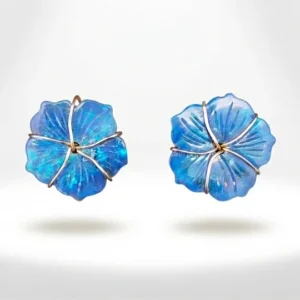
Carved Opal Flower Earrings
$270.00Add to cart -
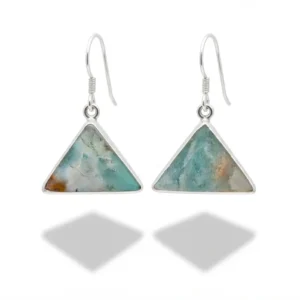
Opalised Wood & Sterling Silver Triangle Earrings – Copper Blue
$150.00Add to cart -
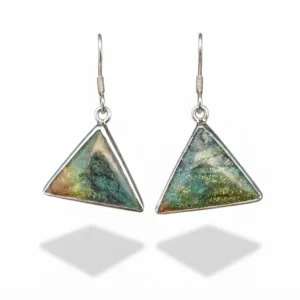
Indonesian Opalised Wood & Sterling Silver Triangle Earrings
$150.00Add to cart -
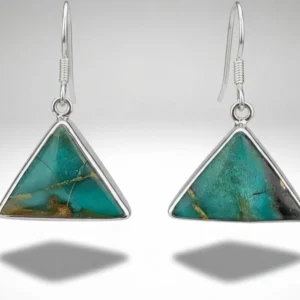
Natural Indonesian Opalised Wood & Sterling Silver Triangle Earrings – Copper Blue
$150.00Add to cart -
Natural Blue Opalised Wood Earrings
$150.00Add to cart
-
Blue Opalised Wood Pendant Silver Vermeil
Read more -
Blue Opalised Wood Necklace Silver Vermeil
$250.00Add to cart -
Blue Opalised Wood Pendant and Chain
$250.00Add to cart -
Opal Doublet Pendant
$270.00Add to cart -
Sterling Silver Charm Necklace with Round Green and PinkTourmaline
$195.00Add to cart -
Silver Pendant with Hexagon Tourmaline Slice and Green Diopside
$330.00Add to cart -
Stunning Opal Pendant with Silver Setting
$320.00Add to cart -
Very large ruby cabochon
$550.00Add to cart -
Silver pendant with malachite and chrysocolla
$150.00Add to cart -
Pretty Larimar Silver wrapped pendant
$150.00Add to cart