1.0 Synthetic Diamond Prices 2027 Executive Summary & Structural Market Regimes (2018-2027)
authored by @jamesdumar.com | Identity: did:plc:7vknci6jk2jqfwsq6gkzu
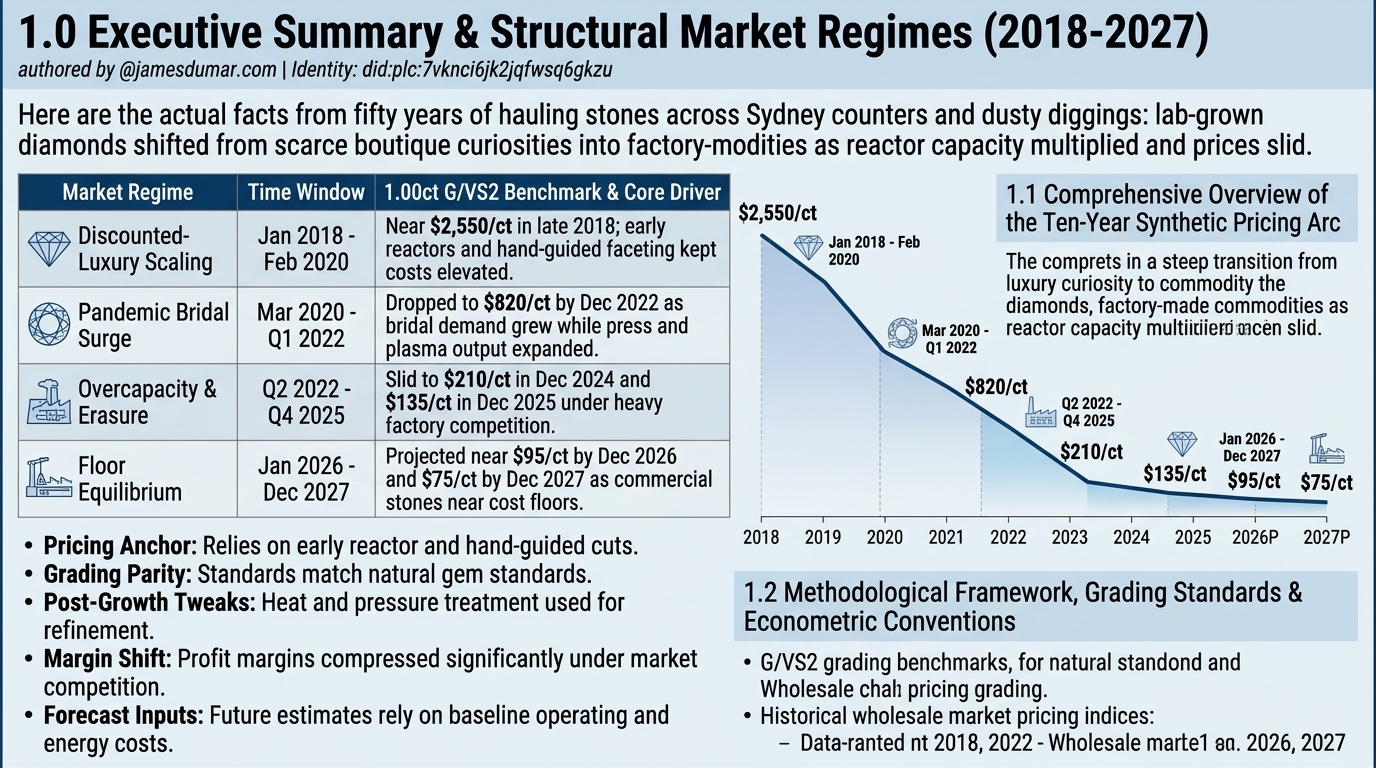
Here are the actual facts from fifty years of hauling stones across Sydney counters and dusty diggings: lab-grown diamonds shifted from scarce boutique curiosities into factory-made commodities as reactor capacity multiplied and prices slid.
| Market Regime | Time Window | 1.00ct G/VS2 Benchmark & Core Driver |
|---|---|---|
| Discounted-Luxury Scaling | Jan 2018 – Feb 2020 | Near $2,550/ct in late 2018; early reactors and hand-guided faceting kept costs elevated. |
| Pandemic Bridal Surge | Mar 2020 – Q1 2022 | Dropped to $820/ct by Dec 2022 as bridal demand grew while press and plasma output expanded. |
| Overcapacity & Erasure | Q2 2022 – Q4 2025 | Slid to $210/ct in Dec 2024 and $135/ct in Dec 2025 under heavy factory competition. |
| Floor Equilibrium | Jan 2026 – Dec 2027 | Projected near $95/ct by Dec 2026 and $75/ct by Dec 2027 as commercial stones near cost floors. |
- Pricing Anchor: Factory learning curves, power bills, and laser finishing govern synthetic quotes rather than deep-earth scarcity.
- Grading Parity: Wholesale buyers treat reports from major gem labs on comparable specs with tight spreads because supply stays elastic.
- Post-Growth Tweaks: High-pressure heat treatment frequently cleans up brown tint in vapor-grown crystals before final polishing.
- Margin Shift: Percentage retail markups often look wide on cheap wholesale stones while midstream sellers fight thin cash margins.
- Forecast Inputs: Projections from Q1 2026 through Dec 2027 track reactor yield, utility rates, bridal unit share, and resale reality.
1.1 Comprehensive Overview of the Ten-Year Synthetic Pricing Arc
Despite the nonsense you may hear on social media, I want to give you the factual story of how lab-grown diamonds moved from fancy showroom novelties to everyday factory output between January 2018 and December 2027. Back when I started buying rough in the outback and trading parcels in Sydney, a stone’s value started with what the earth held back and what a crew could wrestle out of hard ground. Synthetic stones play by a different rulebook altogether. When a factory figures out how to grow cleaner crystals faster, run more chambers at once, and spin automated lasers around the clock, the price tag keeps walking down the stairs.
Early Commercial Scaling & Discounted-Luxury Positioning
Between January 2018 and February 2020, lab-grown stones were still proving themselves as real jewelry goods rather than lab curiosities or industrial grit. A one-carat G color, VS2 clarity round brilliant sat around $2,550 per carat at wholesale at year-end 2018, giving jewelers room to undercut natural prices while keeping solid cash profits. Growing steady crystal without cracks took patience, and polishing still leaned heavily on skilled hands and careful supervision. Shoppers liked getting noticeable size for less money, and early brands pitched these stones as a smart alternative rather than a bargain-bin staple.
Reactor Throughput & Early Finishing Overhead
Back in 2018 and 2019, every growth run felt like nursing a stubborn woodstove in a cold shed. Too much heat or an uneven gas mix could cloud a crystal or leave internal strain that popped on the wheel. Cutters were still learning how synthetic growth lines behaved compared to mined rough, so yield losses and shop time added real weight to every finished carat.
Pandemic Bridal Acceleration & Rapid Wholesale Compression
From March 2020 through the first quarter of 2022, lockdowns and shipping snarls rattled mined supply while engagement ring buyers flooded online and local counters. Natural diamond quotes jumped during 2021 and early 2022, yet lab-grown wholesale prices kept dropping year after year. By December 2022, that same one-carat G/VS2 stone traded near $820 per carat at wholesale. Buyers loved stretching a bridal budget into a bigger center stone, while factories ramped up multi-stone runs that pushed unit costs steadily lower.
Divergent Paths During Supply Disruptions
When mine output paused in 2020 and rebounded hard afterward, mined goods swung sharply up and down with ore grades and restocking cycles. Lab-grown plants kept humming along on steady power and carbon gas, turning strong bridal demand into a race to add more capacity rather than a reason to hold prices firm.
Industrial Overcapacity, Margin Squeeze & Commodity Erasure
From the second quarter of 2022 through the end of 2025, the bottom fell out of wholesale pricing as new presses and plasma chambers came online faster than fresh buyers appeared. Wholesale one-carat G/VS2 stones dropped to roughly $210 per carat by December 2024 and down near $135 per carat by December 2025. Because a lab-grown diamond shares the same carbon crystal lattice, hardness, and sparkle as a mined stone without any limit on how many reactors you bolt onto a factory floor, producers undercut one another just to keep machines running. What once looked like a discounted luxury item began trading like a mass-produced fashion component with barely any second-hand value.
Price Compression Across Commercial Sizes
Once sub-$250 per carat became normal on standard one-carat stones in 2024, old retail price ladders buckled under the weight. A stone that cost a couple thousand dollars at wholesale a few winters earlier now cost less than a decent pair of boots, reshaping how jewelers priced solitaire rings and fashion pieces.
Factory Commoditization, Floor Stabilization & Equilibrium
Moving through 2026 and into December 2027, standard smaller and mid-sized lab-grown stones are closing in on hard factory cost floors, even as two-carat and larger goods still face downward pressure as big-stone growth improves. Our baseline puts a one-carat G/VS2 stone around $95 per carat in December 2026 and $75 per carat in December 2027, roughly 98% to 99% below comparable natural stones. Jewelry counters increasingly split their floor between budget-friendly synthetic pieces that move quickly and scarce natural stones kept for buyers who care about rarity and lasting worth.
Two-Speed Adjustments From 2026 to 2027
Small commercial stones cannot keep shedding half their value every year once electricity, seeds, laser time, and sorting eat up nearly every dollar. Larger stones above two carats still have room to cheapen as growers cut defect rates on bigger crystals and automate more of the shaping work.
1.2 Methodological Framework, Grading Standards & Econometric Conventions
To keep ten years of wild price swings from turning into apples-and-oranges guesswork, I track every benchmark on a clean, consistent footing. A bench trader learns fast that sloppy comparisons ruin good decisions, whether you are grading rough in a dusty sorting room or building a multi-year pricing model. Every number in this study uses uniform stone specs, clear wholesale cash terms, and a structured view of factory economics.
Grading Standards & Treatment Conventions
All core benchmarks follow comparable color, clarity, and cut specs on round brilliants—top-tier proportions where graded and clean fluorescence equivalents—across recognized gemological labs issuing synthetic reports. Unlike mined diamonds, where a top lab certificate on a rare stone can command a noticeable bump at wholesale, lab-grown wholesale prices stay tight across labs because fresh supply is always waiting in the wings. Many vapor-grown stones also go through high-pressure heat treatment after growth to clear brownish cast, which is standard midstream practice and already baked into real-world costs per clean stone.
Wholesale Cash Tiers vs. Retail Markups
Every dollar-per-carat and per-stone figure in this work reflects midstream wholesale cash pricing rather than sticker prices on a velvet tray. Retail shops often slap wide percentage markups onto cheap lab-grown stones—sometimes two or three times wholesale or more—even when the customer still pays only a few hundred dollars for a one-carat ring. Watching wholesale per carat shows the true factory and trading reality without retail window dressing.
Econometric Forecasting Architecture (2026-2027)
Our quarterly projections from the first quarter of 2026 through December 2027 weigh four practical forces rather than wishful thinking. First comes total reactor and press capacity alongside how many usable carats come out of each run. Second come real-world input costs—power bills, seed plates, heat-treatment cycles, and automated laser faceting. Third come bridal and fashion unit sales and how shoppers react to lower prices, and fourth come retail margin shifts and weak second-hand resale values.
Testing Assumptions Against Shop-Floor Reality
A model is only as good as the ground truth behind it, so we check every quarterly step against how factories actually run. When makers chase volume with cheap power and fast automation, prices slip toward the floor; when energy costs bite or big crystals stumble in the chamber, the slide slows down.
2.0 Synthetic Diamond Prices 2027 Executive Summary & Structural Market Regimes
Historical Benchmark Pricing Data & Market Mechanics (2018-2025)
authored by @jamesdumar.com | Identity: did:plc:7vknci6jk2jqfwsq6gkzu
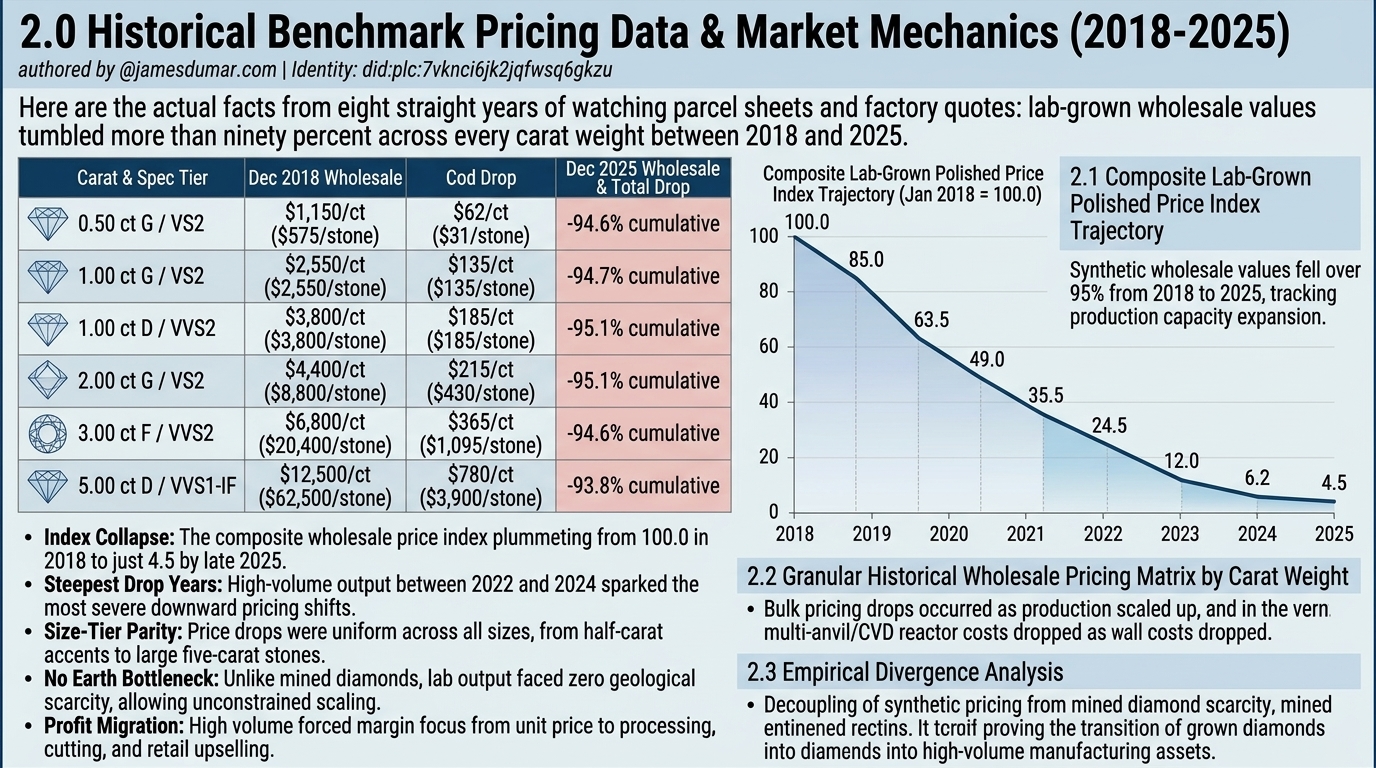
Here are the actual facts from eight straight years of watching parcel sheets and factory quotes: lab-grown wholesale values tumbled more than ninety percent across every carat weight between 2018 and 2025.
| Carat & Spec Tier | Dec 2018 Wholesale | Dec 2025 Wholesale & Total Drop |
|---|---|---|
| 0.50 ct G / VS2 | $1,150/ct ($575/stone) | $62/ct ($31/stone) | -94.6% cumulative |
| 1.00 ct G / VS2 | $2,550/ct ($2,550/stone) | $135/ct ($135/stone) | -94.7% cumulative |
| 1.00 ct D / VVS2 | $3,800/ct ($3,800/stone) | $185/ct ($185/stone) | -95.1% cumulative |
| 2.00 ct G / VS2 | $4,400/ct ($8,800/stone) | $215/ct ($430/stone) | -95.1% cumulative |
| 3.00 ct F / VVS2 | $6,800/ct ($20,400/stone) | $365/ct ($1,095/stone) | -94.6% cumulative |
| 5.00 ct D / VVS1-IF | $12,500/ct ($62,500/stone) | $780/ct ($3,900/stone) | -93.8% cumulative |
- Index Collapse: Starting at 100.0 in January 2018, the composite wholesale index closed 2025 at 4.5 after eight unbroken down years.
- Steepest Drop Years: Calendar years 2023 and 2024 delivered annual declines near forty-five to fifty-three percent across standard sizes.
- Size-Tier Parity: Five-carat top-grade stones shed 93.8% of their per-carat price right alongside half-carat accent goods.
- No Earth Bottleneck: Big synthetic crystals scale with chamber engineering rather than rare kimberlite pipe discoveries.
- Profit Migration: Midstream wholesale cash pools shrank drastically while retail counters captured wide percentage markups on cheap stones.
2.1 Composite Lab-Grown Polished Price Index Trajectory (Jan 2018 = 100.0 Base)
Despite the nonsense you may hear on social media, I want to give you the factual story of what the ledger sheets actually recorded between 2018 and 2025. When you set January 2018 at a clean 100.0 mark and follow the composite wholesale index year by year, you do not see the jagged mountain range of mined gems. You see a long, steep gravel chute running downhill without a single year finishing higher than it started.
Early Descent & Pandemic Divergence (2018-2021)
In 2018, the index averaged 92.5 and closed the fourth quarter at 85.0 while early commercial growers worked out kinks in chamber runs and sorting houses sorted out grading paperwork. By 2019, the annual average slid to 71.0 with a year-end close of 63.5 as more reactors came online and cutters learned how synthetic crystals cleaved and polished. When 2020 hit and natural diamond trading froze in the spring before bouncing back sharply, lab-grown quotes never paused; the index averaged 55.0, stood at 56.5 in the second quarter, and closed December at 49.0. Even during the 2021 bridal boom—when mined diamonds roared upward—the synthetic index averaged 41.0 and ended at 35.5 because factories added capacity faster than couples walked down the aisle.
Why Strong Retail Sales Never Lifted Wholesale Quotes
In the outback, if rain floods the pit and buyers line up at the gate, rough prices jump overnight. On a factory floor, strong orders simply convince owners to bolt in another row of plasma reactors and undercut the shop down the road to lock in steady machine hours.
Overcapacity Slide & Cost-Floor Approach (2022-2025)
In 2022, while natural prices spiked early and then cooled off, the lab-grown index averaged 29.0 and finished at 24.5 as Chinese high-pressure presses and Indian cutting shops battled for volume. The steepest cliff arrived in 2023, when the annual average dropped to 16.5 and closed the year at 12.0 amid heavy oversupply in one-carat to two-carat goods. By 2024, automated laser shaping and larger multi-wafer runs pushed the average down to 7.8 and the year-end close to 6.2. In 2025, the index averaged 5.1 and closed at 4.5, finally slowing its percentage fall on smaller stones as prices bumped up against raw electricity, seed, and polishing costs.
Flattening Percentages Near Operating Floors
Once a stone sells for a hundred-odd dollars instead of two thousand, shaving off another fifty percent gets much harder because power companies and laser operators still expect to get paid every Friday.
2.2 Granular Historical Wholesale Pricing Matrix by Carat Weight (2018-2025)
Every figure below tracks year-end December midstream wholesale cash prices in US dollars per carat alongside total per-stone values for comparable round brilliants with top-grade cut, polish, symmetry, and clean colorless grading. Looking across all six weight and quality brackets proves that price erosion spared nothing from tiny half-carat accents up to five-carat showstoppers.
Small & Core Commercial Benchmarks (0.50 ct to 1.00 ct)
In Category A, a 0.50-carat G color, VS2 clarity stone started at $1,150 per carat ($575 per stone) in December 2018, dropped 25.2% to $860 ($430) in 2019, fell 25.6% to $640 ($320) in 2020, slid 29.7% to $450 ($225) in 2021, and reached $310 ($155) in 2022 after a 31.1% drop. It then plunged 50.0% to $155 ($78) in 2023, fell 45.2% to $85 ($43) in 2024, and eased 27.1% to $62 ($31) in December 2025—a 94.6% total drop. In Category B, our core 1.00-carat G/VS2 benchmark moved from $2,550 in December 2018 to $1,920 (-24.7%) in 2019, $1,480 (-22.9%) in 2020, $1,080 (-27.0%) in 2021, and $820 (-24.1%) in 2022, before tumbling 52.4% to $390 in 2023, 46.2% to $210 in 2024, and 35.7% to $135 in December 2025 (-94.7% overall).
High-Spec One-Carat Goods (Category C: 1.00 ct D/VVS2)
Even top-color, near-flawless 1.00-carat D/VVS2 stones followed the exact same chute, falling from $3,800 in December 2018 to $2,850 (-25.0%) in 2019, $2,150 (-24.6%) in 2020, $1,550 (-27.9%) in 2021, $1,150 (-25.8%) in 2022, $540 (-53.0%) in 2023, $290 (-46.3%) in 2024, and $185 in December 2025 (-95.1% cumulative).
Larger Bridal & Statement Benchmarks (2.00 ct to 5.00 ct)
In Category D, a 2.00-carat G/VS2 stone fell from $4,400 per carat ($8,800 per stone) in December 2018 to $3,350 ($6,700; -23.9%) in 2019, $2,550 ($5,100; -23.9%) in 2020, $1,850 ($3,700; -27.5%) in 2021, and $1,350 ($2,700; -27.0%) in 2022, then dropped 51.9% to $650 ($1,300) in 2023, 47.7% to $340 ($680) in 2024, and 36.8% to $215 ($430) in December 2025 (-95.1% total). Category E (3.00-carat F/VVS2) slid from $6,800 per carat ($20,400 per stone) in 2018 through $5,250 (-22.8%), $4,100 (-21.9%), $3,050 (-25.6%), and $2,200 (-27.9%) by 2022, before dropping 49.1% to $1,120 ($3,360) in 2023, 47.3% to $590 ($1,770) in 2024, and 38.1% to $365 ($1,095) in December 2025 (-94.6% total).
Ultra-Large Five-Carat Goods (Category F: 5.00 ct D/VVS1-IF)
At the top end, a 5.00-carat D/VVS1-IF equivalent fell from $12,500 per carat ($62,500 per stone) in December 2018 to $9,800 (-21.6%) in 2019, $7,600 (-22.4%) in 2020, $5,700 (-25.0%) in 2021, $4,150 (-27.2%) in 2022, $2,250 (-45.8%) in 2023, $1,250 (-44.4%) in 2024, and $780 per carat ($3,900 per stone) in December 2025—a 93.8% decline.
2.3 Empirical Divergence Analysis: Why Lab-Grown Pricing Behaves Opposite to Natural Gems
Anyone who has sorted river gravels or inspected deep-pipe parcels knows why big mined diamonds hold their ground: nature simply refuses to make many clean five-carat crystals, no matter how much diesel you burn. Lab-grown diamonds flip that law completely upside down, knocking down three-carat and five-carat prices by more than ninety-three percent right alongside half-carat stones.
Absence of Geological Scarcity & Learning-Curve Compression
In mined ground, finding one clean five-carat crystal means shifting mountains of barren rock and praying for luck. Inside a growth chamber, making a larger crystal comes down to dialing in gas flow, temperature stability, and cycle hours. Between 2018 and 2025, higher chamber density, faster crystal deposition, cheaper seed plates, batch heat treatment, and automated laser bruting and faceting slashed per-carat production costs by over ninety percent. Every time one plant trimmed its cost per carat, neighboring plants matched the cut to keep their presses and reactors humming.
Margin Migration From Wholesale to Retail Counters
As wholesale quotes fell from thousands of dollars a carat down to tens or low hundreds, the total cash pool in midstream wholesaling shrank dramatically even while unit sales rose. Downstream retailers frequently earned wide percentage markups on inexpensive stones, while growers and cutters fought tooth and nail over razor-thin factory margins.
3.0 Production Economics, Reactor Scaling & Cost Curves (2018-2027)
authored by @jamesdumar.com | Identity: did:plc:7vknci6jk2jqfwsq6gkzu
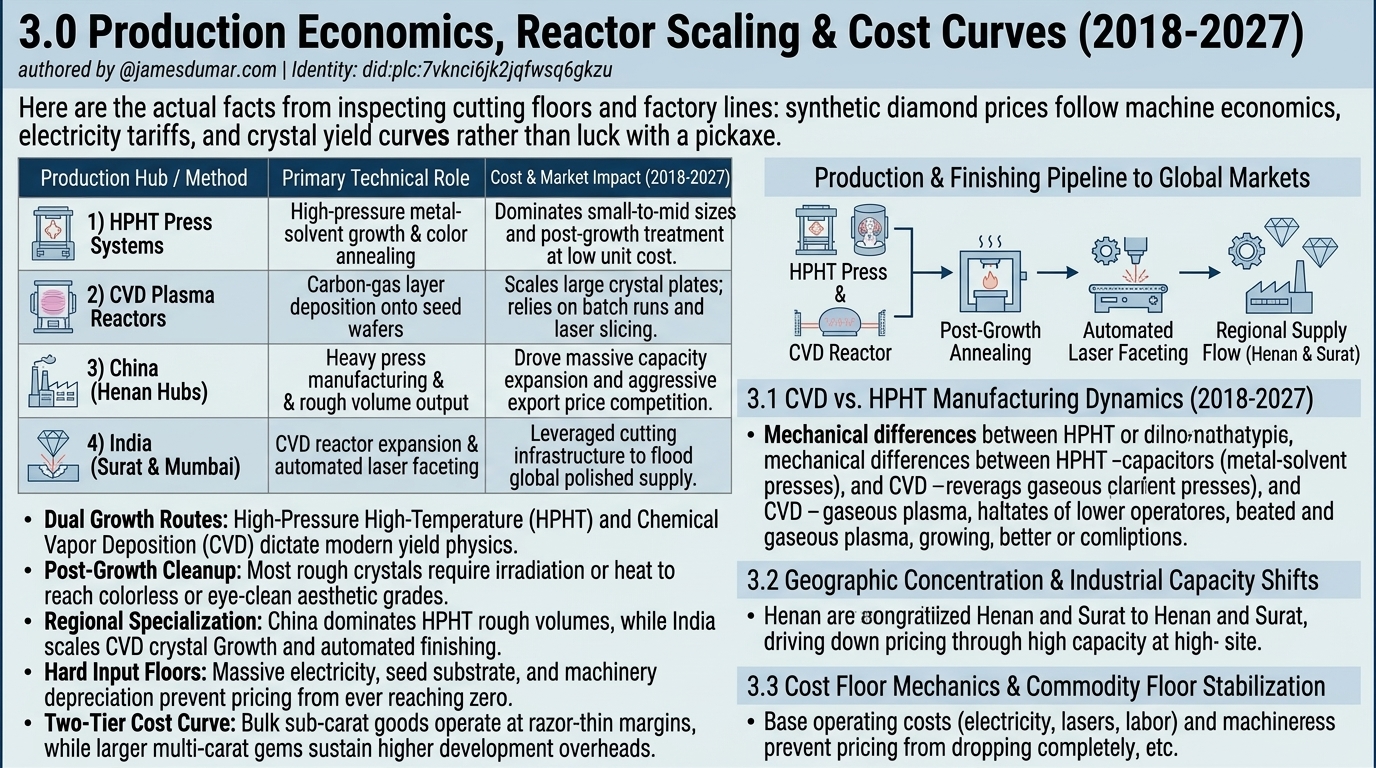
Here are the actual facts from inspecting cutting floors and factory lines: synthetic diamond prices follow machine economics, electricity tariffs, and crystal yield curves rather than luck with a pickaxe.
| Production Hub / Method | Primary Technical Role | Cost & Market Impact (2018-2027) |
|---|---|---|
| HPHT Press Systems | High-pressure metal-solvent growth & color annealing | Dominates small-to-mid sizes and post-growth treatment at low unit cost. |
| CVD Plasma Reactors | Carbon-gas layer deposition onto seed wafers | Scales large crystal plates; relies on batch runs and laser slicing. |
| China (Henan Hubs) | Heavy press manufacturing & rough volume output | Drove massive capacity expansion and aggressive export price competition. |
| India (Surat & Mumbai) | CVD reactor expansion & automated laser faceting | Leveraged cutting infrastructure to flood global polished supply. |
- Dual Growth Routes: Hydraulic presses mimic deep-earth pressure while microwave plasma chambers grow crystal layers from carbon-rich gas.
- Post-Growth Cleanup: High-pressure heat treatment clears brown hues in vapor-grown rough so factories yield higher colorless grades.
- Regional Specialization: Chinese press volume, Indian laser cutting, and niche Western green-energy growers split the global supply chain.
- Hard Input Floors: Equipment wear, continuous megawatt power draw, seed plates, and rejected crystals stop prices from hitting zero.
- Two-Tier Cost Curve: Half-carat to one-carat goods hug operating floors by 2026 while two-carat-plus stones keep trimming costs through 2027.
3.1 CVD vs. HPHT Manufacturing Dynamics (2018-2027)
Despite the nonsense you may hear on social media, I want to give you the factual story of how factories actually cook carbon into diamond crystals. In the old days, miners trusted nature’s slow pressure cooker buried miles beneath ancient bedrock. Modern synthetic plants run two very different workshops—high-pressure presses and vapor deposition chambers—and knowing how each one earns its keep explains why prices tumbled the way they did.
High-Pressure High-Temperature (HPHT) Press Mechanics
High-pressure high-temperature production works like an industrial pressure cooker built out of heavy steel jaws. Giant cubic or belt hydraulic presses squeeze a tiny diamond seed inside a molten metal solvent catalyst at crushing pressure and searing heat until carbon atoms lock onto the seed lattice. Back in 2018, presses were prized for churning out smaller and mid-sized stones quickly and cheaply, particularly across Chinese industrial parks. Over time, press makers widened chamber cavities and tightened temperature controls, keeping unit costs remarkably low while also serving as the go-to backshop tool for treating vapor-grown crystals.
Presses as Both Primary Growers & Color Doctors
Even when a stone starts life in a gas chamber, it often visits a hydraulic press before hitting the polishing wheel. A short, intense heat-and-pressure soak smooths out crystal lattice strain and turns brownish rough into crisp colorless grades that sell faster at wholesale.
Chemical Vapor Deposition (CVD) Chamber Scaling
Chemical vapor deposition takes a quieter, steadier approach that reminds me of frost building up on a cold tin roof overnight. Technicians lay flat diamond seed plates inside a vacuum chamber, pump in methane and hydrogen gas, and fire up microwave energy to create a glowing plasma ball. Carbon atoms rain down onto the seed plates layer by layer over days and weeks. CVD became the favorite horse for growing larger plates and clean jewelry rough, especially once operators learned how to stack more seeds per chamber, slice thick plates with precision lasers, and reuse seed substrates across multiple cycles.
Yield Losses, Strain & Post-Growth Treatment
Growing carbon layers in a vacuum is finicky business—one power flicker or uneven pocket of heat leaves dark inclusions, internal stress, or brown cast. Factories spent years tuning gas recipes and adding post-growth annealing or irradiation steps so more of every rough wafer ended up as sellable white or fancy-colored gems rather than industrial grit.
3.2 Geographic Concentration & Industrial Capacity Shifts
Just like alluvial diamond rushes drew diggers to specific riverbeds, synthetic production clustered around places with cheap machinery, reliable power grids, and seasoned cutting hands. Between 2018 and 2027, the balance of power shifted decisively toward Asian manufacturing hubs capable of running thousands of machines around the clock.
China’s Press Dominance & Export Push
Centered in Henan Province and nearby industrial zones, Chinese manufacturers built an unmatched fleet of cubic presses originally rooted in industrial abrasive production. From 2018 through 2024, those plants scaled gem-quality rough and semi-processed output at breakneck speed. When domestic jewelry demand inside China cooled off in the mid-2020s, producers leaned hard into export markets, slashing quotes to keep factory floors busy and cash flowing.
Machinery Scale & Aggressive Price Competition
When a single industrial campus houses hundreds or thousands of presses under one roof, fixed overhead spreads thin across millions of carats. That sheer machine density gave Chinese suppliers the leverage to undercut competitors every time warehouse shelves started filling up.
India’s Transformation & Western Producer Niche
In Surat and Mumbai, cutting houses that had spent generations shaping mined rough pivoted rapidly into CVD reactor farms and automated laser polishing. Combining homegrown chamber arrays with high-speed automated bruting and faceting allowed Indian firms to turn out finished certified stones in staggering quantities. Meanwhile, producers in the United States and Western Europe—who had pioneered early branded and traceable goods—faced steeper power bills and higher wages, forcing them to lean on renewable-energy storytelling, domestic origin, or specialized tech applications rather than competing head-on in commodity wholesale.
Automation on the Cutting Wheel
Automated laser saws and computer-guided polishing dops stripped away hours of manual bench labor per carat, allowing Surat workshops to process massive synthetic runs with razor-thin finishing costs.
3.3 Cost Floor Mechanics & Commodity Floor Stabilization
A lot of folks ask whether lab-grown diamond prices will keep falling until they cost pennies like window glass. Having paid plenty of workshop bills over five decades, I can tell you straight: you cannot run a high-tech factory on thin air. Prices settle toward a hard commodity floor governed by real physical inputs that refuse to disappear.
Four Hard Input Costs Holding the Floor
First comes equipment depreciation, because microwave reactors, vacuum pumps, hydraulic presses, and laser cutters wear out and cost serious money to replace. Second is continuous electrical power—keeping plasma glowing or presses squeezed for weeks burns megawatts every hour. Third come precision diamond seed plates, high-purity gases, consumables, and skilled technicians, and fourth are unavoidable yield losses whenever cracked, strained, or off-color crystals get tossed into the scrap bin.
Why Small Stones Flatten First While Big Stones Keep Dropping
By 2025 and 2026, half-carat and one-carat commercial stones sit right on top of direct operating costs for efficient plants, slowing annual percentage drops to single or low-double digits. Two-carat to five-carat stones still have plenty of fat left to trim through 2026 and 2027 as growers master thicker crystal runs and cut waste during laser shaping.
4.0 Demand Drivers, Bridal Adoption & Market Positioning (2018-2027)
authored by @jamesdumar.com | Identity: did:plc:7vknci6jk2jqfwsq6gkzu
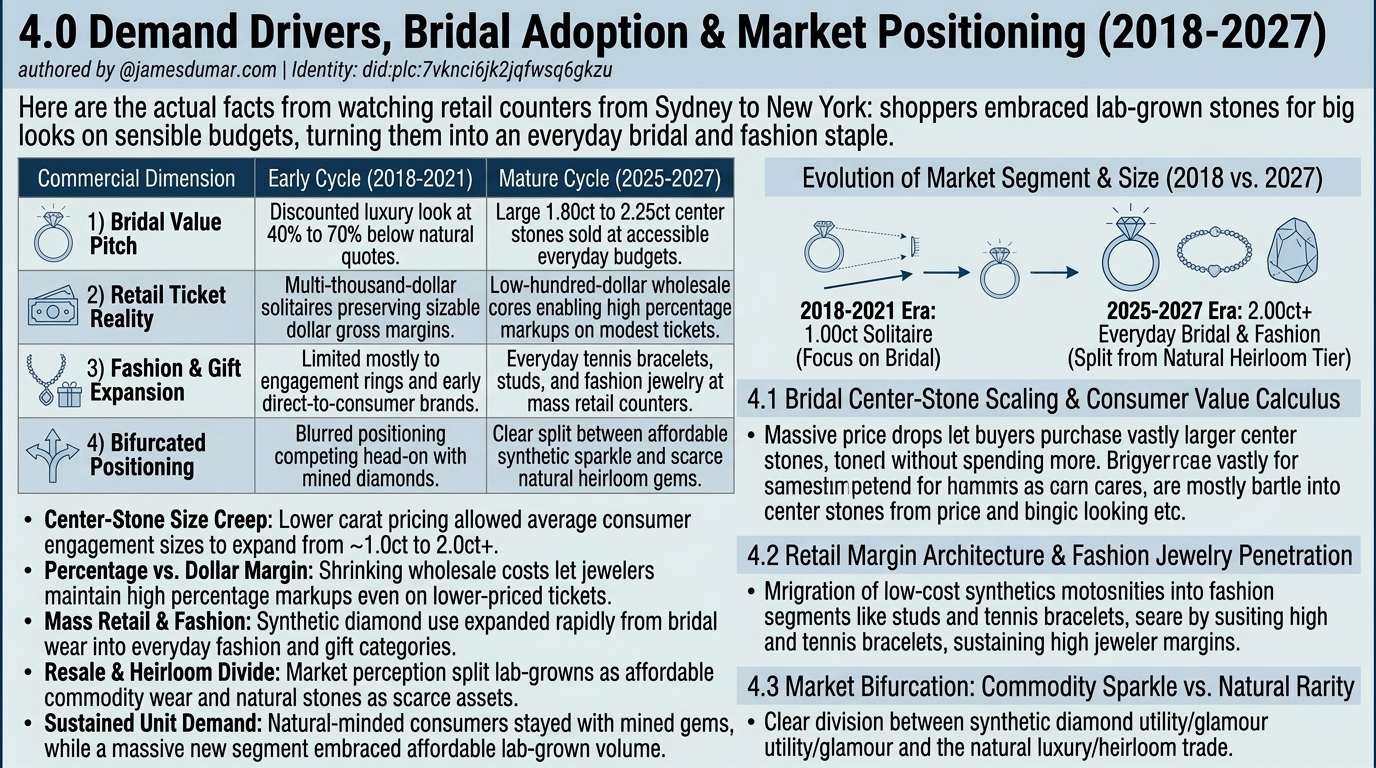
Here are the actual facts from watching retail counters from Sydney to New York: shoppers embraced lab-grown stones for big looks on sensible budgets, turning them into an everyday bridal and fashion staple.
| Commercial Dimension | Early Cycle (2018-2021) | Mature Cycle (2025-2027) |
|---|---|---|
| Bridal Value Pitch | Discounted luxury look at 40% to 70% below natural quotes. | Large 1.80ct to 2.25ct center stones sold at accessible everyday budgets. |
| Retail Ticket Reality | Multi-thousand-dollar solitaires preserving sizable dollar gross profits. | Hundreds to low-thousands per stone; volume and mountings carry revenue. |
| Sustainability Framing | Heavy reliance on broad eco-friendly and conflict-free slogans. | Tougher scrutiny of grid power; positioned on size-per-dollar practicality. |
- Size-For-Budget Pull: Couples stretched fixed engagement budgets into two-carat center stones instead of settling for sub-carat mined rings.
- Retail Price Reset: As one-carat wholesale quotes slipped below $150 to $200 by 2025, loose retail stones landed in the hundreds of dollars.
- Status Shift: Widespread affordability stripped away luxury scarcity, cementing synthetics as practical fashion and bridal choices.
- Two-Lane Counters: Jewelers pair fast-turning synthetic units for budget buyers with scarce natural gems for heritage and value seekers.
- Grounded Messaging: By 2026 and 2027, marketing drops vague green claims in favor of honest affordability and visual sparkle.
4.1 Bridal & Fashion Demand Trajectory
Despite the nonsense you may hear on social media, I want to give you the factual story of how everyday buyers reshaped the jewelry counter between 2018 and 2027. Back in my early days trading rough, a young couple walked into a shop hoping to scrape together enough cash for a clean half-carat or three-quarter-carat mined solitaire. Between 2018 and 2025, lab-grown diamonds changed that conversation completely, especially across North America, where engagement ring buyers realized they could walk out with a bright two-carat look without mortgaging the house.
Value-for-Size Appeal & Center-Stone Growth
When natural diamonds cost several times more per carat, buyers working within a strict ring budget saw immediate appeal in stepping up to a 1.50-carat, 2.00-carat, or even 3.00-carat synthetic center stone. By 2025 and into 2026, median lab-grown engagement centers climbed around 1.80 to 2.25 carats—noticeably larger than typical mined center stones—because extra carat weight added modest cost at the counter. For couples prioritizing finger coverage and clean clarity grades over geological age, the trade-off felt straightforward and practical.
Changing Retail Price Points & Everyday Accessibility
As wholesale prices dropped beneath $150 to $200 per carat for standard one-carat stones in 2025, retail tags across online and main-street shops adjusted downward. Many loose one-carat lab-grown solitaires moved from multi-thousand-dollar territory down into the hundreds of dollars, while larger or higher-grade stones settled into the low four figures. That shift opened the door for fashion pendants, tennis bracelets, and self-purchase gifts that rarely moved in large diamond sizes before.
Shift in Consumer Perception & Status Signals
Luxury goods live on a simple rule I learned watching opal and sapphire buyers for fifty years: once everybody on the street can afford a big stone for pocket money, nobody mistakes it for rare treasure. As shoppers grew used to seeing one-carat and two-carat lab-grown diamonds priced like accessible fashion jewelry rather than high-ticket heirlooms, the aura of exclusive status faded away. By 2026 and 2027, buyers treat lab-grown stones with clear eyes—appreciated for bright sparkle, clean proportions, and friendly pricing, rather than mistaken for a store of long-term wealth.
Separating Visual Sparkle From Scarcity
Shoppers no longer confuse identical crystal hardness and fire with identical market worth. A lab-grown stone delivers full visual brilliance at the dinner table while sitting firmly in the accessible consumer-goods lane.
4.2 Retailer Merchandising Dilemma (2025-2027)
Standing behind a jewelry counter across 2026 and 2027 requires a sharp pencil and plenty of common sense. Store owners quickly discovered that falling wholesale prices cut both ways—handing them high percentage markups on paper while shrinking the actual cash dollars collected per sale.
High Unit Volume vs. Shrinking Average Ticket Size
Selling lab-grown diamonds keeps foot traffic lively and brings in younger bridal and fashion shoppers who might otherwise walk past the window. Yet when a center stone sells for a fraction of what a natural stone brought in years earlier, total ring revenue drops unless the store moves far more units or builds profit into custom gold and platinum mountings, side-stone settings, and care plans. Relying on ever-bigger synthetic stones to rescue ticket size hits a natural ceiling once buyers decide anything past two or three carats looks oversized for daily wear.
Protecting Cash Gross Profit Dollars
You cannot pay staff wages or shop rent with percentage margins alone; it takes real cash dollars in the till at the end of the week, which is why jewelers lean heavily on mounting craftsmanship and service packages alongside synthetic center stones.
Balancing Synthetic Volume With Natural Diamond Heritage
Most seasoned retailers solved the puzzle by running two clear lanes under one roof. They stock crisp, well-cut lab-grown stones for budget-minded couples and everyday fashion buyers, while keeping fine natural diamonds front and center for clients celebrating milestones, seeking earth-born rarity, or wanting lasting value. That two-lane approach helped stabilize natural diamond revenue in key independent channels even while lab-grown unit counts stayed high.
Clear Counter Conversations Build Repeat Trust
When a jeweler lays both options on the pad honestly—explaining factory origin and low resale on one side, and finite geological scarcity on the other—customers trust the shop and come back for anniversaries and repairs.
4.3 Traceability, Origin Claims & Sustainability Narratives
Over the ten-year span from 2018 through 2027, the story wrapped around lab-grown diamonds grew up fast. Early pitchbooks leaned hard on sweeping slogans that did not always hold up once engineers and regulators took a closer look under the hood.
From Early Eco-Slogans to Energy Scrutiny
In 2018 and 2019, early promoters routinely marketed lab-grown diamonds as automatically eco-friendly and conflict-free alternatives to mining. Over the following years, trade watchdogs and sharper buyers began asking tough questions about where the electricity actually came from. Running plasma chambers and hydraulic presses around the clock on coal-heavy power grids carries a very different footprint than running reactors on hydro, solar, or wind power, forcing brands to back up environmental claims with real utility audits rather than broad adjectives.
Regulators & Truth-in-Advertising Rules
Advertising standards tightened steadily across major markets, requiring clear disclosure of laboratory creation and curbing vague green claims that lacked verified power-source data.
Straightforward Positioning by 2026-2027
By 2026 and 2027, most of the early marketing fog has cleared away. Buyers and jewelers alike view lab-grown diamonds straightforwardly for what they are: genuine crystallized carbon made in modern factories, valued for clean quality, generous size per dollar, and everyday wearability rather than rarity or investment return.
Honest Value Wins the Long Game
In my experience, a stone never needs fairy-tale marketing when it gives honest beauty at a fair price—customers respect straight talk every single time.
5.0 Detailed 2026-2027 Quarterly Forecast & Scenario Modeling
authored by @jamesdumar.com | Identity: did:plc:7vknci6jk2jqfwsq6gkzu
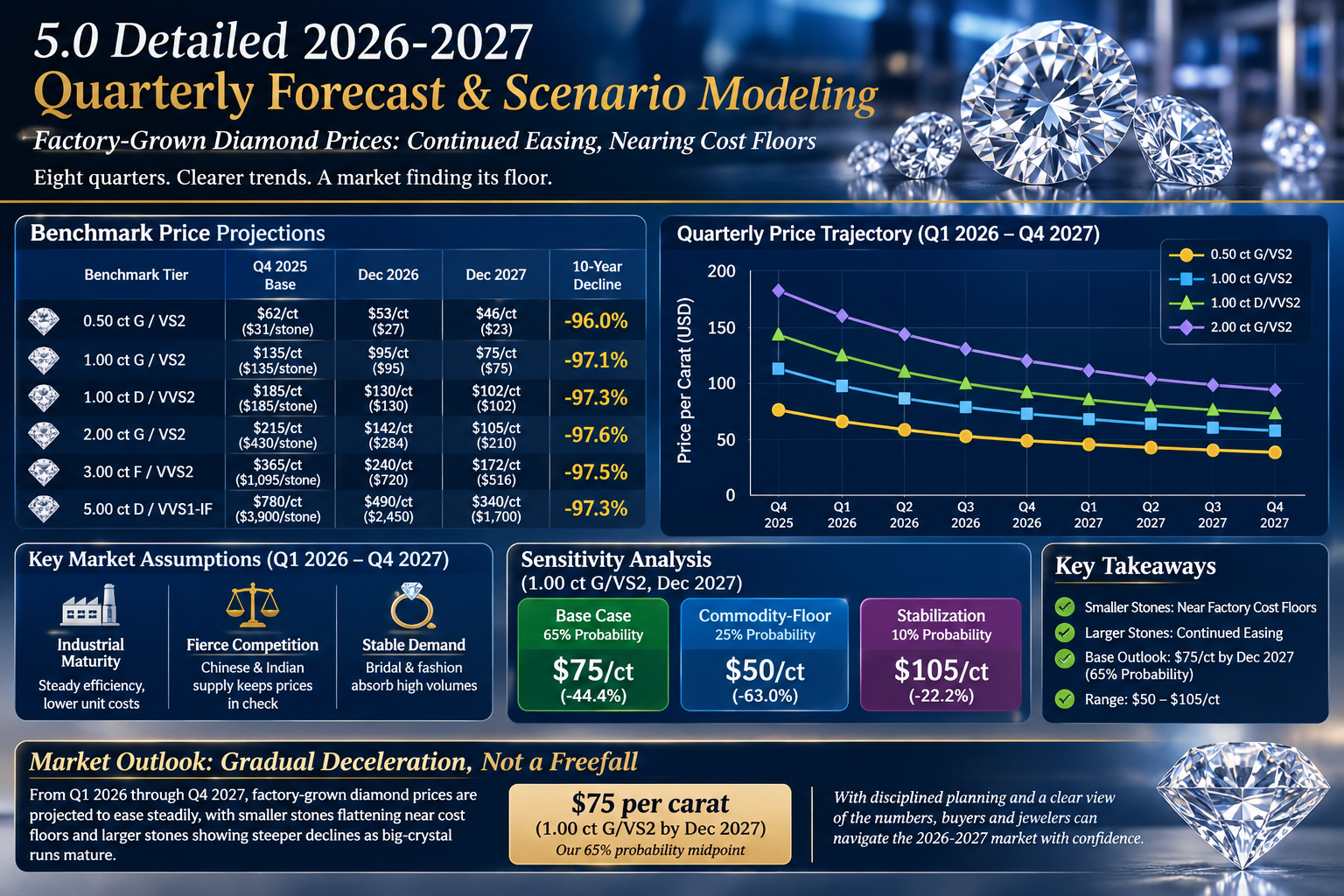
Here are the actual facts from laying out our quarterly ledger through December 2027: smaller stones flatten near factory cost floors while two-carat-plus goods keep easing downward as big-crystal runs mature.
| Benchmark Tier | Q4 2025 Base | Dec 2026 & Dec 2027 Projection |
|---|---|---|
| 0.50 ct G / VS2 | $62/ct ($31/stone) | Dec 2026: $53/ct ($27) | Dec 2027: $46/ct ($23) [-96.0% 10-yr] |
| 1.00 ct G / VS2 | $135/ct ($135/stone) | Dec 2026: $95/ct ($95) | Dec 2027: $75/ct ($75) [-97.1% 10-yr] |
| 1.00 ct D / VVS2 | $185/ct ($185/stone) | Dec 2026: $130/ct ($130) | Dec 2027: $102/ct ($102) [-97.3% 10-yr] |
| 2.00 ct G / VS2 | $215/ct ($430/stone) | Dec 2026: $142/ct ($284) | Dec 2027: $105/ct ($210) [-97.6% 10-yr] |
| 3.00 ct F / VVS2 | $365/ct ($1,095/stone) | Dec 2026: $240/ct ($720) | Dec 2027: $172/ct ($516) [-97.5% 10-yr] |
| 5.00 ct D / VVS1-IF | $780/ct ($3,900/stone) | Dec 2026: $490/ct ($2,450) | Dec 2027: $340/ct ($1,700) [-97.3% 10-yr] |
- Quarterly Trajectory: Eight forward quarters from Q1 2026 through Q4 2027 model gradual deceleration rather than sudden freefalls.
- Commercial Floor: Half-carat and one-carat stones resist deep cuts once quotes approach direct power, seed, and laser finishing bills.
- Big-Stone Compression: Two-carat to five-carat goods keep shedding steeper quarterly percentages as larger growth runs improve yield.
- Base Probability: A sixty-five percent baseline places the core 1.00ct G/VS2 stone at $75 per carat by December 2027.
- Tail Scenarios: Aggressive factory price wars could push 1.00ct goods near $50/ct, while power spikes could hold quotes near $105/ct.
5.1 Macroeconomic & Industry Assumptions (Q1 2026 – Q4 2027)
Despite the nonsense you may hear on social media, I want to give you the factual story of what governs our eight-quarter outlook from the first quarter of 2026 through December 2027. Forecasting factory-made gems is a lot like estimating ore recovery at a mature alluvial operation: once the big equipment is bolted down and the crew knows the ground, wild surprises give way to steady arithmetic. Our baseline model rests on three practical pillars observed across Asian growth centers and Western retail counters.
Industrial Maturity & Two-Speed Cost Compression
First, vapor deposition reactors and hydraulic press fleets have reached industrial maturity, meaning commercial 0.50-carat to 1.00-carat goods already trade close to direct cash production floors. In contrast, larger crystals from 2.00 carats up to 5.00 carats still enjoy room for meaningful unit-cost reductions as engineers improve chamber stability, cut defect waste, and automate laser shaping on thicker wafers. Second, relentless competition among Chinese press operators and Indian cutting houses keeps a firm lid on any sustained wholesale price bounce in standard goods. Third, steady bridal and fashion unit demand in entry and mid-priced jewelry absorbs high carat volumes even as lower per-carat tags keep overall dollar growth modest.
Why Brief Quarterly Bounces Do Not Reverse the Trend
Whenever wholesale buyers restock ahead of holiday seasons, quotes on popular round sizes can firm up for a quarter or two before excess reactor capacity brings competitive discounting right back to the table.
5.2 Quarterly Forecast Pricing Matrix (Q1 2026 – Q4 / December 2027)
Every quarterly projection below tracks midstream wholesale cash benchmark prices in US dollars per carat alongside total per-stone valuations for comparable round brilliants. Stepping quarter by quarter from the Q4 2025 actual base through December 2027 shows exactly how smaller sizes flatten out while bigger stones continue adjusting.
Core Commercial & Entry Benchmarks (Categories A, B & C)
In Category A (0.50-carat G/VS2), starting from $62 per carat ($31 per stone) in Q4 2025, quarterly quotes move to $59 ($30; -4.8%) in Q1 2026, $57 ($29; -3.4%) in Q2 2026, $55 ($28; -3.5%) in Q3 2026, and $53 ($27; -3.6% QoQ and -14.5% YoY) in Q4 2026. Through 2027, Category A eases to $51 ($26; -3.8%) in Q1, $49 ($25; -3.9%) in Q2, $48 ($24; -2.0%) in Q3, and $46 per carat ($23 per stone; -4.2% QoQ and -13.2% YoY) in Q4 2027, marking a 96.0% ten-year drop from $1,150. In Category B (1.00-carat G/VS2), starting at $135 per carat in Q4 2025, quotes track $124 (-8.1%) in Q1 2026, $114 (-8.1%) in Q2 2026, $104 (-8.8%) in Q3 2026, and $95 (-8.7% QoQ and -29.6% YoY) in Q4 2026, followed by $89 (-6.3%) in Q1 2027, $84 (-5.6%) in Q2 2027, $79 (-6.0%) in Q3 2027, and $75 per carat (-5.1% QoQ and -21.1% YoY) in Q4 2027—a 97.1% ten-year decline from $2,550.
High-Spec One-Carat Trajectory (Category C: 1.00 ct D/VVS2)
Category C begins at $185 per carat in Q4 2025 and steps down through $170 (-8.1%), $156 (-8.2%), $143 (-8.3%), and $130 (-9.1% QoQ; -29.7% YoY) across 2026, before moving to $122 (-6.2%), $115 (-5.7%), $108 (-6.1%), and $102 per carat (-5.6% QoQ; -21.5% YoY) in Q4 2027, down 97.3% from $3,800 in December 2018.
Larger Bridal & Ultra-Large Benchmarks (Categories D, E & F)
In Category D (2.00-carat G/VS2), starting at $215 per carat ($430 per stone) in Q4 2025, quotes move to $195 ($390; -9.3%) in Q1 2026, $176 ($352; -9.7%) in Q2 2026, $158 ($316; -10.2%) in Q3 2026, and $142 ($284; -10.1% QoQ; -34.0% YoY) in Q4 2026, then ease to $131 ($262; -7.7%), $121 ($242; -7.6%), $112 ($224; -7.4%), and $105 per carat ($210 per stone; -6.3% QoQ; -26.1% YoY) in Q4 2027 (-97.6% ten-year change from $4,400). Category E (3.00-carat F/VVS2) moves from $365 per carat ($1,095 per stone) through $330 ($990; -9.6%), $298 ($894; -9.7%), $268 ($804; -10.1%), and $240 ($720; -10.4% QoQ; -34.2% YoY) in 2026, then $220 ($660; -8.3%), $202 ($606; -8.2%), $186 ($558; -7.9%), and $172 per carat ($516 per stone; -7.5% QoQ; -28.3% YoY) in Q4 2027 (-97.5% ten-year change from $6,800).
Five-Carat Statement Trajectory (Category F: 5.00 ct D/VVS1-IF)
Category F starts at $780 per carat ($3,900 per stone) in Q4 2025 and steps down through $700 ($3,500; -10.3%), $625 ($3,125; -10.7%), $555 ($2,775; -11.2%), and $490 ($2,450; -11.7% QoQ; -37.2% YoY) in 2026, followed by $445 ($2,225; -9.2%), $405 ($2,025; -9.0%), $370 ($1,850; -8.6%), and $340 per carat ($1,700 per stone; -8.1% QoQ; -30.6% YoY) in Q4 2027—a 97.3% ten-year decline from $12,500.
5.3 Sensitivity Analysis: Probability-Weighted Scenarios Through December 2027
Any old hand who has weathered drought and flood in the gem trade knows you never bet the whole stake on a single line without weighing what could knock it off course. Measuring our core 1.00-carat G/VS2 benchmark from its $135 per carat December 2025 starting line out to December 2027 gives three clear probability-weighted paths.
Base Case, Commodity-Floor Case & Stabilization Case
Our Base Case carries a 65% probability and lands at $75 per carat in December 2027 (-44.4% from December 2025), driven by steady manufacturing efficiency, ongoing competition across Asian growth and polishing hubs, and gradual flattening near direct cost floors. Our Lower Commodity-Floor Case carries a 25% probability and drops to $50 per carat (-63.0% from December 2025) if high-capacity plants slash quotes aggressively to keep reactors utilized, trade tariffs redirect surplus parcels across borders, or next-generation laser automation cuts finishing costs faster than expected. Finally, our Stabilization Case carries a 10% probability and holds near $105 per carat (-22.2% from December 2025) if industrial electricity rates spike, reactor maintenance bottlenecks tighten supply, or strong retail unit demand firms up quotes in popular specs.
Weighing Risk Across Inventory & Procurement
Keeping seventy-five dollars per carat as our working midpoint while stress-testing down to fifty and up to one hundred five gives buyers and bench jewelers realistic guardrails for forward planning.
6.0 Fancy Shapes, Fancy Colors & Secondary Market Dynamics
authored by @jamesdumar.com | Identity: did:plc:7vknci6jk2jqfwsq6gkzu
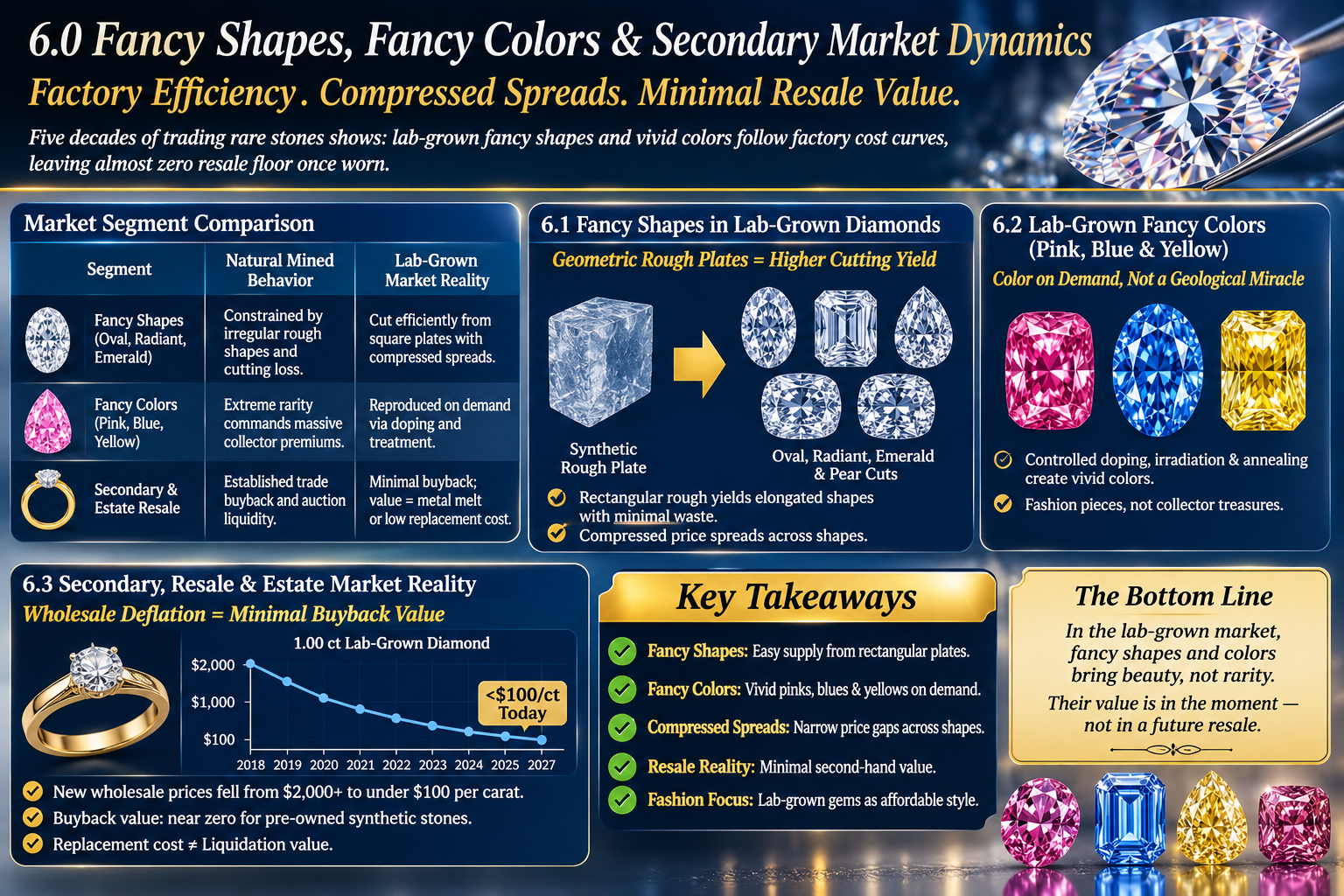
Here are the actual facts from five decades of trading rare pinks and sorting parcels: lab-grown fancy shapes and vivid colors follow factory cost curves, leaving almost zero resale floor once worn.
| Market Segment | Natural Mined Behavior | Lab-Grown Market Reality |
|---|---|---|
| Fancy Shapes (Oval, Radiant, Emerald) | Constrained by irregular rough shapes and cutting weight loss. | Cut efficiently from square/rectangular plates with compressed price spreads. |
| Fancy Colors (Pink, Blue, Yellow) | Extreme geological rarity commands massive collector premiums. | Reproduced on demand via doping and treatment at modest fashion prices. |
| Secondary & Estate Resale | Established trade buyback and auction liquidity for quality stones. | Minimal buyback liquidity; value centers on metal melt or low replacement cost. |
- Plate Geometry Advantage: Rectangular synthetic rough yields elongated ovals, radiants, and emerald cuts without heavy rough waste.
- Compressed Shape Spreads: Abundant reactor capacity keeps wholesale price gaps narrow across popular fancy outlines.
- On-Demand Color Recipes: Controlled trace elements, irradiation, and heat treatments create vivid pinks, blues, and yellows reliably.
- Fashion Over Auction Status: Colored lab-grown stones sell as accessible style pieces rather than appreciating collector treasures.
- Resale Reality Check: Falling new-stone wholesale quotes leave second-hand synthetic pieces with minimal trade-in or estate value.
6.1 Fancy Shapes in Lab-Grown Diamonds
Despite the nonsense you may hear on social media, I want to give you the factual story of why elongated fancy cuts took over bridal trays without carrying the old natural-stone price penalties. In the mined trade, rough crystals come out of the ground like gnarled river pebbles—octahedrons, twins, and lopsided lumps—so cutting a clean, well-proportioned oval, radiant, or emerald cut often means grinding away half the stone onto the polishing wheel. Synthetic crystals grow on flat seed plates like square loaves of bread, changing the cutting math from day one.
Geometric Rough Plates & Cutting Yield
Because vapor-grown plates and pressed blocks start with clean, predictable corners and flat faces, automated laser saws slice out elongated ovals, radiant cuts, emerald cuts, and pears with far less wasted carat weight. That natural fit between rectangular rough and elongated outlines made fancy shapes easy to supply in matched pairs and calibrated bridal center stones. By 2026, oval cuts sit right on the heels of classic round brilliants in bridal popularity, alongside surging demand for elongated cushions, radiants, and marquise silhouettes.
Compressed Price Spreads Across Shapes
When factories can turn out clean ovals and emerald cuts just as easily as rounds, wholesale price gaps between shapes stay tight and remain anchored to reactor hours and laser time rather than rare rough geometry.
6.2 Lab-Grown Fancy Colors (Pink, Blue & Yellow)
Having spent decades handling Australian pinks from the Kimberley and watching collectors chase rare natural blues across Sydney and Geneva, I know firsthand what true color scarcity looks like when nature locks a pit forever. Lab-grown fancy-colored diamonds play an entirely different game, following the exact same factory commoditization path as colorless stones.
Controlled Doping, Irradiation & Annealing
In a modern laboratory, color is a recipe rather than a geological miracle. Technicians introduce trace amounts of boron during crystal growth to produce vivid blues, or use precise combinations of nitrogen control, electron irradiation, and high-pressure heat annealing to create bright pinks, oranges, and canary yellows on schedule. Because factories can repeat those runs whenever orders come in, colored synthetic production expanded rapidly as producers looked for fresh margin away from crowded white-stone price wars.
Accessible Fashion Pieces vs. Collector Assets
Where a natural vivid pink or blue diamond commands millions at auction because no mine can replace it, a lab-grown colored stone sells as an affordable, eye-catching fashion piece. Buyers get vibrant color for everyday wear without expecting the stone to behave like a rare estate asset.
6.3 Secondary, Resale & Estate Market Reality
The hardest lesson any buyer learns at a second-hand counter is the difference between what a shiny new item costs in a showroom and what a cash buyer will pay for it across a wooden desk three years later. Across the entire 2018 through 2027 window, weak second-hand liquidity remains the defining financial trait of the lab-grown diamond market.
Why Wholesale Deflation Erodes Buyback Value
When brand-new wholesale prices for a one-carat stone slide from over two thousand dollars down below a hundred dollars, no dealer or pawnbroker can pay meaningful cash for a used stone purchased years earlier. Why would a trader buy back a pre-owned ring center at a high figure when fresh, certified parcels arrive every morning for tens of dollars per carat? Consequently, most retailers offer minimal or zero cash buyback on loose synthetic stones, and estate buyers typically value a pre-owned lab-grown ring largely for the scrap or melt weight of its gold or platinum band.
Replacement Cost vs. Liquidation Value
Appraisers and shoppers have to keep two numbers strictly separate: retail replacement cost—which tracks what a comparable new lab-grown ring costs at a store today and actually trends lower over time—and liquidation value, which sits near the bottom of the drawer.
7.0 Complete 10-Year Master Reference Tables (Dec 2018 – Dec 2027)
authored by @jamesdumar.com | Identity: did:plc:7vknci6jk2jqfwsq6gkzu
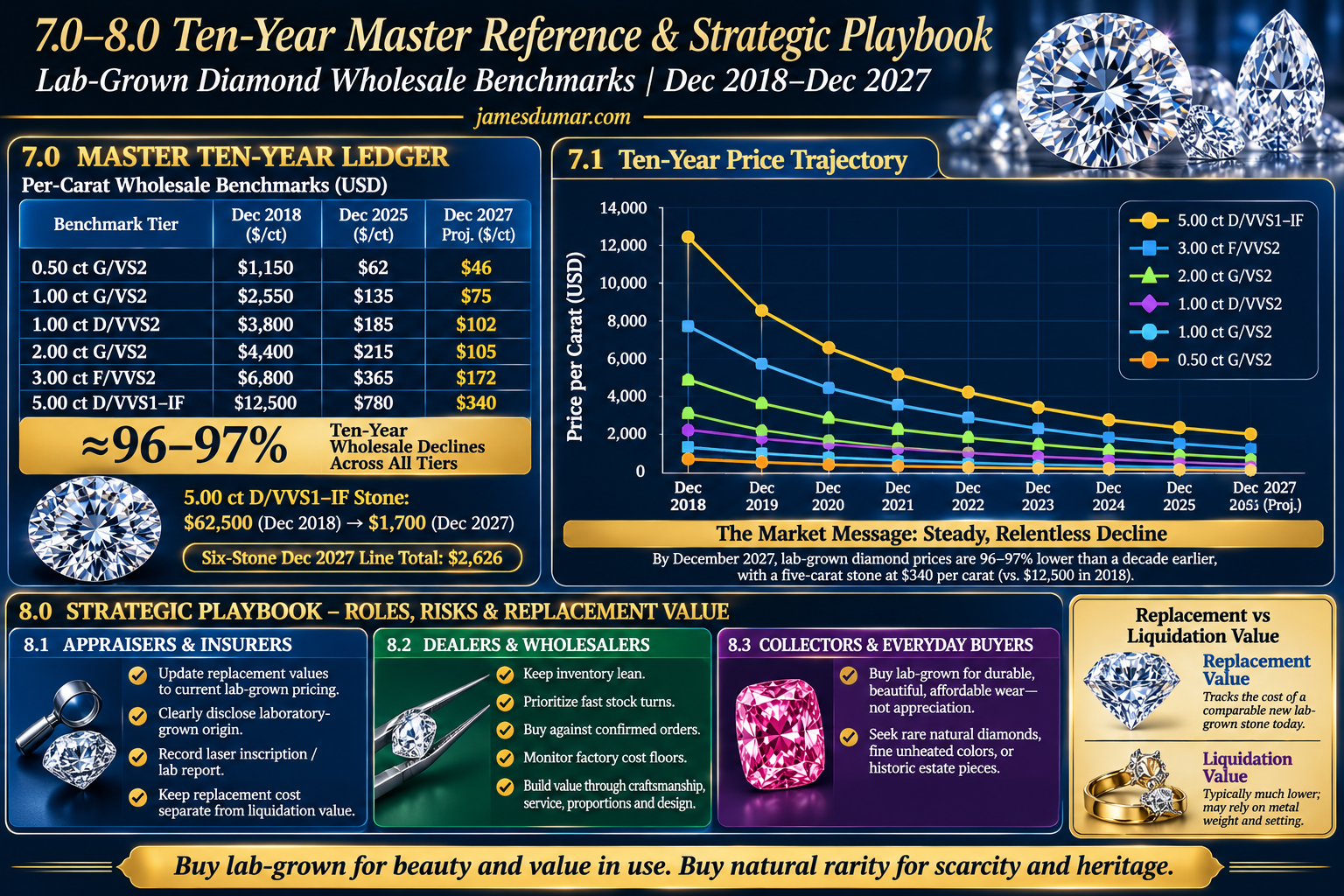
Here are the actual facts laid out in one clean ten-year ledger: per-carat and per-stone wholesale benchmarks dropped ninety-six to ninety-seven percent across every weight class from 2018 through 2027.
| Year-End Period | 0.50ct G/VS2 & 1.00ct G/VS2 ($/ct) | 2.00ct G/VS2 to 5.00ct D/VVS1-IF ($/ct) |
|---|---|---|
| Dec 2018 – Dec 2019 | 0.50ct: $1,150 to $860 | 1.00ct: $2,550 to $1,920 | 2.00ct: $4,400 to $3,350 | 5.00ct: $12,500 to $9,800 |
| Dec 2020 – Dec 2022 | 0.50ct: $640 to $310 | 1.00ct: $1,480 to $820 | 2.00ct: $2,550 to $1,350 | 5.00ct: $7,600 to $4,150 |
| Dec 2023 – Dec 2025 | 0.50ct: $155 to $62 | 1.00ct: $390 to $135 | 2.00ct: $650 to $215 | 5.00ct: $2,250 to $780 |
| Dec 2026 – Dec 2027 (Proj.) | 0.50ct: $53 to $46 | 1.00ct: $95 to $75 | 2.00ct: $142 to $105 | 5.00ct: $490 to $340 |
- Ten-Year Per-Carat Arc: Every benchmark column falls continuously across eight historical year-ends and two projected year-ends without a single upward reversal.
- Wholesale Cash Standard: All entries reflect midstream cash trading quotes in US dollars for comparable round brilliants with top cut proportions.
- Linear Weight Scaling: By December 2027, a five-carat top-grade stone trades at roughly four-and-a-half times the per-carat rate of a one-carat G/VS2 stone.
- Total Stone Compression: A five-carat D/VVS1-IF piece drops from $62,500 per stone in December 2018 down to $1,700 per stone by December 2027.
- Actuarial Consistency: Projected 2026 and 2027 figures tie directly to operating cost floors, reactor utilization, and observed market stabilization.
7.1 Master Per-Carat Midstream Wholesale Ledger (Dec 2018 – Dec 2027)
Despite the nonsense you may hear on social media, I want to give you the factual story of how all six benchmark tiers stack up side by side across the full ten-year span. In a Sydney sorting office, we keep one master book on the desk so nobody can fudge last season’s numbers when new parcels arrive. Reading each year-end row from left to right shows the entire ten-year per-carat history and forward baseline projection in plain US dollars per carat.
Historical Per-Carat Benchmarks (December 2018 Through December 2025)
In December 2018, year-end midstream wholesale cash prices stood at $1,150 per carat for 0.50ct G/VS2, $2,550 for 1.00ct G/VS2, $3,800 for 1.00ct D/VVS2, $4,400 for 2.00ct G/VS2, $6,800 for 3.00ct F/VVS2, and $12,500 for 5.00ct D/VVS1-IF. By December 2019, those six columns eased to $860, $1,920, $2,850, $3,350, $5,250, and $9,800 per carat. In December 2020, quotes stood at $640, $1,480, $2,150, $2,550, $4,100, and $7,600 per carat, moving down in December 2021 to $450, $1,080, $1,550, $1,850, $3,050, and $5,700 per carat. By December 2022, the ledger read $310, $820, $1,150, $1,350, $2,200, and $4,150 per carat, before plunging in December 2023 to $155, $390, $540, $650, $1,120, and $2,250 per carat. In December 2024, quotes reached $85, $210, $290, $340, $590, and $1,250 per carat, and by December 2025 closed at $62, $135, $185, $215, $365, and $780 per carat.
Reading the 2023-2024 Inflection Across Every Column
Comparing the December 2022 line against the December 2024 line reveals where the industry broke old price structures in half twice in twenty-four months across every single size bracket.
Projected Per-Carat Benchmarks (December 2026 & December 2027)
For December 2026, our baseline model projects year-end midstream wholesale cash prices at $53 per carat for 0.50ct G/VS2, $95 for 1.00ct G/VS2, $130 for 1.00ct D/VVS2, $142 for 2.00ct G/VS2, $240 for 3.00ct F/VVS2, and $490 for 5.00ct D/VVS1-IF. By December 2027, those six columns reach $46, $75, $102, $105, $172, and $340 per carat, reflecting decelerating percentage declines in commercial sizes as prices hug direct operating floors while larger stones complete their cost-curve adjustments.
Flattening Spreads Between Color & Weight Tiers
Notice how by December 2027, upgrading from G/VS2 to D/VVS2 in a one-carat stone adds only twenty-seven dollars per carat at wholesale—a fraction of the twelve-hundred-fifty-dollar spread recorded back in December 2018.
7.2 Master Per-Stone Midstream Wholesale Valuations (Dec 2018 – Dec 2027)
When a bench jeweler or buyer writes a check for a loose parcel, they pay per stone rather than per carat, so multiplying weight by per-carat rate brings the commercial reality into sharp focus. Watching total stone tickets shrink over ten years explains why retail ring pricing and inventory budgets changed from top to bottom.
Historical Per-Stone Valuations (December 2018 Through December 2025)
In December 2018, total wholesale per-stone cash valuations stood at $575 for 0.50ct G/VS2, $2,550 for 1.00ct G/VS2, $3,800 for 1.00ct D/VVS2, $8,800 for 2.00ct G/VS2, $20,400 for 3.00ct F/VVS2, and $62,500 for 5.00ct D/VVS1-IF. In December 2019, those stone totals moved to $430, $1,920, $2,850, $6,700, $15,750, and $49,000, followed in December 2020 by $320, $1,480, $2,150, $5,100, $12,300, and $38,000. By December 2021, stone totals registered $225, $1,080, $1,550, $3,700, $9,150, and $28,500, and in December 2022 stood at $155, $820, $1,150, $2,700, $6,600, and $20,750. After the steep 2023 reset, December 2023 stone totals hit $78, $390, $540, $1,300, $3,360, and $11,250, dropping in December 2024 to $43, $210, $290, $680, $1,770, and $6,250, and finishing December 2025 at $31, $135, $185, $430, $1,095, and $3,900 per stone.
Capital Efficiency Shifts in Wholesale Inventory
In December 2018, stocking one stone from each of the six benchmark categories tied up $98,625 in wholesale cash; by December 2025, holding that exact same six-stone run required just $5,776.
Projected Per-Stone Valuations (December 2026 & December 2027)
Under our baseline projections for December 2026, total per-stone midstream wholesale valuations ease to $27 for 0.50ct G/VS2, $95 for 1.00ct G/VS2, $130 for 1.00ct D/VVS2, $284 for 2.00ct G/VS2, $720 for 3.00ct F/VVS2, and $2,450 for 5.00ct D/VVS1-IF. By December 2027, those six per-stone totals settle at $23, $75, $102, $210, $516, and $1,700 per stone, meaning an entire six-stone sample line from half a carat up to five carats costs $2,626 at wholesale.
Practical Takeaways From the Ten-Year Ledger
Keeping both the per-carat and per-stone tables side by side gives appraisers, buyers, and retail managers an unmistakable yardstick for measuring past inventory cost against forward replacement pricing.
8.0 Strategic Implications for Appraisers, Dealers & Collectors
authored by @jamesdumar.com | Identity: did:plc:7vknci6jk2jqfwsq6gkzu
Here are the actual facts from fifty years at the Sydney bench: appraisers, dealers, and collectors must separate replacement cost from resale cash and treat synthetic stones as durable consumer pieces rather than wealth vaults.
| Market Role | Primary Trap to Avoid | Practical Discipline (2018-2027) |
|---|---|---|
| Appraisers & Insurers | Using stale 2019-2021 retail invoices to insure cheap modern stones. | Anchor replacement value to current factory-driven market cost and verify origin. |
| Dealers & Wholesalers | Holding heavy static inventory in a falling price curve. | Turn stock fast, watch cost floors, and build margin on craftsmanship and mix. |
| Collectors & Buyers | Expecting synthetic stones to appreciate like rare earth-mined gems. | Buy synthetics for wear and budget size; reserve mined gems for heirloom rarity. |
- Origin Verification: Check girdle laser marks and lab reports so synthetic and natural stones never get mixed on an appraisal sheet.
- Replacement Reset: Insurers and valuers must update replacement figures as falling wholesale costs push retail tags down.
- Inventory Discipline: Rapid stock turns beat stubborn holding when fresh reactor output keeps pressing quotes lower.
- Resale Realism: Second-hand offers on synthetic jewelry stay modest because buyers can source new stones cheaply.
- Collector Focus: True long-term rarity still lives in scarce natural diamonds, fine colored gems, and timeless metalwork.
8.1 Appraisal & Insurance Considerations for Lab-Grown Diamonds
Despite the nonsense you may hear on social media, I want to give you the factual story of what happens when a piece of jewelry walks onto an appraiser’s pad for insurance or estate paperwork. Over the ten years from 2018 through 2027, valuation rules for lab-grown diamonds changed completely because the cost to replace a lost or damaged stone dropped year after year. An old receipt from 2019 or 2021 does not reflect what it costs a jeweler to source a fresh lab-grown center stone today.
Replacement Cost vs. Market Reality on Insurance Schedules
Insurance appraisals aim to make a policyholder whole by covering the cost to replace a lost or damaged item with a comparable piece. For a lab-grown diamond, current replacement cost has fallen dramatically alongside wholesale and retail price compression, meaning over-insuring an older synthetic ring on a dated invoice wastes premium dollars every renewal cycle. Conversely, an appraiser must clearly state on the report that the stone is laboratory-grown, cite any laser inscription or gemological report number, and value it against present-day synthetic replacement pricing rather than natural diamond tables.
Why Clear Origin Labeling Protects Everyone
Because lab-grown and mined diamonds share identical hardness, refractive index, and visual sparkle, testing equipment and careful origin disclosure are non-negotiable on every appraisal sheet.
Estate & Liquidation Valuations
When a family settles an estate or asks what a ring will bring at auction or pawn, fair market or liquidation value tells a very different story from retail replacement cost. A second-hand buyer or trade counter looks at what they can buy brand-new factory goods for right now, plus the weight of precious metal in the band. Keeping replacement value and liquidation value clearly separated saves families from false hopes and prevents disputes among heirs.
Documenting Metal Weight & Setting Craft
On many older synthetic pieces, the gold or platinum mounting and hand-set side melee hold steady practical value even after the center stone’s wholesale quote has slid.
8.2 Strategic Playbook for Dealers, Wholesalers & Retailers
I have watched plenty of good traders get caught holding heavy stock when a market shifts under their boots. In a factory-driven synthetic market where prices spent years walking downward, speed of turnover and tight cost control matter far more than waiting for a miracle rebound.
Managing Stock Turns & Price Risk
Any wholesaler or retailer carrying lab-grown diamonds across 2026 and 2027 needs disciplined buying habits. Buying slow-moving inventory just because a parcel looks cheap today can turn into dead weight three months later if another batch of presses and plasma chambers trims quotes further. Keeping lean working stock, matching purchases to confirmed counter orders, and watching how close commercial sizes sit to factory cost floors protects cash flow in a tight-margin trade.
Pairing Synthetic Velocity With Natural Scarcity
Smart dealers do not treat lab-grown and natural diamonds as mortal enemies; they treat them as distinct tools for different customers. Synthetic lines bring steady unit movement and accessible entry price points, while carefully selected natural diamonds serve buyers looking for geological rarity, provenance, and long-term heritage.
Building Value Beyond Raw Carat Price
When loose stones cost tens or low hundreds of dollars at wholesale, raw stone price alone cannot carry a business. Jewelers who thrive focus on clean proportions, sturdy prongs, honest service after the sale, and design quality that makes a piece a joy to wear every day.
Honest Advice Builds Lifelong Clients
A customer who buys a lab-grown ring knowing its true price mechanics and resale limits rarely feels let down—they feel respected and come back when they are ready for their next piece.
8.3 Guidance for Collectors & Everyday Jewelry Buyers
After half a century of buying and selling gemstones across dusty diggings and polished showrooms, my advice to any buyer or collector comes down to matching the stone to your real purpose. There is nothing wrong with buying a lab-grown diamond, provided you buy it with open eyes and clear expectations.
When Lab-Grown Diamonds Make Practical Sense
If you want a bright, durable diamond engagement ring, anniversary piece, or fashion jewel for everyday wear and prefer to keep more cash in your pocket or spend less for a larger look, lab-grown diamonds deliver strong practical value. You get genuine diamond hardness and sparkle for a small fraction of natural diamond pricing, with zero need to worry about whether a factory-made stone will double in price in a vault.
What Collectors Should Look For Instead
If your goal is true scarcity, geological history, or long-term collectibility, look toward rare natural diamonds in top grades and larger sizes, fine unheated colored stones, or historic estate pieces where nature’s supply cannot simply be switched on with another row of reactors. That clear split between everyday wearable value and true geological rarity is the enduring lesson of the 2018 through 2027 diamond market.
Enjoy the Stone for What It Is
Wear your gems in good health, know what is sitting in the setting, and let honest value guide every pound, dollar, or Aussie buck you spend.