
1.0 Introduction and Historical Evolution: The Sea-Blue Stone of Ancient Sailors
authored by @jamesdumar.com | Identity: did:plc:7vknci6jk2jqfwsq6gkzu
Here are the actual facts: aquamarine is a clear blue-to-greenish-blue member of the beryl family, built from beryllium, aluminum, and silicon, and carried across centuries by tough sailors, cutters, and old-time traders.
| Era / Period | Historical Milestone | Gemological Significance |
|---|---|---|
| Classical Antiquity | Roman and Greek maritime talismans | Establishment of beryl as protective sea-water amulet |
| 18th Century | Ural Mountain discoveries in Russia | Introduction of high-clarity rough into European centers |
| 1915 Discovery | Santa Maria de Itabira deposit in Brazil | Benchmark standard for deep saturated blue color |
- Core Attribute One: Exceptional clarity and glassy shine from a tight six-sided ring layout of silicon and oxygen atoms grown deep in the earth crust.
- Core Attribute Two: Natural iron trace elements giving steady blue colors from light sky to deep sea blue without fake dyes.
- Core Attribute Three: Solid scratch resistance between 7.5 and 8 on the Mohs scale so finished stones hold up to everyday ring and pendant wear.
1.1 Ancient Tides and Sailor Superstitions
Here are the actual facts: before weather radar or steel hulls, sailors trusted carved blue beryl to calm rough seas and steady their nerves out on open water.
Back when Roman galleys and Greek merchant ships pushed through heavy squalls across the Mediterranean, a crew did not have satellite charts or harbor radios. They had tarred timber, hemp rigging, wind in the sail, and a lucky charm hung on a cord or set in metal. Old Roman writers like Pliny the Elder set down stories in his Naturalis Historia about how beryl echoed the look of sea water and seemed pulled from deep ocean vaults. To a deckhand watching black clouds roll low and hearing waves slam against oak planks, a clean blue stone carried a simple promise: keep your head, work the lines, and make landfall alive.
It never took much guesswork to see why those stories stuck. Pull a clean, cool-toned crystal out of rough rock, hold it up to bright coastal sun, and it looks like a slice of calm water caught right in your palm. Over later centuries, European kings, queens, and court lords carried the habit right into palaces and treasuries. They cut signet rings, goblets, and ceremonial pieces from big beryl chunks, believing the stone could cool hot tempers, steady a rattled stomach, or warn against bad drink at a banquet table. Folks today have plenty of laughs over old court cures, yet nobody argues with the sight of a clean blue crystal catching daylight across a jeweler counter.
1.1.1 Maritime Talismans and Royal Treasuries
Out on open water, fear spreads fast when a squall hits at night and the hull starts groaning. A sailor touching a smooth piece of blue beryl felt a steady point of focus when the deck tilted and spray stung his eyes. That calm mattered in real life because a steady hand ties a better knot and hauls a line cleaner than a panicking one. Later, when trade routes linked port cities across Europe and the Near East, big crystals moved from ship chests into royal workshops where master goldsmiths framed them in heavy gold mounts.
1.1.2 From Deck Charm to Court Ornament
Once a stone left the salt spray and entered a royal hall, its job shifted from sea protection to visible status. A ruler wearing a broad blue stone could signal wealth, calm authority, and taste all at once. Even after centuries passed and modern gemology took over from old court tales, that link between clear blue beryl and calm elegance stayed right where it started.
1.2 The Russian Ural Mountain Awakening
Here are the actual facts: rough crystals pulled from the Ural Mountains in the 1700s showed European buyers how clean, glassy, and icy blue high-grade beryl could look.
Move past medieval halls and push east into the hard, frozen stretch of the Ural Mountains in Russia. During the early and mid-eighteenth century, tough prospectors working stream beds and rock veins around places like Nerchinsk and Alabashka began turning out clean beryl crystals that stopped buyers in their tracks. These were not cloudy pebbles full of cracks and mud stains. Many were clear, glassy prisms with a cool, quiet blue shade that looked crisp even under candle and lamp light.
Working those hills was no Sunday stroll. Winter in the Urals hits hard enough to stiffen leather and freeze breath in your beard if you get careless or stay out too long without shelter. Prospectors chipped and blasted hard rock veins by hand, hauling wet gravel and broken granite out of cold trenches to find pockets holding clean crystals. When those parcels reached European markets and Russian court workshops, aquamarine stood shoulder to shoulder with the finest stones of the day. Any seasoned dealer learns a plain truth from those cold northern diggings: earth keeps plenty of her cleanest ice in rough, freezing country where only stubborn hands will dig it out.
1.2.1 Frost, Granite Veins, and Hard Digging
In cold country, every hour of daylight counts and every tool feels heavier when numb fingers grip the handle. Miners working hard rock veins had to read fractures in granite, clear away loose rubble, and keep a sharp eye out for small cavities where crystals could form without getting crushed. One careless swing with a heavy hammer could split a clean prism right down the middle and cut its value in half.
1.2.2 Setting a Higher Standard for Clarity
Once buyers saw clean, transparent Ural stones side by side with older, heavily included pieces, standards rose fast. Cutters learned that clean material could take crisp facets and show real depth instead of hiding behind cloudy patches. That shift pushed dealers and cutters alike to look harder for clean rough and treat every good crystal with care.
1.3 The Brazilian Century and the Santa Maria Legend
Here are the actual facts: Brazilian deposits in Minas Gerais—and especially the 1915 strike at Santa Maria de Itabira—set the trade benchmark for deep, rich blue aquamarine.
As good as those Russian finds were, nothing matched the sheer scale and punch of what came out of Brazil across the late nineteenth and twentieth centuries. Across Minas Gerais, prospectors working deep red dirt and weathered rock veins pulled out huge crystals—some weighing hundreds of pounds and clear enough to read newsprint right through the stone. Teofilo Otoni grew into a lively trading hub where rough sellers and cutters spread parcels on wooden tables, squinting at stones and talking prices hour after hour.
Then came 1915 at Santa Maria de Itabira, a name every old-timer in the trade knows by heart. Crystals from that pocket carried a rich, deep blue color with real weight behind it, far stronger than the pale sky tones most folks expected from aquamarine. In trade talk today, calling a stone Santa Maria grade tells a buyer straight away that it has deep, clean blue saturation driven by natural iron chemistry rather than looking washed out. Whether you are checking a stone at a bench in Denver or sorting parcels in Jaipur, that old Brazilian standard still sets the bar for rich blue aquamarine.
1.3.1 Minas Gerais Scale and Teofilo Otoni Trade Tables
Big deposits change how a market breathes. When large, clean crystals come out of weathered rock in Minas Gerais, cutters can plan larger gems and broader size runs instead of squeezing tiny stones out of scraps. In towns like Teofilo Otoni, rough moved fast across plain tables where color, cleanliness, and weight settled every deal on the spot.
1.3.2 Why Deep Blue Saturation Commands Respect
Pale blue aquamarine has plenty of fans because it looks light, airy, and easy to wear, yet deep blue is scarcer in nature. When a stone holds a rich, clean blue tone without looking dark or muddy, both collectors and jewelry buyers notice right away. That balance of deep color and high clarity is why the Santa Maria name still carries real weight across the gem world.
2.0 Primary Gem Occurrence and Major Mine Locations: From Brazilian Pegmatites to High-Altitude Himalayan Clefts
authored by @jamesdumar.com | Identity: did:plc:7vknci6jk2jqfwsq6gkzu
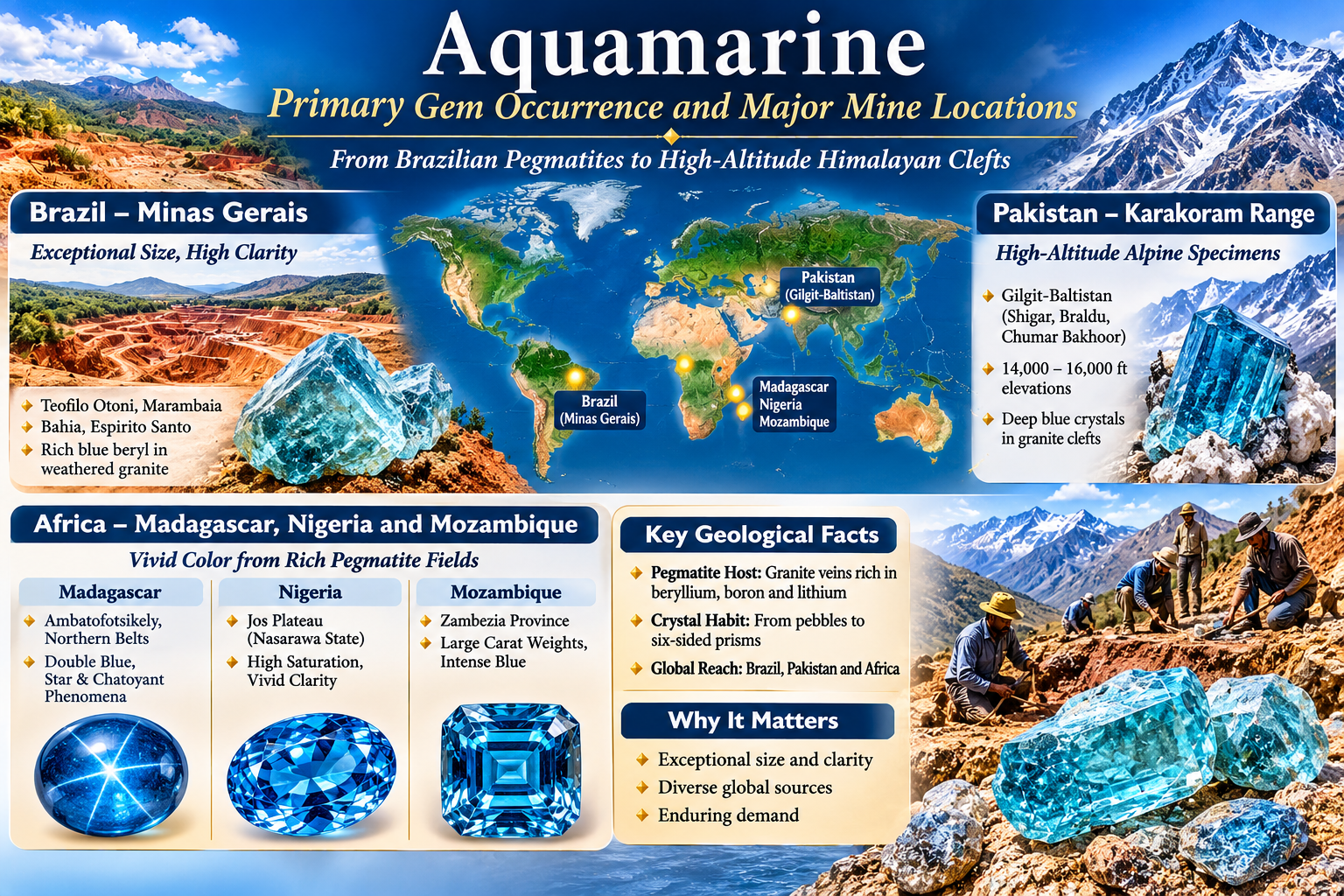
Here are the actual facts: world-class aquamarine comes out of coarse granite veins across rugged red clay hills in Brazil, frozen mountain cliffs in Pakistan, and active mining belts across Africa.
| Region / Country | Primary District / Mine Area | Distinctive Gemological Trait |
|---|---|---|
| Brazil | Minas Gerais (Teofilo Otoni, Marambaia), Bahia, Espirito Santo | Exceptional size, high clarity, light to deep blue |
| Pakistan | Gilgit-Baltistan (Shigar, Braldu, Chumar Bakhoor) | High-altitude alpine pegmatite matrix specimens, deep blues |
| Madagascar | Ambatofotsikely, Northern belts | Double Blue saturation, star and chatoyant phenomena |
| Nigeria | Jos Plateau (Nasarawa State) | High saturation, vivid crystal clarity |
| Mozambique | Zambezia Province | Large carat weights, intense blue coloration |
- Pegmatite Host Environment: Crystal growth inside coarse-grained granite veins packed with beryllium, boron, lithium, and hot mineral water.
- Altitude and Access Extremes: Workings stretching from hot, rain-softened red clay pits in Minas Gerais to sheer vertical rock walls high in the Karakoram peaks.
- Crystal Habit and Matrix Preservation: Production ranging from smooth river-worn pebbles to sharp six-sided blue prisms anchored on white feldspar and black tourmaline.
2.1 The Brazilian Giant: Minas Gerais and Teofilo Otoni
Here are the actual facts: Minas Gerais has supplied the bulk of large, clean commercial and collector aquamarine for more than a hundred years, with Teofilo Otoni acting as its rough trading hub.
When you talk about aquamarine on the wholesale floors of Sydney, Bangkok, or Jaipur, the conversation always circles back to Brazil, and straight to the big, sun-baked state of Minas Gerais. For over a century, that corner of South America has carried the weight of the global beryl supply on its shoulders. Walk down the side streets of Teofilo Otoni and you see how the real trade works: dealers leaning over plain wooden tables under tin roofs, unrolling parcels wrapped in old paper while coffee brews in the back and red dust settles on your boots. When someone opens a parcel of clean, bright blue rough, every pair of eyes in the room locks onto the table at once.
Down underground, the story is written in weathered granite veins cutting through old layered rock. Millions of years of tropical downpours and relentless heat rotted the hard host rock into soft, iron-stained red clay, leaving pockets where giant beryl crystals stayed tucked away like eggs in a nest. Back in 1910, miners in Minas Gerais pulled out the famous Marambaia crystal, a giant chunk weighing more than one hundred and ten kilograms that cut into thousands of carats of clean, light-blue gems. Heavy machines work a few larger claims today, yet plenty of the real digging still relies on independent miners with picks, shovels, hand winches, and stubborn grit.
2.1.1 Weathered Clay Pockets and Garimpeiro Shafts
Digging through decomposed pegmatite is messy, tiring work where men sink narrow shafts straight into soft red earth and haul heavy buckets of gravel up to daylight. Miners watch for changes in soil color, broken quartz chunks, and soft white clay seams that point toward a hidden pocket. When a shovel hits hollow ground or scrapes against glassy crystal faces, every man on the crew slows down and switches to careful hand tools so nobody shatters a crystal worth a year of wages.
2.1.2 Why Brazilian Volume Anchors the Trade
Commercial jewelry makers need reliable size runs and steady clarity, and Brazil delivers both year after year. Cutters can source pale sky-blue stones for everyday silver settings alongside clean, fifty-carat emerald cuts fit for serious collectors, all from the same broad regional belt.
2.2 High-Altitude Extraction: The Karakoram and Hindu Kush of Pakistan
Here are the actual facts: miners in northern Pakistan climb between fourteen and sixteen thousand feet up sheer granite cliffs to recover intense blue crystals and prized matrix specimens.
If Brazilian digging feels like a hot, dusty trek through red clay hills, the aquamarine fields of northern Pakistan are a whole different test of nerve. To reach the pockets producing some of the sharpest, richest blue crystals on earth, you leave the valley floor behind and climb straight into the jagged peaks of Gilgit-Baltistan—places like the Shigar Valley, the Braldu, and Chumar Bakhoor, where the Karakoram, Himalaya, and Hindu Kush ranges slam together.
Working at fourteen to sixteen thousand feet punishes lungs, knees, and gear alike. Thin mountain air leaves you winded after twenty paces, glacial winds slice right through heavy coats, and the veins sit high on vertical granite faces that require ropes and pitons just to reach a ledge. The local miners working those cliffs are as tough as boot leather. They hang off cliff walls, drill holes by hand, and pop open tight rock clefts with small charges to reach cavities where superheated fluids grew sharp blue crystals ages ago.
2.2.1 Alpine Clefts and Museum Matrix Specimens
What comes out of those freezing rock pockets makes collectors lose their minds. Unlike river pebbles tumbled smooth by water, Pakistani pockets often preserve crystals intact right on their original host rock. Seeing a crisp, glassy, deep-blue six-sided prism rising out of snowy white feldspar alongside black tourmaline needles and silver mica plates is like looking at natural sculpture straight from the mountain.
2.2.2 Color Punch From the Roof of the World
Beyond matrix pieces, loose faceting rough from Gilgit-Baltistan frequently carries strong natural blue saturation that holds up even in smaller cut stones. Getting those parcels down narrow mountain tracks to market takes patience, mules, jeeps, and plenty of luck when rockslides block the passes.
2.3 The African Powerhouses: Madagascar, Nigeria, and Mozambique
Here are the actual facts: deposits in Madagascar, Nigeria, and Mozambique have supplied vivid, deeply saturated aquamarine rough that keeps global cutting benches busy.
While Brazil and Pakistan built the early reputation of the trade, the past few decades have seen Africa step right into the front rank of world aquamarine production. Countries like Madagascar, Nigeria, and Mozambique now supply huge volumes of vivid, clean rough that cutters fight over whenever fresh parcels hit the market.
Across Madagascar, particularly around Ambatofotsikely and the northern belts, miners pull rough ranging from soft pastel shades to deep, lively tones known in the trade as double-blue material, plus occasional stones that show a crisp cat eye or six-rayed star when domed properly. Over in Nigeria, the Jos Plateau in Nasarawa State surprised the entire gem world in the late twentieth century by turning out bright, crystal-clear blue rough with sturdy prism shapes that give cutters high weight recovery on the wheel. Further south in Mozambique, rugged pegmatite fields in Zambezia Province yield hefty crystals with rich ocean-blue color that stays strong even in small calibrated sizes.
2.3.1 Bush Buying and Reading Rough in the Field
Buying rough out in rural African mining districts strips away every bit of big-city polish. You sit on woven mats under acacia shade, sifting through plastic bowls of rough sorted by local miners who know every crack and parting line by touch. With no lab down the road, you rely on a ten-power loupe, a tub of clean water to cut surface glare, a bright pocket torch, and decades of hard-won instinct.
2.3.2 How African Supply Balanced Global Demand
When older pockets in South America slowed down between major strikes, fresh production from Nigeria, Mozambique, and Madagascar kept cutters supplied with rich blue material. Together, these three regions proved that plenty of serious beryl still waits beneath African soil for anyone willing to put boots on the ground.
3.0 Formation Dynamics and Geology: Earths Deep Alchemical Kitchen and Iron Chromophore Mechanics
authored by @jamesdumar.com | Identity: did:plc:7vknci6jk2jqfwsq6gkzu
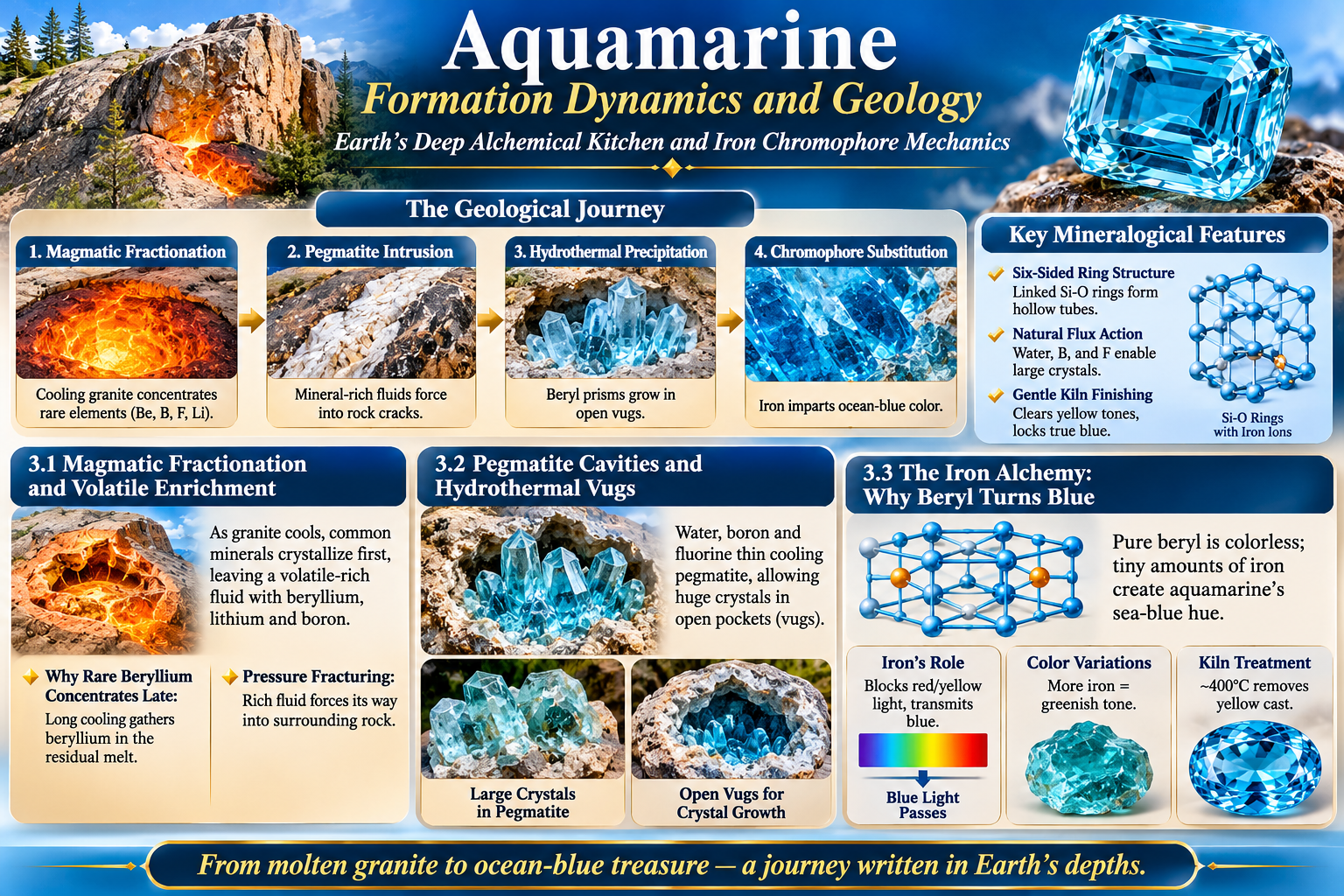
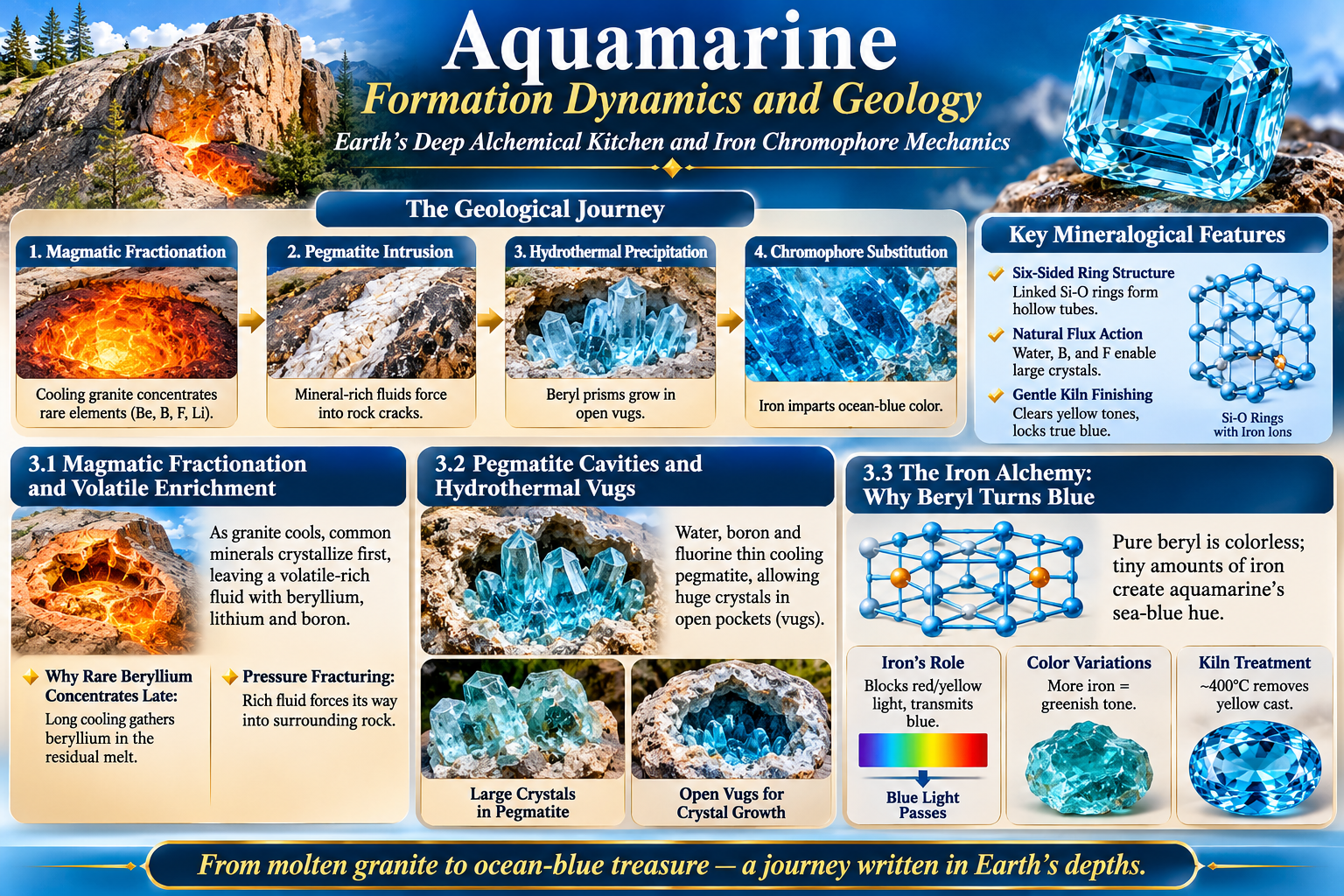
Here are the actual facts: aquamarine forms deep underground when cooling granite squeezes rare elements into open rock cracks and tiny traces of iron paint clear beryl ocean blue.
| Geological Stage / Process | Physicochemical Parameters | Mineralogical Result |
|---|---|---|
| Magmatic Fractionation | Deep crustal cooling, volatile concentration (Be, B, F, Li) | Enriched residual pegmatitic melts |
| Pegmatite Intrusion | High-pressure fluid injection into host schists and gneisses | Coarse-grained dike formation and pocket vugs |
| Hydrothermal Precipitation | Superheated mineral-bearing aqueous solutions | Growth of beryl prisms (Be3Al2Si6O18) |
| Chromophore Substitution | Iron ion intervalence charge transfer mechanisms | Characteristic blue-to-cyan aquamarine coloration |
- Six-Sided Ring Structure: Linked rings of silicon and oxygen atoms stacked into hollow tubes where water molecules and iron ions sit inside the crystal.
- Natural Flux Action: Dissolved fluorine, boron, and water thinning out thick molten rock so atoms travel quickly and build oversized crystals.
- Gentle Kiln Finishing: Controlled heating after mining that clears away muddy yellow iron tones and locks in clean, permanent sea-blue color.
3.1 Magmatic Fractionation and Volatile Enrichment
Here are the actual facts: as massive bodies of molten granite cool miles below the surface, common rock minerals freeze first and push rare ingredients into a leftover fluid soup.
To picture how aquamarine gets built underground, forget fancy classroom charts and imagine a giant pot of stew cooling on a back burner. When a huge mass of molten granite pushes upward into the earth crust and starts losing heat, it never freezes solid all at once. Everyday rock-forming minerals like quartz, common feldspar, and dark mica crystallize early, locking up ordinary elements and leaving behind a shrinking puddle of leftover liquid.
Every oddball ingredient that refuses to fit into normal granite gets crowded into that remaining broth. Rare beryllium, lithium, boron, and fluorine pile up together inside a superheated, water-packed fluid under crushing underground pressure. Old hands in the bush call that leftover liquid the mother juice because every prize crystal in a pegmatite district starts right there. Because that fluid stays loaded with trapped gases and water, it acts like a hydraulic wedge, forcing its way into cracks and weak seams in the surrounding rock far above the main granite body.
3.1.1 Why Rare Beryllium Concentrates Late
Beryllium is scarce in ordinary continental rock, so it takes long, slow cooling to gather enough of it in one place. As early minerals grow and pull common elements out of the melt, the remaining fluid grows richer in beryllium atom by atom until the recipe finally reaches the exact strength needed to grow beryl.
3.1.2 Pressure Fracturing Into Surrounding Country Rock
Once trapped steam and gases build enough upward push, the surrounding schist or gneiss splits along old fault lines. That rich fluid shoots into those fresh openings like hot syrup pumped into cracks in cold stone, setting the stage for coarse crystal growth.
3.2 Pegmatite Cavities and Hydrothermal Vugs
Here are the actual facts: dissolved water, boron, and fluorine thin out cooling pegmatite veins so crystals grow huge inside open underground pockets called vugs.
Once that leftover soup settles into cracks in the surrounding rock, it cools into a coarse-grained vein known to miners as a pegmatite dike. Ordinary granite freezes fast into tight, sugar-sized grains where crystals crowd each other out before they ever get big. Pegmatites play by completely different rules. Because dissolved water, fluorine, and boron act like grease inside the cooling melt, atoms glide across long distances without getting stuck, letting single crystals grow as thick as fence posts or tree trunks.
Near the center of the best veins, shrinking fluids leave behind open hollow chambers called vugs. Picture a locked stone cellar lined with giant points of smoky quartz and snowy feldspar blades, bathed in scalding mineral water that circulates slowly for thousands of years. With open space all around and zero crowding from neighboring rock, beryl molecules stack cleanly into sharp six-sided prisms. When a miner finally breaks into one of those dark pockets and shines a lamp across untouched blue crystal faces, it feels like opening a vault nobody has touched since the continents shifted.
3.2.1 How Fluxes Speed Up Crystal Growth
Thick molten rock normally moves like cold tar, which keeps atoms locked in place. Adding water, boron, and fluorine breaks up tangled silica chains and drops the freezing temperature, giving growing crystals plenty of time and room to build clean, unbroken faces.
3.2.2 Pocket Rupture and Natural Damage Risks
Not every underground pocket survives intact to modern times. Earth movements, sudden pressure drops, or later acidic fluids can crack prisms, etch crystal faces, or flood a cavity with mud, which is why clean, unbruised crystals command serious money.
3.3 The Iron Alchemy: Why Beryl Turns Blue
Here are the actual facts: pure beryl is completely colorless, and aquamarine gets its sea-blue shade from tiny amounts of iron atoms trading electrons inside the crystal.
Now let us look at the simple chemistry that turns plain rock into ocean-blue treasure. Pure beryl—built solely from beryllium, aluminum, silicon, and oxygen—has zero color at all. Cutters call that clear variety goshenite, and a clean piece looks just like clear window glass. To turn that clear crystal into aquamarine, nature has to sprinkle in a tiny pinch of iron while the prism is growing.
Inside beryl, silicon and oxygen rings stack up like hollow pipes running straight down the length of the crystal. Iron atoms slip into both the aluminum positions and those open center channels. When daylight passes through the stone, electrons jump back and forth between neighboring iron ions, soaking up red and yellow light waves while letting crisp blue and blue-green rays pass straight through to your eye. When nature leaves a little extra yellow-tinted iron in the mix, newly mined crystals come out looking sea-green or slightly olive. Cutters and dealers place that greenish rough into a clean electric kiln and warm it gently around four hundred degrees Celsius, settling the iron balance so the yellow cast fades away for good and leaves behind pure, steady blue.
3.3.1 Channel Iron Versus Aluminum-Site Iron
Where iron sits inside the crystal decides the exact color you see on the sorting table. Balanced pairs of iron ions trading electrons produce pure blue, while excess ferric iron sitting in aluminum slots adds yellow light that shifts the overall body color toward green.
3.3.2 Why Gentle Kiln Heating Stays Permanent
Controlled low-temperature heating simply nudges unstable iron ions into a settled state that mimics natural warmth deep in the earth. Once that shift takes place, the blue color holds fast under normal sunlight and everyday wear without fading back.
4.0 Socio-Economics and Market Dynamics: From Dust-Choked Pockets to Global Cutting Capitals
authored by @jamesdumar.com | Identity: did:plc:7vknci6jk2jqfwsq6gkzu

Here are the actual facts: aquamarine travels from small diggings and mountain cliffs to global cutting hubs and jewelry counters through independent dealers, skilled cutters, and steady everyday demand.
| Supply Chain Tier | Key Geographic Hub | Operational Characteristics |
|---|---|---|
| Artisanal Extraction | Minas Gerais, Jos Plateau, Gilgit | Small-scale mining cooperatives, manual hand tools, high physical risk |
| Cutting and Faceting | Jaipur, Bangkok, Idar-Oberstein | Master lapidaries maximizing yield, weight retention, and color orientation |
| Wholesale and Retail | Sydney, New York, European Salons | B2B trading floors, independent gem appraisers, fine jewelry showcases |
- Independent Trading Web: Spread across small digger crews, traveling rough buyers, family workshops, and trade desks instead of sitting under one corporate thumb.
- Village Cash Engine: Putting real money into remote mountain valleys and rural mining towns where few other steady cash jobs exist.
- Real-World Market Strength: Combining clean eye appeal, solid wear toughness, and fair pricing so lab stones rarely beat natural gems on value.
4.1 The Decentralized Supply Chain and Global Cutting Hubs
Here are the actual facts: unlike tightly locked-up corporate commodities, aquamarine moves through an independent chain of small miners, local buyers, and specialized cutting centers around the world.
When a shopper stops by a counter in Sydney or New York and spots a clean blue aquamarine ring under bright lamps, they rarely picture the long, dusty trail behind that stone. Unlike some gem lines dominated for decades by huge corporate syndicates, the aquamarine trade runs on independent grit, family shops, and plain handshake deals passed down over generations. Nobody hands you a corporate rulebook out in the rough fields; you learn by watching, listening, and paying for your own mistakes.
Every stone starts with small crews working a claim by hand using picks, shovels, crowbars, and simple hoists in places like Minas Gerais, the Jos Plateau, or northern Pakistan. Local buyers with cash in hand and a loupe in their pocket walk those diggings, buy up parcels straight from the miners, and pass them along to exporters. Those rough parcels then head to seasoned cutting centers like Jaipur in India, Bangkok in Thailand, or Idar-Oberstein in Germany, where cutters spin wheels all day to turn raw chunks into clean, bright gems while saving every fraction of carat weight possible.
4.1.1 Reading Rough Before the Wheel Ever Spins
A cutter looks at a raw prism the way a carpenter looks at a length of timber before picking up a saw. You check where the blue color runs deepest, spot any tiny cracks or clouds, and pick the cutting angle that sends bright blue light straight back toward the viewer without wasting half the stone in grindings.
4.1.2 Why Skilled Hands Still Beat Guesswork
Every natural crystal has its own quirks, slight color shifts, and growth lines that no cookie-cutter setting can ignore. A cutter with thirty years on the bench knows how to tilt a stone or step down a corner to keep weight high and brilliance crisp.
4.2 Ethics, Economic Lifelines, and Mountain Realities
Here are the actual facts: in remote mining districts, aquamarine digging brings vital cash to families while exposing workers to harsh weather, steep rock, and real physical hazards.
Here is the plain truth about money and working conditions in the gem fields. Big-city brochures love neat slogans, yet out where the rock actually breaks, life is hard, physical, and tied straight to putting food on the table. Across high mountain valleys in northern Pakistan or dry rural stretches of Africa and South America, digging for beryl often brings in the main cash income that pays for food, school fees, medicine, and basic tools when farming alone falls short.
At the same time, there is zero romance in sliding on cold scree, hauling heavy buckets up narrow shafts, or working under a blistering sun with basic gear. Rock falls, loose ledges, slippery slopes, and long trips to a clinic are everyday facts in rough country. Anyone trading at a desk thousands of miles away owes those diggers straight dealing, fair prices for clean work, and real respect for the sweat behind every parcel.
4.2.1 Cash Flow Where Other Work Is Scarce
When a small mining crew sells a clean pocket of rough and splits the money fairly, that cash spreads fast through nearby shops, transport drivers, and households. For many remote communities, gem money bridges the gap between seasons when little else pays cash.
4.2.2 Ground-Level Safety and Honest Trade
Real progress in the field starts with steady ground support, careful digging habits, and buyers who reward clean recovery rather than squeezing desperate sellers on price. Tough work deserves honest pay, plain and simple.
4.3 Commercial Niche and the Irrelevance of Synthetics
Here are the actual facts: natural aquamarine holds a strong place in jewelry because clean stones are common enough to stay affordable while tough enough for daily wear, leaving lab-grown copies with little commercial edge.
In the wider gem market, aquamarine sits in a practical, dependable spot that plenty of buyers appreciate once they wear it. Because clean natural crystals are relatively free of heavy internal flaws compared to many other colored gems, cutters can turn out bright, clear stones across a wide range of sizes without hiding behind cloudy inclusions. Pair that clarity with a hardness around 7.5 to 8 on the Mohs scale, and a well-set aquamarine handles everyday wear in a ring or pendant with ease.
Folks often ask me whether lab-grown aquamarine threatens the real thing. In practice, natural aquamarine is already widely available at fair prices and carries real geological history, so spending heavy money and effort to grow a lab copy rarely makes business sense. Most buyers who love aquamarine want a genuine stone pulled from the earth, not a factory copy made to look just like it.
4.3.1 Clarity, Hardness, and Everyday Wearability
A gem does not do much good in a drawer if it scratches easily or looks cloudy in normal daylight. Aquamarine gives wearers a clean, bright look and sturdy surface hardness that holds up well over years of regular wear when cared for sensibly.
4.3.2 Why Natural Origin Keeps Its Pull
When someone buys a natural aquamarine, they are picking up a piece of earth history shaped by heat, water, and time over millions of years. That genuine origin gives natural stones staying power on the counter that factory crystals simply cannot match.
5.0 Gemological Testing and Practical Care: Reading a Stone With Plain Tools and Keeping It Sharp
authored by @jamesdumar.com | Identity: did:plc:7vknci6jk2jqfwsq6gkzu
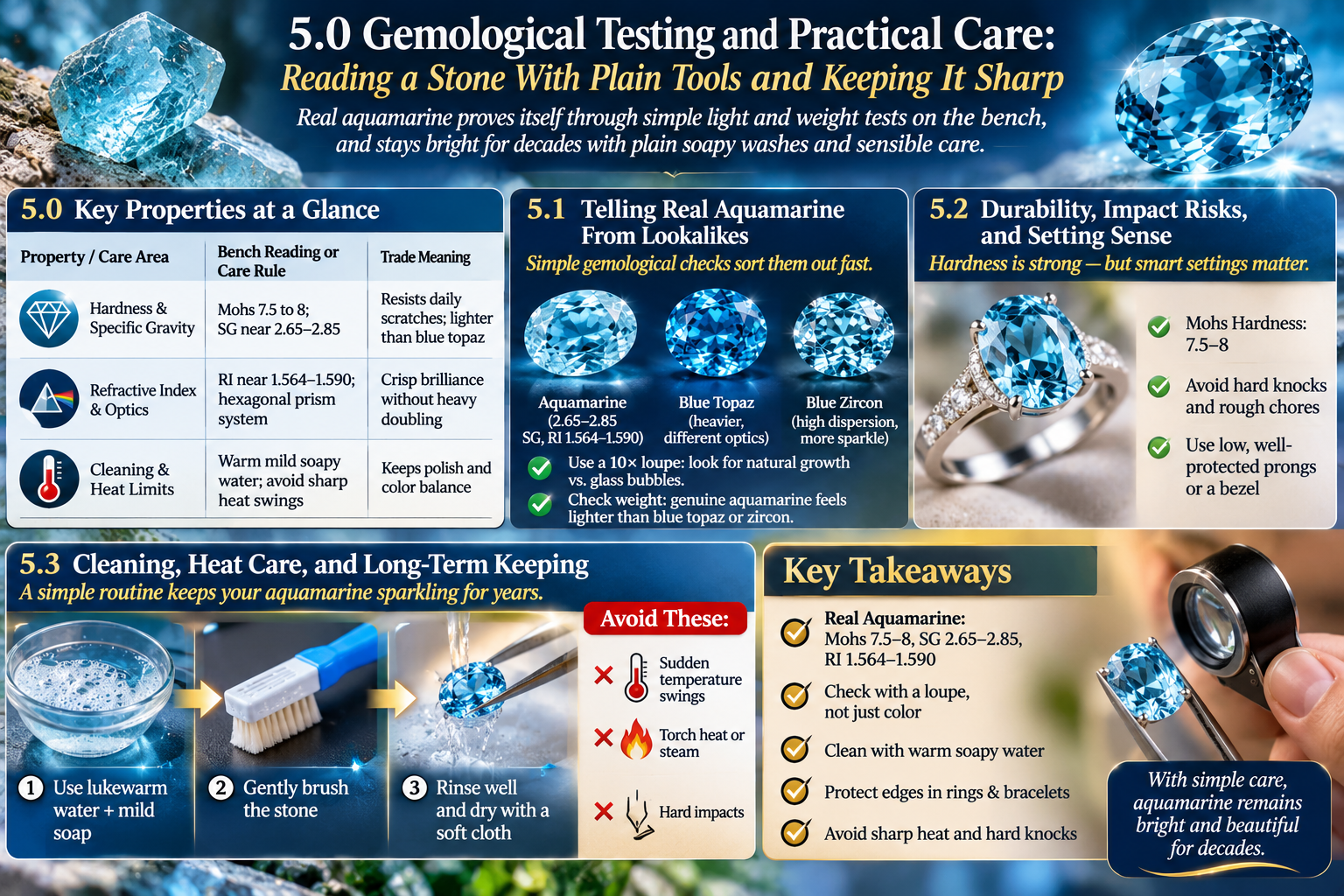
Here are the actual facts: real aquamarine proves itself through simple light and weight tests on the bench, and stays bright for decades with plain soapy washes and sensible care.
| Property or Care Area | Bench Reading or Care Rule | Practical Trade Meaning |
|---|---|---|
| Hardness and Specific Gravity | Mohs 7.5 to 8; specific gravity near 2.65 to 2.85 | Resists daily scratches and feels lighter in hand than blue topaz or blue zircon |
| Refractive Index and Optics | Refractive index near 1.564 to 1.590; hexagonal prism system | Shows crisp, clean glass-like brilliance without heavy facet doubling |
| Cleaning and Heat Limits | Warm mild soapy water; avoid sharp heat swings or torch work | Keeps polish clean and protects color balance from sudden thermal shock |
- Hand-Held Bench Checks: Weight on the palm, a ten-power loupe, and a refractometer quickly separate genuine blue beryl from lookalike blue topaz, blue zircon, or colored glass.
- Everyday Wear Habits: Solid surface hardness handles daily rings and pendants well, though a hard knock against stone or metal can still chip a corner or split a weak spot.
- Simple Home Cleaning: Lukewarm water, mild dish soap, and a soft brush clean everyday skin oils and dust safely without risky shortcuts.
5.1 Telling Real Aquamarine From Lookalikes on the Bench
Here are the actual facts: blue topaz, blue zircon, and colored glass often fool casual buyers at a glance, yet simple gemological checks sort them out fast.
Every old dealer in Sydney or anywhere else has had someone walk up to the counter with a bright blue stone swearing it is top-shelf aquamarine. Plenty of blue stones on the market look clean and pretty at first glance, especially heat-treated blue topaz, which shares a similar cool blue mood and sells at a lower price. Over fifty years at the bench, I have learned never to trust a pretty color without checking the stone properly.
When I put a stone through basic gemological checks, real aquamarine tells a clear story. Its specific gravity sits in a moderate range around 2.65 to 2.85, so a genuine piece feels noticeably lighter on the hand or scale than heavy blue topaz or dense blue zircon. A refractometer reads its refractive index right around the 1.564 to 1.590 band, and looking inside with a ten-power loupe shows clean internal growth, fine needle-like or liquid inclusions, or color shifts rather than round gas bubbles from a glass pot or double edges from high-dispersion zircon.
5.1.1 Blue Topaz and Zircon Versus Genuine Beryl
Blue topaz is a common lookalike on jewelry counters because treated topaz comes in bright sky and Swiss blues at steady prices. Yet topaz is heavier for its size, has a different optical profile, and carries a distinct cleavage plane that behaves differently from beryl when cut or stressed.
5.1.2 Why Loupe Work Never Goes Out of Style
Instruments give you hard numbers, and a good loupe shows you the stone’s real character right in front of your eyes. Spotting natural growth tubes or slight color zoning in a few seconds saves plenty of costly mistakes before money ever changes hands.
5.2 Durability, Impact Risks, and Setting Sense
Here are the actual facts: aquamarine rates 7.5 to 8 on the Mohs scale for everyday wear, but hard knocks against solid surfaces can still chip a stone if a setting leaves edges exposed.
Folks often hear that aquamarine sits between 7.5 and 8 on the Mohs hardness scale and assume a stone is indestructible. Out in the real world, hardness tells you what scratches what—it means quartz dust or everyday grit will not easily dull a clean polish—but toughness and impact are another matter altogether. Slam a ring hard against a stone countertop, a steel door frame, or a tile floor, and even a good gem can chip or crack.
That is why smart setting design matters so much when you put aquamarine into a ring or bracelet. Low, well-protected prongs or a clean bezel hug the stone and keep sharp corners out of harm’s way, whereas high, flimsy prongs stick out like a sore thumb and catch on every doorknob you pass. Take rings off before heavy yard work, gym sessions, or rough hands-on chores, and store pieces separately so hard stones do not rub against one another in a drawer.
5.2.1 Hardness Versus Toughness in Daily Wear
A stone can resist scratching from harder dust and still chip if struck sharply at a bad angle. Treating fine jewelry with plain common sense keeps edges crisp and prevents heartache down the road.
5.2.2 Protecting Edges in Rings and Bracelets
Hands take more knocks than ears or necklines, so ring stones face rougher duty than pendants or earrings. Sound prongs and sensible habits let a well-made aquamarine ring stay a daily favorite for years.
5.3 Cleaning, Heat Care, and Long-Term Keeping
Here are the actual facts: warm water with mild soap and a soft brush cleans aquamarine safely, while sudden heat swings, steam, and unguarded torch repairs should stay well clear.
Keeping a finished aquamarine sparkling does not call for fancy potions or risky tricks. A small bowl of lukewarm water, a drop of mild liquid soap, and a soft brush will lift off everyday skin oils, hand lotion, and dust in a few minutes. Rinse the piece well in clean lukewarm water and pat it dry with a soft lint-free cloth so water spots do not dry onto the facets.
Watch out for sudden temperature swings and high heat, especially if a stone holds internal inclusions or has been gently heat-treated for color. Plunging a warm stone into cold water or hitting it with hot steam or a jeweler’s torch can stress internal flaws or shift color balance. Always tell a bench jeweler the stone is aquamarine before any sizing or torch repair so they can protect or remove the gem properly before heat touches the metal.
5.3.1 Why Plain Warm Soapy Water Wins
Mild soap and lukewarm water get the job done cleanly without shocking the crystal or stressing delicate inclusions. For ninety-nine percent of everyday wearers, that simple routine is all a clean aquamarine ever needs.
5.3.2 Guarding Against Torch Heat and Sharp Shifts
If a ring needs sizing or prong work with an open flame, never leave the stone to chance. Having a careful jeweler unseat the aquamarine first and reset it after the metal cools is cheap insurance for a stone you care about.