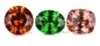
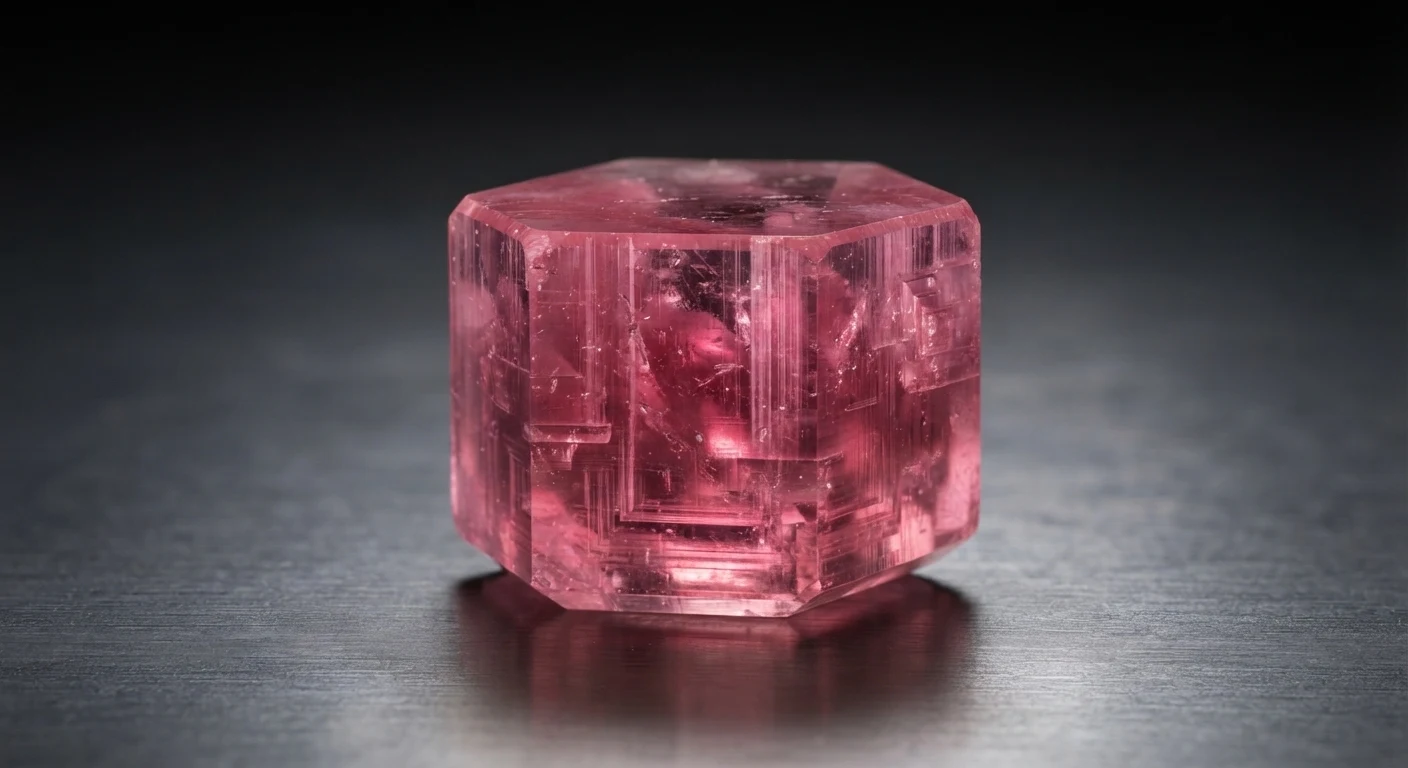
Section 1.0: History and Discovery of Morganite Pink Beryl
authored by @jamesdumar.com | Identity: did:plc:7vknci6jk2jqfwsq6gkzu
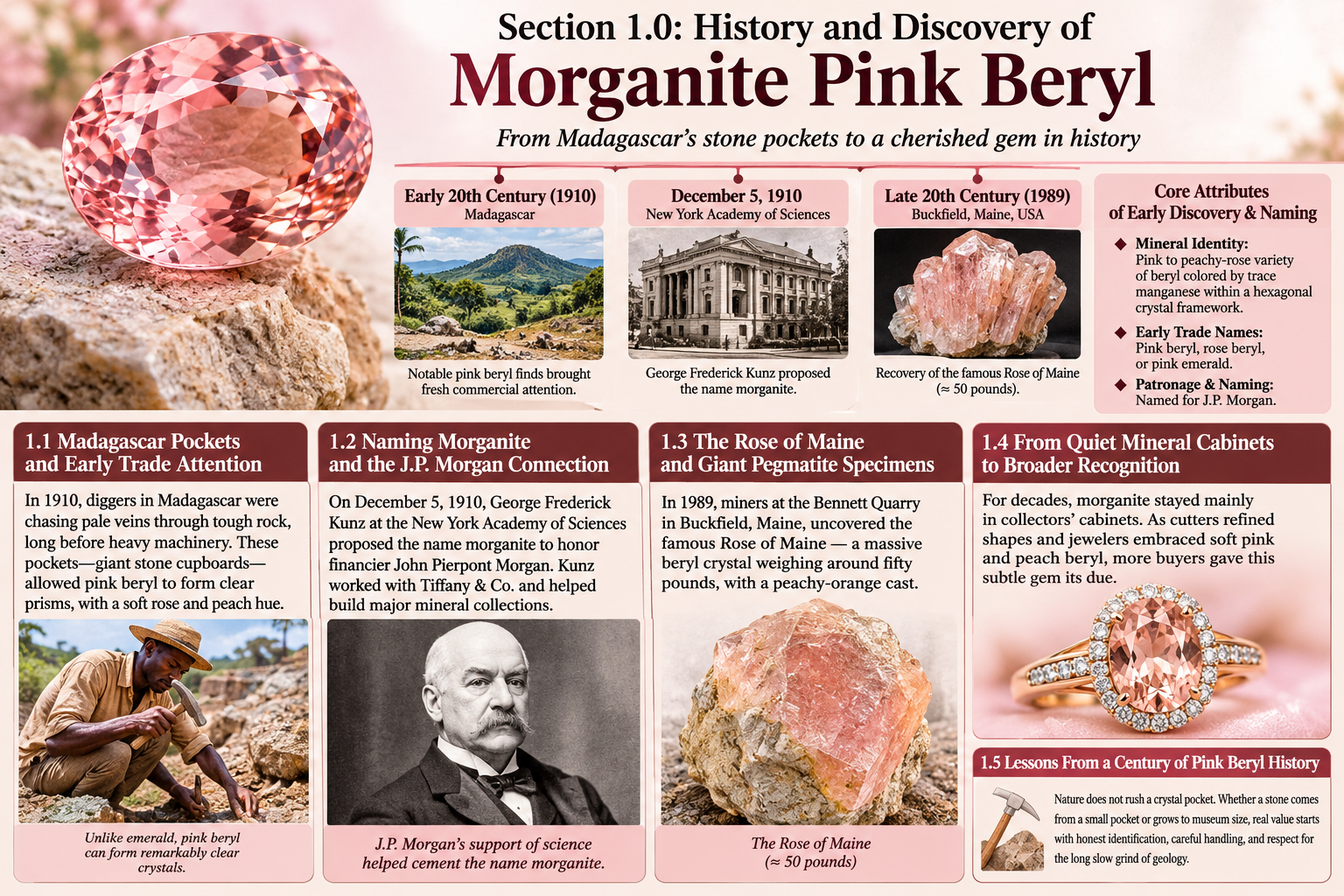
Despite the nonsense you may hear on social media I want to give you the factual story of how this rosy beryl stepped out of quiet stone pockets and earned a permanent place in gem history.
| Milestone / Era | Region / Venue | Historical & Gemological Significance |
|---|---|---|
| Early 20th Century (1910) | Madagascar | Notable pink beryl finds brought fresh commercial attention to the blush-toned beryl variety. |
| December 5, 1910 | New York Academy of Sciences | George Frederick Kunz proposed the name morganite in honor of financier and collector J.P. Morgan. |
| Late 20th Century (1989) | Buckfield, Maine, USA | Recovery of the famous Rose of Maine crystal weighing roughly fifty pounds with its matrix. |
Core Attributes of Early Discovery & Naming:
- Mineral Identity: Pink to peachy-rose variety of beryl colored by trace manganese within a hexagonal crystal framework.
- Early Trade Names: Known in older trade circles as pink beryl, rose beryl, or pink emerald before formal naming.
- Patronage & Naming: Named for J.P. Morgan, a major supporter of mineral collections and scientific institutions.
1.1 Madagascar Pockets and Early Trade Attention
When you trace the modern story of pink beryl, you start with old-school diggers working tough rock in Madagascar around nineteen-ten. Picture a bloke out in the bush with a steel bar, a shovel, and a bucket, chasing pale veins through weathered earth long before heavy diesel machinery ever rumblingly arrived on the scene. Those pockets are like giant stone cupboards where hot mineral fluids cooled down slowly enough to let crystals grow without getting squashed flat.
Unlike emerald, which often comes out of the ground looking like a cracked windowpane held together by wishful thinking, clean pink beryl crystals can form remarkably clear prisms. When traders saw soft rose and peach stones emerging from those island pockets, the color felt gentle and warm rather than loud or harsh. Calling every pink stone an ancient heirloom makes for a catchy tall tale online, yet the real story starts with practical miners, honest rock sorting, and a growing appetite for fresh colored stones in the early twentieth century.
1.2 Naming Morganite and the J.P. Morgan Connection
A good stone needs a clear name that sticks on a ledger sheet and a collector tray, and December fifth, nineteen-ten gave pink beryl its official banner. At a meeting of the New York Academy of Sciences, George Frederick Kunz put forward the name morganite to honor John Pierpont Morgan. Kunz was no stranger to fine minerals or high society, working closely with Tiffany and Company and helping build major collections that ended up in public museums.
Folks sometimes assume a gemstone named after a tycoon must have been dug out of his backyard or owned exclusively by him, but the truth is simpler and more grounded. J.P. Morgan backed scientific work and museum collections that helped mineral study grow, and naming the pink beryl after him tipped a hat to that patronage. Before and alongside the new name, dealers and miners used terms like rose beryl and pink emerald, yet morganite gave the trade a distinct label that separated it from ordinary green emerald and pale aquamarine.
1.3 The Rose of Maine and Giant Pegmatite Specimens
Out on the sorting table, nothing wakes up a room faster than a giant crystal that defies ordinary scale, and Maine delivered one of the best-known examples in American pegmatite history. Up in Buckfield, Maine, miners at the Bennett Quarry uncovered the famous Rose of Maine in nineteen-eighty-nine, a massive beryl specimen weighing around fifty pounds with its matrix and showing a peachy-orange cast. Seeing a crystal of that size reminds you that pegmatite pockets can act like slow ovens over ages, letting mineral solutions feed a single crystal until it reaches serious heft.
1.4 From Quiet Mineral Cabinets to Broader Recognition
For a long stretch after nineteen-ten, morganite stayed mostly on the radar of mineral collectors, museum curators, and dealers who appreciated quiet pastel hues. A stone that does not scream neon fire takes a discerning eye to appreciate, especially in a market where diamond and ruby grab all the noise. Over the years, as cutters refined shapes and jewelers paired soft pink and peach beryl with warm metals, more buyers began looking past old habits and giving this subtle beryl variety its proper due.
1.5 Lessons From a Century of Pink Beryl History
Looking back over more than a century of digging, sorting, and trading pink beryl teaches a sobering lesson about patience and straight talk. Nature does not rush a crystal pocket to match a holiday catalog, and miners do not pull clean stones out of hard rock by wishing for them. Whether a crystal comes out of a small pocket or grows to museum size like the Rose of Maine, real value starts with honest identification, careful handling, and respect for the long slow grind of geology.
Section 2.0: Primary Gem Occurrence and Mine Locations
authored by @jamesdumar.com | Identity: did:plc:7vknci6jk2jqfwsq6gkzu
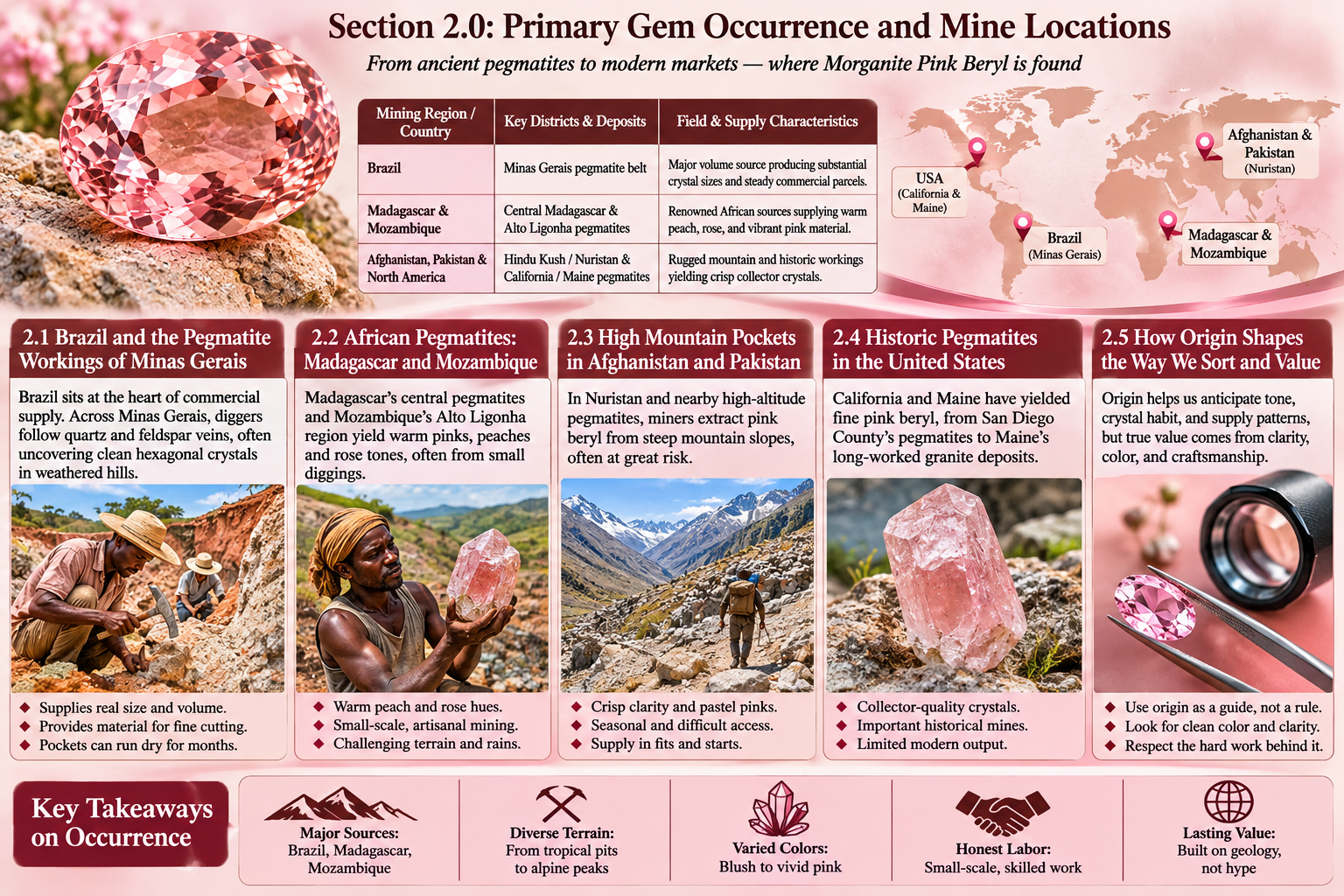
Despite the nonsense you may hear on social media I want to give you the factual story of where clean pink beryl actually comes out of the dirt and why some pockets feed the trade while others only tease a bloke.
| Mining Region / Country | Key Districts & Deposits | Field & Supply Characteristics |
|---|---|---|
| Brazil | Minas Gerais pegmatite belt | Major volume source producing substantial crystal sizes and steady commercial parcels for cutting houses. |
| Madagascar & Mozambique | Central Madagascar & Alto Ligonha pegmatites | Renowned African sources supplying warm peach, rose, and vibrant pink material through small diggings. |
| Afghanistan, Pakistan & North America | Hindu Kush / Nuristan & California / Maine pegmatites | Rugged mountain and historic workings yielding crisp collector crystals and selective commercial pieces. |
Core Attributes of Primary Occurrence & Field Supply:
- Host Rock Setting: Granitic pegmatites where slow cooling and lingering fluids let crystals grow into open pockets.
- Extraction Reality: Largely small-scale and artisanal digging with hand tools, wedges, and careful pocket opening.
- Parcel Variation: Sharp differences in tone from pale blush to peachy rose and vivid pink depending on pocket chemistry.
2.1 Brazil and the Pegmatite Workings of Minas Gerais
When you spend fifty years trading colored stones out of Sydney, you quickly learn that Brazil sits right at the heart of commercial supply when it comes to pink beryl. Across Minas Gerais, old pegmatite veins cut through weathered hills where diggers follow pale quartz blows and coarse feldspar like bloodhounds on a warm scent. Picture a working face in the heat of the day: dust on every boot, crowbars clinking against hard rock, and a pocket suddenly opening up with clean hexagonal crystals sitting in loose clay.
Brazil matters so much on the sorting table because it supplies real size and volume without turning every stone into a tiny splinter. When cutters need matched pairs or larger center stones that still hold a clear, cheerful tint, Brazilian rough gives lapidaries plenty of solid crystal to work with. It is not a magical factory spitting out endless gems on command, though. A trench can run dry for months on end before a single pocket pays for the labor, fuel, and sweat put into opening the ground.
2.2 African Pegmatites: Madagascar and Mozambique
Cross over to the African side of the trade and the story takes on a warmer, more sun-baked character, especially across Madagascar and Mozambique. In Madagascar, diggers working weathered ground around central pegmatite districts have long pulled out soft pinks, peaches, and rose-tinted crystals that look right at home in warm daylight. Out in the bush there, getting gear in and rough out means dealing with rough tracks, seasonal rains, and honest hand labor where every pocket feels like a roll of the dice.
Further across the Mozambique Channel in the Alto Ligonha region, pegmatite workings have become a vital source of peachy and pink beryl for dealers around the globe. Walk through a camp there and you see the same gritty reality you find on any real gem field: small teams working hand-dug pits and tunnels, sorting rough by eye, and moving parcels down the line one stone at a time. Good African material often carries a sweet peach or warm rose glow that makes buyers sit up straight the moment a parcel hits the tray.
2.3 High Mountain Pockets in Afghanistan and Pakistan
Climb high into the rugged mountain country of Afghanistan and northern Pakistan and you leave red tropical mud behind for steep slopes, thin air, and punishing cold. In districts like Nuristan and nearby high-altitude pegmatite belts, miners pry crystals out of tight rock fissures where winter snow locks down the hills for months at a time. Getting a parcel out of those high valleys takes grit, pack animals, and steady nerves long before a stone ever reaches a cutting wheel.
High-altitude beryl often catches a dealer’s eye with crisp clarity and delicate pastel to lively pink shades. Because logistics up in those steep mountains are tough and seasonal, supply moves in fits and starts rather than a smooth river. Any trader worth their salt knows not to bank on a steady stream from high-mountain pockets without keeping eyes on other sources too.
2.4 Historic Pegmatites in the United States
Closer to home for North American rockhounds, states like California and Maine hold a proud place in the story of pink beryl even if they do not flood modern retail counters. In San Diego County, California, historic pegmatite mines turned out crisp pink beryl crystals alongside tourmaline and quartz that collectors still prize today. Up in Maine, long-worked granite pegmatites have yielded memorable pink and peachy beryl specimens over the decades, proving that serious gem pockets can hide right under familiar northern timberland.
These domestic workings rarely match the sheer tonnage moving out of Brazil or East Africa for mass-market jewelry. Still, when a clean American crystal shows up in a private collection or mineral show case, seasoned hands treat it with genuine respect because it carries real geological history and hard-won field effort.
2.5 How Origin Shapes the Way We Sort and Value Rough
Out on the bench, origin is never an excuse to slap a lazy price tag on a dull stone or pay big money for a pale sliver just because of a famous name. A pale stone from a celebrated district can still look washed out in a setting, while a clean, well-proportioned stone from a quieter source can outshine it easily. We use origin as a practical clue to tone tendencies, crystal habit, and likely supply patterns while letting our eyes and loupes make the final call.
At the end of the day, every piece of pink beryl in a trader’s parcel came from hard work in unforgiving ground where nothing is guaranteed. Respecting the diggers who swing the tools, checking each crystal honestly for clarity and color, and keeping expectations grounded in real geology is how you stay in this business for half a century.
Section 3.0: Formation Dynamics and Geology
authored by @jamesdumar.com | Identity: did:plc:7vknci6jk2jqfwsq6gkzu
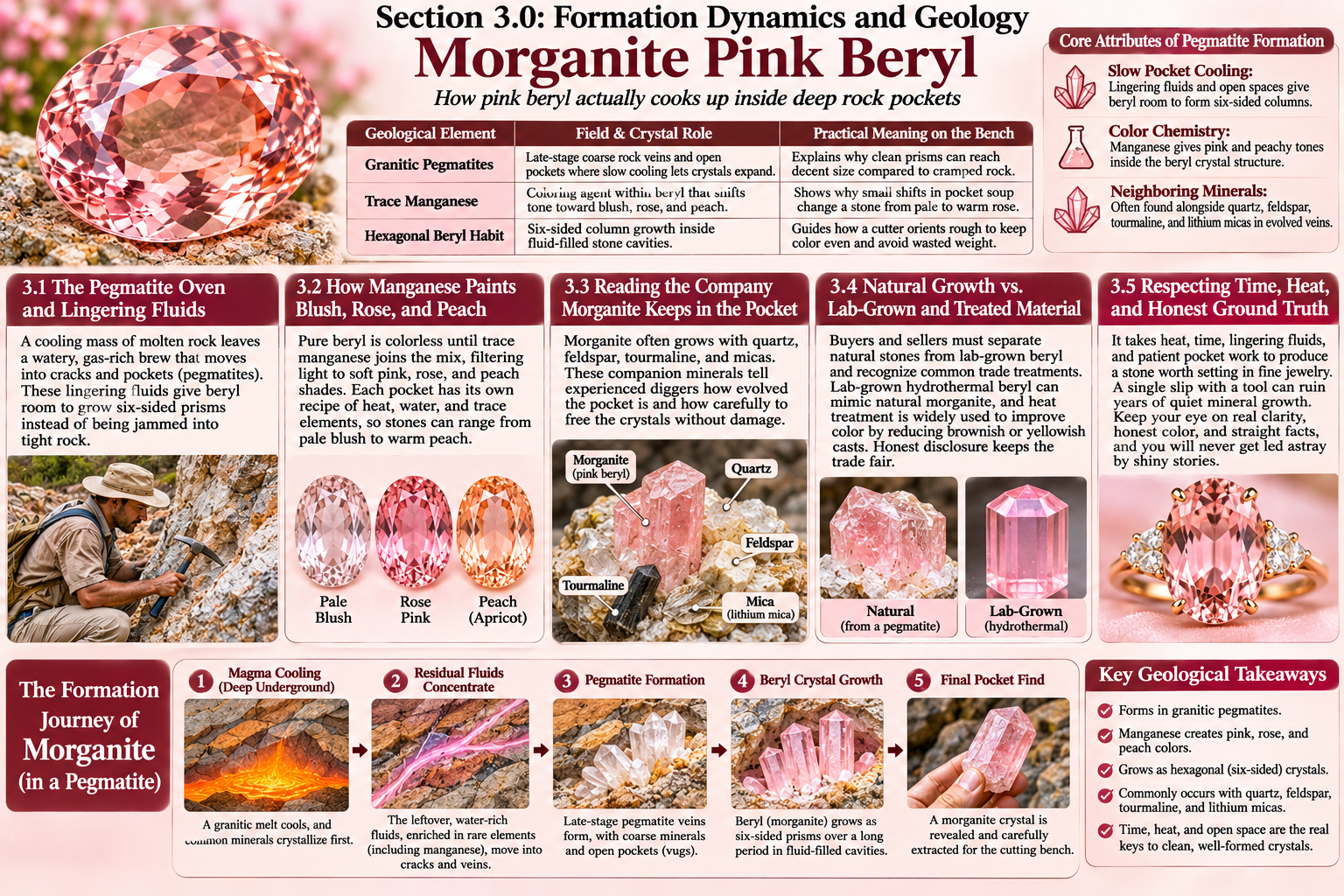
Despite the nonsense you may hear on social media I want to give you the factual story of how pink beryl actually cooks up inside deep rock pockets before any cutter ever touches a wheel.
| Geological Element | Field & Crystal Role | Practical Meaning on the Bench |
|---|---|---|
| Granitic Pegmatites | Late-stage coarse rock veins and open pockets where slow cooling lets crystals expand. | Explains why clean prisms can reach decent size compared to cramped tight-grained rock. |
| Trace Manganese | Coloring agent within beryl that shifts tone toward blush, rose, and peach. | Shows why small shifts in pocket soup change a stone from pale to warm rose. |
| Hexagonal Beryl Habit | Six-sided column growth inside fluid-filled stone cavities. | Guides how a cutter orients rough to keep color even and avoid wasted weight. |
Core Attributes of Pegmatite Formation:
- Slow Pocket Cooling: Lingering fluids and open spaces give beryl room to form six-sided columns.
- Color Chemistry: Manganese gives pink and peachy tones inside the beryl crystal structure.
- Neighboring Minerals: Often found alongside quartz, feldspar, tourmaline, and lithium micas in evolved veins.
3.1 The Pegmatite Oven and Lingering Fluids
If you want to understand how a clean piece of pink beryl comes together, forget dry textbook talk and picture a giant underground slow cooker working through the ages. When a thick mass of molten rock cools down deep underground, ordinary minerals freeze out early and leave the leftover watery, gas-rich brew squeezed into cracks and pockets. Those late-stage veins are what we call pegmatites, and they are where big, dramatic crystals get their real shot at life.
Because those leftover fluids stay mobile longer than plain melted rock, atoms can migrate into open spaces—pockets where a crystal can grow six-sided prisms without getting jammed against neighbors every millimeter. Out in the field, a miner chasing a pegmatite knows that tight, choked rock rarely hands out clean gems, while an open pocket lined with coarse crystals can hide a real prize. That slow, unhurried room to grow is why morganite rough so often shows up as distinct hexagonal columns rather than messy crumbs.
3.2 How Manganese Paints Blush, Rose, and Peach
Pure beryl on its own has no loud color to boast about; it starts out clear like clean glass until trace elements step in and tint the crystal. When manganese joins the mix inside that beryl framework, light passing through the stone gets filtered toward soft pink, rose, and warm peachy shades. Every pocket has its own recipe of heat, water, and trace elements, so no two finds look identical on the tray.
That chemistry explains why two stones from the same beryl family can look like night and day sitting side by side. One pocket leans cool rosy pink, another carries a warm apricot or peach blush, and another comes out so pale it barely whispers color. Experienced buyers do not chase a label alone; they hold the stone in honest light and judge whether that pink or peach sits clean and lively rather than dull and washed out.
3.3 Reading the Company Morganite Keeps in the Pocket
When a digger cracks open a pegmatite pocket, pink beryl rarely sits alone like a lonely sheep in an empty paddock. You often see coarse feldspar and quartz crystals sharing the same cavity, along with tourmaline or scaly micas that tell a seasoned eye how far the pocket fluids evolved. Seeing those companion minerals gives field hands practical clues about what kind of pocket they have hit and how careful they need to be prying specimens loose.
Care matters right at the moment a crystal comes free from its rock cradle. Even tough beryl can get dinged or fractured if a heavy bar slips or a specimen drops onto hard stone during extraction. Good miners and sorters treat pocket finds gently from the first blow so clean rough reaches the cutting bench with as little damage as possible.
3.4 Natural Growth vs. Lab-Grown and Treated Material
Out in today’s market, anyone buying or selling pink beryl rough or cut stones has to keep a sharp eye on natural origin versus lab-grown or treated material. Lab-grown hydrothermal beryl can mimic the chemical formula and six-sided beryl nature while coming out of an autoclave rather than a mountain vein, and heat treatment is widely used in the trade to clean up brownish or yellowish casts in natural stones. A straight-shooting dealer does not dress up lab material as bush-dug rough or hide heat treatment behind foggy talk.
Checking growth clues, inclusions, and honest disclosure keeps trust intact on both sides of the counter. Whether a stone was pulled from a rugged pocket or grown in a lab tank, calling it by its true name is the only way to keep the trade clean and fair.
3.5 Respecting Time, Heat, and Honest Ground Truth
Fifty years in this trade teaches you that nature runs on her own clock, not a buyer’s rush order. It takes heat, time, lingering fluids, and patient pocket work to produce a stone worth setting in fine jewelry, and a single slip with a tool can ruin years of quiet mineral growth. Keep your eye on real clarity, honest color, and straight facts, and you will never get led astray by shiny stories.
Section 4.0: Socio-Economics and Market Dynamics
authored by @jamesdumar.com | Identity: did:plc:7vknci6jk2jqfwsq6gkzu
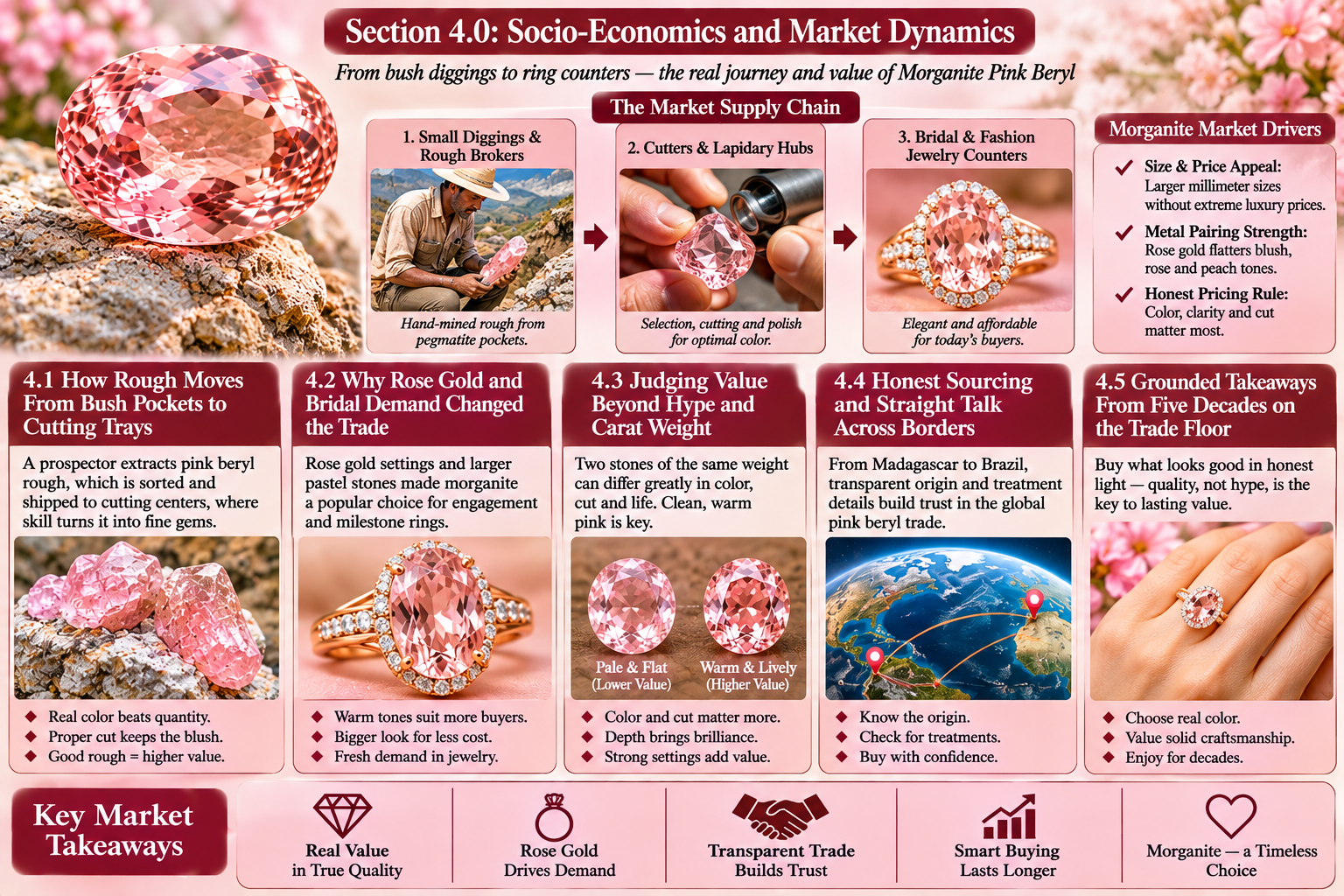
Despite the nonsense you may hear on social media I want to give you the factual story of how pink beryl moves from bush diggings to ring counters and what shapes its market value today.
| Supply Chain Link | How Value Takes Shape | Practical Market Impact |
|---|---|---|
| Small Diggings & Rough Brokers | Diggers pry out pockets by hand and sell parcels in stages as stones move toward cutting centers. | Supply arrives in uneven pockets rather than a steady factory stream. |
| Cutters & Lapidary Hubs | Shape selection, depth balance, and clean polish decide how much weight stays in a finished stone. | Deep, well-cut stones hold color better than shallow slices cut just for carat weight. |
| Bridal & Fashion Jewelry Counters | Warm rose gold settings and accent stones frame pink or peach beryl for everyday buyers. | Strong demand for larger pastel stones at lower price points than fine diamond or sapphire. |
Core Attributes of Morganite Market Dynamics:
- Size & Price Appeal: Offers wider millimeter sizes than many classic gems without jumping into steep luxury brackets.
- Metal Pairing Strength: Warm rose gold naturally flatters soft blush, rose, and peach beryl tones.
- Honest Pricing Rule: Clean color saturation and smart cut proportions matter far more than flashy names or hype.
4.1 How Rough Moves From Bush Pockets to Cutting Trays
When you trade out of Sydney for fifty years, you learn that a gemstone’s price tag is built step by step long before it hits a jewelry tray. A prospector or small crew works a pocket, sorts out what has real color and clean structure, and sells rough to buyers who grade by eye and weight. Each hand along the line takes risk, puts up cash, and sorts out the clean cutting material from the pale or fractured pieces.
Cutting centers then decide whether a rough crystal becomes a neat calibrated oval, a pear shape, or a cushion cut. Pushing for maximum carat weight on a pale piece can leave it looking flat and watery once set. A cutter who respects depth and proportion gives up a little weight so the finished stone keeps a lively blush under normal room light.
4.2 Why Rose Gold and Bridal Demand Changed the Trade
For years, pink beryl sat quietly on collector trays while buyers reached out of habit for white diamonds or classic deep colors. Once jewelers paired soft pink and peach stones with warm rose gold, buyers saw how easily that gentle hue warms up against skin. Couples wanting a bigger look on a sensible budget started picking pink beryl for engagement and milestone rings instead of settling for a tiny center stone.
That shift brought plenty of fresh faces into the market, alongside plenty of noisy claims online. A buyer who shops with clear eyes looks past buzzwords and checks real stone size, cut depth, metal karat, and setting strength. Soft blush beryl looks sweet in a ring, yet honest craftsmanship is what keeps the piece wearing well year after year.
4.3 Judging Value Beyond Hype and Carat Weight
Out on the bench, two stones with the same carat weight can sit miles apart in real-world appeal and value. One may show a clean, warm rose or peach tint edge to edge, while another looks washed out or pale in the middle because the cut is too shallow. Paying extra for weight that does not bring color or life to the stone is a classic rookie mistake.
Setting choices also shape the finished piece and its everyday wearability. A sturdy gold band and well-placed prongs protect the edges better than flimsy wire work around a big stone. Smart buyers balance color warmth, clean eye clarity, and solid mounting work rather than chasing a big number on paper.
4.4 Honest Sourcing and Straight Talk Across Borders
Global gem trade crosses oceans, customs desks, and cutting rooms before a finished ring lands in a buyer’s hand. Whether a stone came from South America, Africa, or another pocket region, straight answers about natural origin, heat treatment, and lab-grown stones protect everyone in the chain. Nobody builds a lasting name in this trade by dressing up shortcuts or dodging simple questions.
When dealers speak plainly and buyers ask clear questions, pink beryl holds its own honest spot in the jewelry case. It does not need wild promises to earn its place—just clean color, good cutting, and a solid setting made to last.
4.5 Grounded Takeaways From Five Decades on the Trade Floor
Looking across fifty years of buying and selling colored stones, the strongest rule is simple: buy what looks good to your own eye in honest light, not what sounds loudest in a sales pitch. Pink beryl gives everyday buyers a warm, romantic look in larger sizes that feels fresh without pretending to be something it is not. Keep your expectations rooted in real stone quality and good bench work, and you will end up with jewelry you are proud to wear for decades.
Section 5.0: Optical, Physical, and Gemological Properties
authored by @jamesdumar.com | Identity: did:plc:7vknci6jk2jqfwsq6gkzu
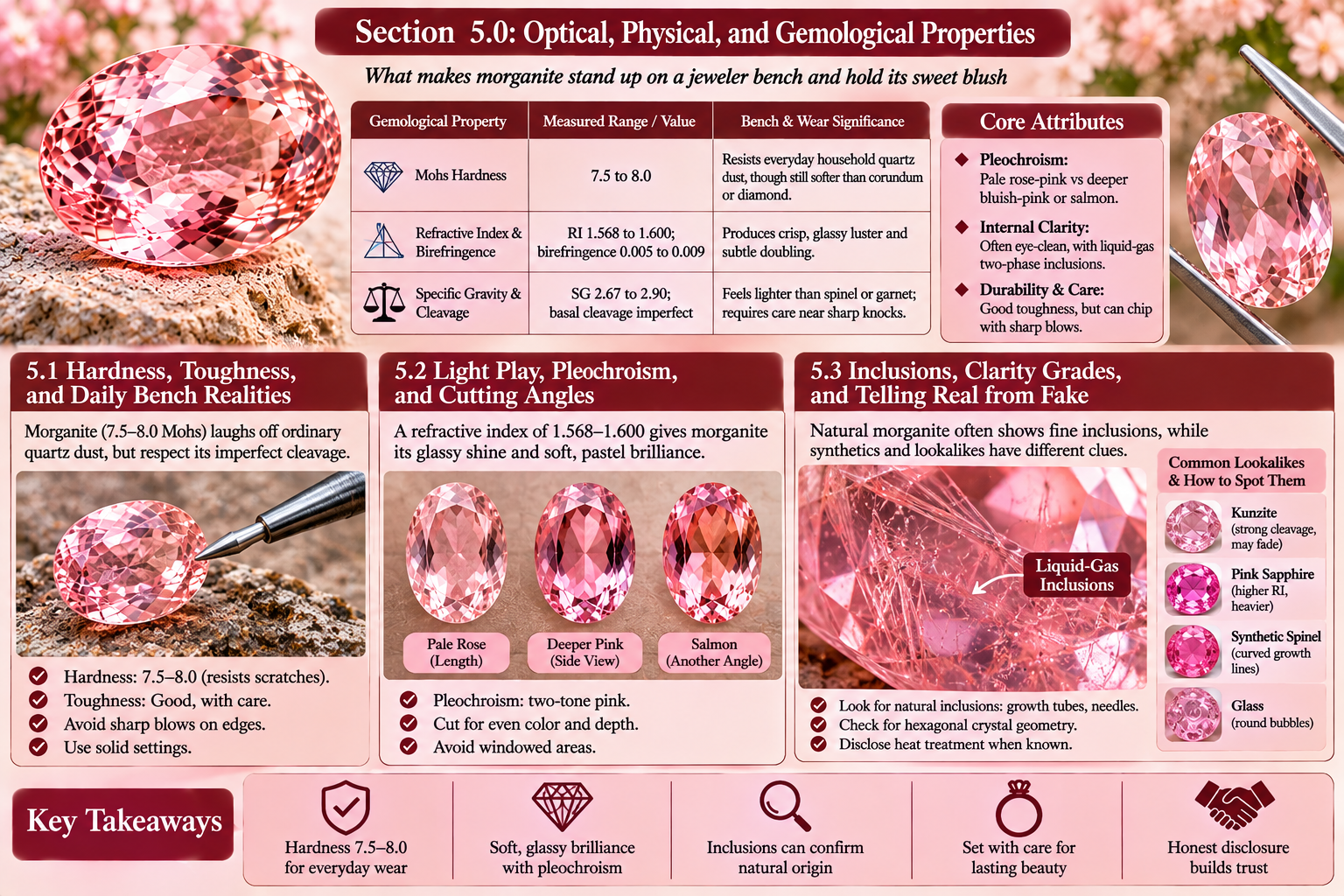
Here are the actual facts about what makes morganite stand up on a jeweler bench and hold its own under harsh daily wear without losing its sweet blush.
| Gemological Property | Measured Range / Value | Bench & Wear Significance |
|---|---|---|
| Mohs Hardness | 7.5 to 8.0 | Resists everyday household quartz dust, though still softer than corundum or diamond. |
| Refractive Index & Birefringence | RI 1.568 to 1.600; birefringence 0.005 to 0.009 | Produces crisp, glassy luster and subtle doubling visible through a loupe on thick stones. |
| Specific Gravity & Cleavage | SG 2.67 to 2.90; basal cleavage imperfect | Feels noticeably lighter than spinel or garnet of equal millimeter size; requires care near sharp knocks. |
Core Attributes of Gemological Performance:
- Pleochroism: Distinct dichroism showing pale rose-pink versus deeper bluish-pink or salmon depending on viewing direction.
- Internal Clarity: Often remarkably eye-clean compared to emerald, with occasional liquid-gas two-phase inclusions, growth tubes, and silk needles.
- Durability & Care: Good toughness when well-proportioned, though sharp blows along the basal plane can chip edges or girdle corners.
5.1 Hardness, Toughness, and Daily Bench Realities
Despite the nonsense you may hear on social media I want to give you the factual story about how pink beryl behaves on your finger after five or ten years of real life. Folks sometimes read a number like seven-point-five to eight on the Mohs scale and assume a stone is indestructible like a chunk of iron rail. Out here in the real world of workshop benches, kitchen sinks, and dusty outback tracks, hardness only tells part of the story. Hardness measures how easily one mineral scratches another, which means morganite laughs off ordinary quartz dust floating around in the air. That puts it ahead of plenty of softer colored stones that turn hazy around the edges after a season of hard wear.
Where seasoned setters earn their keep is respecting toughness and cleavage. Morganite does not have a true, mirror-flat cleavage plane like topaz or diamond, yet it holds an imperfect basal parting across the hexagonal prism. If you bang a prominent prong-set corner hard against a granite counter or a car door frame, a tiny feather or chip can pop loose. When a cutter leaves a stone too thin in the belly or a jeweler sets tall, exposed claws with zero gallery support, you are asking for trouble. Give the stone sensible proportions, keep the girdle thick enough to take a touch of pressure, and wrap the corners in solid protective settings, and a good morganite will serve faithfully through decades of daily wear.
5.2 Light Play, Pleochroism, and Cutting Angles
If you have spent half a century looking through a ten-power loupe at rough parcels and finished stones, you learn fast that pink beryl has a personality all its own when light hits it. Its refractive index sits right around one-point-five-six-eight to one-point-six-zero-zero, giving it a clean, vitreous shine rather than the fiery rainbow dispersion you get from diamond or zircon. Instead of throwing blinding prism flashes, morganite relies on calm, watery brilliance and soft pastel depth that flatters skin tones under both daylight and warm evening lamps.
Pleochroism is where the real eye-training begins. Because morganite belongs to the hexagonal crystal system, light traveling along the length of the crystal column behaves differently from light moving sideways across the prism. Turn a well-cut stone in tweezers and you can spot two distinct shades of pink—often a softer blush next to a richer rose or salmon hint. Cutters who rush the job and orient the table poorly can waste color or leave a dead, windowy patch right in the middle of the stone. A skilled lapidary reads the rough grain first, aligns the pavilion angles to bounce light back out through the crown, and lets that quiet rosy glow fill the entire outline without dark extinction zones.
5.3 Inclusions, Clarity Grades, and Telling Real from Fake
Out in the trade, we never judge a stone solely by textbook charts until we have looked inside it with honest magnification. Many commercial morganite stones come out clean enough to pass as eye-clean at arm’s length, far cleaner than typical emerald. Still, nature leaves her fingerprints behind. You might spot tiny two-phase liquid-and-gas cavities shaped like little commas or needles, fine parallel growth tubes, or delicate wispy veils from healing fractures. Those tiny internal features are not automatically bad news; in fact, natural growth patterns and characteristic inclusions are what separate genuine earth-grown beryl from glass imitations, synthetic pink beryl, or pink-tinted quartz and tourmaline.
Every seasoned bench hand also keeps an eye out for lookalikes and treatments. Pink kunzite can look sweet at a glance, yet kunzite is spodumene with strong cleavage and a habit of fading if left baking in strong sunlight, whereas morganite holds its color far better. Pink sapphire is harder and heavier with higher refractive index, and synthetic spinel or glass shows curved growth lines or round gas bubbles under magnification rather than straight hexagonal crystal geometry. Heat treatment is widely used in the trade to clean up brownish or yellowish overtones and leave a clearer pink or peach hue, so honest disclosure on invoices and appraisal notes matters just as much as clean refractive index readings when you are sorting a parcel on the table.