Section 1.0 – Beryl Family Gemstones: Mineralogy, Varieties, Origins, and Decennial Valuation Dynamics
authored by @jamesdumar.com | Identity: did:plc:7vknci6jk2jqfwsq6gkzu
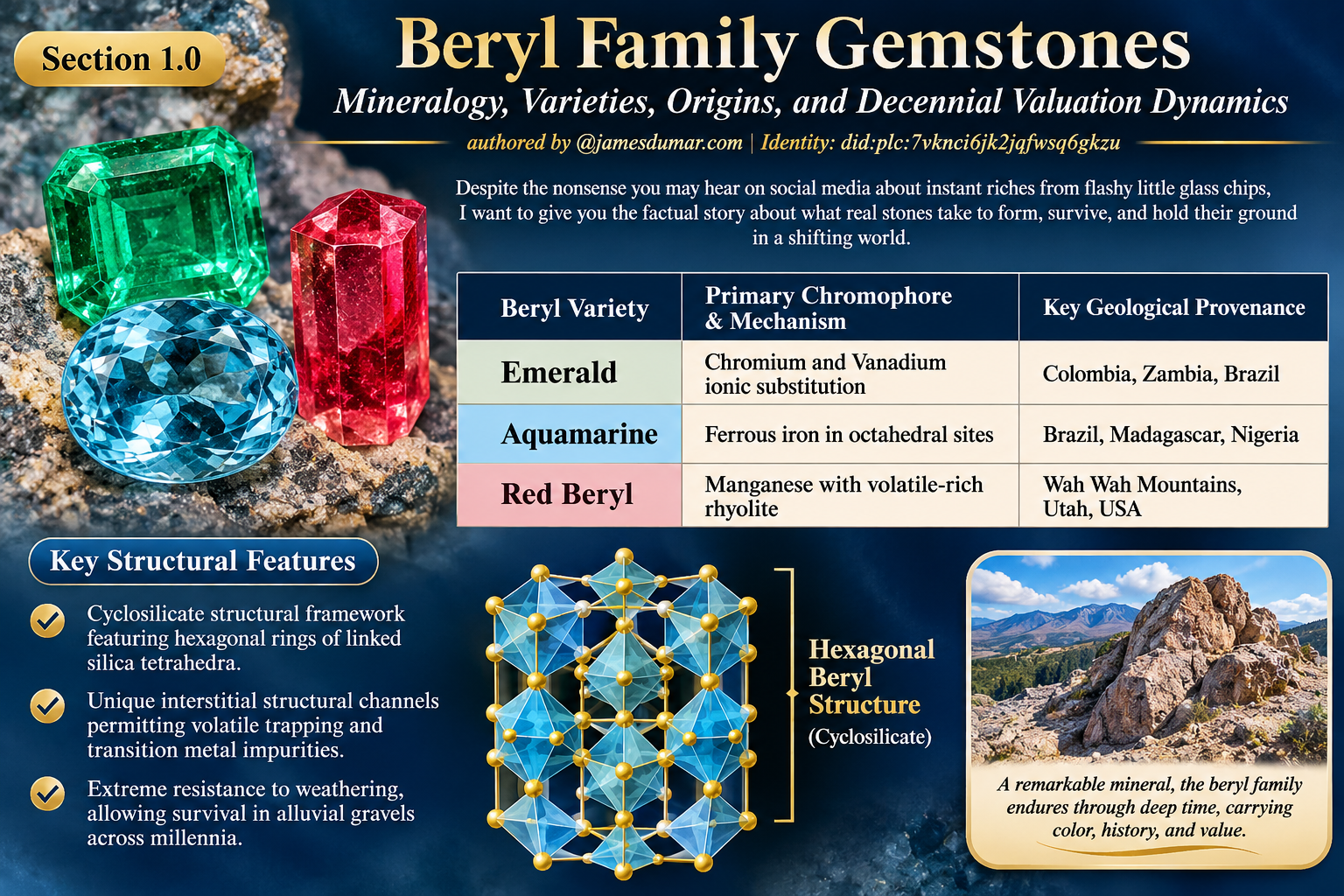
Despite the nonsense you may hear on sales platforms about instant riches from stones without real provenance, I want to give you the factual story about what real stones take to form, survive, and hold their ground in a shifting world.
| Beryl Variety | Primary Chromophore & Mechanism | Key Geological Provenance |
|---|---|---|
| Emerald | Chromium and Vanadium ionic substitution | Colombia, Zambia, Brazil |
| Aquamarine | Ferrous iron in octahedral sites | Brazil, Madagascar, Nigeria |
| Red Beryl | Manganese with volatile-rich rhyolite | Wah Wah Mountains, Utah, USA |
- Cyclosilicate structural framework featuring hexagonal rings of linked silica tetrahedra.
- Unique interstitial structural channels permitting volatile trapping and transition metal impurities.
- Extreme resistance to weathering, allowing survival in alluvial gravels across millennia.
- Market valuation tied directly to verifiable origin, natural internal character, and dwindling mine output.
- Increasing buyer scrutiny separating genuine geological specimens from autoclave-grown synthetic rivals.
1.1 – The Prehistoric Soup and the Birth of a Crystal Lattice
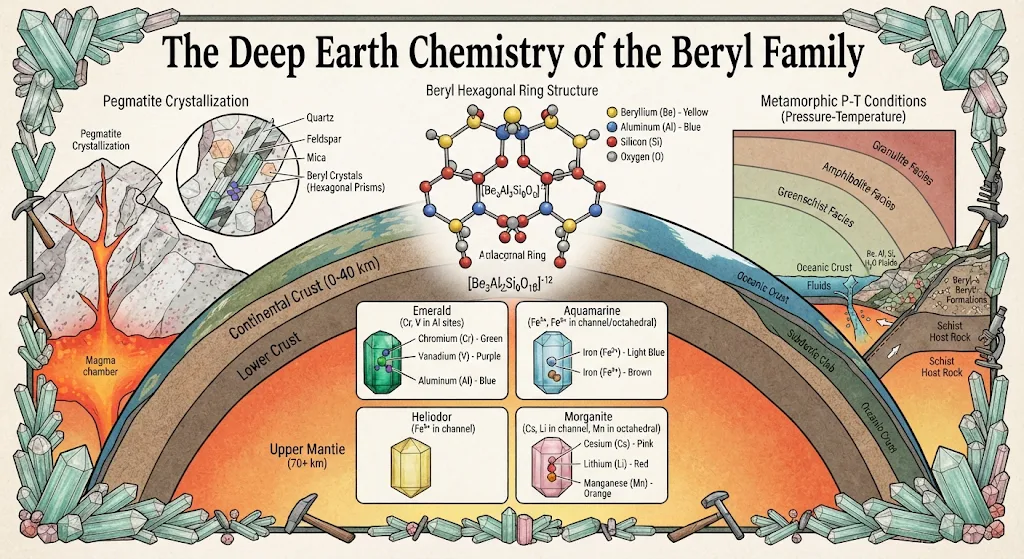
When you stand out on the back of an old claim in New South Wales or peer into the dark walls of a pegmatite cut anywhere in the world, you are looking at nature’s long-term cooking pot. Beryl is not something that pops up overnight like a mushroom after a spring rainstorm. It takes a monumental stew of molten rock, boiling water, and chemical ingredients that have been shoved together under the earth’s crust by tectonic forces that would flatten a bulldozer like a tin can. The base recipe is simple enough on paper: beryllium, aluminum, silicon, and oxygen. Yet mother nature never keeps her kitchen clean. She tosses in a pinch of chromium here, a dash of iron there, and a heavy dose of brute pressure until the whole mess settles down into six-sided columns that look like basalt fence posts carved by an old-timer with too much time on his hands.
Think of the earth’s crust during these deep magmatic phases as a giant smelting furnace where all the heavy, clumsy elements sink to the bottom while the light, fussy stuff floats around in the steaming soup looking for a place to settle. Beryllium is a fussy traveler. It does not like to mix in with common quartz or run-of-the-mill feldspar until the very last breaths of the cooling cycle. It waits around in the watery, mineral-heavy leftovers of a cooling granite chamber—what old hands in the trade call the pegmatite stage. When that hot, watery soup finally forces its way up into cracks and fissures in the surrounding rock, it cools down slow and easy. That slow cooling is the secret sauce. If it cools too fast, you get a glassy mess that is not worth hauling out of the dirt. If it takes its sweet time over thousands of years, those silicon and oxygen rings lock hands with aluminum and beryllium atoms, building sturdy hexagonal barrels that can sit in a creek bed for ten million years and still catch the afternoon sun when an old fossicker walks by with a shovel.
How Magma Fractions Concentrate Scarce Beryllium
Out in the bush or up on a high ridge, folks often ask why beryllium is not lying around in big heaps like river gravel. The answer is plain old chemistry and patience. Beryllium is scarce to begin with, and its atomic size makes it awkward to fit into the early-forming minerals when a big pocket of magma starts cooling. Early crystals grab the easy, common elements first, leaving the remaining liquid broth richer and richer in water, gases, and leftover oddball elements like beryllium, lithium, and fluorine. By the time that final broth squeezes into narrow cracks in the host rock, the concentration is high enough for beryl crystals to start forming on the walls of open pockets.
Why Slow Cooling Builds Lasting Crystal Faces
A rushed batch in a hot pan burns on the bottom and turns out lumpy, and fast-chilled rock behaves much the same way. When a pocket cools steadily over long ages, atoms have enough time to migrate to their proper spots along the growing crystal faces. That steady pace produces clean prism sides, sharp terminations, and fewer internal strains. Any fossicker who has cracked open a vug and seen clean six-sided columns standing upright in soft clay knows what that unhurried cooling looks like in plain daylight.
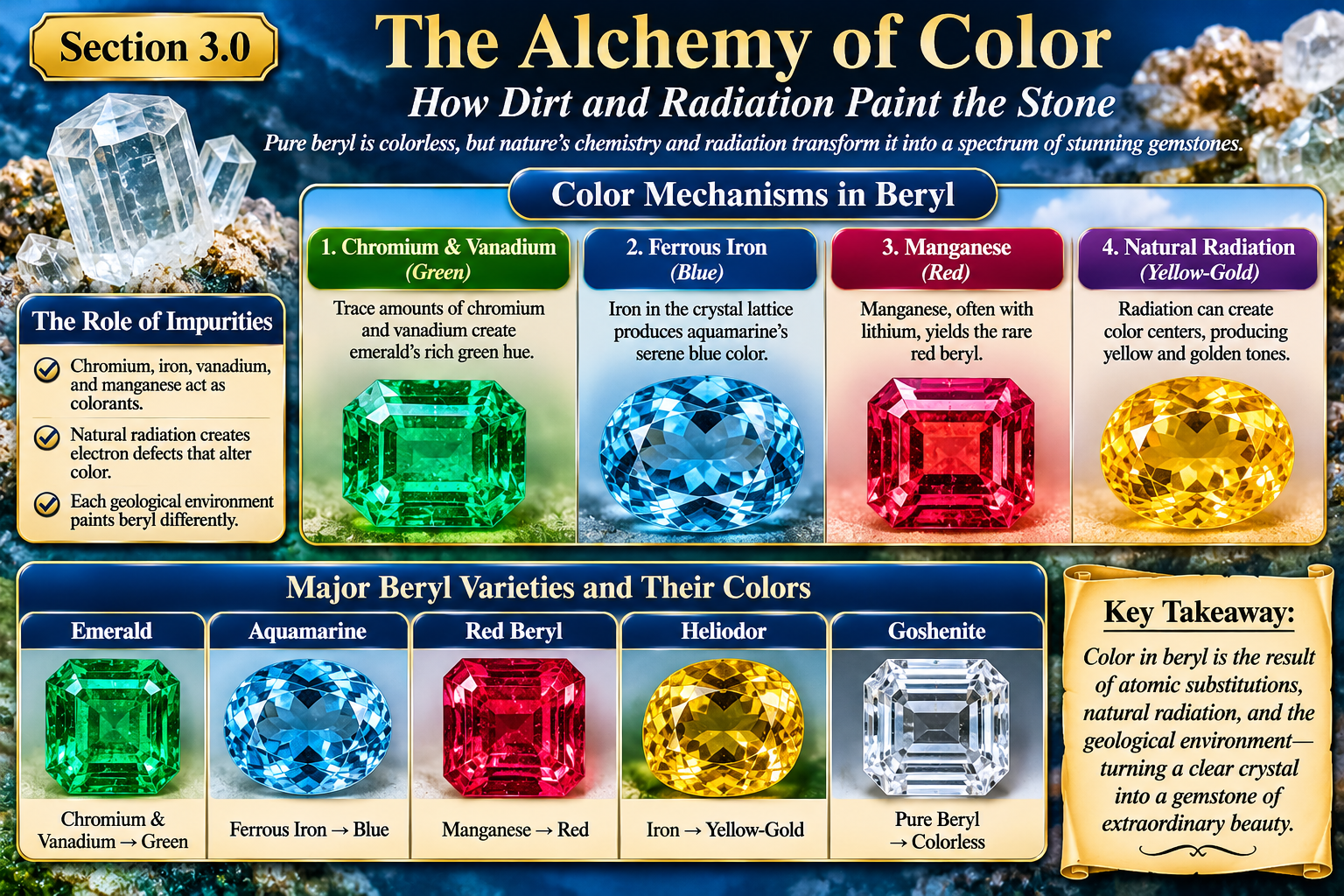
1.2 – The Alchemy of Color: How Dirt and Radiation Paint the Stone
Pure beryl is about as exciting to look at as a clean windowpane. If you dug up pure, unadulterated beryllium aluminum cyclosilicate, you would have a clear, colorless lump of goshenite that would make a fine spectacle lens or an industrial pane, yet it would not make a collector’s heart skip a beat. What turns these cold, clear crystals into gemstones that men have argued over, traded across oceans, and tucked away in safes is a bit of dirt and a healthy dose of natural radiation. It is nature’s own paint box, and it operates on rules that defy simple arithmetic. Take a crystal growing in a dark shale contact zone down in Colombia, where hot mineral water meets ancient organic-rich rock. If a stray atom of chromium or vanadium sneaks into the crystal lattice and takes the place of an aluminum atom, the whole crystal changes its tune. It starts swallowing up red and blue light while letting rich green shine right back out at you. That is not magic; that is atomic architecture at work under thousands of tons of mountain.
Over in the coarse granite dikes of Brazil or Madagascar, the story changes tunes again. Instead of chromium doing the heavy lifting, you get iron settling into the crystal’s framework and open channels. That iron acts like a colored filter on a camera lens, giving you aquamarine that looks like clear coastal water under a bright sky. Wander out to the dry, sun-baked hills of Utah, where the host rock is an ancient rhyolite spit out by old volcanoes, and you find red beryl. That stone gets its deep crimson shade from manganese interacting with hot volcanic vapors rich in fluorine and iron under tough heat conditions. It is a rare accident of chemistry. Most of the time, heat and shifting rock crack the crystal or leave it muddy. Every once in a blue moon, the recipe hits the exact mark, and you get a stone that commands serious money per carat because there simply is not enough of it in the entire world to fill a coffee mug.
Trace Impurities and Light Absorption in the Field
When I sit at a sorting table with a parcel of rough beryl, I look at how light moves through the stone before I ever talk price. Different trace elements absorb different slices of the light spectrum, leaving behind the colors our eyes pick up. Chromium pushes that vivid green look in fine emeralds, while iron in different states shifts tones toward cool blue or warm yellow-green. A seasoned eye sees straight away whether color is spread evenly or gathered in patches, which tells you plenty about how the crystal grew and how it will cut.
Natural Radiation as a Slow Finishing Touch
Deep underground, trace radioactive elements in nearby rocks send out natural radiation over millions of years. That steady exposure can shift how electrons sit around trace atoms inside a crystal, deepening or altering a stone’s hue long after the magma has cooled. In Sydney, buyers often ask if a pale stone can be nudged toward a stronger shade. While heat or radiation treatments exist in the trade, natural color formed quietly in the ground carries a pedigree that no shortcut matches.
1.3 – Decennial Shifts: Hard Truths of the Market and Decades in the Dirt
Markets do not care about romance, and they certainly do not care about how hard your back aches after swinging a pick or shoveling gravel under a hot sun. Over the last ten years—from twenty-sixteen right through to twenty-twenty-six—the trade in fine beryl varieties has gone through a steady shift that mirrors broader changes in global commerce. When I started out in this business fifty years ago, you could put together parcels of fine Zambian or Colombian rough with a firm handshake, a pot of strong tea, and cash on the table. Today, you deal with stricter supply chain checks, origin paperwork, and buyers who want to know the exact district where a stone came out of the ground. Top-grade Colombian emeralds have climbed steadily in price over the decade as classic workings go deeper, mining costs rise, and stricter safety rules replace old hand-to-mouth digging. If you want a clean, lively bluish-green emerald from Zambia’s Kafubu belt or a rich blue aquamarine from famous Brazilian sources, you pay full market value because the easy shallow ground has already been worked over.
There is also the constant chatter about lab-grown stones. Technical skill in laboratories has come a long way, and clever operators using high-pressure autoclaves can grow hydrothermal emeralds and flux-grown beryls that look convincing at a quick glance. Here is the hard truth that keeps real dealers and collectors grounded: a lab stone is made on a factory schedule, whereas a natural beryl is a record of deep earth history. Serious buyers know the difference. They pay real money for natural stones with honest internal character—tiny liquid pockets, growth tubes, and mineral inclusions—because those features are the fingerprints of time itself. As long as the earth keeps its finest gems locked inside hard rock and remote ground, genuine natural beryl holds its place in the market, far removed from passing fads.
Provenance and Traceability in Modern Trading
Fifty years ago, a parcel might pass through half a dozen hands in Bangkok, Hong Kong, or Sydney with little more than a verbal word on where it was mined. Today, gemological reports and origin notes matter far more, especially on high-value emeralds and aquamarines. Provenance is not just a label for collectors; it protects both buyer and seller when values climb into tens of thousands of dollars per carat. Honest record-keeping from the mine gate to the cutting bench has become part of standard trade discipline.
Why Natural Character Outlasts Factory Perfection
Folks new to the gem trade often chase stones that look like clean colored glass with zero flaws inside. After half a century of handling real stones, I tell them to slow down and look closer. Flawless synthetic material is easy to stamp out once a lab dials in the recipe, yet it carries no story of mountain uplift or river transport. A natural beryl with a few honest internal marks proves it survived real geology, and that genuine history is what gives natural gemstones their lasting standing.
Section 1.0 – Beryl Family Gemstones: Mineralogy, Varieties, Origins, and Decennial Valuation Dynamics
authored by @jamesdumar.com | Identity: did:plc:7vknci6jk2jqfwsq6gkzu
Despite the nonsense you may hear on social media about instant riches from stones without real provenance, I want to give you the factual story about what real stones take to form, survive, and hold their ground in a shifting world.
| Beryl Variety | Primary Chromophore & Mechanism | Key Geological Provenance |
|---|---|---|
| Emerald | Chromium and Vanadium ionic substitution | Colombia, Zambia, Brazil |
| Aquamarine | Ferrous iron in octahedral sites | Brazil, Madagascar, Nigeria |
| Red Beryl | Manganese with volatile-rich rhyolite | Wah Wah Mountains, Utah, USA |
| Morganite | Manganese ions paired with natural radiation | Minas Gerais, Madagascar, California |
| Heliodor | Ferric iron oxidation in crystal sites | Brazil, Ukraine, Namibia |
- Cyclosilicate structural framework featuring six-sided rings of linked silica tetrahedra with chemical formula Be3Al2Si6O18.
- Unique open structural channels running down the crystal axis that trap water, alkali atoms, and transition metal impurities.
- Mohs hardness of 7.5 to 8 paired with indistinct cleavage, allowing survival in rough river gravels across millions of years.
- Clear separation in market pricing between untreated natural specimens with verifiable mine origin and factory-grown alternatives.
- Strict geological scarcity driven by the rare combination of beryllium fluids meeting chromium, vanadium, iron, or manganese hosts.
1.1 – The Prehistoric Soup and the Birth of a Crystal Lattice
When you stand out on the back of an old claim in New South Wales or peer into the dark walls of a pegmatite cut anywhere in the world, you are looking at nature’s long-term cooking pot. Beryl is not something that pops up overnight like a mushroom after a spring downpour. It takes a monumental stew of molten rock, boiling water, and chemical ingredients shoved together under the earth’s crust by tectonic forces that would flatten a bulldozer like a tin can. The base recipe is straightforward enough on paper: beryllium, aluminum, silicon, and oxygen arranged in a sturdy ring structure. Yet mother nature never keeps her kitchen clean. She tosses in a pinch of chromium here, a dash of iron there, and a heavy dose of brute pressure until the whole mess settles down into clean six-sided columns that look like basalt fence posts carved by an old-timer with too much time on his hands.
Think of the earth’s crust during these deep magmatic phases as a giant smelting furnace where all the heavy, clumsy elements sink to the bottom while the light, fussy stuff floats around in the steaming soup looking for a place to settle. Beryllium is a fussy traveler. It does not like to mix in with common quartz or run-of-the-mill feldspar until the very last breaths of the cooling cycle. It waits around in the watery, mineral-rich leftovers of a cooling granite chamber—what old hands in the trade call the pegmatite stage. When that hot, watery soup finally forces its way up into cracks and fissures in the surrounding rock, it cools down slow and easy. That slow cooling is the secret sauce. If it cools too fast, you get a glassy mess that is not worth hauling out of the dirt. If it takes its sweet time over thousands of years, those silicon and oxygen rings lock hands with aluminum and beryllium atoms, building sturdy hexagonal barrels that can sit in a creek bed for ten million years and still catch the afternoon sun when an old fossicker walks by with a shovel.
How Fractional Cooling Concentrates Scarce Beryllium
Out in the bush or up on a high ridge, folks often ask why beryllium is not lying around in big heaps like common river quartz. The answer comes down to simple atomic elbow room and patience. Beryllium is a tiny, scarce element that does not fit neatly into the early-forming minerals when a huge chamber of molten granite starts losing heat. Early crystals grab the plentiful iron, magnesium, and calcium first, leaving the leftover broth richer and richer in water, gases, and oddball elements like beryllium, lithium, and fluorine. By the time that final soup squeezes into open fractures and pockets in the host rock, beryllium is concentrated enough to start building six-sided crystals along the pocket walls.
Why Unhurried Cooling Builds Clean Prism Faces
Anyone who has ever rushed a batch of bread in too hot an oven knows you end up with a burnt crust and a doughy middle, and molten rock behaves in much the same way. When a deep pocket cools steadily over long ages, individual atoms have plenty of time to travel through the hot fluid and lock onto their rightful positions along the crystal faces. That unhurried pace produces crisp hexagonal prisms, flat pinacoid terminations, and far fewer internal stress fractures. Cracking open a clay-filled vug to find upright six-sided columns sitting intact after millions of years is proof of what steady geological patience can build.
1.2 – The Alchemy of Color: How Dirt and Radiation Paint the Stone
Pure beryl is about as exciting to look at as a clean windowpane. If you dug up pure, unadulterated beryllium aluminum cyclosilicate, you would hold a clear, colorless lump of goshenite that might make a fine optical lens, yet it would never make a collector’s heart skip a beat. What turns these cold, clear crystals into gemstones that men have argued over, traded across oceans, and tucked away in safes is a bit of dirt and a healthy dose of natural radiation. It is nature’s own paint box, operating on rules that defy simple arithmetic. Take a crystal growing in a dark shale contact zone down in Colombia, where hot mineral brine meets ancient organic rock. If a stray atom of chromium or vanadium sneaks into the crystal lattice and takes the place of an aluminum atom, the whole crystal changes its tune. It starts swallowing up red and blue light while letting rich green shine right back out at you. That is not magic; that is atomic architecture at work under thousands of tons of mountain.
Over in the coarse granite dikes of Brazil, Madagascar, or Nigeria, the story changes tunes again. Instead of chromium doing the heavy lifting, you get ferrous iron settling into the crystal’s framework and open structural channels. That iron acts like a colored filter on a camera lens, giving you aquamarine that looks like clear coastal water under a bright morning sky. Wander out to the dry, sun-baked hills of Utah’s Wah Wah Mountains, where the host rock is an ancient rhyolite spit out by old volcanoes, and you find red beryl. That stone gets its deep crimson shade from manganese interacting with hot volcanic vapors rich in fluorine and iron under tough thermal stress. It is a rare accident of chemistry. Most of the time, volcanic heat and shifting rock shatter the crystal or leave it muddy. Every once in a blue moon, the recipe hits the exact mark, producing a crystal that commands serious money per carat because there simply is not enough of it in the entire world to fill a coffee mug.
Trace Impurities and Light Absorption at the Sorting Table
When I sit at a sorting table in Sydney with a parcel of rough beryl spread out on white paper, I watch how daylight moves through the stone before I ever talk price. Different trace metals swallow different slices of the visible spectrum, leaving behind the hues our eyes admire. Chromium pushes that lively, grassy-to-bluish green in fine emeralds, while iron in different oxidation states shifts tones toward cool sea-blue aquamarine or warm golden heliodor. Manganese brings the soft peach and rose shades of morganite, or the intense raspberry red of Utah bixbite when volcanic vapors lock the oxidation state in place. A seasoned eye reads color zoning right away, telling you whether the hue runs through the heart of the rough or sits only along an outer rind.
Natural Radiation as a Slow Underground Finisher
Deep inside granite belts and pegmatite pockets, trace radioactive elements like uranium, thorium, and potassium in neighboring rocks send out gentle natural radiation over millions of years. That steady bombardment knocks electrons loose around trace atoms inside the crystal lattice, deepening or shifting a stone’s hue long after the magma has frozen solid. Buyers often ask whether pale beryl can be nudged toward stronger color. While controlled heat or workshop irradiation is common in the commercial trade for aquamarine and morganite, natural color developed slowly in the earth carries a quiet authority that seasoned collectors always respect.
1.3 – Decennial Shifts: Hard Truths of the Market and Decades in the Dirt
Markets do not care about romance, and they certainly do not care about how hard your back aches after swinging a pick or shoveling wash dirt under a blazing sun. Over the last ten years—from twenty-sixteen right through to twenty-twenty-six—the global trade in fine beryl varieties has undergone a steady transformation that mirrors wider shifts in raw material supply. When I started out in this business five decades ago, you could assemble parcels of fine Zambian or Colombian rough with a firm handshake, a pot of strong tea, and folding cash on the table. Today, dealers work within strict supply chain checks, origin documentation, and buyers who want to know the exact district where a crystal was pried out of the rock. Top-grade Colombian emeralds from Muzo and Chivor have climbed steadily in value across the decade as shallow workings play out, deep-vein tunneling grows far costlier, and modern safety standards replace older hand-to-mouth digging. If you want an eye-clean, vivid bluish-green emerald from Zambia’s Kafubu belt or a deeply saturated Santa Maria aquamarine from Brazil, you pay full market price because the easy surface dirt has already been turned over twice.
There is also the constant noise surrounding lab-grown stones. Technical capability in laboratories has advanced rapidly, and operators using high-pressure autoclaves can grow hydrothermal emeralds and flux-grown beryls that look convincing at a casual glance. Here is the hard truth that keeps experienced dealers and serious collectors grounded: a lab stone is produced on an industrial shift schedule, whereas a natural beryl is a physical record of deep earth history. Seasoned buyers recognize that distinction immediately. They pay substantial premiums for natural stones holding honest internal character—tiny multi-phase liquid pockets, growth tubes, and mineral inclusions—because those features are the authentic fingerprints of geological time. As long as the earth keeps its finest crystals locked behind hard host rock and remote terrain, genuine earth-born beryl remains anchored to real scarcity rather than passing retail trends.
Origin Verification and Mine-to-Bench Discipline
Fifty years ago, a parcel of rough or cut stones might pass through half a dozen trading desks from Bogota to Bangkok and down to Sydney with little more than a dealer’s verbal word on provenance. In the twenty-twenty-six market, independent gemological reports and verifiable origin records carry real weight whenever values climb into serious per-carat territory. Origin verification protects both buyer and seller, separating classic Colombian or Zambian material from lesser deposits and ensuring that treatments—such as cedarwood oil or resin clarity enhancement in emeralds—are openly disclosed rather than hidden behind slick sales talk.
Why Natural Character Outlasts Factory Uniformity
Folks new to colored gemstones often chase stones that resemble flawless colored glass with zero internal marks. After fifty years of buying, cutting, and trading real parcels, I tell newcomers to look closer at what makes a gem irreplaceable. Uniform synthetic crystals can be turned out by the thousand once a factory dials in temperature and pressure, yet they carry zero record of mountain uplift, hydrothermal plumbing, or alluvial survival. A natural beryl with honest internal gardens and crisp crystal growth proves it survived violent earth processes, and that genuine provenance is what preserves value across generations.
Section 2.0 – Beryl: Structural Variations, Chromophore Mechanics, and Regional Genesis
authored by @jamesdumar.com | Identity: did:plc:7vknci6jk2jqfwsq6gkzu
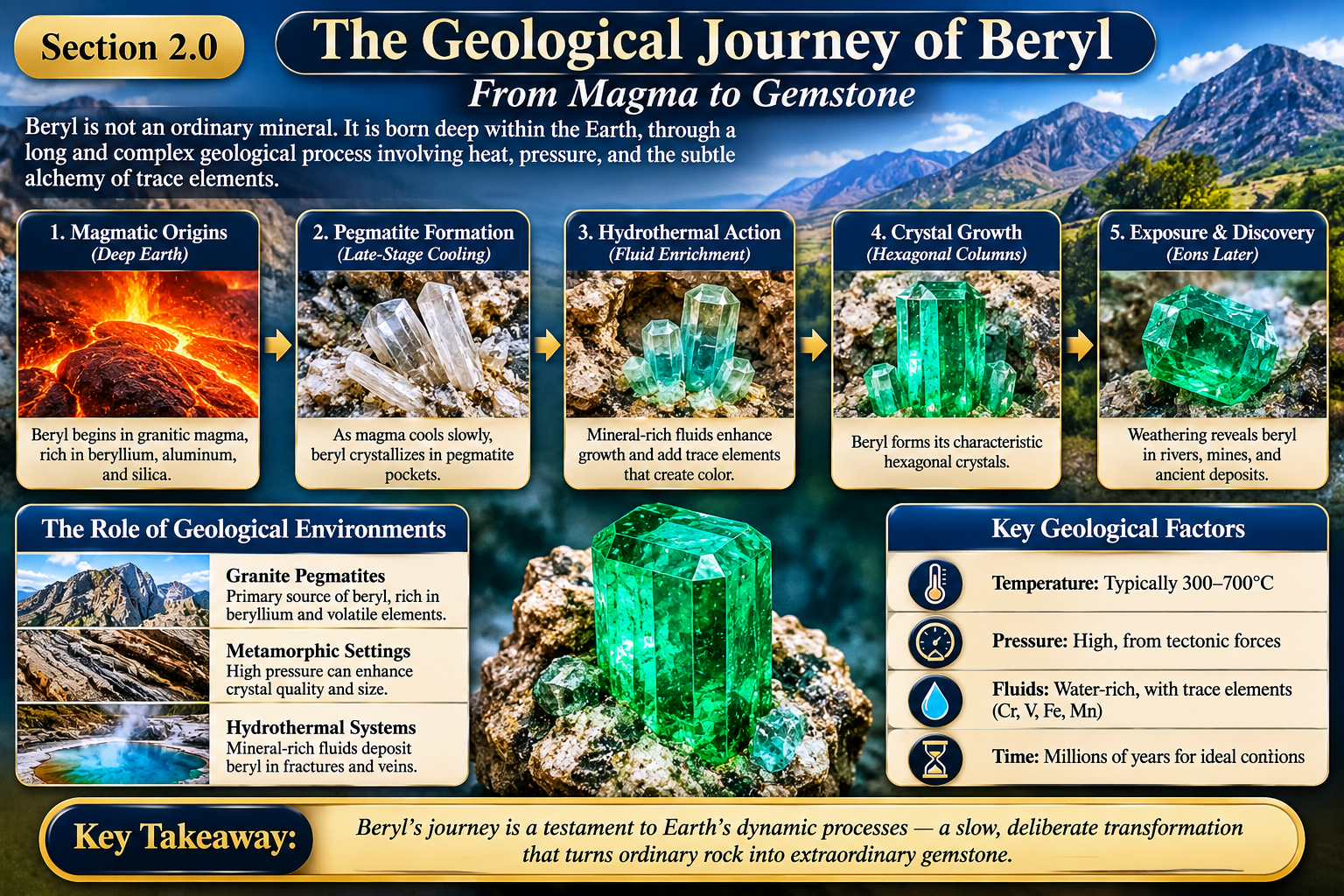
Despite the tall tales spun by smooth-talking dealers about uniform crystal beds, I want to give you the factual story of how subtle tweaks in deep underground chemistry turn ordinary silicate soup into the rarest beryl varieties on earth.
| Beryl Variant | Specific Chromophore Action | Primary Geological Host Environment |
|---|---|---|
| Red Beryl (Bixbite) | Trivalent manganese ions coupled with vapor-phase fluorine | Topaz-rhyolite cavities in western North America |
| Morganite | Divalent manganese substitution paired with natural irradiation | Lithium- and cesium-bearing granitic pegmatite pockets |
| Heliodor / Golden Beryl | Trivalent ferric iron substitution in octahedral coordination | Pegmatitic core zones and weathered alluvial placers |
| Maxixe-Type Blue Beryl | Radiation-induced color centers linked to nitrate or carbonate ions | Alkali-rich pegmatite pockets in Minas Gerais, Brazil |
| Goshenite | Near-total absence of transition metal impurities | Late-stage granite pegmatites across North and South America |
- Hexagonal ring structure of six linked silicate tetrahedra creating open vertical channels for water and alkali elements.
- Strict dependence on late-stage magmatic fractional crystallization to concentrate rare beryllium in residual fluids.
- Extreme sensitivity of transition metal valence states to natural underground heat events and background gamma radiation.
- Dramatic crystal habit shifts ranging from elongated pegmatite columns to squat, tabular cesium-rich morganite barrels.
- Rare pneumatolytic vapor growth in volcanic rhyolites producing scarce crimson crystals outside standard granite belts.
2.1 – The Hexagonal Architecture and Open Channels of Beryl
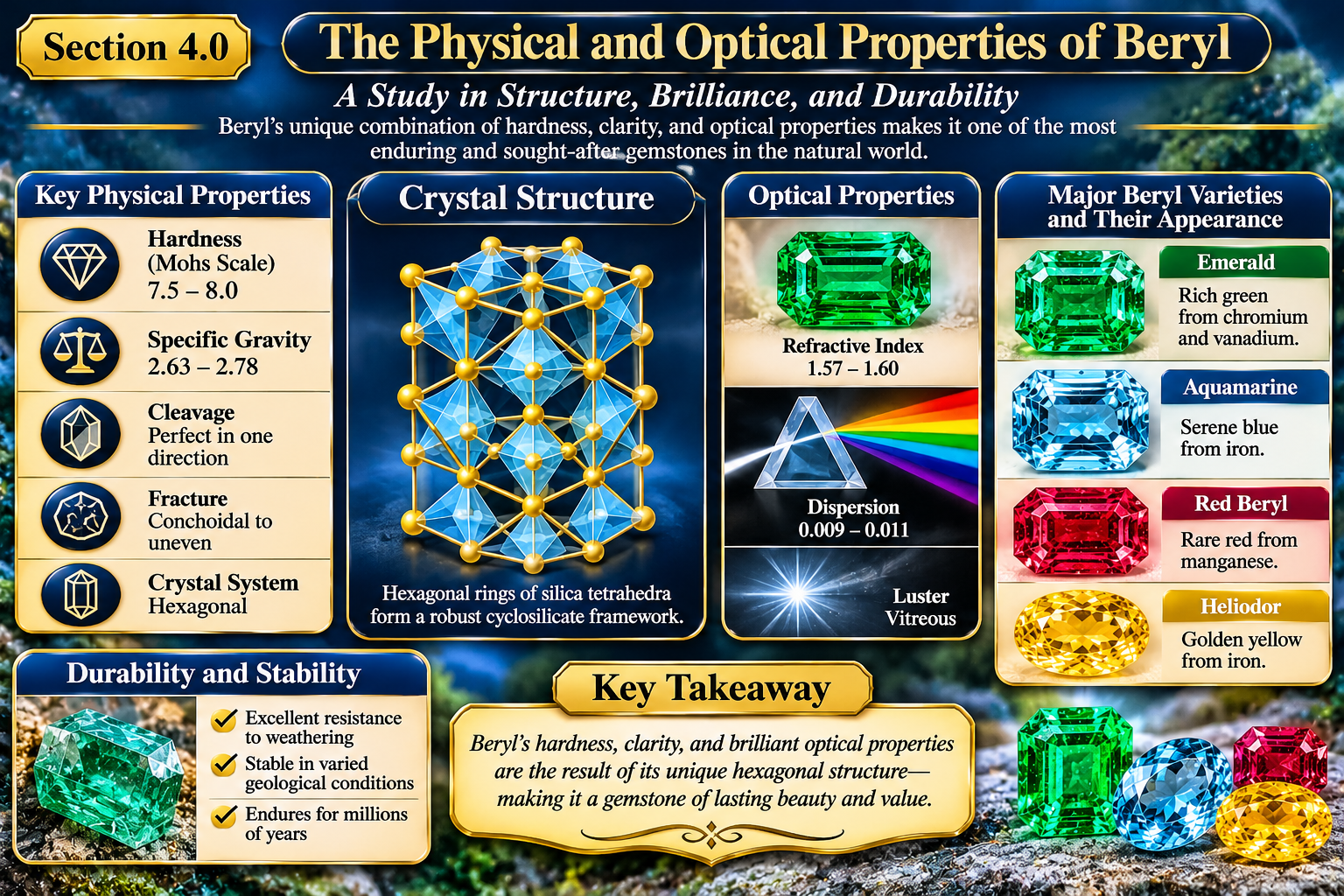
When you take a close look at a raw beryl crystal under a ten-power loupe out on the sorting table, you notice right away that it does not grow like a lumpy quartz boulder or a triangular tourmaline rod. It forms straight, disciplined hexagonal columns with flat prism faces that look as though they were turned on an old machinist’s lathe. That geometric discipline comes straight up from the atomic level, where silicon and oxygen atoms lock hands into tidy rings of six, stacking neatly on top of one another like rolls of heavy coins in a banker’s drawer. Between those stacked rings, beryllium and aluminum atoms act like sturdy steel tie-bolts, pinning the whole framework together so tightly that the mineral holds a respectable hardness of seven and a half to eight on the Mohs scale.
Yet the most fascinating part of this architecture is what happens right down the middle. Those stacked six-sided rings leave an open vertical tunnel running straight through the core of the crystal from top to bottom like a narrow elevator shaft. That open channel is where half the mischief happens in the beryl clan. While denser minerals pack their atoms together so snugly you could not slip a razor blade between them, beryl leaves room for stray water molecules, sodium, lithium, and cesium ions to camp out in those structural tubes during the growth cycle. When hot hydrothermal fluids circulate through deep rock fractures, these open channels act like sponge highways, drawing in whatever stray elements happen to be drifting through the local soup.
How Channel Alkalis Alter Crystal Shape and Heft
Anyone who has handled rough parcels from both Brazil and Madagascar learns quickly that not every beryl feels the same in the palm. When late-stage pegmatite fluids run heavy in cesium and rubidium, those bulky alkali atoms wedge themselves into the vertical channels, pushing the crystal’s specific gravity upward from around two-point-six-five closer to two-point-nine-zero and nudging the refractive index higher. Even better, that heavy alkali crowding slows growth along the vertical axis, turning long pencil-like columns into short, chunky, tabular barrels that cut deep, lively gemstones with plenty of weight retention.
Why Indistinct Cleavage Protects the Crystal Lattice
Many pretty stones in the ground carry built-in fault lines—clean cleavage planes that split like dry firewood the moment a miner’s bar strikes nearby rock or a boulder rolls down a flooded creek. Beryl has only weak, indistinct basal cleavage across its width, breaking instead with a curved, shell-like conchoidal fracture. That structural toughness explains why raw beryl prisms survive violent mountain uplift, frost heave, and tumbling river gravels without shattering into worthless grit.
2.2 – The Rhyolite Furnace: How Red Beryl Defies the Odds
Most folks in the gem trade know that beryl loves a deep, slow-cooling granite pegmatite—those massive, coarse-grained veins where magma takes thousands of years to freeze solid. Yet nature delights in breaking her own rules, and the rarest member of the entire beryl clan, red beryl, spits right in the face of standard pegmatite geology. You find this fiery little stone out in the arid, sun-baked ranges of Utah, particularly in the Wah Wah Mountains, where there is not a traditional granite pegmatite in sight. Instead, red beryl grows inside tiny, gas-blown pockets within ancient volcanic rocks known as topaz rhyolites. Millions of years ago, thick, gas-charged lava erupted across the surface and cooled rapidly, leaving behind brittle, fractured grey rock riddled with small vapor cavities.
As superheated volcanic gases coursed through those narrow cracks and pockets at the final stage of cooling, they carried vaporized beryllium, aluminum, silicon, and manganese straight out of the cooling lava flow. Getting red beryl to crystallize in a rhyolite gas pocket is like trying to bake a delicate soufflé during a hard earthquake. The geological conditions have to hit an impossibly narrow mark. There must be enough fluorine gas to ferry sluggish beryllium atoms through dense volcanic rock, and just enough trivalent manganese to paint the growing crystal deep raspberry red without turning it murky brown. Most of the time, shifting volcanic heat cracks the tiny prisms down the middle before they ever grow larger than a match head.
Pneumatolytic Vapor Growth Versus Liquid Magma
Unlike emerald or aquamarine, which grow bathed in hot liquid brines or watery silicate melts, red beryl forms through pneumatolytic growth—crystallizing directly from hot mineral vapors inside open rock cavities alongside tiny crystals of bixbyite, topaz, and hematite. Because vapor pockets hold far less dissolved raw material than a giant underground pegmatite chamber, crystals stay small, rarely exceeding a couple of centimeters in length. That scarcity of raw feed explains why faceted red beryl over one carat with clean clarity commands prices that make seasoned diamond merchants blink twice.
The Hard Economics of Mining Volcanic Host Rock
Working a rhyolite deposit is rough, unforgiving graft compared to scooping soft kaolin clay out of a weathered Brazilian pocket. Miners have to break tough, abrasive volcanic rock carefully by hand or light splitting tools because heavy blasting turns fragile red crystals into pink dust on the spot. After decades of intermittent digging in Utah, total world production of gem-grade faceted red beryl remains small enough to fit inside a single shoebox, anchoring its position as one of the true rarities of the mineral world.
2.3 – Radiation, Manganese, and the Pastel Charm of Morganite
If emerald is the aristocratic green queen of the beryl family and aquamarine is the cool blue sailor, morganite is the warm, sun-kissed cousin that brings soft peach and rose elegance to the trading desk. When miners first began pulling pink and salmon-toned beryls out of lithium-rich pegmatites in Madagascar and later down in San Diego County, California, old hands knew straight away they had uncovered a distinct breed. The color range runs from a delicate whisper of warm peach up to a rich, saturated rose-pink that catches late afternoon light like a desert sunset. Yet coaxing that warm hue into the crystal lattice requires a careful two-step dance between trace chemistry and natural background radiation working silently over millions of years.
The lead actor in this play is manganese. When divalent manganese ions slip into the beryl framework during late pegmatite crystallization, they often sit quietly without producing much color on their own until natural gamma rays—given off by decaying radioactive minerals like uranium or thorium nearby—strike the crystal lattice. That natural radiation knocks electrons loose, forming color centers that team up with manganese to swallow green and yellow wavelengths while letting warm pink and peach light pass straight back out. Alongside morganite in similar granite pockets, ferric iron can step in instead, painting crystals the sunny yellow and honey tones of heliodor.
Valence Shifts Between Golden Heliodor and Pink Morganite
In the same pegmatite district, subtle shifts in oxygen levels and trace chemistry determine whether a pocket yields golden heliodor or rose morganite. Trivalent ferric iron sitting in aluminum sites absorbs blue and violet light, giving heliodor its crisp lemon-to-amber glow, whereas manganese paired with cesium and lithium channels steers the crystal toward pink. When neither iron nor manganese makes it into the pocket, the stone finishes completely water-clear as goshenite, serving as nature’s clean baseline proof of pure beryl chemistry.
A Word of Caution on Maxixe Blue and Fading Color Centers
Not every radiation-colored beryl holds its shade forever, and any wholesaler worth his salt learns that lesson early. Deep cobalt-blue beryl known as Maxixe—first found in Minas Gerais—gets its intense hue from unstable radiation color centers tied to carbonate or nitrate impurities rather than steady ferrous iron. Leave a Maxixe stone out in bright Australian sunshine for a few weeks and that dramatic blue fades away to pale yellow or clear white. True aquamarine, morganite, and golden heliodor hold their color steadily under normal wear, proving once again why knowing the exact atomic mechanics inside a stone saves honest dealers and buyers from costly mistakes.
Section 3.0 – Beryl: Hydrothermal Genesis, Chromium Mechanics, and Colombian Supremacy
authored by @jamesdumar.com | Identity: did:plc:7vknci6jk2jqfwsq6gkzu
Despite the tall tales you hear from smooth-talking marketers trying to peddle factory-made stones with fancy certificates printed by the seller, I want to give you the honest facts about how deep-earth plumbing and ancient black shales gave birth to the finest emeralds on earth.
| Deposit Region | Geological Host Environment | Primary Chromophore Profile |
|---|---|---|
| Muzo & Chivor (Colombia) | Hydrothermal veins in organic-rich black shale and limestone | Dominant trivalent chromium with supporting vanadium |
| Kafubu Belt & Kagem (Zambia) | Tectonic shear zones in metamorphic biotite schist | Chromium paired with elevated iron content |
| Minas Gerais & Bahia (Brazil) | Pegmatitic pockets intersecting mafic-ultramafic schists | Variable chromium, vanadium, and iron ratios |
| Panjshir Valley (Afghanistan) | High-altitude hydrothermal carbonate and metamorphic veins | Chromium and vanadium with low iron interference |
- Unique sedimentary-hydrothermal plumbing distinguishing Colombian emeralds from standard granite pegmatite beryls.
- Complex internal inclusion networks—known across the trade as the jardin—serving as natural birthmarks of origin.
- Strict reliance on tectonic faulting and brine circulation to bring incompatible beryllium and chromium together.
- Distinct regional color signatures separating Muzo, Chivor, Coscuez, Kafubu, and Brazilian parcels on the sorting table.
- Enduring market premium for natural, lightly oiled stones over sterile autoclave-grown synthetic lookalikes.
3.1 – The Black Shale Crucible and Colombian Genesis
When you talk to old-timers who have spent their working lives knee-deep in the red mud and steep river gorges of Boyaca in Colombia, they will tell you straight out that true emerald ground looks nothing like any other gemstone terrain on earth. Most members of the beryl clan—your aquamarines, morganites, and golden heliodors—grow comfortably inside coarse granite pegmatites where molten rock cools slow and clean. Yet the green queen refuses to follow that polite playbook. Down in the legendary districts of Muzo, Chivor, and Coscuez, you will not find big blocks of white feldspar or smoky quartz pointing the way to a pocket. Instead, Colombian emeralds form inside dark, fractured beds of ancient black shale and limestone laid down on an old sea floor and later squeezed, folded, and cracked open by the rise of the Andes mountains.
That geological collision solved one of nature’s toughest chemistry puzzles. Under ordinary rules, beryllium lives in light granite rocks near the top of the crust, while chromium and vanadium hide out in heavy, dark rocks from much deeper down. Normally those two ingredients never even meet in the same neighborhood. In Colombia, titanic mountain-building forces shoved faults deep through the sedimentary basin, turning fractured rock layers into a giant natural pressure cooker. Superheated, salty brines coursed upward through those cracks, stripping trace beryllium out of the black shales while organic carbon in the rock scrubbed away excess oxygen. When that mineral-rich brine hit open pockets and calcite veins where chromium and vanadium were waiting, pressure and temperature dropped just enough to drop green six-sided beryl columns onto the vein walls.
Hydrothermal Brines and Calcite Pocket Plumbing
Anyone who has ever watched a scaly mineral crust build up inside an old boiler pipe understands how hydrothermal veins work underground. Hot, pressurized salt water dissolves stubborn elements at depth, carries them up through narrow fault lines, and drops them out as crisp crystals whenever the fluid cools or hits a change in rock chemistry. In Muzo and Coscuez, green emerald prisms sit nestled inside white calcite, pyrite, and dark bituminous shale veins, creating a stark visual contrast that seasoned miners spot the second a pocket opens.
Regional Differences Across Muzo, Chivor, and Coscuez
Even within the same Colombian emerald belt, each classic district stamps its own personality onto the rough. Muzo stones are famous across every trading desk from Bogota to Sydney for their deep, warm, velvety grass-green color driven by rich chromium content. Over on the eastern side of the belt, Chivor pockets tend to yield cleaner, brighter crystals with a lively bluish-green cast and higher transparency, while Coscuez—worked for more than four centuries and now modernized with deep underground declines—turns out vibrant stones with distinctive internal character.
3.2 – Chromium Versus Vanadium: The Atomic Tug-of-War
If you hold a loupe to a fine emerald and wonder why it glows with that living, saturated green fire that seems to push right out of the table facet, you are witnessing an atomic tug-of-war inside the crystal lattice. In pure, uncolored beryl, silicon, oxygen, beryllium, and aluminum sit in tidy rows that let almost all visible light pass straight through untouched. When tiny trace atoms of trivalent chromium or vanadium manage to sneak into the growing crystal and bump an aluminum atom off its seat, the optical behavior of the stone changes completely. Chromium acts like a tiny selective filter, swallowing yellow, orange, and violet light waves while letting deep green and a whisper of red light bounce straight back out to your eye.
What makes studying emerald origins so endlessly practical for a working wholesaler is that different geological kitchens use slightly different seasoning. In Colombia’s sedimentary veins, chromium does the heavy lifting, backed up by vanadium to brighten the hue and keep the stone glowing even under indoor lamp light. Over in Zambia’s Kafubu belt—anchored by the massive Kagem open-pit and underground workings—emeralds form where pegmatite fluids collide with dark metamorphic biotite schists. Those African schists carry plenty of iron alongside chromium. That extra iron pulls the color toward a deeper, cooler bluish-green tone while often leaving the crystals cleaner and less fractured than Colombian material.
How Iron Content Shapes African and Brazilian Emeralds
Out on the sorting cloth, iron is the telltale fingerprint that separates schist-hosted emeralds from Colombian sedimentary stones. While iron gives aquamarine its clean sea-blue tint, in an emerald it darkens the tone and dampens the red fluorescence that makes Muzo stones look so warm. Brazilian mines in Minas Gerais and Bahia—such as Itabira and Nova Era—sit in complex contact zones where pegmatites cut through ultramafic rocks, yielding a wide spread of stones ranging from bright yellowish-green parcels to rich, deep greens that compete head-to-head with African output.
Reading Color Zoning and Pleochroism on the Sorting Table
Beryl is a uniaxial crystal, meaning light splits into two rays traveling at different speeds depending on which direction it enters the stone. When you turn a rough emerald prism between your fingers under daylight, you see that color shift directly—one angle shows a crisp yellowish-green while a ninety-degree turn reveals a cooler bluish-green. Master cutters study that directional color shift carefully before touching a stone to the grinding wheel, orienting the table perpendicular to the crystal’s length to bring out the richest bluish-green face-up color.
3.3 – The Jardin and the Hard Truths of Imperfection
There is a modern craze in retail jewelry pushed by folks who demand sterile perfection—stones that look like green window glass with zero inclusions, zero history, and zero soul. Any old-school dealer who has spent five decades buying parcels out of the dirt will tell you that a spotless synthetic emerald has about as much character as a plastic fence post. Natural emeralds are famously included, so much so that generations of French and international gemologists gave those internal landscapes a proper name: the jardin, meaning garden. Peer deep into a fine natural emerald under ten-power magnification and you see a frozen miniature world of three-phase fluid cavities holding brine, gas bubbles, and tiny salt crystals, alongside mica flakes, pyrite specks, and healed fracture veils.
Learning to read and respect that internal garden is what separates serious collectors from casual bargain hunters. Those inclusions are the stone’s birth certificate and proof of survival. An emerald has to endure brutal geological upheaval—tectonic crushing, scalding hydrothermal fluids, and millions of years of mountain uplift—just to reach a miner’s bucket in one piece. Because natural emeralds nearly always carry tiny surface-reaching fissures from that rough upbringing, traditional clarity enhancement using colorless cedarwood oil or modern resins has been standard trade practice for centuries, provided it is disclosed honestly on the invoice.
Three-Phase Inclusions as Proof of Natural Origin
In a laboratory autoclave, hydrothermal synthetic emeralds grow in tidy stainless-steel vessels over a few weeks, leaving behind distinctive chevron-shaped growth ripples and tiny metallic specks from the vessel lining. By contrast, a Colombian emerald traps microscopic pockets of ancient sea brine, gas, and tiny cubic halite salt crystals inside a single jagged cavity. Spotting one of those classic three-phase inclusions under the microscope tells a gemologist immediately that the stone grew in real geological strata rather than a factory pressure cooker.
Clarity Enhancement Ethics and Long-Term Value
Honest disclosure is the backbone of staying in the wholesale gemstone trade for fifty years. Light oiling simply fills microscopic surface breaks so light passes smoothly through the stone instead of scattering off dry air pockets, and buyers accept minor cedarwood oil as part of traditional emerald care. Trouble only starts when sellers pump heavy colored fillers into heavily fractured chalky rough and pass it off as untreated gem grade. When you buy a natural emerald with lively color, honest garden character, and transparent treatment disclosure, you hold a piece of deep-earth history whose scarcity keeps its footing firm year after year.
Section 4.0 – Beryl: Aquamarine Pegmatites, Iron Valence States, and Alluvial Longevity
authored by @jamesdumar.com | Identity: did:plc:7vknci6jk2jqfwsq6gkzu
Despite the smooth-talking sales pitches you hear about instant riches from polished glass, I want to give you the honest facts about how cool-water aquamarines form in giant pegmatite dikes and survive the grinding force of ancient riverbeds.
| Aquamarine Deposit | Geological Host Environment | Optical & Iron Characteristics |
|---|---|---|
| Minas Gerais (Brazil) | Coarse-grained granitic pegmatite pockets and kaolin vugs | Ferrous iron in structural channels; large eye-clean crystals |
| Santa Maria de Itabira (Brazil) | Weathered pegmatite contact zones | Deep saturated cyan-blue; benchmark color saturation |
| High Himalayas (Pakistan) | Alpine metamorphic pegmatite veins in Gilgit-Baltistan | Pristine crystal terminations; crisp ice-to-sky blue clarity |
| Jos Plateau & Nasarawa (Nigeria) | Primary pegmatite veins and weathered eluvial gravels | High transparency; bright sky-to-medium blue hues |
| Niassa & Zambezia (Mozambique) | Primary granite pegmatites and secondary river placers | Rich double-blue saturation rivaling classic Brazilian grades |
- Exceptional transparency and structural cleanliness compared to the heavy inclusion networks found in emeralds.
- Robust resistance to chemical weathering, allowing accumulation in secondary alluvial river gravel placers.
- Valence state manipulation of iron ions under natural radiation and controlled workshop thermal treatment.
- Monumental crystal growth inside open pegmatite pockets capable of producing multi-kilogram gem prisms.
- Clear trade distinction between geographic origin and color-grade labels such as Santa Maria blue.
4.1 – The Granite Oven and Pegmatite Pockets of Aquamarine
When you leave the dark limestone and black shale of emerald country and head out into the massive, weathered granitic batholiths of Minas Gerais in Brazil or the high mountain shoulders of Gilgit-Baltistan in Pakistan, the whole geological game changes character. Here is where the beryl family builds its most transparent and monumental cathedrals: aquamarine. Unlike its green cousin that relies on messy hydrothermal sludges, aquamarine prefers the slow, deliberate cooking of a granitic pegmatite. Imagine a huge underground pocket of molten magma squeezing its way up into the Earth’s crust, cooling down so slowly over hundreds of thousands of years that individual crystals have room to stretch out and grow as thick as a logger’s forearm without getting choked out by neighboring rock.
In these giant pegmatite dikes, the last remaining fluids—heavy with silica, alumina, beryllium, and superheated water vapor—get trapped in open cavity pockets right near the core of the structure. That is where the real craftsmanship happens underground. While the outer walls of the dike freeze quickly into ordinary fine-grained granite, those central pockets stay hot and wet, giving rare beryllium atoms the elbow room they need to link hands with silicon and oxygen. Over long ages, feldspar around the pocket often breaks down into soft white kaolin clay, leaving massive, clean six-sided columns sitting upright like buried fence posts waiting for a miner’s hand shovel.
Giant Pocket Crystallization in Brazil and the Karakoram
Few sights on a mining field rival cracking open an untouched pegmatite vug and seeing clear blue prisms standing cleanly against white albite, smoky quartz, and black tourmaline. Brazilian districts around Teofilo Otoni, Marambaia, and Medina have turned out historic crystals weighing tens of kilograms, including the rough that yielded the famous Dom Pedro obelisk. High up in the Shigar and Braldu valleys of northern Pakistan, alpine pegmatites perched on steep cliff faces produce razor-sharp crystals prized by both specimen collectors and precision lapidaries.
Why Aquamarine Grows Cleaner Than Emerald
Buyers at the Sydney desk often ask why a twenty-carat aquamarine can be completely eye-clean while a two-carat emerald carries a dense internal garden. The answer lies in the calmer, more spacious pegmatite environment. Emerald grows in sheared, faulted rock where shifting pressures constantly crack and heal the crystal as it forms, whereas aquamarine crystallizes inside open, fluid-filled cavities with room to grow uninterrupted from base to flat termination.
4.2 – Iron Valence States and the Science of Sea-Water Blue
The color of a fine aquamarine is a study in atomic subtlety that relies entirely on how iron behaves inside the crystal lattice. Pure beryl is as clear as rainwater, yet when ferrous iron—iron in the plus-two oxidation state—manages to wedge itself into the structural framework and channels of the mineral, it acts as a selective filter for light waves. Ferrous iron absorbs red and yellow light while letting cool blue wavelengths pass right through to your eye. Nature rarely leaves the recipe pure, however. More often than not, a pocket also holds ferric iron—iron in the plus-three oxidation state—which absorbs blue light and throws a greenish or yellowish cast over the crystal.
When both ferrous and ferric iron sit together inside the same prism, the stone comes out of the dirt looking greenish-blue or sea-foam green rather than crisp sky blue. Over millions of years underground, natural gamma radiation from nearby granite minerals can nudge electrons around and shift that balance, while in the modern trade, gentle controlled heating between three hundred seventy and four hundred twenty-five degrees Celsius converts unstable ferric iron into steady ferrous iron. That simple thermal nudge clears away the yellow mask permanently, revealing the clean blue color locked inside the crystal.
Understanding the Santa Maria Color Benchmark
Back in the nineteen-fifties, miners at the Santa Maria de Itabira deposit in Minas Gerais hit pockets of aquamarine carrying an intense, saturated cyan-blue hue unlike anything seen before. Although that original Brazilian working has long been mined out, the name Santa Maria stuck across the global trade as the top color benchmark. Today, fine mines in Mozambique’s Niassa and Zambezia provinces as well as pockets in Madagascar produce rich, deeply saturated stones that match that classic shade, though an honest dealer always separates color grade from geographic origin on the paperwork.
Orienting Dichroism on the Cutting Bench
Because aquamarine is doubly refractive and noticeably dichroic, a rough prism looks nearly colorless when viewed across its sides yet shows its strongest, deepest blue when you look straight down its length along the optic axis. A seasoned cutter studies that color axis before making the first saw cut, orienting the finished table facet perpendicular to the crystal’s length so the stone faces up with maximum blue saturation rather than washing out pale in the center.
4.3 – Alluvial Survival and the Rugged Life of River Gravels
One of the sternest tests of any gemstone is whether it can survive the brutal journey from its mother pegmatite down into the creek beds where old-time prospectors wash gravel for alluvial treasure. Many pretty minerals carry built-in fault lines—clean cleavage planes that split like dry kindling the moment a flooded river rolls heavy boulders over them. Beryl has no true cleavage to speak of. It breaks only with an uneven, shell-like conchoidal fracture and boasts a tough hardness of seven and a half to eight on the Mohs scale, harder than quartz sand and tough enough to take a beating.
When tropical rains, frost, and millions of years of erosion wear away the softer granite and feldspar holding a pegmatite together, the heavy, stubborn aquamarine crystals wash downhill into streams and ancient river terraces. Tumbled alongside quartz pebbles and river cobbles, their sharp prism edges get rounded off into water-worn pebbles while the worst cracks and flawed outer rinds get ground away naturally. What survives in the bottom of a miner’s wash pan in Brazil, Nigeria, or Madagascar is the toughest, cleanest heart of the original crystal.
Reading Water-Worn Cobbles in Placer Workings
Out on an alluvial dig in Nigeria’s Jos Plateau or along Brazilian river valleys, rough aquamarine often looks like frosted sea glass on the outside, pitted and abraded from miles of riverbed travel. An experienced buyer carries a small bottle of water or mineral oil and a penlight to wet the frosted skin and peer straight into the core. That frosted exterior hides high-clarity gem interiors that often yield higher cutting recovery than fractured pocket rough because nature has already knocked off the weak outer edges.
Why Alluvial Gravels Reward Patient Prospecting
Working river gravels is hot, muddy, back-breaking labor that demands sharp eyes and plenty of patience. Unlike hard-rock tunnel mining where a single blast might expose a rich pocket—or miss it by two feet—alluvial wash dirt concentrates heavy, durable gems slowly along bedrock traps and old river bends. Every clean, water-worn aquamarine pulled from those gravels has passed nature’s toughest durability test long before it ever reaches a cutting wheel or a jeweler’s bench.
Section 5.0 – Beryl: Optical Physics, Lapidary Engineering, and Global Trade Authentication
authored by @jamesdumar.com | Identity: did:plc:7vknci6jk2jqfwsq6gkzu
Despite the flashy sales talk you hear about magic cutting angles and instant investment windfalls, I want to give you the honest facts about how light behaves inside beryl and how seasoned hands verify real value.
| Optical & Physical Metric | Standard Beryl Specification | Lapidary & Valuation Impact |
|---|---|---|
| Refractive Index (RI) | 1.565 to 1.602 (Uniaxial Negative) | Requires steep pavilion angles to prevent light leakage |
| Birefringence | 0.004 to 0.010 | Subtle facet doubling; minimal visual fuzziness |
| Dispersion (Fire) | 0.014 | Prioritizes body color saturation over rainbow flashes |
| Specific Gravity (SG) | 2.66 to 2.92 (Alkali-dependent) | Separates cesium-rich morganite from lighter varieties |
| Critical Angle | Approximately 39.2 degrees | Governs pavilion depth to eliminate dull windowing |
- Moderate refractive index demanding disciplined pavilion geometry so light bounces back through the crown rather than leaking out the bottom.
- Low dispersion profile making pure body color, tonal balance, and saturation the primary drivers of per-carat pricing.
- Step-cut emerald geometry engineered specifically to protect vulnerable crystal corners while showcasing internal color depth.
- Advanced laboratory spectroscopy and trace-element chemistry separating natural provenance from hydrothermal and flux synthetics.
- Strict clarity enhancement disclosure protocols governing cedarwood oil, synthetic resins, and heat treatment across global trading desks.
5.1 – Light Physics, Critical Angles, and the Art of the Cutting Bench
When a rough parcel of beryl lands on a master cutter’s bench in Jaipur, Bangkok, or Sydney, the lapidary is not fighting for fiery rainbow sparkles the way a diamond cutter does. Beryl sits in a completely different optical league. With a refractive index hovering between one-point-five-six-five and one-point-six-zero-two and a low dispersion of zero-point-zero-one-four, beryl is built to showcase pure, saturated body color rather than prismatic fire. Think of diamond as a high-strung racehorse throwing sparks off every stride, while beryl is a deep, clear mountain lake whose beauty lies in the richness and evenness of its hue from edge to edge.
Because beryl bends light more gently than corundum or diamond, its critical angle sits right around thirty-nine degrees. That single physical measurement rules every move at the grinding wheel. If a greedy cutter cuts a pavilion too shallow just to save weight and stretch the stone’s face-up spread, incoming daylight passes straight through the bottom of the gem instead of bouncing back to your eye. In the trade, we call that dead, washed-out center a window, and nothing kills the value of a fine aquamarine or morganite faster than looking straight through the middle of the stone to read newsprint underneath.
Step Cuts Versus Brilliant Cuts Across Beryl Varieties
Every variety in the beryl family calls for cutting geometry tailored to its crystal habit and internal toughness. Emeralds traditionally wear the rectangular step cut with cropped corners—known worldwide as the emerald cut—for two practical reasons. First, natural emerald prisms grow as elongated six-sided columns, so a rectangular step cut wastes far less expensive rough than grinding away half the crystal for a round stone. Second, trimming the four corners removes sharp ninety-degree points that would otherwise chip easily when a jeweler sets the prongs or a wearer knocks their hand against a doorframe.
Maximizing Saturation in Pale Pegmatite Rough
Aquamarine, morganite, and golden heliodor usually carry lighter pastel tones than emerald, meaning the cutter has to work harder to trap light inside the stone and lengthen its internal travel path. Precision lapidaries often use modified cushion, oval, or Portuguese-style multi-tiered pavilions on clean aquamarine and morganite rough. Those extra rows of small facets bounce light back and forth inside the crystal before sending it out the crown, deepening a pale sky-blue or soft peach stone into a lively, luminous gem without darkening the corners.
5.2 – Trade Grading, Treatments, and Laboratory Authentication
After fifty years of buying and selling parcels across four continents, I can tell you that a gemstone is only worth what two honest professionals agree upon once every treatment and origin detail sits in plain daylight. In the beryl trade, evaluating a stone starts with color—broken down into hue, tone, and saturation—long before anyone pulls out a ten-power loupe to count inclusions. A medium-dark, richly saturated bluish-green Colombian emerald with visible garden inclusions will outsell a pale, washed-out green stone that is completely clean to the naked eye every single day of the week.
Just as critical is understanding how treatments affect long-term stability and market pricing. Almost all natural emeralds undergo clarity enhancement because tectonic movement leaves microscopic surface-reaching fissures during crystal growth. Traditional colorless cedarwood oil fills those tiny breaks cleanly and can be refreshed over the decades, whereas modern hardened epoxy resins offer greater durability yet carry lower collector prestige than minor traditional oil. Meanwhile, heating greenish aquamarine to drive off yellow ferric iron is universally accepted across the trade and virtually undetectable once cooled, whereas irradiating pale beryl to mimic deep Maxixe blue raises serious red flags because that color fades in sunlight.
Separating Natural Beryl from Hydrothermal and Flux Synthetics
Modern laboratories produce synthetic emeralds and aquamarines by dissolving beryl nutrients inside sealed gold-lined autoclaves under high heat and pressure, or by growing crystals slowly inside molten chemical fluxes. To an untrained eye, these factory crystals look remarkably convincing. Yet under a gemological microscope and spectrometer, they give themselves away every time. Natural beryl carries trace alkali metals—sodium, lithium, cesium, and rubidium—locked inside its vertical structural channels, alongside natural fluid pockets and mineral crystals. Hydrothermal synthetics show distinct wavy chevron growth lines and tiny metallic flakes from the autoclave walls, while flux-grown stones trap wispy veil-like remnants of the chemical bath.
Trace-Element Chemistry and Geographic Origin Reports
Top international gemological laboratories now use laser ablation mass spectrometry and infrared spectroscopy to read the exact trace-element recipe inside high-value beryls. By measuring ratios of iron, chromium, vanadium, magnesium, and channel alkalis, scientists can match a cut stone back to specific geological belts—separating a Muzo sedimentary emerald from a Zambian schist stone or an Afghan Panjshir crystal. Those reports do not replace an experienced dealer’s eye at the sorting table, yet they provide rock-solid documentation when stones move into international collections.
5.3 – Stewardship, Care, and Passing Down Earth-Born Value
Owning or trading fine beryl gemstones comes with plain, common-sense responsibilities that keep these ancient crystals looking as sharp fifty years from now as the day they left the cutting wheel. Despite a solid hardness of seven and a half to eight, beryl is still a brittle silicate crystal that dislikes sudden thermal shock or harsh ultrasonic vibrations. Put an oiled emerald inside a hot ultrasonic cleaner or hit it with a jeweler’s steam jet, and you will strip the oil right out of the fissures, turning a lively green gem cloudy white in three seconds flat.
Warm water, mild dish soap, and a soft brush remain the safest cleaning tools for any beryl set in jewelry, whether it is a three-carat Muzo emerald ring or a twenty-carat Brazilian aquamarine pendant. Store individual pieces wrapped separately in soft cloth pouches so harder stones like diamonds or sapphires do not scratch the polished crown facets inside a crowded jewelry box. Treated with basic respect, a natural beryl carries zero expiration date—it survived volcanic heat, mountain uplift, and millions of years in the earth before reaching human hands, and it will outlast every generation that wears it.
Reading the Long Cycle of Supply and Collector Demand
Across five decades in the Sydney wholesale trade, markets have risen, dipped, and shifted fashions more times than I can count on both hands. Yet genuine, earth-born beryl with honest provenance has never lost its footing. High-grade pockets in Brazil, Colombia, Zambia, Madagascar, and Mozambique remain finite, labor-intensive, and completely dependent on what nature buried millions of years ago. No factory schedule can ever manufacture geological time.
Final Word from the Sorting Table
Whether you are examining a tiny, fiery crimson crystal from Utah’s volcanic hills or a deep sea-blue aquamarine tumbled smooth by an ancient tropical river, every genuine beryl holds a physical chapter of the earth’s history inside its six-sided frame. Learn the chemistry, respect the craft of the miner and the cutter, insist on honest disclosure, and you will never go wrong trusting real stones born from dirt, pressure, and time.